Friday, August 29, 2025


South Korea to ban mobile phones in school classrooms

Seoul (AFP) – South Korea has passed a bill banning the use of mobile phones in school classrooms nationwide, officials said Thursday, joining other countries in efforts to curb social media use among minors.


Issued on: 28/08/2025 -

South Korea has passed a bill banning the use of mobile phones in school classrooms nationwide, joining other countries in efforts to curb social media use among minors © YELIM LEE / AFP/File

One of the world's most wired nations, South Korea has recently sought to tighten rules on electronic devices in schools, citing concerns over smartphone addiction among students.

The bill, which will take effect in March next year, bans smart devices including mobile phones in classrooms and was passed Wednesday, a National Assembly spokeswoman told AFP.

The move makes South Korea the latest country to restrict social media use among schoolchildren, following similar steps in countries including Australia and the Netherlands.

Seoul's Education Ministry said in a statement that the law bans the use of smartphones in classrooms except when needed as assistive tools for students with disabilities or special education needs, or for educational purposes.

One of the world's most wired nations, South Korea has recently sought to tighten rules on electronic devices in schools, citing concerns over smartphone addiction among students © YELIM LEE / AFP/File


The measure also establishes a legal basis to "restrict the possession and use of such devices to protect students' right to learn and support teachers' activities", it added.

Lawmakers including opposition People Power Party member Cho Jung-hun, who introduced the bill, said the issue had long been "contentious amid concerns over human rights violations".

But the country's National Human Rights Commission recently changed its stance, saying limits on phone use for educational purposes do not breach rights given their negative impact on students' learning and emotional well-being.

Against this backdrop, the law was needed to ease social conflict "by clearly defining rules on smart device use in schools", the lawmakers said in a document introducing the bill.

But it has drawn backlash from groups including the left-wing Jinbo Party, which said the law will "infringe on students' digital rights and right to education".

The measure "prevents adolescents from learning to make responsible decisions on their own and deprives them of opportunities to adapt to the digital environment", the party said in a statement.


© 2025 AFP
'We know it's not a gun thing': Reporter invited by Karoline Leavitt rants on shootings


David Edwards
August 28, 2025
RAW STOR


A conservative influencer invited to the White House press briefing by Press Secretary Karoline Leavitt argued that mass shootings were not "a gun thing
."

During Thursday's White House briefing, Leavitt said she had invited YouTuber Brandon Tatum to ask the first question of the day.

Tatum used his first question to address Wednesday's mass shooting in Minneapolis that left two children dead.

"We know that it's not a gun thing," the YouTube star told Leavitt. "Any rational person knows it's not a gun thing. We know it's a mental health issue. So I want to know from you, what is President Trump and the White House going to do to address mental health issues around the country associated with these shootings?"

Tatum also wondered what actions President Donald Trump planned to take in Chicago, where he said "crime is out of control."

For her part, Leavitt declined to say what the Trump administration would do to address gun violence.

"Well, to your first question about this shooting in Minnesota right now, the administration is focused on helping the people of Minnesota," she remarked. "Less than a day, of course, since this tragedy happened. We have federal law enforcement on the ground assisting local law enforcement. This investigation is ongoing."

The press secretary insisted that Trump was determined to crack down on crime in Chicago.

"There have been more illegal guns recovered in Chicago than in New York City and Los Angeles combined," she explained. "And this is Governor Pritzker's legacy. He should put politics aside."


"He should pick up the phone and call this president, who would be more than happy to do right by law-abiding American residents in the city of Chicago," Leavitt insisted.


Trump fires Democratic member of Surface Transportation Board ahead of huge rail merger decision

Story by JOSH FUNK
AP


STB Firing Rail Merger© David Zalubowski

President Donald Trump has fired one of two Democratic members of the U.S. Surface Transportation Board to break a 2-2 tie before the body considers the largest railroad merger ever proposed.

Board member Robert E. Primus said on LinkedIn that he received an email from the White House Wednesday night terminating the position he has held since he was appointed by Trump in his first term. The vacancy would allow Trump to appoint two additional Republicans to the board before its decision on the Union Pacific-Norfolk Southern merger though the Senate would have to confirm them.

Primus was the only board member to oppose Canadian Pacific’s acquisition of Kansas City Southern railroad when it was approved two years ago because he was concerned it would hurt competition. He was named Board chairman last year by former President Joe Biden and led the board until Trump, after his election, elevated Board member Patrick Fuchs to Chairman.

This follows Trump’s previous firings of board members at the National Transportation Safety Board, Federal Reserve, Equal Employment Opportunity Commission and Nuclear Regulatory Commission, which are all supposed to be independent agencies.

“Robert Primus did not align with the President’s America First agenda, and was terminated from his position by the White House," White House spokesman Kush Desai said. "The administration intends to nominate new, more qualified members to the Surface Transportation Board in short order.”

Primus said he doesn't think the firing is valid because the White House didn't offer any cause for it, and he plans to fight. He also rejected their explanation for the move because he has long tried to encourage railroads to serve every industry better and help them grow, but he has already been removed from the STB website.

“I’ve been pro growth across the board in terms of encouraging growth in the freight rail network, which in turn will grow our national economy. So if that’s not being in line with America first, then I don’t know what America he’s saying is first,” Primus said to The Associated Press.

He said the firings at all these agencies threaten their independence and credibility. Primus said in his tenure the STB always strove to be impartial and apolitical.

Democratic U.S. Sen. Tammy Baldwin, who serves on the Commerce Committee, said it's clear that “Donald Trump is trying to stack the deck so the federal government rubberstamps the merger as a huge favor for Wall Street and wealthy railroad owners.” She said Primus has been a fair regulator who worked hard to make sure railroads delivered for their customers and focused on safety.

Every rail worker union and the nonprofit Rail Passengers Association also quickly condemned the firing.

“The explanation provided for this decision — that his position has been “eliminated” — is nothing short of outrageous. Appointed bodies established through federal code are not designed to be erased at the whim of powerful corporate interests," said the SMART-TD union that represents concductors. "This action is unprecedented, unlawful in spirit, and reeks of direct interference from hedge funds and the nation’s largest rail carriers."

The board is set to consider Union Pacific’s $85 billion acquisition of Norfolk Southern in the next two years before deciding whether to approve the nation’s first transcontinental railroad and reduce the number of major freight railroads in the U.S. to five.

Primus said the biggest problems in the industry are the lack of growth and poor service after all the deep cuts railroads have made over the last decade in the interest of efficiency and improving profitability. He hasn't taken a position on the UP-NS deal, but he doesn't think mergers will necessarily improve competition.

“We don’t need to merge to increase competition. We need to understand that we have to grow,” he said.

Campaigners want to change world map to show Africa is bigger


In tonight's edition: Africa says it's time the world sees it at the right size. The African Union has backed a campaign to replace the centuries-old Mercator map, which shrinks the continent, with the more accurate Equal Earth projection. Also, Tanzania's election campaign officially begins. Plus, Nigeria bans the export of raw shea nuts for six months, aiming to become a global supplier of refined shea butter and skincare products. 


UN experts decry 'enforced disappearances' of Gazans at food aid sites

UN rights experts on Thursday expressed alarm at reports of “enforced disappearances” of starving Palestinians seeking food in Gaza. The seven independent experts said in a statement they had received reports that a number of individuals, including one child, had been “forcibly disappeared” after going to aid distribution sites in Rafah, southern Gaza.

Issued on: 28/08/2025 - 
By: FRANCE 24

Palestinians carry humanitarian aid, they gathered after an aid drop, as they walk in the Mawasi area of Rafah in the southern Gaza Strip on August 18, 2025. © AFP photo

UN rights experts voiced alarm Thursday at reports of “enforced disappearances” of starving Palestinians seeking food at distribution sites run by the Gaza Humanitarian Foundation (GHF), urging Israel to end the “heinous crime”.

The seven independent experts said in a joint statement they had received reports that a number of individuals, including one child, had been “forcibly disappeared” after going to aid distribution sites in Rafah, southern Gaza.

“Reports of enforced disappearances targeting starving civilians seeking their basic right to food is not only shocking, but amounts to torture,” said the experts, who are mandated by the UN Human Rights Council, but who do not speak on behalf of the United Nations itself.

“Using food as a tool to conduct targeted and mass disappearances needs to end now.”

Israel’s military was reportedly “directly involved in the enforced disappearances of people seeking aid”, said the statement signed by the five members of the UN Working Group on Enforced or Involuntary Disappearances, along with Francesca Albanese, the UN special rapporteur on rights in the Palestinian territories, and her counterpart on the right to food, Michael Fakhri.

'Israel has the legal obligation to provide food'


Famine © France24
00:50


Israel’s military was “refusing to provide information on the fate and whereabouts of persons they have deprived of their liberty”, in violation of international law, the statement said.

“The failure to acknowledge deprivation of liberty by state agents and refusal to acknowledge detention constitute an enforced disappearance.”

The UN declared a famine in Gaza governorate last week, blaming “systematic obstruction” of humanitarian deliveries by Israel. Israel, which has accused Hamas of looting aid supplied by the UN, imposed a total blockade on Gaza between March and May.

Read more
UN declares famine in Gaza City, the first in Middle East history

Once it began easing restrictions, the GHF, a private organisation supported by Israel and the United States, was established to distribute food aid, effectively sidelining UN agencies.

The experts pointed to how “aerial bombardment and daily gunfire at and around the crowded facilities have resulted in mass casualties”.

“The Gaza Humanitarian Foundation is obligated to provide secure distribution sites and has contracted private military security companies to that end,” they said.

The UN human rights office said last week it had documented that 1,857 Palestinians had been killed while seeking aid since late May, including 1,021 near GHF sites.

Read more
Israel says Gaza City evacuation is 'inevitable' as Trump holds talks on post-war plans

Now, the experts warned, “the distribution points pose additional risks for devastated individuals of being forcibly disappeared”.

The experts urged Israeli authorities to “put an end to the heinous crime against an already vulnerable population”.

They demanded that the authorities “clarify the fate and whereabouts of disappeared persons and investigate the enforced disappearances thoroughly and impartially and punish perpetrators”.

(FRANCE 24 with AFP)

No, the UN did not say that 87% of Gaza's humanitarian aid is looted by Hamas

Pro-Israeli internet users claim that the UN has stated that 87 percent of humanitarian aid entering Gaza is being looted by Hamas. The UN has never made such a statement, and the claims likely stem from a misleading distortion of statistics published by a UN agency.


Issued on: 28/08/2025 -
By: The FRANCE 24 Observers/
Quang Pham

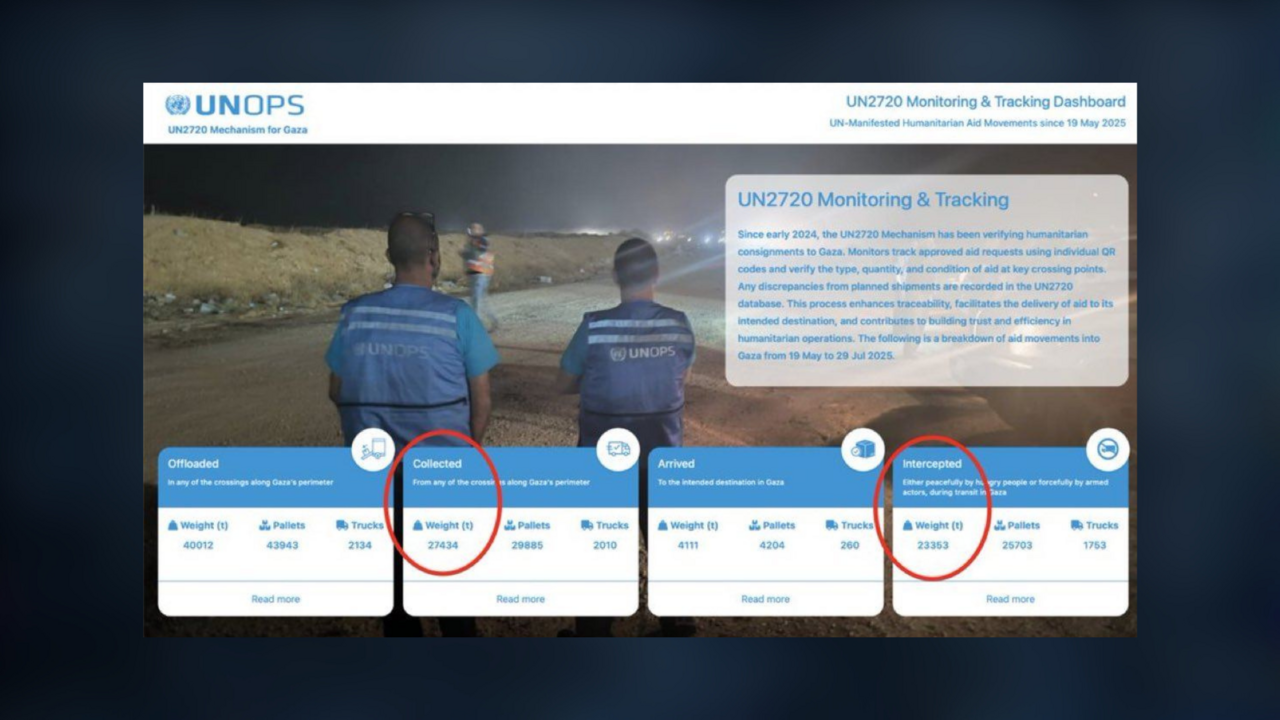
Online accounts have been using this image to support claims that 87% of the humanitarian aid coming into Gaza is looted by Hamas. © UN

The accusation was the Israeli government's main argument for imposing a blockade to prevent food aid from reaching Gaza, which was partially eased at the end of May. Israel claims that Hamas loots most of the international aid sent to the enclave for its own benefit.

On May 22, Israeli Prime Minister Benjamin Netanyahu stated in a speech, "Since October 7, Israel has sent 92,000 aid trucks into Gaza. [...] Yet as we had let the aid come in, Hamas stole it. They took a huge chunk for themselves. The rest they sold at exorbitant prices to the Palestinian population."

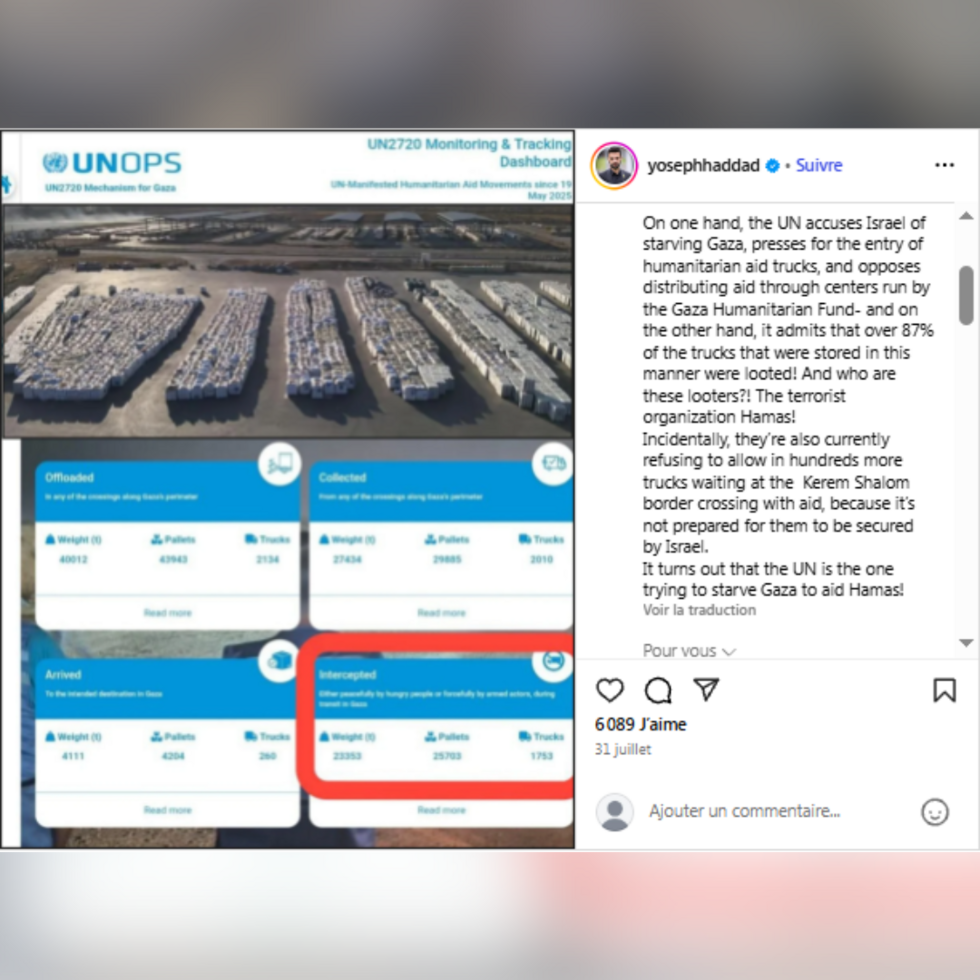
What these pro-Israel internet users claim is false: the UN has never stated that 87 percent of the humanitarian aid sent to Gaza was looted by Hamas. © X © Instagram

According to several pro-Israel internet users, the United Nations also shares the Israeli head of state's assessment. “87% of humanitarian aid has been looted by Hamas,” they write on XInstagram and Facebook, sharing a poster that also shows a fighter from the Islamist movement. According to these posts, the source of the 87 percent figure for looted aid is the UN.

A misleading interpretation of UN statistics

However, the UN has never made this claim. There is no official statement from the United Nations claiming that Hamas steals 87 percent of humanitarian aid on the website of the Office for the Coordination of Humanitarian Affairs (OCHA), the UN agency responsible for aid to Palestinians.

So where did the 87 percent figure come from? It is likely a misleading use of UN data. The UN2720 website, the UN body responsible for statistics on humanitarian aid in Gaza, keeps a precise track of the number of aid trucks entering the enclave.


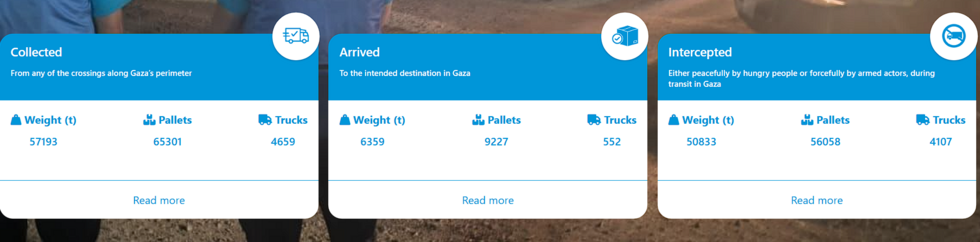
UN270 statistics from May 19 to August 22, 2025, on humanitarian aid in Gaza. © UN270


From May 19 to August 22, UN270 reveals that 4,659 trucks carrying humanitarian aid entered Gaza. Of this total, 4,107 trucks were “intercepted” – meaning that their cargo was stolen – representing 88 percent of the total number of aid trucks sent.

However, contrary to what internet users claim, UN2720 does not assert that most of this aid was diverted by Hamas. On its website, the organisation simply states that the “intercepted” trucks were taken “either peacefully by hungry people or forcefully by armed actors”.

Olga Cherevko, from the Office for the Coordination of Humanitarian Affairs, provided further details about the looters to the Israeli media outlet Times of Israel: the vast majority of the looting was being carried out “by hungry Gazans, not by armed gangs”, the UN employee said.

“The long-standing restrictions on the entry of aid have created an unpredictable environment where there is a lack of confidence by the communities that aid will reach them. This has resulted in many of our convoys offloaded directly by starving, desperate people,” Cherevko explained.

Israeli army says 25% of aid diverted by Hamas

The Israeli army has also released its own estimate of the proportion of aid allegedly diverted by Hamas. As reported by Reuters on July 25, the IDF claims, based on intelligence reports, that Hamas has diverted up to 25 percent of aid supplies for its own fighters or to be resold at a profit to Palestinian civilians. The army's estimate is therefore significantly lower than the 87 percent claimed by internet users.

Hamas, for its part, categorically denies any allegations of diversion. Reuters reports that it has not been able to independently verify the statements made by the Israeli army and Hamas.

However, a report published on July 25, 2024, by the Office of the Inspector General of USAID, the agency responsible for delivering US humanitarian aid to Gaza, estimated that USAID-funded aid was at “high risk for diversion and misuse” by Hamas and other armed groups.

Another USAID report published a year later on July 25, 2025, nevertheless concluded that the agency had found no evidence of widespread Hamas theft of US-funded humanitarian aid, based on an analysis of 156 incidents that occurred between October 2023 and May 2025.
The Bright Side: Malawi's sacred Mount Mulanje added to UNESCO World Heritage List


The sacred Mount Mulanje in southern Malawi was listed as a UNESCO World Heritage site in July, a move that locals hope will promote eco-tourism while curbing illegal logging.


Issued on: 29/08/2025 -
Reading time
By: FRANCE 24
Video by: Tom CANETTI

02:01

Mount Mulanje Cultural Landscape in southern Malawi has been officially added to the UNESCO World Heritage List, marking a significant milestone for one of Africa’s underrepresented sites.

The site's recognition not only honours the mountain’s rich cultural and ecological significance but is also anticipated to enhance eco-tourism and promote sustainable development in the region.

Chief Gibson of the Longwe Tribe said that she believed the listing would support local workers.

"We'll get more visitors as people will hear more about Mount Mulanje," she said. "And that will change people's lives here, because it will create more jobs."

Click on the player to watch the full report.


To defend against Russian tanks, Finland and Poland consider restoring wetlands

Analysis

Finland and Poland are both considering rewetting dried out peatbogs to form defence barriers against a potential Russian ground invasion. Restoring these natural carbon sinks could also bring significant environmental benefits.


Issued on: 28/08/2025 - 
FRANCE24
By: Joanna YORK

A peatland-swamp in North East Finland, near Kapyla, on October 25, 2023. © Olivier Morin, AFP

Since Russian tanks rolled into Ukraine in 2022, European countries that share borders with Russia have ramped up security on their eastern borders.

Finland recently completed the first stretch of a wall along its 1,340 kilometre frontier with Russia, and has been closely monitoring an increase in Russian troop movements on the other side.

This summer, Poland added protective minefields to a 20 kilometre stretch bordering both Russia and Belarus, as part of its sprawling “East Shield” development programme for defence infrastructure.

Now, the NATO-members are looking to the natural world to further fortify their defences – by revitalising peat bogs.

Wetlands that accumulate peat are made up of spongy, waterlogged ground that is impenetrable for tanks. They are typically found in cooler northern climates and are dotted throughout the northern and eastern European nations that share land borders with Russia and Belarus.

‘Nature is an ally’

There are increasing calls in Europe to accelerate peatland restoration plans on both ecological and defence grounds.

Finland’s defence and environment ministries will in autumn begin talks on launching a peatland repair pilot project, a member of the working group said in an article published by Politico this week.

Read more  Could the Finland-Russia border be the next conflict zone after the Ukraine war?

In Poland, the defence ministry is keen to restore wetlands along the eastern border and talks are underway between scientists and the defence and environment ministries.

“Nature is an ally, and we want to use it,” Cezary Tomczyk, a state secretary at Poland’s defence ministry, told Politico.

German peatland thinktank, The Greifswald Mire Centre, in June called for the EU to establish a fund worth up to €500 million to finance planning and rewetting 100,000 hectares of land.

“Naturally wet and equally rewetted peatlands are impassable for tanks, slowing down troop movements and forcing predictable corridors that are easier to defend,” the organisation said in a statement.

“Peatlands offer additional protection for critical infrastructure by making troop movements near transport routes, energy facilities and strategic supply points more difficult.”


Abandoned Russian military equipment pictured during the Ukarinian Army counter-offensive in Kharkiv region, on September 9, 2022. © Press service of the Commander-in-Chief of the Ukrainian Armed Forces via AFP

‘Healthy peatland’

There is a Ukrainian precedent for the faith in using wetlands as defence.

In March 2022, Ukraine’s armed forces destroyed the Kozarovychi Dam, flooding 2,800 hectares of land and successfully slowing down Russian troops advancing towards Kyiv.

But the deliberate flooding also caused widespread damage including in residential areas. In environmental terms, it may have done more harm than good.

Pollutants including sewage and heavy metals were likely to have been released by the flood waters, along with invasive species from local fish farms.

“If you rewet rapidly then you just end up with a lake, basically, and not necessarily with all the biodiversity that you might envisage,” says Mark van der Wal, senior ecologist at the Dutch branch of the International Union for Conservation of Nature (IUCN).

“If you want to increase the positive ecological impact, it needs to be done carefully and it may take a while,” says Caspar Verwer, Senior Expert Nature Conservation at the IUCN. “It's not just a matter of opening the gate and the water flows in, and you have your healthy peatland.”

Carbon sinks

Peatlands are unique ecosystems that sequester large amounts of carbon dioxide – but their benefits have not always been celebrated.

In Finland “one third of the country is peatland, but we have drained half of this area”, says Kristiina Lang, a research professor and peat specialist at the Natural Resources Institute of Finland (Luke).

After World War II, vast swathes of wetland were given over to the profitable forestry industry, and smaller areas for agriculture in parts of the country that lacked farmland.

The situation is similar across Europe, where nearly half of all peatlands are degraded largely due to artificial drainage.

While forests and farms have thrived in nutrient-rich peat soil, the loss of wetlands has taken an environmental toll.

“Drained peatland makes up 10% of Finland’s agricultural land, but it produces more than half of the agricultural greenhouse gas emissions”, Lang says.

When wet, peatlands, which are made up largely of undecomposed organic matter, can store huge amounts of carbon and act as a natural carbon sink. But when drained, microbial activity starts to decompose the organic matter and peat becomes a carbon emitter.


Sundew plants grow in a bog in Dorset, southwest England, on May 27, 2025. © Justin Tallis, AFP

In the EU, drained peatlands currently emit around 7% of total annual greenhouse gas emissions – something the bloc is keen to rectify.

Under EU restoration laws, member countries must restore at least 30% of drained peatlands by 2030, and 50% by 2025.

According to the European Parliament, “restoring drained peatlands is one of the most cost-effective ways to reduce emissions in the agricultural sector”.
‘A hole in our defence’

In Finland there are some obvious sites for rewetting, such as areas drained for forestry that failed to grow trees.

“It's very logical to wet these large areas again,” Lang says. “And if we need to rewet part of our peatlands anyway, then why not close to the eastern border?”

In other areas, the conversion could be more complex. Many areas of drained peatland are now privately owned. Some may be in prime defence locations but are now thriving – and profitable – forests and farmland.

In the Baltic states of Latvia, Lithuania and Estonia there are no current plans to rewet peatbogs as a defence measure, says Dr. Māris Andžāns, director of the Center for Geopolitical Studies Riga, Latvia.

Read moreBaltic region prepares for war as Russia and US debate Ukraine's fate

For now, there are greater threats to focus on. During the war in Ukraine, Russia has carried out hybrid warfare activities via their shadow fleet in the Baltic Sea, and there is also the aerial threat of drone attacks.

“No Baltic state has long range air defence systems,” says Andžāns. “The sky is a big hole in our defence.”

Even though the Baltic countries have invested in improving defences such as anti-tank ditches, focusing too much on a ground invasion would be a mistake, Andžāns says: “The next war might be completely different and there is a real danger that by approaching defence in such a classical manner, we miss other more likely scenarios.”

'We're at the most dangerous moment for science in America', public health law expert says


From the show
A propos

FRANCE 24's Sharon Gaffney speaks with Lawrence Gostin, Director of the WHO Collaborating Centre on National and Global Health Law, about CDC Director Susan Monarez's firing by US President Donald Trump. He says that the latest development is "a very dangerous moment for the United States" and part of a "systematic assault on science, public health and vaccinations".


US ends tariff exemption for small packages shipped from abroad, citing narcotics

The administration of US President Donald Trump on Friday ended the de minimis exemption on small packages being shipped to the US from abroad, saying that closing the "loophole" was necessary to cut the flow of narcotics into the country. Packages valued at or under $800 had previously been allowed to enter the US duty-free in an effort to foster small business growth.

29/08/2025 - 
By:  FRANCE 24


File photo: A person walks out of a US Post Office on April 1, 2024 in Montclair, California. © Mario Tama, Getty Images via AFP

The United States on Friday ended tariff exemptions on small packages entering the country from abroad, in a move that has sparked concern among small businesses and warnings of consumer price hikes.

President Donald Trump's administration cited the use of low-value shipments to evade tariffs and smuggle drugs in ending duty-free treatment for parcels valued at or under $800.

Instead, packages will either be subject to the tariff level applicable to their country of origin, or face a specific duty ranging from $80 to $200 per item. But exclusions for some personal items and gifts remain.

Trump's trade adviser Peter Navarro told reporters that closing this "loophole" helps restrict the flow of "narcotics and other dangerous and prohibited items" while bringing fresh tariff revenues.

"This is a permanent change," a senior administration official said, adding that any push to restore the exemptions for trusted trading partner countries was "dead on arrival". The de minimis exemption has been in place since 1938, starting at $5 for gift imports and was raised from $200 to $800 in 2015 as a means to foster small business growth on e-commerce marketplaces.

But direct shipments from China exploded after Trump raised tariffs on Chinese goods during his first term, creating a new direct-to-consumer business model for e-commerce firms Shein and Temu.

Postal services, including in France, Germany, Italy, India, Australia and Japan, earlier said most US-bound packages would no longer be accepted.

Read moreFrench suspension of US package deliveries over tariffs comes into effect

The UK's Royal Mail, which took a similar step, announced new services Thursday for customers to continue sending goods to the United States.

On Tuesday, the United Nations' Universal Postal Union said 25 member countries' postal operators had suspended outbound postal services to the country.

"Foreign post offices need to get their act together when it comes to monitoring and policing the use of international mail for smuggling and tariff evasion purposes," Navarro added Thursday.

US officials maintain that just five percent of duty-free small package shipments arrived via the postal network, while most went through express couriers.

The National Coalition of Textile Organizations called the move a "historic win" for US manufacturing by closing a loophole that allowed foreign fast-fashion firms to avoid tariffs and import apparel sometimes made with forced labour, undercutting American jobs.

"The administration’s executive action closes this channel and delivers long overdue relief to the US textile industry and its workers," the group said.

CBP has estimated that the number of packages claiming the de minimis exemption jumped nearly 10-fold from 139 million in fiscal 2015 to 1.36 billion in fiscal 2024 – a rate of nearly 4 million per day.

But the impending change has brought confusion and concern to small businesses.
Delays, cost hikes

UK retailer Liz Nieburg told AFP she had stopped shipping products to US customers while the Royal Mail worked out a system to honour the changes.

US buyers form about 20 percent of sales at her online business SocksFox, which sells socks, undergarments and sleepwear.

She sees little choice but to hike prices if new duties are here to stay: "Our margins are too tight to be able to absorb that."

The Trump administration has imposed tariffs in rapid succession this year.

Cornell University professor Li Chen warned that it takes time for postal services to establish systems for duty collection: "It's not like there's a switch you can turn on and turn off."

"On the consumer side, there will be potential delays, because now all the parcels have to clear customs," Chen added. Prices may also rise if businesses pass on the tariffs.

Read moreStunned by Trump’s tariffs, world clothing suppliers are preparing to squeeze workers

He expects the impact on small businesses to be "much greater", as larger firms can absorb shocks.

These include businesses like Chinese-founded consumer platforms Shein and Temu, which were hit when Washington ended the exemption for China-origin products this year.

They might have to raise costs, Chen said, but they are not fully dependent on US consumers.

Ken Huening, whose California-based business CoverSeal manufactures outdoor protective covers in China and Mexico, has had to eliminate free shipping for customers.

While he had benefited from the duty-free exemption, the hit to China and now Mexico is posing challenges.

"Textile and manufacturing is not available in the US currently," Huening said. "It might be in the future, but by that time, we're all out of business."
Confusion

"It's a super confusing time for our customers," said Haley Massicotte, who runs Canada-based cleaning products company Oak & Willow.

She said US consumers do not always understand how tariffs work, and how they might have to bear added costs.

"We are going to do everything in our power to not raise prices," she stressed.

Similarly, ceramics retailer Sarah Louise Jour in Bangkok is trying to keep shipping costs down after facing issues with Thailand's postal service.

This forced her to tap more expensive services for shipments to US buyers, constituting some 90 percent of her business.

"I don't have time to worry, because I have to think about my team," she said. "I have rent I need to pay for the office."

While she expects sales to hold up over the holidays, the outlook is murkier afterwards.

Massicotte said: "This tariff war is just going to hurt the American and the Canadian consumer, especially small business owners."

(FRANCE 24 with AFP and Reuters)
An AI simulation of a Mount Fuji eruption is being used to prepare Tokyo for the worst


Issued on: 29/08/2025 - FRANCE24


Mount Fuji hasn’t erupted since 1707. But for Volcanic Disaster Preparedness Day, Japanese officials have released computer- and AI-generated videos showing a simulation of a potential violent eruption of the active volcano.


Video by:  Nicholas RUSHWORTH