"President Trump is using religion to promote his self-aggrandizement and political agenda, all the while perpetuating the lie that America is a Christian nation and that religion is under attack," said one critic.
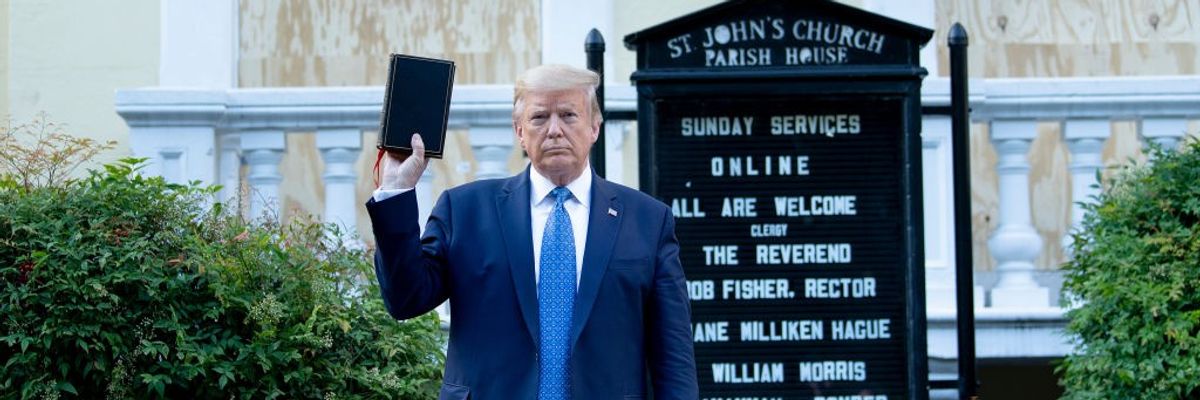
US President Donald Trump holds a Bible while visiting St. John's Church across from the White House after the area was cleared of people protesting the death of George Floyd, on June 1, 2020, in Washington, DC.
(Photo by Brendan Smialowski/AFP via Getty Images)
Brett Wilkins
Sep 08, 2025
COMMON DREAMS
Proponents of separating church and state on Monday decried US President Donald Trump's pledge to protect prayer in public schools, warning that the administration is advancing the agenda of far-right Christian nationalists seeking to impose their religious beliefs upon everyone.
Speaking at a meeting of the president's so-called Religious Liberty Commission at the Museum of the Bible in Washington, DC, Trump announced upcoming Department of Education guidance "protecting the right to prayer in our public schools, and it's total protection."
"We're defending our rights and restoring our identity as a nation under God," Trump said. "To have a great nation, you have to have religion. I believe that so strongly. As president, I will always defend our glorious heritage, and we will protect the Judeo-Christian principles of our founding."
The president added that it is "ridiculous" that the nation's public school students are "indoctrinated with anti-religious propaganda, and some are even punished for their religious beliefs."
Trump also launched his "America Prays" initiative, which asks the faithful to "join with at least 10 people to meet each week for one hour to pray" for the country.
In response to the president's speech, the Freedom From Religion Foundation (FFRF) said on social media: "We've never been 'one nation under God.' There's nothing to restore. Our true identity is freedom of conscience—the right to believe in any faith, or none at all."
"A great nation isn't built on religion—it's built on equality, liberty, and justice for all," FFRF added. "Our strength comes from We The People, not belief in a god."
Rachel Laser, president of the group Americans United for Separation of Church and State, said in a statement that Monday's event "once again demonstrated that this commission isn't about religious liberty; it's about rejecting the nation's religious diversity and prioritizing one set of Christian beliefs."
"From the professions of Christian faith to the chorus of 'amens' during Christian prayers to the exclusively Christian speakers this morning, this government hearing was more like a church service," Laser noted. "Once again, President Trump is using religion to promote his self-aggrandizement and political agenda, all the while perpetuating the lie that America is a Christian nation and that religion is under attack."
Laser continued:
The Trump administration is advancing this Christian nationalist agenda with the launch of his 'America Prays' initiative, which calls on Americans to pray for our country. People who care about religious freedom don't need to be told when or how to pray; they need leaders who are committed to separation of church and state.

"Our country's promise of church-state separation means that families—not politicians or public school officials—get to decide how and when children engage with religion," Laser added. "Yet many of the organizations represented at today's meeting and members of the Religious Liberty Commission have tried to undermine this fundamental American principle and turn our public schools into Sunday schools."
Monday's event came as some GOP-led states push forward with plans for more overt displays of religiosity in public schools. Most notably, Texas Attorney General Ken Paxton—a US Senate candidate—is urging schools to display the Ten Commandments in spite of a federal judge's recent injunction on a law requiring the Judeo-Christian religious and ethical directives to be displayed in all classrooms.
Paxton is also urging all schools "to begin the legal process of putting prayer back in the classroom and recommending the Lord's Prayer for students."
Responding to Paxton's push, gun control advocate Fred Guttenberg said last week on social media: "Hey Ken, many have said that you committed adultery. Shouldn't you worry about your own morality before imposing this on others? Looks like you are using religion for personal gain."
Recent polls have shown a significant drop in the number of Americans who identify as Christian in recent decades, an all-time low in belief in "God," and a steady overall decline in religiosity among younger Americans.

Over the past decades, the use of the Bible to justify what passes for “law and order” (and the punishing of the poor) has only intensified. Image by Marjhon Obsioma.
It was a moment somewhat like this, 30 years ago, that turned me into a biblical scholar. In the lead-up to the passage of the 1996 Welfare Reform Act, political and religious leaders quoted scripture to justify shutting down food programs and kicking mothers and their babies off public assistance. Those leaders, many of them self-described Christians, chose to ignore the majority of passages in the Bible that preached “good news” to the poor and promised freedom to those captive to injustice and oppression. Instead, they put forward unethical and ahistorical (mis)interpretations and (mis)appropriations of biblical texts to prop up American imperial power and punish the poor in the name of a warped morality.
Three decades later, the Trump administration and its theological apologists are working overtime, using Jesus’s name and the Bible’s contents in even more devastating rounds of immoral biblical (mis)references. In July, there was the viral video from the Department of Homeland Security, using the “Here I am, Lord. Send me” quotation from Isaiah — commonly cited when ordaining faith leaders and including explicit references to marginalized communities impacted by displacement and oppression — to recruit new agents for the U.S. Immigration and Customs Enforcement agency, or ICE, a job that now comes with a $50,000 signing bonus, thanks to Donald Trump’s “One Big Beautiful Bill.”
Secretary of Defense Pete Hegseth’s former pastor went even further in marrying the Bible to anti-immigrant hatred by saying, “Is the Bible in favor of these ICE raids?… The answer is yes.” He then added: “The Bible does not require wealthy Christian nations to self-immolate for the horrible crime of having a flourishing economy and way of life, all right? The Bible does not permit the civil magistrate to steal money from its citizens to pay for foreign nationals to come destroy our culture.”
A month earlier, during a speech announcing the bombing of Iran, President Trump exhorted God to bless America’s bombs (being dropped on innocent families and children): “And in particular, God, I want to just say, we love you God, and we love our great military. Protect them. God bless the Middle East, God bless Israel, and God bless America. Thank you very much. Thank you.”
And in May, Speaker of the House Mike Johnson and Republican congressional representatives formed a prayer circle on the floor of the House as they prepared to codify the president’s Big Beautiful Bill. Of course, that very bill threatens to cut off millions of Americans from life-saving food and healthcare. (Consider it a bizarre counterpoint to Jesus’s feeding of the 5,000 and providing free health care to lepers.)
The Antichrist
And if that weren’t enough twisting of the Bible to bless the rich and admonish the poor, enter tech mogul Peter Thiel, co-founder of Palantir and the man behind the curtain of so much now going on in Washington. Though many Americans may be increasingly familiar with him, his various companies, and his political impact, many of us have missed the centrality of his version of Christianity and the enigmatic “religious” beliefs that go with it.
In Vanity Fair this spring, journalist Zoe Bernard emphasized the central role Thiel has already played in the Christianization of Silicon Valley: “I guarantee you,” one Christian entrepreneur told her, “there are people that are leveraging Christianity to get closer to Peter Thiel.”
Indeed, his theological beliefs grimly complement his political ones. “When you don’t have a transcendent religious belief,” he said, “you end up just looking around at other people. And that is the problem with our atheist liberal world. It is just the madness of crowds.” Remember, this is the same Thiel who, in a 2009 essay, openly questioned the compatibility of democracy and freedom, advocating for a system where power would be concentrated among those with the expertise to drive “progress” — a new version of the survival of the fittest in the information age. Such a worldview couldn’t contrast more strongly with the Sermon on the Mount, where Jesus demonstrates his preferential option for the poor and his belief in bottom-up strategies rather than top down ones.
More recently, Thiel has positioned himself “right” in the middle of the Republican Party. He served as Trump’s liaison to Silicon Valley in his first term. Since then, he has convened and supported a new cohort of conservatives (many of whom also claim a right-wing Christianity), including Vice President J.D. Vance, Trump’s Director of Policy Planning Michael Anton, AI and crypto czar billionaire David Sacks, and Elon Musk, who spent a quarter of a billion dollars getting Trump elected the second time around. Thiel is also close to Curtis Yarvin, the fellow who “jokingly” claimed that American society no longer needs poor people and believes they should instead be turned into biofuel. (A worldview that simply couldn’t be more incompatible with Christianity’s core tenets.)
Particularly relevant to recent political (and ideological) developments, especially the military occupation of Washington, D.C., Thiel is also close to Joe Lonsdale, co-founder of Palantir and founder of the Cicero Institute, a right-wing think tank behind a coordinated attack on the homeless now sweeping the nation. That’s right, there’s a throughline from Peter Thiel to President Donald Trump’s demand that “the homeless have to move out immediately… FAR from the Capital.” In July, Trump produced an executive order facilitating the removal of housing encampments in Washington, a year after the Supreme Court upheld a law making it a crime, if you don’t have a home, to sleep or even breathe outside. And Thiel, Lonsdale, and the Cicero Institute aren’t just responsible for those attacks on unhoused people and “blue cities”; they also bear responsibility for faith leaders being arrested and fined for their support of unhoused communities and their opposition, on religious grounds, to the mistreatment of the poor.
On top of this troubling mix of Christianity and billionaires, however, I find myself particularly chagrined that Thiel is offering an oversold four-part lecture series on the “antichrist” through a nonprofit called ACTS 17 collective that is to start in September in San Francisco. News stories about the ACTS 17 collective tend to focus on Christians organizing in Silicon Valley and the desire to put salvation through Jesus above personal success or charity for the poor. That sounds all too ominous, especially for those of us who take seriously the biblical command to stop depriving the poor of rights, to end poverty on earth (as it is in heaven), and defend the very people the Bible prioritizes.
For instance, Trae Stephens (who worked at Palantir and is partners with Thiel in a venture capital fund) is the husband of Michelle Stephens, the founder of the ACTS 17 collective. In an interview with Emma Goldberg of the New York Times, Michelle Stephens describes how “we are always taught as Christians to serve the meek, the lowly, the marginalized… I think we’ve realized that, if anything, the rich, the wealthy, the powerful need Jesus just as much.”
In an article at the Denison Forum, she’s even more specific about her biblical and theological interpretation of poverty and the need to care for those with more rather than the poor. She writes, “Those who see Christ’s message to the poor and needy as the central pillar of the gospel make a similar mistake. While social justice movements have done a great deal to point out our society’s longstanding sins and call believers to action, it can be tempting for that message to become more prominent than our innate need for Jesus to save us.” Such a statement reminds me of the decades-long theological pushback I lived through even before the passage of welfare reform and the continued juxtaposition of Jesus and justice since.
A Battle for the Bible
Of course, such a battle for the Bible is anything but new in America. It reaches back long before the rise of a new brand of Christianity in Silicon Valley. In the 1700s and 1800s, slaveholders quoted the book of Philemon and lines from St. Paul’s epistles to claim that slavery had been ordained by God, while ripping the pages of Exodus from bibles they gave to the enslaved. During the Gilded Age of the nineteenth century, churches and politicians alike preached what was called a “prosperity gospel” that extolled the virtues of industrial capitalism. Decades later, segregationists continued to use stray biblical verses to rubber-stamp Jim Crow practices, while the Moral Majority, founded in 1979 by Baptist minister Jerry Falwell, Sr., helped mainstream a new generation of Christian extremists in national politics.
Over the past decades, the use of the Bible to justify what passes for “law and order” (and the punishing of the poor) has only intensified. In Donald Trump’s first term, Attorney General Jeff Sessions defended the administration’s policy of separating immigrant children from their families at the border with a passage from the Apostle Paul’s epistle to the Romans: “I would cite you to the Apostle Paul and his clear and wise command in Romans 13, to obey the laws of the government because God has ordained them for the purpose of order. Orderly and lawful processes are good in themselves and protect the weak and lawful.”
White House Press Secretary Sarah Huckabee Sanders summed up the same idea soon after in this way: “It is very biblical to enforce the law.” And in his first speech as speaker of the House, Mike Johnson told his colleagues, “I believe that Scripture, the Bible, is very clear: that God is the one who raises up those in authority,” an echo of the New Testament’s Epistle to the Romans, in which Paul writes that “the authorities that exist are appointed by God.”
Over the past several years, Republican politicians and religious leaders have continued to use biblical references to punish the poor, quoting texts to justify cutting people off from healthcare and food assistance. A galling example came when Representative Jodey Arrington (R-TX), rebutting a Jewish activist who referenced a commandment in Leviticus to feed the hungry, quoted 2 Thessalonians to justify increasing work requirements for people qualifying for the Supplemental Nutrition Assistance Program (SNAP). And that was just one of many Republican attacks on the low-income food assistance program amid myriad attempts to shred the social welfare system in the lead-up to President Trump’s “Big Beautiful Bill,” the largest transfer of wealth from the bottom to the top in American history and a crowning achievement of Russell Vought’s Project 2025. Arrington said: “But there’s also, you know, in the Scripture, tells us in 2 Thessalonians chapter 3:10 he says, uh, ‘For even when we were with you, we gave you this rule: if a man will not work, he shall not eat.’ And then he goes on to say ‘We hear that some among you are idle’… I think it’s a reasonable expectation that we have work requirements.”
And Arrington has been anything but alone. The same passage, in fact, had already been used by Representatives Kevin Cramer (R-ND) and Stephen Lee Fincher (R-TN) to justify cutting food stamps during a debate over an earlier farm bill. And Representative Mo Brooks (R-AL) used similarly religious language, categorizing people as deserving and undeserving, to argue against a healthcare plan that protects those of us with pre-existing conditions. He insisted that only “people who lead good lives” and “have done the things to keep their bodies healthy” should receive reduced costs for health care.
Such “Christian” politicians regularly misuse Biblical passages to blame the impoverished for their poverty. There is never a suggestion, of course, that the rich, who have functionally stolen people’s wages and engorged themselves by denying them healthcare, are in any way to blame.
A Theology of Liberation for a Time Like This
Such interpretations of biblical texts are damaging to everyone’s lives (except, of course, the superrich), but especially the poor. And — though you wouldn’t know it from such Republicans — they are counter to the main themes of the Bible’s texts. The whole of the Christian Bible, starting with Genesis and ending with the Book of Revelation, has an arc of justice to it. The historical equivalents of anti-poverty programs run through it all.
That arc starts in the Book of Exodus with manna (bread) that shows up day after day, so no one has too much or too little. This is a likely response to the Egyptian Pharaoh setting up a system where a few religious and political leaders amassed great wealth at the expense of the people. God’s plan, on the other hand, was for society to be organized around meeting the needs of all people, including describing how political and religious leaders are supposed to release slaves, forgive debts, pay people what they deserve, and distribute funds to the needy. The biblical arc of justice then continues through the prophets who insist that the way to love and honor God is to promote programs that uplift the poor and marginalized, while decrying those with power who cloak oppression in religious terms and heretical versions of Christian theology.
My own political and moral roots are in the welfare rights and homeless union survival movements, efforts led by poor and dispossessed people organizing a “new underground railroad” and challenging Christianity to talk the talk and walk the walk of Christ. Such a conviction was captured by Reverend Yvonne Delk at the 1992 “Up and Out of Poverty Survival Summit,” when she declared that society, including the church, must move to the position that “poor people are not sinners, but poverty is a sin against God that could and should be ended.”
Delk’s words echo others from 20 years earlier. In 1972, Beulah Sanders, a leader of the National Welfare Rights Organization, the largest organization of poor people in the 1960s and 1970s, spoke to the National Council of Churches. “I represent all of those poor people who are on welfare and many who are not,” she said, “people who believe in the Christian way of life… people whose nickels and dimes and quarters have built the Christian churches of America. Because we believe in Christianity, we have continued to support the Christian churches… We call upon you… to join with us in the National Welfare Rights Organization. We ask for your moral, personal, and financial support in this battle for bread, dignity, and justice for all of our people. If we fail in our struggle, Christianity will have failed.”
In a Trumpian world, where Christian extremism is becoming the norm, we must not let the words of Beulah Sanders be forgotten or the worst fears of countless prophets and freedom fighters come true. Rather, we must build the strength to make a theological and spiritual vision of everybody-in-nobody-out a reality and create the capacity, powered by faith, to make it so. Now is the time. May we make it so.
This piece first appeared on TomDispatch.