Monday, September 22, 2025


Why Trump’s Desperate Chase For Bagram Airbase Could Reshape Afghanistan’s Future Forever – Analysis

File photo of an F-16 Fighting Falcon assigned to the 4th Expeditionary Fighter Squadron from Hill Air Force Base, Utah, takes off at Bagram Air Field, Afghanistan, Jan. 23, 2015. Photo Credit: Staff Sgt. Whitney Amstutz, Wikipedia Commons

By 

The return of Donald Trump to the White House has brought back one of his most persistent fixations – the Bagram Airbase in Afghanistan. His recent threats to punish Afghanistan if they don’t return the strategic military facility reveal a deeper game of global power politics that could have far-reaching consequences for the war-torn nation.

\

Trump’s obsession with Bagram is not just about military pride or correcting what he sees as Biden’s withdrawal mistakes. The 79-year-old President’s determination to reclaim this airbase stems from three critical strategic calculations that go far beyond Afghanistan’s borders.

The China Factor: A New Cold War Battleground

The most compelling reason behind Trump’s Bagram fixation is its proximity to China. Located just 800 kilometres from the Chinese border, Bagram offers an unmatched strategic advantage in America’s growing rivalry with Beijing. Trump has repeatedly mentioned China’s increasing influence in Afghanistan, and he sees Bagram as the perfect counter-move in this chess game.

China has been quietly expanding its presence in Afghanistan since the Taliban’s return to power. Through infrastructure projects and mining deals, Beijing is slowly but steadily gaining a foothold in the region. For Trump, losing Bagram means giving China a free pass to dominate Central Asia without American oversight. Reclaiming the base would allow the US to monitor Chinese activities closely and maintain a strategic presence in this crucial region.

The Geopolitical Chessboard: More Than Just Afghanistan

Bagram’s value extends far beyond its role in Afghan affairs. The airbase sits at the crossroads of South Asia, Central Asia, and the Middle East. Control over Bagram means having a launching pad for operations across this volatile region. It provides easy access to Pakistan, Iran, and the Central Asian republics – all areas where American influence has been declining.

For a president who believes in projecting American strength globally, Bagram represents the ultimate power projection tool. It’s not just about Afghanistan; it’s about maintaining American dominance in a region that’s becoming increasingly important for global trade and security.

\

Economic and Resource Considerations

Afghanistan sits on an estimated one trillion dollars worth of untapped mineral resources, including rare earth elements crucial for modern technology. China has already shown interest in these resources, signing preliminary agreements with the Taliban government. Trump’s push for Bagram could be part of a broader strategy to ensure American companies get their share of Afghanistan’s mineral wealth.

The airbase would provide the security and logistical support needed for American businesses to operate safely in Afghanistan. Without a military presence, the US risks being completely shut out of Afghanistan’s economic opportunities while China reaps the benefits.

The Devastating Impact on Afghanistan

For Afghanistan, Trump’s Bagram demands create an impossible situation. The Taliban government, which has struggled to gain international recognition and desperately needs foreign aid, now faces threats from the world’s most powerful military. Returning Bagram would mean allowing foreign troops back on Afghan soil – something that goes against everything the Taliban fought for during their 20-year insurgency.

The timing couldn’t be worse for Afghanistan’s people. The country is facing a severe humanitarian crisis, with millions needing food aid and basic services. International sanctions have crippled the economy, and most foreign aid has dried up. Trump’s threats add another layer of uncertainty to an already unstable situation.

If Afghanistan refuses to return Bagram, Trump’s promised “consequences” could include harsher economic sanctions, military action, or support for anti-Taliban groups. Any of these options would further destabilise the country and cause more suffering for ordinary Afghans who have already endured decades of war.

A Dangerous Game with Global Consequences

Trump’s Bagram strategy reflects his broader approach to international relations – using American military and economic power to force other nations to comply with US demands. While this might appeal to his domestic supporters who want to see America “winning” again, it risks creating new conflicts and undermining global stability.

Financial software

The international community is watching closely to see how this unfolds. If Trump successfully pressures Afghanistan into returning Bagram, it could set a precedent for other powerful nations to make similar demands on weaker countries. This could lead to a more chaotic and unpredictable world where might makes right.

The Road Ahead: Limited Options for All

As this standoff continues, both sides have limited good options. Trump cannot easily invade Afghanistan again without significant domestic and international backlash. The American public has little appetite for another long war in Afghanistan, and allies would be reluctant to support such action.

For Afghanistan, the choices are equally difficult. Giving up Bagram would undermine the Taliban’s legitimacy and invite more foreign interference. Refusing could bring devastating consequences from the world’s most powerful military.

Conclusion: A Test of Wills with Global Stakes

Trump’s desperate pursuit of Bagram Airbase is about much more than correcting past mistakes or showing strength. It’s a calculated move in America’s competition with China and an attempt to maintain global dominance in a changing world order.

For Afghanistan’s long-suffering people, this great power competition means more uncertainty and potential conflict. The country that just wanted peace after decades of war now finds itself at the centre of a new geopolitical storm.

The coming months will reveal whether Trump’s threats are serious or just political posturing. Either way, his Bagram obsession has already changed the dynamics in Afghanistan and reminded the world that the Great Game in Central Asia is far from over. The stakes couldn’t be higher – for Afghanistan, for regional stability, and for the future of global power politics.


Girish Linganna

Girish Linganna is a Defence, Aerospace & Political Analyst based in Bengaluru. He is also Director of ADD Engineering Components, India, Pvt. Ltd, a subsidiary of ADD Engineering GmbH, Germany. You can reach him at: girishlinganna@gmail.com


Sperry Marine Paper Sets Out S-100 Step Change For Marine Navigation

Sperry Marine
Front Cover image of 'VisionMaster S-100 ECDIS - A step change for marine navigation'

Published Sep 21, 2025 10:38 PM by The Maritime Executive


[By: Sperry Marine]

Sperry Marine, a global leader in navigation solutions for seagoing vessels, has issued a whitepaper to explain how new S-100 standards lay the foundation for enhancing the quantity, quality and appearance of the information navigators need to ensure vessel safety, efficiency and sustainability.

‘VisionMaster S-100 ECDIS - A step change for marine navigation’ explains how the new S-100 framework will help free electronic chart information systems (ECDIS) software from constraints embedded in existing standards that were conceived in the 1990s. The paper offers guidance to customers on S-100’s consequences for equipment procurement, crew training and in-service systems, while also introducing Sperry Marine’s VisionMaster S-100 ECDIS to market.

The International Hydrographic Organization (IHO) has worked with industry to develop S-100 to replace existing S-52, S-57 and S-63 standards - respectively covering the way ECDIS show electronic navigation charts (ENCs), formats used for transferring hydrographic data, and cyber security verification. First phase developments focused on finalising S-100 standards for ENCs, bathymetric surface, water level information, surface currents, navigational warnings, and under keel clearance management.

“The advent of S-100 represents the single biggest change to ECDIS since IMO adopted the revised ECDIS Performance Standards in 2006,” said Simon Cooke, Technical Manager, Sperry Marine. “This whitepaper offers practical guidance on how ships’ navigational and voyage management systems can realise the potential of accelerating digitalisation.”

The contemporary geospatial standards (ISO 19100) used in S-100 allow multiple navigational data layers to be presented simultaneously on a single display, while S-100 standards are also extensible so that new data products can be added as required, said Cooke.

The International Maritime Organization has revised its ECDIS performance standards to accommodate S-100. Users are free to use software conforming to the standard on a voluntary basis in new ECDIS installations from January 1, 2026, with their use scheduled to be mandatory for new ECDIS installations from January 1, 2029.

As Sperry Marine’s insightful paper explains, however, manufacturers need type approval that S-100 ECDIS satisfies test standard IEC 61174 Edition 5, which the International Electrotechnical Commission (IEC) has yet to finalise. IMO has also not set a deadline for updating existing ECDIS installations, with hydrographic offices continuing to publish S-57 ENCs for the foreseeable future.

“Experience demonstrates that close collaboration is critical between regulators and marine technology specialists on ECDIS to ensure ship safety, efficiency, environmental responsibility, and orderly transition,” said Cooke. For good reason, Sperry Marine’s VisionMaster S-100 ECDIS will have ‘dual fuel’ compatibility with S-100 and S-57 standards, he added.

The first-time user of the VisionMaster S-100 ECDIS would experience new generation benefits going beyond S-100 requirements, he added, for example by allowing the navigator to see charted dangers further along planned or current routes, and to set preferences to minimise distractions from alerts while maintaining awareness of significant charted objects.

“But, as this white paper also shows, the IMO’s 2026 milestone for voluntary S-100 ECDIS adoption is an opportunity to acknowledge the benefits these standards will bring for industry as a whole. Sperry Marine is ready to work with its customers on the timely transition to S-100 for the better of ship safety, ship performance and maritime decarbonisation.”

Download the white paper here.

The products and services herein described in this press release are not endorsed by The Maritime Executive.


UK Planning to Open an Additional Submarine Dockyard

Submarine section
Full speed ahead for the front end of HMS Dreadnought through Barrow in Furness en route to the BAE Submarine Assembly Hall (Dreadnought Alliance)

Published Sep 21, 2025 8:04 PM by The Maritime Executive


In response to a parliamentary written question, the British Ministry of Defence has confirmed that as part of a $460m upgrade to Rosyth Dockyard on the East coast of Scotland, a docking facility is to be created able to receive Dreadnought Class nuclear ballistic missile submarines.

The requirement has arisen because once launched from Barrow, scheduled not before 2028, first-in-class HMS Dreadnought will be too large to get back into Barrow after its fit-out and during sea trials. The lack of sufficient space is likely to get worse, as submarine production at Barrow is accelerated to deliver a submarine every 18 months as part of the AUKUS program. Nor will there be capacity for the boat in the Faslane Naval Base on the Clyde.

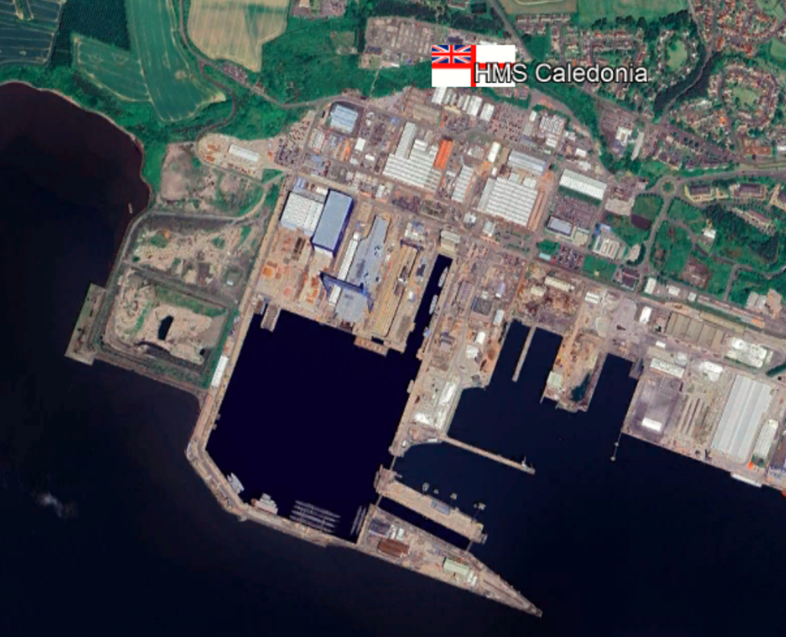
Rosyth Dockyard, with HMS Queen Elizabeth (R08) under maintenance in 2024 (Google Earth/Airbus/CJRC)

Although it still retains a Royal Navy presence in the form of the shore station HMS Caledonia, the Rosyth Dockyard was privatized in 1993 and bought by Babcock International. The dockyard currently has a role is breaking up decommissioned nuclear submarines, the Royal Navy’s two aircraft carriers were completed at Rosyth, and Type 31 frigates are built in the yard. A submarine maintenance facility was built at the yard in the late 1980s, but was never brought into use before the work was transferred to Devonport. Hence it is likely that the new facility can take advantage of some existing infrastructure.

With a period approaching when the UK’s nuclear attack submarine fleet is to nearly double in size, with the nuclear ballistic Vanguard Class coming out of service and the Dreadnoughts coming into service, the Ministry of Defence may have concluded that having only two active submarine dockyards, at Faslane and Devonport, presents too much concentration of risk and insufficient contingency capacity. The scope and role of the new facility, and who is going to pay for it, is likely to be the subject of ongoing discussions between Babcock and the UK government.


LA REVUE GAUCHE - Left Comment: Search results for PERMANENT ARMS ECONOMY


19 Smugglers Charged With Throwing Dozens of Passengers Overboard

Typical West African "cayuco," or canoe (Salvamento Maritimo)

Published Sep 21, 2025 11:07 PM by The Maritime Executive


Police in the Canary Islands have charged 19 people with murder in connection with the deaths of dozens of migrants who went "missing" from a wooden boat on the crossing from Senegal, a route that is always perilous but may have had an additional hazard on this particular voyage. 

About 300 people set out from Senegal in August aboard a 20-meter wooden boat, bound for the Canary Islands and the opportunity for EU asylum. On August 24, the rescue boat Guardamar Urania made a long voyage south from Gran Canaria to reach the migrant vessel off Dajla, a town in southern Morocco (or Western Sahara). At the time of intercept and rescue, there were 248 people still alive on the vessel. 

Upon return to the dock, the surviving passengers identified 19 individuals as the organizers of the voyage. The survivors alleged that this group of human smugglers "assaulted dozens of people" and even "threw migrant alive into the sea." Anyone who went overboard accidentally was left behind. 

The motives behind these killings were twofold, according to police. The organizers allegedly wished to get rid of migrants who they believed to be practitioners of "witchcraft," and thereby responsible for breakdowns, bad weather or other failures on board. Survivors told the police that the smugglers would throw "witches" into the sea whenever misfortune occurred. Others were selected for elimination because they disagreed with the smugglers or protested their circumstances on board. 

Based on the number of people who set out and the number who survived to be rescued, prosecutors estimate that the organizers killed at least 30 and likely more than 50 people. According to El Dia, the 19 smugglers face charges of  bodily harm, homicide, torture, and assisting illegal immigration.

Even with a well-intentioned crew, the crossing to the Canary Islands is long and dangerous. Those leaving Senegal or Mauritania have a northerly voyage of 1,000 nautical miles to cross in order to reach their destination, though (as in this particular case) SAR forces may reach them much sooner. The hazards in the open Atlantic ocean are severe, and an estimated 10,000 people died on the crossing in 2024, according to aid group Caminando Fronteras. 

Spain's naval chief of staff, Admiral General Antonio Pineiro, recently emphasized the government's priority on search and rescue, rather than the pushback campaigns seen in parts of the Mediterranean. "We're not here to fight the cayucos, but to help them," he told El Dia in an interview Friday.  


Morocco Celebrates Expansion Milestones in Casablanca Port Complex

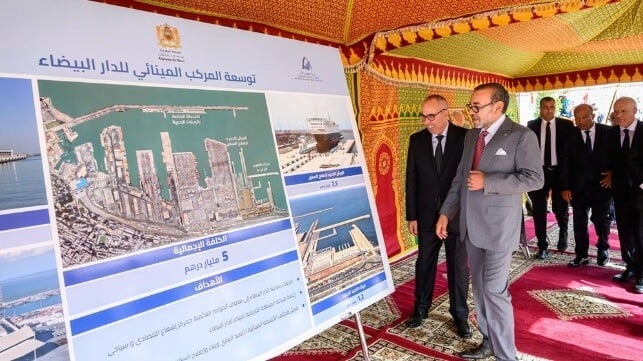
King Mohammed VI of Morocco visits Port of Casablanca (Moroccan Embassy in the UK)

Published Sep 21, 2025 11:27 PM by The Maritime Executive


As Morocco pushes ahead with expansion of its maritime infrastructure, last week the country launched several development initiatives in Casablanca port complex. The launch event was presided by King Mohammed VI, who is keen to position Morocco as a global maritime hub.

The Casablanca port complex expansion project is valued at around $577 million. This involves renovation of a fish port, construction of a new shipyard and expansion of the cruise terminal. A new office complex is also underway, with Casablanca aiming to house port stakeholders under one roof.  

The fish port project is valued at $120 million, an investment targeted at expanding Morocco’s fish processing capacity and export volumes. The fish port is expected to accommodate 260 artisanal fishing boats and about 100 coastal fishing vessels. The port will also have ice generators, modern fish market and offices for shipowners.

An important highlight of the launch event is King Mohammed VI’s tour of the new Casablanca port shipyard. In a speech in 2023, the King directed for development “of a strong, competitive, national commercial marine fleet.” As a follow-up measure, a Moroccan public think-tank - the Economic, Social and Environmental Council (CESE) - last year opened a public consultation for Morocco’s national shipbuilding roadmap.

These efforts in domestic shipbuilding are reflected in the government’s investment of $250 million towards the Casablanca shipyard. The Moroccan National Port Agency is about to issue a private firm with rights to operate and further develop the yard.

The new Casablanca port cruise terminal was also inaugurated, a project expected to boost the city’s status as a tourism destination in the Mediterranean region. The terminal has capacity to host up to 450,000 cruise passengers annually. The $72 million terminal features a 650-meter disembarkation quay, three gangways and a parking area for 44 coaches.

The upgrades in Casablanca port complex are coming at a time Moroccan ports are recording growth in cargo throughput. In the first quarter of 2025, Moroccan ports reached a cargo volume of 60.80 million tons representing an increase of 10.2% year on year, according to data released recently by the Directorate of Studies and Financial Forecasts. The directorate attributed the surge in commercial activity to strengthening transshipment traffic, which accounted for 49.9% of total traffic.

During the same period, cruise activity also recorded growth of 46.9%, with 55,668 cruise passengers handled in Moroccan ports.

ALL THAT IS OLD IS NEW AGAIN

Royal Navy Returns to Sail Training for Young Officers

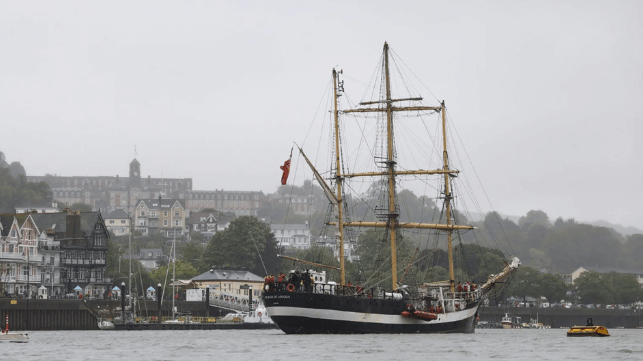
Sail training ship Pelican of London on the Dart (Royal Navy)

Published Sep 21, 2025 11:35 PM by Royal Navy News


The Royal Navy is looking to train officers under sail for the first time in decades by chartering a tall ship.

Experts believe the unique experience of crewing a traditional sailing vessel around the British Isles will teach vital navigational skills and nurture a strong bond of teamwork and community spirit integral to life in the Royal Navy.

Several trials have taken place this year on the British-flagged square rigged Sail Training Ship Pelican of London, with sailors experiencing sailing in the Irish Sea and Bristol Channel and visiting Liverpool, Dublin, Belfast.

The feedback has been overwhelmingly positive, said Lieutenant Commander David Carter, the Royal Navy’s liaison officer with the Merchant Navy, who is now hoping to charter a similar vessel for nine months in 2026, giving hundreds of trainee officers and sailors the unique experience.

The initiative would mostly benefit would-be warfare officers waiting to begin their demanding courses. With space limited on Royal Navy warships, some of the key elements of practical, real-world instruction could be delivered on a sailing vessel.

Lt Cdr Carter said Pelican of London was a “fabulous ship for instilling Royal Navy ethos and concentrating on training value”, hosting up to 32 trainees and four instructors at a time. “It’s also a morale lifter, a truly fabulous experience for many starting at sea.”

While the tall ship may lack the technology and sensors of a modern warship, the fundamentals of seafaring are identical, and the experience of crewing such a ship has fostered a strong sense of teamwork and boosted morale.

The latest batch of junior officers – both Royal Navy and Royal Fleet Auxiliary – helped bring Pelican of London into Dartmouth this week after battering through a Force 8 gale in the Channel.

The tall ship’s Master Captain Roy Love said life aboard his vessel – a former trawler built just after World War 2, converted into a sail training vessel for young people – was rudimentary, but the experience was hugely beneficial.

“The modern Navy is very technical – we are not,” he explained. “There are few electronics. We are here to teach the basics of seamanship, what’s it like to live and work at sea, how to work together. It’s a steep learning curve for most, but the skills benefit anyone who sails with us.”

Sub Lieutenant Isaac Robinson struggled with seasickness on the voyage from Dublin, but when on duty found it an exhilarating experience.

“This is an experience of real life at sea – a great starting block, learning the basics of life at sea, getting into the rhythm. It’s harking back to what our ancestors did and the origins of the Navy,” said the junior officer from Ramsgate in Kent.

Aboard on the same rough crossing was Royal Fleet Auxiliary Cadet Adam Dennis. Although he’s undergone six months of intensive training in college, he had not spent any time at sea until joining the Pelican.

“It’s been an experience – certainly rougher than we expected, but once we’ve dried off I think we will look back and say we enjoyed it. I certainly jumped in at the deep end, picked things up on board quickly. I would absolutely recommend it,” he said.

Sub Lieutenant Joel Crownshaw said crewing a vessel like the Pelican had provided an excellent introduction to important training – as well as broader experience of life at sea in the Navy.

“The ship offers a good introduction - she makes approximately six knots, allowing a calm environment in which to consider situations and make measured decisions, building up confidence before you move on to larger and faster vessels,” Joel explained.

“In addition, the mix of officers and ratings provided a career first introduction to personnel support and considerations – the two are generally kept quite separate up to this point. All of us found that experience incredibly beneficial in setting us up for future responsibilities.”

There was also praise for the merchant crew who passed on their skills and experience to the young Royal Navy officers, like Sub Lieutenant Hilton Forsyth who sailed to Portsmouth, Dartmouth, Dublin and the wildlife haven of Lundy in the Bristol Channel and find his several weeks at sea and found them packed with “worthwhile experiences”.

“The most notable benefit for warfare young officers was a navigation teaching/testing/discussion session with an experienced crew member,” Hilton added. “His teaching style is memorable and was of great benefit.”

This article appears courtesy of Royal Navy News and may be found in its original form here

The opinions expressed herein are the author's and not necessarily those of The Maritime Executive.