Monday, September 22, 2025


Democracy As Resistance: Tibet’s Non-Violent Identity – Analysis

Tibetan prayer flags in Nepal

By 

A Silent Struggle Under Watchful Eyes

Few societies endure surveillance as suffocating as Tibet’s. Police checkpoints dissect its towns and villages, facial-recognition cameras track every step, and mandatory spyware on mobile phones grants the state access to calls, messages, and even biometric data. In this environment, something as simple as possessing a photograph of the Dalai Lama can trigger interrogation or imprisonment.


Beijing calls this regime “stability maintenance.” For Tibetans, it is the weight of constant suspicion that shadows every aspect of daily life. Yet beneath this dragnet of control, resistance endures. A whispered prayer on a sensitive anniversary, the quiet singing of a folk song in unadulterated Tibetan, or a parent teaching a child their mother tongue at home — each gesture is a quiet defiance. Resistance in Tibet is measured not in uprisings but in the refusal to let a culture be extinguished.

The Ultimate Sacrifice

At its most searing, this defiance has taken the form of self-immolation. Since 2009, more than 150 Tibetans have set themselves ablaze in public squares and monastery courtyards. Many carried photographs of the Dalai Lama or unfurled the banned Tibetan flag as flames engulfed them.

These were not suicides in the conventional sense but desperate declarations of dignity — acts intended to compel the world’s attention. They reflect the complete absence of lawful space for dissent inside Tibet. In societies where protest is permitted, such extremes would be unnecessary. That Tibetans have repeatedly chosen this harrowing form of resistance underscores both the depth of repression and the extraordinary lengths to which individuals will go to preserve their identity.

Democracy in Exile

Across the Himalayas in Dharamshala, a very different Tibet exists — one that embodies the possibility of a democratic future. The Central Tibetan Administration (CTA), often described as a government-in-exile, mirrors the institutions of a functioning state.

Its parliament is elected by Tibetans worldwide. The Sikyong, or president, is chosen directly by the people. An independent judiciary provides oversight. These institutions are not symbolic but functional, operating with procedures and accountability that many sovereign states would recognise.


This commitment to democracy is itself an act of resistance. Where Tibetans inside Tibet are silenced, those in exile legislate and debate. Where Beijing enforces conformity, Dharamshala embraces pluralism — with representation for the three historic provinces of Tibet and inclusion of all major Buddhist schools as well as the Bon faith.

Rooted in History

Tibetan democracy in exile is not an improvisation born of recent necessity. Its foundations stretch back decades. The 1959 uprising and the subsequent flight of the Dalai Lama to India marked the beginning of institutional exile. In 1991, the adoption of the Charter of Tibetans-in-Exile codified democratic governance, while in 2011, the Dalai Lama’s voluntary handover of political authority to elected leaders reinforced the legitimacy of the system.

This long arc demonstrates that Tibetan democracy is not a borrowed model but one adapted, indigenised, and sustained by the values of the community itself.

A Philosophy of Non-Violence

What makes this democracy remarkable is not only its survival without territory, but its foundation in non-violence. While many stateless movements have resorted to militancy, Tibetans have consistently rejected armed struggle.

The institutions in Dharamshala are shaped by Buddhist values of compassion, restraint, and moral responsibility. Leaders emphasise education, dialogue, and example over partisanship or power politics. This principled approach directly challenges Beijing’s claim that Tibetans are unfit for self-rule. The existence of a functioning, non-violent democracy in exile undermines that narrative and keeps alive an alternative vision of Tibetan self-determination.

Lessons for the World

The Tibetan experience carries significance far beyond the plateau. In an era when authoritarian models project confidence and democracies appear fragile, Tibet demonstrates that democracy can survive even without territory, resources, or sovereignty — provided it is deeply rooted in the values of its people.

It also reveals that non-violence is not weakness. On the contrary, it is resilience: the ability to preserve identity, dignity, and political imagination under conditions designed to annihilate them. Where authoritarianism thrives on control, non-violent democracy demonstrates endurance.

Implications for Asia and the International Community

Tibet’s experience poses important questions for the international order. In Asia, where authoritarian systems often claim to deliver stability and efficiency, the Tibetan exile democracy proves that legitimacy can flow from consent and participation, even in the absence of statehood.

For the wider international community, Tibet is more than a humanitarian issue. Supporting its democratic institutions strengthens the broader struggle for political freedoms in the Indo-Pacific — a region where the contest between democracy and authoritarianism is intensifying. Ignoring Tibet risks normalising cultural erasure as a tool of governance. Recognising and engaging with Tibet’s democratic model, however, reinforces a vision of governance based on consent rather than coercion.

Democracy over Dictatorship

In Tibet itself, under the gaze of surveillance towers and checkpoints, resistance is whispered in prayers and sustained in homes. In Dharamshala, under the bright light of debate and elections, it is voiced in legislation and representation. These are not parallel struggles, but two expressions of the same determination to remain Tibetan.

By choosing democracy over dictatorship, and non-violence over insurgency, Tibetans have forged a resistance that denies Beijing its ultimate aim: the erasure of identity. In their defiance lies a lesson for the world — that dignity can outlast domination, and that freedom, even in exile, remains a form of victory



Ashu Mann

Ashu Mann is an Associate Fellow at the Centre for Land Warfare Studies. He was awarded the Vice Chief of the Army Staff Commendation card on Army Day 2025. He is pursuing a PhD from Amity University, Noida, in Defence and Strategic Studies. His research focuses include the India-China territorial dispute, great power rivalry, and Chinese foreign policy.

 

Why Trump’s Desperate Chase For Bagram Airbase Could Reshape Afghanistan’s Future Forever – Analysis

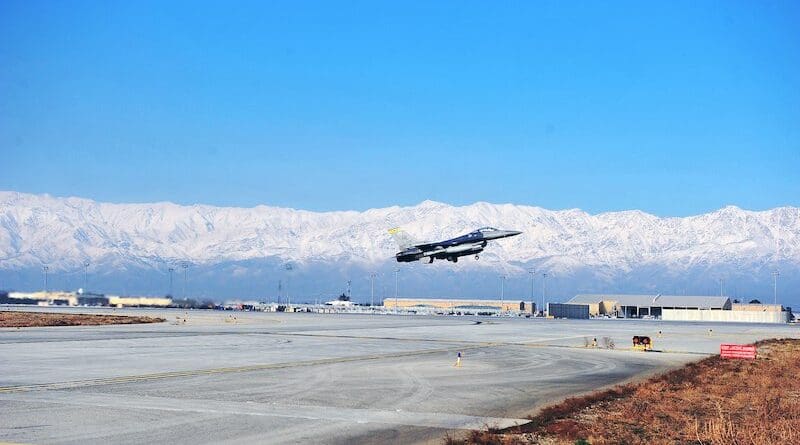
File photo of an F-16 Fighting Falcon assigned to the 4th Expeditionary Fighter Squadron from Hill Air Force Base, Utah, takes off at Bagram Air Field, Afghanistan, Jan. 23, 2015. Photo Credit: Staff Sgt. Whitney Amstutz, Wikipedia Commons

By 

The return of Donald Trump to the White House has brought back one of his most persistent fixations – the Bagram Airbase in Afghanistan. His recent threats to punish Afghanistan if they don’t return the strategic military facility reveal a deeper game of global power politics that could have far-reaching consequences for the war-torn nation.

\

Trump’s obsession with Bagram is not just about military pride or correcting what he sees as Biden’s withdrawal mistakes. The 79-year-old President’s determination to reclaim this airbase stems from three critical strategic calculations that go far beyond Afghanistan’s borders.

The China Factor: A New Cold War Battleground

The most compelling reason behind Trump’s Bagram fixation is its proximity to China. Located just 800 kilometres from the Chinese border, Bagram offers an unmatched strategic advantage in America’s growing rivalry with Beijing. Trump has repeatedly mentioned China’s increasing influence in Afghanistan, and he sees Bagram as the perfect counter-move in this chess game.

China has been quietly expanding its presence in Afghanistan since the Taliban’s return to power. Through infrastructure projects and mining deals, Beijing is slowly but steadily gaining a foothold in the region. For Trump, losing Bagram means giving China a free pass to dominate Central Asia without American oversight. Reclaiming the base would allow the US to monitor Chinese activities closely and maintain a strategic presence in this crucial region.

The Geopolitical Chessboard: More Than Just Afghanistan

Bagram’s value extends far beyond its role in Afghan affairs. The airbase sits at the crossroads of South Asia, Central Asia, and the Middle East. Control over Bagram means having a launching pad for operations across this volatile region. It provides easy access to Pakistan, Iran, and the Central Asian republics – all areas where American influence has been declining.

For a president who believes in projecting American strength globally, Bagram represents the ultimate power projection tool. It’s not just about Afghanistan; it’s about maintaining American dominance in a region that’s becoming increasingly important for global trade and security.

\

Economic and Resource Considerations

Afghanistan sits on an estimated one trillion dollars worth of untapped mineral resources, including rare earth elements crucial for modern technology. China has already shown interest in these resources, signing preliminary agreements with the Taliban government. Trump’s push for Bagram could be part of a broader strategy to ensure American companies get their share of Afghanistan’s mineral wealth.

The airbase would provide the security and logistical support needed for American businesses to operate safely in Afghanistan. Without a military presence, the US risks being completely shut out of Afghanistan’s economic opportunities while China reaps the benefits.

The Devastating Impact on Afghanistan

For Afghanistan, Trump’s Bagram demands create an impossible situation. The Taliban government, which has struggled to gain international recognition and desperately needs foreign aid, now faces threats from the world’s most powerful military. Returning Bagram would mean allowing foreign troops back on Afghan soil – something that goes against everything the Taliban fought for during their 20-year insurgency.

The timing couldn’t be worse for Afghanistan’s people. The country is facing a severe humanitarian crisis, with millions needing food aid and basic services. International sanctions have crippled the economy, and most foreign aid has dried up. Trump’s threats add another layer of uncertainty to an already unstable situation.

If Afghanistan refuses to return Bagram, Trump’s promised “consequences” could include harsher economic sanctions, military action, or support for anti-Taliban groups. Any of these options would further destabilise the country and cause more suffering for ordinary Afghans who have already endured decades of war.

A Dangerous Game with Global Consequences

Trump’s Bagram strategy reflects his broader approach to international relations – using American military and economic power to force other nations to comply with US demands. While this might appeal to his domestic supporters who want to see America “winning” again, it risks creating new conflicts and undermining global stability.

Financial software

The international community is watching closely to see how this unfolds. If Trump successfully pressures Afghanistan into returning Bagram, it could set a precedent for other powerful nations to make similar demands on weaker countries. This could lead to a more chaotic and unpredictable world where might makes right.

The Road Ahead: Limited Options for All

As this standoff continues, both sides have limited good options. Trump cannot easily invade Afghanistan again without significant domestic and international backlash. The American public has little appetite for another long war in Afghanistan, and allies would be reluctant to support such action.

For Afghanistan, the choices are equally difficult. Giving up Bagram would undermine the Taliban’s legitimacy and invite more foreign interference. Refusing could bring devastating consequences from the world’s most powerful military.

Conclusion: A Test of Wills with Global Stakes

Trump’s desperate pursuit of Bagram Airbase is about much more than correcting past mistakes or showing strength. It’s a calculated move in America’s competition with China and an attempt to maintain global dominance in a changing world order.

For Afghanistan’s long-suffering people, this great power competition means more uncertainty and potential conflict. The country that just wanted peace after decades of war now finds itself at the centre of a new geopolitical storm.

The coming months will reveal whether Trump’s threats are serious or just political posturing. Either way, his Bagram obsession has already changed the dynamics in Afghanistan and reminded the world that the Great Game in Central Asia is far from over. The stakes couldn’t be higher – for Afghanistan, for regional stability, and for the future of global power politics.


Girish Linganna

Girish Linganna is a Defence, Aerospace & Political Analyst based in Bengaluru. He is also Director of ADD Engineering Components, India, Pvt. Ltd, a subsidiary of ADD Engineering GmbH, Germany. You can reach him at: girishlinganna@gmail.com


Sperry Marine Paper Sets Out S-100 Step Change For Marine Navigation

Sperry Marine
Front Cover image of 'VisionMaster S-100 ECDIS - A step change for marine navigation'

Published Sep 21, 2025 10:38 PM by The Maritime Executive


[By: Sperry Marine]

Sperry Marine, a global leader in navigation solutions for seagoing vessels, has issued a whitepaper to explain how new S-100 standards lay the foundation for enhancing the quantity, quality and appearance of the information navigators need to ensure vessel safety, efficiency and sustainability.

‘VisionMaster S-100 ECDIS - A step change for marine navigation’ explains how the new S-100 framework will help free electronic chart information systems (ECDIS) software from constraints embedded in existing standards that were conceived in the 1990s. The paper offers guidance to customers on S-100’s consequences for equipment procurement, crew training and in-service systems, while also introducing Sperry Marine’s VisionMaster S-100 ECDIS to market.

The International Hydrographic Organization (IHO) has worked with industry to develop S-100 to replace existing S-52, S-57 and S-63 standards - respectively covering the way ECDIS show electronic navigation charts (ENCs), formats used for transferring hydrographic data, and cyber security verification. First phase developments focused on finalising S-100 standards for ENCs, bathymetric surface, water level information, surface currents, navigational warnings, and under keel clearance management.

“The advent of S-100 represents the single biggest change to ECDIS since IMO adopted the revised ECDIS Performance Standards in 2006,” said Simon Cooke, Technical Manager, Sperry Marine. “This whitepaper offers practical guidance on how ships’ navigational and voyage management systems can realise the potential of accelerating digitalisation.”

The contemporary geospatial standards (ISO 19100) used in S-100 allow multiple navigational data layers to be presented simultaneously on a single display, while S-100 standards are also extensible so that new data products can be added as required, said Cooke.

The International Maritime Organization has revised its ECDIS performance standards to accommodate S-100. Users are free to use software conforming to the standard on a voluntary basis in new ECDIS installations from January 1, 2026, with their use scheduled to be mandatory for new ECDIS installations from January 1, 2029.

As Sperry Marine’s insightful paper explains, however, manufacturers need type approval that S-100 ECDIS satisfies test standard IEC 61174 Edition 5, which the International Electrotechnical Commission (IEC) has yet to finalise. IMO has also not set a deadline for updating existing ECDIS installations, with hydrographic offices continuing to publish S-57 ENCs for the foreseeable future.

“Experience demonstrates that close collaboration is critical between regulators and marine technology specialists on ECDIS to ensure ship safety, efficiency, environmental responsibility, and orderly transition,” said Cooke. For good reason, Sperry Marine’s VisionMaster S-100 ECDIS will have ‘dual fuel’ compatibility with S-100 and S-57 standards, he added.

The first-time user of the VisionMaster S-100 ECDIS would experience new generation benefits going beyond S-100 requirements, he added, for example by allowing the navigator to see charted dangers further along planned or current routes, and to set preferences to minimise distractions from alerts while maintaining awareness of significant charted objects.

“But, as this white paper also shows, the IMO’s 2026 milestone for voluntary S-100 ECDIS adoption is an opportunity to acknowledge the benefits these standards will bring for industry as a whole. Sperry Marine is ready to work with its customers on the timely transition to S-100 for the better of ship safety, ship performance and maritime decarbonisation.”

Download the white paper here.

The products and services herein described in this press release are not endorsed by The Maritime Executive.