Friday, September 26, 2025


Real-Time Engine Oil Quality Monitoring is Now in Reach
iStock
iStock

Published Sep 18, 2025 6:24 PM by The Maritime Executive


Lube oil contamination is one of the fastest ways to get into trouble in the engine room, and engineers monitor their oil closely for signs of problems. But it's hard to catch everything without a lab on board - at least, until recently. Castrol has come up with a new solution, SmartMonitor, that regularly checks the oil's properties and lets the crew (and shore staff) know about any developing issues. To find out more, TME caught up with Castrol Technical Service Manager, Are Sletten, who has been working with the product throughout early trials. 


Just for background, what's the standard process for analyzing engine oil?


What happens normally on board the vessel is that an engineer takes a physical oil sample in a bottle and repeats the process once every three months. They will ship it to the laboratory. It takes two to three weeks before you get a reply, because it takes time for shipping and there is processing time at the lab. And then it will be checked and the results will be sent. 


How does Castrol's new equipment do it differently?


The SmartMonitor unit will give you the same information as a lab report, but every hour. It will automatically take a sample from the main engine, run it through the unit, and then drain it back into the engine. 


SmartMonitor will give you the total base number, viscosity, oxidation, and water content, when used in an engine application. There is a display on the unit that the engineer can have a look at to see if everything is okay, but the unit also feeds data up to the cloud, and then the customers on shore can go into our website and view the results. They have access to the graphs, the trends, the alarm limits, and all of that. So, if you want to go back and see if something happened last week, you could go back and see the trend. 


What can this help prevent? How does it save the operator money?


It's sort of like insurance: you might not need it, but in the event you do, then it will more than pay for itself. First, if you detect any water early, that's very valuable because of the damage that water ingress can do to an engine. The second most important factor is viscosity, especially when customers are considering new fuels. Fuel oil is always affecting the lube oil in the engine. In this time when people are testing biofuels, ammonia and methanol, having this on board is a valuable way to make sure that the fuel is not causing problems.


For example, if there is a little bit of methanol fuel getting into the engine oil, the viscosity will go down, and then you lose your lubrication. If you lose the lubrication film, you might end up with bearing damage. This unit will tell you instantly if viscosity is going down and of course it has a low-level alarm to alert the engineers. At the same time, company managers on shore can get the alert via email or on the phone as a text message.  


Even if you're not paying attention, it's watching the engine every hour. It's a huge help for inexperienced engineers, and it takes a bit of stress off for senior engineers as well. 


Do you have any early success stories? 


We have done trials for several years and we have prevented engine damage. With one customer, the unit gave an alert that there was water in the engine oil. The engineers thought it was a faulty sensor and believed the unit was wrong, but we asked them to check anyways. They found that there was water in the oil, and because our SmartMonitor caught it early, they were able to fix the problem at lower cost. The customer then bought several more of our SmartMonitor units for their other vessels.

-TME


ClassNK to Enhance the Safety and Loading Capacity of Container Ships

ClassNK

Published Sep 24, 2025 8:05 AM by The Maritime Executive


[By: ClassNK]

ClassNK has released new guidelines for those involved in container shipping, aiming to enhance the efficiency of container stowage while ensuring safety measures  such as preventing cargo collapse. These guidelines apply the latest expertise in weather forecasting, ship motion, and digital twin technologies.

The newly released 'Guidelines for the Safety of Maritime Cargo Based on Weather Forecasts,' 'Guidelines for Anti-Rolling Devices,' and 'Guidelines for Container Stowage and Securing Arrangements (Edition 3.3)' enable safer and higher-capacity container shipping by optimizing stowage based on weather forecasts for short-term voyages, and by taking advantage of the roll reduction effects of anti-rolling devices.

The details of each guideline are as follows: 

'Guidelines for the Safety of Maritime Cargo Based on Weather Forecasts'
Route selection based on metocean information is one of the key factors in the safe transportation of cargo. Although weather forecasts are a valuable source of information when the forecast period is sufficiently short, it is necessary to take their uncertainties into account to ensure safety. However, there have been no specific standards until now, and each company has handled it individually.

By clarifying the correlations between the AIS records accumulated by ClassNK, over one million cases of past metocean data, and actual sea conditions through big data analysis, this guideline specifies new technical requirements for uncertainty qualification of weather forecast values and safety assessments of cargo, and describes corresponding standard evaluation methods. In addition, this guideline also specifies a calculation method for a load correction factor based on weather forecasts for short-term voyages, related to container loading and lashing strength assessments for container carriers.
By applying this guideline, safe and optimized stowage operations can be achieved in short-term voyages based on weather forecasts.

'Guidelines for Anti-Rolling Devices'
Anti-rolling devices such as anti-rolling tanks have been increasingly installed on cargo ships in recent years for the purpose of improving safety, comfort, and work efficiency by reducing ship rolling. With growing concerns about cargo collapse accidents, attention to anti-rolling tanks has increased. While their installation on large merchant ships has started to spread, there have been no common safety standards so far.

This guideline specifies technical and inspection requirements for anti-rolling devices installed on ships, making use of the expertise on ship motions gained during the development of the 'Guidelines for Parametric Roll Countermeasures,' and sets out a method for evaluating the effect of anti-rolling tanks on reducing roll motion. 
By applying this guideline, safe container stowage operations considering the roll reduction effects of anti-rolling devices can be realized.

'Guidelines for Container Stowage and Securing Arrangements' (Revised)
The 'Guidelines for Container Stowage and Securing Arrangements (Edition 3.0),' released in 2023, has contributed to balancing safety and economic efficiency by enabling optimized stowage operations that take into account the effects of routes and seasons, in response to the enlargement of container ships and advances in lashing technology.

With the release of the guidelines on weather forecasts and anti-rolling devices, the related requirements have now been revised to enable container stowage that also reflects these factors.
The guidelines are available for download via "Guidelines" of My Page on ClassNK’s website after registration: https://www.classnk.or.jp/account/en/Rules_Guidance/ssl/guidelines.aspx

ClassNK will continue to contribute to achieving safe and efficient shipping under various operating conditions through the guidelines and other initiatives.

The products and services herein described in this press release are not endorsed by The Maritime Executive.

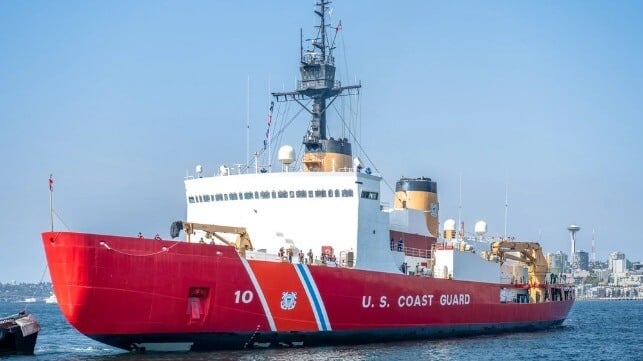


USCG Polar Star Finishes Maintenance and Returns to Seattle After 308 Days

Polar Star icebreaker USCG
Polar Star was away from her homeport for 308 days (USCG)

Published Sep 25, 2025 6:02 PM by The Maritime Executive


The U.S.’s only icebreaker capable of completing the annual supply missions to Antarctica, Polar Star, returned to her homeport of Seattle on September 23. The vessel had been away for 308 days, completing the annual trip to McMurdo Station and then to California for critical maintenance to keep the nearly 50-year-old vessel operational.

“Much has been asked of this ship over the past five decades,” said Capt. Jeff Rasnake, Polar Star’s commanding officer. “The completion of this extensive five-year maintenance and recapitalization project is a major milestone in enabling Polar Star’s operations into the future.”  

Polar Star’s Service Life Extension Program (SLEP) was completed in five phases, spaced so that the vessel could also undertake the yearly trip to Antarctica. The last phase of the program began on March 30, 2025. It was focused on updating the gyro repeater, replacement of ancillary pumps and motors critical to the main propulsion and auxiliary systems, and refurbishing the heating, ventilation, and air conditioning systems. Work completed in Phase Five took 175 days and represented an additional $12.7 million investment.

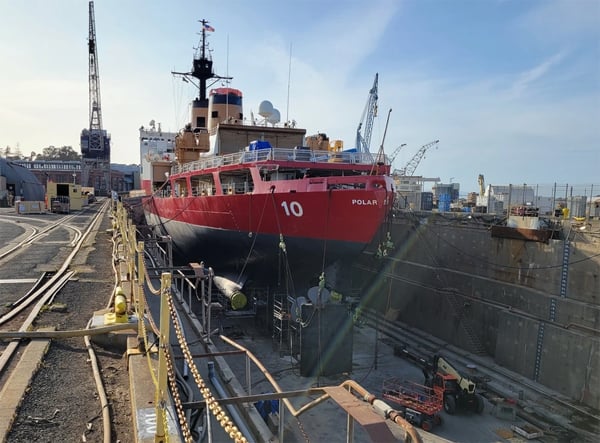
Returning from Operation Deep Freeze, the vessel proceeded directly to Mare Island Dry Dock in Vallejo. While in the yard, they overhauled one of the nine main diesel engines, and work was performed on the ship’s sanitary systems. Additional major work completed includes removing the centerline shaft for servicing and inspection, exchanging all three propellers, and renewing both forward and aft main deck surfaces.


Work on the rudder and props in April 2025  (U.S. Coast Guard photo by Seaman Nestor Molina)


“This is a tremendous ship, and it is in better shape today than it was ten years ago,” said Rasnake.?“That’s a testament to the unrelenting efforts of the crew, the enduring support of our mission partners, and the renewed enthusiasm and investment in our nation’s polar icebreaking capabilities.”

Commissioned in 1976, Polar Star is 399 feet (121 meters) in length and 13,500 tons displacement. Despite reaching nearly 50 years of age, Polar Star remains the world’s most powerful non-nuclear icebreaker with the ability to produce up to 75,000 shaft horsepower.

The Coast Guard highlights the critical nature of keeping the vessel operational for the annual mission to transport personnel, equipment, and supplies to Antarctica. The efforts over the past few years have been designed to extend her service life until at least the first of the new Polar Security Cutters can be delivered. While Bollinger was approved this spring to proceed with full construction of the vessel to be known as USCGC Polar Sentinel, the program is at least six years behind schedule. The Coast Guard anticipates the first ship will not be delivered before 2030.

India Commits $8B to Expand Shipbuilding Industry to Reach Top 5 Worldwide

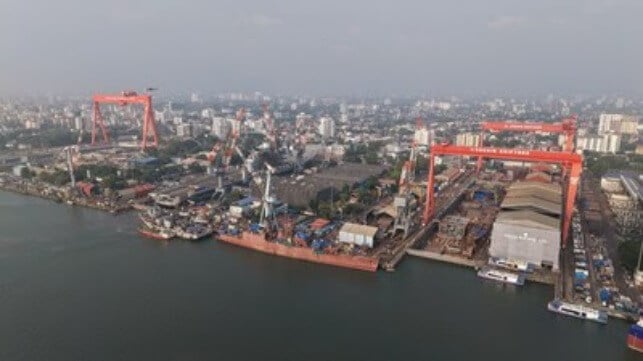
Cochin India shipbuilding
India's largest shipbuilder Cochin looks to move capacity from government projects to the commercial industry (Cochin)

Published Sep 25, 2025 7:21 PM by The Maritime Executive


The Indian government approved financing and a series of steps designed to support the ambitious plan outlined by Prime Minister Narendra Modi to transform Indian shipbuilding to be among the top five worldwide. Calling shipbuilding the “mother of heavy engineering,” the government approved a total investment of just under $8 billion, including the Shipbuilding Financial Assistance Scheme scheduled to run until March 31, 2036.

The Prime Minister highlights the critical nature of shipbuilding as part of the initiative to strengthen national, energy, and food security and to reinforce India’s geopolitical resilience and strategic self-reliance. Revitalizing India’s shipbuilding and maritime ecosystem, Modi says, will drive investment and create large numbers of new jobs both for domestic shipping and as an exporter of newbuilds.

“India has a long and illustrious maritime history, with centuries of trade and seafaring that connected the subcontinent to the world,” the government news agency said announcing the adoption of the budget. “Today, the maritime sector remains a backbone of the Indian economy, supporting nearly 95 percent of the nation’s trade by volume and 70 percent by value.”

The package, they said, introduces four pillars designed to strengthen domestic capacity, improve long-term financing, promote greenfield and brownfield shipyard development, enhance technical capabilities and skilling, and implement legal, taxation, and policy reforms to create a robust maritime infrastructure. Reports said that by giving infrastructure status to large ships, the government is providing tools to use them as collateral for loans. It will ensure easier and cheaper financing for the industry.

At the heart of the program are three financing packages. They will provide nearly $2.8 billion for the shipbuilding financing initiative. Another nearly $2.3 billion will be in a maritime development fund, and a further $2.25 billion will be devoted to expanding domestic shipbuilding capacity to 4.5 million gross tons. A separate proposal, the Shipbreaking Credit Note scheme, incentivizes ship owners to recycle their vessels in India, offering a credit worth approximately 40 percent of the ship's scrap value, which can be applied within three years to building a new ship in India.

Among the elements of the program that have been previously discussed are plans to develop new greenfield shipyards. The plan calls for clusters of shipbuilding capabilities to be developed around the country. The country’s large shipbuilders, including Cochin Shipyard, have already begun to develop international partnerships as they look to expand their capabilities to build larger ships.

India has also been working to develop interest from the leading Western shipping companies, both for ship repair and construction. It has been linked to discussions with the largest container carriers, including MSC Mediterranean Shipping Company, Maersk, and CMA CGM.

The government highlights the massive amount of money India spends each year with foreign shipping companies. Prime Minister Modi is extolling a Made in India strategy to enhance the country’s economy and build greater self-reliance.

China’s Dalian Shipbuilding Delivers its First LNG Newbuild

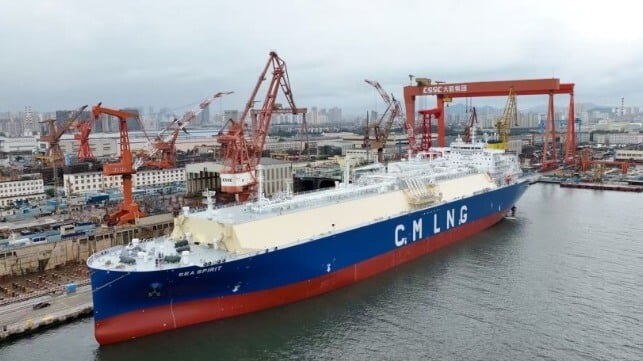
LNG carrier built in China
DSIC's first LNG carrier was delivered as China seeks to build its share of the market (CSSC)

Published Sep 25, 2025 5:48 PM by The Maritime Executive


Chinese shipbuilding’s efforts to chip away at South Korea’s domination of the LNG carrier market took another step forward as Dalian Shipbuilding delivered its first newbuild LNG carrier. The vessel is the first of eight being built for China Merchants Energy Shipping and is being highlighted as DSCI’s first independently designed vessel in this key segment of the industry.

Parent company China State Shipbuilding Company hailed the vessel as part of the “crown jewel of the shipbuilding industry.” It highlights the “extremely high design and construction difficulty” for LNG carriers as another demonstration of China’s expanding expertise in shipbuilding. The handover celebration took place in Dalian on Wednesday, September 24. 

Chinese yards have begun to break into the LNG segment, building for both domestic carriers such as CMES and for export. They were successful in winning a few international orders linked to Qatar and its massive shipbuilding program. LNG carriers had traditionally been the domain of the South Korean yards, which still win the majority of the orders for these vessels.

While they are highlighting the domestic shipbuilding capabilities, the new ship Sea Spirit uses the well-established GTT Mark III membrane containment system along with a reliquification unit. France’s Gaztransport & Technigaz (GTT) remains the supplier of the containment systems to the world’s carriers despite efforts to develop competing systems.

The new ship is otherwise a fairly standard LNG carrier with a capacity of 175,000 cbm. DSIC highlights that by employing the standard size, the vessel will be able to dock at the vast majority of LNG terminals worldwide. They report the ship will have "excellent port adaptability and ship-to-shore compatibility." The ship is 295 meters (968 feet) in length. It is powered by an LNG dual-fuel low-speed main engine.

China Merchants ordered its first LNG carriers from DSIC in 2022. The initial order was for two ships with options that were later exercised. The order has been expanded to eight ships, and they will operate through a number of joint ventures, including with PetroChina and Sinochem. In 2024, NYK announced the formation of its sixth shipmanagement company, OPearl, which it said would manage LNG carriers, including six vessels that will be chartered to CNOOC Gas and Power Singapore Trading & Marketing. China Merchants is a partner along with CETS Investment Management (HK) Co., a subsidiary of the CNOOC Group, in the management company.

DSIC floated the first ship in May 2024 and reported that sea trials combined with gas trials were completed in July 2025. The yard has also launched Sea NavigatorSea CreationSea ArgosySea Energy, and Sea Charity, as it works to fill out the order.

EPS to Consolidate LNG Transport by Buying Remaining Shares of CoolCo

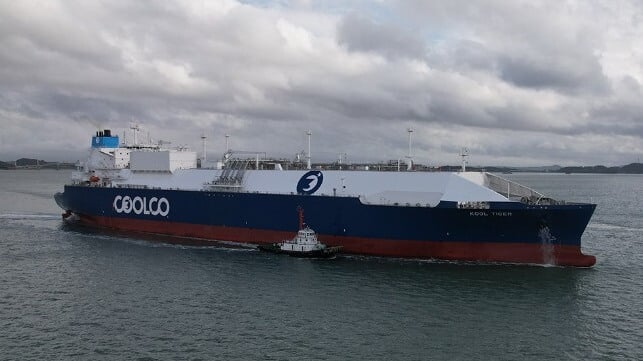
LNG carrier
CoolCo owns 13 LNG carriers having grown since in 2022 spin off from Golar (CoolCo)

Published Sep 24, 2025 7:39 PM by The Maritime Executive


CoolCo, a pure play LNG Carrier, which has been publicly traded for just over three years, is in advanced discussions with its majority owner, Eastern Pacific Shipping, for a potential buyout of its outstanding shares. The move comes in response to the outlook for LNG shipping after CoolCo grew rapidly after being spun off from Golar LNG in 2022.

EPS worked with Golar in the formation of the dedicated LNG shipping company to simplify the corporate structure and create a pure play well-positioned to participate in the rapidly growing LNG market. Three years later, analysts expect an emerging oversupply of LNG as the United States and others have moved rapidly to increase production and exports. There has also been a rush to build vessels for the sector, and now the U.S. is looming over the business with a proposed requirement that a portion of LNG exports must be carried on U.S.-flagged vessels.

“Despite challenging market conditions, our commitment to CoolCo’s long-term development and, above all, to serving our charterers with the highest level of reliability and dedication remains unchanged. We believe our offer provides the best long-term alternative for CoolCo shareholders, and we hope to bring this proposed transaction to a close in the very near future,” said Cyril Ducau, CEO of Eastern Pacific Shipping.

The terms being discussed call for a cash offer of $9.65 per share for the 41 percent of the stock that EPS does not currently own. It represents a 26 percent premium to the closing price on September 22, 2025, and a 38 percent premium to the 90-day trading average. The Board of Directors of CoolCo has established an independent Special Committee, comprised solely of independent and disinterested directors, to review and negotiate the terms of the potential transaction. 

CoolCo traces its origins to the founding of Gotaas-Larsen in 1946 and the company’s first LNG carrier ordered in 1970. Gotaas-Larsen became Golar in 2001 and later entered the FLNG sector as a developer of floating terminals, and today is the only independent provider of FLNG as a service. They separated the business in 2022 as part of a long-term plan that the companies had been pursuing for several years. 

The LNG standalone company named CoolCo emerged, owning eight vessels, and acquired the ship management business from Golar. Today, the fleet consists of 13 LNG carriers owned by CoolCo as well as three additional managed vessels. It took delivery on two newbuilds in Q4 2024 and Q1 2025, while highlighting that its strategy includes ongoing assessment of growth opportunities through vessel acquisitions and potential consolidation in the fragmented LNG market. It draws on its relationship with EPS to strengthen its position with shipyards, financial institutions, and deal flow access.