Saturday, October 11, 2025

AI steers education innovation across US states


By Dr. Tim Sandle
SCIENCE EDITOR
DIGITAL JOURNAL
October 9, 2025


AI tools could change the traditional rules of the classroom. — © AFP

With the rise of artificial intelligence use and other innovations in education providing equitable access to learning and preparing students for more advanced futures. The non-profit organization SmileHub has released new reports into the use of AI in the U.S, titled States Leading the Way in Educational Innovation and the Best Charities for Education in 2025.

As the preamble indicates: “Through hybrid or virtual learning over platforms like Zoom, schools are able to hold classes without disruption when people are sick and provide education access to more students. Additionally, rapid growth in artificial intelligence (AI) use globally has schools racing to prepare students for a bolder, AI-driven future.”

To highlight the states innovating the most in their education systems and the ones that have more work to do, SmileHub compared each of the 50 states based on 14 key metrics. The data set ranges from test-optional universities per capita to the number of education charities per capita to the adoption of K-12 computer science policies.

This revealed the most innovative states to be:

1. California

2. Massachusetts

3. New York

4. Pennsylvania

5. Illinois

6. Florida

7. Texas

8. Ohio

9. Washington

10. Indiana

In contrast, the least innovative states were revealed to be:

41. Delaware

42. New Mexico

43. Montana

44. Hawaii

45. Mississippi

46. West Virginia

47. Nevada

48. Alaska

49. North Dakota

50. South Dakota

Within the main rankings there are some interesting variances. California, for example, has the most creative workspaces per capita – 18.4 times more than Mississippi, which has the fewest creative workspaces.

Indiana has the most blue ribbon schools per capita – 10.9 times more than Nevada, which has the fewest blue ribbon schools. Returning to California, the state has the most education charities per capita – 8.4 times more than New Hampshire, which has the fewest charities.

Shaping the future of learning and work: University of Waterloo and Google collaborate


By Dr. Tim Sandle
SCIENCE EDITOR
DIGITAL JOURNAL
October 2, 2025


Google image: - © AFP SEBASTIEN BOZON

Education can be a powerful equalizer, opening doors and creating new opportunities in people’s lives. One area that is creating considerable interest from the current generation of university students is artificial intelligence. There are many directions to take AI research; one such area is to understand its impact on learning and work.

With these twin areas in mind, Google and the University of Waterloo have jointly announced a new research collaboration that examines how artificial intelligence will shape education and career preparedness.

The partnership includes a $1 million in contribution from Google. The bulk of the funding will go towards a new Google Chair in the Future of Work and Learning. Additional funding will be directed towards hands-on learning labs to enable participants to co-create AI-powered tools and prepare students for the evolving workplace.

Google Chair in the Future of Work and Learning

The first Chair is set to be Professor Edith Law, Computer Science professor. Law has made pioneering contributions to fostering human-AI collaboration in the pursuit of enhanced creativity.

Law will be working closely with students and researchers to co-create AI-facilitated learning technologies and to answer some of the fundamental questions facing educational institutions today:How can we best prepare students for jobs that don’t exist yet?
How do we evolve the learning experience to meet learners where they are?
How do we make sure learners are ready for the workforce in an increasingly evolving world?

Learning by doing: The futures lab workshop

With the laboratory support, the Futures Lab, a unique, hands-on learning lab where interdisciplinary student teams will come together with University of Waterloo faculty and Google mentors to build new, AI-powered learning prototypes, with tools such as Gemini and AI Studio.

In this setting, interdisciplinary student teams will come together, multiple times per year, with University of Waterloo faculty and Google mentors to build new, AI-powered learning prototypes, with tools such as Gemini and AI Studio.

Google view

Speaking about the partnership, Mira Lane, VP Society and Technology, Google explains the motivation for the initiative: “In an era of rapid technological advancement, ensuring education can continue to fulfil that promise for everyone is critical.”

In terms of the support Google will be providing, Law says: “This collaboration brings together our expertise in AI with University of Waterloo’s visionary educational approach. To kick things off, we will be providing a $1 million CAD contribution to establish a new Google Chair in the Future of Work and Learning to explore new paradigms of learning and teaching. This partnership marks our shared commitment to redefine education and empower the next generation to thrive in an AI-driven world.”

Other projects

Google has an established history of working with the University of Waterloo, including Kids on Campus, a programme that brings Grade 4 classes to the university for a day of STEM activities. Google has also provided funding for the university’s Women in Computer Science (WiCS) programme and, most recently, Google collaborated with the university’s Jimmy Lin Data and the Waterloo Data and Artificial Intelligence Institute to host a K-12 AI Day for Educators.

Op-Ed: AI vs education — ‘Outsourcing’ education to AI can’t work at all, but there is real hope


By Paul Wallis
EDITOR AT LARGE
DIGITAL JOURNAL
September 30, 2025


A view of Harvard University campus in Cambridge, Massachussetts in April 2025 - Copyright AFP Joseph Prezioso

The understandable howls of outrage about AI vs education have been pretty much continuous. The shameless misrepresentation of generative AI as a learning tool has truly taken root in education.

The problem is that AI “creates knowledge” on demand. This outcome is in direct conflict with the nature of learning.

A lot of fundamental learning is about students learning how to learn, backed up by learning to understand the information and applications. It lacks depth on the student side.

That’s hardly good enough. It’s exactly what educators worldwide dread, delivering little value as actual education. Nobody’s learning much but how to use the AI, in theory. How much actual knowledge and skills are being learned? Education has quite enough problems without this vacuous outcome.

Somebody called Assistant Professor Kimberley Hardcastle from Northumbria University in Newcastle was kind enough to produce this very useful article on the subject of AI in education.

You need to read this article to get the core issues clear.

Her area of special interest is epistemology, the study of knowledge. This approach nails the big picture issues with AI all too well. It’s scary.

This very real problem is NOT about “the kids are doing it all with AI”. It’s far more complex, about the nature and quality of educational knowledge, and it’s pretty grim.

The generation and pseudo-creation of knowledge on demand for students is now in the hands of first-generation AI. It’s a technological toddler itself. Big Tech is being its usual immature, infantile self in terms of the quality of info, with some exceptions.

Hardcastle patiently points out the contrast between “original” and “assisted” thinking. This is critical, and it’s essential to the learning process on any level.

If you’re a teacher, how the hell are you supposed to know:

Whether the student is doing the necessary thinking and actual research or just letting the AI do it

Whether they understand the information about the subject, or your questions at all

Whether the student gets the point that critical thinking is required

Try this little workout for yourself:

Pick any subject at random.

Search the subject and check the AI response.

At what point do you become totally dependent on the AI information?

Almost immediately, perhaps?

Can you question what the AI has created? No. That’s the problem.

Now put yourself in the position of any schoolkid or undergraduate,

Are you “educated” yet?

You’re not, and you can’t be.

Unless you put in a lot of effort to fix the knowledge gaps, you lack anything resembling a personal knowledge base.

How “productive” does this sound so far? Does anyone detect the subtle suggestion that any amount of dud useless information can be generated?

What a surprise.

The good news, eventually.

I want to point out that this situation is far from insoluble. It can solve itself.

Maybe it’s the use of words like epistemology that appeals to my hyper-antisocial polysyllabic soul. Maybe a good, worthwhile subject feels good to write about.

Here’s the good news about AI and education for the future.

AI is a learning tool. Learn how to use it.

Kids will have to use AI anyway.

It makes sense to create accredited academic AI for education purposes.

Accreditation is a major plus for products and puts some skin in the game for AI companies.

LLMs can be tweaked to any degree for academic purposes.

You can work with these LLMs and AI to create high standards of testing and assignments with built-in oversight on standards of learning and curricula.

You can test these LLMs using existing methods.

You can make academic LLMs and AI subject to contract terms.

You can stop worrying about the quality of information and the massive, inexcusable holes in knowledge bases when you use AI properly.

___________________________________________________________

Disclaimer
The opinions expressed in this Op-Ed are those of the author. They do not purport to reflect the opinions or views of the Digital Journal or its members.



Plastic pollution treaty not dead in the water: UN environment chief

By AFP
October 10, 2025


Countries were unable to find common ground on tackling the scourge of plastic pollution - Copyright AFP Olivier MORIN
Robin MILLARD

The UN’s environment chief insists that a landmark global treaty tackling plastic pollution remains achievable, despite talks twice imploding without agreement, and the chair suddenly resigning this week.

United Nations Environment Programme (UNEP) executive director Inger Andersen told AFP in an exclusive interview that countries were not walking away, regardless of their sharp differences on combating the ever-growing problem, including in the oceans.

A large bloc wants bold action such as curbing plastic production, while a smaller clutch of oil-producing states wants to focus more narrowly on waste management.

Supposedly final talks in South Korea in 2024 ended without a deal — and a resumed effort in Geneva in August likewise collapsed.

Countries voiced anger and despair as the talks unravelled, but said they nonetheless wanted future negotiations.

“We left with greater clarity. And no-one has left the table,” said Andersen.

“No-one has walked away and said, ‘this is just too hopeless, we’re giving up’. No-one. And all of that, I take courage from.”

– ‘Totally doable’ –

The plastic pollution problem is so ubiquitous that microplastics have been found on the highest mountain peaks, in the deepest ocean trench and scattered throughout almost every part of the human body.

More than 400 million tonnes of plastic are produced globally each year, half of which is for single-use items.

While 15 percent of plastic waste is collected for recycling, only nine percent is actually recycled.

Nearly half, or 46 percent, ends up in landfills, while 17 percent is incinerated and 22 percent is mismanaged and becomes litter.

Annual production of fossil fuel-based plastics is set to triple by 2060.

As things stand, there is no timetable for when further talks might be held, and no countries have made formal offers to host them.

But Andersen “absolutely” thinks a deal is within reach.

“This is totally doable. We just need to keep at it,” she said.

– Red line clarity –

UNEP has been shepherding the talks process, which began in 2022.

Summarising where countries are at, Andersen said: “The mood music is: ‘we’re still in the negotiations. We are not walking away. We have our red lines, but we have a better understanding of the others’ red lines. And we still want this’.”

Andersen said Norway and Kenya convened a well-attended meeting at the UN General Assembly in New York last month.

The COP30 climate summit in Brazil in November will provide another opportunity to put the feelers out, ahead of the UN Environment Assembly in Nairobi in December.

Luis Vayas Valdivieso, Ecuador’s ambassador to Britain who chaired the last three of six negotiation rounds, has announced he is stepping down, leaving the process rudderless.

– ‘Serious allegation’ –

Vayas’s Geneva draft treaty text was instantly ripped apart by countries in brutal fashion, and while a revised effort gained some traction, the clock ran out.

British newspaper The Guardian reported that staff from Andersen’s UNEP team held a covert meeting on the last night in Geneva, aimed at coaxing members of civil society groups into pressuring Vayas to quit.

“This is a very, very serious allegation,” Andersen said.

“I did not know and obviously had not asked anyone to do something of this sort.”

She said the allegation had been referred to the UN’s Office of Internal Oversight Services.

“I’ve been in this business for 40 years, and I have never, ever done such a thing, and I would never have asked a staff of mine, or anyone else for that matter, to go and have covert meetings and quote my name and ask to undo a seated chair who is elected by member states. It’s outrageous.”

As for whether a new chair could provide fresh momentum, she said: “As always, when there’s change, there is a degree of a different mood.”
Living Wage, Affordability Platforms Like Mamdani and Platner’s Have ‘Major Electoral Advantage’: Polls

Democratic leaders in recent months have refused to throw their support behind candidates who are centering affordability in their campaigns.


New York mayoral candidate Zohran Mamdani speaks during a press conference on October 8, 2025 in New York City.
(Photo by Michael M. Santiago/Getty Images)


Julia Conley
Oct 09, 2025
COMMON DREAMS

As One Fair Wage launched a new political action committee focused on electing candidates who will push for a true living wage that makes it possible for working people across the US to thrive, the coalition said two new surveys provide a “roadmap for 2026” for candidates and Democratic leaders who are willing to follow it.

The polls were conducted by Democratic polling firm Lake Research Partners on behalf of One Fair Wage (OFW) and the Living Wage for All Coalition, and found “overwhelming support for living wage policies in competitive swing districts and in major cities.”
RECOMMENDED...


‘People Are Being Robbed’: Maine’s Platner Credited for Showing Democrats How to Win Back Trump Voters


‘Corporate Greed Is Out of Control’: Tlaib-Sanders Bill Would Tax Companies for Excessive CEO Pay

In 18 competitive congressional districts across the country, the first survey found that 55% of respondents supported raising the minimum wage for all workers to $25 per hour, even after being exposed to opposition messaging.

Latino voters showed the strongest support at 72%, along with people of color overall at 64%, women at 60%, and people under age 40 at 59%.

With grocery prices harder to afford than they were one year ago in many swing districts, as another poll showed last week, 56% of people said raising the minimum wage is a high or medium priority for them, including 71% of Democratic voters.

The firm also asked voters in major cities with high costs of living, including New York, Los Angeles, Chicago, and San Francisco, whether they supported raising the minimum wage to $30 in those areas, and found similar results.

Two-thirds said they backed gradually raising the minimum wage for all workers to $30 per hour.

“Support is strongest among the very voters Democrats must mobilize to win in 2026 and 2028: Black voters (80%), Latino voters (73%), young voters under 40 (72%), and women (72%) all back the proposal,” Lake Research Partners said.

“If Democrats don’t deliver, the right will continue to exploit the affordability crisis to divide working people. Delivering real affordability is how we restore trust—and how we save democracy.”

Support for the proposal was highest in New York City, where Assembly Member Zohran Mamdani (D-36) has included a $30 minimum wage proposal as part of his mayoral campaign platform—one that’s heavily focused on making the city more affordable for all New Yorkers.

Seventy-two percent of New Yorkers said they supported the proposal.

The polling comes as endorsements from lawmakers and advocacy groups that have long been aligned with the Democratic Party have piled up for Mamdani—and as powerful party leaders in New York including US House Minority Leader Hakeem Jeffries, Senate Minority Leader Chuck Schumer, and Sen. Kirsten Gillibrand have continued to refuse to publicly support the democratic socialist.

Saru Jayaraman, president of OFW, warned that a failure to deliver on affordability and living wages before the midterm elections next year will make ”saving democracy“ from President Donald Trump and the Republican Party impossible.

”We represent 13.6 million restaurant workers in America,“ Jayaraman told Common Dreams. ”And over the last nine months, they’ve repeatedly asked us: ‘You want us to come to a rally on a Saturday to save democracy? I work three jobs and I earn $3 [an hour]. What has democracy done for me lately? Nothing.’“

Along with electing candidates who center living wages and affordability, Jayaraman said in a statement that delivering on the issue ”means passing Living Wage for All legislation in every blue state next spring and ensuring no one is left behind.“

”If Democrats don’t deliver, the right will continue to exploit the affordability crisis to divide working people,“ she said. ”Delivering real affordability is how we restore trust—and how we save democracy.”

Joining OFW in launching the Make America Affordable Now PAC on Thursday are Democratic candidates who are centering affordability and living wages in their campaigns, including Minnesota state Sen. Omar Fateh (D-62), who is running for mayor of Minneapolis; Seattle mayoral candidate Katie Wilson; and US Senate candidate Graham Platner of Maine.

Like Mamdani, Platner’s candidacy has elicited excitement from progressives as he’s spoken out against US support for Israel’s assault on Gaza and the oligarchy that has seen billionaires like Trump megadonor Elon Musk amass more political power as working people struggle to afford healthcare, groceries, and other essentials. He has put forward a platform that calls to raise the federal minimum wage and index it to inflation.

But Democratic leaders have shown little enthusiasm for Platner’s embrace of policies that would make life more affordable for Mainers—despite polls showing that such proposals could help him win a seat that’s been held by Sen. Susan Collins (R-Maine) since 1997.

Schumer has led a push for Democratic Gov. Janet Mills to enter the race instead of backing Platner, who in addition to backing broadly popular policies, has shown to be a formidable fundraiser—bringing in more than $4 million since announcing his candidacy in August.

On Thursday, Sen. Bernie Sanders (I-Vt.)—who has endorsed Platner—denounced Democratic leaders for meddling in the race.

“It’s disappointing that some Democratic leaders are urging Gov. Mills to run,” said Sanders. “We need to focus on winning that seat and not waste millions on an unnecessary and divisive primary.”
Instead of Charity, Peter Thiel Told Elon Musk to Use Billions for Right-Wing Crusade Against ‘Antichrist’

Thiel also accused environmental activist Greta Thunberg of being one of the Antichrist’s “legionnaires.”


Peter Thiel speaks at The Cambridge Union on May 8, 2024 in Cambridge, Cambridgeshire.
(Photo by Nordin Catic/Getty Images for The Cambridge Union)

Brad Reed
Oct 10, 2025
COMMON DREAMS

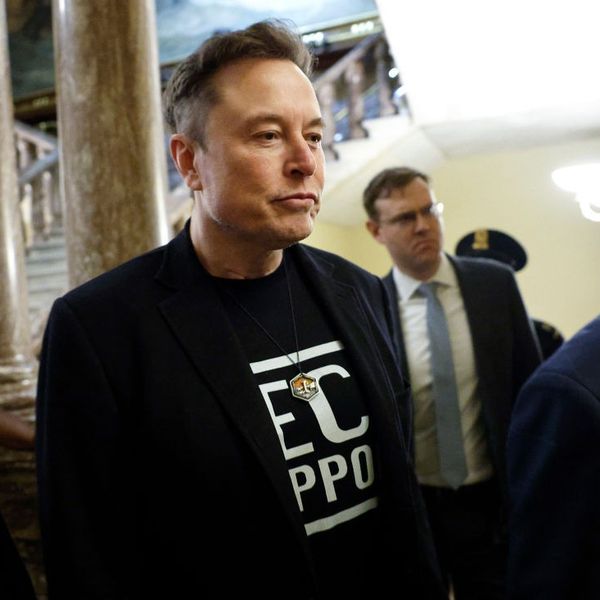
Right-wing billionaire Peter Thiel recently told an audience that he pushed Tesla CEO and fellow billionaire Elon Musk not to give money to charity and instead horde it so it could be used to battle a future “Antichrist.”

According to a Thursday Reuters report, Thiel told attendees of closed-door event in San Francisco last month that he pressed Musk to rescind his commitment to the Giving Pledge, the charitable campaign cofounded by Microsoft cofounder Bill Gates that asks signatories to leave a majority of their wealth to a charity of their choosing


Thiel said he warned Musk that his wealth was likely to end up going “to left-wing nonprofits that will be chosen by Bill Gates” and that his fortune would be better served to fight against a potential Antichrist figure that might emerge. Musk appeared receptive to these concerns, Thiel added.

Investigations have found that while Musk has pledged donations to charities and has donated money to charitable organizations, the funds have often either benefited his own interests or have not been properly distributed. His philanthropic group, the Musk Foundation, failed to donate the legally required amount to qualify as a charitable foundation last year for the third consecutive year.

He pledged nearly $6 billion worth of Tesla shares—just 2% of his net worth at the time—to the United Nations in 2021 to help feed 42 million people who were at risk of starvation for a year, but instead sent the money to his own foundation.

As Reuters noted, the Antichrist is a figure prophesied in the Christian Bible, and Thiel personally believes that this figure will emerge to “create a one-world government on the promise of something like stopping nuclear, AI, or climate-induced disaster.”

The Washington Post, which along with Reuters got a transcript of Thiel’s lectures on the Antichrist, added some more context to Thiel’s personal conception of the Antichrist in a Thursday report.

Specifically, the Post reported that Thiel told his audience that environmental activist Greta Thunberg and artificial intelligence critic Eliezer Yudkowsky were “legionnaires of the Antichrist.”

“In the 17th, 18th century, the Antichrist would have been a Dr. Strangelove, a scientist who did all this sort of evil crazy science,” Thiel said. ”In the 21st century, the Antichrist is a Luddite who wants to stop all science. It’s someone like Greta or Eliezer.“

The Post also reports that Thiel complained during his lecture that he’s had a much harder time in recent years avoiding paying taxes.

“It’s become quite difficult to hide one’s money,” he said. “An incredible machinery of tax treaties, financial surveillance, and sanctions architecture has been constructed.”

Thiel, a cofounder of digital payment platform PayPal, has long been an associate of both Musk and Vice President JD Vance, whose 2022 US Senate campaign he generously funded.


The Robots Are Not Here, But AI Is Still Supercharging US Militarism

This new AI-centric military-industrial complex threatens to become an unaccountable superpower wielding new levels of control at home and abroad.


An image shows an abstract rendition of artificial intelligence.
(Photo by Getty Images)

Nicholas Rabb
Oct 10, 2025
Common Dreams

President Donald Trump has recently been touring around with an entourage of Big Tech CEOs, proselytizing their massive profits and future prospects of more gain via advances in AI. At a recent event at the White House, First Lady Melania Trump, who is chairing the Artificial Intelligence Education task force, claimed that “[t]he robots are here. Our future is no longer science fiction.”

While much focus has been given to AI in education and the workplace, less has found its way to militarized AI, despite its widespread usage. When thinking of military AI, it’s easy to conjure up images of Terminator, the Matrix, HAL from 2001: A Space Odyssey, or the “Entity” from the newest Mission Impossible. Doomsday scenarios where AI goes rogue or becomes the driver of a machine-driven war against humanity are common Hollywood stories. As Melania claimed, it’s easy to imagine that “the robots are here.”
RECOMMENDED...


As Big Tech Oligarchs Wage War on Workers, Sanders Warns AI Could Kill Nearly 100 Million US Jobs


‘Red Flag’: Analysts Sound Major Alarms As AI Bubble Now ‘Bigger’ Than Subprime

But for now, these situations are far from reality. Despite the US military and Big Tech hyping up militarized AI—funding and promising autonomous weapons, drone swarms, precision warfare, and battles at hyperspeed—the truth is that the vision is way beyond the capabilities of current systems.

But that does not mean that militarized AI is not dangerous—quite the opposite. The present danger is that the US government is employing unregulated and untested AI systems to conduct mass surveillance, mass deportations, and targeted crackdowns on dissent. All the while, Big Tech is profiting enormously off of fantasy projects, sold on visions of autonomous warfare, and a desire for authoritarian control. The new AI-centered military-industrial complex is indeed a tremendous threat to democratic society.
The Lucrative Business of AI Warfare Hype

US military plans for the modern AI wave go back to 2018 with the Department of Defense (DOD) Artificial Intelligence Strategy. This document set the tone for militarized AI strategy for the subsequent years to come, as well as the foundations for how to pursue it. The 2018 AI Strategy prioritizes a few key points: (1) AI supremacy is essential for national security, (2) AI supremacy is essential for preserving US market supremacy, (3) China and Russia are the main AI competitors threatening US AI supremacy, and (4) the US government must rapidly pursue strategic partnerships with industry and academia to develop and push AI to achieve the prior three goals.

Big Tech companies are gaining tremendous power, both financially and politically, as a result of their partnerships with war-waging states.

In the years following, the Army followed suit by releasing a 2019 Army Modernization Strategy, similarly uplifting Russia and China as main threats. Yet this report went further than the 2018 Strategy, arguing that China and Russia are developing AI-based armed forces, hypersonic missiles, robotics, and swarming technologies. In 2021, one final, albeit massive, AI document was published by the US government: the National Security Commission on AI (NSCAI) report. This temporary commission was headed by Eric Schmidt, the former CEO of Google, who has been deeply involved in AI and military projects since leaving the company. The NSCAI report introduced a new lens to the AI and military equation: focusing on AI enabling informational advantages on the battlefield including enhanced decision-making, cyber operations, information warfare, and constant monitoring of the battlefield.

True to the goals of the 2018 AI Strategy, the Pentagon has built lasting partnerships with Big Tech to research and develop militarized AI tools. Domestically, major technology companies like Google, Microsoft, Amazon, and Palantir have taken on a host of projects for the government to the tune of hundreds of millions, or sometimes billions, of dollars in contract fees. Crescendo, a research project jointly conducted by the Action Center on Race and the Economy (ACRE), MPower Change, and Little Sis, has calculated that Amazon has netted over $1 billion in DOD and $78 million in Department of Homeland Security (DHS) contracts, Microsoft $42 billion (DOD) and $226 million (DHS), and Google $16 million (DOD) and $2 million (DHS).

Moreover, Big Tech has also profited enormously from militarized AI developed for foreign nations, especially Israel. In 2021, Google was under fire for their new $1.2 billion-valued Project Nimbus, a system developed for Israel to use AI systems like object detection and emotion detection to enhance Israeli military operations in the Occupied Territories. Google and Amazon have continued work on Project Nimbus, despite continued protests. Recently, Microsoft also came under fire for reports that its Azure cloud service has been used to store data and surveil Palestinians.

These relationships have fundamentally changed the landscape of the military-industrial complex, adding in a new dimension of AI-powered systems. Big Tech companies are gaining tremendous power, both financially and politically, as a result of their partnerships with war-waging states. Without even considering the actual systems themselves, this dynamic is a dangerous escalation in the domination of tech companies over democratic society.
AI Escalates Militarization Even Without Killer Robots

Despite the enormous funding given to Big Tech to develop militarized AI, the systems in reality are not in line with the most ambitious visions of the government. By and large, the systems developed for domestic use include projects to develop and store massive biometric databases of individuals living in the US, or strengthen immigration policy and deportation enforcement. Police departments across the US have been adopting facial recognition technologies for use in ordinary cases. AI systems have been deployed to surveil social media of international students to deport pro-Palestine activists. It was recently reported that Immigration and Customs Enforcement will be using Israeli spyware to enhance its deportation agenda.

For projects used abroad, it seems that the dominant systems are ones that process information for surveillance. Both Maven and Nimbus were designed to use AI for battlefield advantage through information, via mapping social networks or identifying objects that could be potential targets. Microsoft recently came under fire for reports that its Azure cloud service has been used to store data and surveil Palestinians. Palantir has also been in the spotlight for working on surveillance tools.

There is a significant mismatch between the hype featured in US AI plans and Big Tech rhetoric, and the actual uses we observe. In fact, dissatisfaction with this discrepancy appears to be simmering inside of the military itself. In October of 2024, Paul Lushenko, a US army lieutenant colonel and instructor at the US Army War College, and Keith Carter, an associate professor at the US Naval War College, wrote a piece for the Bulletin of the Atomic Scientists critiquing AI hype in the military. They argue that “tech industry figures have little to no operational experience… they cannot draw from first-hand accounts of combat to further justify arguments that AI is changing the character, if not the nature, of war.” They contest visions of autonomous weapons and AI-driven warfare, claiming that that “the current debate on military AI is largely driven by ‘tech bros’ and other entrepreneurs who stand to profit immensely from the military’s uptake of AI-enabled capabilities.”

Yet even if military applications of AI are not panning out, it does not mean that AI technologies are not being used for control and domination in dangerous ways. This point becomes especially clear if we move from analyzing military AI to militarization through AI. Jessica Katzenstein, in a report for Brown University’s Costs of War project, warns of increases in militarism broadly as a threat that is potentially more pervasive than weapons themselves. She defines militarism as “the use of military language, counterinsurgency tactics, the spread of police paramilitary units, and military-derived ideologies about legitimate and moral uses of violence.”

AI technologies that assist in surveillance, targeting protesters, and deporting immigrants are indeed escalations in US militarism. It seems that government and Big Tech have figured out that these applications are possible and also extremely profitable—a worrying development in the fight for democratic society. Every militarized AI project Big Tech develops contributes to justifications of violence and oppression, especially for those sympathetic to technology and AI culture.
A New Frontier of Anti-War Dissent

As militarized AI continues to be funded and developed within strengthening government-Big Tech partnerships, we should focus dissent on the AI systems currently terrorizing society while keeping a vigilant eye on likely future escalations. Current militarized AI being used for policing is a consequence of earlier systems developed for use in the wars in Iraq and Afghanistan. Notably, they are modeled after Project Maven (famous for its partial cancellation in the wake of Google employee protests in 2018), which was designed to map “terrorist” networks through surveillance and social network mapping and use older AI technologies to detect military targets of interest through video surveillance.

Adding tech into the equation simply supercharges the capability of the government to police with impunity, as well as enriches and entrenches Big Tech in the process.

The most recent escalation in military AI has been through the Israeli military’s use of automated systems in the Occupied Palestinian Territories. In 2023, Amnesty International reported on the Israeli military implementing automated apartheid in the Occupied Territories via a system called Red Wolf (formerly Blue Wolf). This system used CCTV cameras and soldiers carrying smart devices to build massive biometric and facial scan databases on every Palestinian, subsequently feeding data into a program of movement and rights restrictions. In late 2023 and early 2024, +972 released reports of AI systems used by the Israeli military to target civilians and their families during the early months of the genocide.

The Israeli military attempted to cloak these systems in rhetoric of “precision” and “intelligence,” as well as hunting “Hamas terrorist[s]” who “conduct combat from within ostensibly civilian buildings.” They insisted that these systems allowed them to find and target Hamas terrorists and distinguish from civilians, a point they have stuck to even despite being brought to the highest courts in the world for claims of genocidal intent. Yet the same +972 reports detail, via statements from Israeli soldiers and engineers, that these systems were in fact incapable of distinguishing enemy combatants from civilians (or even ignored in cases they did somewhat distinguish) and led to mass death of the noncombatant population.

As Big Tech and military partnerships continue, and the Trump administration increases its authoritarian projects at home, it is prudent to worry about development and deployment of systems similar to Red and Blue Wolf for control of the population. AI systems are already being used for policing universities, immigrants, and those speaking out against the genocide in Palestine. It would not be far-fetched to imagine the biometric databases being developed by Big Tech to be used for policing, with police and paramilitary even surveilling via smart devices, as Israeli soldiers do, and using AI models engage in mass surveillance and generate targets for repression.

It is also likely that the Trump administration would use a similar logic of precision and smart-targeting while engaging in these authoritarian acts. We must be clear that even in the best case, AI models are deeply biased (as in the examples of facial recognition systems used in policing generating false suspects and failing to detect faces of those with dark skin) and imprecise. Taking a more realistic view, it is likely that systems would be used in a far worse manner, intentionally generating targets for repression with purposely flawed definitions of “security threats” or “domestic terrorists.”

The fundamental projects of US militarism and repression of dissent are illegitimate even before considering the AI dimension. Adding tech into the equation simply supercharges the capability of the government to police with impunity, as well as enriches and entrenches Big Tech in the process. This new AI-centric military-industrial complex threatens to become an unaccountable superpower wielding new levels of control at home and abroad. We must double efforts to reign in Big Tech, through building worker power and disrupting recruitment pipelines, before AI-powered militarization becomes too entrenched.

Our work is licensed under Creative Commons (CC BY-NC-ND 3.0). Feel free to republish and share widely.

Nicholas Rabb
Nicholas Rabb is a postdoctoral scholar at California State University, Los Angeles. He holds a PhD in computer and cognitive science from Tufts University where he researched misinformation and sociotechnical systems.
Full Bio >


Venezuela ask for UN Security Council meet over US ‘threats’

By AFP
October 9, 2025


Thousands of Venezuelans have joined a civilian militia in response to President Nicolas Maduro's call for bolstering the cash-strapped country's defenses in the face of what it says is US aggression - Copyright AFP/File Juan BARRETO

Venezuela on Thursday asked the UN Security Council to hold emergency talks over what it said were “mounting threats” from the United States, which has sent warships to the Caribbean to fight drug trafficking.

At UN headquarters in New York, diplomats told AFP the talks would take place on Friday at 3:00 pm (1900 GMT).

The foreign ministry said in a statement that US strikes in international waters — which have killed at least 21 people in recent weeks — endangered “peace, security and international and regional stability.”

Caracas said it wanted the UN Security Council — on which the US is a permanent veto-wielding member — to debate the issue and “make recommendations to curb any plans of aggression” on Washington’s part.

Diplomats told AFP that Venezuela’s request for a meeting was backed by Russia and China, who also have Council veto power.

The United States is in “armed conflict” with drug cartels, President Donald Trump said last week in a letter to Congress, asserting legal authority for the deadly strikes so far.

The US military bombed several small boats off the coast of Venezuela, which it says were carrying drugs bound for the United States, leading to the 21 deaths.

Along with a small Navy armada in the Caribbean, the United States has deployed F-35 war planes to Puerto Rico.

Washington has made Venezuela the focal point of its fight against drug trafficking, even though most of the illegal drugs entering the United States originate in, or are shipped through, Mexico.

The US accuses Venezuelan President Nicolas Maduro of leading a drug cartel, and does not recognize him as the country’s legitimate leader, claiming that he fraudulently retained power after elections last year.

Maduro says Trump’s true goal is regime change.

Thousands of Venezuelans have joined a civilian militia in response to Maduro’s call for bolstering the cash-strapped country’s defenses.

Caracas and Washington severed diplomatic ties in 2019.


‘Peace’ Has No Meaning When Right-Wingers Like Maria Corina Machado Win the Nobel Prize

THE LESSER EVIL THAN TRUMP


As Venezuelan-American, I know exactly what Machado represents: the smiling face of Washington’s regime-change machine, the polished spokesperson for sanctions, privatization, and foreign intervention dressed up as democracy.


Venezuela opposition leader Maria Corina Machado gives a speech during an anti-government protest on January 9, 2025 in Caracas, Venezuela.
(Photo by Jesus Vargas/Getty Images)


Michelle Ellner
Oct 10, 2025
Common Dreams


When I saw the headline “Maria Corina Machado Wins the Nobel Peace Prize,” I almost laughed at the absurdity. But I didn’t, because there’s nothing funny about rewarding someone whose politics have brought so much suffering. Anyone who knows what she stands for knows there’s nothing remotely peaceful about her politics.

If this is what counts as “peace” in 2025, then the prize itself has lost every ounce of credibility. I’m Venezuelan-American, and I know exactly what Machado represents. She’s the smiling face of Washington’s regime-change machine, the polished spokesperson for sanctions, privatization, and foreign intervention dressed up as democracy.

Machado’s politics are steeped in violence. She has called for foreign intervention, even appealing directly to Israel Prime Minister Benjamin Netanyahu, the architect of Gaza’s annihilation, to help “liberate” Venezuela with bombs under the banner of “freedom.” She has demanded sanctions, that silent form of warfare whose effects—as studies in The Lancet and other journals have shown —have killed more people than war, cutting off medicine, food, and energy to entire populations.

Machado has spent her entire political life promoting division, eroding Venezuela’s sovereignty, and denying its people the right to live with dignity.

Machado isn’t a symbol of peace or progress. She is part of a global alliance between fascism, Zionism, and neoliberalism, an axis that justifies domination in the language of democracy and peace.

This is who Maria Corina Machado really is:She helped lead the 2002 coup that briefly overthrew a democratically elected president, and signed the Carmona Decree that erased the Constitution and dissolved every public institution overnight.
She worked hand in hand with Washington to justify regime change, using her platform to demand foreign military intervention to “liberate” Venezuela through force.
She cheered on Donald Trump’s threats of invasion and his naval deployments in the Caribbean, a show of force that risks igniting regional war under the pretext of “combating narcotrafficking.” While Trump sent warships and froze assets, Machado stood ready to serve as his local proxy, promising to deliver Venezuela’s sovereignty on a silver platter.
She pushed for the US sanctions that strangled the economy, knowing exactly who would pay the price: the poor, the sick, the working class.
She helped construct the so-called “interim government,” a Washington-backed puppet show run by a self-appointed “president” who looted Venezuela’s resources abroad while children at home went hungry.
She vows to reopen Venezuela’s embassy in Jerusalem, aligning herself openly with the same apartheid state that bombs hospitals and calls it self-defense.
Now she wants to hand over the country’s oil, water, and infrastructure to private corporations. This is the same recipe that made Latin America the laboratory of neoliberal misery in the 1990s.

Machado was also one of the political architects of La Salida, the 2014 opposition campaign that called for escalated protests, including guarimba tactics. Those weren’t “peaceful protests” as the foreign press claimed; they were organized barricades meant to paralyze the country and force the government’s fall. Streets were blocked with burning trash and barbed wire, buses carrying workers were torched, and people suspected of being Chavista were beaten or killed. Even ambulances and doctors were attacked. Some Cuban medical brigades were nearly burned alive. Public buildings, food trucks, and schools were destroyed. Entire neighborhoods were held hostage by fear while opposition leaders like Machado cheered from the sidelines and called it “resistance.”

She praises Trump’s “decisive action” against what she calls a “criminal enterprise,” aligning herself with the same man who cages migrant children and tears families apart under ICE’s watch, while Venezuelan mothers search for their children disappeared by US migration policies.

If Henry Kissinger could win a Peace Prize, why not María Corina Machado? Maybe next year they’ll give one to the Gaza Humanitarian Foundation for “compassion under occupation.”

Machado isn’t a symbol of peace or progress. She is part of a global alliance between fascism, Zionism, and neoliberalism, an axis that justifies domination in the language of democracy and peace. In Venezuela, that alliance has meant coups, sanctions, and privatization. In Gaza, it means genocide and the erasure of a people. The ideology is the same: a belief that some lives are disposable, that sovereignty is negotiable, and that violence can be sold as order.

If Henry Kissinger could win a Peace Prize, why not María Corina Machado? Maybe next year they’ll give one to the Gaza Humanitarian Foundation for “compassion under occupation.”

Every time this award is handed to an architect of violence disguised as diplomacy, it spits in the face of those who actually fight for peace: the Palestinian medics digging bodies from rubble, the journalists risking their lives in Gaza to document the truth and the humanitarian workers of the Flotilla sailing to break the siege and deliver aid to starving children in Gaza, with nothing but courage and conviction.

But real peace is not negotiated in boardrooms or awarded on stages. Real peace is built by women organizing food networks during blockades, by Indigenous communities defending rivers from extraction, by workers who refuse to be starved into obedience, by Venezuelan mothers mobilizing to demand the return of children seized under U.S. ICE and migration policies and by nations that choose sovereignty over servitude.

That’s the peace Venezuela, Cuba, Palestine, and every nation of the Global South deserves.
Import companies warn there will be shortages this Christmas from Trump tariffs


Sarah K. Burris
October 8, 2025
RAW STORY


Donald Trump and the first lady at the White House for Christmas. USA
 - December 15, 2018. (Photo credit: Rawpixel.com Shutterstock)

The holidays are about to more difficult and more expensive, warned importers speaking to CNBC for a Wednesday report.

President Donald Trump's tariffs are leading to complications for countries that don't know how to submit funds that come as a result of the tariffs. While Trump has boasted that trillions of dollars are coming in from his tariffs, in August, at least 30 countries simply gave up and suspended or restricted all shipments to the United States.

U.S. tariffs on Chinese goods mean that the world's largest Christmas tree manufacturer will face an extra 57.6% tariff, according to the Peterson Institute for International Economics.

“We brought in about 25% less product,” said Chris Butler, CEO of National Tree Company, when speaking to CNBC about the matter. “We are definitely going to see a short supply this year. So if you’re a consumer and you are in the market for Christmas goods this year, I would definitely act now and get ahead of the curve.”

Butler leads "the Christmas Trade Group," which is a group of organizations with over 1,000 employees who generate $1 billion in revenue annually.

He explained that Black Friday is usually a big day for purchases on Christmas décor and trees are just scratching the surface of the smaller amount of items being imported. The reduction of imports means such items will likely sell out quickly.

“I would get ahead of that. So buy now, buy early is what I would say to consumers,” Butler said.

He went on to say that prices will be increased by at least 10% as a result of Trump's trade war.

“I think most consumers will be able to weather the 10% price increase, but consumers at the lower end of the economic spectrum may struggle,” he continued.


Butler has already met with the the Trump administration twice about his hope to "save Christmas."

“This is why we are having conversations with the [Trump] administration so we can potentially save Christmas going forward and give American consumers the low prices that we think they deserve,” he said.

Read the full report here.
Librarian gets massive payday after firing for refusal to yank LGBTQ books off shelves

Matthew Chapman
October 9, 2025
RAW STORY


Shutterstock

A librarian fired by county officials in Campbell County, Wyoming, for refusing to remove LGBTQ books from shelves got the last laugh with a $700,000 settlement.

According to The New York Times, "Terri Lesley, the former director of the Campbell County Public Library in Gillette, Wyo., filed a federal lawsuit in April for defamation and the violation of her civil rights against the county, its board of commissioners, the library board and individual members of both government boards. The lawsuit accused them of violating her First Amendment right to free speech, and of firing Ms. Lesley in a retaliatory and discriminatory way."

These kinds of battles are playing out all over the country, with Republican officials pushing for greater control over the content in libraries, and even sometimes private bookstores, with an eye for censoring LGBTQ content from younger people.

Lesley has been working in the public library system since 1996 and was director for over a decade.

The controversy initially began in June 2021, when the Gilette library highlighted LGBTQ themed books to honor Pride Month. Before long, activists filed challenges against 25 books, including Juno Dawson's “This Book is Gay,” Anna Fiske's “How Do You Make a Baby,” Nadya Okamoto's “Period Power,” Hannah Witton's “Doing It,” Corey Silverberg's “Sex is a Funny Word,” and Andrew Smiler's “Dating and Sex: A Guide for the 21st Century Teen Boy.”

Lesley fiercely resisted calls to remove the books or place them in the adult section, saying, “If you segregate these books, say, in the adult section, and you’re teenager, and you go to try to find something on a topic and that book isn’t there, you won’t discover it. That is a form of censorship.”

After months of disputes, the library board fired her — but despite Gillette being one of the most conservative areas of a state that backed President Donald Trump by almost 50 points, hundreds of people swarmed the library board meeting to support her.

“I don’t regret standing up for the First Amendment in any way,” Lesley said of the conclusion of her lawsuit in hindsight, “but it was kind of a brutal process to experience it, to have it be such a contentious issue, and for it to be across the country and be called things like a ‘pedophile’ or a ‘child groomer.’ Those things were all very hard to experience.”


Canadian Rock legend vows to yank music off Amazon over Jeff Bezos' support of Trump


Daniel Hampton
October 10, 2025 
 RAW STORY


Rock legend Neil Young took a swipe at Amazon this week over its support of President Donald Trump's administration and vowed to yank his music off the e-commerce website.

Young wrote on his website that the "time is here."

"FORGET AMAZON. Soon my music will not be there. It is easy to buy local. Support your community. Go to the local store. Don’t go back to the big corporations who have sold out America," he railed.
Young, 79, continued, "We all have to give up something to save America from the Corporate Control Age it is entering. They need you to buy from them. Don’t. They shut down our government[,] your income[,] your safety[,] your family’s health security. Take America Back together, stop buying from the big corporations[,] support local business. Do the right thing. Show who you are."

Elsewhere, he told visitor to forget Whole Foods and Facebook as well.

"BEZOS SUPPORTS THIS GOVERNMENT," wrote Young.

Bezos shifted toward supporting Trump this year following a yearslong frosty relationship. Bezos urged Trump to select Doug Burgum as vice president, attended Trump’s inauguration — to which Amazon donated $1 million — and publicly praised Trump’s comeback and victory. He also overhauled The Washington Post's opinion pieces to be more Trump-friendly.

Young, known for searing protest music that dates to the late 1960s, debuted a new political ditty earlier this year that targeted Tesla CEO Elon Musk and Trump.