Saturday, October 11, 2025

Trump hosts roundtable accusing ‘sick’ media of backing Antifa


By AFP
October 9, 2025


US President Donald Trump chairs a roundtable about Antifa in the White House State Dining Room - Copyright AFP Jim WATSON
Aurélia END

Seated in the White House State Dining Room, US President Donald Trump called on far-right content creators to name and shame backers of Antifa, leading a roundtable discussion that quickly devolved into media bashing.

The president had invited “independent journalists” to the White House on Wednesday to share their experiences with the nebulous left-wing antifascist movement that his administration accuses of inciting violence against conservatives.

But Trump and his guests largely used the event to pile on mainstream media, blaming one of his favorite scapegoats for inflaming left-wing “anti-fascist” activists who have increasingly clashed with far-right groups.

“I think they [Antifa] work in conjunction with some of the media,” Trump told the roundtable, which was also attended by Secretary of State Marco Rubio and other administration officials.

Trump recently classified Antifa as a terrorist group, despite its amorphous and leaderless nature, and has pledged to dismantle it.

The 79-year-old Republican, who has launched multiple lawsuits against the media, also called MSNBC “sick,” and ABC and NBC “very bad.”

He encouraged participants to continue the tirade against the press corps.

“What network would you say is the worst, if I could ask?”

Seated at a large, U-shaped table, many of the assembled guests joined in.

“The same media that’s sitting in this room with us has declared all of us at this table Nazis and fascists, and they’ve been doing this for years,” said Savanah Hernandez a representative of youth conservative organization Turning Point USA, whose founder Charlie Kirk was assassinated.

“This is why Antifa feels emboldened to attack us.”


– ‘Garbage’ –


Conservative influencer Nick Sortor accused the press of lying about the Trump administration’s immigration crackdown.

“People genuinely believe, based on what comes out of the garbage standing over here, that you guys are deporting US citizens,” he said, pointing at the press box, cordoned off by a velvet rope.

Sortor brought a partially burned American flag to the event, saying he had recovered it from Portland.

The Democratic-run city on the US West Coast has emerged as a flashpoint, with Trump declaring it under attack from Antifa and sending troops to quell demonstrations against Immigration and Customs Enforcement raids.

Trump asked Sortor to give Attorney General Pam Bondi the name of the man who burned the flag so she could file charges.

Trump signed a decree in August that makes burning the American flag punishable by up to a year in prison.


– ‘Worst network’ –


Reality TV personality Trump pivoted during his reelection campaign to relying on social media influencers and podcasters to amplify his views.

Once back at the White House, he has granted them significant access, inviting them to attend his addresses in the Oval Office and to travel aboard Air Force One.

At the same time, he has escalated his war on legacy media, often calling outlets “fake news” and “enemy of the people”, at a time of already record-low public trust.

He has moved to exclude major news outlets from the press pool and suggested TV networks critical of his policies should have their licences revoked.

The American Civil Liberties Union, a rights advocacy group, has accused the Trump administration of autocratic retaliation against the press, likening its targeting of opponents to the Red Scare of the 1940s and 1950s under senator Joseph McCarthy.

During a Q&A session on Wednesday, Trump lashed out at a journalist attempting to question him about the Middle East: “That’s CNN, by the way. She’s one of the worst journalists… I don’t even want to take that question.”

However, Trump said he was optimistic about CBS, where Bari Weiss, a noted critic of mainstream media, was recently appointed editor-in-chief.

“We have hope for CBS,” he said.


ANTIFA IS AMERIKAN AS APPLE PIE


'Bombing random buildings?' Alarm as Trump mulls 'antifa' foreign terrorist designation

Jordan Green, Investigative Reporter
October 10, 2025
RAW STORY


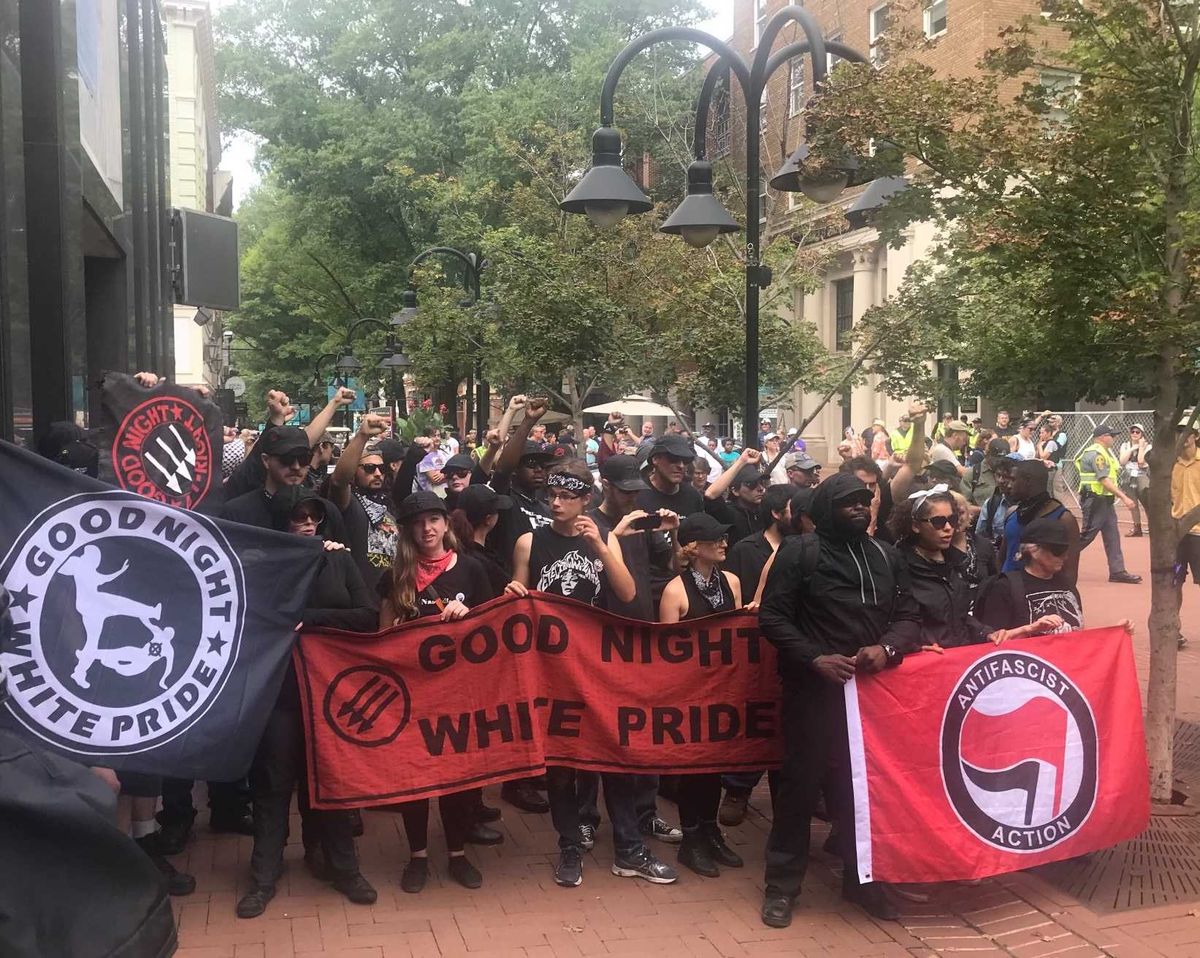
Antifascists march through Charlottesville, Va. in 2018 to honor Heather Heyer, who was murdered by a man who rallied with white supremacists at Unite the Right. 
Picture: Jordan Green


President Donald Trump’s interest in designating “antifa” as a foreign terrorist organization could provide the government with new tools to prosecute the amorphous left-wing movement and, one former counterterrorism official argues, potential justification for using lethal force.

The president has already rhetorically targeted “antifa” as a terrorist entity through a largely symbolic executive order that holds no statutory teeth.

But on Wednesday a cohort of right-wing influencers and Trump-friendly journalists invited to the White House asked the administration to go further, and designate “antifa” as a foreign terrorist organization (FTO).

ALSO READ: Trump's very own Wormtongue is goading him to declare martial law

An FTO designation effectively functions as a ban by making it unlawful for any person in the United States to knowingly provide “material support or resources” to the entity concerned.

“I’d be glad to do it,” Trump said. “I think it’s the kind of thing I’d like to do, if you’d like. Does everybody agree? If you agree, I agree. Let’s get it done.”

Trump turned to Secretary of State Marco Rubio, who is officially responsible for FTO designations.


“Marco, we’ll take care of it,” Trump said.

“Steve, are you okay with it?” Trump added, turning to Senior Advisor Stephen Miller.

“Yes, it’s true,” Miller replied. “There are extensive foreign ties, and I think that would be a very valid step to take.”


“Antifa” is short for antifascism, a global movement that dates back to Weimar Republic in Germany, and typically describes a decentralized movement that sometimes uses militant tactics to oppose white supremacy and other forms of authoritarianism.

Regardless, Trump cabinet members have made it clear that they consider “antifa” to be no different to drug cartels such as Tren de Aragua, the Venezuelan group which was added to the State Department’s terror list in February, or groups such as ISIS that are more typical of groups traditionally targeted by U.S. counterterrorism efforts.

“This network of antifa is just as sophisticated as MS-13, as TDA, as ISIS, as Hezbollah, as Hamas, as all of ’em,” Homeland Security Secretary Kristi Noem said on Wednesday.


“They are just as dangerous. They have an agenda to destroy us, just like the other terrorists we’ve dealt with for many, many years.”

Attorney General Pam Bondi added: “Just like we did with cartels, we’re going to take this same approach, President Trump, with antifa. Destroy the entire organization, from top to bottom.”

Olivia Troye, who was counterterrorism advisor to Vice President Mike Pence in the first Trump administration, raised the question of whether the administration is signaling a willingness to use lethal force against individuals deemed to be “antifa.”

“I guess the question is, are we just going to start bombing random buildings where they think antifa is residing?” Troye said on Thursday, on the podcast The Left Hook with Wajahat Ali, after the host observed that the U.S. military has recently carried out strikes against alleged drug boats in the Caribbean.

“I know that sounds hyperbolic,” Troye said, “but what does that mean when Pam Bondi says that?”

The Department of Justice did not respond to a request from Raw Story to clarify Bondi’s remarks.


Miles Taylor, who was chief of staff for the Department of Homeland Security in the first Trump administration, said on the same podcast that Bondi’s remarks have to be considered in context with Defense Secretary Pete Hegseth’s call, in a speech to generals in Virginia last week, to loosen rules of engagement.

Taylor also flagged Trump’s recommendation at the same meeting to “use some of these dangerous cities as training grounds for our military” against an “enemy within.”

“We’re not talking about loosening the rules of engagement to go after Taliban fighters,” Taylor said. “We’re talking about loosening the rules of engagement to go after the domestic opposition. This is not hyperbole.”

The White House has claimed military strikes against alleged drug boats are in line with the law of armed conflict. Legal experts disagree.

Trump and members of his cabinet describe “antifa” as a single group, but have presented no evidence of any network responsible for coordinating left-wing violence exists.

Rather, the president’s recent counterterrorism memorandum, known as NSPM-7, blames an array of incidents of left-wing violence on an “umbrella of self-described ‘anti-fascism.’”

The memorandum names the core tenets of antifascism as “anti-Americanism, anti-capitalism, and anti-Christianity; support for the overthrow of the United States government; extremism on migration, race, and gender; and hostility towards those who hold traditional American views on family, religion, and
 morality.”


ISIS precedent

Beyond the specter of an extrajudicial offensive against “antifa,” an FTO designation would open perceived opponents of the Trump administration to prosecution for a broad array of activities that could be construed as “material support.”

The federal statute defines “material support and resources” to include “any property, tangible or intangible, or service, including currency or monetary instruments or financial securities, financial services, lodging, training, expert advice or assistance, safehouses, false documentation or identification, communications equipment, facilities, weapons, lethal substances, explosives, personnel… and transportation.”

The U.S. government’s recent prosecution of Ashraf Al Safoo, an ISIS propagandist who operated in Chicago, illustrates how the material support provision could be used against “antifa” targets.

Al Safoo led the Khattab Media Foundation, described by one witness as “an unofficial ISIS media organization.” Following his bench trial in May, Al Safoo was convicted of conspiracy to provide material support to a foreign terrorist organization and other offenses. He faces up to 130 years in prison.

The case against Al Safoo focused on his use of social media to encourage violence against ISIS’ perceived enemies and recruit for the organization. Federal prosecutors also proved Al Safoo made wire transfers of up to $400 to an ISIS leader in Syria, who testified that the money was spent to buy food and medicine for families in ISIS-controlled territory.

The government witness, a former “emir” for media operations for ISIS in Al-Anbar, in Iraq, testified that organizations such as Khattab Media Foundation “provided support to ISIS because they increased the amount of content ISIS could release and amplify,” according to a ruling issued by U.S. District Court Judge John Robert Blakey in August.

Blakey ruled that Al Safoo’s “activities were not independent advocacy or otherwise protected speech.” The judge found that Al Safoo’s media work on ISIS’ behalf constituted “intangible services.”

Citing the U.S. Supreme Court 2010 ruling in Holder v. Humanitarian Law Project, Blakey wrote that “expressive activity may be constitutionally limited when the support is addressed to, directed by, or coordinated with a foreign terrorist organization.

“Khattab Media Foundation existed, by its members’ own words (including defendant’s own admissions), to do just that: provide critical media services to ISIS at ISIS’s approval and direction, strictly adhering and complying with ISIS’s messaging and directives,” Blakey continued.

“This is exactly the type of material support through intangible services” the law “prohibits.”

Jordan Green is a North Carolina-based investigative reporter at Raw Story, covering domestic extremism, efforts to undermine U.S. elections and democracy, hate crimes and terrorism. Prior to joining the staff of Raw Story in March 2021, Green spent 16 years covering housing, policing, nonprofits and music as a reporter and editor at Triad City Beat in North Carolina and Yes Weekly. He can be reached at jordan@rawstory.com. More about Jordan Green.


Op-Ed: Insurrection Act? Maladministration of the stupid kind

By Paul Wallis
EDITOR AT LARGE
DIGITAL JOURNAL
October 8, 2025


The US Capitol building is visible as armed members of the National Guard stand outside Union Station on August 27, 2025 in Washington, DC - Copyright POOL/AFP Nathan Howard

The startling news that the Trump administration is looking at the Insurrection Act of 1807 to permit deployment of US troops on US soil hasn’t gone down well. The possible use of this law is seen as a means to circumvent courts and state governors protesting the presence of National Guard troops in their cities.

The previous deployments of troops to Washington, LA and other cities have been largely cosmetic. There was and still is no need for troops in any of these cases. Sending 800 troops to Portland, for example, borders on farcical. Portland is a city of over 600,000 people. How are 800 troops going to control a city of this size? As usual, there is no sign of any level of violence that couldn’t be controlled by local authorities.

The Insurrection Act was previously used by President Eisenhower to protect black students during integration. The troops deployed were the 101st Airborne, a famous US Army combat unit, in the face of very real and serious violence. 101st Airborne aren’t famous for their ambiguity. The violence stopped pretty much instantly.

That’s definitely not the case now. There are no indications of any such levels of violence in US cities. The deployment of troops to Portland remains blocked. Hence, presumably, a need for the invocation of the Insurrection Act. No kidding, Goofy?

Critics say this is an excuse to “militarize” US cities. If so, the means used are also beyond ridiculous. You can’t possibly control these gigantic cities with virtual tourist groups of troops. Maybe they’ll buy souvenirs, but that’s about as much impact as they can have.

Trump has been talking about “the enemy within” in speeches to the US military command. Trump’s long lineage of lack of military experience is showing.

Meanwhile, these troops aren’t fighting dangerous gangs or serious threats to the public. MS 13 and the other fun lovers are doing fine, thanks for asking. they’re intruding on Joe Renter and everyday people for no reason at all.

A few military points:

There is no physical event justifying the use of troops. Absolutely none.

Current deployments have achieved precisely nothing. Even the White House isn’t claiming any significant achievements. Bit late now, if it does.

This is a colossal waste of military resources and emergency resources which could be better used elsewhere. When Kentucky got blown down this year, what was done?

It’s extremely expensive, costing millions per day for no benefit whatsoever to the cities, the US taxpayer, and definitely not the US military. The cost factor isn’t getting much attention from the administration.

It adds to the burden of US military commitments. What if you sprinkled the National Guard all over the US? What would be the effect on logistics alone? What level of operational coherence would you expect? “We have guys in a park somewhere in the continental United States” isn’t exactly top-of-the-line deployment practice. On the other hand, if the squirrels stage a revolution, they’ll be ready, right?

The US military has much better things to do with its time than put down non-existent threats. US states and governors aren’t at all happy. The courts are getting choked with lawsuits against these deployments.

It’s looking more like a game show than policy. If you’ve ever seen someone who doesn’t know how to play chess playing chess, you’ll see the similarities. They’ll move anything anywhere, always to the wrong places. In this case, there is no game and no other side.

The Insurrection Act won’t change any of that. It appeals to the authoritarianism addicts, but nobody else. It makes America look utterly ridiculous.

__________________________________________________________________

Disclaimer
The opinions expressed in this Op-Ed are those of the author. They do not purport to reflect the opinions or views of the Digital Journal or its members.
Toxic white men are taking over but I found a simple way to fight back

D. Earl Stephens
October 9, 2025 
RAW STORY


People react as Donald Trump speaks in Maryland in February. REUTERS/Nathan Howard

White, toxic masculinity has become a plague on America, and it’s about time white guys started speaking out about it, and putting it down.

The time to look away and ignore it as if it isn’t plainly in sight is long past, because it is quickly wrecking this country — again.

Too many of our noxious, white brothers are vile, rude, loud, and even very dangerous in today’s unsteady America. Worse yet, these guys somehow think they have a free pass to be just as gross as they want to be, because one of our very worst ascended to America’s most powerful office — twice.

Graciousness in defeat has been replaced by sore losers.
Good manners have been shoved to the floor to seat rudeness at the table.
Truth has been replaced with lies, lies, and more lies.
Thoughtfulness has gone the way of bombast.
Right has been replaced with might.

Nothing is their fault.


We are in a terrible place thanks to these men, and they must be called out by the men who know better.


I’m dead serious about this, guys.

Somehow these grown boys who were born with a leg up solely because of their race and gender, believe everybody is against them, and mostly these uppity, educated women and people of color. They’ve ended up in the slow lane, while everybody else has passed them by, and now that needs to be everybody else’s fault except theirs.

Instead of taking accountability, they play the victim, and that’s just pathetic.


We saw them in Charlottesville, when they marched on that Virginia city in 2017 with their tiki torches at a “Unite the Right” rally, where that vile president they worship called them “very fine people.”

We saw them again at our nation’s capitol January 6th, 2021, when they violently attacked our country at behest of that outgoing white supremacist president, who spent the better part of three hours doing nothing except hoping they would succeed in destroying the results of an election he lost.

They gather at his ugly rallies, so they can be just as gross as they want to be while setting one helluva terrible example for our children.


Man, I am sick and tired of these guys.

This is a piece that has needed writing for years now, but I was finally spurred to action by a run-in with one of these dudes very early one morning this week.

We have a condo we frequent in North Carolina. That makes me luckier than hell, and there isn’t an hour of the day, I don’t know it. It’s on the beach, and every time I get here, I am reminded that things worked out better for me than they had a right to.


I have no trouble admitting that the color of my skin and gender, gave me a hand up. I never had to look over my shoulder, only straight ahead to the good that was coming if I worked hard enough.

We’re on the top floor of the building, which affords a nice view, but also means negotiating several flights of stairs. The place is pretty basic, because all you really need is the beach. There is no elevator, but there is a creaky lift for things like boxes, bags and groceries.

When the lift is on the fritz, as it has been since yesterday, the small things in life can be a little inconvenient.


As the sun was rising this morning, and I was rolling around in bed, I could hear the lift starting and stopping. Apparently, somebody had rolled in early with their boxes and bags, and got a rude welcoming from the grouchy lift.

After about 10 minutes of listening to the thing start and stop, I grumbled, rolled out of the rack, slapped on some shorts and a T-shirt and wandered out onto the corridor to break the news that didn't need breaking: “The lift isn’t working,” I said to a blonde woman about my age.

That’s when she turned around, and said “I know, but he said he is going to fix it.”


I looked down and saw “he.”

Gray, flabby Hercules was three flights down, shaking the lift, and moaning like a bear who got the bees, but not the honey.

You’ve seen the type, crewcut, stocky build, walrus goatee, red ball cap, muscular and fat at the same time, boots suffocating dirty white socks, shorts that go down to the shins, tattoos everywhere …

Look, I am not stereotyping here, because this is a genuine type, and you know it.


We’ve become overrun with ‘em in America. When they are not attacking this country, they’re likely the guys working for ICE, zip-tying kids, while wearing those masks they hated during a killer pandemic, but now cover their chicken-shit faces, because thankfully most Americans still don’t like women- and children-abusing bullies.

Did I mention that Hercules was driving a loud, black pickup truck? Again, not stereotyping here, just reporting a disturbing pattern …

And for all of Hercules’ unattractive features, it was his quiet wife I became concerned about. Because when she turned around and told me her husband was “Going to fix it,” I saw pretty clearly the fixer had already broken his wife — or “Baby” as he called her while he was screaming and bossing her around the joint.


“Baby” was to stand on the third floor and keep quiet while Hercules shook the lift and sweated buckets.

I shot her a knowing glance, turned around, and headed back to my place. But the nagging wasn’t going to let me get back to sleep.

I’ve seen women like this, and the trouble they live with.

My mother was one of those women, until she escaped my rotten dad when I was young. You never forget the look in their eyes, when they around the monsters …

That was many decades ago, but it seems like these men are being celebrated now, instead of condemned.

So I rolled out of bed, and returned to the scene of the crime, went down the stairs and starting carrying their crap up to their condo. Hercules told me it wasn’t necessary, even if it was. Then he said he couldn’t help because, “his knees hurt.”

I let that one go, because guys like Hercules generally carry guns to overcompensate for what little they were given underneath those baggy drawers.

When I finished, Hercules thanked me for the help, apologized for waking me up, and got back to pushing Baby and their life around.

Baby never said another thing. Her sad eyes were doing all the talking …(D. Earl Stephens is the author of “Toxic Tales: A Caustic Collection of Donald J. Trump’s Very Important Letters” and finished up a 30-year career in journalism as the Managing Editor of Stars and Stripes. You can find all his work here.)
Body Language Experts Say Stephen Miller's CNN 'Glitch' Might Just Be The 'Reptilian' Brain In Action


Katherine Speller
Fri, October 10, 2025 
HUFFPOST

Earlier this week, President Donald Trump’s deputy chief of staff Stephen Miller had a “glitch” on CNN that had legal experts and other viewers raising their brows.

Miller was discussing whether Trump has the legal ability to send National Guard troops into Portland, Oregon, and briefly (and incorrectly) asserted that “under Title 10 of the U.S. Code, the president has plenary authority.” He began another thought before abruptly stopping.

What followed was a long pause with nearly 10 seconds of dead air. Host Boris Sanchez tried to confirm the connection was still working and then cut to a commercial break.

CNN later confirmed, as HuffPost reported, that there was a technical issue at play.


White House deputy chief of staff Stephen Miller caught flak after his CNN interview featured a discomfiting glitch. via Associated Press

However, the moment — and the choice of words on Miller’s part, referring to “plenary authority” specifically— caught quite a few viewers by surprise. For one, it incorrectly claimed the president has nearly unlimited or absolute power. Which is alarming. And in that glitch moment, it seemed, however briefly, like Miller might have even second-guessed using the term.

To better understand what about the exchange held people’s attention, we asked some body language experts to unpack what was going on in the segment and that silent moment — and what the nonverbal communication on display could tell us.

Understanding Standard Stephen Miller Comms

“Stephen Miller’s baseline communication style is generally quite restrained. He typically shows low physical movement, limited facial animation, and few visible micro-expressions, which gives him a composed and controlled appearance,” Beth Dawson, a communication, body language and behavior analyst, told HuffPost. “At the start of the interview, Miller sits upright with a polite smile. However, this smile does not fully reach his eyes, as the muscles around the eyes remain inactive. This suggests it is more of a professional or performative smile, appropriate for a political interview setting.”

Dawson notes that, earlier in the interview, there were behaviors associated with a situation where you are trying to retrieve information and formulate the right words for a situation — pretty on par with an interview.

“When the journalist thanks him for joining, Miller immediately overlaps with ‘My pleasure,’ indicating no time lag or audio issue at that point. His quick response shows attentiveness and a readiness to engage,” Dawson said. “As the first question begins, there is an increase in blinking rate and the disappearance of the smile, replaced by a more closed facial expression. An increase in blink frequency can correspond to heightened cognitive processing, as the brain works harder to retrieve information or manage pressure. There is also a subtle forward and backward rocking motion, which can be a way of maintaining focus while formulating an answer.”

Likewise, there were a few moments that, to Dawson, seemed to hint at navigating memorized responses (which, again, isn’t uncommon for a political interview): “In this clip his delivery sounds prepared, especially when he says, ‘the administration files an appeal,’ where his pitch varies in a way that sounds memorized. When referencing ‘under Title 10 of the U.S. Code,’ the rise in pitch on the word ‘code’ reinforces the sense of rehearsed emphasis.”

Thinking (And Speaking) On Your Feet

But when we get to the part where he uses the phrase “plenary authority,” Dawson said the moment suggested “internal processing, as if he is reevaluating what to say next.”


“At the key phrase ‘plenary authority,’ Miller says ‘has’ and then stops suddenly, with several brief eye movements to his left while keeping his head and body facing forward,” Dawson said, noting that, at least from a body language perspective, the behavior might suggest a cognitive pause or perhaps an auditory-only issue. (CNN later confirmed to Newsweek that there was a different, incorrect audio feed playing in Miller’s inner ear monitor at the time of the “glitch.”)

Traci Brown, a body language expert and behavior analyst also adds that Miller’s behaviors and body language in the clip could be consistent with “cognitive overload,” particularly common when people say less-than-true things and are aware of the fact.

“Every body language tell of deception and stress is due to cognitive overload,” Brown said. “During deception the neocortex takes over to construct info. That’s our adult thinking and logic part of the brain. Memory is in the reptilian and mammalian parts of the brain. This is how overload happens.”

Dawson also notes that we could be viewing “a brief moment of cognitive load” in this clip, which she adds can occur when the brains are “managing several demands at once.”

“We can see subtle signs of cognitive load, such as increased blinking and a small shoulder movement, which suggest he was mentally editing his words,” Dawson said. “In Stephen Miller’s case, the mid-sentence pause does appear awkward, but that doesn’t necessarily indicate confusion. It’s entirely possible that he realized he was veering slightly away from his prepared line of thought and was unsure, in that instant, how best to bring his response back on track. In that context, the sudden stop reads less as a technical problem and more as a moment of self-restraint, a controlled decision to stop rather than risk saying something he doesn’t want to.”

“Retrieving information, monitoring language, regulating emotion, and staying aware of how we’re coming across” are all things the brain is keeping track of in that moment, Dawson added. “In live interviews, particularly political ones, that kind of mental juggling is completely normal.”

“When someone is experiencing cognitive load, we may notice subtle behavioral changes such as an increase in blinking, a pause mid-sentence, or a temporary reduction in facial expression while the person recalibrates,” Dawson said. “There can also be a slight rise in physical movement or even some verbal ‘leakage,’ what we sometimes refer to as a Freudian slip in everyday language.”


Opinion

Stephen Miller Accidentally Says “I” When Discussing Trump’s Powers

Malcolm Ferguson
Fri, October 10, 2025
THE NEW REPUBLIC


Stephen Miller may have just accidentally confirmed that he, not President Donald Trump, is the one calling the shots in regard to deportation raids and National Guard deployments.

“Illinois governor says we’re provoking actions that are unlawful,” Miller said on CNN on Monday. “Why would the mere presence—just think about this for a second. If I put federal law enforcement and National Guard into a nice sleepy Southern town, is anyone gonna riot?”

Miller’s use of the first person is alarming here, suggesting that he—an unelected deputy chief of staff—has either the complete authority or an outsize influence on the administration’s most authoritarian decisions.

“Miller says quiet part out loud,” one user wrote on X. “He determines where to put ICE, CBP & other federal agencies, but he is also doing the same for various National Guards. An unelected staffer making these decisions, where is the president? Both Miller and Vought are running this admin.”

Additionally, Miller misrepresents small Southern towns and the actions of the National Guard. If hundreds of armed military members descended on some remote Southern locale and started violently rounding up neighbors, employees, and friends, I’d be willing to bet that it wouldn’t go so peacefully.

Miller made the remarks in the same interview where he claimed Trump has “plenary authority,” after being asked whether the administration would abide by court rulings blocking his deployment of troops to American cities.


 Opinion

How far will Donald Trump go to sell a lie?

Brian Karem
Fri, October 10, 2025
SALON


President Donald Trump speaks during a Cabinet meeting at the White House on Oct. 9, 2025. Anna Moneymaker/Getty Images

After a week of government shutdown, it is obvious the United States is irreparably broken.

You don’t have to believe me. Just listen to White House deputy chief of staff Stephen Miller. In a recent CNN appearance, he claimed President Donald Trump “has plenary authority” — absolute power — to ignore court rulings. Oops. In other words, Trump is God.

No one is happier about that than the president, who said on Tuesday that some vital workers still on the clock won’t get back pay after the shutdown ends. “There are some people that don’t deserve to be taken care of, and we’ll take care of them in a different way,” Trump said.

How, pray tell, will that be, Donny? Putting that aside, consider a country where masked men without identification are dragging citizens out of their homes. No charges are filed. Due process is ignored and people are held against their will. Members of the clergy are physically attacked. Only one faith is accepted. The legislature is so broken it cannot operate. The criminal justice system is compromised by corruption and sloth.

Consider a country where the press is filled with sycophants who do the bidding of the country’s leader. Anyone presenting information not approved by the ruler is denounced and belittled, ostracized and denied access. Media companies are controlled by those loyal to the leader. Academia is attacked for not teaching what the government decrees to be true. Political opponents are labeled as criminals and enemies. The leader decrees what is acceptable entertainment.

Though these may seem like they are representative of our current government, they are actually themes explored by director Raoul Peck in “Orwell: 2+2=5”, the newly theatrically-released documentary about George Orwell’s life as he wrote the dystopian novel “1984.”

“A totalitarian state is in effect a theocracy,” Orwell wrote in his diary while he was working on the book. “It has to be thought of as infallible.” Therefore, “only one opinion is permissible at any given moment.”

While today those who lovingly swoon at the thought of working in GOP Rep. Marjorie Taylor Greene’s congressional office may dismiss Orwell’s novel as mere fiction, he was merely doing what every good writer does — he wrote about what he knew. As a former police officer and a journalist in the British Empire, Orwell grew up in a reality he used to create his fiction.

Today, facts told as fiction are not nearly as popular as fictions presented as facts. That is the Donald Trump twist on reality. And as much as some would dismiss the obvious parallels between the book “1984” and current reality, the fact is that two plus two does not equal five and never will.

Trump, for example, claims Portland is war ravaged. So Secretary of Homeland Security Kristi Noem showed up in the city on Tuesday, and right-wing influencers depicted her staring down the “army of antifa.” In reality, Noem was on a rooftop staring at photojournalists, fewer than a dozen protesters — and one guy in a chicken suit.

That brings us to Jeff Tischauser, an adjunct professor and a frequent protester at the Immigration and Customs Enforcement facility in Broadview, a suburb of Chicago. Hewas struck by a rubber bullet and hit with tear gas last week in an apparently unprovoked attack by DHS agents. “I had a hard time seeing. My eyes stung and I was out of breath. A young Latino man grabbed me and pulled me out of there. I don’t know what would have happened if he hadn’t helped,” he told me

In a series of press releases, DHS told a different story and justified firing “non-lethal” weapons on crowds by calling them rioters, looters, gypsies, tramps and thieves.

“Political language makes lies sound truthful and murder acceptable,” Orwell warned. “Totalitarianism demands the continuous alteration of the past and in the long run probably demands a disbelief in the very existence of objective truth.”

This observation explains Trump’s recent moves. A day after Texas National Guard troops arrived in Chicago, Trump threatened the city’s mayor, Brandon Johnson, and Illinois Gov. JB Pritzker, both Democrats. “Chicago Mayor should be in jail for failing to protect Ice Officers!” he said in a Truth Social post. “Governor Pritzker also!”

The president didn’t say what federal law the men broke, or if he had asked the National Guard to take them into custody. Questions about that remained unanswered by the White House press office. Pritzker dared Trump to come after him, and he laughed at the idea of a convicted felon claiming he should be jailed.

But in Trump’s dangerous, delusional state, which is dominated by the fear of anyone saying the name “Epstein,” he is telling us exactly how far he’ll go to sell a lie. To Trump, the nation is on fire. He should know. He supplied the gas and the match.

“We have no choice but to do this,” he said in an Oval Office event Monday, referring to blue cities he has targeted. “Portland is on fire. Portland has been on fire for years…These are unsafe spaces. We’re going to make them safe.”

Want more sharp takes on politics? Sign up for our free newsletter, Standing Room Only, written by Amanda Marcotte, now also a weekly show on YouTube or wherever you get your podcasts.

Trump went on to claim that the people of Memphis “are so happy.” Black women in Chicago, he said, are wearing MAGA hats “all over the place.” Everyone is welcoming National Guard troops. “They want the Guard to come in, or they don’t care who comes in. They just want to be safe and they really don’t care…We’re going to go city by city. We’re going to have safe cities.”

The president added a dark warning: “So far, it hasn’t been necessary. But we have an Insurrection Act for a reason.” He suggested the law could be invoked “if people were being killed and courts were holding us up or governors or mayors were holding us up.” He said, “I want to make sure that people aren’t killed. We have to make sure that our cities are safe.”

Desperation and fear bleed through everything he dispenses. But there is still a method to the madness. Miles Taylor, who worked in the first Trump administration, posted on Substack: “I co-wrote Trump’s first anti-terrorism plan in 2017-18. He’s not trying to stop ‘left-wing’ terrorism. He is staging it. His troop deployments are a false flag — meant to provoke a response in order to justify harsh crackdowns. This is now very obvious.”

And Trump is not above pitting Southern red states against Northern blue states. Sounds familiar, doesn’t it? He said that Texas Gov. Abbott is not the only red state governor to offer troops: “Every one of them is willing to offer whatever we need.” To hear him tell it, that’s because “they want our agents protected.”

Trump will never serve a day in prison for his corruption or crimes. But the more people scream about Jeffrey Epstein, the more seriously Trump will consider invoking the Insurrection Act.


Meanwhile, he’s got House Speaker Mike Johnson, R-La., running interference for him by keeping the House in recess. “Why are we in recess?” GOP Rep. Thomas Massie of Kentucky, who is leading the effort to release law enforcement files about the deceased sex offender, posted on X. “Because the day we go back into session, I have 218 votes for the discharge petition to force a vote on releasing the Epstein files.”

Johnson is also holding the House’s newest member, Rep.-Elect Adelita Grijalva, D-Ariz., hostage. Despite telling CNN on Tuesday that he would swear her in “as soon as she wants,” the speaker has made no move to do so. He certainly hasn’t had any problem swearing in Republicans whenever he wants. On Tuesday, a House leadership aide made Johnson’s position clear: “We will swear [her] in…as soon as the House returns to session when Chuck Schumer, Mark Kelly and Ruben Gallego decide to open up the government.”

There’s a reason for the delay: Grijalva is expected to provide the final signature needed on a petition to force a full House vote on releasing further materials in the Epstein case. The delay in swearing her in, Johnson has said, has anything to do with Epstein. Sure, and Richard Nixon had nothing to do with Watergate. Ronald Reagan had nothing to do with the Contras. And George W. Bush had nothing to do with Iraq.

Johnson is willing to further Trump’s narratives because he faces losing control of the House if the president fails. Trump needs total control to avoid accountability. And Attorney General Pam Bondi, Defense Secretary Pete Hegseth, White House border czar Tom Homan and especially Stephen Miller need control to prevent the long arm of justice from ever reaching them. While Trump may never serve a day in prison, that can’t be said of some of the most corrupt power-brokers in his regime.

MAGA diehards will call whatever ends up befalling these shady, side-show sycophants a “weaponizing of the Justice Department.” Democrats will simply call it justice. I guess both statements can be true, but the motive matters little. The endgame will not be pretty.

Last week I said I’ve never seen Trump so scared. This week, as he struggles vainly against the rising tide of accountability, we’ve seen writ large across the national stage to what lengths his fear will lead him. Trump’s health appears to be failing him. His charm is failing him. Soon he’ll be reduced to the same level as William Jennings Bryan in his last days — an itinerant flycatcher, sitting in the courtyard of Mar-a-Lago, making sounds like a bullfrog and babbling like a cicada on meth.

On Friday, for the second time in a year, Trump will “stop by” Walter Reed Medical Center for an annual physical. On deep background Thursday night, a source close to Trump wouldn’t say specifically why he was going to the hospital, “but no one has an annual physical twice in the same year — unless there’s something going on with their health.”

Should Trump’s health fail completely before he is held accountable, it would be in the best interest of the country for his wealth to be stripped from his heirs and his vast property holdings turned into low-cost housing for the underprivileged and the homeless. Then Trump should be relegated to the same dustbin of history as Epstein.

In “1984,” the state controlled everything; that’s Trump’s goal. He continues to pressure his Department of Justice to arrest and prosecute his political opponents to achieve that aim. New York Attorney General Letitia James, who defeated Trump in court, is the latest victim of his fear and anger. She was indicted Thursday in Virginia on two felony charges — bank fraud and making false statements to a financial institution — after pressure from Trump.

James’ answer to the indictment should be the response of everyone who is persecuted by Trump’s regime, from the poorest immigrants to the former government officials he despises: “I am not fearful, I am fearless.”

The only way to beat a bully is to stand up to a bully.

How Trump secured a Gaza breakthrough which eluded Biden

Anthony Zurcher - North America correspondent
 Tom Bateman - State Department correspondent
BBC
Fri, October 10, 2025 

At the time, Israel's air strike against the Hamas negotiating team in Qatar seemed like yet another escalation that pushed the prospect of peace further away.

The attack on 9 September violated the sovereignty of an American ally and risked expanding the conflict into a region-wide war.

Diplomacy appeared to be in ruins.

Instead it turned out to be a key moment that has led to a deal, announced by President Donald Trump, to release all remaining hostages.

This is a goal that he, and President Joe Biden before him, had sought for nearly two years.

It is just the first step towards a more durable peace, and the details of Hamas disarmament, Gaza governance and full Israeli withdrawal remain to be negotiated.

But if this agreement holds, it could be Trump's signature achievement of his second term - one that eluded Biden and his diplomatic team.

Trump's unique style and crucial relationships with Israel and the Arab world appear to have contributed to this breakthrough.

But, as with most diplomatic achievements, there were also factors at play beyond control of either man.


Shoulder to shoulder - Trump and Netanyahu [Getty Images]


A close relationship that Biden never had

In public, Trump and Israeli Prime Minister Benjamin Netanyahu are all smiles.

Trump likes to say that Israel has no better friend, and Netanyahu has described Trump as Israel's "greatest ever ally in the White House". And these warm words have been matched by actions.

During his first presidential term, Trump moved the US embassy in Israel from Tel Aviv to Jerusalem and abandoned a long-held US position that Israeli settlements in the Palestinian West Bank are illegal, the position under international law.

When Israel began its air strikes against Iran in June, Trump ordered US bombers to target the nation's nuclear enrichment facilities with its most powerful conventional bombs.

Those public demonstrations of support may have given Trump the room to exert more pressure on Israel behind the scenes. According to reports, Trump's negotiator, Steve Witkoff, browbeat Netanyahu in late 2024 into accepting a temporary ceasefire in exchange for the release of some hostages.

When Israel launched strikes against Syrian forces in July, including bombing a Christian church, Trump pressured Netanyahu to change course.

Trump exhibited a degree of will and pressure on an Israeli prime minister that is virtually unprecedented, says Aaron David Miller of the Carnegie Endowment for International Peace. "There is no example of an American president literally telling an Israeli prime minister that you're going to have to comply or else."


Israelis wave national and US flags after news of the agreement [Reuters]

ANALYSIS: Gaza deal is huge moment but just the start

Biden's relationship with Netanyahu's government was always more tenuous.

His administration's "bear hug" strategy held that the US had to embrace Israel publicly in order to allow it to moderate the nation's war conduct in private.

Underneath this was Biden's nearly half-century of support for Israel, as well as sharp divisions within his Democratic coalition over the Gaza War. Every step Biden took risked fracturing his own domestic support, whereas Trump's solid Republican base gave him more room to manoeuvre.

In the end, domestic politics or personal relationships may have had less importance than the simple fact that, during Biden's presidency, Israel was not ready to make peace.

Eight months into Trump's second term, with Iran chastened, Hezbollah to its immediate north greatly diminished and Gaza in ruins, all its major strategy objectives had been accomplished.
Business history helped secure Gulf's backing

The Israeli missile attack in Doha, which killed a Qatari citizen but no Hamas officials, prompted Trump to issue an ultimatum to Netanyahu. The war had to stop.

Trump had given Israel a relatively free hand in Gaza. He lent American military might to Israel's campaign in Iran. But an attack on Qatar soil was a different matter entirely, moving him towards the Arab position on how best to end the war.

Several Trump officials have told the BBC's US partner CBS this was a turning point which galvanised the president to exert maximum pressure to get a peace deal done.


An emergency Arab summit was held in Doha after the attack [Reuters]

This US president's close ties with the Gulf states are well documented. He has business dealings with Qatar and the UAE. He began both his presidential terms with state visits to Saudi Arabia. This year, he also stopped in Doha and Abu Dhabi.

His Abraham Accords, which normalised relations between Israel and several Muslim states, including the UAE, was the biggest diplomatic achievement of his first term.

The time he spent in the capitals of the Arabian Peninsula earlier this year helped change his thinking, says Ed Husain of the Council on Foreign Relations. The US president did not visit Israel on this Middle East trip but visited the UAE, Saudi Arabia and Qatar where he heard repeated calls to bring an end to the war.

World reacts to first stage of Gaza peace deal

'Joy and pain': Palestinians celebrate ceasefire deal

What we know about the 'first phase' of the Gaza peace deal

Less than a month after that Israeli strike on Doha, Trump sat nearby as Netanyahu personally phoned Qatar to apologise. And later that day, the Israeli leader signed off on Trump's 20-point peace plan for Gaza - one that also had the backing of key Muslim nations in the region.

If Trump's relationship with Netanyahu gave him the room to pressure Israel to strike a deal, his history with Muslim leaders may have secured their support, and helped them convince Hamas to commit to the deal.

"One of the things that clearly happened was that President Trump developed leverage with the Israelis, and indirectly with Hamas," says Jon Alterman of the Center for Strategic and International Studies (CSIS).

"That made a difference. His ability to do this on his timing, and not succumb to the desires of the combatants has been a problem that lot of previous presidents have struggled with, and he seems to do relatively successfully."

The fact that Trump is much more popular in Israel than Netanyahu himself was leverage that he used to his benefit, he adds.

Now Israel has committed to releasing more than 1,000 Palestinians held in Israeli prisons and has agreed to a partial withdrawal from Gaza.


Hamas will release all the remaining hostages, living and dead, taken during the original 7 October Hamas attack, which resulted in the death of more than 1,200 Israelis.

An end to the war, which has resulted in the devastation of Gaza and the deaths of more than 67,000 Palestinians is now imaginable.
Europeans exert their influence

The global condemnation of Israel over its actions in Gaza also weighed on Trump's thinking.

Conditions on the ground are unprecedented in terms of destruction and the humanitarian catastrophe for Palestinians. Over recent months the Netanyahu government became increasingly isolated internationally.

As Israel took military control of the food supply to Palestinians and then announced a planned assault on Gaza City, several major Europeans countries, led by French President Emmanuel Macron, decided they couldn't stay aligned with Washington's position of unequivocal support for Israel.


Palestinians look out from a window in Gaza after the ceasefire announcement [Reuters]

A historic split followed between the Americans and European allies when it came to key elements of diplomacy and the future of the Israeli-Palestinian conflict.

The Trump administration castigated France when it said it would recognise a Palestinian state, a move followed by the UK. They were trying to keep the idea of a two-state solution on life support, but more fundamentally marginalise the extremes on both sides and revive a diplomatic path to a shared Israeli-Palestinian future.

But Macron was astute in getting the Saudis on board for his peace plan.

Ultimately Trump was faced with a European-Arab alliance versus Israeli nationalists and the far right when it came to visions for Gaza's longer term future. He chose his friends in the Gulf.

Under a French-Saudi peace plan, Arab countries also issued an unprecedented condemnation of Hamas' October 7 attacks and called for the group to end its rule on Gaza and hand over its weapons to the Palestinian Authority under independent statehood.

This was a diplomatic win for the Arabs and Europeans. Trump's 20-point plan drew on the France-Saudi plan in key areas, including a reference to eventual Palestinian "statehood" even if this was vague and highly conditional.

Trump, while asking Turkey, Qatar and Egypt to maintain pressure on Hamas, boxed in Netanyahu, putting unprecedented pressure on him to end the war.

No-one could be the side to say no to Trump.
Trump's unique style unlocked stalemate

Trump's unorthodox manner still has the capacity to shock. It starts with bluster or bombast but then develops into something more conventional.

In his first term, his "little rocket man" insults and "fire and fury" warnings appeared to be taking the US to the brink of war with North Korea. Instead he engaged in direct talks.

Trump kicked off his second term with an eye-popping suggestion that Palestinians should be required to relocate from Gaza as it was turned into an international oceanfront resort.

Muslim leaders were incensed. Seasoned Middle East diplomats were aghast.

Trump's 20-point peace plan, however, isn't that different from the kind of deal Biden would have struck and that America's allies had long endorsed. A blueprint for a Gaza Riviera it was not.

Trump has taken a very unconventional path to what is a conventional result. It has been messy. It may not be how they teach diplomacy in Ivy League universities. But, at least in this case and at this moment, it has proven effective.

Tomorrow the Nobel Committee will announce this year's Peace Prize winner. And while it is unlikely that Trump will be the recipient, that prospect doesn't seem nearly as unlikely as it did just a few weeks ago.

Additional reporting by Kayla Epstein
Putin says 'no big deal' for Russia if US declines to extend nuclear warhead limits

Reuters
Fri, October 10, 2025 

Russian President Vladimir Putin takes part in the CIS leaders' summit in Dushanbe, Tajikistan October 10, 2025. Sputnik/Grigory Sysoev/Pool via REUTERS

MOSCOW (Reuters) -President Vladimir Putin said on Friday that Russia was developing new strategic weapons and it would not be critical for Moscow if the United States declined to extend the warhead limits set out in a nuclear arms treaty that expires next year.

He said it would, however, be a shame if nothing remained of the arms control framework between the two countries, which have by far the world's biggest nuclear arsenals.

Speaking to reporters at a summit in Tajikistan, Putin said an arms race was already in progress.

Russia has said it is willing to voluntarily extend the warhead limits defined in the New START treaty, which expires in February, if the United States is willing to do the same. Washington has not yet formally agreed to the proposal.

"Will these few months be enough to make a decision on an extension? I think it will be enough if there is goodwill to extend these agreements. And if the Americans decide they don't need it, that's not a big deal for us," Putin said.

He added that Russia was continuing to develop and test new-generation nuclear weapons.

"We're ready to negotiate if it's acceptable and useful for the Americans. If not, then no, but that would be a shame, because then there would be nothing left in terms of deterrence in the area of ​​strategic offensive weapons."

For the second time in a week, Putin referred to the possibility that other countries, which he did not name, might carry out a nuclear test - something only North Korea has done this century. He has said that Russia would also perform a test if this happens.

Security experts say a test by one country would have a knock-on effect, prompting other nuclear powers to do the same, raiing geopolitical tensions further from their current, already high, levels.

"There's always a temptation to test the effectiveness of the same fuel that's been inmissiles for many, many years. All of this is being simulated on computers, and experts believe that is sufficient, but some of these same experts believe repeat tests are necessary," Putin said.

"So some countries are thinking about it; as far as I know, they're even preparing, and that's why I said that if they do it, we'll do the same."

That would be good from a security perspective, but bad from the point of view of curbing the arms race, he said.

"But in this same context, extending the New START Treaty for at least a year is a good idea."

(Reporting by Darya Korsunskaya, Olesya Astakhova, Maxim Rodionov, Anastasia Teterevleva, Filipp Lebedev and Lucy Papachristou; Writing by Mark TrevelyanEditing by Andrew Osborn)
Melania Has Been Secretly Working With Putin for Months


SHE IS FLUENT IN RUSSIAN, TRUMP'S PEACE ENVOY WITKOFF ISN'T


Sarah Ewall-Wice
Fri, October 10, 2025 at 10:36 AM MDT


First Lady Melania Trump made a rare formal announcement from the White House on Friday where she revealed that she has been engaged in secret talks with Russian President Vladimir Putin.

The first lady said that due to ongoing efforts eight children separated during the war in Ukraine have now been reunited with their families, and she said the work continues.

Trump said that her dialogue with Putin has been ongoing since she sent him a letter in August. The president first revealed the letter she had written to the Russian leader on Truth Social, which was hand-delivered to Putin during his summit with Trump in Alaska.


First lady Melania Trump announced at the White House on October 10, 2025 that she has been engaging in communications with Russian President Vladimir Putin to help reunite Ukrainian children separated from their families by the war in Ukraine. / Kevin Dietsch / Kevin Dietsch/Getty ImagesMore

“Since President Putin received my letter last August, he responded in writing, signaling a willingness to engage with me directly, and outlining details regarding the Ukrainian children residing in Russia,” the first lady said Friday.

“Since then, President Putin and I have had an open channel of communications regarding the welfare of these children,” she continued.

Trump said that for the past three months, both the U.S. and Russia participated in several back-channel meetings and calls.

“We have agreed to cooperate with each other for the benefit of all people involved in this war,” Trump said. “My representative has been working directly with President Putin’s team.”


First Lady Melania Trump, pictured with her husband on October 5, has been quietly advising the president as he pushes for a peace deal in Ukraine and engages with Russian President Vladimir Putin. / Alex Wong / Alex Wong/Getty ImagesMore

The first lady, who spends most of her time in New York, made her roughly five-minute speech from a podium at the White House before turning around and exiting the room without taking any questions.

Melania has been a quiet adviser to her husband on the war in Ukraine since he took office. The president has said on numerous occasions that the first lady has been quick to point out to her husband that Putin had not been negotiating with him in good faith as the war dragged on.

The negotiations between the first lady and Russia to successfully reunite the eight children with their families may be one of the few successful outcomes to emerge from the president’s high-stakes meeting with Putin in Anchorage.

Trump said on Friday that of the eight children, three were separated from their parents and displaced to Russia because of frontline fighting, while the other five were separated from their families across borders because of the conflict. The first lady said that the U.S. verified the identities and circumstances of each of the children.

“This is an important initiative for me,” Trump said.

Ukraine has said it has been able to verify Russia has kidnapped nearly 20,000 children since the start of the war, but estimates the true figure is actually much higher. The Humanitarian Research Lab at Yale estimated the total was closer to 35,000 in March.


First Lady Melania Trump's letter to Russian President Vladimir Putin was delivered during his summit with President Donald Trump in Anchorage, Alaska in August. / Wu Xiaoling/Xinhua via Getty Images

In her first letter in August, the first lady wrote to Putin that protecting children would benefit not only Russia but also “will serve humanity itself.”

During her Friday remarks, the first lady said her ongoing mission would be to optimize the flow of information on all children who have been victims of the war and to facilitate the regular reunification of children with their families.


First lady Melania Trump announced at the White House on October 10, 2025 that eight children have been reunited with their families as she has been engaging in communications with Russian President Vladimir Putin to help reunite Ukrainian children separated by the war. / Kevin Dietsch/Getty ImagesMore

The first lady said that Russia has also agreed to rejoin those who were separated from their families during the three-year war and have since turned 18. She said it remains an ongoing effort and plans are already underway to reunite more children

“I hope peace will come soon. It can begin with our children,” Trump concluded.

It follows the first lady’s attendance at the United Nations General Assembly alongside her husband in New York last month. While there, she met directly with Ukrainian First Lady Olena Zelenska, where they discussed those impacted by Russia’s war in Ukraine.

US awards $4.5 billion in border wall contracts, DHS says

WHEN WILL MEXICO PAY FOR THE WALL?!

Reuters
Fri, October 10, 2025 


FILE PHOTO: A new section of border wall stands in Arizona's San Rafael Valley in Santa Cruz County, Arizona, U.S., September 22, 2025. REUTERS/Cheney Orr/File Photo

FILE PHOTO: A new section of border wall stands in Arizona's San Rafael Valley in Santa Cruz County, Arizona, U.S., September 22, 2025. REUTERS/Cheney Orr/File Photo

FILE PHOTO: A drone view shows a new section of the border wall that stands in Arizona's San Rafael Valley in Santa Cruz County, Arizona, U.S., September 22, 2025. REUTERS/Cheney Orr/File Photo


WASHINGTON (Reuters) -The federal government has awarded 10 construction contracts worth $4.5 billion that will add 230 miles of barrier along the southwest U.S. border, the Department of Homeland Security said on Friday.

The contracts will add hundreds of miles to a so-called Smart Wall border security system that includes steel barriers, waterborne barriers, patrol roads, lights, cameras, and advanced detection technology, according to its statement.

Seven of the 10 contracts, which were awarded in September, went to BCCG Joint Venture, according to the statement from DHS and Customs and Border Protection.

"The Smart Wall means more miles of barriers, more technology, and more capability for our agents on the ground. This is how you take control of the border," CBP Commissioner Rodney Scott said in the statement.

DHS Secretary Kristin Noem issued two waivers for nine miles of Smart Wall in CBP's San Diego Sector and for approximately 30 miles in New Mexico within the El Paso Sector "to cut through bureaucratic red tape and expedite the construction of the Smart Wall," the statement said.

It was not immediately clear why the waivers were necessary. Such waivers are sometimes used to bypass certain environmental or other laws.

(Reporting by Doina Chiacu; Editing by Nick Zieminski)