Madagascar's President Andry Rajoelina said Monday he was in a “safe place” after an assassination attempt, dismissing calls to quit amid worsening unrest that has driven him into hiding. The twice-delayed speech was his first since a mutinous army unit backed anti-government protests and reports he had fled abroad.
Issued on: 14/10/2025 -
By:FRANCE 24
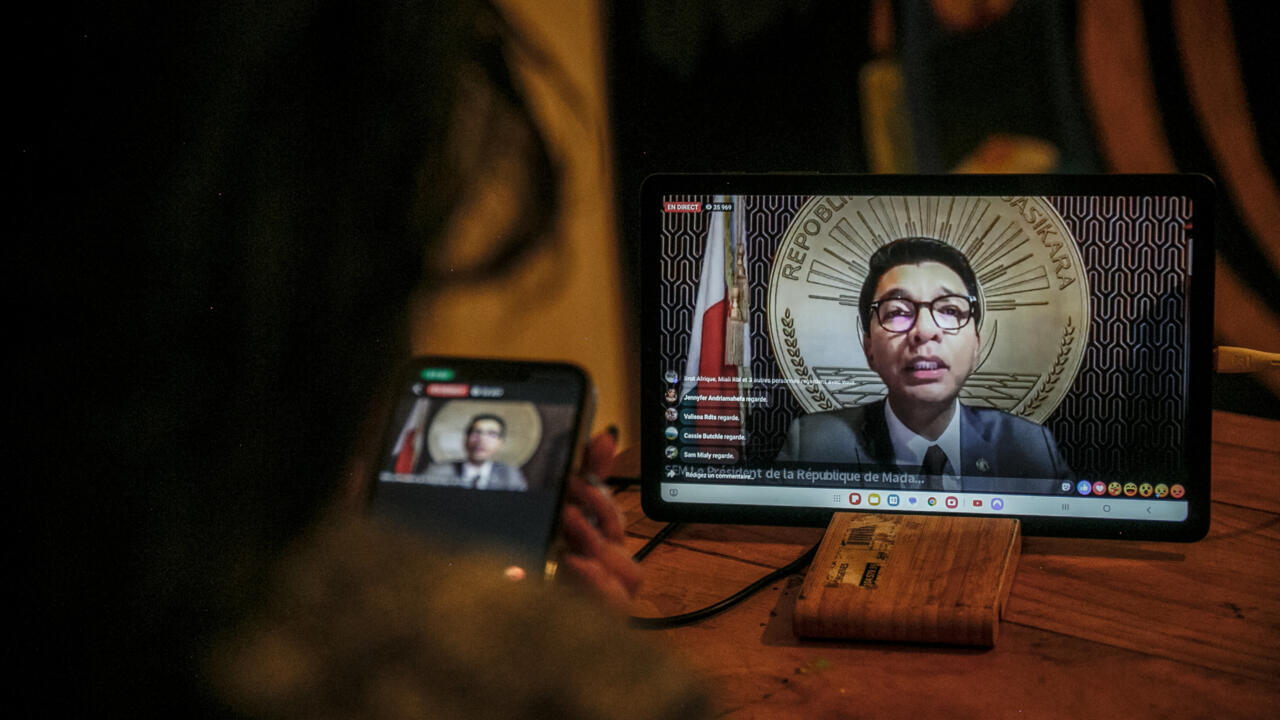
A resident of Antananarivo watches Madagascan President Andry Rajoelina address the nation via the Madagascan Presidency's Facebook page on October 13, 2025. © Rijasolo, AFP
Madagascar's embattled President Andry Rajoelina said Monday he was sheltering in a "safe place" following an attempt on his life, ignoring calls to resign after spiralling unrest that has forced him into hiding.
The twice-delayed speech marked his first public address since a mutinous army unit backed anti-government protests, and followed reports that the 51-year-old leader had fled the country.
"Since September 25, there have been attempts on my life and coup attempts. A group of military personnel and politicians planned to assassinate me," he said in a live address on Facebook.
"I was forced to find a safe place to protect my life," he said, without revealing his location.
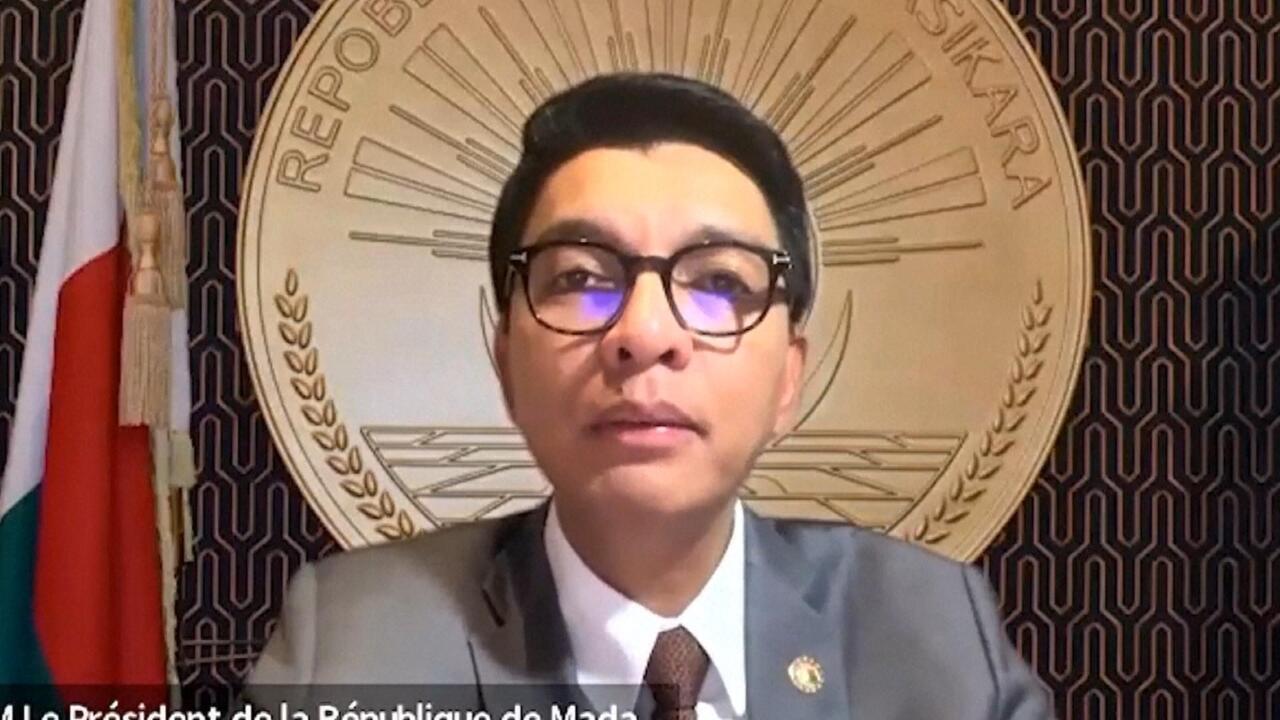
Madagascar's embattled President Andry Rajoelina said Monday he was sheltering in a "safe place" following an attempt on his life, ignoring calls to resign after spiralling unrest that has forced him into hiding.
The twice-delayed speech marked his first public address since a mutinous army unit backed anti-government protests, and followed reports that the 51-year-old leader had fled the country.
"Since September 25, there have been attempts on my life and coup attempts. A group of military personnel and politicians planned to assassinate me," he said in a live address on Facebook.
"I was forced to find a safe place to protect my life," he said, without revealing his location.
Eye on Africa © France 24
11:01
11:01
The protests, led by mostly young demonstrators, erupted over chronic power and water cuts in the impoverished Indian Ocean country, but developed into a broader anti-government movement calling for Rajoelina to resign.
Rajoelina, a former mayor of the capital, Antananarivo, called for the constitution to be respected, ignoring calls to step down.
"I am on a mission to find solutions," he said.
Read moreMalagasy President Rajoelina says he fled to a "secure location" to "protect his life"
Rajoelina first came to power in 2009 following a coup sparked by an uprising that ousted former president Marc Ravalomanana.
Radio France Internationale said Rajoelina left Madagascar on a French military plane at the weekend, but French officials did not immediately respond to AFP's request for confirmation.
French President Emmanuel Macron, who expressed "great concern" over the island's crisis, also refused to confirm this.
Rajoelina has not appeared in public since Wednesday and his address, set for state television and radio, was twice delayed Monday as armed forces attempted to seize the state broadcaster.
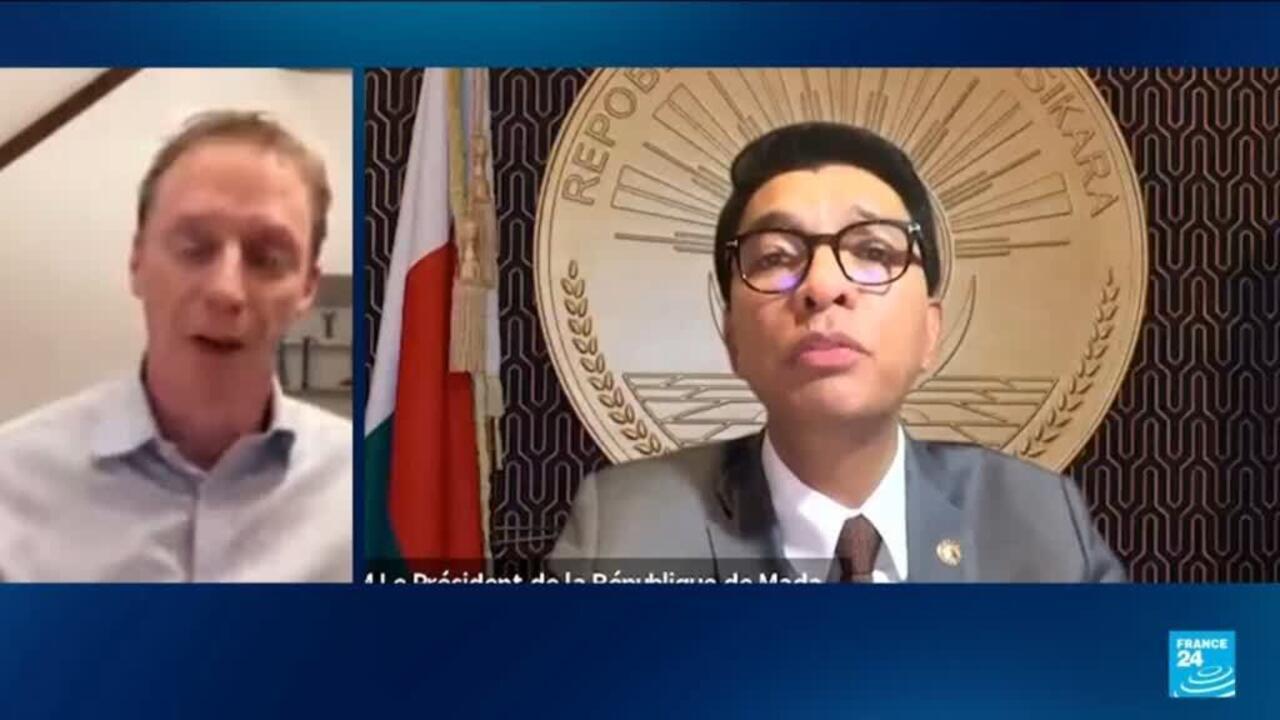
© France 24
09:10
09:10
Defying orders
Earlier in the day, mutinous soldiers and security forces who pledged support to the demonstrators at the weekend joined jubilant crowds in front of Antananarivo city hall, in a rally that had an air of celebration amid expectations Rajoelina would step down.
Among the crowds in the morning rally were soldiers from the army CAPSAT unit, which played a major role in the 2009 coup.
On Saturday, the unit declared it would "refuse orders to shoot" on demonstrations, some of which have been met with harsh security force action.
Also present were officers from the gendarmerie paramilitary police force, accused of using heavy-handed tactics during the protests. They admitted in a video statement to "faults and excesses" in their response.
The United Nations has said at least 22 people were killed in the first days of the protests, some by security forces and others in violence sparked by criminal gangs and looters.

Rajoelina has disputed the toll, saying last week there were "12 confirmed deaths and all of these individuals were looters and vandals".
As pressure mounted on Rajoelina, he pardoned eight individuals in a decree issued Monday, including French-Malagasy dual national Paul Maillot Rafanoharana, who was sentenced in 2021 to 20 years in prison for an attempted coup in Madagascar.
Amid rumours that Rajoelina had fled, his government said Saturday he remained in Madagascar and was managing national affairs.
Ahead of his speech, protesters said they expected him to step down.
"We hope that he will apologise and genuinely announce his resignation," law student Finaritra Manitra Andrianamelasoa, 24, told AFP at the city hall gathering, where a large flag of the Gen Z movement that led the protests was on display.
"We already expect him to offer his apologies to all Malagasy citizens, as we have had many casualties, relatives, who have been injured during the protests," said 19-year-old Steven Rasolonjanahary.
To try to defuse the protests, the president last month sacked his entire government.
Meeting one of the demands of the protesters, the Senate announced Sunday the dismissal of its president, Richard Ravalomanana, a former general of the gendarmerie.
Madagascar has had a turbulent political history since the country off the east coast of Africa gained independence from France in 1960.
The latest turmoil drew expressions of concern from the region.
The African Union's security council called on all armed forces "to return to uphold their constitutional mandate, and to refrain from meddling in the political affairs of the country".
(FRANCE 24 with AFP)
Madagascar's president urges respect for constitution, ignores calls to resign
Madagascar's embattled President Andry Rajoelina has said he was sheltering in a "safe place" following an attempt on his life, ignoring calls to resign after spiralling unrest that has forced him into hiding.
Issued on: 14/10/2025 - RFI
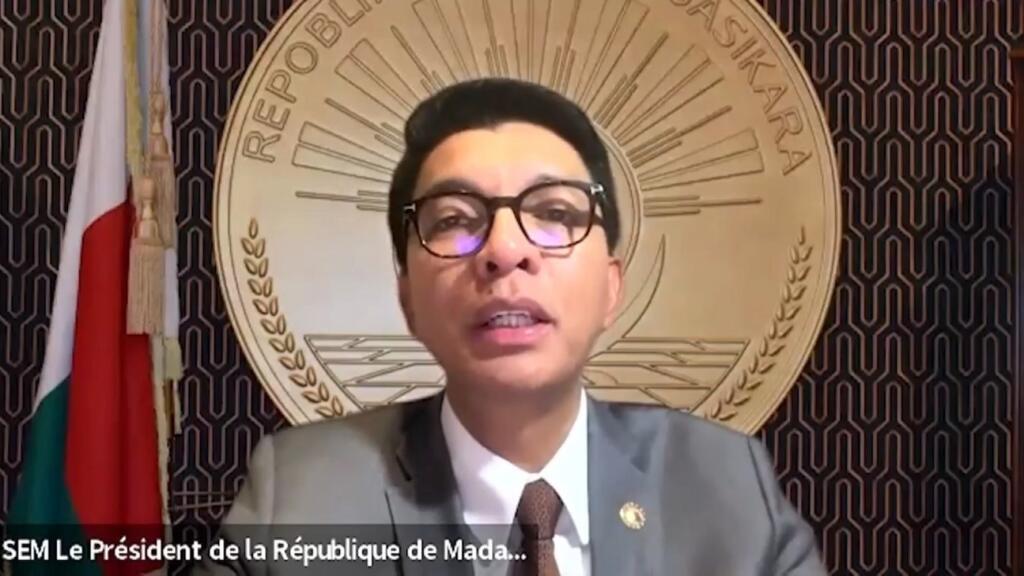
Rajoelina adresses the public on Facebook, 13 October 2025, from an unknown location.
© Capture d'écran Facebook/Présidence de la République de Madagascar
The twice-delayed speech marked his first public address since a mutinous army unit backed anti-government protests, and followed reports that the 51-year-old leader had fled the country.
"Since September 25, there have been attempts on my life and coup attempts. A group of military personnel and politicians planned to assassinate me," he said in a live address Monday evening on Facebook.
Sources told RFI that he had left Madagascar on Sunday on a French military plane.
"I was forced to find a safe place to protect my life," he said, without revealing his location.
Constitution must be respected
The protests, led by mostly young Gen Z demonstrators, erupted over severe power and water cuts in the impoverished Indian Ocean country, but developed into a broader anti-government movement calling for Rajoelina to resign.
Rajoelina, a former mayor of the capital, Antananarivo, called for the constitution to be respected and ignored calls to step down.
“There is only one solution to these problems: to respect the constitution currently in force,” he said at the start of his address. “If we fail to do that, poverty will only worsen."
"I am on a mission to find solutions," he said.
Mobilisations to continue
Eliott, a member of GenZ Madagascar, was sceptical. "He is clearly not open to dialogue, it is not even certain he will take part in national consultations or engage with stakeholders,” he told RFI.
"Mobilisations will continue, as will efforts to organise broad national consultations to find a way out of the crisis,” he added.
Rajoelina first came to power in 2009 following a coup sparked by an uprising that ousted former president Marc Ravalomanana.
While acknowledging that the constitutional framework should be respected, Ravalomanana called for the head of state to step down.
“The solution is a peaceful transition – to acknowledge the power vaccuum in Madagascar – but we are nonetheless obliged to respect the constitution,” he told RFI.
Rajoelina has not appeared in public since Wednesday and his address, set for state television and radio, was twice delayed Monday as armed forces attempted to seize the state broadcaster.
French President Emmanuel Macron, has expressed "great concern" over the island's crisis.
“It is very important that constitutional order and institutional continuity are preserved in Madagascar, because the country’s stability – and the wellbeing of its people – depend on it,” Macron said.
(with newswires)
The twice-delayed speech marked his first public address since a mutinous army unit backed anti-government protests, and followed reports that the 51-year-old leader had fled the country.
"Since September 25, there have been attempts on my life and coup attempts. A group of military personnel and politicians planned to assassinate me," he said in a live address Monday evening on Facebook.
Sources told RFI that he had left Madagascar on Sunday on a French military plane.
"I was forced to find a safe place to protect my life," he said, without revealing his location.
Constitution must be respected
The protests, led by mostly young Gen Z demonstrators, erupted over severe power and water cuts in the impoverished Indian Ocean country, but developed into a broader anti-government movement calling for Rajoelina to resign.
Rajoelina, a former mayor of the capital, Antananarivo, called for the constitution to be respected and ignored calls to step down.
“There is only one solution to these problems: to respect the constitution currently in force,” he said at the start of his address. “If we fail to do that, poverty will only worsen."
"I am on a mission to find solutions," he said.
Mobilisations to continue
Eliott, a member of GenZ Madagascar, was sceptical. "He is clearly not open to dialogue, it is not even certain he will take part in national consultations or engage with stakeholders,” he told RFI.
"Mobilisations will continue, as will efforts to organise broad national consultations to find a way out of the crisis,” he added.
Rajoelina first came to power in 2009 following a coup sparked by an uprising that ousted former president Marc Ravalomanana.
While acknowledging that the constitutional framework should be respected, Ravalomanana called for the head of state to step down.
“The solution is a peaceful transition – to acknowledge the power vaccuum in Madagascar – but we are nonetheless obliged to respect the constitution,” he told RFI.
Rajoelina has not appeared in public since Wednesday and his address, set for state television and radio, was twice delayed Monday as armed forces attempted to seize the state broadcaster.
French President Emmanuel Macron, has expressed "great concern" over the island's crisis.
“It is very important that constitutional order and institutional continuity are preserved in Madagascar, because the country’s stability – and the wellbeing of its people – depend on it,” Macron said.
(with newswires)
France evacuates Madagascar president amid protests and army revolt
Madagascar’s president Andry Rajoelina has been evacuated from the country by a French military plane as protests and a military mutiny threaten to topple his government, RFI has confirmed.
Issued on: 13/10/2025 - RFI
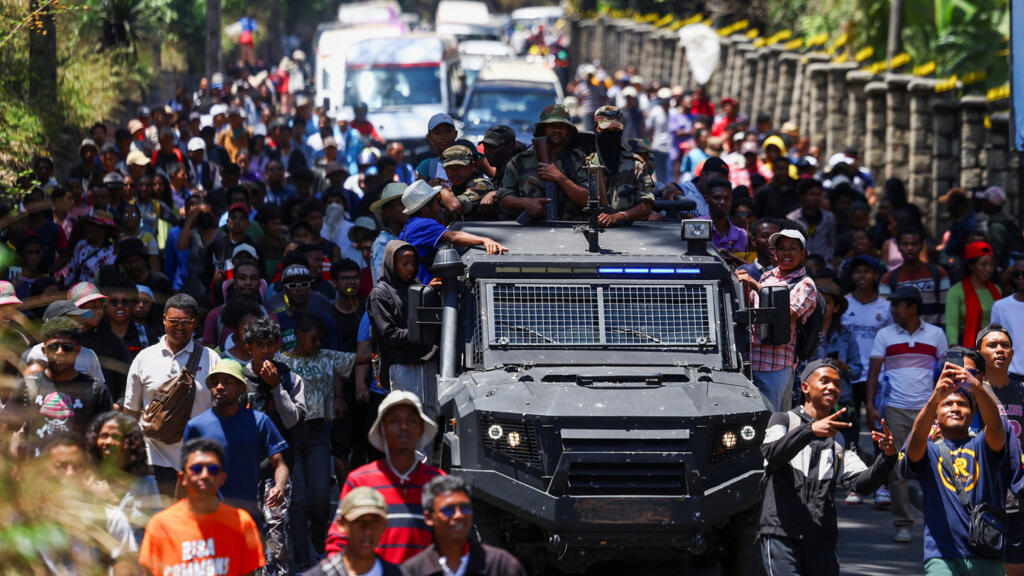
Protesters in Antananarivo, Madagascar, embrace a military vehicle, 13 October 2025.
© Siphiwe Sibeko/Reuters
The evacuation followed an agreement with French president Emmanuel Macron. French authorities said they are not intervening in Madagascar’s internal crisis, which has rocked the country since 25 September.
The unrest began over widespread water and electricity cuts but has grown into a nationwide movement demanding Rajoelina’s resignation.
Security forces have used force to disperse demonstrations, while officers backing the protesters have taken control of the paramilitary gendarmerie.
Whereabouts unclear
Rajoelina was expected to address the nation on Monday evening, but his location was unclear before his evacuation was confirmed.
“The President will address the Malagasy people today at 7pm (4pm GMT),” the presidency announced on its official Facebook page.
He has not spoken publicly since the officers supporting the protests said they had taken control of the gendarmerie.
The evacuation followed an agreement with French president Emmanuel Macron. French authorities said they are not intervening in Madagascar’s internal crisis, which has rocked the country since 25 September.
The unrest began over widespread water and electricity cuts but has grown into a nationwide movement demanding Rajoelina’s resignation.
Security forces have used force to disperse demonstrations, while officers backing the protesters have taken control of the paramilitary gendarmerie.
Whereabouts unclear
Rajoelina was expected to address the nation on Monday evening, but his location was unclear before his evacuation was confirmed.
“The President will address the Malagasy people today at 7pm (4pm GMT),” the presidency announced on its official Facebook page.
He has not spoken publicly since the officers supporting the protests said they had taken control of the gendarmerie.
Madagascar: Why is the CAPSAT army unit so influential?
DW
13/10/2025
President Andry Rajoelina has reportedly fled the country after an elite army unit joined protests demanding his resignation. What is the CAPSAT army unit, and why is it so powerful?

CAPSAT claimed control of Madagascar's military and gave "refuse to shoot" orders to other units
Image: Luis Tato/AFP/Getty Images
Since September 25, Madagascar has witnessed a dramatic shift in its political landscape as young protesters took to the streets, sparking one of the most powerful demonstrations in the country’s recent history.
On Monday, thousands of people gathered on a square in the capital, Antananarivo, shouting: "The president must quit now".
The movement gained significant momentum and support when the Corps d'administration des personnels et des services administratifs et techniques (CAPSAT) unit of the armed forces chose to stand behind the Gen Z-led demonstrations.
"From now on, all orders of the Malagasy army, whether land, air or military, will come from CAPSAT headquarters," officers from the unit declared in a video statement on Saturday.
They urged the country’s security forces to stand firm in solidarity by refusing any "orders to shoot" at protesters, emphasizing the importance of protecting citizens’ rights and maintaining peace during this critical moment.
Madagascar's army units join Gen Z anti-government protests 01:57
Where is President Andry Rajoelina?
President Andry Rajoelina's location is currently unknown.
Siteny Randrianasoloniaiko, leader of the opposition in parliament, told the Reuters news agency that Rajoelina left Madagascar on Sunday after CAPSAT declared its support for the protesters.
"We called the staff of the presidency, and they confirmed that he left the country," Randrianasoloniaiko said.
A military source also told Reuters that Rajoelina flew out of the country on a French military aircraft on Sunday. French radio RFI said he had struck a deal with President Emmanuel Macron.
This has not been confirmed by the French government.
Earlier on Sunday, Rajoelina's office released a statement denouncing CAPSAT's support for protesters as "an attempt to seize power illegally and by force, contrary to the constitution and to democratic principles."
Opposition members of Madagascar's National Assembly will begin impeachment proceedings against Rajoelina, Randrianasoloniaiko said. "Our constitution gives us the right to impeach the president; we are impeaching him," he said of Rajoelina.
Protesters celebrated the exit of Rajoelina from the country, singing the national anthem and waving flags as they marched on the streets.

President Andry Rajoelina's whereabouts are unknown
Image: Siphiwe Sibeko/REUTERS
Is history repeating itself?
Rajoelina came to power in 2009, after CAPSAT supported a revolt to oust his predecessor.
At the time, Rajoelina was the mayor of the capital and assembled several tens of thousands in the streets demanding the resignation of President Marc Ravalomanana's government.
Observers say the events unfolding are too similar to ignore.
"Because of the influence, the history and the legitimacy that CAPSAT has, it means that, as much as Rajoelina has leverage and control of other units, the balance of power is not in his favor right now,” political risk analyst Rose Mumanya told DW.
A report by Small Arms Survey suggests that Rajoelina's predecessor, 75-year-old Marc Ravalomanana, was not overthrown by a violent military coup but simply lost control of the security apparatus.
Mumanya said that, although Rajoelina has tried to put his loyalists in other units of the Armed Forces to prevent a repetition of history, CAPSAT remains independent of his influence, posing a significant threat to his rule.
What makes CAPSAT so important?
Although CAPSAT is not a front-line combat unit, it controls important aspects of the army, including personnel management, administrative support, logistics and technical services.
"It's led by influential elites from the gendarmerie group, and has close links to influential and business elites in the country. A lot of them are not pro-Rajoelina now. In the last three to four years, they have become increasingly suspicious of Rajoelina and questioned whether their interests align,” Mumanya added.
Analysts believe that the power of the army makes it one of the best-organized institutions in Madagascar, with the power to intervene in a political crisis.
Rajoelina came to power in 2009, after CAPSAT supported a revolt to oust his predecessor.
At the time, Rajoelina was the mayor of the capital and assembled several tens of thousands in the streets demanding the resignation of President Marc Ravalomanana's government.
Observers say the events unfolding are too similar to ignore.
"Because of the influence, the history and the legitimacy that CAPSAT has, it means that, as much as Rajoelina has leverage and control of other units, the balance of power is not in his favor right now,” political risk analyst Rose Mumanya told DW.
A report by Small Arms Survey suggests that Rajoelina's predecessor, 75-year-old Marc Ravalomanana, was not overthrown by a violent military coup but simply lost control of the security apparatus.
Mumanya said that, although Rajoelina has tried to put his loyalists in other units of the Armed Forces to prevent a repetition of history, CAPSAT remains independent of his influence, posing a significant threat to his rule.
What makes CAPSAT so important?
Although CAPSAT is not a front-line combat unit, it controls important aspects of the army, including personnel management, administrative support, logistics and technical services.
"It's led by influential elites from the gendarmerie group, and has close links to influential and business elites in the country. A lot of them are not pro-Rajoelina now. In the last three to four years, they have become increasingly suspicious of Rajoelina and questioned whether their interests align,” Mumanya added.
Analysts believe that the power of the army makes it one of the best-organized institutions in Madagascar, with the power to intervene in a political crisis.
Protesters in Madagascar reject president's offer for talks 03:24
The installation of new Chief of Army Staff General Demosthene Pikulas, chosen by CAPSAT, has consolidated its importance in the army. His installation follows Rajoelina's dissolution of his government, leaving several positions vacant.
"I give him my blessing," Armed Forces Minister Manantsoa Deramasinjaka Rakotoarivelo was quoted as saying at a ceremony to install Pikulas into the post.
Mumanya expressed worry. "If the coup is successful and Rajoelina is able to be removed from power, the repercussions will be very serious," she said. "It would be a continuation of the same cycle where you have very weak institutions and a relatively stronger army which can intervene, not for the benefit of the people but for the benefit of business and political elites."
Rajoelina had already fired his government and appointed a new prime minister, but protesters remained unfazed.
Some analysts believe that a genuine national dialogue that brings aboard all aggrieved stakeholders could be a key starting point for solving the impasse.

Protesters have been resolute in demanding President Andry Rajoelina's resignationI
mage: RIJASOLO/AFP/
Edited by: Silja Fröhlich

Adwoa Tenkoramaa Domena Ghanaian author and multimedia journalist
Edited by: Silja Fröhlich
Adwoa Tenkoramaa Domena Ghanaian author and multimedia journalist
On Sunday the presidency warned of an attempted coup by members of Capsat, an elite unit that helped Rajoelina seize power during a 2009 coup.
Former prime minister Christian Ntsay and businessman Mamy Ravatomanga, a close ally of the president, flew to Mauritius on a private jet on Saturday night, according to local reports.
Rajoelina was also absent from a ceremony the same day to install General Nonos Mbina Mamelison as head of the gendarmerie.
The event was attended by Armed Forces Minister General Deramasinjaka Rakotoarivelo and General Demosthène Pikulas, whom Capsat has named as chief of the army.
Around a thousand people gathered on Sunday in Antananarivo’s symbolic Place du 13 Mai, in front of city hall, to celebrate the Capsat troops.
By midday, three armoured vehicles made their way through the cheering crowd, carrying soldiers who waved and smiled, weapons in hand, as demonstrators waved Malagasy flags.
(with newswires)








.jpg)