Saturday, October 18, 2025


China–North Korea Ties: Old Allies, New Calculations – Analysis
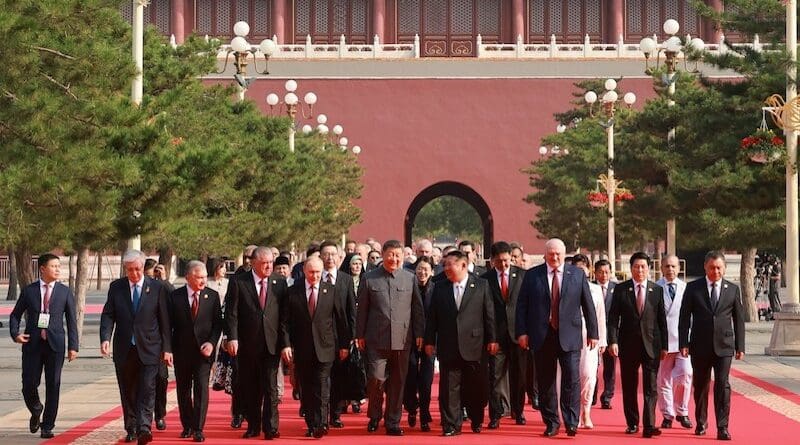

Russian President Vladimir Putin, Chinese President Xi Jinping, and North Korean leader Kim Jong Un, arrive for a military parade marking the 80th anniversary of the end of World War II, in Beijing, Sept. 3, 2025. Photo Credit: Kremlin.ru
By Observer Research Foundation
By Abhishek Sharma

On 4 September 2025, Kim Jong-un travelled to Beijing to commemorate the 80th Anniversary of the end of World War II. The visit marks the thawing of ties between Beijing and Pyongyang, which have been frozen since Xi’s previous visit in 2019. Building on the understanding reached at the leader level, the respective high-level meetings in Beijing and Pyongyang have taken forward the conversation, widening the discussion to strengthening comprehensive ties. Although the political leadership has initiated the process of normalising relations, it is unclear whether these efforts reflect tactical adjustment or strategic alignment.

Xi-Kim Bonhomie

Kim Jong-un and Xi Jinping assumed the leadership of their respective countries around the same time in 2011 and 2013, respectively. Since taking over, both leaders have played an outsized role in the governance of their country, including driving its foreign policy. Xi was the first Chinese leader to visit North Korea in 2019, after a hiatus of 14 years, reciprocating Kim Jong-un’s first official foreign visit to Beijing in 2018. The visit emphasised the strategic importance of bilateral ties and their political intent to resolve issues through diplomatic channels. The meetings occurred against the strained relations between China and North Korea due to the former’s support for the sanctions regime.

Today, there appears to be a re-telecast of the same characters playing the same script under different circumstances, another story of Kim-Xi bonhomie. However, this time, it may turn out differently, considering the intent and substance.

Following the leader’s meeting, Choe Son Hui, North Korea’s Foreign Minister, visited Beijing, and Chinese Premier Li Qiang’s sojourn to North Korea to attend the 80th Anniversary of DPRK’s ruling party celebration, underscores the intent of both sides to deepen the relations, building on the strategic guidance given by the leader. Notably, the latter visit is significant, considering it is the first high-level visit after a long time and the Chinese Premier’s first visit in 16 years. The last visit was by Li Hongzhong, a Politburo member in the 2023 military parade. Choe’s statement highlighted the positive turn in ties. It stated that the recent meeting between the leaders “charted the course for the development of DPRK-China relations” and that they were committed to “enhance strategic communication, increase friendly exchanges, deepen practical cooperation.”

The intent is clear, and the substance also lives up to it. The discussion between the two sides shows that the tone and tenor are shifting. The joint statements emphasise the importance of this relationship for both sides. Reuters reported, Wang said to Choe, ‘China is willing to strengthen coordination and cooperation with [North Korea] in international and regional affairs’, and Choe reciprocated by expressing North Korea’s willingness to promote the development of bilateral ties to a ‘new and higher-level.’


Trade as the True Touchstone


Besides the political substance, the trade figures also back the assertion that ties are moving towards normalisation. Irrespective of the political friction between Beijing and Pyongyang, the bilateral trade had been mainly isolated (return to pre-COVID levels), which points to two critical reasons. First is the continued recognition of North Korea’s geopolitical and strategic relevance in Beijing; second is the importance of political stability in its immediate neighbour. This reveals Chinese foreign policy pragmatism: balancing supporting regime security and limiting Pyongyang’s adventures.

Figure 1: China and North Korea bilateral Trade statistics
Source: General Administration of Customs, China *The data presented in Figure 1 illustrates North Korea’s total trade with China and its imports from China between July 24 to August 25.

According to China’s General Administration of Customs, total trade with China touched US$1.47 billion till July 2025, matching the pre-pandemic levels. At the same time, Pyongyang also achieved its fastest Gross Domestic Product (GDP) growth rate of 3.7 percent after eight years, driven by an increase in the manufacturing, mining, and construction industries. The economic trade between the two countries is expected to increase further as overall relations improve, driven by increasing Russian demand and imports from China. Some recent developments, such as the resumption of train, flights, labour, and land postal routes, underline the easing of goods and mobility.

For Kim, another reason for improving ties with China is its vital role in achieving his domestic goals. As Kim pushes for more development through his Regional Development 20*10 Policy (create modernised factories in 20 cities and counties every year over 10 years), as seen recently through the beach resort and domestic construction, it would require more supplies from China. Better ties will ensure Korea’s economic growth remains uninterrupted. Besides cross-border trade, North Korean workers employed in garment factories and other occupations in China will receive more relaxation, further boosting remittances.

Is this the onset of Strategic Reset?

Unlike popular perception, realistic calculations rather than ideological affinity have driven North Korea and China’s strategic ties. Irrespective of their differences and distrust, both countries have always prioritised keeping each other close. Hence, while North Korea’s neglect of Chinese concerns regarding the nuclear weapons programme was a source of irritation, it never derailed the relationship. The extension of the Treaty on Friendship, Cooperation, and Mutual Assistance in 2021 for another 20 years underlined the importance of North Korea for China.

This implies that the structural conditions are responsible for North Korea’s continued strategic relevance for China, and vice versa for North Korea (dependence on China for trade and stability). While leadership support plays a vital role in maintaining, strengthening, and deepening bilateral ties, its disinterest has not adversely impacted the relationship status. Nonetheless, today the situation is different. The changing political dynamics and the leadership’s support are driving factors in improving the ties. This was visible during the recent Kim-Li meeting, where Li remarked, “China-DPRK friendship is entering a new chapter of the development of relations under the strategic guidance of the top leaders [Kim and Xi].” However, what are the drivers of this tactical shift?

It is crucial to contextualise the evolving bilateral ties with three trends: the changing world order (bipolar), the regional political dynamics (multipolar), and the domestic compulsions. Today, China is forging a larger coalition of like-minded countries, including North Korea, in the East Asian region, which gives Beijing greater strategic influence. Beijing understands the strategic value of North Korea at a time when its ties with the US are at their worst. This attempt is also a way to undercut Trump’s renegotiation with Kim Jong-un.

Unlike the last time, when China actively welcomed and supported the Trump-Kim meeting, it has refused to play any role this time. Instead, China has used the opportunity to deepen its ties. For instance, in his message to Kim, Xi said, “China and the DPRK should strengthen strategic coordination and uphold common interests in international and regional affairs.” Some Chinese scholars have emphasised that Beijing will continue to support North Korea in the security and economic sectors, including investing in its economy.

On the other hand, North Korea feels that the time is opportune to mend the ties with China. Three critical factors drive Kim’s decisions: first, to achieve his objectives to revive the broken domestic economic system with the help of Chinese assistance second, to leverage its normalised ties with China (including Russia) to come out of its diplomatic isolation phase, and third, to work with China to forge a ‘fairer and more just world order’.

The benefits of this are already visible. With the participation of the Chinese Premier and the Russian President in the parade, Kim has signalled to his neighbours, Korea and Japan, and the United States (US) that their efforts to isolate Pyongyang diplomatically have failed. Furthermore, their presence also gives legitimacy to North Korea’s military modernisation, including advancing its nuclear arsenal. Kim also leverages diplomatic opportunities by piggybacking through multilateral diplomacy and meeting political leaders from Vietnam, Laos, and Iran.

Given the regional geopolitical circumstances (for China and North Korea) and the internal challenges in North Korea, it is likely that bilateral ties will continue to improve. The resumption of economic trade points to this argument. Nonetheless, to further assess the status of relations, as it is said, the proof of the pudding lies in the eating. In the China-North Korea case, the reality is hidden behind the data and figures, which currently underline the return to the status quo. However, whether this tactical shift will translate into a strategic partnership through deeper security and economic cooperation (as seen in the Russia-North Korea case) will depend on external factors, particularly the US’s allies’ security posture and military modernisation.


About the author: Abhishek Sharma is a Junior Fellow with the Strategic Studies Programme, Observer Research Foundation.

Source This article was published by Observer Research Foundation.


Observer Research Foundation
ORF was established on 5 September 1990 as a private, not for profit, ’think tank’ to influence public policy formulation. The Foundation brought together, for the first time, leading Indian economists and policymakers to present An Agenda for Economic Reforms in India. The idea was to help develop a consensus in favour of economic reforms.
Diwali, Christmas, And Hanukah For All – OpEd


October 18, 2025
By Rabbi Allen S. Maller


A very thoughtful article appeared in the Eurasia Review on October 17, 2025 written by Dr. Fr. John Singarayar said “Every autumn, when millions of clay lamps flicker across India’s rooftops and courtyards, a beautiful paradox unfolds in the homes of Indian Christians. While their Hindu neighbors celebrate Diwali with prayers to Lakshmi and stories of Rama’s return, these followers of Christ find themselves navigating a delicate dance between faith and culture, between standing apart and belonging together.


The question that haunts many Christian families during this season is not whether to celebrate, but how to honor their beliefs while living authentically in the land they call home. Some see Diwali’s rituals as incompatible with their faith, choosing instead to retreat into quiet prayer while the world outside bursts into celebration. Others light their own lamps, not in worship of Hindu deities, but as a cultural embrace of the community around them.

Many Jews have faced similar challenges in Christian lands. I think a third way can be found in the Catholic Bible’s Books of the Maccabees. Every year in December (starting the evening of December 15 this year), Jewish people throughout the world, celebrate the eight day holiday of Hanukah. If you ask any Jew to tell you how Hanukah began, or why Jews celebrate this festival for eight days, they will relate this story.

Once a Syrian Greek king polluted the Holy Temple in Jerusalem by erecting a statue in it. Then, after more than three years of fighting, Judah the Maccabee and his warriors recaptured the holy Temple in Jerusalem, and began to purify it.

But all the pure olive oil for the lamp that should burn continuously had been polluted except for one little jar of oil that miraculously burned for eight days.

This Hanukah story is about two kinds of battle; the physical struggle against others (political and sometimes military); and the spiritual struggle within ourselves to trust in God (the oil).


When the Maccabees recaptured and rededicated (Hanukah) the Temple in Jerusalem in 164 b.c.e. the physical struggle for religious freedom and independence did not end. It went on for another 25 years until full independence was attained.

But the spiritual struggle (oil) miraculously lasted only for eight days.

Look at the oldest written sources. About four or five decades after the first Hanukah, two books were written about the Maccabean Wars and the rededication (Hanukah) of the Holy Temple in Jerusalem.

The First Book of Maccabees, compiled sometime before 130 b.c.e., was originally written in Hebrew. Today all we have is an early Greek translation. Its intended audience was the Jewish community in the Land of Israel. It describes the recapture of the Jerusalem Temple, its purification and rededication (Hanukah).

“They also made new sacred vessels, and they brought the lamp stand … into the Temple. They burned incense on the altar and lit the lights on the lamp stand, and the Temple was filled with light…. For eight days they celebrated the dedication of the altar. … Then Judah, his brothers and the entire community of Israel decreed that the days of rededication of the altar should be celebrated with a festival of joy and gladness at this same time every year beginning on the 25th of the month of Kislev and lasting for eight days. (First Maccabees 4:49-59)

This first ancient source does not mention the “little jar of oil” miracle. At that time, the miracle was the victory itself, that God had enabled the Jews in Israel to physically and militarily defeat the far mightier Syrian Greek Empire.

The Second Book of Maccabees, was compiled a decade or two after First Maccabees, and covers most of the same period, but was written in Greek for the Jewish community outside the land of Israel. That Jewish community, whose primary language was Greek, was concentrated largely in the bustling port city of Alexandria in Egypt.

The purpose of Second Maccabees, clearly stated in the two letters that open the book, is to urge the Jews of Alexandria to adopt this new festival. The author states that his source for the history of the Maccabean war was a (now lost) larger five-volume history by one Jason of Cyrene.

Second Maccabees describes the purification of the Temple, adding significant information that is not found in First Maccabees: “Judah the Maccabee and his men, under the Lord’s leadership, recaptured the Temple and the city of Jerusalem. … After purifying the Temple, they built a new altar; made a new fire; … offered sacrifices and incense … and lit the lamps. … On the anniversary of the very same day on which the Temple had been defiled, the 25th of Kislev, they now purified the Temple.

“They celebrated joyfully for eight days, just as on Hajj Sukkot, knowing that (only two months before) on Hajj Sukkot (google my article on the Biblical holiday of Hajj Sukkot) they had spent the festival (hiding) like wild animals in the mountains and caves. That is why they now came carrying palm fronds and fruit, and singing hymns of praise to God, who had given them the victory that brought about the purification of His Temple.

“By a vote of the community they decreed that the whole Jewish nation should celebrate these festival days every year. (Second Maccabees 10:1-8)

The story of the small jar of oil that lasted much longer than anyone expected, is not mentioned in the early sources because they focus on the physical military battle to liberate the Jerusalem temple from Greek rule and restore Jewish political independence.

However, two and a half centuries later, the Holy Temple and Jerusalem itself were in ruins. In the generations following the destruction of Jerusalem by the Romans in 70 c.e. the Jewish people would have despaired, and become discouraged and depressed. They might even have lost faith in God when the Romans built a new pagan city on Jerusalem’s ruins; with a Roman Temple filled with statues of Roman Gods in its center..

So the rabbis started emphasizing the spiritual internal battle needed for Jewish survival. Everyone, even small children, need to believe in a better future. All of us need to avoid negativeness. Everyone needs to have faith and trust in God.

When the Maccabees realized that it would take a week or more to produce the ritually pure olive oil needed for the lamp that must burn continually before the (Sakina) Holy Ark, most of them wanted to delay the Hanukah celebration because they feared disappointing and dismaying their supporters if the light went out and spoiled the eight day celebration.

Only a minority led by a young girl, favored using the little jar of oil that they had found, and trusting that somehow it would be enough. As the rabbis expressed it in the Talmud (Shabbat 21b): “Why Hanukkah? Our rabbis taught: ‘On the 25th day of Kislev begin the eight days of Hanukkah on which mourning and fasting are forbidden.

“For when the Greeks entered the Temple, they defiled all the oil; and when the Maccabees prevailed and defeated them, they searched and found only one jar of oil with the official seal of the High Priest, but which was only enough for one day’s lighting.

“Yet a miracle occurred, and they lit the lamp with it for eight days. The following year these days were decreed a festival with the recital of Psalms and thanksgiving.”

Notice that the miracle is two fold. That the oil lasted is a physical miracle. That they lit it, knowing it couldn’t last, is the spiritual miracle. To this day we still use one candle to ignite all the other Hanukah candles.

And to this day we acknowledge that the greater jihad is more important than the lesser jihad because the Jewish people are still here; long after the Greek and Roman Empires have disappeared.


Rabbi Allen S. Maller
Allen Maller retired in 2006 after 39 years as Rabbi of Temple Akiba in Culver City, Calif. He is the author of an introduction to Jewish mysticism. God. Sex and Kabbalah and editor of the Tikun series of High Holy Day prayerbooks.


Why haven't UEFA and FIFA suspended Israel from international competitions?

Pressure is mounting on international football authorities to exclude the Israeli national team from their tournaments, following the United Nations declaration that Israel has committed genocide in the Gaza Strip. But despite protests by fans and players, governing bodies show few signs of taking a stand.


Issued on: 18/10/2025 - RFI

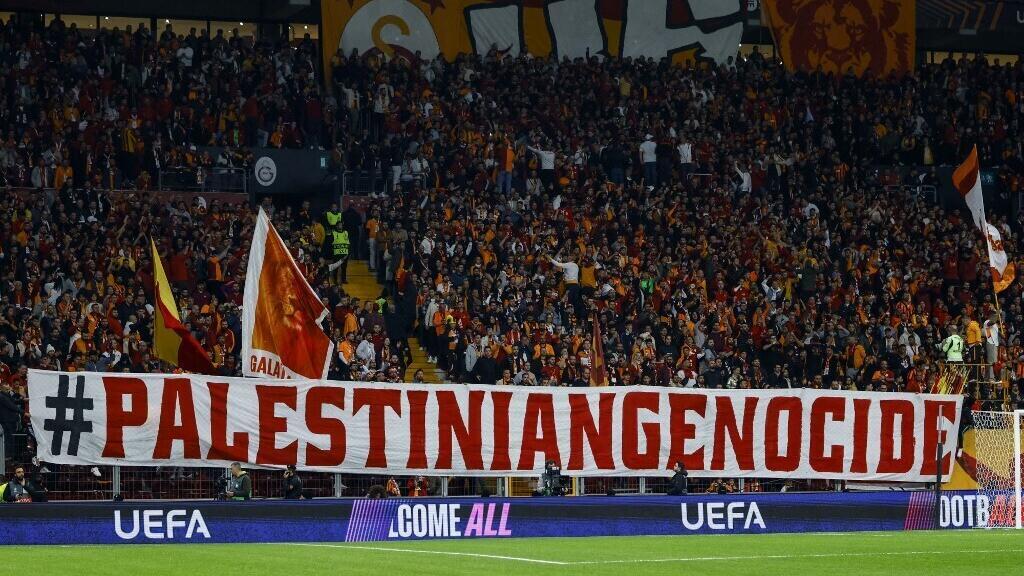
Supporters of Turkish club Galatasaray hold a banner in support of the Palestinian people before the UEFA Europa League group stage match against Tottenham in Istanbul on 7 November, 2024. 
© AFP - KEMAL ASLAN

One week a UN inquiry concluded on 16 September that Israel had committed genocide against Palestinians in Gaza, another group of experts appointed by the UN published their own statement – calling for Israel to be excluded from international football.

Addressing their statement to Uefa and Fifa – football's European and international governing bodies, respectively – 30 experts called on them to suspend Israel "as a necessary response to address the ongoing genocide in the occupied Palestinian territory".

"Sporting bodies must not turn a blind eye to grave human rights violations," they declared.

Palestinian football targeted

The genocide in Gaza is one in which Palestinian athletes have been deliberately targeted. Over the past two years, the Israeli army has killed some 898 Palestinian athletes – including at least 420 footballers.

Among them were Hani Al-Masdar, assistant coach of the Palestinian national football team; Mohammed Barakat, star striker of the national team; and Suleiman Al-Obeid, known as the "Palestinian Pelé", who was killed on 6 August while waiting for humanitarian aid in the southern Gaza Strip.

The death of Al-Obeid caused international outrage. Uefa posted on X: "Farewell to Suleiman al-Obeid, the 'Palestinian Pelé'. A talent who gave hope to countless children, even in the darkest of times."

The tribute prompted Liverpool forward and captain of the Egyptian national team Mohamed Salah to respond: "Can you tell us how he died, where, and why?"

Israel has also attacked almost 290 sports facilities in two years in the Palestinian enclave and the occupied West Bank.

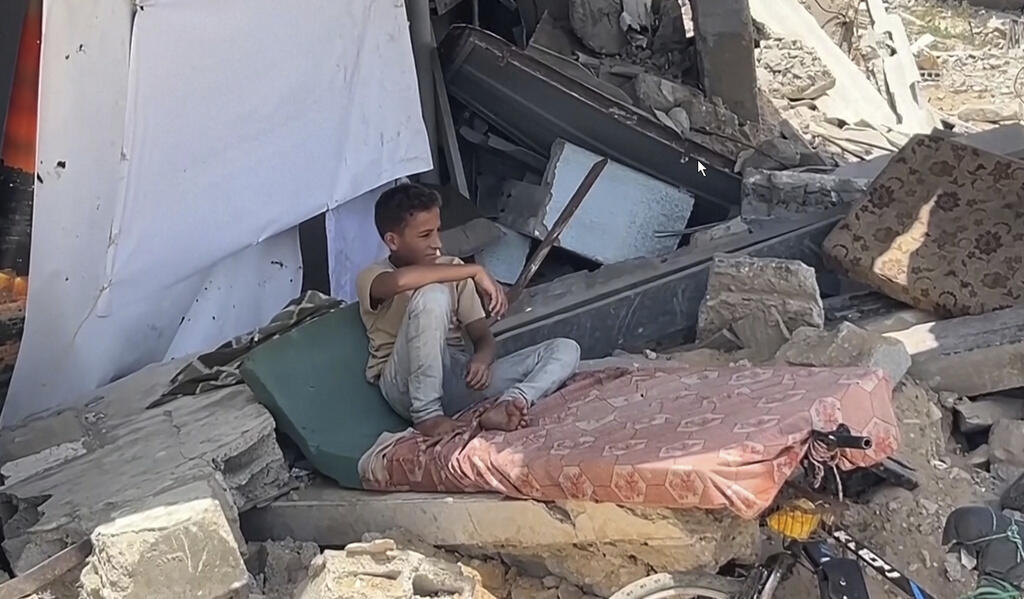
Opened in 1952 and rebuilt many times following Israeli attacks, Gaza City's 9,000-seat Yarmouk Stadium became a refuge at the start of the latest conflict.

But in December 2023, the Israeli army entered the stadium and turned it into an interrogation site – or "torture camp", in the words of Nader Jayousi, deputy secretary of the Palestinian Olympic Committee.
A boy sitting in the rubble in Yarmouk Stadium in Gaza City on 5 July, 2024. © AP

It was subsequently demolished, its ruins becoming a refugee camp for displaced Gazans.

On 5 October this year, the headquarters of the Palestinian Football Association (PFA), located in East Jerusalem beside the national team’s Faisal Al-Husseini stadium, were targeted by tear gas and sound grenades fired by the Israeli army.

The PFA said in a statement: "These actions are not isolated incidents but part of a systematic policy of targeting Palestinian sport, in direct contravention of the principles enshrined in the Fifa statutes, the Uefa regulations, and the Olympic Charter, all of which are founded on respect for human dignity, equality, and peace."
Fans, players and politicians protest

Palestinian rights activists have been calling for Israel to be banned from global football competitions for several decades – and since the start of the 2023 war, despite restrictions, football fans have been displaying banners and flags in support of the Palestinian people in stadiums around the world.

Earlier this month, Spanish football club Athletic Bilbao organised a pre-match ceremony as a show of solidarity with Palestinians at the San Mamés stadium, just before their La Liga match against Real Mallorca.

Eleven Palestinian refugees living in Spain, alongside representatives of the UN's Palestinian refugee agency UNRWA, walked on to the pitch as Athletic fans waved Palestinian flags and gave them a standing ovation.

In September, 48 athletes under the banner Athletes 4 Peace, including French football international Paul Pogba and Moroccan international Hakim Ziyech, signed an open letter denouncing the genocide in Gaza and calling for the exclusion of Israeli teams from competitions organised by Uefa.

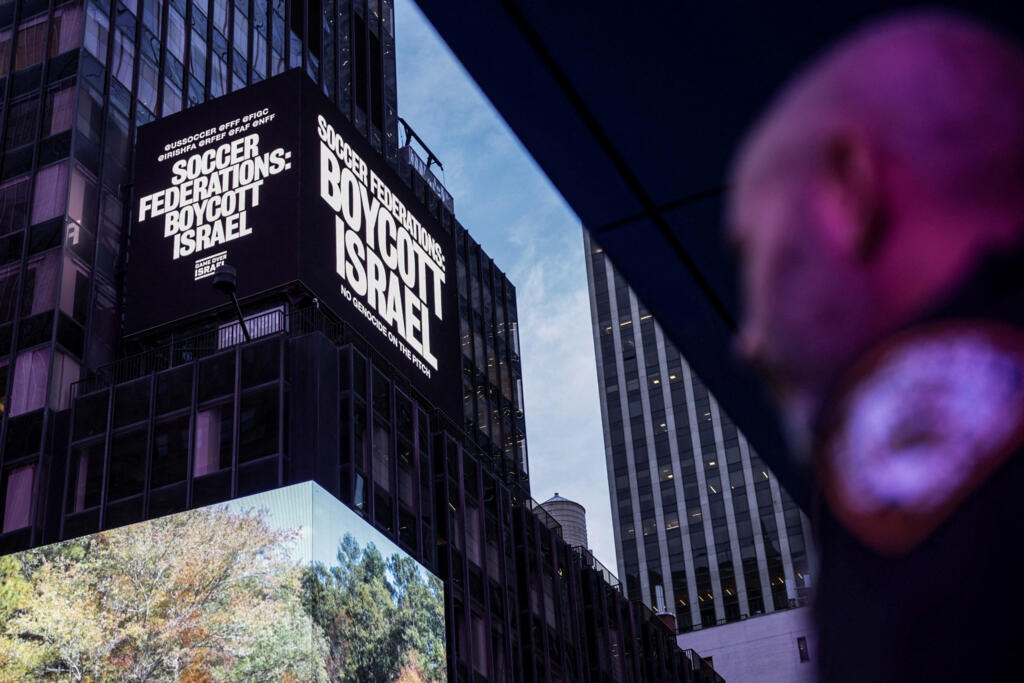
Game Over Israel is another movement waging an international campaign, mobilising sports stars and fan groups alongside human rights organisations. On 16 September, their slogan "Soccer federations: boycott Israel" was beamed from a billboard in New York's Times Square. New York is set to host eight matches in the World Cup next year, including the final.

A billboard in Times Square, New York, with the message ‘Soccer federations: boycott Israel’ on 16 September, 2025. @ REUTERS - Jeenah Moon

Spanish Prime Minister Pedro Sanchez has also called for Israel to be excluded from tournaments, citing the difference with how Russia has been treated since its invasion of Ukraine in February 2022. "Israel cannot continue to use any international platform to whitewash its image," he told elected representatives of his Socialist Workers' Party.

Patxi López, leader of the Socialist group in parliament, said that Spain would be prepared to boycott the 2026 World Cup if Israel qualifies.

The president of the Israel Football Association (IFA), Moshe Zuares, responded in French newspaper Le Parisien, saying: "I heard the Spanish prime minister's stupid threat. I suppose he made it after consulting the table and realising that we would not qualify for the World Cup."

On 14 October, several thousand demonstrators gathered in Udine, Italy, to protest the genocide before the kick-off of a qualifier between Italy and Israel – a match that saw the end of Israel's World Cup hopes with a 3-0 defeat. The country has only qualified for the tournament once – for Mexico 1970, at which it was eliminated in the group stage.
Clubs cautious

Fan protests aside, Turkey's football federation is the only Uefa member so far to publicly call for Israel to be suspended from international matches. It has described the situation in Gaza as "inhumane and unacceptable".

If a team withdraws from a match against any side, the boycotters earn an automatic 3-0 defeat. "But if no one is doing this with regard to Israel, it is mainly because they are all afraid of being labelled antisemitic," notes Romain Molina, an investigative journalist and football specialist.

"Another point to note is that many football club owners have ties to Israel. One of the greatest football agents in history is Israeli, Pini Zahavi. He was the one who brought the Barça team to Israel [for the 2013 "Peace Tour"], and it was a huge diplomatic victory for Israel to see Neymar, Messi and others at the Wailing Wall."

At the Uefa Super Cup final between Tottenham and Paris Saint-Germain on 13 August, a banner reading "Stop killing children. Stop killing civilians" was displayed on the pitch in front of the players as they lined up before kick-off.

However, Uefa's gesture met with criticism for not going far enough. "To name the crime but not the perpetrator is an act of cowardice," said Shaista Aziz of Amnesty International.

FIFA statutes

On 1 October, Amnesty called on Fifa and Uefa to suspend the IFA from their tournaments until it bans at least six clubs based in illegal settlements in the Occupied Palestinian Territory from continuing to play in Israeli leagues.

Article 64.2 of Fifa's statutes stipulates that "member associations and their clubs may not play on the territory of another member association without the latter’s approval".

Article 3 is similarly clear: "Fifa is committed to respecting all internationally recognised human rights and shall strive to promote the protection of these rights."

The PFA filed an official complaint with Fifa in March 2024. It cited Israel's actions in Gaza as well as the inclusion of clubs from Israeli settlements and the failure of IFA to take action against discrimination and racism.

Fifa has repeatedly postponed a vote on Palestine's motion to ban Israel from the international stage, saying its experts are still investigating.
Russian precedent

Several countries have previously been suspended by footballing bodies – South Africa during apartheid, Yugoslavia during the Yugoslav wars and most recently, Russia.

Four days after its February 2022 invasion of Ukraine, Uefa and Fifa jointly excluded Russian clubs and the national team from international competitions, a sanction that is still in force.

However, a source told French daily Le Monde: "Russia's suspension was not a political decision. It was due to the fact that more than 40 federations refused to play against the Russians. The decision was therefore taken to ensure the integrity of the competitions. There is currently no such pressure regarding Israel."

In Molina's view: "They said to themselves, 'this could be dangerous for our own power, so we'll ban Russia'. That wasn't the case for Israel. So as long as that doesn't happen, Israel won't be suspended. They're always looking for excuses."

European football chiefs ban Russian teams from international tournaments
Trump and Infantino

At the end of September, according to revelations in British daily The Times, a majority of Uefa committee members were "in favour of suspending" Israel in response to the UN declaration of genocide.

A meeting was scheduled to decide on the matter, but was put on hold due to the presentation of US President Donald Trump's peace plan for Gaza, with Sky News reporting: "There is a belief among leaders in European football now that imposing sporting sanctions on Israel would not be the right move in the middle of peace talks."

Molina sees it differently. "Trump's proposal does not absolve Uefa and Fifa from making decisions. In fact, they are using it as an excuse not to decide," he says. "It's just a matter of electoral interest. They don't care about the war."

The United States, host of the 2026 World Cup alongside Mexico and Canada, "will absolutely work to fully stop any effort to attempt to ban Israel’s national soccer team from the World Cup", a US State Department spokesperson told the New York Times on 25 September – although, officially, governments have no role in the decisions of Fifa or Uefa.

Trump has a close relationship with Fifa boss Gianni Infantino, who was present on 13 October in Sharm el-Sheikh for the signing of the Gaza peace plan – at the US president's invitation.

Trump says Fifa chief would back moving World Cup games

On 2 October, Fifa issued a statement in which Infantino stressed the importance of promoting "peace and unity", without mentioning Israel or the IFA.

“At Fifa, we are committed to using the power of football to bring people together in a divided world. Our thoughts are with those who are suffering in the many conflicts that exist around the world today," he said, adding: "Fifa cannot solve geopolitical problems."

Molina, however, says that Infantino "has politicised a sporting institution like never before".

"He dreams of winning the Nobel Prize before becoming secretary-general of the United Nations," jokes Molina. "At the Fifa annual congress a few months ago, he arrived two hours late because he was on tour with Donald Trump.

"As long as Trump is around, Infantino won't budge an inch."

This article has been adapted from the original version in French by Anne Bernas.
European Commission calls on Israel to lift restrictions on aid deliveries to Gaza


Copyright AP Photo

By Amandine Hess
Published on 17/10/2025 - EURONEWS


Israel says the reduced amount of aid is in response to Hamas allegedly breaching the truce agreement by returning the bodies of deceased Israeli hostages too slowly.

The European Commission has called on Israel to lift restrictions on the delivery of aid to Gaza, one week after the ceasefire between Israel and Hamas came into force.

The agreement, brokered by US President Donald Trump, stipulates that Israel must grant passage to 600 aid trucks daily.

So far, Israel has limited the flow of aid with authorities only allowing the entry of half the agreed-upon amount daily.

Israel says that's in response to Hamas allegedly breaching the truce agreement by returning the bodies of deceased Israeli hostages too slowly.

For instance, 319 tonnes of shelter items sent through the EU Humanitarian Air Bridge (HAB), including tents and winter kits, are still waiting to enter Gaza from warehouses in Amman and Al-Arish, the Commission told Euronews.


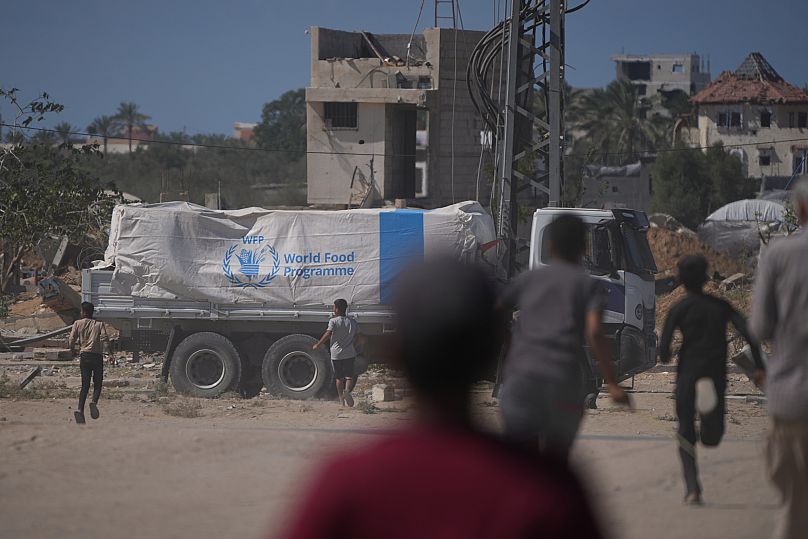
Palestinians rush toward trucks carrying aid from the World Food Programme as they drive through Deir al-Balah, 15 October, 2025 AP Photo/Abdel Kareem Hana

A spokesperson for the Commission says there are many bureaucratic obstacles hampering NGOs' ability to distribute aid, such as the current registration criteria imposed by Israel which can lead to the deregistration of some organisations.

"We need to get more food in," Eva Hrncirova, European Commission spokesperson told Euronews.

"We cooperate, for example, with World Food Programme, a UN partner. World Food Programme has about 170,000 tonnes of food ready to be delivered to Gaza and this would be enough for three months for all the population of Gaza to have nutrition," she said.

NGOs and international organisations have begun increasing delivery efforts, the Commission says. The UN has lifted the staff ceiling in Gaza to allow agencies to deploy more staff and the World Food Programme is maximising cargo inflow to Gaza to enhance nutrition programs and support bakeries, which can now supply 105,000 people with 2 kgs bread bundles every day.

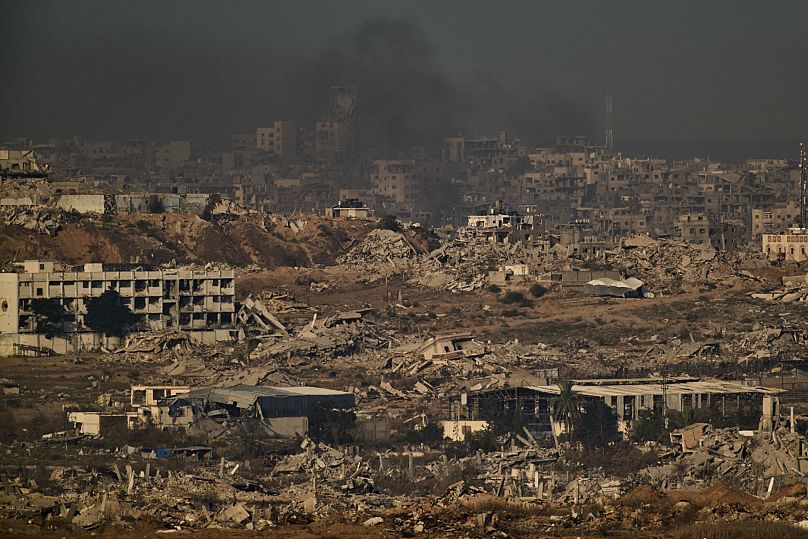
Buildings that were destroyed during Israeli ground and air operations in the northern Gaza Strip, 17 October, 2025 AP Photo

The EU has three humanitarian warehouses in Gaza, the Commission adds. The Daraj warehouse in North Gaza was evacuated in September 2025 and can no longer be operated, while stocks have been transferred to the operational Musadar and Zawayda warehouses.

"The needs in Gaza are immense. We have famine which means that basically everything is needed now. Obviously priority is food, nutrition, but also hygiene, medical, obviously equipment, healthcare, water. We also try to get in fuel to be able to power the services," Hrncirova said.

The European Commission also demanded access to Gaza for its staff and urged Israeli authorities to open all crossing points into Gaza.

It noted that of the four main ones, only two are currently open: Kerem Shalom and Kissufim, both located in the southern part of Gaza.

UN aid chief foresees 'massive job' ahead on tour of ruined Gaza

Jerusalem (AFP) – The United Nations' aid chief took stock of the monumental task of restoring basic necessities in the devastated Gaza Strip on Saturday, and Israel received the remains of another October 7 hostage as a ceasefire entered its second week.

Issued on: 18/10/2025 - FRANCE24

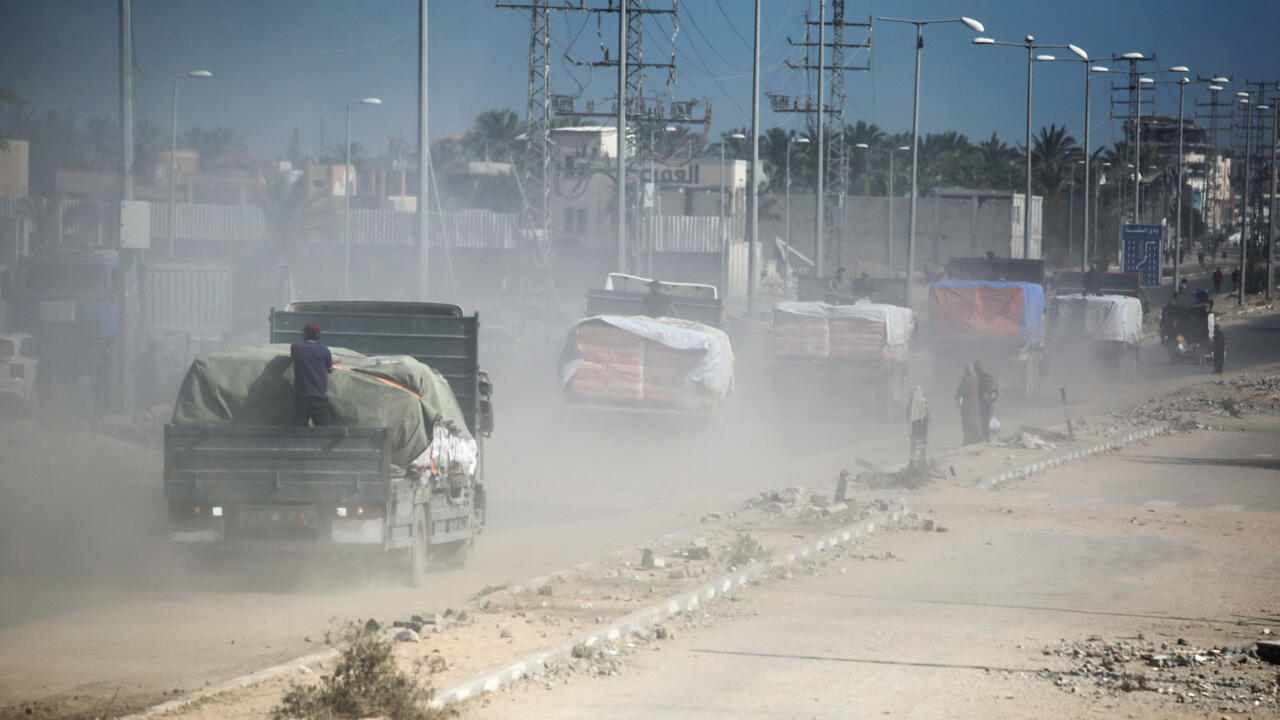
Aid trucks are now arriving in number in Gaza via two Israeli checkpoints but the UN is pushing for the Rafah crossing to Egypt to also be opened © Bashar TALEB / AFP


In a short convoy of white UN jeeps, relief coordinator Tom Fletcher and his team wound their way through the twisted rubble of shattered homes to inspect a wastewater treatment plant in Sheikh Radwan, north of Gaza City.

"I drove through here seven to eight months ago when most of these buildings were still standing and, to see the devastation, this is a vast part of the city, just a wasteland, and it's absolutely devastating to see," he told AFP.

The densely packed cities of the Gaza Strip, home to more than two million Palestinians, have been reduced to ruins by two years of bombardment and intense fighting between Hamas and the Israeli army.

Just over a week since US President Donald Trump helped broker a truce, the main border crossing to Egypt has yet to be reopened, but hundreds of trucks roll in daily via Israeli checkpoints and aid is being distributed.

Hamas has returned the final 20 surviving hostages it was holding and has begun to hand over the remains of another 28 who died.

On Friday night, it turned over a set of remains identified by Israel as Eliyahu Margalit, 75, who died in the October 2023 attack that ignited the war in Gaza.


Digging latrines


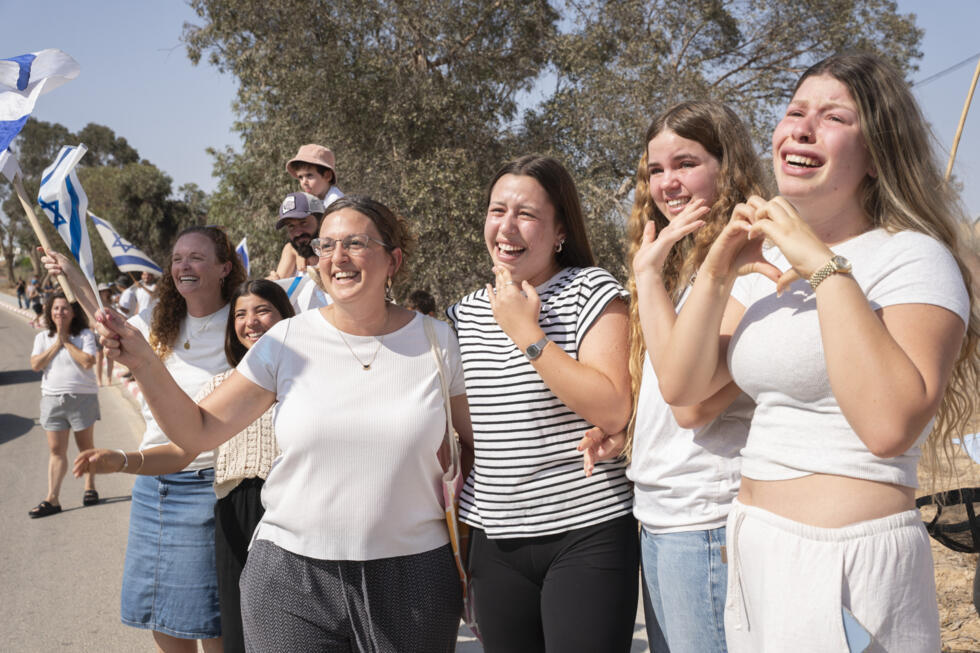
Former Israeli hostages have been welcomed home with joy since the ceasefire, but Hamas is under pressure to find the remains of 20 more who are thought to have died in custody © Maya LEVIN / AFP


Surveying the damaged pumping equipment and a grim lake of sewage at the Sheikh Radwan wastewater plant, Fletcher said the task ahead for the UN and aid agencies was a "massive, massive job".

The British diplomat said he had met residents returning to destroyed homes trying to dig latrines in the ruins.

"They're telling me most of all they want dignity," he said. "We've got to get the power back on so we can start to get the sanitation system back in place.

"We have a massive 60 day plan now to surge in food, get a million meals out there a day, start to rebuild the health sector, bring in tents for the winter, get hundreds of thousands of kids back into school."

According to figures supplied to mediators by the Israeli military's civil affairs agency and released by the UN humanitarian office, on Thursday some 950 trucks carrying aid and commercial supplies crossed into Gaza from Israel.

Relief agencies have called for the Rafah border crossing from Egypt to be reopened to speed the flow of food, fuel and medicines, and Turkey has a team of rescue specialists waiting at the border to help find bodies in the rubble.

Hostage remains


Israel's Prime Minister Benjamin Netanyahu approved the ceasefire but is under pressure at home to restrict access to Gaza until the remaining bodies of the hostages taken during Hamas's brutal attacks have been returned.

On Saturday, his office confirmed that the latest body, returned by Hamas via the Red Cross on Friday night, had been identified as Margalit, the elderly farmer who was known to his friends at the Nir Oz kibbutz as "Churchill".

"He was a cowboy at heart, and for many years managed the cattle branch and the horse stables of Nir Oz," said the Hostages and Missing Families Forum, a support group founded by relatives of the hostages.

"He was connected to the 'Riders of the South' group whose members shared a love of horseback riding for over 50 years. On October 7, he went out to feed his beloved horses and was kidnapped from the stable."

Margalit had been married with three children and three grandchildren. His daughter Nili Margalit, also taken hostage, was freed during the war's first brief truce in November 2023.

In a statement confirming he had been identified and his remains returned to his family, Netanyahu's office said "we will not compromise ... and will spare no effort until we return all of the fallen abductees, down to the last one".


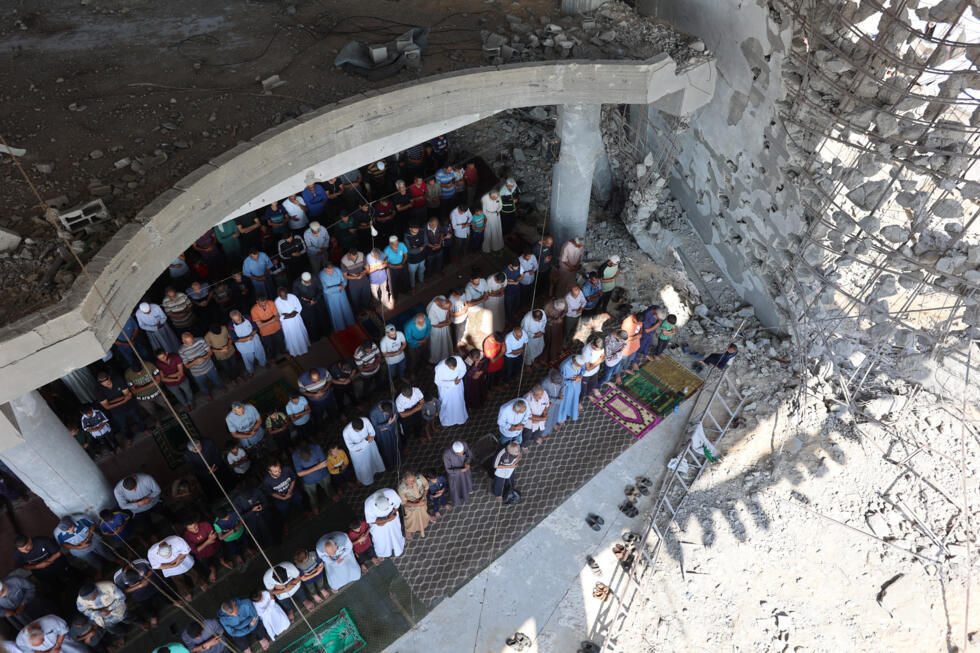
Palestinian Muslims returned to weekly prayers this week after the ceasefire in the war between Israel and Hamas but many of their mosques have been damaged or destroyed © Omar AL-QATTAA / AFP

Hamas spokesman Hazem Qassem said on Friday that the group "continues to uphold its commitment to the ceasefire agreement... and it will continue working to complete the full prisoner exchange process".

Under the ceasefire agreement between Israel and Hamas, negotiated by Trump and regional mediators, the Palestinian militant group has returned all 20 surviving hostages and the remains of 10 out of 28 deceased ones.

burs-dc/jd/smw

© 2025 AFP


UN Urges Opening Of All Gaza Crossing's To Deliver Three-Month Food Supply


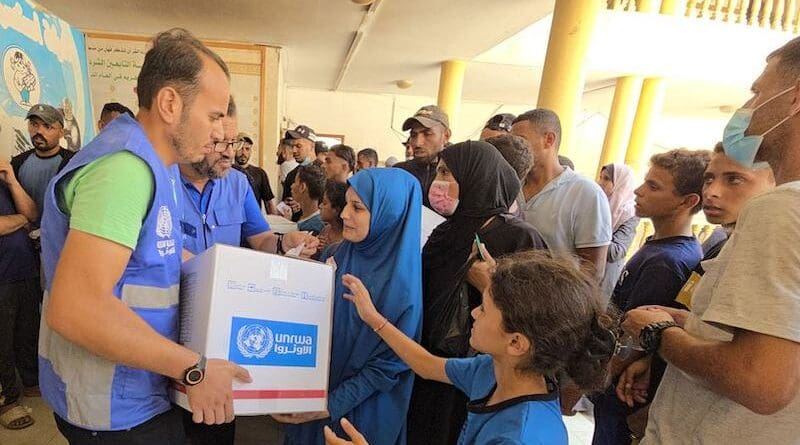
An UNRWA staff member distributing aid to affected civilians in Gaza. Photo Credit: UNRWA

October 18, 2025 0 Comments

By UN News


The UN World Food Programme (WFP) has warned food aid cannot reach everyone in Gaza unless all border crossings are opened, particularly in the north where famine was declared in August.

The agency says it already has enough supplies in place to feed the entire population of the Strip for three months – if full access is granted by Israel.

One week into the fragile ceasefire, WFP has been bringing in an average of 560 tonnes of food each day.

“The ceasefire deal has opened a narrow window of opportunity, and WFP is moving very quickly to scale up food assistance and reach families who have endured months of blockade, displacement and hunger,” said Abeer Etefa, WFP Senior Regional Communications Officer and Spokesperson for the Middle East, North Africa and Eastern Europe.

Speaking to journalists in Geneva, Ms. Etefa said teams and supply networks were fully mobilised.
Five distribution points now open

“We’re still below what we need, but we’re getting there,” she noted. Five food distribution points are now operating across Gaza, focusing on women and children. “Our goal is to expand to 145 distribution points across all of Gaza—that’s the scale we’re aiming for,” she added.

Aid agencies stress that sustained access and multiple crossings are essential to reach everyone in need. Only two crossings are currently open, and those in the north remain closed, restricting deliveries to the hardest hit areas.

“Roads are blocked and destroyed. This is a huge limitation to transport,” Ms. Etefa said.

Because of access and security constraints, no food distributions have yet taken place in Gaza City, only nutrition supplies for children and pregnant or breastfeeding women.

Jens Laerke, spokesperson for the UN aid coordination office (OCHA), said the northern crossings remain closed “because the Israeli authorities have not opened them”.

He added that road repairs and clearance of unexploded ordnance are also essential for safety and access. “It is very important to have these openings in the north, as that is where the famine took hold,” he said.
Fletcher says UN determined to deliver

UN relief chief Tom Fletcher joined the aid effort in Gaza on Friday, saying humanitarian teams are delivering on a 60-day plan to massively scale up life-saving work.

He said though the challenges ahead are immense, the UN is determined to deliver on the humanitarian possibilities created by US President Donald Trump’s peace deal.

The Humanitarian Affairs chief drove to Deir al Balah, where he visited the Castle Bakery – one of nine that the World Food Programme (WFP) supports across southern and central Gaza.

UN Spokesperson Stéphane Dujarric said the ceasefire has meant that the bakery can access fuel and flour, allowing it to produce up to 300,000 loaves of pita bread per day.
170,000-tonne aid scale up

According to WFP, 57,000 tonnes of food are already pre-positioned in Egypt, Jordan and inside Israel, with plans to scale up to 170,000 tonnes – enough for 1.6 million people over three months. “Beyond that, we need to maintain at least three months of stocks at all times,” Ms. Etefa said.

On 16 October, 950 trucks entered Gaza, including eight carrying fuel and three carrying gas, according to OCHA. Around of third of them passed through UN-coordinated mechanisms.
UN Women: Recovery must be led by women and girls

UN Women’s Chief of Humanitarian Action, Sofia Calltorp, urged the international community on Friday to turn Gaza’s fragile ceasefire into a recovery led by women and girls.

“We have heard from so many women and girls across Gaza since the ceasefire began – a mix of fragile hope, deep exhaustion and quiet strength,” she said.

“For the first time in months, some can seek care, receive aid and sleep without the sound of airstrikes. But hope, on its own, is not enough.”

Ms. Calltorp stressed that over one million women and girls need food aid and a quarter of a million require urgent nutrition support. “This ceasefire is our window to deliver fast, to stop famine where it has begun and prevent it where it looms,” she said.


UN News
News provided by UN News Centre

What The Gaza Ceasefire Reveals About The New Middle East? – OpEd


October 18, 2025

By Altaf Moti


The recent Gaza ceasefire is more than a temporary truce. It is a revealing moment that exposes shifting power dynamics in the Middle East and the growing global recognition of the Palestinian struggle.

While the agreement is fragile, it has forced regional and international actors to confront realities that Israel has long tried to suppress. This ceasefire is not simply a tactical deal; it reflects a changing regional order in which the Palestinian issue has re-emerged as a central question of justice and political legitimacy.

A Transactional Deal with Deep Implications


The ceasefire between Israel and Hamas is transactional. It was negotiated step by step, focusing on immediate exchanges and temporary measures rather than a long-term vision. It represents only the first phase of what could become a broader process, but it can also collapse at any time if parties fail to meet their commitments.

Israel enters this process with considerable military strength. It remains the dominant power on the ground. Nothing significant moves without its approval. Yet its ability to dictate terms unilaterally is being challenged by the growing involvement of regional states and global mediators. Qatar, Turkey, Egypt, and the United States all played essential roles in shaping the deal. These actors are increasingly balancing Israeli power, using diplomacy, mediation, and security guarantees to shape outcomes.

Shifting Regional Power Dynamics

The composition of the negotiating table reflects a “new Middle East.” In the past, large Arab states dominated diplomacy through pan-Arab initiatives. Today, smaller Gulf states have emerged as critical mediators because of their unique connections to both Western governments and groups like Hamas. Turkey and Egypt also play active roles.

This redistribution of influence reduces Israel’s ability to isolate the Palestinian question. Regional actors have realized that normalization with Israel, without addressing Palestinian rights, does not bring real stability. The ceasefire negotiations show that Israel cannot bypass Palestinian demands by relying only on bilateral deals with Arab governments.

Israel’s Position of Power and Its Limits

Israel continues to rely on overwhelming military force to impose its will. However, this strategy has reached its limits. After months of bombardment in Gaza, Israel faced growing international criticism for massive civilian casualties, destruction of infrastructure, and collective punishment. Global opinion shifted sharply, and many states began pressing for accountability.

At the same time, internal political divisions in Israel weakened its ability to produce a coherent long-term strategy. Concessions from Israel required political pressure from external actors. Even the United States had to push hard to bring the Netanyahu government to accept aspects of the ceasefire. This shows that Israel’s power is not absolute and that international pressure can shape its behavior.

The Ceasefire Does Not Address Core Issues

Despite its significance, the ceasefire does not resolve any of the core political questions. Gaza’s future governance, border control, security arrangements, and reconstruction remain unsettled. The Israeli occupation of Palestinian land continues. There is no agreed plan for Palestinian sovereignty or for ending decades of systemic discrimination and displacement.

Many analysts have described the ceasefire as tactical rather than strategic. Without addressing root causes, such agreements remain temporary. This view is echoed by Palestinian voices who stress that occupation and injustice are the real sources of instability.

Palestinian Voices Reasserted


The conflict has brought the Palestinian issue back to the international agenda. In recent years, Israel sought to normalize relations with Arab states while bypassing Palestinian rights. This strategy has now been exposed. The war and the subsequent ceasefire have shown that no regional arrangement can be stable without a just solution for Palestinians.

It is also clear that normalization without justice is meaningless. Palestinians demand sovereignty, dignity, and independence. Temporary truces and economic incentives cannot replace these fundamental rights. The ceasefire has strengthened the moral and political claim of Palestinians on the global stage.

Implementation is the Real Test

The success or failure of the ceasefire depends on implementation. Mediators must monitor and enforce commitments. Without credible guarantees, the deal can collapse. Regional actors must remain engaged to keep the process alive.

Enforcement mechanisms are essential. In the absence of accountability, Israel has often violated past agreements with little consequence. The international community must ensure that violations are address
ed and that Palestinian rights are upheld. Failure to do so will lead to renewed conflict.

The Two-State Solution Remains Central

Despite years of stagnation, the two-state solution remains the only viable path to lasting peace. No alternative exists that can deliver stability, security, and justice. For Palestinians, this means an independent state with real sovereignty. For Israelis, it means accepting that occupation cannot continue indefinitely without consequences.

The ceasefire provides a narrow opening to restart meaningful political discussions. If seized wisely, it could mark the beginning of a broader transformation. If ignored, it will become another missed opportunity.

A Moment of Choice

The Gaza ceasefire reveals two competing paths. One is the continuation of occupation, repression, and cycles of war — a path that has led to destruction, isolation, and moral condemnation for Israel. The other is a shift towards justice, recognition of Palestinian rights, and genuine regional cooperation.

Palestinians have shown resilience in the face of overwhelming force. Their cause has re-emerged with renewed strength. Regional states and global powers now face a clear test: whether they will allow Israel to continue policies of domination, or whether they will support a fair and lasting political solution.

This ceasefire is not an end. It is a signal of changing realities. Israel’s military power remains strong, but its ability to control the political narrative is weakening. The Palestinian issue has regained international urgency. Regional actors have become more assertive.

A transactional deal can be transformed into a political breakthrough if there is sustained pressure for justice and accountability. The world must not allow Israel to turn this moment into another temporary pause before renewed violence. Genuine peace can only come through ending occupation and recognizing Palestinian rights. Anything less will ensure that history repeats itself.


Altaf Moti writes on diverse topics such as politics, economics, and society.


Could Gaza’s ceasefire process draw lessons from Northern Ireland’s path to peace?

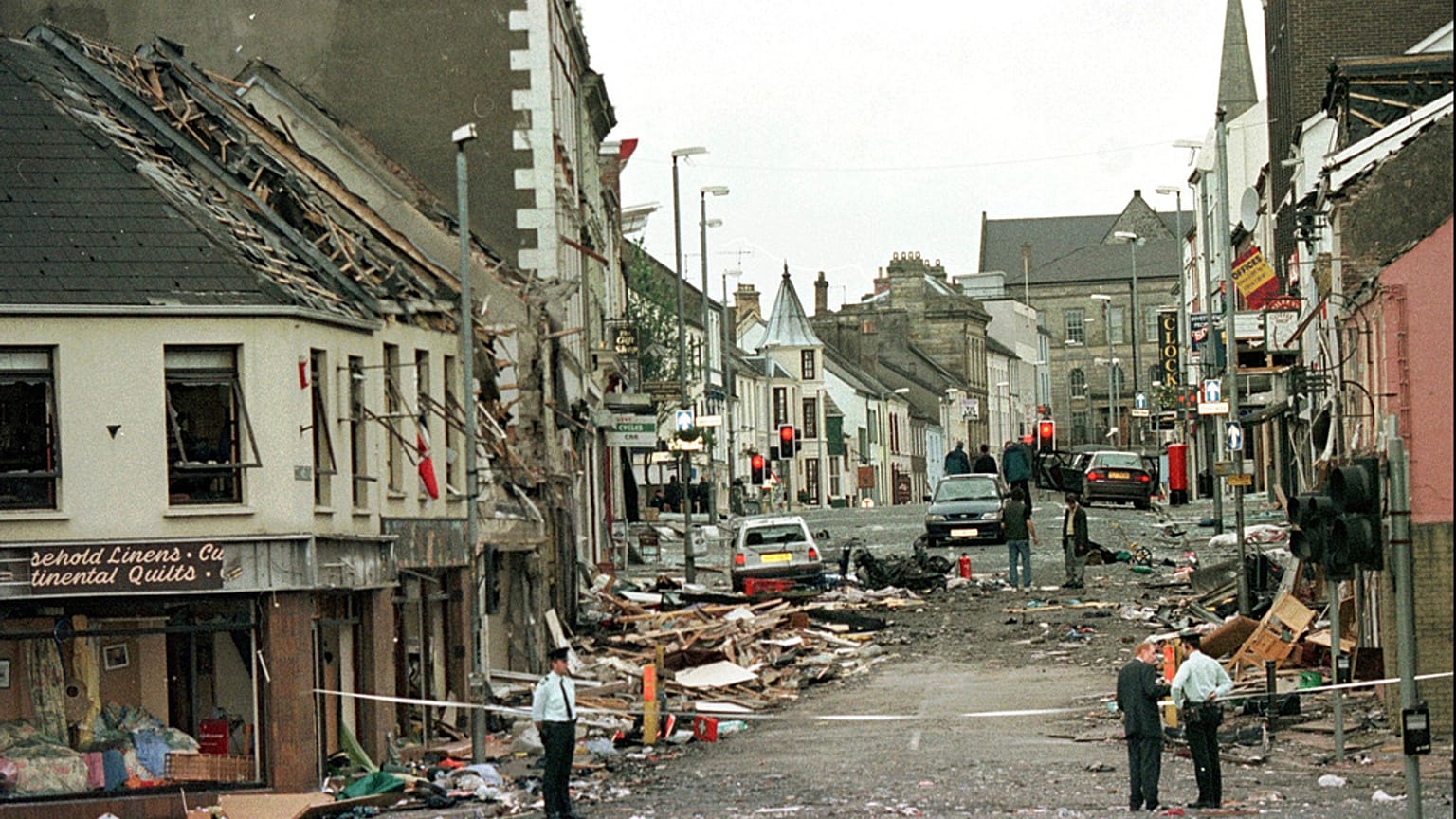
Royal Ulster Constabulary Police officers stand on Market Street, the scene of a car bombing in the centre of Omagh, Co Tyrone,Northern Ireland, on Aug. 15, 1998.
Copyright Paul McErlane/AP1998

By Euronews with AP
Published on 

'If there was a broad lesson from the success of Northern Ireland, it’s that an inclusive process worked – and I mean inclusive in the full sense, all different parties, even including militants,' Peter McLoughlin.

As Palestinians and Israelis wait to see what comes after the ceasefire in Gaza, some are looking to Northern Ireland’s peace process in the 1990s for lessons on how to move from war to peace.

Two figures from that process, former Prime Minister Tony Blair and his former chief of staff Jonathan Powell, are back in the spotlight as they are involved in talks with the United States and other countries about Gaza’s future.

Prime Minister Keir Starmer said this week that “drawing on our experience in Northern Ireland, we stand ready to play a key role in the decommissioning of Hamas’ weapons and capability.”

During “the Troubles,” around 3,600 people were killed and 50,000 wounded in three decades of violence over Northern Ireland’s status. A peace deal, the Good Friday Agreement, was finally signed in 1998. It ended most of the fighting and led to the disarming of the Irish Republican Army (IRA) and other militant groups.

The Trump-backed plan for Gaza is much narrower. It does not deal with the wider Israeli–Palestinian conflict which began decades before the latest war. It doesn't offer a path either to Palestinian statehood, something Israel rejects but that is seen internationally as the only way to resolve the conflict.

The plan calls for Hamas to disarm, something the group refuses to do, though it says it might hand some weapons to a Palestinian or Arab authority.

In Northern Ireland, the IRA’s refusal to give up its weapons was a major problem that threatened the peace process.

Experts say there are similarities, but also major distinctions, between the Northern Ireland conflict and the devastating war in Gaza, which was sparked by Hamas’ 7 October attack on Israel, in which 1,200 people were killed and 251 taken hostage.

Israel's retaliatory offensive has reduced much of Gaza to rubble, led to famine and killed nearly 68,000 Palestinians, according to the local authorities.

Kristian Brown a politics lecturer at Ulster University in Belfast, said “The level of challenge in the Middle East now is monumental,” adding “The level of bitterness, the sense of immediate threat and the levels of destruction (in Northern Ireland) were not as cataclysmic as Gaza.”

The Irish Republican Army eventually agreed to put its arsenal “beyond use” through a secret process monitored by an international group. This happened while political talks were under way to settle the main disputes, something that more than three decades of US-led peace efforts in the Middle East have failed to accomplish.

In Northern Ireland, disarmament was slow. The IRA began giving up its weapons in 2001 and finished in 2005, seven years after the peace deal. Several other British loyalist and Irish republican militant groups also disarmed as part of the process.

“The British might be able to counsel patience and pragmatism,” said Niall Ó Dochartaigh, a professor of political science at the University of Galway. “The IRA leadership had to be helped in various ways to make that argument (for disarmament) within the organisation.

“Ultimately, decommissioning only happened in the Irish case once the IRA was satisfied that there was a political settlement bedded down,” he added. And while “the contours of a compromise settlement emerged quite early in Northern Ireland,” a similar consensus in the Middle East appears far off.

Fragile power-sharing

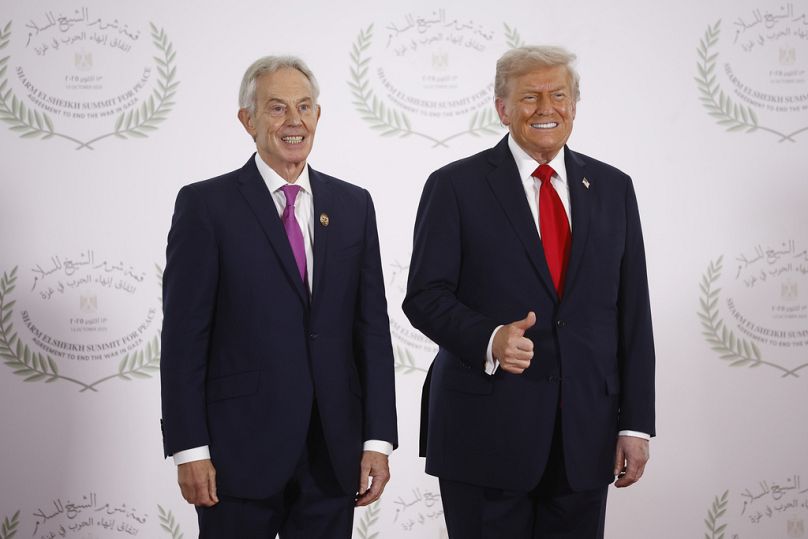
President Donald Trump and British former prime minister Tony Blair pose at the Gaza Peace Summit in Sharm el-Sheikh, Egypt, Monday, Oct.13 2025. Yoan Valat/AP

The 20-point plan for Gaza includes steps from ceasefire to reconstruction but leaves big questions unanswered, such as the future of Jerusalem, the return of Palestinian refugees, security arrangements, future borders and the scores of Israeli settlements and violence in the occupied West Bank.

The Good Friday Agreement was clearer, setting up a local government and power-sharing system. But even that peace has faced challenges, with occasional attacks and political crises over the years.

Despite this, Northern Ireland remains mostly peaceful. Parties once linked to violence, like Sinn Féin, now play major political roles.

According to Peter McLoughlin, a senior lecturer in politics and history at Queen’s University Belfast, the key to success of Northern Ireland's peace process was "Engaging those involved with violence and bringing them down democratic paths”.

He said excluding Hamas, which has ruled Gaza since 2007, in the future of the strip, could be a problem.

“If there was a broad lesson from the success of Northern Ireland, it’s that an inclusive process worked – and I mean inclusive in the full sense, all different parties, even including militants," McLoughlin said.

“Hamas is being excluded from the political process and is expected to give up its weapons," he added. “I don’t know how feasible that is.”

The return of key players

Tony Blair is seen as possible advisers for Gaza by Trump. Blair, prime minister from 1997 to 2007, also served as envoy to Israel and the Palestinians for the “Quartet”: the US, EU, Russia and UN. But he remains controversial for backing the Iraq War in 2003 and Trump has acknowledged that Blair might not be “an acceptable choice to everybody” in the region.

Meanwhile Jonathan Powell, Starmer’s national security adviser, who attended recent talks in Egypt was praised by US Middle East special envoy Steve Witkoff for “incredible input and tireless efforts” in reaching the agreement.

But Bronwen Maddox, the director of Chatham House, the UK-based international affairs institute, was skeptical about drawing parallels between the two processes. She said Britain “can play a small diplomatic part” in Gaza, but probably not a decisive one.

The Northern Ireland peace deal “was a successful and really important peace negotiation," she said. "But it was very much of itself, I think.”

A Trumpian World, Or Not – OpEd


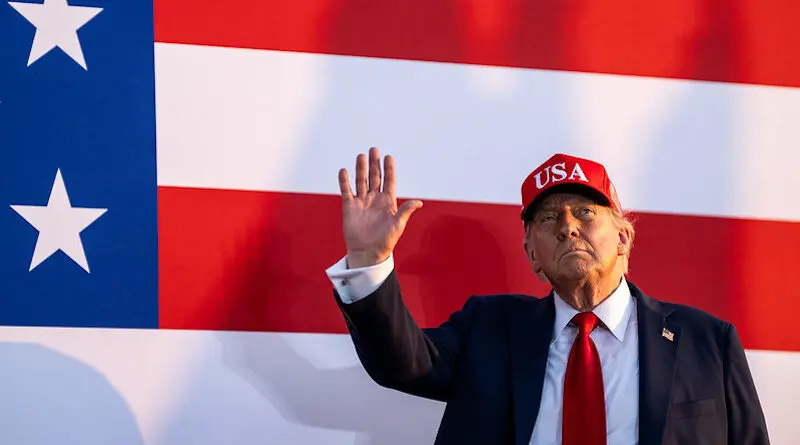
US President Donald Trump (Official White House Photo by Daniel Torok)

October 18, 2025

By IFIMES
By Dr. J. Scott Younger


At the new year several years ago, I wrote in my diary ‘’In looking through a world view prism most of mankind is just trying to get on with life, a few awkward individuals trying to make it follow their generally twisted thinking, whether from a religious or political or simply selfish basis, and a few presenting a decent, enlightened and compassionate viewpoint. It would appear that little or nothing has changed. And is it ever thus? Probably, but there are significantly more of us now and getting around the world and faster is much easier. The world has ‘shrunk’ just in a lifetime.

The western media have largely been taken up with the many ‘doings’ of the American President over the past month or so. In mid-September it was the occasion of the State visit to the UK at the invitation of King Charles. A grand affair of much pageant with everyone watching their ‘p’s and q’s so that nothing was said out of place, cause offence, and with undue flattery given to the President, as journalists have written. A few days later, the President spoke at a General Assembly meeting of the United Nations and ranted for over an hour, the usual length of speech being in the order of 15 minutes. Most of what he said was untrue, gibberish in other words. Climate change was a hoax, he said. (The US is the largest emitter of greenhouse gases). Further, Sadiq Khan, the mayor of London was the worst mayor in the world, as measured in terms of crime. He would soon be introducing sharia law! Wrong on both counts. Trump has hardly, been in London. The speech, repeating himself in his usual style, after a moment’s silence was greeted with a polite applause, much of the audience somewhat taken aback at the length and rambling content.

On the domestic front he decided to use the deemed power of his position – it being generally acknowledged that he ‘controls’ the Republican party – to go after the Democrats, whom he considers to have done him some wrong in the previous presidential campaigns. He is currently trying to do this against pro-democratic Chicago, Illinois, and Portland, Oregon, by putting in Federal troops, under the White House command, to clean up a crime level on the streets of the cities which he states, quite wrongly, exists. The judiciary at the highest level has been called in to check whether he has the powers to do this. In similar vein he has recalled all senior officers, generals, from stations around the world to lecture them on the situation, as he perceives it, and to alert them that they might be recalled to address a domestic problem should it get out of hand. He is determined to engage with these states despite strong objections which could backfire and cause needless trouble across the US. We have not heard the end of this.

Israel’s bombing of an American ally

A few weeks ago, Netanyahu ordered the IDF to bomb a hotel in Qatar where key Hamas people were staying as part of the team supposed to be negotiating a ceasefire in Gaza. Considerable damage was caused to the building but the Hamas negotiators were left unscathed. As Qatar is a close ally of the US, President Trump was not well pleased and so advised Netanyahu accordingly in robust terms. In short, this led to the Israeli PM, in Trump’s presence, reluctantly telephoning the Qatari Emir and apologising for the infraction. Meanwhile, Steve Witkoff and Jared Kushner, the Middle East envoy and Trump’s son-in-law respectively, were tasked with drawing up a detailed peace plan to stop the ongoing one-sided conflagration. This peace agreement of 20 points, with much fanfare, has recently been signed by all parties, reluctantly in some cases, and a ceasefire taken place bringing an end to hostilities, at least in the short term.

The key early part in the agreement relates to Hamas releasing all the hostages they captured 2 years ago, 20 still alive and 28 ostensibly in body bags. In exchange, the Israelis would release almost 2000 Palestinians held in captivity, some for as much as 20 years but most for largely flimsy reasons, often with no trial in conditions deplorable, some even suffering torture or other degrading things done to them. This must be balanced, however, by the shocking conditions which Hamas has inflicted on some of the hostages.

At time of writing, the Peace Agreement was signed just two-three days ago. Hamas is still looking for dead hostages some yet unidentified or simply not found underneath the 55 billion tons of rubble which is all that remains of Gaza city. The Hamas people have not disarmed, and do not look as if they intend to. The IDF have withdrawn to a line roughly half way back to the old boundary of the Gaza strip. Each side wary of the other. Peace may have been declared, and the Palestinian people are relieved, but it would not take much to trigger a resumption of hostilities, particularly when the Israeli PM feels that he has been ‘robbed’ of finishing the war on his terms.

The clauses of the Agreement deal with matters going forward, but most of these usually and naturally are quite vague. What is the nature of the organisation to handle the transition of power to the Palestinians, minus Hamas, and engage in the start of the rebuilding of the Gaza strip. The 2-state solution is the only way to secure peace for the future, and no one said this more forcibly than King Abdullah of Jordan, despite Netanyahu saying the opposite. The sooner the state of Israel changes its government the better, and then there will be a chance to make a lasting peace. Israel must change from acting like an authoritarian state, although it would deny that, since it thinks it is a democracy and there is press freedom. There is not, at the moment, anyway; the press is under the control of Netanyahu’s government, which is why some of the public wrongly believe and state the government line that there is no food shortage and critical starvation in Gaza, for instance.

Fear and yet hope for the success of the peace plan

Several foreign correspondents, who know the area well, take a rightfully correct stance of doubting that the Peace Plan will work but hoping otherwise. Hamas’ slow return of the hostage body-bags has presented the IDF to close off one of the entries for food aid. Now Hamas are admitting that it will be difficult, if not impossible, for them to return all the body bags because Gaza is almost entirely just a mass of rubble from the unrelenting Israeli bombing of the past months, and it will take time and earth-moving machines to retrieve them. At least President Trump has recognised this, so some allowance of time can be expected. Those opposing the Peace Plan will be looking for any excuse to derail it. Hamas has not yet disarmed, as per the agreement, and strut around showing off their weaponry. Trump is not impressed and has promised violent retribution. Difficult days ahead.

President Trump does not have a reputation as having a long attention span. It is therefore important that his appointees to the transition role, which will also take responsibility for the rebuilding of the strip and involving and training up the Palestinians to take over the government. However, in the 2- state solution, in parallel the problems of the west bank must be resolved. The Israeli settlers have, for the past three decades, been creeping onto Palestinian land, their government turning a blind eye to this illegal action, if not encouraging it. The 2-state solution has been made more difficult by this action. Watch the days ahead.

The US has now turned its attention to the other troubled area, Ukraine. President Zelenskiy is arriving in Washington today to advise President Trump of the latest situation. Let us wait to see what comes out of that. I have no reason to alter my thoughts as expressed at the beginning! Life continues as before, the weapons of destruction only becoming more sophisticated. Hello, drones! 


About the author: Dr. J. Scott Younger, OBE, is a professional civil engineer; he spent 42 years in the Far East undertaking assignments in 10 countries for WB, ADB, UNDP. He published many papers; he was a columnist for Forbes Indonesia and Globe Asia. He served on British & European Chamber boards and was a Vice Chair of Int’l Business Chamber for 17 years. His expertise is infrastructure and sustainable development and he takes an interest in international affairs. He is an International Chancellor of the President University, Indonesia and Honorary Senior Research Fellow of the Glasgow University. He is a member of IFIMES Advisory Board. Lived and worked in Thailand from 1978 to 1983 and visited Burma, Bangladesh and Nepal for projects.


The views expressed in this article are the author’s own and do not necessarily reflect IFIMES official position.


IFIMES

IFIMES – International Institute for Middle-East and Balkan studies, based in Ljubljana, Slovenia, has special consultative status with the Economic and Social Council ECOSOC/UN since 2018. IFIMES is also the publisher of the biannual international scientific journal European Perspectives. IFIMES gathers and selects various information and sources on key conflict areas in the world. The Institute analyses mutual relations among parties with an aim to promote the importance of reconciliation, early prevention/preventive diplomacy and disarmament/ confidence building measures in the regional or global conflict resolution of the existing conflicts and the role of preventive actions against new global disputes.
UN Security Council Backs Lebanon’s Efforts To Assert Sovereignty, Calls For Global Support Of Army


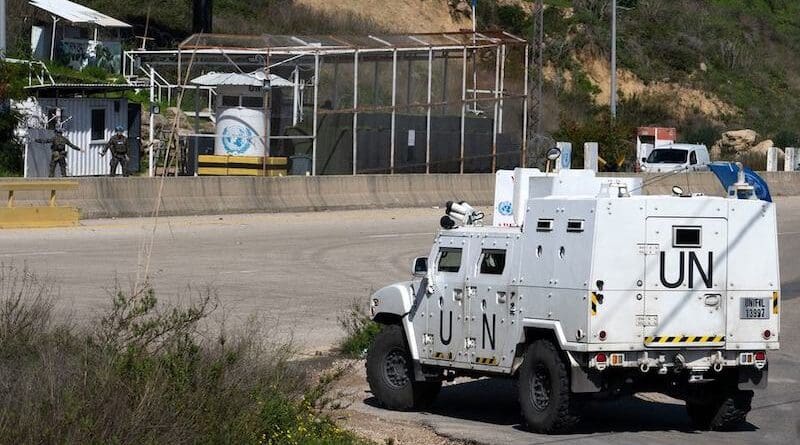
File photo of UNIFIL peacekeepers patrol in the vicinity of Tyre, south Lebanon. 
Photo Credit: UN Photo/Pasqual Gorriz


October 18, 2025 
 Arab News
By Ephrem Kossaify


UN Security Council on Friday expressed its strong support for Lebanese authorities in their efforts to assert sovereignty over their entire territory, and called on international community to step up the assistance it provides to the Lebanese Armed Forces.

It comes as UN peacekeepers in southern Lebanon report violations of UN resolutions, including the discovery of unauthorized weapon caches.

In a unanimous statement, the 15 members of the Security Council welcomed the Lebanese government’s commitment to the extension of state authority across the country through the deployment of the army, and said no authority should be recognized other than that of the government.

They also called for increased international backing to ensure the “effective and sustainable deployment” of the Lebanese army south of the Litani River, a region in which tensions with neighboring Israel have frequently flared.

Members reiterated their full support for the UN Interim Force in Lebanon and urged all sides in the country to take “all necessary measures” to guarantee the safety of the peacekeepers and their facilities. “Peacekeepers must never be targeted by attack,” they said.

The council called on all parties to honor their commitments under the Nov. 26, 2024, cessation of hostilities agreement between Israel and Hezbollah, and to adhere to the principles of international humanitarian law by ensuring the protection of civilians.

Welcoming the stated willingness of Beirut to delineate and demarcate its border with Syria, and its efforts to curb cross-border smuggling, council members called for the full implementation of Security Council Resolutions 1701 and 1559, which address the disarmament of non-state militias and the authority of the Lebanese state.

Also on Friday, Stephane Dujarric, spokesperson for UN Secretary-General Antonio Guterres, said that UNIFIL peacekeepers in southern Lebanon, have been monitoring and reporting violations of resolution 1701, including unauthorized weapon caches, in their area of operations.

“On Thursday, mortar shells were found in Sector West, while on Tuesday, a joint patrol with the Lebanese army discovered damaged rockets and their launchers in Sector East,” he said.

“UNIFIL also continues to observe Israel Defense Forces military activities in the area of operations, including on Wednesday, where mortar fire from south of the Blue Line was detected, impacting near Yaroun in Sector West.”

The Blue Line is a line of demarcation separating Israel and Lebanon set by the UN in 2000 to confirm the withdrawal of Israeli forces.

“Also on Wednesday, in Sarda in Sector East, IDF soldiers pointed infrared lasers at UNIFIL patrol vehicles,” Dujarric said. “We once again stress these acts of interference must stop.

“Meanwhile, UNIFIL’s Maritime Task Force conducted training this week with Lebanese Navy personnel aboard a Maritime Task Force vessel. Separately, peacekeepers in Sector East trained with Lebanese army personnel to address threats posed by explosive remnants of war.”


Arab News is Saudi Arabia's first English-language newspaper. It was founded in 1975 by Hisham and Mohammed Ali Hafiz. Today, it is one of 29 publications produced by Saudi Research & Publishing Company (SRPC), a subsidiary of Saudi Research & Marketing Group (SRMG).