Copyright Shafiqullah Mashaal/Copyright 2025 The AP. All rights reserved.
By Malek Fouda
Published on 19/10/2025 - EURONEWS
Published on 19/10/2025 - EURONEWS
The two sides have agreed to hold follow-up talks in Qatar to establish conditions and a framework for lasting peace, bringing an end to a week of deadly cross border skirmishes, which have killed dozens of people.
Afghanistan and Pakistan have agreed to an immediate ceasefire after holding talks with Qatari mediators in Doha, according to Qatar’s Foreign Ministry.
The deal marks an end to a week of cross-border fighting that has killed dozens of people and injured hundreds more, in what was the deadliest crisis between the two countries in several years.
The two sides have agreed to establish mechanisms to consolidate lasting peace and stability, and to hold follow-up talks in the coming days to ensure the sustainability of the truce, the Qatari statement said.
The statement added that Turkish negotiators also contributed to brokering this deal.
Violence has escalated between the neighbours since earlier this month, with each country saying they were responding to aggression from the other. Afghanistan denies harbouring militants who carry out attacks in border areas, a key area of concern for Islamabad.
Pakistan has been grappling with a surge in militancy in its western border areas with Afghanistan since 2021, after the Taliban seized control and returned to power in Afghanistan.
Fighting has threatened to further destabilise a region where groups including the Islamic State group and al-Qaeda are trying to resurface.
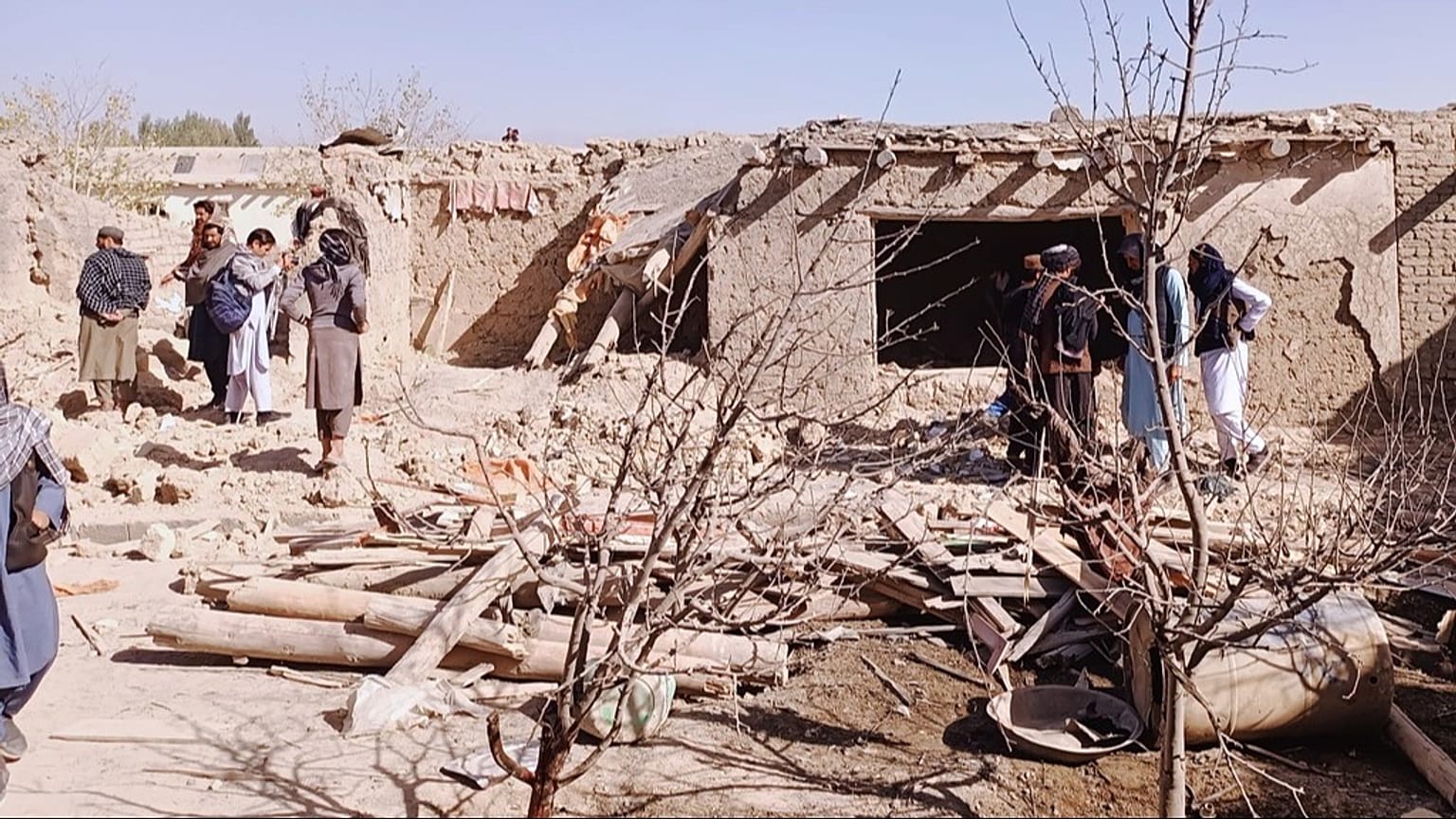
On Friday, just hours after the expiration of a 48-hour truce, Pakistan struck across the border, targeting militants belonging to the Hafiz Gul Bahadur group, in the eastern Afghan province of Paktika.
Afghanistan and Pakistan have agreed to an immediate ceasefire after holding talks with Qatari mediators in Doha, according to Qatar’s Foreign Ministry.
The deal marks an end to a week of cross-border fighting that has killed dozens of people and injured hundreds more, in what was the deadliest crisis between the two countries in several years.
The two sides have agreed to establish mechanisms to consolidate lasting peace and stability, and to hold follow-up talks in the coming days to ensure the sustainability of the truce, the Qatari statement said.
The statement added that Turkish negotiators also contributed to brokering this deal.
Violence has escalated between the neighbours since earlier this month, with each country saying they were responding to aggression from the other. Afghanistan denies harbouring militants who carry out attacks in border areas, a key area of concern for Islamabad.
Pakistan has been grappling with a surge in militancy in its western border areas with Afghanistan since 2021, after the Taliban seized control and returned to power in Afghanistan.
Fighting has threatened to further destabilise a region where groups including the Islamic State group and al-Qaeda are trying to resurface.
On Friday, just hours after the expiration of a 48-hour truce, Pakistan struck across the border, targeting militants belonging to the Hafiz Gul Bahadur group, in the eastern Afghan province of Paktika.
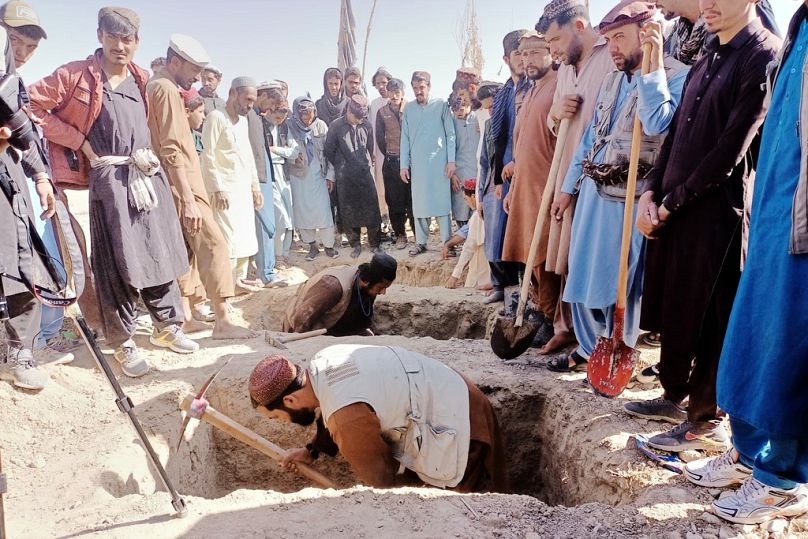
Locals dig graves for people killed in a cross-border airstrike by the Pakistani army in Afghanistan's eastern Paktika province, Saturday, Oct. 18, 2025 Shafiqullah Mashaal/Copyright 2025 The AP. All rights reserved.
Islamabad claimed the attacks on at least two districts in the Afghan province neutralised dozens of armed fighters, and killed no civilians.
Officials added that the strikes were in response to a suicide bombing of a security forces compound in Mir Ali in Pakistan’s western Khyber Pakhtunkhwa province a day earlier.
Taliban officials however say the aerial raids killed at least 10 civilians, including women, children and local cricket players who had been competing in a match in close proximity to the sites targeted.
The attacks prompted the national cricket board to boycott an upcoming competition in Pakistan. Cricket's global governing body, the International Cricket Council, said it was “saddened and appalled by the tragic deaths of three young and promising Afghan" players.
Zabihullah Mujahid, the Taliban government’s chief spokesman, had earlier criticised the “repeated crimes of Pakistani forces and the violation of Afghanistan’s sovereignty.”
Such acts were deemed provocative and viewed as “deliberate attempts” to prolong the conflict, he added.
Islamabad claimed the attacks on at least two districts in the Afghan province neutralised dozens of armed fighters, and killed no civilians.
Officials added that the strikes were in response to a suicide bombing of a security forces compound in Mir Ali in Pakistan’s western Khyber Pakhtunkhwa province a day earlier.
Taliban officials however say the aerial raids killed at least 10 civilians, including women, children and local cricket players who had been competing in a match in close proximity to the sites targeted.
The attacks prompted the national cricket board to boycott an upcoming competition in Pakistan. Cricket's global governing body, the International Cricket Council, said it was “saddened and appalled by the tragic deaths of three young and promising Afghan" players.
Zabihullah Mujahid, the Taliban government’s chief spokesman, had earlier criticised the “repeated crimes of Pakistani forces and the violation of Afghanistan’s sovereignty.”
Such acts were deemed provocative and viewed as “deliberate attempts” to prolong the conflict, he added.
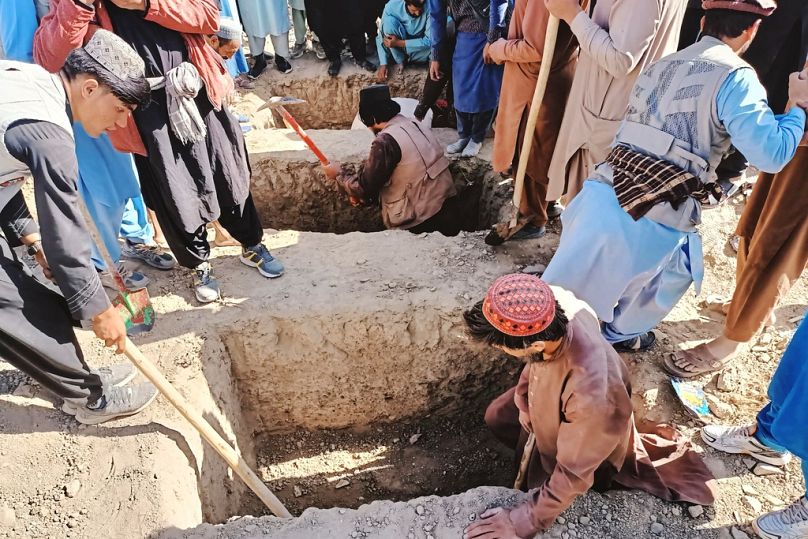
Locals dig graves for people killed in a cross-border airstrike by the Pakistani army in Afghanistan's eastern Paktika province, Saturday, Oct. 18, 2025 Shafiqullah Mashaal/Copyright 2025 The AP. All rights reserved.
Pakistan's army chief, Asim Munir, urged Afghans to choose “mutual security over perpetual violence and progress over hardline obscurantism.”
“The Taliban must rein in the proxies who have sanctuaries in Afghanistan,” he told an audience at the Pakistan Military Academy in Kakul, Khyber Pakhtunkhwa, as high-level delegations from both countries met in the Qatari capital on Saturday for the negotiations.
The two countries share a more than 2,600 kilometre border, known as the Durand Line, but Afghanistan has never recognised it, viewing it as a historical issue imposed during British colonial rule, although it functions as the de facto border in practice.
Kabul has rejected the borders, saying it was imposed on them under duress in 1893 and divides Pashtun tribes who inhabit western Pakistan and eastern Afghanistan.
It instead recognises the 1947 borders, which disputes large swathes of Pakistani land, and has resulted in various cross border skirmishes over the decades, led by local militant groups, over control and territorial disputes.
Additional sources AP
Pakistan's army chief, Asim Munir, urged Afghans to choose “mutual security over perpetual violence and progress over hardline obscurantism.”
“The Taliban must rein in the proxies who have sanctuaries in Afghanistan,” he told an audience at the Pakistan Military Academy in Kakul, Khyber Pakhtunkhwa, as high-level delegations from both countries met in the Qatari capital on Saturday for the negotiations.
The two countries share a more than 2,600 kilometre border, known as the Durand Line, but Afghanistan has never recognised it, viewing it as a historical issue imposed during British colonial rule, although it functions as the de facto border in practice.
Kabul has rejected the borders, saying it was imposed on them under duress in 1893 and divides Pashtun tribes who inhabit western Pakistan and eastern Afghanistan.
It instead recognises the 1947 borders, which disputes large swathes of Pakistani land, and has resulted in various cross border skirmishes over the decades, led by local militant groups, over control and territorial disputes.
Additional sources AP
China–India Rapprochement And Its Strategic Implications For Afghanistan – Analysis
October 19, 2025
By Imran Zakeria, Scott N. Romaniuk and László Csicsmann
Afghanistan’s history reads as a catalogue of great power competition. From the 19th-century rivalry between Tsarist Russia and Great Britain to the Cold War confrontation between the United States (U.S.) and the Soviet Union, the country’s strategic location has repeatedly drawn external actors into its domestic affairs. Its terrain and position have made it both a prize and a battleground, where the ambitions of powerful neighbors have often eclipsed the needs of its own people.
These rivalries not only hindered meaningful reconstruction but actively eroded Afghanistan’s existing infrastructure, underscoring how external competition repeatedly translated into internal devastation. Following the US military intervention at the start of the 21st century, Afghanistan witnessed modest economic growth and partial infrastructure reconstruction, but these outcomes came at an extraordinary cost. External powers once again turned the country into a battleground for their geopolitical rivalries, prioritizing strategic interests over Afghan stability and welfare. Ordinary citizens endured the heaviest burden, facing daily casualties and profound human suffering.
While Afghanistan’s strategic geography has made it a target of foreign rivalries, the persistence of its problems cannot be explained by external factors alone. The absence of effective strategic vision among Afghan rulers, coupled with their inability to manage the country’s geopolitical position within regional and international frameworks, has perpetuated instability and limited opportunities for national resilience. Domestic political challenges—including factional divisions within the Islamic Emirate, governance capacity limitations, and local power dynamics—further shape decision-making and influence Afghanistan’s ability to leverage regional partnerships. Without stronger internal legitimacy and administrative effectiveness, even well-intentioned foreign engagement faces significant constraints.
Afghanistan–Pakistan Relations and Regional Frictions
During the period of US military presence, relations between Afghanistan and Pakistan were characterized by persistent tension and mistrust. Since the return of the Islamic Emirate in 2021, these frictions have not only continued but intensified, reflecting enduring disputes over border security, militancy, and mutual accusations of interference.
Disputes over the Durand Line, Pakistani airstrikes on Afghan territory, and reciprocal accusations of supporting terrorism have further deepened the complexity of bilateral relations. India, as another key regional actor, has consistently criticized Pakistan in international forums, holding it accountable for sponsoring terrorism and undermining regional stability. Recent frictions, particularly Pakistan’s repeated closure of the Torkham gate, have strained bilateral ties and impeded regional economic cooperation.
Pakistan’s hosting of the two-day conference ‘Toward Unity and Trust’, organized by the South Asia Strategic Stability Institute (SASSI), marked the first occasion on which Taliban opponents were formally received by Islamabad. The event highlights the complexity of regional involvement in Afghanistan’s internal politics. Some observers viewed the meeting as a cautious step towards political inclusivity, while others regarded it as a demonstration of Pakistan’s continued leverage and a reflection of the fragmented Afghan political landscape. The episode underscores both Islamabad’s enduring influence and the challenges the Islamic Emirate faces in consolidating domestic legitimacy while navigating regional pressures.
Although China has attempted to mediate between Afghanistan and Pakistan, historical experience suggests such initiatives may yield limited outcomes. Afghanistan also faces ongoing security threats from ISIS-K and other militant groups, as well as border challenges with Iran and Pakistan. These risks not only undermine domestic stability but affect Afghanistan’s ability to participate in regional connectivity projects and attract foreign investment, highlighting the interconnection between security and strategic positioning.
Emerging China–India Interests in Afghanistan
Despite its political isolation, the Islamic Emirate of Afghanistan has achieved a relative improvement in relations with India. India has continued development and humanitarian initiatives, including constructing the Afghan Parliament building, the Salma Dam, and investments in healthcare and education. These historically cordial ties, combined with China’s pragmatic non-interference policy, have drawn both powers’ attention towards Kabul. China has engaged through economic dialogue and regional forums such as the SCO, exploring opportunities for trade and connectivity without overt political involvement.
Afghanistan’s strategic location makes it critical for regional stability, affecting trade routes, energy corridors, and security dynamics. The sustainability of these relations depends on internal governance. The Islamic Emirate faces factional divisions and limited administrative capacity, which shape policy implementation and foreign engagement. Improved ties with India and engagement with China offer strategic openings, but their long-term benefits hinge on Afghanistan’s ability to consolidate governance, manage internal divisions, and deliver stable, predictable policies that reassure regional partners.
Afghanistan’s Role in Regional Connectivity
Guided by a balanced and economically oriented foreign policy, the Islamic Emirate has drawn increasing attention from Central Asian states and other regional actors. Afghanistan maintains constructive relations with Central Asia and China, alongside positive ties with India, creating potential avenues for regional economic cooperation.
Central Asia possesses abundant energy resources, and Afghanistan’s strategic location provides a viable corridor for transporting these resources to South Asian markets. A key initiative illustrating this potential is the Turkmenistan–Afghanistan–Pakistan–India (TAPI) pipeline, designed to deliver Turkmen natural gas to Pakistan and India via Afghanistan. If successfully implemented, TAPI could become a cornerstone of regional energy integration, offering Afghanistan transit revenues and employment while linking Central and South Asian economies.
Such connectivity supports Central Asia’s economic development, reduces reliance on Russian energy, and offers Afghanistan prospects for stability and long-term growth through regional projects. If India and China cooperate more closely, the strategic significance of Iran’s Chabahar port increases, offering Afghanistan an alternative trade corridor for Indian goods to Central Asia. Afghanistan’s geography also provides China the shortest route to the Middle East; with Iran’s expanding railway network and China’s potential construction of the Wakhan road in Badakhshan, Chinese goods could transit through Afghanistan to Iran and onward to Middle Eastern markets.
Despite these opportunities, practical constraints remain, including limited infrastructure, political instability, logistical challenges, insecurity along corridors, and environmental pressures such as water scarcity and land degradation.
Prospects for Trilateral Cooperation: China, India, and Afghanistan
Western criticism of the Islamic Emirate, particularly from the U.S. over human rights concerns, combined with ongoing trade frictions between India and the U.S., may create space for closer engagement between Afghanistan, India, and China.
Such engagement depends on the Islamic Emirate addressing concerns, responding to legitimate expectations, and fostering trust through diplomatic exchanges and visits. Russia’s recognition of the Islamic Emirate highlights close ties between the two countries and may catalyze stronger Afghanistan–India–China relations. Russia, India, and China, as SCO and BRICS members, are influential regional powers viewing Afghanistan as a potential source of security challenges. A coordinated stance could foster regional consensus and contribute to reconstruction and economic stabilization, provided domestic governance and security challenges are addressed.
India–China Relations and Their Impact on Afghanistan
India’s opposition to Afghanistan joining the China–Pakistan Economic Corridor (CPEC) reflects strained India–China relations. However, Prime Minister Narendra Modi’s recent visit to China and participation in the two-day SCO summit in Tianjin, China, from 31 August to 1 September 2025 signals potential improvement.
Greater India–China cooperation could allow Afghanistan to join CPEC while deepening historic ties with India. This would position Afghanistan as a vital connector of regional corridors, enhancing its economic and geopolitical significance. Afghanistan’s capacity to benefit depends on managing internal political divisions, ensuring security along trade routes, and developing necessary infrastructure.
Multipolarity and the Decline of US Influence in Asia
The global order is shifting towards multipolarity, accompanied by declining confidence in US influence in Asia. The recent SCO summit demonstrated China’s soft power and its ability to convene regional powers in a cooperative framework. China’s 3 September military parade showcased hard power, highlighting advancements in technology and defense industry growth. President Xi Jinping emphasized the necessity of a multipolar world grounded in equality, signaling dissatisfaction with the US-led order.
Amid these dynamics, Afghanistan’s internal governance remains critical. The recent Kandahar meeting convened by Taliban leader Hibatullah Akhundzada illustrates efforts to consolidate discipline and secure strategic assets, including Bagram Air Base, amid concerns over potential US intervention. The episode reveals factional anxiety, sensitivity to US intentions, and a deliberate show of unity to deter threats, highlighting how the Islamic Emirate navigates domestic governance while projecting strength to regional and internal audiences.
The evolving multipolar framework offers Afghanistan opportunities to engage multiple powers while mitigating US influence, provided the Islamic Emirate strengthens governance, security, and infrastructure.
Policy Recommendations and Strategic Positioning
Afghan authorities should strengthen and expand relations with India and China. Their engagement offers Afghanistan an opportunity to overcome political isolation.
Given its strategic location and rich resources, Afghanistan can attract investment across key economic sectors. Cooperation could foster growth, advance infrastructure reconstruction, and enhance regional integration. Afghanistan is well-positioned to serve as a hub connecting regional economic corridors, but success depends on governance, legitimacy, and security.
Closer ties with India may heighten Pakistan’s sensitivities. However, Foreign Minister Amir Khan Muttaqi emphasized that Afghanistan’s foreign policy seeks balance, fostering equitable relations with all major actors while enabling economic cooperation.
Afghanistan’s stability is intrinsically linked to regional stability. SCO members should work towards a unified policy promoting political stability and economic growth through investment. Achieving this requires full SCO membership for Afghanistan and deeper India–China cooperation, resolving border disputes peacefully, and respecting regional influence.
Improved ties could mitigate US strategic competition while opening avenues for bilateral collaboration and joint regional initiatives.
Afghanistan’s Future at the Intersection of Power and Geography
Afghanistan’s geography and history at the crossroads of great power rivalries continue to shape its environment. The emerging China–India rapprochement, combined with improving relations with both powers, offers opportunities to leverage connectivity, economic corridors, and infrastructure investment. Domestic governance, security threats, and environmental constraints may limit these prospects.
Key questions include: Can the Islamic Emirate strengthen legitimacy and administrative capacity to manage partnerships and attract sustainable investment? Can it mitigate security risks along trade and energy corridors? How will it balance engagement with competing regional powers amid evolving India–China relations and Pakistan’s sensitivities?
Multilateral mechanisms such as SCO and BRICS also raise questions: to what extent can they support Afghanistan’s reconstruction and economic integration while respecting sovereignty and internal dynamics? Environmental and infrastructure limitations pose practical challenges to translating strategic geography into economic gains.
Afghanistan’s future hinges on its ability to manage domestic stability, regional diplomacy, and economic development simultaneously. Its potential as a hub for regional connectivity could be transformative, but only if governance, security, and sustainable development strategies are pursued alongside careful navigation of complex regional and global relationships.
About the authors:Imran Zakeria is a Research Fellow at the Regional Studies Center, Afghanistan Science Academy.
Scott N. Romaniuk: Senior Research Fellow, Centre for Contemporary Asia Studies, Corvinus Institute for Advanced Studies (CIAS), Corvinus University of Budapest, Hungary
László Csicsmann: Full Professor and Head of the Centre for Contemporary Asia Studies, Corvinus Institute for Advanced Studies (CIAS), Corvinus University of Budapest, Hungary; Senior Research Fellow, Hungarian Institute of International Affairs (HIIA)
Source: This article was also published at Geopoliticalmonitor.com
Imran Zakeria is a Research Fellow at the Regional Studies Center, Afghanistan Science Academy.