Sunday, October 19, 2025


It was never a Gaza ‘war’. The ‘ceasefire’ is a lie cut from the same cloth


Trump’s ‘peace plan’ is doomed. No people in history has ever resigned itself to permanent servitude and oppression. The Palestinians will prove no different


Jonathan Cook, based in Nazareth, Israel is a winner of the Martha Gellhorn Special Prize for Journalism. His latest books are Israel and the Clash of Civilisations: Iraq, Iran and the Plan to Remake the Middle East (Pluto Press) and Disappearing Palestine: Israel's Experiments in Human Despair (Zed Books). Read other articles by Jonathan, or visit Jonathan's website.

From Sabra and Shatila to Gaza: The Vicious Cycle of US-Israeli ‘Peace’ Ploys

by  | Oct 15, 2025 | 

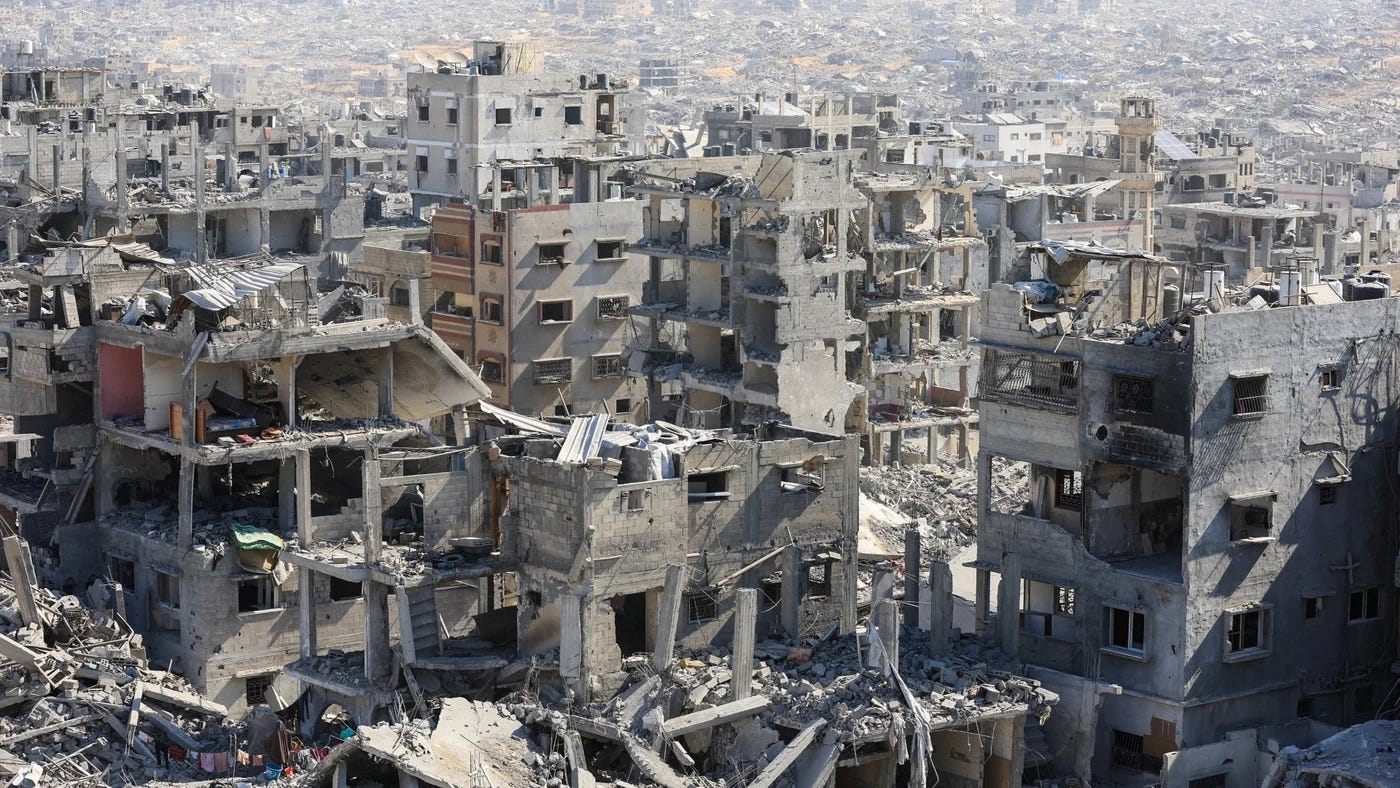
The history of Zionism is fundamentally one of deception. This assertion is critically relevant today, as it contextualizes the so-called ‘Trump Gaza proposal,’ which appears to be little more than a veiled strategy to defeat the Palestinians and facilitate the ethnic cleansing of a significant portion of Gaza’s population.

Since the start of the current conflict, the United States has been Israel’s staunchest ally, going as far as framing the outright slaughter of Palestinian civilians as Israel’s “right to defend itself.” This position is defined by the wholesale criminalization of all Palestinians – civilians and combatants, women, children, and men alike.

Any naive hope that the Trump administration might restrain Israel proved unfounded. Both the Democratic administration of Joe Biden and the Republican administration of his successor have been enthusiastic partners in Israeli Prime Minister Benjamin Netanyahu’s messianic mission. The difference has been primarily rhetorical. While Biden wraps his staunch support in liberal discourse, Trump is more direct, using the language of overt threats.

Both administrations pursued strategies to hand Netanyahu a victory, even when his war failed to achieve its strategic objectives. Biden used his Secretary of State, Antony Blinken, as an emissary to broker a ceasefire fully tailored to Israeli priorities. Similarly, Trump utilized his son-in-law, Jared Kushner, and former British Prime Minister Tony Blair, among others, to concoct a parallel ploy.

Netanyahu deftly exploited both administrations. The Trump era, however, saw the US lobby and Israel seemingly dictating American foreign policy. A clear sign of this dynamic was the famous scene last April, during Netanyahu’s White House visit, when the ‘America First’ President pulled out a chair for him. The summoning of Blair, who once headed the US-controlled Quartet for Peace, to the White House alongside Kushner in August, was another foreboding signal. It was evident that Israel and the US were planning a much larger scheme: one not only to crush Gaza but to prevent any attempt at resurrecting the Palestinian cause altogether.

While ten countries were declaring recognition of the state of Palestine to applause at the UN General Assembly between September 21 and 23, the US and Israel were preparing to reveal their grand strategy, with critical contributions from Ron Dermer, then Israel’s Minister of Strategic Affairs.

The Trump Gaza proposal was announced on September 29. Almost immediately, several countries, including strong supporters of Palestine, declared their backing. This support was given without realizing that the latest iteration of the plan was substantially altered from what had been discussed between Trump and representatives of the Arab and Muslim world in New York on September 24.

Trump announced that the proposal was accepted by Israel and threatened Hamas that, if it does not accept it within “three or four days”, then “ it’s going to be a very sad end.” Still, UN Secretary-General Antonio Guterres, who, along with the UN, has largely failed to hold Israel accountable, declared his support for the Trump proposal, stating that “it is now crucial that all parties commit to an agreement and its implementation.”

Netanyahu felt a newfound elation, believing the weight of international pressure was finally lifting, and the onus was shifting to the Palestinians. He reportedly said that “now the whole world, including the Arab and Muslim world, is pressuring Hamas to accept the conditions.” Comfortable that the pendulum had swung in his favor, he openly restated his objectives in Gaza on September 30: “To release all our hostages, both the living and the deceased, while the IDF remains in most of the Strip.” Even when Arab and Muslim nations protested the amendments to the initial Trump plan, neither Netanyahu nor Trump relented, the former continuing the massacres, while the latter repeating his threats.

The implication is stark: regardless of the Palestinian position, Israel will continue to push for the ethnic cleansing of the Strip using both military and non-military means. The plan envisions Gaza and the West Bank being administered as two separate entities, with the Strip falling under the direct control of Trump’s so-called “Board of Peace”, thus effectively turning Blair and Kushner into the new colonial rulers of Palestine.

History is most critical here, particularly the history of Israeli deception. From its onset, Zionist colonialism justified its rule over Palestine based on a series of fabrications: that European settlers held essential historical links to the land; the erroneous claim that Palestine was a “land without a people”; the assertion that indigenous natives were intruders; and the stereotype that Arabs are inherently anti-Semitic. Consequently, the state of Israel, built on ethnically cleansed Palestinian land, was falsely marketed as a ‘beacon’ of peace and democracy.

This web of falsehoods deepened and became more accentuated after every massacre and war. When Israel faltered in managing its military efforts or its propaganda war, the United States invariably intervened. A prime example is the Israeli invasion of Lebanon in 1982, where a ‘peace deal’ was imposed on the PLO under US pressure. Thanks to US envoy Philip Habib’s efforts, Palestinian fighters left Beirut for exile, on the understanding that this step would spare thousands of civilian lives. Tragically, the opposite occurred, directly paving the way for the Sabra and Shatila massacre and a prolonged Israeli occupation of Lebanon until 2000.

This historical pattern is repeating itself in Gaza today, though the options are now more stark. Palestinians face a choice between the guaranteed defeat of Gaza – accompanied by a non-guaranteed, temporary slowdown of the genocide – and the continuation of mass slaughter. Unlike the Israeli deception in Lebanon four decades ago, however, Netanyahu makes no effort to mask his vile intentions this time. Will the world allow him to gt away with this deception and genocide?Share

Dr. Ramzy Baroud is a journalist, author and the Editor of The Palestine Chronicle. He is the author of six books. His forthcoming book, ‘Before the Flood,’ will be published by Seven Stories Press. His other books include ‘Our Vision for Liberation’, ‘My Father was a Freedom Fighter’ and ‘The Last Earth’. Baroud is a Non-resident Senior Research Fellow at the Center for Islam and Global Affairs (CIGA). His website is www.ramzybaroud.net
Italy’s Second General Strike for Gaza Brought 2 Million Workers into the Streets

The next day, one million people joined a demonstration in Rome, which highlighted Italy’s complicity in the genocide.
October 11, 2025

Protesters marching in Rome, on October 3.Giorgio Grappi

It seemed impossible for Italy to strike for Palestine more successfully than it did the first time, yet it happened: 2 million people returned to the streets on October 3, blocking everything again. The second general strike was called by Si Cobas labor union on September 18, and circulated broadly after September 22, the date of the first strike.

After Israel attacked the Global Sumud Flotilla on the evening of October 1, CGIL (the biggest Italian union) and USB (the union that called the earlier general strike) joined the call. This landmark event marked the first time that all the leftist labor unions in the country decided to go on strike together.

The days preceding the strike were filled with constant mobilization. People took to the streets as soon as the attack on the flotilla was reported through media channels. A spontaneous rage and a will to act took over, with people rushing to the main squares in different Italian cities. After two years of genocide witnessed through phone and laptop screens, people of all ages gathered together physically in continuous and heterogeneous demonstrations. On October 2, the day after the attacks, people were in the streets again, in a diffuse vibrant and electric atmosphere that foreshadowed what would happen over the next two days.

As Marika Giati — a PhD student at the University of Pisa and part of the Women’s Assembly of the Migrants Coordination in Bologna — told Truthout, “In these demonstrations, a new consciousness could be felt — one that exploded and connected with the massive mobilizations stretching from Spain to France, Germany, the Netherlands, Greece, Tunisia, Mexico, and Morocco.”

People were enraged by the Italian government as well. Deputy Prime Minister Antonio Tajani, speaking about Israel’s illegal control of the international waters adjacent to Gaza, said that international law is important, “but does not always matter” — justifying both the Israeli blockade, and the fact that the Italian frigate accompanying the flotilla abandoned the flotilla while it was being attacked and while Italian citizens were being illegally arrested by Israel.

Related Story

We Said “We Will Block Everything” and We Did: Inside Italy’s Strike for Gaza
Following a 24-hour general strike on September 22, the country is now gearing up for more national protests. By Laura Montanari , Truthout September 30, 2025

In the meantime, Prime Minister Giorgia Meloni openly opposed the strike and the protests, claiming that the strikers only wanted a longer weekend and didn’t want to work. Such comments purposely overlooked the conditions under which workers are striking, as if people were paid to be on strike. The Strike Guarantee Commission, the Italian regulatory authority on the right to strike, also attempted to hinder the strike, labelling it illegitimate and claiming that the unions didn’t provide enough advance notice.

“For Gaza we block everything!!!” Protesters in the streets of Rome during the general strike.Giorgio Grappi

Matteo Salvini, Meloni’s other deputy prime minister, argued that heavier fines were needed for those striking illegally. This was an attempt to scare many workers, who, if they went on strike under illegitimate conditions, risked having to pay a fine (up to 1000 euros), as there is already a measure in Italian law set up for this. As Domenico Conte, a USB organizer, told Truthout, “the Commission of Guarantee acted politically rather than as a neutral guarantor, weakening the strike.” Luckily in Italy, though, if one labor union (Si Cobas in this case) calls for a general strike, members of other unions can also join, and CGIL confirmed the strike was legitimate, and said they will take action against the decision of the Commission.

Despite Salvini’s new security law, which introduced criminal penalties of up to two years in jail for blocking roads and railways, hundreds of thousands of people across Italy continuously blocked stations, ports, and highways. “The marches [during the strike day and the previous days] were composed of industrial workers, students, migrants, and second-generation migrants,” continued Conte. “There was an incredible, never-before-seen diversity. Even small bar owners, people outside the unions, everyone stood side by side in a multiethnic crowd. This is the Italy we love, standing against the racism of Meloni and Salvini.”

“Enjoying the long weekend.” Protesters ironically respond to Meloni’s statements during the march in Bologna on general strike day.Stella Chirdo

“Participation, however, neutralized this attempt to undermine the movement,” continued Conte. “The strikes on the 22nd and especially on the 3rd gave new strength and momentum.” The massive participation in the strike, with more than 80 percent of workers striking in some factories and national libraries, effectively carried forward the movement that began with the dockworkers in Genoa. Such high participation was hard to expect, as workers who decided to go on strike for the second time in less than two weeks had two days deducted from their salary. In Giati’s words:


Many people went on strike for the first time in their lives. They did so despite an economic crisis that is eroding their wages, aware that this impoverishment stems from the effects of a war that goes even beyond Gaza: one that directly concerns us because it is transforming European societies themselves, driving an unprecedented surge in rearmament and militarism.… Through the political tool of the strike, students, factory workers, hospital workers, public service employees, teachers, high school and university students, and activists filled the streets with unstoppable and astonishing crowds. The feeling, both in Bologna on October 3 and even more so in Rome on October 4, was one of growing awareness: that war is not something that must simply be endured, that it is not an inevitable sacrifice, that we can refuse it and its costs.

Protesters in Bologna blocking the highway on October 3.

Matilde Ciolli, an activist with the Transnational Migrants Coordination and postdoctoral fellow at the University of Aosta Valley who was present at the demonstrations, told Truthout, “In Rome, on the 3rd, around 60 percent of workers went on strike. It wasn’t only an act of solidarity with Palestine and a call to end the occupation and genocide — the recent absurd Trumpian ‘peace negotiations’ were also connected to the broader war scenario taking shape in Europe, of which Palestine represents the most acute expression. For this reason, workers used the strike as a tool to declare that they are no longer willing to accept the living and working conditions produced by war.” Many people are increasingly aware not just of the genocide but also of the Italian government’s contradictions and incapacities.

The far-right Meloni government, in fact, not only allowed another state to detain Italian citizens illegally, but even denied the use of state flights for activists imprisoned and then released by Israel. On the other hand, Italy has in the past provided generous accommodations for Israelis, like allowing Israeli soldiers on holiday at the Italian seaside to be escorted by the Italian police, or allowing Mossad itself to manage the security at an Italy-Israel football match happening on October 14 in Udine.

Protesters in Rome on October 4. “Show Israel the red card.”Lorenzo Delfino

Italy has enabled the genocide since the beginning: The government abstained from voting for the UN ceasefire agreements. It pushed the idea of Israel’s “right to defense,” and in the past two years, did not suspend arms exports to Israel. In response, a complaint lodged with the International Criminal Court has accused Meloni of “complicity in genocide.”

Gianplacido Ottaviani, a union organizer from FIOM-CGIL at the Bonfiglioli Riduttori factory in Bologna, said, “The results were even greater than those of strikes over labor contracts. And this was a strike not directly related to wages. The government was afraid; it did not issue a back-to-work order, showing its fear of possible future strikes in reaction to a heavier repression…. The strike mobilized all those who refuse to be complicit, both in the genocide and in a government that in these days is showing all its hypocrisy.” Ottaviani added that the strike “was characterized more by being against the government than in support of the unions.”

Conte confirmed: “The strike is the most important tool to overturn the government’s paradigm and decisions.”

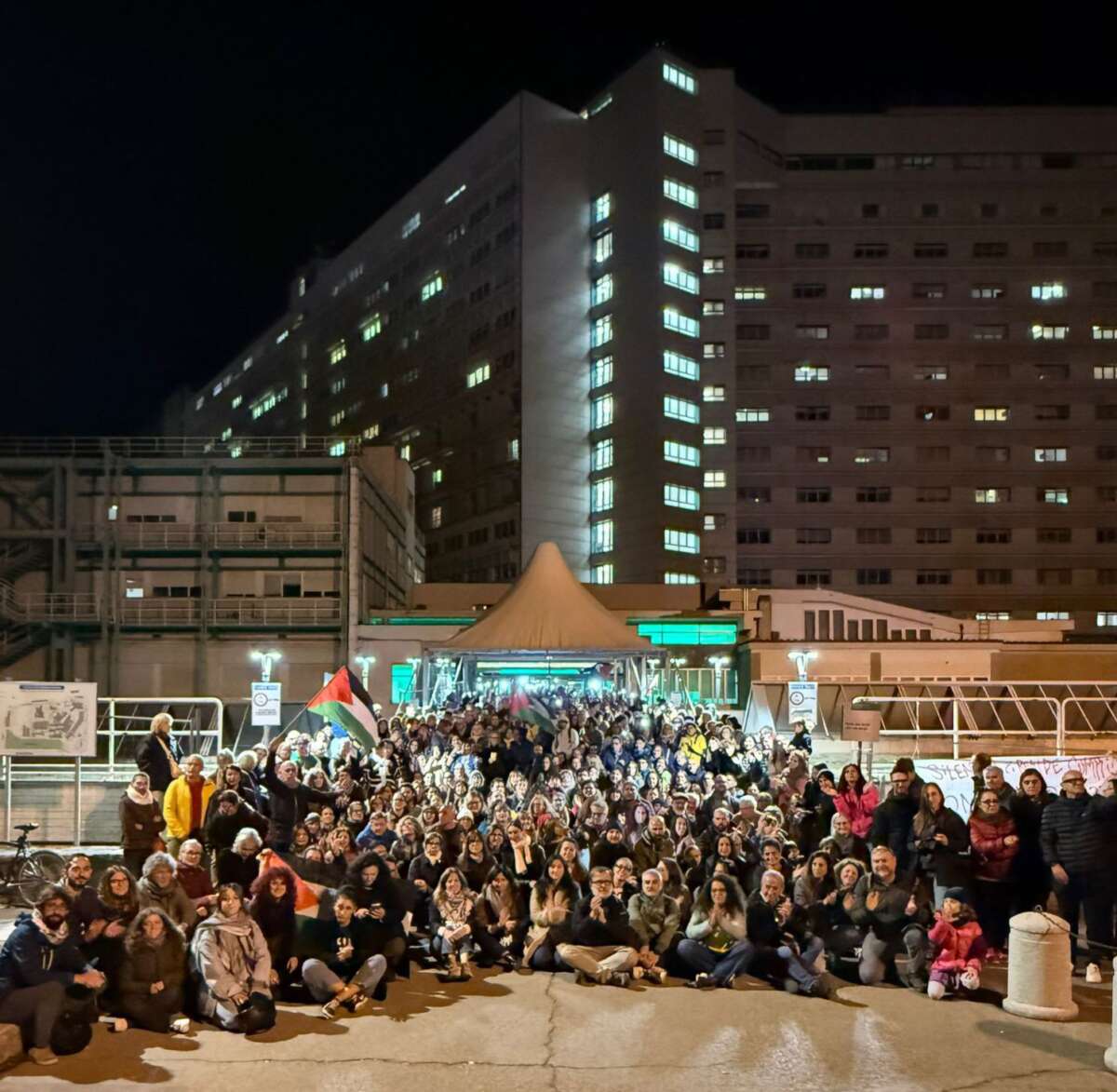
Medics and hospital workers striking and posing in fron of “Ospedale Maggiore” hospital in Bologna on October 3.Diego Chece

The day after the strike, on October 4, one million people gathered for a national demonstration in Rome. Conte went:“There was a tense atmosphere: police carried out sweeping checks on buses arriving from outside the city. The right wing, rooted in a neo-fascist tradition, showed its true nature — its reaction to full squares was repression. They tried to criminalize the demonstrations and sow division, but they failed, because what emerged was unity and massive popular participation: the Italian people standing against genocide.”

Giati and Ciolli, who were also in Rome, noted the historic turnout. “The city was once again flooded with people — it was the most widely attended mobilization I have ever seen in Italy. The crowd was so large that it was nearly impossible to walk,” Ciolli said. By the time people reached the end of the march, there were still participants standing at the starting point.”
Protesters march in Rome on October 4 with the banner “On-land crew against the economy of war – stop genocide.”Giorgio Grappi

Ciolli added, “On the 4th as well, unions, workers, students, and schools of all levels took part. Despite the continuous mobilizations in the preceding days, participation did not wane — it revealed an enormous capacity to keep taking to the streets until the genocide stops. This generated irritation within the government majority, yet it became clear that the government was forced into a corner and compelled to confront the issue.”
Protesters blocking one entrance of the train station in Milan on strike day.Francesca della Santa

The Meloni government is still trying to squash pro-Palestine movements, for example, with a new proposed law on antisemitism, which equates it with anti-Zionism and could prevent teachers and professors from talking freely about Palestine. However, after the second strike and subsequent demonstrations, Meloni issued a ban and a withdrawal of licenses on arms exports to Israel for the first time in the past two years.

Though a ceasefire has been reached, Ciolli warns that “The government’s agreements envision a future of even greater subordination and poverty for Palestinians in Gaza.” This story is not yet finished; for this reason, the words of the dockworkers from Ravenna that we previously interviewed, who spoke of establishing “a durable project capable of halting the arms trade as a whole,” resonate even more.

As Conte said:


Here and now, the demand is for an end to the genocide and a solution that guarantees Palestine’s self-determination. But there must be continuity: we must fight against the war economy, European rearmament, and the ‘dual-use’ industry shift. This must be done at the European level. If industries transition from civilian to military production, we must build total opposition. ‘We don’t work for war’ is our slogan.

Two women at the window supporting the demonstration on the general strike day in Turin. Matteo Rossi


This article is licensed under Creative Commons (CC BY-NC-ND 4.0), and you are free to share and republish under the terms of the license.


Laura Montanari

Laura Montanari is a student based in Germany and is part of Precarious Disconnections collective in Italy and of Transnational Social Strike Platform
.
Israeli military launches attack on Gaza despite ceasefire agreement, Israeli media reports

Issued on: 19/10/2025 -

The Israeli military has launched an attack on Gaza, as Israel continued to trade blame with Palestinian militant group Hamas over violations of the U.S.-brokered ceasefire aiming to end the war in the enclave, Israeli media reported on Sunday. Details by FRANCE 24 correspondent in Jerusalem, Noga Tarnopolsky.

Video by: Noga TARNOPOLSKY


TRUMP REPEATS BIBI'S LIES

US says Hamas planning attack against Gaza civilians, armed group slams ‘misleading narrative’

Hamas on Sunday rejected a US State Department warning that the Palestinian armed group was planning an attack against civilians in Gaza. In a statement, Hamas called on the US to stop "repeating" Israel's "misleading propaganda". The US provided no details of the planned Hamas attack in its warning issued Saturday.


Issued on: 19/10/2025 - 
By:FRANCE 24

Palestinians watch Hamas members search for bodies in Khan Younis, in southern Gaza on Ocober. 17, 2025. © Abdel Kareem Hana, AP

The US State Department on Saturday said it had "credible reports" that Palestinian armed group Hamas was planning an imminent attack against civilians in Gaza, a move Washington said would be a "ceasefire violation".

"This planned attack against Palestinian civilians would constitute a direct and grave violation of the ceasefire agreement and undermine the significant progress achieved through mediation efforts," said the State Department in a statement.

"Should Hamas proceed with this attack, measures will be taken to protect the people of Gaza and preserve the integrity of the ceasefire."

No details of the planned attack were provided


Hamas however rejected the US claim, calling it "misleading Israeli propaganda".


In a statement released Sunday, the Palestinian militant group called on the US to “stop repeating" Israel's "misleading narrative and to focus on curbing its repeated violations of the ceasefire agreement”.

Hamas accused Israeli authorities of forming, arming and funding "criminal gangs" that carried out murders, kidnappings and aided looting.

“The facts on the ground reveal the exact opposite," said the statement, which accused the criminal gangs of carrying out "killings, kidnappings, theft of aid trucks, and assaults against Palestinian civilians".

The Palestinian militant group said police forces in Gaza were performing their duty by pursuing those gangs to hold them accountable.

Hamas-led fighters clashed with at least two armed groups in eastern Gaza City that Hamas alleges are involved in looting aid and collaborating with Israel. They executed a handful of suspects in public, in widely condemned street killings.

Earlier this week, Hamas tightened its grip on Gaza's ruined cities, launching a crackdown and executing alleged collaborators.

Hamas published a video on its official channel showing the street execution of eight blindfolded and kneeling suspects, branding them "collaborators and outlaws." The footage was apparently from Monday evening.

US President Donald Trump this week threatened Hamas over the killings of civilians.

"If Hamas continues to kill people in Gaza, which was not the Deal, we will have no choice but to go in and kill them," Trump had said in a post on his Truth Social network, without specifying who he meant by "we".
Israel to keep Rafah crossing closed

The first phase of the Gaza ceasefire deal, which was brokered by the Trump administration, involves a prisoner-hostage exchange between Israel and Hamas and the resumption of aid distribution in the war-torn Palestinian enclave.

But Israeli Prime Minister Benjamin Netanyahu on Saturday said the Rafah border crossing between Gaza and Egypt will remain closed until further notice.

Its reopening will depend on Hamas handing over the bodies of deceased hostages, said the Israeli prime minister.

Netanyahu's statement came shortly after the Palestinian embassy in Egypt announced that the Rafah crossing would reopen on Monday for entry into Gaza.

Israel and Hamas have been trading blame over violations of the US-mediated ceasefire for days.

The dispute over the return of bodies, and shipments of life-saving humanitarian aid, underlines the fragility of the ceasefire and still has the potential to upset the deal along with other major issues that are included in Trump's 20-point plan to end the war.

As part of the deal, Hamas released all 20 living Israeli hostages it had been holding for two years, in return for almost 2,000 Palestinian detainees and convicted prisoners jailed in Israel.

(FRANCE 24 with AFP, AP and Reuters)
Palestinians cannot know peace till Trump and his fellow ghoul finally leave the stage

Tom Tyner
October 16, 2025 
RAW STORY


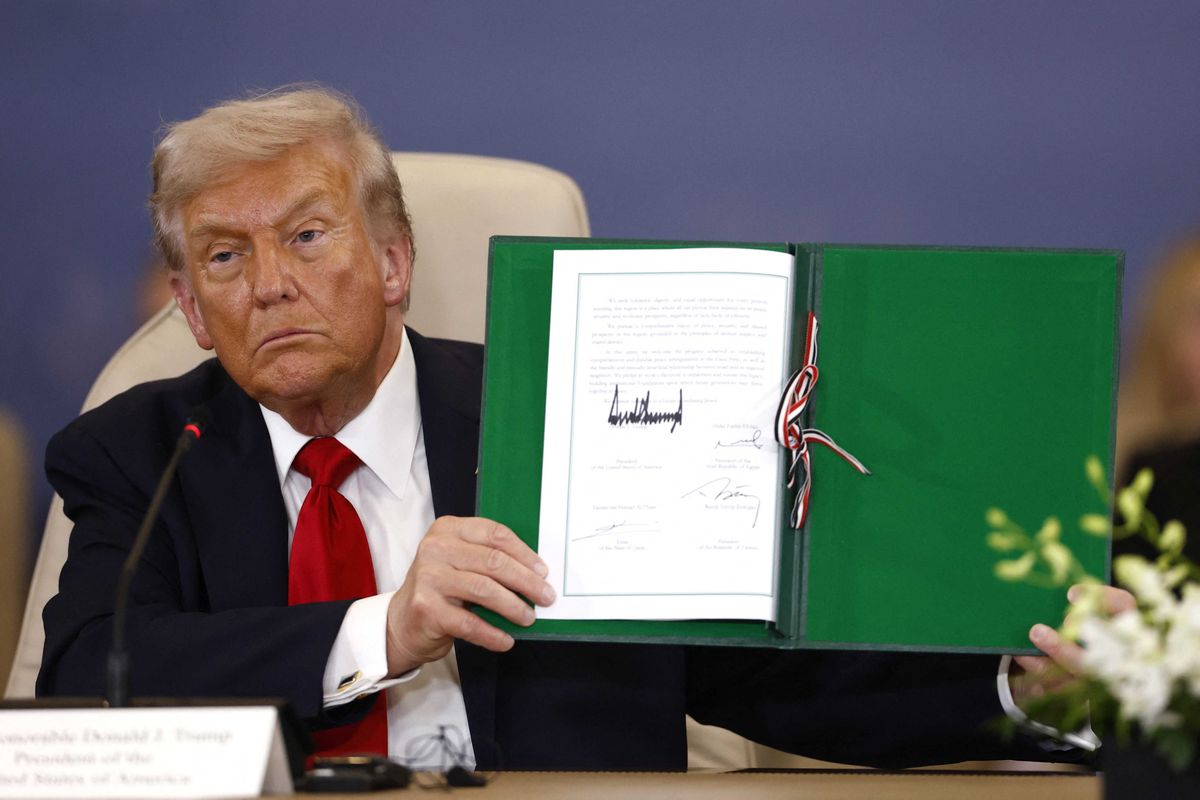
Donald Trump poses with the signed agreement on ending the Gaza war. Yoan Valat/Pool via REUTERS


Before Donald Trump is officially canonized for ending the Israeli-Palestinian war and bringing peace to the Middle East, let’s do a reality check on Trump’s role and on the ultimate long-term impact.

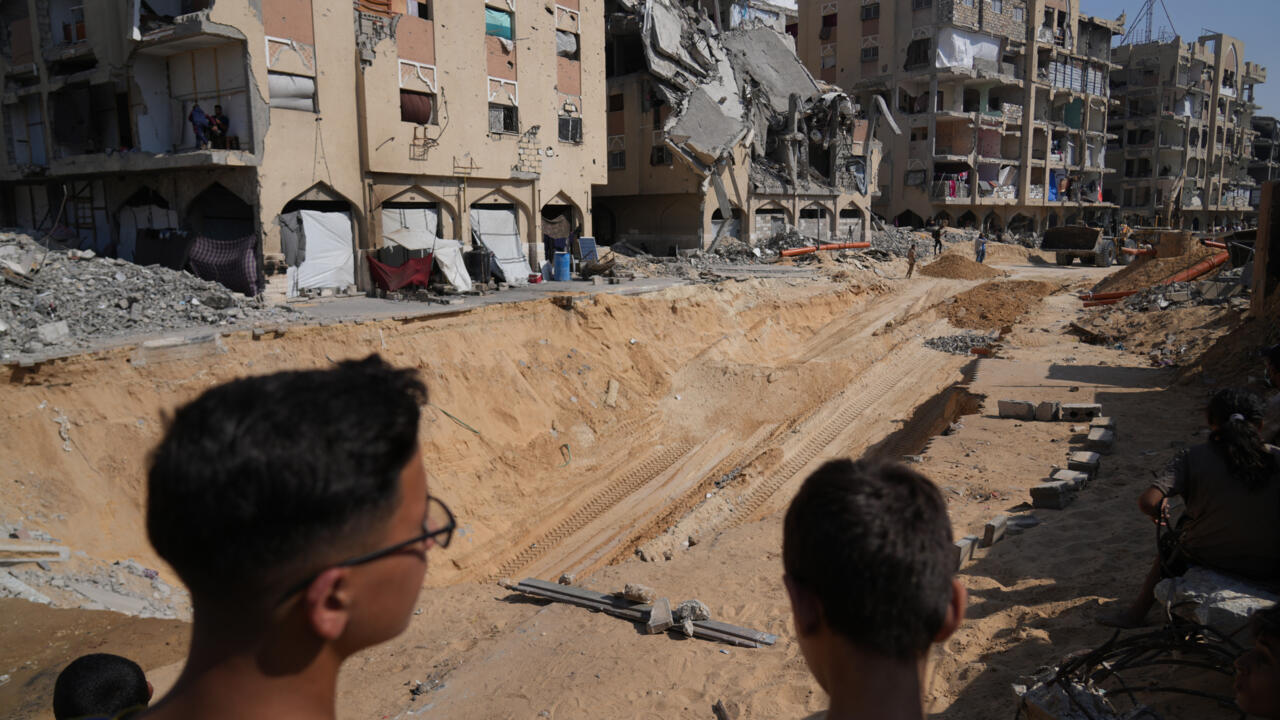
First, it was past time for Benjamin Netanyahu to end the war and he knew it. He had accomplished his goals: severely degrading Hamas, killing or injuring 10 percent of Gaza’s Palestinian population including over 20,000 children and 10,000 women, displacing nearly 90 percent of the population, and destroying Gaza’s infrastructure to ensure the displaced would come home to cataclysmic, unlivable ruin. He was also losing support in Israel every day the onslaught continued.

Decades ago, Netanyahu was heard on tape as saying of the Palestinians, "We must beat them up, not once but repeatedly, beat them up so it hurts so badly, until it's unbearable."

Netanyahu accomplished his goal.

As the war raged on in 2025, Trump’s disdain for the Palestinians was evident. Trump offered to turn Gaza into a real estate magnate’s Shangri-La, assumedly free of Palestinians. He continued to supply Israel’s mighty military force with more weaponry against a woefully inferior opponent. Under Trump, the US voted against United Nations resolutions demanding a ceasefire in the Israel-Palestinian war, killing the resolutions.

Trump refused to condemn Israel’s massacre of Palestinian civilians while the world’s International Criminal Court issued an arrest warrant for Netanyahu, for using “starvation as a method of warfare,” restricting humanitarian aid, and intentionally targeting civilians. Under Trump, the US has refused to join the 147 nations that recognize Palestinian statehood or even commit to supporting a two-state Israeli-Palestinian solution.

Trump has been Netanyahu’s boy since the beginning of the war, enabling Netanyahu to carry out his scorched earth campaign until the Palestinians were ground into the Gaza dust, their territory destroyed. Netanyahu was more than happy to reward Trump’s unconditional support by giving Trump an uncontested slam dunk: ending the war after Netanyahu had accomplished all he wanted.

Of course, there will be no just peace agreement coming out of negotiations. Israel will maintain its military occupation of Gaza and the West Bank, further increase its stranglehold on the territories, build more Jewish settlements in the West Bank in violation of international law, and prolong the misery under which Gaza residents will suffer for decades.

A two-state solution, which any just peace agreement must include, will remain sheer fantasy until Netanyahu is no longer in power. As Netanyahu said in 1999 after sabotaging the Oslo Accords, which provided a roadmap for Palestinian statehood, “I’m proud I blocked a Palestinian state.” A two-state solution has always been anathema to Netanyahu, the Palestinians unwanted interlopers on lands rightfully belonging to Israel.

An elaborate diplomatic charade will occur among participants in the peace negotiations that will ultimately end in Israel maintaining iron-clad control over Palestinian territories and making no significant concessions. Trump will brag about the settlement bringing peace to the Middle East when all it will do is ensure decades of subjugation of a badly broken Palestinian people to their brutal occupier.

The entire world is thankful that the slaughter of Palestinian civilians and devastation of their homeland has ended. Netanyahu, however, should never be forgiven for his brutally asymmetrical response to the Hamas attack on Israel, resulting in 82 percent of the war’s casualties being Palestinians, 56 times as many as Israelis.

It should also be remembered that Trump never wavered in his support for Netanyahu, that he refused to condemn the annihilation of Palestinians, that he continued providing weapons to Israel, that his administration killed UN ceasefire resolutions, and that his end-the-war overtures came after Netanyahu had demolished Gaza and killed 67,000 Palestinians.

Netanyahu and Trump are kindred spirits, comrades in corruption, in extreme-right politics, in authoritarian rule, in undermining their countries’ democracies, and in their indifference to the suffering of Palestinians. In a 2001 tape discussing sabotaging the Oslo Accords, Netanyahu wasn’t concerned about the US response because the US, he said was “easily manipulated.” That remark was certainly prescient regarding his relationship with Trump.

Netanyahu knows that as long as Trump is staunchly in his corner, he can do whatever he wants and the rest of the world be damned, including the UN, the International Criminal Court, international law, and the 149 nations that recognize Palestinian statehood. Trump’s loyalty has proven unshakeable throughout the war and will continue throughout the peace talks.

Trump did not end the Israeli-Palestinian war. He was handed the “honor” on a silver platter by his grateful political doppelgänger. Until both men have mercifully left the political stage, Palestinians will be left twisting in the bitter wind.
Tom Tyner is a freelance editorialist, satirist, political analyst, blogger, author and retired English instructor
Trump’s TikTok deal presents new challenge for Palestine’s defenders


Omar Zahzah 
19 October 2025

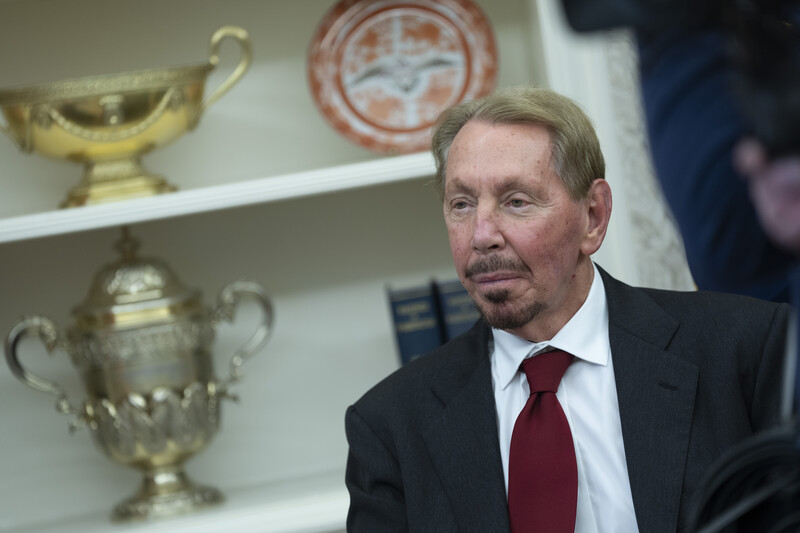
Larry Ellison, cofounder of Oracle, joined President Donald Trump in the Oval Office of the White House on 3 February. Chris KleponisCNP / Polaris

We have entered a troubling new phase in the fight against Zionist media hegemony.

In 2023 and 2024, the Anti-Defamation League (ADL) and AIPAC-funded politicians helped whip up a moral panic about the mobile video app TikTok’s alleged culpability in decreasing support for Israel, particularly among social media savvy young people.

This narrative seemed to breathe new life into campaigns against the app, which spanned as far back as Donald Trump’s failed 2020 attempt to ban it amidst empty fearmongering about the threat of American user data falling into the hands of the Chinese Communist Party. With global indignation against Israel’s genocide following 7 October 2023 at an all-time high, an increasing number of activists and organizers have taken to digital platforms like TikTok to document their opposition to Israeli colonial atrocities.

What ADL CEO Jonathan Greenblatt defined as a “TikTok problem, a Gen Z problem” regarding the demise of unquestioned support for Israel mobilized fresh, bipartisan efforts against the app and its parent company ByteDance. This culminated in the Congressional bill signed into law by President Joe Biden on 24 April 2024 giving ByteDance 270 days to sell the app or face a ban in the US.

“Bipartisan” can’t be emphasized enough here. Signed into law and heavily boosted by Democrats – among them Congressman Raja Krishnamoorthi, who qualified his support for the ban by saying “October 7 really opened people’s eyes to what’s happening on TikTok” – the bill was introduced by Republican Representative Mike Gallagher, one of whose top donors before he decided not to run for office in 2024 was reportedly the American Israel Public Affairs Committee (AIPAC).

Human rights lawyer and former UN official Craig Mokhiber hit the nail on the head when he posted in March 2024, “They are not trying to ban TikTok. They are trying to use government power to force TikTok to be taken over by pro-Israel ownership to silence criticism of genocide and apartheid.”

Fast forward to the present. Following several extensions on the ban, US President Donald Trump has announced a $14 billion deal to buy TikTok that would reportedly involve a consortium of investors including Rupert Murdoch (the right-wing media magnate whose empire includes Fox News, the New York Post, and The Wall Street Journal), Dell Technologies founder and CEO Michael Dell, and Oracle, a software company cofounded by Larry Ellison.

None of these names bodes well for TikTok’s future utility to the Palestinian struggle. Why this is the case for Rupert Murdoch (and his son Lachlan, whom Trump also floated as a potential partner) should go without saying.

On 22 July 2025, The Electronic Intifada published an exposé on Dell Technologies’ deep entrenchment in Israel’s genocide. This included, among other damning revelations, how Dell hardware is used in running Israel’s AI-generated assassination programs “Lavender” and “The Gospel.”

But Ellison’s hitherto relative anonymity in comparison to other outsized tech moguls such as Elon Musk is inversely proportional to the grave implications his involvement in Trump’s TikTok acquisition poses for digital advocacy and activism for Palestine. As Sam Husseini reports, Ellison speaks at Israeli military galas “as though he were an Israeli citizen.”

“We’ve actually acquired a number of Israeli companies,” Husseini quotes Ellison as saying. “We have two CEOs at Oracle. One’s name is Safra Catz, and she was born in Israel. So again, we love the country of Israel and will do everything we can to support the country of Israel.”

A bombshell report from Drop Site News reveals that Ellison in fact vetted current Secretary of State Marco Rubio regarding sufficient fealty to Israel for Ron Prosor, former Israeli ambassador to the UN, during Rubio’s failed 2016 presidential cycle run. The Oracle cofounder has since become a “major patron” of Rubio, who has championed kidnapping and deportation of student critics of Israel.

Ellison, who has “given or pledged” over $350 million to the Tony Blair Institute, also boasted of arranging for Rubio to meet Blair, the former British prime minister who is under consideration to co-chair Trump’s dystopian and colonial Gaza Board of Peace.

Blair’s potential candidacy for the Orwellian “Board of Peace” is also deeply concerning given his history as a co-conspirator in the US’ 2003 war and colonial occupation of Iraq, not to mention his (strategic) failure to halt Israeli settlement expansion or advance Palestinian statehood during his time as a Middle East “peace” envoy. This outcome should come as no surprise given that Blair’s Zionism is so pronounced he also did pro bono work for the Israel lobby.

Husseini recalls that Oracle, which was cofounded by Ellison, Robert Miner and Ed Oates in 1977, has direct ties to the CIA: the intelligence agency was its first client, from one of whose projects the company’s name emerges. Former CIA director and Pentagon head Leon Panetta currently sits on the Oracle board of directors.

I believe Husseini is right in opining that we don’t “understand the ramifications” of how the databases provided by Oracle are “used by an enormous number of governments and companies.” Ellison, who champions “unifying” data, has espoused a dystopian vision of how omnipresent, AI-enabled surveillance will ensure that “citizens will be on their best behavior, because we’re constantly recording and reporting everything that’s going on.”

The convergence between Oracle’s data centers and AI is already underway, Husseini reveals, quoting independent journalist Max Jones, given that Open AI’s Stargate Project saw the AI company sign a $300 billion project with Oracle.
Back to TikTok

This is not Ellison’s first peak at the trough.

In fact, Oracle has been storing TikTok’s US data since 2020 – replacing no less a tech giant than Google in the process – and initially reached a deal with the Trump administration that same year to buy TikTok before the deal was blocked. This is Ellison’s second chance, an opportunity to gain far more than exclusive storage privileges for Oracle – with the prospect of anti-hegemonic digital support for Palestinian liberation hanging in the balance.

And the threat is multimodal: following federal approval, SkyDance Media, the media company owned by Larry Ellison’s son, David, underwent a merger with Paramount Global. The newly minted Paramount-SkyDance Corporation houses Paramount Pictures, Comedy Central, MTV and CBS News, which has now installed Bari Weiss as editor-in-chief following the company’s $150 million purchase of Weiss’ conservative digital outlet The Free Press.

The venture-capitalist backed publication featured such anti-Palestinian content as the widely lambasted piece, “The Gaza famine myth.” Alan MacLeod reports that Weiss was sought out for the role due to her pro-Israel views, and that Weiss’ desired candidacy for the position “mirrors” how TikTok “hired former IDF [Israeli military] soldier and Israel lobbyist, Erica Mindel, to oversee its online hate speech policy, with particular regard to anti-Semitism.”

Importantly, Weiss’ Free Press is not merely a propaganda organ; it has also established itself as a formidable tool in the Trump administration’s war on Columbia University (of which Weiss is an alum).

As David Klion argues, from its hand-picked status to announce the Trump administration’s withholding of $400 million in federal grants due to “anti-Semitism” to its publication of leaked transcripts of Zoom meetings in which Columbia officials deliberated how to respond to the Trump administration’s demands, “Weiss’ publication … was the preferred vehicle for conveying information from Columbia insiders who wanted to purge all criticism of Israel from the university to Trump administration officials who were using unprecedented financial pressure to help them do exactly that.”

Weiss also arguably put a target on the late Palestinian poet, professor and intellectual, Refaat Alareer, after he made a satirical post about Zionist genocide propaganda. “If I get killed by Israeli bombs or my family is harmed, I blame Bari Weiss and her likes,” Alareer posted on X. “Many maniacal soldiers already bombing Gaza take these smears seriously and they act upon them.”

Alareer was indeed assassinated by Israeli airstrike on 6 December 2023.

“Bari Weiss – who once put a target on a Palestinian poet later killed by Israel – now leading CBS news editorial is a new stain on an already blood-soaked industry,” media critic Sana Saeed posted on X.

I have been writing at length about digital settler colonialism, a term I have repurposed to explore how digital technologies and platforms act as online extensions of the physical processes of apartheid, military occupation and genocide inherent to Zionist settler colonialism – often with the eager support of anti-democratic US business interests.

In June 2024, I wrote about how TikTok’s forced sale by the US government in light of the app’s decried role in amplifying pro-Palestinian messaging made it an important example of this phenomenon. But the initial impetus for my project relied on a functional distinction between corporate legacy media and corporate social media.

However increasingly censorious corporate social media was becoming – a fundamental issue for my book and adjacent writings – I had not anticipated a cross-medium convergence of the kind we are witnessing at present. I largely conceptualized social media censorship of Palestine as an (ultimately futile) attempt to recreate the same anti-Palestinian discursive climate so pervasive within legacy media, particularly as social media had proved itself an essential (if unpredictable) resource to advancing narratives of Palestinian liberation.

But the consolidation of industries that would be realized through the current TikTok deal, as well as the Ellisons’ new media empire under the authoritarian Trump administration, arguably suggests a new paradigm of power, with digital and legacy media consolidation unfolding at an unprecedented scale, and all under explicit collaboration between the US and Israeli governments and tech giants.

Media domination, however crude or seemingly total, cannot undo popular opposition to Israel’s genocide, but the movement must be prepared for the current reconfiguring of power in advancing the ongoing struggle for Palestinian liberation.

Omar Zahzah’s new book, Terms of Servitude: Zionism, Silicon Valley, and Digital Settler Colonialism in the Palestinian Liberation Struggle, is published by The Censored Press and Seven Stories Press.
As support for Israel drops, the mainstream media is becoming even more Zionist

Support for Israel is plummeting among the U.S. public, but Zionism dominates mainstream media more than ever. Several recent high-profile examples show the staggering disconnect between the media establishment and its viewers.
 October 17, 2025 
MONDOWEISS

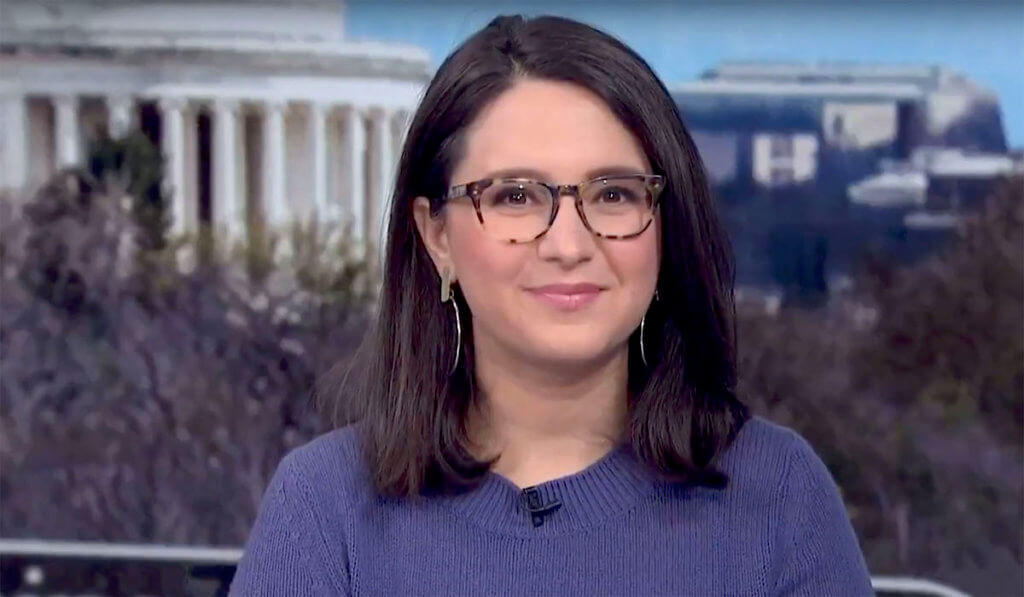
Bari Weiss on MSNBC’s Morning Joe

During a recent appearance on Real Time with Bill Maher, CNN’s Van Jones told the studio audience that young people protesting Israel’s genocide are actually falling for an Iranian-Qatari disinformation campaign.

Jones proceeded to do an impression of a young person’s social media feed. “Dead Gaza baby, dead Gaza baby, dead Gaza baby, Diddy, dead Gaza baby, dead Gaza baby!,” he joked.


Jones’s callous attempt at humor was condemned across social media, and he quickly apologized for the comments, acknowledging that they were “insensitive and hurtful.”
Advertisement

However, as Howard University law professor Ziyad Motala notes in an Al Jazeera op-ed, Jones’s apology failed to engage with a dark reality at the root of his joke: the consistent dehumanization of Palestinians.

“A true apology would have confronted the deeper problem: the instinct, common in US media, to distrust evidence of Palestinian pain unless it is filtered through Western validation,” wrote Motala. “It is an impulse rooted in hierarchy, the same hierarchy that divides the grievable from the disposable, the innocent from the suspect.”

That hierarchy has been on full display in recent days, as the mainstream media has centered stories of released Israeli captives while largely ignoring stories of Palestinians.

In a Middle East Eye, Doha Institute professor Mohamad Elmasry identifies a number of such examples.

“Since Trump announced his plan two weeks ago, western coverage has focused heavily on Hamas’s requirement to release the remains of 28 dead Israeli captives,” points out Elmasry. “Much less attention has been devoted to Israel’s obligation, under Article 5 of the plan, to return the remains of 420 Palestinians it has long withheld.”

Such bias has been par for the course throughout the genocide. Media critic Adam Johnson recently noted that the Sunday cable news shows have not featured a single Palestinian guest since October 7.

“As we mark the two-year anniversary of the still ongoing genocide in Gaza, there are dozens of data points one can point to showing media bias against Palestinians, as the U.S. government continues to arm and fund Israel’s massacre in Gaza, but few so perfectly capture the absurdity of U.S. media’s entirely lopsided treatment of the ​’conflict’ than the agenda-setting Sunday morning shows almost entirely ignoring Palestinian voices. NBC, ABC, and CNN Sunday shows did not even bother to find a token Palestinian academic, pundit or reporter to push back slightly,” writes Johnson at In These Times.

“Instead we get a string of Israeli Officials, Official-Sounding Pundits and Official Government Spokespeople with Official-Sounding Titles, and Serious Journalists at Serious Publications sitting around a well-lit table on corporate-owned media, telling Americans and their leaders what to care about every week: Who’s winning, who’s losing, what the ​’strategy’ is, and how many Palestinians deserve to die that week on the altar of ​’Israeli security,’ while the people with the most to lose, whose world has been literally flattened with their loved ones still remain, 24 months on, buried under rubble, are shut out from the discussion entirely,” he continued.

This double standard is obviously not new. Hundreds of thousands of pages have been written about how the U.S. media manufactures consent for Israel’s atrocities.

However, in recent years, something about the media has changed: the viewers.

For years, polling showed that (beyond the occasional outlier) most Americans supported Israel, regardless of their political affiliation. However, recent surveys reveal that’s changed.

A March Gallup poll found that just 46% of U.S. adults support Israel, the lowest number in 25 years.

A September poll from the New York Times and Siena University found that just 34% of U.S. voters said they supported Israel, compared to 47% who said they supported the country shortly after October 7.

“Nearly two years into the war in Gaza, American support for Israel has undergone a seismic reversal,” declared the Times.

Israel’s image has plummeted most dramatically among Democratic voters (a February Economist/YouGov poll found that just 9% of Democrats sympathize more with Israelis than Palestinians), in contrast to Republicans, who still back the country by a definitive majority.

However, discernible cracks are emerging on the right as well.

In a March 2025 Pew poll, 50% of GOP voters under the age of 50 expressed a negative view of Israel, compared to just 35% who had a negative view in 2022. An August 2025 University of Maryland Critical Issues survey found that just 24% of Republican voters ages 18-34 sympathize more with Israelis than Palestinians.

Despite these numbers, the mainstream media is seemingly moving even further to the right on this issue.

Self-described “Zionist fanatic” Bari Weiss recently became editor-in-chief at CBS News, after selling her right-wing website, The Free Press, to CBS’s parent company, Paramount Skydance, for $150 million. The Free Press was frequently criticized for its Palestine coverage, which included a piece that claimed Gaza wasn’t actually experiencing a famine.

The results are already evident:

In her new role, Weiss will be reporting to Paramount CEO David Ellison, a billionaire ally of President Donald Trump and Israeli Prime Minister Benjamin Netanyahu. David Ellison is the son of Larry Ellison, the second richest person in the world, also a noted supporter of Israel, and co-founder of Oracle. Oracle is set to oversee the algorithms of Tik Tok, the very app that pro-Israel billionaires originally wanted to eradicate for allegedly being too pro-Palestine.

So while media ownership and management seems to be getting consolidated in the hands of a well-heeled minority of Zionist true believers, the audience just isn’t buying it anymore.

This was demonstrated in a recent episode of The View, of all places, where New York City mayoral candidate Zohran Mamdani was pressed by pro-Israel host Sara Haines on the issue. Haines pointed out that Mamdani had “made inflammatory statements, like calling Israel an apartheid state and questioning its right to exist as a Jewish state” and asked why voters should trust the Democratic nominees judgement.

In his response to Haines, Mamdani reiterated his positions and noted that his beliefs led him to refer to what’s happening in Gaza as a genocide.

That assertion was met with some applause from the crowd.

“The home audience of the top-rated daytime talk show is dominated by middle-aged women, according to industry data,” conceded the Times of Israel. “It is one of several demographics where support for Israel has declined sharply in the two years.”

That small View moment represents a large disconnect, and it’s only getting wider.
Freed Gaza photographer overjoyed to find family alive after being told in Israeli jail they were dead


Freed Palestinian detainee Shadi Abu Sido sits with his wife Hanaa Bahlul and their children at their home in Nuseirat, central Gaza Strip, after he was released from Israeli detention. (REUTERS/File)

Reuters
October 16, 2025

Shadi Abu Sido says Israeli prison guards told him his family had been killed in Gaza war
The Palestinian photojournalist was detained without trial under Israel’s Unlawful Combatants Law, severely beaten

KHAN YOUNIS, Gaza Strip: Shadi Abu Sido said his world shattered in Israeli detention when guards told him his wife and two children had been killed in the Gaza war.

“I got hysterical,” the Gaza Palestinian photographer said.

It wasn’t until his release on Monday, part of the US-mediated ceasefire deal between Hamas and Israel that halted two years of war, that he discovered his loved ones were alive.

His wife, Hanaa Bahlul, raced down the hallway of his family’s house in Khan Younis and leapt into his arms. He spun her in the air as they clung to each other. Abu Sido kissed his children’s cheeks again and again, murmuring “my love” as he held the daughter and son he thought he would never see again.

“I heard her voice, I heard the voice of my children, I was astonished, it cannot be explained, they were alive. I saw my wife and children alive. Imagine amid death — life,” he said.

Abu Sido, a photojournalist, said he was detained at Shifa hospital in the northern Gaza Strip on March 18, 2024.

He was among 1,700 Palestinians detained by Israeli forces during the devastating war in Gaza and released on Monday, along with 250 prisoners convicted or suspected of involvement in deadly attacks, in exchange for 20 Israeli hostages held by Hamas since its October 2023 cross-border assault.

DETAINED UNDER THE ‘UNLAWFUL COMBATANTS’ LAW

Bahlul said a lawyer from Addameer, a Palestinian human rights group, had told her Abu Sido was being held under Israel’s Unlawful Combatants Law — a form of administrative detention.

Omer Shatz, an Israeli international law expert at Sciences Po university in Paris, said the law allows Israel to limit access to lawyers, incarcerate people without charge or trial, and arbitrarily detain many Palestinians in Gaza.

According to Addameer, 2,673 Gazans are currently detained under this law.

The Israeli military said in a statement sent to Reuters that its detention policy was “in full alignment with Israeli law and the Geneva Conventions” on legal standards for humanitarian treatment in wartime.

Israel’s Justice Ministry did not respond to Reuters requests for comment.

In March 2024 the Israeli military said it raided Shifa hospital, accusing Hamas of operating from the premises. Hamas has denied Israeli allegations it had command posts underneath Shifa and other Gaza hospitals. Reuters could not independently verify the assertions of either side.

’A GRAVEYARD FOR THE LIVING’

Abu Sido said he was severely beaten, handcuffed, blindfolded and forced to kneel for long periods while in detention. His wrists looked raw during his meeting with Reuters, which he said had been caused by the shackles. Reuters could not independently verify the details of his account.

He was first held at Israel’s Sde Teiman military detention camp, then transferred to the Ofer military camp — which is in the Israeli-occupied West Bank — and later to Ketziot prison in Israel, according to his wife.

Bahlul said Abu Sido was arrested only for being “a journalist for a Palestinian institution.”

A spokesperson for the Israeli Prison Service said all inmates were held according to legal procedures and their rights upheld. “We are not aware of the claims described, and to the best of our knowledge, no such incidents occurred under IPS responsibility,” the spokesperson said.

The Israeli military statement said mistreatment of detainees was “strictly prohibited.” The military said that prolonged restraint was only allowed in “exceptional cases” with significant security risks, and denied that detainees were forced to remain in a crouching position.

An Israeli military official told Reuters in September that of around 100 criminal investigations related to the Gaza war, most concerned allegations of abuse or death of detainees in military custody. Two cases have led to indictments, and one soldier was sentenced to 17 months in prison.

Reuters previously spoke to released Palestinian prisoners who said they suffered abuses in Israeli detention.

Many of the Israeli hostages released by Hamas have also described torture, sexual assault, psychological abuse, and denial of food and medical care.

Amany Srahneh of the Palestinian Prisoners Society said conditions for Palestinian inmates deteriorated dramatically after Hamas’ October 7, 2023 attack, with reports of sexual assault, beatings, denial of medication, and food shortages.

She said conditions were even worse for Gaza Palestinians held in military detention.

Abu Sido said that prison was “the graveyard of the living. When I returned to Gaza, it was like my soul returned to my body. But when I saw the destruction..., how can I start again?“