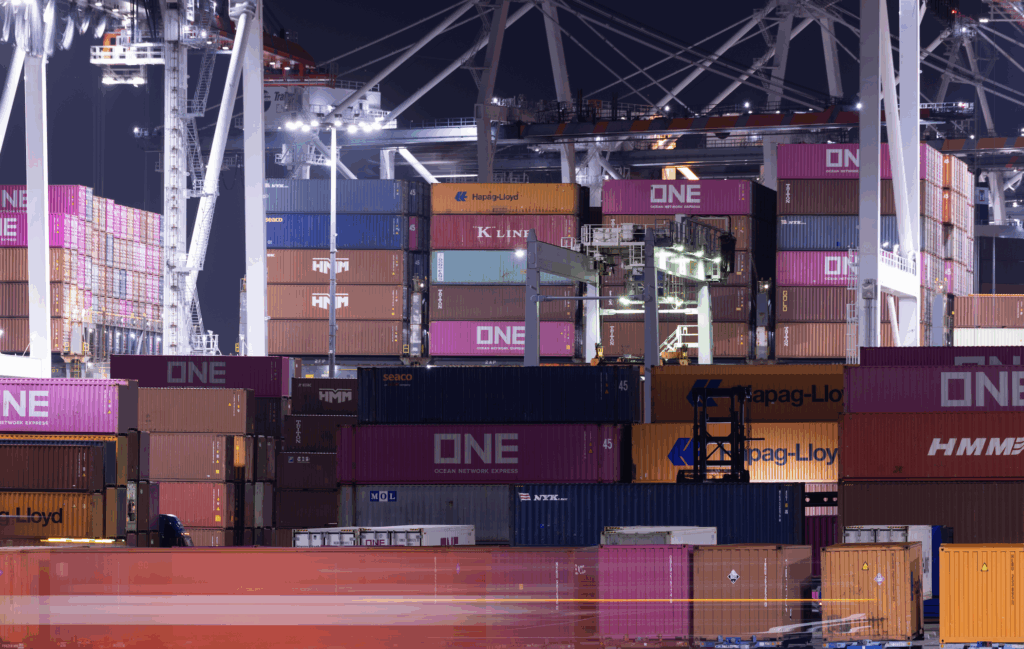
Shipping containers at the Port of Los Angeles. Stock image by Matt Gush.
The United States is entering a new era of resource security. With fresh agreements signed with Australia and Malaysia, and another on the horizon with Japan, the country is taking decisive steps to secure access to the critical minerals that power everything from electric vehicles (EVs) and renewable energy systems to advanced defense technologies.
These deals represent far more than trade diplomacy; they mark a strategic pivot toward independence in a market long dominated by China. For too long, America’s industrial and energy ambitions have been tied to a single point of global processing control. By asserting stronger partnerships with key Indo-Pacific allies, the US is signaling to the world that it will no longer rely on competitors to fuel its growth.
Now, for the first time in decades, these partnerships are laying the foundation for a more independent, resilient, and competitive future where US innovation is no longer constrained by foreign bottlenecks but fueled by reliable access to the resources that matter most.
Strengthening US supply security and innovation
With these new agreements in place, the US is positioned to strengthen not only its access to raw materials but also its capacity to refine, process, and recycle them at home. Diversifying imports away from China gives American industries the stability they need to plan and invest with confidence.
By locking in commitments like Malaysia’s pledge to avoid export bans or quotas on rare earths bound for the US, and similar cooperative frameworks with Thailand, Cambodia, and now Australia and Japan, the country is building a supply network anchored in trust and transparency. This kind of coordination is essential for ensuring that future technologies—particularly in EV batteries, aerospace, and semiconductor manufacturing—have secure, ethical, and scalable inputs.
Reduced exposure to Chinese export controls means more predictable pricing and greater certainty for investors, which in turn accelerates the development of domestic processing hubs and clean-energy technologies. The ripple effects extend across every sector that depends on critical minerals, meaning this shift is not simply about securing supply but rather rebuilding control over the industrial inputs that define the modern economy. By prioritizing allied cooperation and domestic capability, the US is laying the groundwork for a future defined by innovation, resilience, and true energy independence.
A new era of opportunity
For US miners, these developments represent a long-awaited turning point. The clarity and certainty created by these trade agreements give the industry the stability it needs to grow responsibly and competitively. With dependable access to raw materials from trusted allies, American mining companies can focus on efficient extraction, high environmental standards, and value-added processing within North America.
At the same time, new policy alignment between trade and resource strategy is reducing barriers that once slowed investment and project development. Lower financing risk, faster permitting timelines, and renewed investor confidence are likely to follow, opening the door to new offtake partnerships and co-development opportunities with allied suppliers.
The economic potential is substantial, with billions in added sector value and thousands of new, high-paying jobs projected across key mining states such as Nevada and Wyoming. Beyond the immediate business gains, this momentum signals something larger: a transition from dependence to leadership. By aligning trade policy with industrial capability, the US is positioning itself at the center of a secure, allied mineral supply chain that strengthens national security, fuels clean energy growth, and makes resource independence not just an aspiration but a defining feature of America’s economic future.
President Trump’s trade strategy has set the stage for a stronger, more secure future for American industry. These agreements are not just about access to minerals; they are about restoring control, confidence, and competitiveness to the US in this critical sector.
By fostering reliable partnerships, encouraging domestic investment, and prioritizing American production, the country is rebuilding the foundation of its industrial strength. From clean energy to advanced defense systems, every sector that depends on critical minerals stands to benefit from a supply chain rooted in trust, transparency, and shared prosperity.
Ultimately, the path ahead is clear: through continued collaboration with allies and bold investment in homegrown capability, the US can secure its place as the global benchmark for resource security and industrial innovation.
* Brodie Sutherland is CEO of Patriot Critical Minerals Corp., and a geologist with over a decade of experience leading mineral exploration across 20+ countries.
Trump’s $8.5 Billion Effort to Secure a Rare Earths Supply Chain
By Felicity Bradstock - Nov 01, 2025
- The U.S. and Australia signed an $8.5 billion deal to boost critical minerals and rare earth projects, including new mining and refining facilities.
- China currently dominates the rare earth sector, controlling over two-thirds of mining and nearly all magnet manufacturing capacity.
- Despite progress, experts warn that developing alternative supply chains could take up to a decade, keeping the West reliant on Chinese materials in the near term.
The United States is looking to develop new rare earth minerals supply chains to reduce China’s dominance of the sector. In October, President Donald Trump and Australian Prime Minister Anthony Albanese met at the White House to sign an agreement for the strengthening of the critical minerals and rare earths supply chain, with $8.5 billion in projects outlined.
Rare earths are critical minerals that are used in a variety of applications, including the production of magnets for weapons platforms, semiconductor manufacturing, robotics, and electric vehicles. Currently, China is the largest producer of rare earth metals, dominating the global supply chain. China holds around 70 percent of the world’s rare earth metals, or 44 million metric tonnes of reserves, followed by Brazil with 21 million tonnes, India with 6.9 million tonnes, and Australia with 5.7 million tonnes.
As an ally with the United States, Australia is well-positioned to develop its rare earths market, with financial support from the North American country to help counter Chinese dominance. Following the meeting, Albanese said there would be three groups of joint projects between Australia and the U.S., including companies such as the U.S. aluminium firm Alcoa.
The deal reportedly includes an investment of $3 billion from the U.S. for mining and processing projects and outlines a price floor for critical minerals. The White House announced that it plans to invest in the construction of a gallium refinery in Western Australia with a capacity of 100 metric tonnes per year. It said that U.S. investments in Australia were expected to unlock deposits of critical minerals worth $53 billion.
President Trump told reporters, “In about a year from now, we’ll have so much critical mineral and rare earths that you won’t know what to do with them.” He also said that the U.S. is working with countries other than Australia to diversify its critical mineral supply chains.
However, the development of Australia’s rare earth metals market could take between five and seven years, according to sectoral experts. Meanwhile, China continues to contribute 90 percent of the world’s rare earths refining capacity, around 69 percent of global rare earth mining, and 98 percent of magnet manufacturing.
Following the deal between Trump and Albanese, China’s Ministry of Foreign Affairs, Guo Jiakun, responded by saying, “Resource-rich nations with critical minerals should play a proactive role in safeguarding the security and stability of the industrial and supply chains, and ensure normal economic and trade cooperation.”
Earlier in October, China’s Commerce Ministry announced expanded curbs on the export of rare earths, stating that it aimed to prevent the “misuse” of minerals in the military and other sensitive sectors. The Asian giant added dozens of pieces of refining technology to its control list and announced rules requiring compliance from foreign rare earth producers who use Chinese materials. This led many in the industry to raise concerns over the lack of diversity in the global supply and the potentially detrimental effect of China’s decision.
The rare earth market was valued at $6 billion in 2024, according to Goldman Sachs. The financial institution warned that a disruption of 10 percent in industries reliant on rare earths could lead to $150 billion in economic losses. It said that samarium, graphite, lutetium, and terbium would be extremely vulnerable to export reductions.
The bank said that Western producers, such as Lynas Rare Earths and Solvay, could alleviate the shortages, but dependence on China remains high. It emphasised the eight-to-10-year timeline to develop new rare earth mines and the need for advanced expertise and infrastructure, which most countries with mining potential would need to develop.
The U.S. government is not only looking to Australia to reduce its reliance on China, but is also discussing the possibility of establishing a strategic reserve of rare earths and supporting domestic producers with price controls and tariffs. During his trip to Asia this month, Trump also signed deals with Japan, Malaysia, Thailand, Vietnam, and Cambodia to diversify access to critical minerals.
This week, the U.S. and China reached a framework agreement that will halt the implementation of a 157 percent tariff on Chinese goods and could make way for a trade deal between President Trump and Chinese leader Xi Jinping when they meet. Little information has been released about the deal, but it is likely to include an agreement on rare earths.
Despite the potential deal between the U.S. and China, the Trump administration is expected to continue to seek ways to diversify its critical minerals supply chain to reduce its reliance on China. Following several months of strained trade relations, the U.S. is expected to continue investing in its energy sovereignty by offering financial support to domestic companies and establishing deals with other world allies across a range of energy sources.
By Felicity Bradstock for Oilprice.com