It’s possible that I shall make an ass of myself. But in that case one can always get out of it with a little dialectic. I have, of course, so worded my proposition as to be right either way (K.Marx, Letter to F.Engels on the Indian Mutiny)
Wednesday, December 03, 2025
AU
Barrick IPO proposal puts Nevada Gold Mines in M&A spotlight
Barrick Mining Corp.’s proposal to hive off its US assets from its sprawling portfolio in riskier countries will pique the interest of rival miners, according to analysts.
A separate company housing Barrick’s joint-venture interests and the Fourmile discovery in the state of Nevada, as well as a mine in the Dominican Republic, would be attractive to Newmont Corp. and Agnico Eagle Mines Ltd., Jefferies analysts wrote Monday.
“It’s an easier acquisition to execute versus current Barrick because it’s smaller and doesn’t require divesting non-core assets in challenging jurisdictions,” a group of Jefferies analysts including Fahad Tariq wrote.
Agnico and Newmont declined to comment.
Barrick’s plan to explore an initial public offering for its North American gold assets follows a Bloomberg report in October that Newmont had studied a deal to gain control of the mines the companies share in Nevada, which have benefited from recent investments.
The new vehicle is “likely to become an acquisition target for Newmont,” National Bank Financial analyst Shane Nagle wrote in a note to clients.
Still, Barrick probably will focus on additional drilling at Fourmile to increase the resource before considering a sale, which would have to garner a significant premium, the Jefferies analysts wrote.
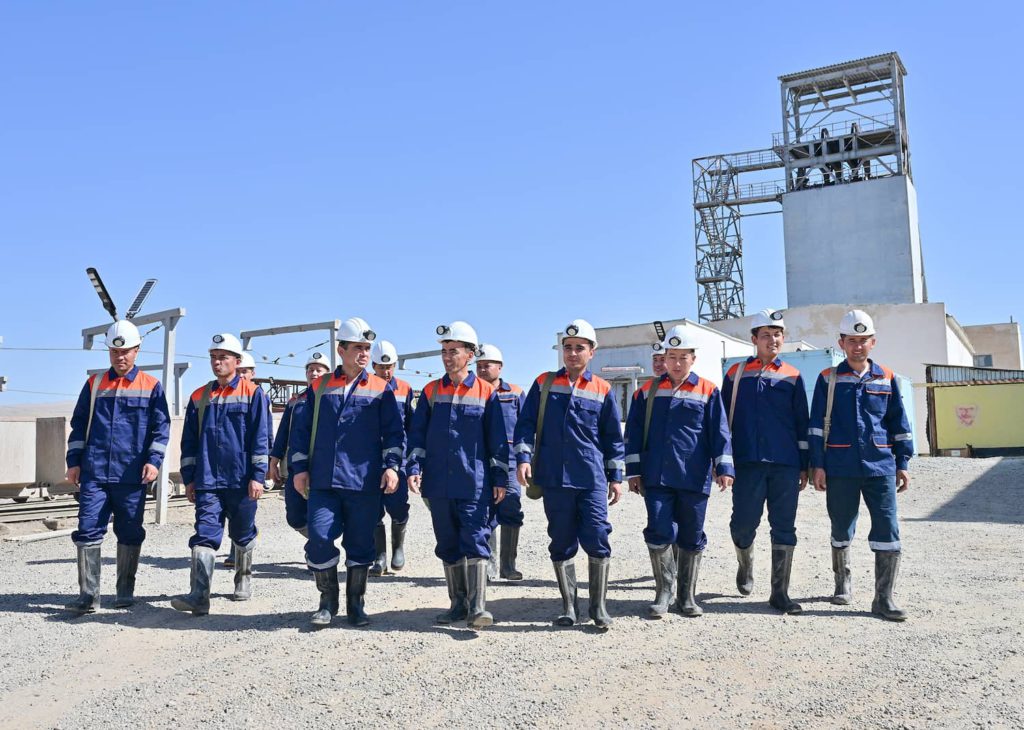
Navoi Mining and Metallurgical Company (NMMC) has received a credit rating upgrade by S&P Global to reflect its status as one of the world’s biggest gold producers.
On Tuesday, S&P upgraded the Uzbekistani miner’s long-term credit rating to ‘BB’, with a ‘Stable’ outlook, citing the Central Asian nation’s improved sovereign rating. The upgrade reflects “the company’s solid financial position and the resilience of its operational performance,” the firm said in a statement.
The agency expects NMMC to maintain a balanced financial approach, enabling the company to continue making a significant contribution to the national economy, it added.
S&P’s rating also aligns with the issuer default rating given recently by Fitch, which cited NMMC’s status as the fourth-largest gold producer globally with production of over 3 million oz. and one of the lowest cost producers with long mine life, high profit margins and low leverage.
Earlier this year, the company successfully placed a new $500 million corporate bond in London, with Citi, JP Morgan, Société Générale and MUFG serving as its bookrunners. Proceeds from the placement will be used to further optimize and diversify the company’s existing credit portfolio on more favorable terms, NMMC said in a May press release.
NMMC currently operates the massive Muruntau deposit in the Kyzylkum Desert, one of the largest in the world. Across all its projects in the region, the company holds a resource gold base that is estimated at 150 million oz.
UK has no immediate plans for critical minerals price floor, minister says
Britain has no plans to match the United States in supporting domestic rare earth companies with a price floor to cut reliance on dominant producer China, Industry Minister Chris McDonald said.
So far Britain is attracting adequate investment in the critical minerals sector to develop home-grown supply, but it will monitor the situation in case other mechanisms are needed, he told Reuters.
Group of Seven (G7) members and the European Union are considering price floors to promote rare earth production, as well as taxes on some Chinese exports to incentivize investment, sources told Reuters in September.
The US provided a guaranteed minimum price to rare earths group MP Materials in July as part of a multibillion-dollar investment by the Pentagon and sources told Reuters the mechanism would likely be extended to other firms.
On Monday, McDonald met with US Pentagon officials in London, who outlined their support policies for critical minerals, including the price floor, he said.
“We’re doing most of them but we’re not doing all of them, and a price floor is one of them that’s currently not on our list. But maybe I’ll keep an eye on how that goes,” he said in an interview.
“Ultimately for me it’s about can we attract this investment, and at the moment we are attracting the investment.”
Britain launched its critical minerals strategy last month, which set targets to meet 10% of domestic demand from UK mining and 20% from recycling by 2035, backed by up to 50 million pounds in funding.
China accounts for about 70% of rare earth mining and 90% of refining.
Britain, which currently produces 6% of its critical mineral needs domestically, is focusing its strategy on lithium, nickel, tungsten and rare earths.
Britain expects lithium processing projects in northern England to break ground within the next few years and aims to produce at least 50,000 metric tons of lithium by 2035.
The country also plans to include stockpiling of critical minerals in its defence procurement plan.
(By Eric Onstad; Editing by Louise Heavens)
Trump pressure fuels Latin America’s critical minerals push
Latin America is stepping up efforts to build critical mineral supply chains as the Inter-American Development Bank (IDB) says governments want to add more value at home while the Trump administration pushes for production closer to the US.
IDB president Ilan Goldfajn said countries across the region are working on increasing their refining and processing capabilities for lithium, copper and other key minerals instead of exporting raw material to Asia.
Together with the European Union, the IBD launched last year a joint initiative to boost responsible investment and develop value chains for critical minerals in Latin America and the Caribbean. Under this program the EU provided a grant of nearly €6.3 million ($7.3m), which is expected to unlock about €120 ($140m) million in IDB funding for mineral-related projects in countries including Argentina, Bolivia, Brazil, Chile and Ecuador.
The funding is especially aimed at supporting downstream activities like processing, refining, and building value chains.
Through a project called Mining for the Energy Transition (MET), the IDB is also providing technical assistance to Latin American nations, with the objective of Strengthening regulatory and investment frameworks, improving geological knowledge and data, supporting low-carbon, sustainable mining and production practices, and enhancing infrastructure.
In an interview with the Financial Times, Goldfajn said Washington has signalled it prefers sourcing and processing within the hemisphere and that governments across the political spectrum see a rare opening to capture more value.
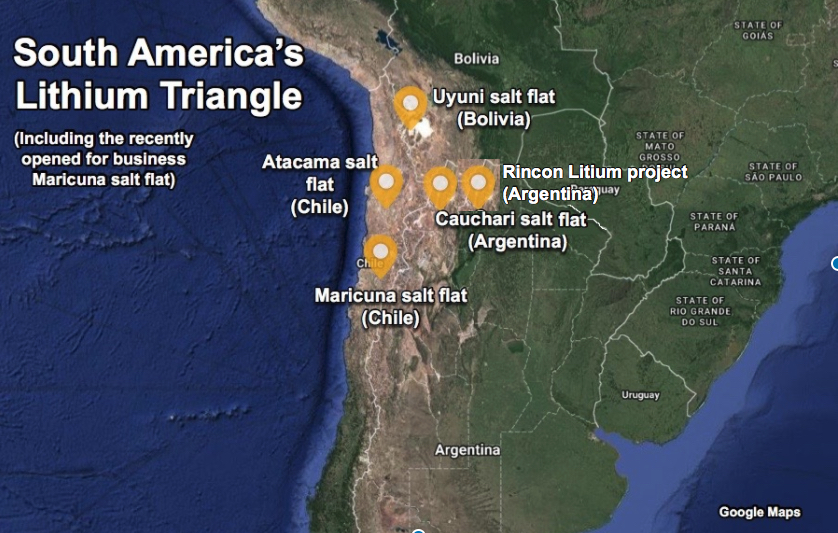
Latin America holds about 60% of the world’s identified lithium reserves and produces roughly 46% of its copper, leading production of the red metal alongside Peru.
Brazil has the world’s second largest rare earths reserves, though its output remains modest because of technical and commercial hurdles. China dominates global processing and its low prices have long undercut efforts by resource countries to move beyond extraction.
By: MINING.COM.
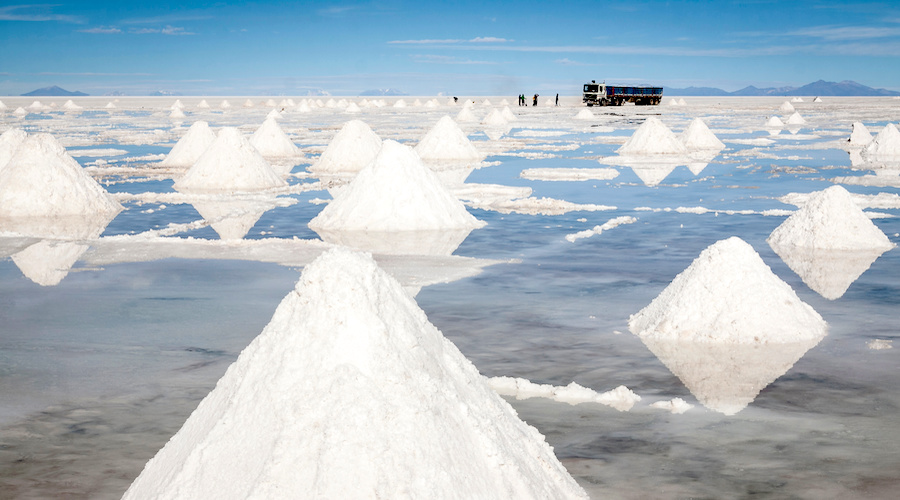
Argentina exports 70% of its lithium to China, only to import it back at prices eight or nine times higher after processing.
Long-term supply contracts are key to closing the cost gap with Asia, Goldfajn said, pointing to a 20-year deal for Chile to sell green hydrogen to Germany that helped unlock IDB financing for the sector.
Extraction too
The bank is also backing extraction and processing projects directly. In Argentina, it is making a $100-million loan toward Rio Tinto’s (ASX: RIO) $2.5 billion plan to produce battery-grade lithium in Salta province.
Goldfajn noted the political divides between the Trump administration and major leftwing governments in Brazil, Mexico and Colombia, but said Washington’s renewed focus on the region was constructive.
Rising demand for financing tied to critical minerals is part of why the IDB group expects to mobilize more than $30 billion this year, up from $23 billion last year. Nearly $20 billion will come from its public-sector arm, while IDB Invest and IDB Lab will finance more than $11 billion for companies.
Appian talking to US, Australia on critical minerals after IFC deal
European Union delegation on a visit to Mt Weld rare earths mine. Credit: Government of Western Australia
Appian Capital Advisory said it is in talks with the US and Australia about replicating the critical minerals investment partnership it recently agreed with a World Bank division.
The private equity firm and the International Finance Corporation (IFC) launched a $1 billion fund in October to invest in projects in Africa and Latin America.
Major economies are stepping up efforts to secure access to critical minerals, which are essential to advanced defence systems, communications equipment and next-generation industrial technologies, including electric vehicles.
“We think that the IFC formula is very attractive,” said Dominic Raab, head of global affairs at Appian, on Tuesday, adding: “We’ve had a lot of interest off the back of the announcement and we’re talking with the US and Australians”.
“We’ve had conversations around Ukraine and things as well about this,” added Raab, a former UK deputy prime minister and foreign minister who joined Appian, which has about $5 billion in assets under management, in February 2024.
Washington and Kyiv signed an agreement in late April that gives the US preferential access to new Ukrainian minerals deals. In October, US President Donald Trump and Australian Prime Minister Anthony Albanese sealed a pact aimed at countering China’s dominance of critical minerals.
Raab said the IFC could rely on Appian’s in-house team of geologists and finance experts, while having more control over project delivery by virtue of owning equity.
Governments want assurances that the mineral offtake they are trying to secure and the mining asset itself will not be “snaffled up by China”, Raab said at the Resourcing Tomorrow conference in London. “Equity control gives you that.”
(By Tom Daly; Editing by Alexander Smith)
Li
Vulcan Energy bags $2.6B financing package for Germany lithium project
Vulcan Energy Resources said on Wednesday it had secured a financing package of 2.2 billion euros ($2.56 billion) that would allow it to begin construction at its Lionheart lithium and renewable energy project in Germany this week.
The Australia-listed company will supply lithium for 10 years from 2028 to companies, including carmaker Stellantis, LG Corp, Umicore and Glencore, from the project, as well as provide renewable energy.
“The board has taken the final investment decision (FID), it’s fully funded and we will be putting shovels in the ground on Friday,” executive chair Francis Wedin told Reuters, noting strong support from European and Australian government-backed institutions for the project.
“It’s a two-and-a-half-year build, so the clock starts now.”
Vulcan will raise up to 603 million euros in equity, via institutional placement and entitlement offers, at a fixed price of 2.24 euros per new share, as part of the financing package.
The project has been backed by European and German government agencies, and a syndicate of 13 financial institutions comprising the European Investment Bank, five export credit agencies and seven commercial banks.
Vulcan is “very positive” on the lithium market going forward despite the price downturn, Wedin said.
“There’s been a deficit of new projects being FID-approved, so at some point that deficit is going to hit home,” he said.
About 72% of its contracted volumes are covered by floor or fixed pricing for the first decade, providing downside protection, he said, with prices “well above the spot price.”
The lithium explorer in July received 104 million euros in German government grants to produce clean lithium, as Berlin aims to boost electric vehicle output and reduce reliance on raw material imports.
Trading was halted on Wednesday in Vulcan shares, which have gained 14.6% so far this year.
($1 = 0.8604 euros)
(By Melanie Burton and Sherin Sunny; Editing by Krishna Chandra Eluri and Subhranshu Sahu)
Rio Tinto Hits the Brakes on Lithium in Strategy Shakeup
New CEO Simon Trott is driving a fundamental reorganization at Rio Tinto, streamlining operations, cutting costs, and potentially selling assets.
Lithium will face tougher internal competition, with Rio Tinto slowing or mothballing projects.
Despite volatility in lithium markets, Rio Tinto still expects strong long-term demand, supported by rising EV and stationary battery sales
Rio Tinto is streamlining operations and drafting a fundamental reset to accelerate projects with quicker and better returns. The strategy overhaul is courtesy of the mining giant’s former head of the iron ore division, the group’s biggest business, who became chief executive officer a few months ago.
New Rio Tinto CEO Simon Trott will unveil his vision of a streamlined Rio Tinto at a Capital Markets Day event in London on Thursday.
Trott has signaled that reorganization will continue to fundamentally reset the company’s businesses. This could include asset sales, slowing developments in lithium projects, and additional cost cuts, analysts tell The Wall Street Journal.
Rio Tinto could slow the timeline for development of some lithium projects, according to investors, after the mining giant bet big on the critical metal last year with the $6.7 billion acquisition of Arcadium Lithium.
The mining group will still bet on lithium, but projects will have to compete with the iron ore and copper developments, analysts say.
Days after becoming CEO, Trott announced in August “a new operating model and executive team to shape the company’s next chapter.”
Effective immediately, Rio Tinto simplified its product group structure to three businesses: Iron Ore, Aluminium & Lithium, and Copper.
Rio Tinto’s Lithium business moved into the Aluminium product group under the leadership of Jérôme Pécresse.
“I think if you try and do everything, you get nothing done,” Trott said at the Goldman Sachs Global Metals and Mining conference 2025 in October.
“One of the really good things about having options, and we've got lots of options in the lithium space, is that the bar is really high, and so we can look at those projects and progress the very best of them.”
Trott hinted Rio Tinto would be more selective in the lithium business to progress the most profitable projects.
The miner still sees strong lithium demand going forward, it said in its Third Quarter Operations Review.
“Lithium demand remains strong, underpinned by a 27% YoY increase in global electric vehicle (EV) sales across the first seven months of this year (compared to 22% over the same period in 2024). Demand from stationary batteries remains solid and is providing additional upside,” Rio Tinto said.
However, last month the group decided to mothball a $2.4 billion lithium project in Serbia after years of trying to obtain all necessary permitting.
“As part of our focus across the overall portfolio to simplify and prioritize near term opportunities, the decision has been made to transition the Jadar project to care and maintenance,” an internal memo reviewed by The Wall Street Journal showed.
Prioritizing quicker returns and payback opportunities will be core to Rio Tinto’s new strategy under Trott.
“The changes we are making are not incremental — they are fundamental,” the CEO wrote in October in an emailed message shared with Bloomberg.
“We are transforming to make life easier for our frontline and lift our performance. It will take discipline and effort from all of us.”
Lithium demand has seen ups and downs in recent years, from booms to busts, as the pace of electric vehicle (EV) adoption, China’s economic growth, and faded energy transition enthusiasm in the U.S. have shaped the market trends.
“Over the past five years, lithium prices have gone from bust to boom and back to bust again because of a disjoint between demand and supply,” said Oliver Heathman?, Head of Metals Assets, Metals & Mining Research at Wood Mackenzie.
“New producers, such as Brazil and Zimbabwe, have emerged in recent years spurred on by higher prices, while the level of optimism over EV demand has subsequently waned creating the current market oversupply as demand growth rates have slowed.”
In its latest market report, Fitch Solutions’ BMI has raised itstin price forecast for 2026 to $35,000 a tonne from $32,000 previously, as continued supply issues keep markets on edge in the face of steady demand from the semiconductor industry.
Supply is dominated by Indonesia, where production and exports are being affected by delays in approving annual work permits. The Southeast Asian nation has long been the world’s largest exporter and the flow of metal to world markets has been interrupted several times in the past when the government tightened production and export rules.
Tin’s supply chain is not just beholden to Indonesia’s resource nationalism but also to that of the Wa State in Myanmar. In July, the International Tin Association announced that shipments from Wa State will resume in the coming months, as several operators at Man Maw — the region’s major tin mine that is currently undergoing a controlled restart — have reportedly secured three-year mining permits.
With no further update at the time of BMI’s report in late November, Fitch analysts have adopted a “wait and see approach”, as news of a resumption of tin mining in Wa State have circulated markets for months without actually materializing.
Historically, Myanmar is the world’s third largest tin producer, and, according to USGS data. It is estimated to have the third largest reserves in the world, at 700,000 tonnes or 15% of total global reserves, after China and Indonesia (800,000 and 720,000 tonnes respectively).
Supply & demand
Three-month futures prices on the LME were hovering around $36,787/t on November 14, and BMI expects prices to remain supported by continued supply issues in the face of steady demand from the semiconductor industry.
China’s tin smelter production remains constrained by the lack of sufficient concentrates, while the resilience in economic activity amid easing trade tensions have boosted demand from the semiconductor industry, analysts note.
On the supply side, a thin pipeline of mining projects will tighten the tin concentrate market, leading to increased competition among smelters and constrained ore feed for refined output growth, BMI forecasts.
On the demand side, the Fitch unit predicts that global use of tin will increase rapidly through the metal’s use in electronics (especially as electric vehicles increasingly contain greater amounts of electronics in their body) and solar panels (in photovoltaic cells), cementing tin’s status as a commodity of the future.
Ultimately, this will allow the market to tighten, and the firm expects a market deficit to tighten.
CU
Vale, Glencore explore Canada JV in bid to boost copper exposure
The old Copper Cliff nickel mine. (Image courtesy of Vale Agency.)
Vale SA and Glencore Plc are considering a joint copper project in Canada as the two companies look to increase their exposure to a metal projected to be in short supply as the world electrifies.
The proposed collaboration between Vale’s base metals unit and the Swiss commodities giant is to jointly develop a $1.6 billion to $2 billion project at their neighbouring properties in the Sudbury basin, Vale said in a statement Tuesday. It would churn out 880,000 metric tons over 21 years.
While Vale and Glencore have been mulling a Canadian partnership for two decades, the agreement is the latest example of collaboration in the industry. Miners are teaming up to contain costs and lift output as ore quality deteriorates and new projects get pricier to develop — at a time when demand for the wiring metal is increasing due to the energy transition and building of data centers to power AI.
The deal may help appease Glencore investors who have grown increasingly frustrated by the stock’s under-performance, with the company’s copper production expected to drop for a fourth straight year.
Vale has laid out a plan to double the base metals unit’s production capacity to about 700,000 tons a year by 2035. That would still be modest compared to rivals, and the Brazilian firm reportedly held on-and-off talks about a combination with Teck Resources Ltd. before the latter agreed to merge with Anglo American Plc.
The Vale-Glencore agreement in Canada provides a framework to explore combining underground operations, including deepening an existing shaft at Glencore’s Nickel Rim South Mine and developing new drifts to tap copper deposits.
The intention is that Vale and Glencore will transition to a joint venture as equal partners in the project. Besides copper, the companies would also produce nickel, cobalt, gold and other critical minerals.
Detailed engineering, permitting and consultation work will take place next year, with a final investment decision penciled in for the first half of 2027.
(By Mariana Durao and James Attwood)
Port Canaveral Nudges PortMiami Out to Become Busiest Cruise Homeport
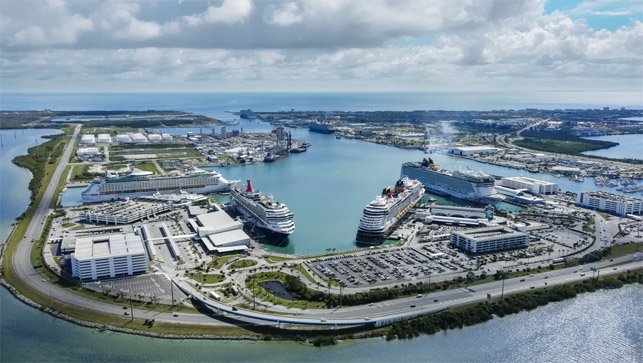
Port Canaveral, Florida became the busiest cruise homeport topping Miami with over 8.6 million passengers (Port Canaveral)
The rivalry between PortMiami in South Florida and Port Canaveral in Central Florida took a surprising turn with Port Canaveral nudging Miami from its traditional number one ranking in FY 2025. The difference was small between the two ports, just 0.4 percent, but it is a major achievement for Port Canaveral as it continues to see rapid growth in its cruise business.
Port Canaveral topped even its own projections, which had set a target of around 8.4 million passenger movements (counting embarkation and debarkations separately as two movements) for FY 2025. The final number came in at 8,602,047 passengers, a better than 13-percent increase over the prior FY.
It is not the first time Port Canaveral has taken the top honors, as it rebounded in 2022 ahead of PortMiami from the pandemic. The Central Florida seaport, which is close to the theme park attractions in the Orlando area, handled 4.21 million passengers in 2022 compared to just over 4.0 million that passed through Miami. Amazingly, the numbers have doubled again.
Canaveral has traditionally benefitted from ships that do short cruises with turns twice per week, but in recent years has also seen strong growth as a homeport for 7-day cruises. Last summer, it became the home to one of the world’s largest cruise ships, Star of the Seas, which operates 7-day cruises, while its fleet mate, Utopia of the Seas, operates 3- and 4-day cruises from Canaveral.
In March 2025, Port Canaveral set a record with its highest monthly passenger movements. That month, it hosted 925,994 passengers, which was up 16 percent versus March 2024. At the time, port officials said they were on track for 8.4 million passengers for the year, up from 7.6 million in the prior year.
“It wasn’t long ago when we exceeded 500,000 guests in a single month. Now, with numbers like this approaching nearly a million, it’s not just remarkable, it demonstrates the strong demand for sailings from our port. We’ve been predicting it, and we were ready for it,” stated Capt. John Murray, Port Canaveral CEO, in April 2025.
The port moved quickly to establish LNG capabilities and was rewarded with the first LNG-fueled cruise ships in North America. It is now implementing a $912 million five-year capital improvement initiative. The port is expanding two existing terminals and will develop a seventh terminal. Just last week, it received one of Princess Cruises’ largest ships for the first time, and in 2027, Carnival Cruise Line will send its new giant Carnival Festivale to the port alongside the Mardi Gras, while MSC will expand its operations by basing the MSC World Atlantic at the port.
PortMiami was just under 8.6 million passengers as it grew including handling 10 cruise ships in a day (PortMiami)
While the rivalry continues between the ports, it also shows the strong growth in the cruise market, and specifically in Florida. Port Everglades is also seeing strong demand, as is Tampa.
PortMiami reported 4 percent growth in its passenger totals, handling a record 8,564,225 cruise passengers in the just concluded FY between October 1, 2024, and September 30, 2025. Long known as the Cruise Capital of the World, PortMiami highlights that it will receive 10 first-time cruise ships in this new year, including five newbuilds. It continues the growth for the port, which in the spring saw the opening of the new MSC Terminal (AA), which is billed as the world’s largest cruise terminal. The port has recently handled 10 cruise ships in a single day.
The rivalry will continue as both ports position for continued strong growth. While cruising continues to grow, Florida remains the epicenter of the industry, and in turn, it contributes a key part of Florida's tourist economy.
Philadelphia Starts Construction on Homeport Cruise Terminal
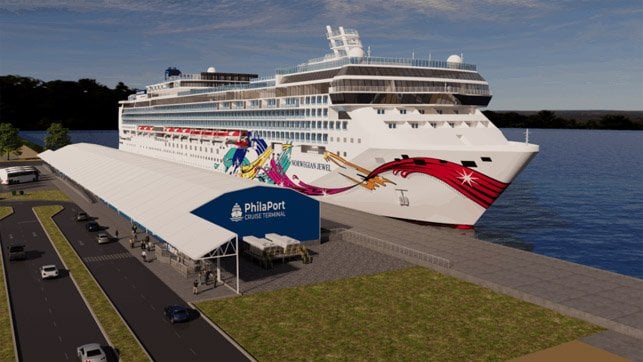
Philadelphia will have a cruise homeport in 2026 for the first time in many years (Philaport rendering)
The Port of Philadelphia announced the groundbreaking for the new PhilaPort Cruise Terminal as the city looks to capitalize on the rapid growth in cruise travel. Philadelphia has not had a cruise business since at least 2011, with travelers forced to go to either New York or Baltimore to sail on a cruise.
Norwegian Cruise Line in 2024 announced that it had entered into a new agreement with Philadelphia to seasonally homeport its cruise ship Norwegian Jewel (93,500 gross tons) in the city for cruises to Bermuda and other destinations. They said the new homeport for NCL would provide residents in the U.S. Mid-Atlantic region more access to cruising, with NCL committed to run cruises through October 17, 2026.
Regional homeporting is a growing trend in the cruise industry over the past decade of more. Norwegian was an early innovator, positioning ships closer to more people, making it possible to drive to their vacations instead of the traditional fly-cruise market. Smaller cities, ranging from Baltimore and Norfolk a well as Charleston for many years, Boston, Galveston, Tampa, have seen their cruise business develop based on people driving to the port.
Philadelphia’s new terminal is the result of coordinated efforts and partnership among PhilaPort, Norwegian Cruise Line Holdings, and Energy Transfer Marketing and Terminals (ETMT). PhilaPort and ETMT have finalized the agreement of sale of property for the site in Tinicum Township, formerly known as the Hog Island Dock Terminal Facility, clearing the way for its redevelopment. It is a 16-acre site adjacent to Philadelphia International Airport.
PhilaPort will manage all marine-side improvements, while Norwegian Cruise Line Holdings will lead the land-side construction and development of the terminal. Under a seven-year berthing agreement running from April 15, 2026, through March 31, 2033, NCLH’s cruise brands will operate as Philadelphia’s exclusive homeport with an initial commitment of 41 sailings per year.
“This is a unique opportunity, and we are fortunate to have two outstanding partners in Energy Transfer and Norwegian Cruise Line, both of whom see tremendous potential in Philadelphia,” said Jeff Theobald, PhilaPort Executive Director and CEO. “It took a lot of hard work to bring this agreement together, and Energy Transfer and Norwegian Cruise Line were committed every step of the way. We have a lot of hard work ahead of us, but we are ready and excited to welcome cruise passengers this spring.”
The terminal’s inaugural season will also likely benefit as the United States celebrates its 250th anniversary in 2026, with Philadelphia hosting a wide range of events and tourism experiences.
According to PhilaPort officials, cruise operations at the new terminal are projected to generate 2,185 direct and indirect jobs and approximately $300 million in annual economic output throughout Pennsylvania, supporting labor-intensive services that contribute to regional economic well-being.
New Cruise Company Signs with China Merchant for Eight B-to-B Ships
United Waterways released a rendering of its concept design reporting it will build expedition and coastal cruise ships with tour and lifestyle brand partners (Tillberg Design of Sweden)
Ship manager United Waterways announced its plans to expand its unique B-to-B approach into ocean cruising, focusing on the popular expedition and coastal cruising segments. The company, which has been a provider of ship management services, announced earlier this year plans to expand into the ownership of river cruise ships and now says it has booked construction slots with China Merchant for the expedition and coastal ships.
The B-to-B concept calls for the company to build the vessels, but instead of direct marketing, it is seeking partners. It reports strong interest from well-known tour operators and also looks to expand into lifestyle brands. The ships will operate under the name of the partner brands. Using a similar approach, the well-known Lindblad Expeditions is launching its first river cruises in 2026 by partnering with another company, Transcend Cruises, which is using a similar B-to-B business model.
United Waterways first announced earlier this year plans to build 10 river cruise ships. The company reports it found partners within six months, working with prestigious brands. The ships are being built in Europe, and the company says it is working with partners in the United States, Asia, and Europe. The ships, they report, will be the first multi-fuel platform and will be ready to comply with the European Union’s emerging regulations.
Based on the strong partner response to the river cruise segment, United Waterways believes there is a similar opportunity in the expedition and coastal cruising segments. It booked construction slots for a total of eight ships, four for coastal and four for expedition, with China Merchant Heavy Industry (Jiangsu) Shipyard. United Waterways is launching a new brand, Ocean Advice, for these ships, and says it believes there will be crossover opportunities with its river partners. It says three of the eight vessels have already been reserved, and it expects to book all the ships within the next 12 months.
It notes that China Merchant has strong experience in the expedition and small cruise ship segment. The shipyard built seven 200-passenger expedition ships for SunStone, which are chartered to major brands. The last of the ships was recently delivered. China Merchant had said it would be deemphasizing the small cruise ships based on strong demand from other segments.
United Waterways reports it has two design concepts, designed in partnership with the well-known Tillberg Design of Sweden. For the expedition market, the ships will have a capacity of 186 passengers. For coastal cruising, the ships will have a capacity of 260 passengers.
Both of the ship classes are focused on providing cozy spaces and exploiting a destination focus. The size will permit the ships to reach out of the way and smaller destinations unavailable to bigger ships. Working with China Merchant, they will also incorporate China’s developments in electrification to make the ships hybrids.
As part of its agreement with China Merchant, the company reports it has already exercised the first slot, signing a contract for an expedition ship due for delivery in 2028. It expects the first coastal ship in 2029.
Philippines Reports Oman Arranged for Release of Crew Held by Houthis
The crew went into the water as the Eternity C began to sink ( Houthi Military Media)
After four months of captivity, the crew of the bulker Eternity C is expected to be released by the Houthis. The Philippines Department of Foreign Affairs reports it has been advised of the release by the government of Oman, although no timing or details were provided.
The Philippines said it had been discussing the plight of the individuals with the Omani authorities as it sought to gain their freedom. The Philippines had made an initial appeal in July when the Houthis reported they had “rescued” several of the crewmembers from the ship. The Philippines reports it again raised the matter with Omanis during a phone call in November.
The statement says that nine individuals will be released and transferred from Yemen to Muscat, Oman. The DFA expressed its “sincere appreciation” to the Sultanate of Oman for the assistance in winning the repatriation of the crew.
The Eternity C was one of the two vessels attacked in rapid succession by the Houthis in the Red Sea in July. It marked a renewal of the aggression timed to the war in Gaza. The vessel was attacked three times by as many as eight boats firing small arms and RPGs on July 7, and the following day, again assaulted by the Houthis after the ship had already been damaged. The reports said that no warships had yet been able to reach the bulker and that its lifeboat had been destroyed, making it impossible for the crew to abandon ship.
The ship started to sink on July 9, and the crew was forced to jump into the water. Cosmoship Management had hired a salvage team, which was working frantically to rescue the crewmembers. They were able to save eight crewmembers and two security guards. The body of another security guard was retrieved, and the death toll was set at a total of nine.
A mystery ensued with the Houthis saying they had rescued several of the crewmembers. They released a video showing nine individuals, and a 10th was shown in a hospital bed. The group said the crew was receiving medical care and was in good condition.
This is believed to be the last of the crew detained by the militants. They previously also held the crew of the car carrier Galaxy Leader for 14 months before the Omanis were also able to negotiate their release.
Haitian Gangs are Setting Up Shop for Seaborne Drug Smuggling
Gang members on patrol in Port-Au-Prince, Haiti (UN)
The United Nations warns that gang warlords in Haiti have turned the country’s coastal waters into a pivotal transshipment hub for drugs originating from South America and destined for key markets across the Caribbean, the U.S. and Europe.
As the country plunges deeper into the abyss of lawlessness, the UN contends that large gangs have taken control and are deeply entrenched along strategic corridors, in effect turning most of the country’s coastal waters into transit routes not only for drugs but also arms and human smuggling. Île de la Tortue (Tortuga), an island located off the north coast of Haiti, has become a transshipment center for most of the international drug trafficking activity owing to its size and remoteness.
While the rocky and mountainous island has a history of having been a playground for pirates, in recent times organized criminal networks involved in drug trafficking, human smuggling and other illicit activities have turned it into a logistical and storage platform for illicit shipments. This owes to its geographical position, which provides direct maritime access to the Bahamas, Cuba and Jamaica, as well as the Turks and Caicos Islands.
Île de la Tortue’s role as a drug trafficking hub is highlighted by the seizure of 1,045 kilograms of cocaine in July, the country’s largest drug bust in over 30 years. In the operation, the Haitian National Police and other agencies seized 49 bags containing a total of 959 packets of cocaine following a shootout with suspected traffickers who were using a boat. Three traffickers of Jamaican nationality were killed, while a fourth individual, a Bahamian national, sustained injuries. Notably, the cocaine was believed to have originated in South America and was intended for distribution across the Caribbean and the U.S.
Just two weeks later, another 426 kilograms of cannabis was confiscated in Petite-Anse, near Cap-Haïtien again in the north of the country. In the same month, two Haitian nationals were arrested in Jamaica with over 1,350 kilograms of cannabis worth $9.3 million.
That some of the drugs entering the European market originate from Haiti is also evident. In August 2025, Belgian authorities seized 1,156 kilograms of cocaine hidden in a container at the port of Antwerp. Investigations indicated that the consignment departed Cap-Haïtien and transited through Kingston before arriving in Belgium where it was intercepted. A year earlier, law enforcement authorities in the Turks and Caicos had interdicted over $2.7 million worth of marijuana traced back to Île de la Tortue.
According to the UN Office on Drugs and Crime (UNODC), drug traffickers and other smugglers involved in illicit activities are using Île de la Tortue as a departure point for overcrowded boats to run their illegal trade leveraging maritime expertise, familial links and cultural connections. Control of domestic routes has allowed gangs to move drugs with impunity while also extorting tolls from boats and engaging in armed robbery at sea, the office says.
“The seizures of drugs both in Haitian waters and in Europe indicate sophisticated, coordinated and established trafficking routes that require a robust regional response by law enforcement agencies,” said the UN.
UNODC is leading efforts to support Haiti in dealing with the growing menace, with measures cutting across helping authorities increase interdiction capacity at ports, airports and land borders, strengthening the capabilities of the Haitian coast guard, identifying and dismantling cross-border criminal networks among others.