ALT.FUEL
Norwegian Timber Ship Will be First to Use Wartsila’s Ammonia Engine
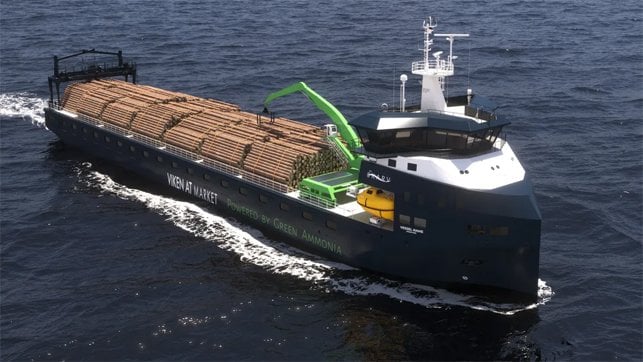
The shipping industry is making several firsts as the order for a Norwegian cargo ship was confirmed as the first to use the new Wärtsilä 25 Ammonia engine. Due to launch in 2027, the vessel will be a key step in the efforts to reduce emissions in Norwegian coastal shipping.
The new vessel is to be built in China at the Huanghao shipyard. The concept was developed by Bergen-based Skarv Shipping, with support from Grieg Shipbrokers to realize the technology and yard agreement. Arriva Shipping will take the vessel on time charter and manage the commercial ship operation for Viken AT Market, a Norwegian timber company.
The ship will be 7,800 dwt with a length overall of 108 meters (354 feet). It will be a self-unloader and is expected to enter service in the summer of 2027.
Wärtsilä will provide its advanced Wärtsilä 25 Ammonia solution to power a new cargo vessel, making it the first newbuild to use this solution. In addition to supplying the engine, Wärtsilä will supply the complete ammonia solution, including the AmmoniaPac Fuel Gas Supply System, the Wärtsilä Ammonia Release Mitigation System (WARMS), and a selective catalytic reduction (SCR) system designed for ammonia. Wärtsilä will begin delivering the equipment for the installation in the fourth quarter of 2026.
“The Wärtsilä 25 Ammonia engine and the whole solution is the result of extensive research and testing over a number of years, in line with our commitment to decarbonizing shipping operations,” highlighted Roger Holm, President of Wärtsilä Marine & Executive Vice President at Wärtsilä Corporation.
Skarv Shipping reports that the ship is designed to sail most efficiently at low speeds, which helps ensure economically viable operations despite the higher cost of ammonia compared to traditional fuels. A 160-cubic ammonia tank, mixed with MGO (Marine Gas Oil) as pilot fuel, will provide enough fuel for a 14-day round trip from Norway to the European continent.
Currently, Viken AT Market ships approximately 1 million tons of Norwegian timber to Europe each year. It highlights that most of the current transport to customers is done with conventional diesel-powered ships. Starting in the summer of 2027, Viken AT Market highlights that it will move part of its timber transport to the new vessel that will run on electricity and ammonia, making a strong contribution to the efforts to reduce carbon emissions.
bound4blue Completes First Contracted eSail Installation for Maersk Tankers
[By bound4blue]
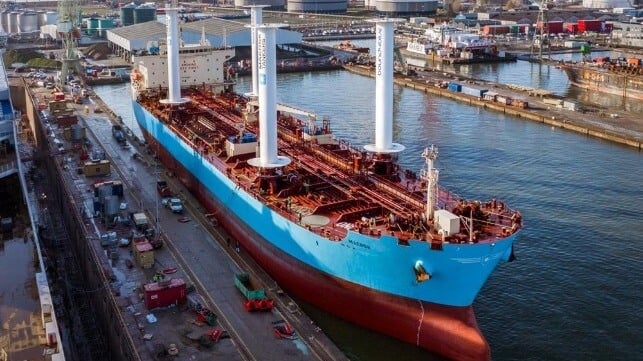
bound4blue and Maersk Tankers have reached a major milestone in their collaboration with the installation of eSAIL® units on board the Maersk Trieste.
Four of the 24-metre ‘plug and play’ suction sails were fitted on the vessel, completing the first stage of an agreement that will see a total of 20 units installed across five advanced medium-range (MR) tankers. The contract, agreed in December 2024, is bound4blue’s largest order to date.
bound4blue CEO and co-founder José Miguel Bermúdez heralded the development as “a watershed moment” in the further acceptance and adoption of wind power for an industry in transition.
The advantage of innovation
bound4blue’s autonomous eSAILs® work by drawing air across an aerodynamically optimised surface to generate lift up to seven times greater than conventional rigid sails of a comparable size.
With configurations tailored for individual vessels, eSAILs® can deliver double-digit percentage reductions in fuel consumption and CO? emissions, while significantly improving a vessel’s Carbon Intensity Indicator (CII) rating. The systems also unlock regulatory and cost benefits under frameworks such as FuelEU Maritime, via the Wind Reward Factor, and EEDI/EEXI.
From contract to completion
bound4blue, Maersk Tankers and system integrator Njord chose a two-step installation process for the Maersk Trieste, maximising efficiency while minimising vessel downtime.
Following preparatory ‘wind ready’ work carried out at Yiu Lian Shipyard in Shenzhen, China - including the installation of deck pedestals and electrical modifications - the vessels arrived at EDR Shipyard in Belgium. Here, the units were lifted onboard, secured to the pre-installed foundations, and connected to onboard power and data networks in a pre-commissioned ‘plug-and-play’ process. The mechanical simplicity of the design supports straightforward integration into conventional shipyard workflows, helping to minimise downtime during retrofit projects.
Tailored for tankers
“Our system was designed from day one to deliver maximum performance with minimum complexity,” comments Bermúdez, “and that’s especially important for scaling up installations within segments that present specific integration challenges, such as tankers.
“The size and efficiency of eSAILs® enable tankers to benefit from wind propulsion safely and cost-effectively, without altering operational profiles - avoiding tilting systems and retaining a normal operational air draft, and all with the simplicity of a non-ATEX solution. These latest installations demonstrate that globally leading shipowners appreciate these benefits, while sharing our vision for a more sustainable, cost effective and compliant maritime future. We’d like to thank Maersk Tankers for this unique, important and powerful partnership.”
Tangible actions
Commenting on the development, Claus Grønborg, Chief Investment Officer, Maersk Tankers, said:
“For the tanker industry, progress on emissions reduction requires concrete investments and implementation. At Maersk Tankers, we focus on deploying advanced energy-efficient technologies to reduce fuel consumption and CO? emissions. Implementing Wind-Assisted Propulsion Systems at scale enables more energy-efficient voyages for our customers, while supporting compliance with FuelEU Maritime and the EU Emissions Trading System.”
bound4blue’s DNV Type Approved technology is designed for simplicity and ease of integration on both newbuild and retrofit projects, across a wide range of ship types (including tankers, bulk carriers, Ro-Ros, cruise vessels, ferries, and gas carriers, amongst others). Installations can be undertaken to fit individual vessels and schedules, with streamlined processes enabling entire systems to be fitted in under a day, when necessary.
Wave of adoption
The Maersk Tankers project follows a series of high-profile eSAIL® contracts and installations with shipowners such as Louis Dreyfus Company, Eastern Pacific Shipping, Odfjell, Klaveness Combination Carriers, and BW Epic Kosan.
Taken together, these projects provide further proof that wind propulsion is rapidly moving from niche innovation to mainstream decarbonisation strategy - driven by tightening regulations, rising fuel costs, and growing industry confidence in the technology’s commercial benefits.
“This is more than just another installation,” concludes Bermúdez. “It’s proof that wind propulsion is ready to deliver at scale, even for complex vessel types like tankers. By partnering with a forward-thinking company like Maersk Tankers, we’re showing that practical decarbonisation solutions are already here… and ready to make a measurable impact today.”
The products and services herein described in this press release are not endorsed by The Maritime Executive.
TOTE Services Signs Up to Provide LNG Bunker-Barge Capacity in Galveston
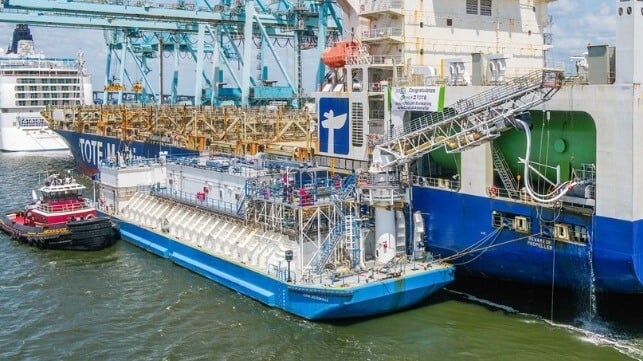
TOTE Group is partnering up with a Texas-based bunkering company to launch LNG bunker barge services in the greater Houston / Galveston Bay area. LNG is an increasingly popular option for cruise ships, boxships and other vessel classes, and locally-produced Texan natural gas, liquefied and delivered, will give these visiting vessels the fuel they need.
TOTE Services and Galveston LNG Bunker Port have signed a heads of agreement that outlines the construction and operation of a Jones Act-compliant bunker vessel service. Bunker barges enable refueling while the receiving vessel is moored alongside the pier at a working cargo or passenger terminal, without requiring it to shift berths to a separate refueling pier. This saves time and cost.
In the conventional HFO/VLSFO market, both Jones Act and foreign-flag bunkering vessels operate out of the Houston area, reflecting the regulatory needs of different operators. Offshore bunkering services outside the port can be legally provided by foreign-flag product tanker tonnage, since the cargo (the bunker fuel) does not move between two U.S. points. The Vitol-chartered, Marshall Islands-flagged Lokholmen is an example of a vessel in this trade. Inshore bunkering is generally done with Jones Act tank barges and push boats or ATBs.
Galveston LNG Bunker Port says that it needs U.S.-owned, built and crewed vessels to move LNG in coastwise trade, and TOTE is well positioned to supply the tonnage. TOTE Services has conducted over 850 LNG bunkering evolutions over the years on the company's own vessels, and that experience will translate into operation of a fleet of Jones Act LNG bunker barges for GLBP.
"The safe and reliable delivery of LNG to our customers is paramount. Securing TOTE Services as our Jones Act partner is a defining milestone for the project and the U.S. LNG bunkerin industry," said Jonathan Cook, CEO of Navergy Infrastructure Partners (formerly Pilot LNG), which is one of the two backers of GLBP.
GLBP has secured all of its federal and state permits, and it has awarded a contract for engineering and construction. Talks with potential customers for offtake purchasing continue, and the venture says that it hopes to achieve a final investment decision this year.
In its first phase, the small-scale bunker port would produce about 0.21 million tonnes per annum (mtpa) of LNG, the standard industry measurement of capacity. It has plans for a second phase of equivalent size, which would bring the total to 0.42 mtpa. GLBP has secured a site in Texas City and selected NV5 LNG as its EPC contractor.
A competing project by Houston-based company Stabilis - which already has two smaller liquefaction facilities - is also in the running. Stabilis holds contracts to supply Carnival's growing fleet of LNG-powered cruise ships. Stabilis says that it has booked long-term sales for more than half of its project's planned capacity.
Correction: The original version of this article misstated the units of the capacity of the Stabilis plant; it is in fact smaller than the GLBP project. Additionally, the second-phase expansion capacity of the GLBP plant has been added to the article.

No comments:
Post a Comment