It’s possible that I shall make an ass of myself. But in that case one can always get out of it with a little dialectic. I have, of course, so worded my proposition as to be right either way (K.Marx, Letter to F.Engels on the Indian Mutiny)
Rocked by corruption and paedophilia scandals, Peter Mandelson was recast by The Times Magazine as a quaint eccentric. It’s a reminder that no reputation is too shameless or tarnished for Britain’s media to launder.
British former Labour Party politician Peter Mandelson on the front cover of The Times Magazine.
On Saturday, The Times Magazine published an interview with Peter Mandelson, along with a cover image of the former minister cooking in his Wiltshire home. Ideally, I wouldn’t share the image because, regardless of what the article contains, seeing anyone in that context has a way of legitimising their place in public life. We see someone in a weekend supplement, and the extent of their evil is automatically limited to that of a comic-book or soap-opera villain, yet Mandelson is neither. At the height of the financial crisis, he sold the country out (allegedly, potentially, etc.) to his paedophile friend — a friend who he’d abetted in many other ways as well.
In the background of the photograph is a painting by the British artist Beryl Cook. Nothing says New Labour quite like visiting Epstein Island and filling your house with Cook. I think our inability to recognise propaganda is a factor in Mandelson’s success. Britons suffer from an exceptionalism that blinds them to the forms of propaganda that exist here. It’s why I’m always adamant that people spend at least part of their twenties or thirties living abroad, not travelling or going on holiday, but actually living elsewhere. Get a boyfriend or girlfriend who grimaces at the smug sarcasm of our media class, at the way that it condescends to working people! I promise you, it will change your life.
I’m fairly sure that Mandelson and the photographer chose to stage their image in front of the Cook because she’s relatable, she’s familiar, she’s fun, but most importantly, she’s recognisably British. Everything about Mandelson is cynical — apart from his deep and abiding love for the paedophile Jeffery Epstein, apparently — and so, it’s fair to assume that no part of the image would have been spontaneous. The inclusion of the Cook is meant to tell us that, despite his callous manoeuvring, Mandelson was someone who held the interests of the British people in his heart; there’s also a domesticity to the scene that feels gendered, and is only heightened by Cook, almost as if the image could subliminally counter the vile misogyny that Epstein represents.
Cook’s paintings have always been considered shorthand for a British proletarian ‘way of life’, but she herself does not fit neatly into the category of a working-class artist. Her husband was an officer in the merchant navy, and she lived in Zimbabwe for nine years. The swinging Plymouth that she painted on her return was a place that had been fattened through empire, and decimated during the war, admittedly, but then rebuilt in part thanks to its advantages as a global port. Cook lived very comfortably, and the people she painted were not exactly hard up either, but enjoying the spoils of globalisation and a new, turbo-charged consumerism. Separating the scourge of American cultural hegemony from the very real liberation that lots of working-class people in places like Plymouth were experiencing for the first time would have been very difficult.
Cook didn’t try to separate them, but then neither did her critics. Often, their valid concerns about the commercialisation of art were mired by their much more straightforward dislike of a woman who dared to paint frivolities, fashion, and sex. (For all of these reasons, I caution against any judgement of Cook’s work that falls too neatly on either side of the critical divide.)
New Labour wrote the manual on how to reduce class politics to pure spectacle in the modern age. No one else before had courted celebrities in quite the same way, not even Thatcher. The effect this had was to shift the locus of class-consciousness away from the organised work forces, meetings and communities of the past, and onto the ego: the self-image. Working class became an identity that New Labour leveraged to make everyone feel proud of their most bullish, individualistic, and competitive tendencies. The point was no longer collective liberation, but individual ‘ascent’. When we hear about the aestheticisation of politics, we tend to think about crude symbols, like the MAGA hat or Trump’s rallies. But what the German philosopher Walter Benjamin meant when coining that term was also the transference of political feeling onto almost any cultural artefact, celebrities included. In my first book, Steal as Much as You Can (2019), I use the example of the class war that was projected onto bands like Blur and Oasis, which became benign proxies of our frustration towards the historic class system, work, and exploitation.
Obviously, the game’s become a lot more sophisticated, or at least a lot more complicated, since then, and Mandelson is from the old guard, trying to distract us from his depravity with tactics that no longer work, thankfully. No one’s buying this attempt to resuscitate his image (though I do worry that by sharing that cover, we risk partially normalising what he has done). It’s just ironic, to me, how apt a choice Cook turns out to be, without him even realising it. Benjamin’s theory of aestheticised politics formed part of a much bigger theory about mechanical reproduction, one that was meant to alert us to the degradation of meaning that was happening on account of images, or their likenesses, being widely available to us across barriers of time and space.
No one was more widely reproduced between the 1960s and the 2000s than Cook. The artist’s paintings became background noise to our daily lives, as constitutive as they were descriptive of a working-class experience. Replications of her work, printed on postcards, tea towels, and greeting cards, imitated advertising, arguably even propaganda. So, yes, I’d expect Mandelson to have them in his home — not because he has an appreciation for Cook the painter, but because the flat, almost caricatured vision of the ‘masses’ that those images came to represent, as they were reproduced endlessly and printed on mugs, calendars and jigsaw puzzles, would seem to chime with the very image he has always had of us.
Contributor
Nathalie Olah is a freelance journalist and editor. Her writing focuses on the intersection between politics and contemporary culture, and she is the author of Bad Taste and Steal as Much as You Can.
Peter Mandelson’s life mission was to transform Labour from a mass political party into a plaything of corporate lobbyists. His downfall must signal the end of the sleazy politics he embodied.
Peter Mandelson's ascent marked the transformation of Labour into a vehicle for elite interests. (Carl Court-Pool/Getty Images)
I’m pinching myself. It is February 2026, and I am writing for Tribune about Peter Mandelson. Moreover, it’s much the same as I was writing over thirty years ago for Tribune — except that, on this occasion, Mandelson has finally managed to surpass even his own appalling record of venality and avarice. At the time of writing, Mandelson’s latest partner in political crime, the Prime Minister’s Chief of Staff, Morgan McSweeney, has fallen on his sword, while erstwhile former friends of Keir Starmer are busy sharpening their knives. Mandelson himself has seen his two homes raided by the police as part of an investigation into misconduct in public office; from everywhere come the noisy sights and sounds of hindsight being played out across the airwaves and across our screens, as former cronies and colleagues scurry to distance themselves from him.
I first came across Mandelson back in 1992, as a volunteer in Gordon Brown’s office during the 1992 general election. A few years earlier, Neil Kinnock had put him in charge of Labour’s communications efforts, and Mandelson caused consternation amongst the trade unions for taking his orders directly from Kinnock, while bypassing the party’s National Executive Committee (NEC). Famously, when the NEC voted to break off all relations with Rupert Murdoch during the bitter Wapping dispute, Mandelson kept up his clandestine briefing meetings with Times journalists. When his own press officer, John Booth, unaware that these meetings were continuing, told another Times journalist that they weren’t, Mandelson sacked him.
Although by 1992 Mandelson was himself a candidate in Hartlepool, the gadfly activities for which he became famed were on full display. He was here, there and everywhere; yellow Post-it notes would be placed on phones and chairs for Brown and further down the corridor for Tony Blair, reading, ‘Peter called — call back!’ On one occasion, he took me to lunch not far from parliament, pinching the odd chip from my plate, angling for information and gossip. The point is that, even then, Mandelson had a reputation for untrustworthiness. Kinnock’s successor, John Smith, for example, would have nothing to do with him.
After Smith died suddenly, Labour’s former long-time chief whip, Nick Brown, told me that while Margaret Beckett and others were in tears, he, Mandelson, was already on the phones, glad-handing MPs on behalf of Blair. He told Gordon Brown that he supported him, and then told Blair the same. Liverpool MP Peter Kilfoyle, who helped organise votes in the PLP for Blair, said, ‘Tony, I’m doing this — but only if you promise that Mandelson will have no role in your campaign.’ Blair promised that this would be the case. After Blair won, and Brown had been betrayed, Mandelson couldn’t help himself. He let it be known through one of his many client journalists that, actually, he had been a key figure in Blair’s campaign all along, operating under the nickname ‘Bobby’.
Fast forward to early January 2001, and I was looking out from the old Tribune offices, in Gray’s Inn Road, as a fine sunset lit up the Gothic backdrop of St Pancras station. The person on the phone was breathlessly telling me about some funny business involving the now minister, Mandelson, the Millennium Dome, for which he was responsible, and something to do with some rich Indian businessmen called the Hindujas and their attempts to gain British passports in return for funding the Millennium Dome. The ‘Hinduja affair’, or ‘cash for passports affair’, was to cost Mandelson his job in government. All that we could do at Tribune was to ask questions, which we did, thus playing a small role in his departure. This was the second major scandal to engulf him and his second resignation, following his failure a few years earlier to reveal that the then paymaster general, Geoffrey Robinson, had secretly loaned him £373,000 for home improvements.
John Smith, Ed Miliband, and Jeremy Corbyn distinguished themselves by not falling for Mandelson’s blandishments. They didn’t even need to be warned about him. Not so Blair; not so the betrayed Gordon Brown, who brought him back into the government (either out of fear or out of some misplaced judgement that he could do some good). Not Corbyn, of whom Mandelson famously boasted, ‘I try to undermine Jeremy Corbyn every single day.’ Yet Starmer did, and we now learn that he was apparently advised by everyone around him, including National Security Adviser Jonathan Powell, Angela Rayner, and David Lammy, not to make Mandelson ambassador to Washington.
The massive flaws and foibles of Mandelson have been widely known for almost four decades. Throughout that time, he was a key architect of Labour’s shift from being a broadly federal, democratic socialist party rooted in the trade union movement and working class, to becoming, via the New Labour interregnum, a barely recognisable political vehicle presided over by an inflexible, right-wing, top-down leadership, and populated, for the most part, by ambitious political professionals, frequently parachuted into what were once safe Labour seats by Mandelson and others.
Mandelson prospered and returned because he was revered by a whole generation of political professionals, ex-students, and lobbyists and because he personified ‘how politics was done’. Some things remain constant. Back in 1997, Mandelson was helping to weed parliamentary candidates out, but, when a few left-wingers and members of the awkward squad slipped through in seats, he never thought that the party would ever win and resolved to tighten the net further. Fast forward to the last general election, and Mandelson was up to his old tricks, presiding over spreadsheets of candidates with his new pal, Morgan McSweeney. Such was Mandelson’s continued access that he was reportedly also involved, with McSweeney, in helping to reshape Starmer’s cabinet following the resignation of Angela Rayner.
Blair famously once said, ‘I will know that my project is complete when the Labour Party has learned to love Peter Mandelson.’ Blair is currently uncharacteristically quiet about his old chum, but even he will know that he has failed — even if he may neither appreciate nor care that the Labour Party that was supposed to love Mandelson is now at risk of being read the last rites. As for Mandelson, after Gordon Brown amazed everyone by bringing him in from the cold and making him the business secretary, he revealed to Labour Conference delegates that his immediate reaction was, ‘Apprehension. Returning to the goldfish bowl of British politics — and all my fans in the media. It made me pause. I had been in this movie before — and its sequel — and neither time did I like the ending.’
Contributor
Mark Seddon is a former senior UN communications adviser & speech writer. He is also a former editor of Tribune.
Mandelson: Why the Prime Minister must resign
FEBRUARY 8, 2026
Keir Starmer has to go because of his political complicity with the disgraced peer, argues Mike Phipps.
It has dominated the headlines all week, but there is still more to say about Jeffrey Epstein. Former Prime Minister Gordon Brown wrote on Saturday: “The sexual trafficking plotted by him and his fellow criminals is the most egregious example of a global network of wealthy and powerful men that thinks it can act with impunity.”
Egregious, yes – but it is just one example, and not only about the trafficking of children. Peter Mandelson’s apparent passing of secret, market-sensitive information to his friend Epstein and encouraging him to “threaten” the then Chancellor of the Exchequer, his Cabinet colleague Alastair Darling, underlines a culture not just of corruption, but of impunity.
And why wouldn’t Mandelson feel impunity? On two previous occasions he had acted improperly, over a scandal involving an undisclosed loan which precipitated his resignation from government in 1998, and again following accusations of using his position to influence an application for a passport, forcing him to resign again in 2001.
So why did Gordon Brown give him a peerage and bring him back into Cabinet as Business Secretary in 2008? Brown says: “I did so in spite of him being anything but a friend to me, because I thought that his unquestioned knowledge of Europe and beyond could help us as we dealt with the global financial crisis. I now know that I was wrong.”
Plausible – but this is not the full story. Anyone who lived through those times will remember that the leadership of the Party at this time was riven between the rival camps of Tony Blair and Gordon Brown – based less on political differences and more on the very issues of career and ego that Brown seems to deprecate in his article. Bringing Mandelson back was an olive branch to the Blair camp, a calming measure that would stop what appeared to be Mandelson’s derogatory briefings against Brown’s team in the media. Brown’s appointment was motivated at least partly by factionalism.
Mandelson’s media operations against people in the Party whose politics he disliked intensified when Jeremy Corbyn became leader. “I work every single day to bring forward the end of [Corbyn’s] tenure in office,” he boasted. Yet many of those who now voice their belated disapproval of this corrupt man were more than happy to go along with this.
Mandelson was operating behind the scenes to get Corbyn’s replacement selected after 2019. Keir Starmer may complain that he was lied to, but it was his decision to fast-track Mandelson’s appointment as US Ambassador, without the inconvenience of parliamentary scrutiny. Starmer – and his team of advisors, headed by Morgan McSweeney – were in debt to Mandelson, without whose factional machinations the election as Labour leader of a vision-less, uncharismatic bureaucrat would have been considerably less likely. This is the real experience that Mandelson brought to the government and which Starmer’s team prized so highly. It helps explain why Mandelson was later allowed to pore over spreadsheets of potential Labour candidates, deleting the names and destroying the careers of those he disliked.
Simon Fletcher, who served as Jeremy Corbyn’s Chief of Staff, says: “I think they brought Mandelson in because it would provide a frisson from the association with Blair-era New Labour. They knew it would be received badly in many parts of the Labour movement but they would think that was a net positive – it would build on the conflict over suspending Jeremy Corbyn to show they were prepared to embrace the previously unthinkable.”
It’s not just that Starmer is weak…
There is a belief among some Labour MPs that Keir Starmer turned to Mandelson because, as a relic of New Labour, Mandelson had a bit of vision, which Starmer so clearly lacked. On this analysis, Starmer is in trouble for being useless, not up to the job.
That’s not good enough. If that were the only problem, the solution would be to replace Starmer with someone more competent at communicating the message, like Wes Streeting. But, this is not about messaging – it’s about the whole direction of travel of the government. Keir Starmer has to go because of his political complicity with Peter Mandelson.
Nor is it enough to say that only Starmer’s Chief of Staff should take the rap. McSweeney should have been sacked months ago, not least for apparently failing to brief Starmer before the latter went into the Commons to defend Mandelson in September, unaware that his officials had been told 24 hours earlier of a fresh pile of evidence of supportive emails from Mandelson to Epstein, casting new doubt on the former US Ambassador’s integrity and probity.
Mandelson was a central part of the factional apparatus that propelled Starmer to power and it is this political bond that has been central to the construction of a culture of impunity. It’s the same arrogance that led Labour Together, the faction led by Morgan McSweeney, to allegedly hire a PR firm to investigate journalists who were looking into the group’s funding.
It’s the same contempt for public accountability that has led the Starmer leadership to leave a trail of broken promises in its wake. The progressive prospectus on which Starmer was elected as Labour leader six years ago was cynically abandoned once he got the job. The Labour manifesto promising “Change” has equally been sidelined in office in favour of private sector-led ‘solutions’ and authoritarian Reform UK-friendly policies.
How ironic it is that Keir Starmer’s allies are saying that if he were replaced as leader by, for example Angela Rayner, a general election would be needed to gain a fresh mandate. As Andrew Fisher points out, cuts to Winter Fuel payments, disability benefit cuts, cutting jury trials, digital ID, raising employers’ NI, freezing tax thresholds, contracts with Palantir – none of these were in Labour’s 2024 Manifesto, none of them had a popular mandate.
Gordon Brown’s proposals go some way to addressing the lack of transparency and the need for accountability in appointments, as well as reining in the power of lobbyists. A robust debate is needed on whether they are enough, but they need to be implemented immediately if any sense of trust is to be restored in political life. These reforms to public life should be accompanied by a comprehensive change of culture inside the Labour Party itself, which has seen top-down factional authoritarianism replace open and democratic selection processes. The culpability of Starmer and McSweeney in both these areas demonstrate that they cannot be the people to pioneer these reforms. They must go.
With Andy Burnham blocked from returning to the House of Commons by Keir Starmer himself and Angela Rayner still recovering from an ethics issue, some might argue that it would be futile for progressives in the Party to call for Starmer to resign if they don’t have a replacement candidate to field. This would be an entirely wrong approach.
The scale of the current turmoil marks a crisis of confidence in our political system and the ability of anyone to fix it. MPs who understand this must start from a point of principle and step forward: Keir Starmer has forfeited the trust invested in him and must be replaced, not just for the good of his Party but in the interests of the country. The sooner this is done, the better, and a new government with a new leader can get on with the job of delivering Labour’s electoral mandate. It’s a huge opportunity over the next three years to bring about the change people voted for and still desperately want.
Mike Phipps’ book Don’t Stop Thinking About Tomorrow: The Labour Party after Jeremy Corbyn (OR Books, 2022) can be ordered here.
Image: https://www.flickr.com/photos/number10gov/54354501680. Creator: Simon Dawson / No 10 Downing Str |Credit: Simon Dawson / No 10 Downing Str Copyright: Crown copyright. License: Attribution-NonCommercial-NoDerivs 2.0 Generic CC BY-NC-ND 2.0Deed
Morgan McSweeney resigned on Sunday afternoon. By that point, his going felt like an inevitability. Exclusive polling conducted for us by Survation and released on Saturday night found that 80% of Labour members wanted him to be sacked.
McSweeney is widely credited with the strategy that delivered Labour a landslide victory at the General Election. That should not be forgotten. Labour has made many mistakes and taken many wrong turns since coming to power. But a lot of good has been done too. Historic legislation that will change lives long after this government has faded from memory has been passed. It would be wrong to forget the part that McSweeney played in ensuring that Labour were in power in order to do that.
However, it is telling that even in Starmer’s statement thanking McSweeney for his service, that it was that election victory and his work on the Labour Party that he praised – rather than the work he has done in the 19 months since the election.
There is a concept ironically called ‘the Peter Principle’ that in a hierarchy everyone tends to rise to their level of incompetence; if you are exceptional at one job you may find you do not have the skills to be exceptional – or even competent – at the job a few rungs up the ladder. Or in this case at a very different job, serving the same person who is also now doing a very different job. It may be that the very skills that McSweeney honed to laserlike focus when planning how to achieve the leap from opposition to government were simply not the same needed to stick the landing and govern the day-to-day that came after July 2024.
Our polling demonstrated a landslide against McSweeney was more ambivalent about Starmer. While 34% of members want the PM to go too, 51% do not. That’s not ideal for the leader, but it’s also worth saying that a majority are in favour of him staying.
This gap between the trust still put in Starmer and that lost by McSweeney give Keir an opportunity. Not just to change the personnel at the top, but to change the culture that has become so toxic and damaging in Downing Street’s relationships with the Party – in Parliament, and with activists.
It will not be enough for Starmer simply to lose McSweeney but change nothing more. Labour MPs – who more than anyone else hold the PM’s fate in their hands – will need to see a real and immediate difference. Feelings still run high and the much used work ‘febrile’ still very much applies. When he speaks to the PLP tonight the PM will need to move beyond his own anger at Mandelson and offer MPs answers on how he will change not just the people in his Downing Street but how it operates and works with – not against – the Parliamentary party.
In Downing Street, Starmer has appointed two women, Vidyha Alakeson and Jill Cuthbertson as acting joint chiefs of staff (they previously served as deputies to McSweeney). They will have a lot to do but changing the culture of Downing Street and how it works with stakeholders and Labour colleagues should be top of the agenda.
I suggest two areas of work that would bear immediate fruit:
First the culture of anonymous briefings against colleagues to the media must go. Actions such as these must be seen to have consequences. Those found doing it should be on a warning. Those found doing it again, on a P45. This will be a good signal, but it must go wider. The new Chiefs of Staff should now ensure that no one ever has cause to call the Downing Street operation a ‘boys club’ – a set of people who put faction before country or party. The operation has to agree on the goals – they do not need to be ideologically identikit. Open the operation up to the same broad talent that worked on Starmer’s leadership campaign. Be open to challenge and allow that sometimes those challenging you are asking the right questions – ones that might avoid scandals such as that we are currently living through.
Secondly, much has been made of the recent backbench trips to Chequers. This is a good start. It is no more than that. One backbencher attending told me it would be the first time they would properly meet the PM.
Politics – and perhaps Labour politics in particular – has a bad habit of thinking that one big gesture/speech/moment can change everything. But we of all parties should know that change is only real when it is systemic. Downing Street has to fix relations with the PLP and they have to do it quickly – as they must know the clock is ticking. This kind of reach out should be routine, not remarkable.
These immediate proposals together could mark the start of a new chapter and a new atmosphere of collegiate productivity that is much needed in this embattled Downing Street. It might even succeed. We should all hope so just as we desperately hope for Labour to succeed in government. But if it doesn’t work to save Starmer’s premiership, that doesn’t mean that this culture change won’t be essential for the Labour Party’s ongoing health.
Downing Street director of communications Tim Allan resigns
Downing Street director of communications Tim Allan has resigned, after serving in post for less than six months.
Allan, who served as an advisor to Tony Blair from 1992 to 1998, succeeded Steph Driver in September 2025, but announced his resignation earlier this morning in order to “allow a new Number 10 team to be built”.
In a statement, Allan said: “I have decided to stand down to allow a new Number 10 team to be built. I wish the Prime Minister and his team every success.”
Allan becomes the fourth director of communications to resign from Starmer’s administration.
Scottish Labour leader Anas Sarwar calls on Starmer to resign
Daniel Green 9th February, 2026
Scottish Labour leader Anas Sarwar has called on Keir Starmer to stand down as Prime Minister.
In a press conference in Glasgow, Sarwar said while the decision was “not without pain”, the situation in Westminster “is not good enough” and said the “distraction needs to end and the leadership in Downing Street has to change”.
Sarwar said that elections in Holyrood in three months needed to be focused on the choice voters face and not on the problems plaguing the Prime Minister.
He said: “I have to be honest about failure wherever I see it. The situation in Downing Street is not good enough. There have been too many mistakes. They promised they were going to be different but too much has happened. It cannot continue.”
It has been reported that senior figures within the Scottish party had said their chances at the May elections in Holyrood would be improved if Keir Starmer left office.
Sarwar said that he had discussed his feelings with the Prime Minister before the press conference – and admitted the pair “disagreed”.
He also said he would not back a particular candidate to replace Starmer.
The news comes after Starmer’s chief of staff Morgan McSweeney resigned yesterday, followed this morning by Number 10’s director of communications Tim Allan.
Two affiliated trade union leaders call on Starmer to resign as Prime Minister
Daniel Green 9th February, 2026
Photo: Number 10/Flickr
Trade union leaders have weighed in on the Prime Minister’s future – with two general secretaries calling for Starmer to resign.
Leaders of the Labour-affiliated Fire Brigades Union and the Transport Salaried Staffs’ Association (TSSA) have called for a leadership contest amid continuing fallout from the Mandelson scandal.
The Prime Minister’s spokesperson has said that Keir Starmer is “upbeat and confident” and said: “The Prime Minister is concentrating on the job in hand. He is getting on with the job of delivering change across the country.”
Speaking to BBC’s Laura Kuenssberg yesterday, FBU general secretary Steve Wright said: “I think there needs to be a leadership change, and I think MPs need to be calling for that and trigger it.
“I think everybody’s thinking it, and people are just not saying it at the moment.”
General secretary of the TSSA Maryam Eslamdoust has also joined calls for Keir Starmer to resign, telling The Telegraph: “This self-inflicted crisis by Keir Starmer has left the government on life support and facing the threat of Nigel Farage leading a far-right government in this country.
“Labour MPs cannot stand by and allow that to happen.
“They must now trigger a leadership contest to allow Labour to elect a new leader who can stop the far-right coming to power here like it has in the US.
“There’s no case for waiting until May, given the scale of defeat we are facing at these critical elections. It’s time to elect a new leader.”
Meanwhile, a spokesperson for rail union ASLEF called on the government to deliver and said: “The government needs to make life better for people in this country and we need a leader who can, and will do that. We need the Labour government to deliver.”
Although Unite’s general secretary Sharon Graham has been an outspoken critic of the government, the union has so far declined to comment.
Eluned Morgan splits with Sarwar and backs Prime Minister
Daniel Green 10th February, 2026
Photo: Number 10
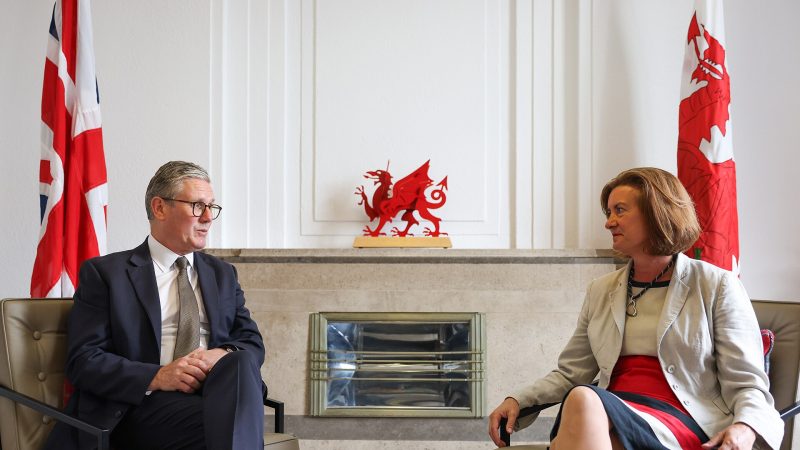
Welsh First Minister and Welsh Labour leader Eluned Morgan has backed the Prime Minister and called for “stability in an age of instability”.
Ahead of a meeting of Labour MSs, Morgan said that she supports the the Prime Minister in his role and said: “Ultimately, I judge any Prime Minister by a simple test: whether they deliver for Wales.”
However, she did say that she “had concerns” around Mandelson’s suitability for public office.
At an emergency press conference yesterday, Sarwar said that leadership in Downing Street “has to change”, adding: “We cannot allow the failures at the heart of Downing Street to mean the failures continue here in Scotland, because the election in May is not without consequence for the lives of Scots.”
More than 100 Labour MPs, including all members of the Cabinet, have since rallied to the support of the Prime Minister, alongside several Labour mayors. However, 11 MPs are currently calling for the Prime Minister to resign.
In her statement, Morgan said: “I support the Prime Minister in the job he was elected to do. After years of revolving-door leadership under the Conservatives, the country needs stability in an age of instability, and that matters for Wales.
“I had concerns that Peter Mandelson was incompatible with public office because of the company he kept. What has since come to light has only reinforced those concerns.
“These issues are deeply troubling not least because, once again, the voices of women and girls were ignored. That failure must be acknowledged and confronted honestly.
“Leadership means upholding standards and acting when they fall short.
“Ultimately, I judge any Prime Minister by a simple test: whether they deliver for Wales. I have been clear with Keir about what Wales needs. Action on the cost of living, investment in our economy and infrastructure, and a continued commitment to stronger devolution.
“My focus remains on leading Wales with integrity and delivering real change for people here.”
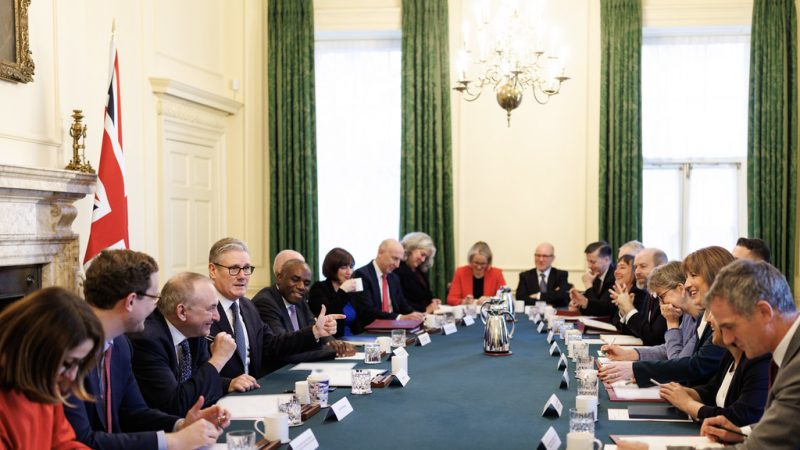
Labour ministers, MPs and mayors rally behind PM amid calls for resignation
Daniel Green 9th February, 2026
Photo: Number 10/Flickr
Labour ministers, MPs and mayors have rallied behind the Prime Minister after Scottish party leader Anas Sarwar called for Starmer’s resignation.
Following Sarwar’s press conference earlier this afternoon, Cabinet ministers lined up to express their confidence and support for the Prime Minister, including rumoured leadership contenders Wes Streeting and Ed Miliband.
Darren Jones, the Chief Secretary to the Prime Minister, warned that the coming years will see a choice between a “modern, diverse Britain led by Labour or a dark, divisive Britain under Reform” and urged colleagues to “get behind the Prime Minister, rise to the challenge and deliver a richer, fairer and stronger future”.
Deputy Prime Minister David Lammy was the first among the Cabinet to express support for the Prime Minister on social media.
In a post, he said: “Keir Starmer won a massive mandate 18 months ago, for five years to deliver on Labour’s manifesto that we all stood on. We should let nothing distract us from our mission to change Britain and we support the Prime Minister in doing that.”
‘Not the moment for internal games or headline-chasing’
Cabinet messages of support were followed by several Labour mayors across the country, including London Mayor Sadiq Khan.
Khan said that Starmer “needs to be given time to deliver, especially given the extremely challenging circumstances he inherited after 14 years of Tory governments”.
Similarly, West Midlands Mayor Richard Parker described the Prime Minister as a “decent man doing an incredibly difficult job”, adding: “This is not the moment for internal games or headline-chasing. It is a moment for stability and delivery – and to show the public that we are a serious country with serious leadership.”
Tracy Brabin, Mayor for West Yorkshire, urged her Labour colleagues to “calm down” and warned: “Every moment we turn inwards as a party is a gift to our enemies.”
She called for “stability to deliver on what was promised”, but also said: “Of course we need to be better, more than ever before we need to bring more women into the room, and rise to that challenge together.”
‘Keir Starmer won a mandate from the British people’
Several backbenchers also voiced support for the Prime Minister, including former whip and welfare reform rebel Vicky Foxcroft.
Tipton and Wednesbury MP Antonia Bance urged her colleagues to “unite behind the Prime Minister and get on with delivering for working people”, while former Labour Together director and MP for Makerfield Josh Simons said: “The chance to govern this country is a rare and privileged thing. Keir Starmer won a mandate from the British people to do just that.”
Hemel Hempstead MP David Taylor said it was “maddening” that some in the party would “choose to have completely needless instability at home” when the Prime Minister has been a “vital voice for diplomacy and security”.
‘Leadership contest would be wrong and counterproductive’
Centre-left group Tribune argued against a leadership contest, but instead suggested that a reshuffle of the Cabinet was needed.
The group’s executive said: “Turning inward to a leadership contest now would be both wrong and counterproductive when there is still so much vital work ahead. Our focus should remain on delivering the change voters asked for, not distracting ourselves from it.
“At the same time, we must recognise that the public rightly expects change to be felt more quickly, especially in our economy and in living standards. Delivering that change will also require a Cabinet and frontbench that reflect the breadth of views across the Parliamentary Labour Party and the diverse traditions that make up our movement, strengthening both unity and effectiveness as we move forward.”
Although left-wing organisation Momentum did not outwardly call for the Prime Minister’s resignation, they said that an “open and democratic leadership contest” should be held if Starmer resigns.
A spokesperson for the group said: “MPs must ensure members can choose from a full range of candidates. A pluralistic, democratic Labour Party is the only antidote to the poisonous legacy of McSweeney and Mandelson.”
Crawley MP calls on PM to announce departure date
Not all MPs have expressed support for the Prime Minister, however, with Crawley MP Peter Lamb calling for Keir Starmer to announce a departure date.
Writing in The House magazine, Lamb said: “He can wait until May and force the country to endure the chaos of removing a sitting Prime Minister, or he can act now and announce his departure in May.
“Doing so would provide continuity for the country, avoiding the need for an interim Prime Minister, and enable Starmer and his team the opportunity to prepare for the end of his ministry.”
Kate Osborne, Jarrow and Gateshead MP, told ITV Tyne Tees she does not have confidence in the Prime Minister – and hasn’t for some time.
She told the broadcaster: “We need more than damage limitation; we need a complete change at the top and we need an end to the dictatorial and chaotic culture that Starmer is and has presided over as leader.”
Meanwhile, two Scottish MPs came to blows on social media over their position on the Prime Minister’s future.
After Alloa and Grangemouth MP Brian Leishman said that Keir Starmer should “consider following McSweeney’s lead one last time” and resign, Alison Taylor called on him to stop his repeated criticism of the government.
The MP for Paisley and Renfrewshire North said: “You wouldn’t have been elected without him, Brian. This is not a good look, always criticising the government and now the advisors.
“Please for the sake of your fellow Scottish MPs, like me, give it a break this week.”
A Plea for Sortition and Direct Democracy in the Wake of the Epstein Files
The Epstein Files do not warrant shock and horror. A quiet nod of the head along with maybe a lopsided, very restrained smile might suffice. I will consider my most cynical smirk – the one conveying a sort of fatalistic disgust normally employed for train delays, and added charges to my cell phone bill. These redacted millions of pages contain just enough information to let us know two things: 1) the rich pukes who run our lives with godly, bored indifference, have been raping, torturing and maybe sometimes murdering trafficked children, and 2) absolutely nothing will be done about it.
The Epstein Files are not a revelation, but a reminder. Why feign horror when the feral dog shits on the rug? Do some of us accept that capitalism performs epic acts of mass murder and torture, yet blanche in utter disbelief at the sadistic hobbies that elites enjoy in private? Did anyone imagine that Larry Summers and Peter Thiel spent their down time delivering blankets to the nearest tent city?
We know the names – Bill Gates, Donald Trump, Bill Clinton, Elon Musk, Richard Branson, Howard Lutnick, this prince and that lord, and so forth – people who unwind from the hard labor of plundering the planet, or strutting and prancing in the glow of celebrity, with Jeffrey Epstein’s commodities. The child sex slaves, disposable as plastic straws, bought off, threatened into silence (murdered if need be), will be forgotten in a matter of weeks. Justice follows the contours of Darwinian power. The rule of law, seldom more than a ruse to placate our restless longing for a national soul, has been mockingly shattered in these Epstein File dumps.
What about Noam Chomsky? How does his illustrious career as a critic of capitalism resolve into a deeply sexist apology for Jeffrey Epstein? Maybe the subtle cultural strands of profit have a more universal toxic reach than most of us thought. In any case, the Epstein Files clarifies (for those who need it) just how unfairly “the system” operates.
As an outreach mental health worker, I quickly became accustomed to see my poor clients do hard time for, say, stealing a bicycle that appeared to be abandoned, or for getting patted down with a dime bag of heroin in their coat pocket. The balance sheet of capitalism requires that every few thousand or so people rotting in prison for the crime of desperate poverty be counterweighted by rapists and extortionists who live lives of complete freedom and sensational excess. The Epstein Files celebrate the names (redacted or not), of people too privileged to ever suffer justice. The “long arm of the law” never reaches the mansion on the hill.
Of course, Trump is the star of the Epstein files – his name appears more frequently in said files than does Jesus’ name get ink in the New Testament (not my line, I can’t recall where I stole it). The sexual criminality of Donald Trump enjoys no secrecy. Trump boasted about his ability to skate unannounced into beauty pageant dressing rooms. He bragged joyously about having free reign to “grab ‘em by the pussy,” and the political system and mass media smiled along as if he had confessed to snatching an extra handful of after dinner mints at Appleby’s.
We Americans have always been a forgiving people. We let bygones be bygones like no other country on earth. Take the case of Lt, William Calley, a forgotten footnote of the Vietnam War, who, somewhat “regrettably,” lead a group of US soldiers from “Charlie Company” into a “battle” against over 500 unarmed civilians in the remote village of My Lai. According to Calley’s Wikipedia page, the members of Charlie Company gunned down or bayonetted 504 Vietnamese unfortunates. If you want a statistical breakdown, the murdered victims included 60 elderly men, 282 women, 17 being pregnant. 120 children and 53 infants died from bayonet thrusts. Many of the women were raped before being shot.
The members of Charlie Company, unlike the names in the Epstein files, did not belong to the ruling class. These men were tools of elite colonial intentions who, therefore, enjoyed abridged, refracted privileges to violate human life. War is never more than a strategy on behalf of profits, and its practitioners have temporary immunity from the bonds of moral restraint. Therefore, the authorities offered Calley, and all the tangentially and explicitly involved killers at Mai Lai, a modified pass. Calley wound up serving three and a half years of “house arrest” for the massacre, rape and torture of 504 people. The “liberal” luminary, Georgia governor, and future president, Jimmy Carter, was outraged at Calley’s punishment – politicians across the nation demanded a full pardon. Calley’s superior, Captain Earnest Medina was acquitted for giving the order to kill. If the richest men on earth can freely rape and abuse children for fun and pleasure, we also have a very tender spot in our national heart for rapists and murderers who commit acts that are incidental to the patriotic cause of war.
The rapist/pardoner-in-chief, Donald Trump himself, gave a full pardon to Eddie Gallagher in 2019. Gallagher had been convicted in a military trial of stabbing a teenage Iraqi prisoner to death and triumphantly posing with the corpse. Trump knows first-hand what it feels like to be self-righteously held in contempt for harming defenseless adolescents. Now, Eddie Gallagher walks about as freely as Donald Trump himself.
But my favorite example of all American forgiveness involves the cases of Alfred Sloan and Charles Kettering – respectively, the executive director and director of research at General Motors a century ago. Sloan and Kettering, who you might associate with the “Memorial Sloan Kettering Cancer Center,” are the two greatest mass murderers in the history of planet earth. These guys realized that tetraethyl leaded gasoline (invented by Kettering’s underling, Thomas Midgely) offered GM the patent rights to each gallon of gasoline pumped in every corner of the globe. They had been warned that lead is a deadly poison, and responded by hiring the chemist and lead denier, Robert Kehoe to confuse the public. Across the past century, leaded gasoline (phased out via Richard Nixon’s 1971 “Clean Air Act”) proceeded to decimate life on earth. Approximately 100 million lives have been foreshortened via atmospheric lead, and every living being whose life spans intersected with the leaded gasoline era became stupider and psychologically less resilient. Those living in densely packed urban centers (poor people) adjacent to highways, suffered disproportionate neurological wounds. Indeed, it is not outrageous to propose that leaded gasoline’s degradation of the human mind has contributed significantly to our crumbling political systems and to the outstanding political feature of our times – fascism (a system wholly founded on human confusion).
What consequences did Alfred Sloan and Charles Kettering receive for committing the most catastrophic crime of all time? If you guessed none at all you win a prize. They were never charged, never investigated, never made to squirm in a courtroom like Lt. William Calley and Earnest Medina. Had Sloan and Kettering lived in our times, it is reasonable to imagine that they might have been regular visitors to Jeffrey Epstein’s Island. I don’t mean to ignore the pain of childhood victims of human trafficking, but the brutal rapes of under-aged girls might be among the least deadly sins committed by the ruling class.
If raping, beating, abusing and even murdering a few hundred children abducted by Epstein and Ghislaine Maxwell represents just a minor side-bar in the US assault on human well-being, how do we put the sexual crimes of oligarchs into a larger perspective? Should we pause from our social media binge of the Epstein spectacle to consider that poor children are 12 times more likely to be raped than those living above the poverty line? Might we also meditate on the fact that people living in poverty have a 200% increased risk to be victimized by violent crime? The names of the wealthy predators listed in the Epstein files might be taken as a who’s who of those driving the poverty industry. The Epstein Files, a family portrait, an unretouched (albeit, redacted) snapshot of the ruling class caught in the spontaneous act of being itself, ought not to be mistaken for something anomalous – an act of mere corruption. The Epstein Files shows the public the private face of societal suicide. When psychopaths seize control of governmental and corporate institutions, they gain the cover needed to act out the most predatory sexual fantasies, but that is nothing compared to what corporate and political policy inflicts upon countless millions of victims. If we are horrified at the private evils committed by Epstein’s clients, we ought to be far more distraught over the public crimes of these morally castrated pillars of capitalism – war, colonialism, privatized prisons, privatized hospitals, privatized armies and the unmitigated project of environmental ruin and mass extinction. If end stage capitalism tinkers with the “doomsday clock” should we be surprised by the noxious personal habits of those who engineer the potential mother of mass extinctions?
The centrist Democratic Party mindset aspires to create a retreat into the past, before Trump tore everything to shreds. But Epstein had no particular affinity for fascist Republicans, and operated across bipartisan spheres and multiple presidential administrations. He had deep ties to Israel and has been labeled as a Jewish supremacist, but I doubt that ideology or religion drove his operations. He was, above all else, a creature of capitalism, a model of self-interest and amoral pursuit of wealth and power. Epstein had, so he thought, the ability to blackmail the people who run planet earth. He had, we imagine, videos of kings, presidents and CEOs caught in the act of raping children. But Epstein overestimated the power of blackmail. The Epstein debacle serves as a reminder of corporate savagery – psychopaths have the combination to the safe, and every conflict hinges on the power of violence.
We have voted and revoted. The ballot box leads inevitably to Trump. We can’t vote our way out of this. It will take massive resistance – Minneapolis writ across the face of the country. I believe that the goal of resistance ought to be the end of electoral politics, the end of parties, the end of super-PACs, the end of politics as mass spectacle. The biggest challenge involves massive, organized, committed civil disobedience – but that will yield nothing without a vision of renewal.
The solution is in plain sight. I got my usual weekly Email from Alastair Binnie-Lubbock of the “Sortition Foundation” – an organization out of the UK that aspires to replace electoral bodies with “citizens’ assemblies.” I have been writing about sortition for a while – here, here and here – for example.
I apologize to my readers for taking so long to get to the point, but so-called electoral democracy created Jeffrey Epstein, Donald Trump and fascism. Electoral democracy, as I have repeatedly argued, is a front for capitalism. Corporate goons select your candidates and howl with laughter as you vote for one or the other of the two handpicked psychopaths who lie to you with all the conviction of a battery powered parrot. The Sortition Foundation has picked up on The Epstein Files because House Of Lords icon, Lord Peter Mandelson’s name, along with Prince Andrew’s, has turned up in the files. The Sortition Foundation has initiated The 858 Project that aspires to replace The House of Lords with a “Citizen’s Assembly” selected via sortition.
The Epstein Files might be seen as being a perfect publicity stunt sent by fate to bolster the cause of “direct democracy.” The only way to prevent ambitious psychopaths from “Bogarting” power, is to replace them with randomly chosen citizens. Once you allow people to “seek power” you open the floodgates of oligarchy, autocracy and fascism. Sortition inverts the process of governance – rather than having people seek power, power seeks people. Members of citizen’s assemblies are drafted at random, thereby destroying identity politics – statistical chance balances the face of power. Half of the members of a citizens assembly will be women, very few will be wealthy, Ivy League grads will all but disappear from the halls of power. Nurses, teachers, palm readers and mechanics will serve terms – not many lawyers will gum up the works. Racial and sexual discrimination have no effect on citizen’s assemblies. Random chance gently empowers everyone.
I believe that sortition will lead to socialism. If corporations lose the ability to fund campaigns, the magical grip that capitalism has over our contrived schemas will all but evaporate. Ordinary people. left to their own devices, will discover socialism with wide-eyed-wonder.
The most enormous obstacle to sortition is the obliviousness of the leftwing alternative media sphere. Who is talking about sortition? Nobody! And yet we feign shock and horror when capitalist electoral politics deliver clients to Jeffrey Epstein. Until the people hold power we will have colonial crimes, inequity, climate ruin, war and the faux meritocratic con-artists that spend their down time molesting children.
Phil Wilson is a retired mental health worker and union member. His writing has been published in ZNetwork.org, Current Affairs, Counterpunch, Resilience, Mother Pelican, Common Dreams, The Hampshire Gazette, The Common Ground Review, The Future Fire and other publications. Phil's writings are posted regularly at Nobody's Voice (https://philmeow.substack.com/).