By Juliet Jacques
02.02.2025
Set against the backdrop of occupied Korea in the 1920s and 1930s, a newly translated book updates the nineteenth-century educational workers’ novel to punchy and defiantly unsubtle effect.
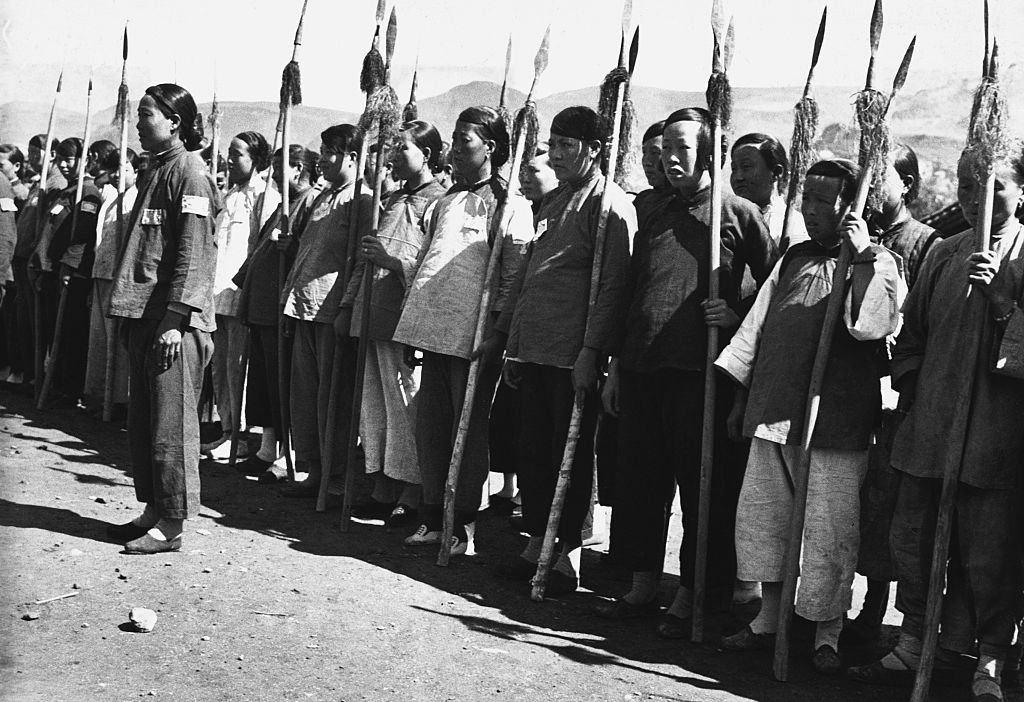
A group of guerrilla fighters in China, circa 1935.
(Hulton-Deutsch Collection / Corbis via Getty Images)
Although it may not sound like it from its (instantly memorable) title, Park Seolyeon’s new novel is a love story. Translated by Anton Hur, Capitalists Must Starve fictionalises the biography of Kang Juryong, whose marriage to Choi Jeonbin leads her first into the fight for Korean liberation from Japanese rule and then into the struggle for socialism, as she leads her colleagues in a rubber factory into their first industrial action (a high-altitude protest against their working conditions atop Eulmil Pavilion in Pyongyang). The book appears in English after a successful fundraiser by Tilted Axis Press (which publishes literature from Asia, Africa, the Caribbean, and Latin America), its title taken from one of Kang’s speeches.
Capitalists Must Starve, which won the Hankyoreh Literature Award in 2018, extends the tradition of the educational socialist novel, which stretches back to the mid-nineteenth century with Nikolai Chernyshevsky’s What Is to Be Done? and into the twentieth century with The Jungle by Upton Sinclair and The Ragged Trousered Philanthropists by Robert Tressell. It is set in the 1920s and 1930s, written in a similar realist style to that of Sinclair and Tressell, and centred on Kang’s emotional journey from nationalism to socialism as she educates herself and others. The old tension between urban intellectuals and workers who have not been able to access higher education — for reasons of class and/or sex — becomes a major plot point, as the Communist Party tries to bring Kang into the fold.
This raises other concerns, seemingly ubiquitous to left-wing organising across time and place: how much to trust the party? When and how to act? And to what extent can or should one person use headline-grabbing actions as a catalyst to speed up change? Park’s characterisation of Kang places her firmly on the side of the workers — although there is an awkward, gradual reconciliation with the party, and one particular official, even if her dedication to the rubber factory strike means that it does not develop into a romance as complicated as the one she shares with Choi.
Park dramatises Kang’s relationships with her family, friends, and colleagues sharply, as conflicts arise (over her choice of man and her involvement in subversive political activity) that pit her against the state and her employers. This is not an exceptionally subtle novel — nor should it be — but the reader is invited to feel Kang’s sadness and frustration at seemingly smaller moments where she is sidelined or belittled because she is a woman (just as much in the Left movement as in the nationalist one), and her fury at how the male factory owners abuse their female staff. The twists in her relationship with Choi are handled skilfully: it begins to collapse over behaviour that seems to him to be mindfulness of her safety, and to her like a revelation of how little he regards her capabilities, typical of how Park brings a feminist slant to the classic workers’ novel.
This emphasis on Kang, with all other people and struggles seen through her (told by an omnipotent narrator rather than first person), puts Capitalists Must Starve on the side of a maverick individual who takes bold action, although it does follow her efforts to adapt her personality to the slow task of workplace organising as well. Her personal qualities — diligence, resilience, willingness to rebel if she thinks circumstances demand it — come to the fore in a novel that asks: what makes a good radical, a good leader, and a good radical leader?
Writing this story as a novel rather than a biography has undoubtedly helped Park to bring Kang’s story to an international audience. It helps that Park’s narrative is expertly paced, condensing the key details from Kang’s (tragically short) life into a compact 200 pages. It begins in adulthood, giving us several scenes with Kang’s parents without delving into her childhood, suggesting that the challenges she meets are social and political, rather than (primarily) psychological. There is plenty of trauma in the book, with the scenes of factory bosses bullying and beating the women being just as violent and harrowing as anything Kang endures with the First Regiment of the Unified Korea Council. Far more than the colonial occupation, this injustice forms the core of Capitalists Must Starve: it is the one Kang feels most able to address, making a difference on a local level, and her relationships with her colleagues and comrades prove ultimately more rewarding than that with her husband.
It’s interesting to think about what a novel can access that other forms can’t: the ability to speculate about people’s motivations and feelings can allow an author to explore the psychological truth of political activism in a way that history or biography aren’t able to. This was true for Bill Broady’s excellent 2024 novel The Night-Soil Men, exploring the strategic and personal tensions within the Independent Labour Party through three figures (Victor Grayson, Philip Snowden, and Fred Jowett) with very different personalities and approaches, going deep into their private lives to build empathy with all of their positions and invite readers to draw their own conclusions about whose approach was best. With the focus entirely on Kang, Capitalists Must Starve doesn’t aim for that — instead, its potential lies in introducing a new generation to the concept of industrial action, preparing it for its frustrations, and asking it to think about a different kind of love that is far less often represented in culture than the search for romantic fulfilment.
Although it may not sound like it from its (instantly memorable) title, Park Seolyeon’s new novel is a love story. Translated by Anton Hur, Capitalists Must Starve fictionalises the biography of Kang Juryong, whose marriage to Choi Jeonbin leads her first into the fight for Korean liberation from Japanese rule and then into the struggle for socialism, as she leads her colleagues in a rubber factory into their first industrial action (a high-altitude protest against their working conditions atop Eulmil Pavilion in Pyongyang). The book appears in English after a successful fundraiser by Tilted Axis Press (which publishes literature from Asia, Africa, the Caribbean, and Latin America), its title taken from one of Kang’s speeches.
Capitalists Must Starve, which won the Hankyoreh Literature Award in 2018, extends the tradition of the educational socialist novel, which stretches back to the mid-nineteenth century with Nikolai Chernyshevsky’s What Is to Be Done? and into the twentieth century with The Jungle by Upton Sinclair and The Ragged Trousered Philanthropists by Robert Tressell. It is set in the 1920s and 1930s, written in a similar realist style to that of Sinclair and Tressell, and centred on Kang’s emotional journey from nationalism to socialism as she educates herself and others. The old tension between urban intellectuals and workers who have not been able to access higher education — for reasons of class and/or sex — becomes a major plot point, as the Communist Party tries to bring Kang into the fold.
This raises other concerns, seemingly ubiquitous to left-wing organising across time and place: how much to trust the party? When and how to act? And to what extent can or should one person use headline-grabbing actions as a catalyst to speed up change? Park’s characterisation of Kang places her firmly on the side of the workers — although there is an awkward, gradual reconciliation with the party, and one particular official, even if her dedication to the rubber factory strike means that it does not develop into a romance as complicated as the one she shares with Choi.
Park dramatises Kang’s relationships with her family, friends, and colleagues sharply, as conflicts arise (over her choice of man and her involvement in subversive political activity) that pit her against the state and her employers. This is not an exceptionally subtle novel — nor should it be — but the reader is invited to feel Kang’s sadness and frustration at seemingly smaller moments where she is sidelined or belittled because she is a woman (just as much in the Left movement as in the nationalist one), and her fury at how the male factory owners abuse their female staff. The twists in her relationship with Choi are handled skilfully: it begins to collapse over behaviour that seems to him to be mindfulness of her safety, and to her like a revelation of how little he regards her capabilities, typical of how Park brings a feminist slant to the classic workers’ novel.
This emphasis on Kang, with all other people and struggles seen through her (told by an omnipotent narrator rather than first person), puts Capitalists Must Starve on the side of a maverick individual who takes bold action, although it does follow her efforts to adapt her personality to the slow task of workplace organising as well. Her personal qualities — diligence, resilience, willingness to rebel if she thinks circumstances demand it — come to the fore in a novel that asks: what makes a good radical, a good leader, and a good radical leader?
Writing this story as a novel rather than a biography has undoubtedly helped Park to bring Kang’s story to an international audience. It helps that Park’s narrative is expertly paced, condensing the key details from Kang’s (tragically short) life into a compact 200 pages. It begins in adulthood, giving us several scenes with Kang’s parents without delving into her childhood, suggesting that the challenges she meets are social and political, rather than (primarily) psychological. There is plenty of trauma in the book, with the scenes of factory bosses bullying and beating the women being just as violent and harrowing as anything Kang endures with the First Regiment of the Unified Korea Council. Far more than the colonial occupation, this injustice forms the core of Capitalists Must Starve: it is the one Kang feels most able to address, making a difference on a local level, and her relationships with her colleagues and comrades prove ultimately more rewarding than that with her husband.
It’s interesting to think about what a novel can access that other forms can’t: the ability to speculate about people’s motivations and feelings can allow an author to explore the psychological truth of political activism in a way that history or biography aren’t able to. This was true for Bill Broady’s excellent 2024 novel The Night-Soil Men, exploring the strategic and personal tensions within the Independent Labour Party through three figures (Victor Grayson, Philip Snowden, and Fred Jowett) with very different personalities and approaches, going deep into their private lives to build empathy with all of their positions and invite readers to draw their own conclusions about whose approach was best. With the focus entirely on Kang, Capitalists Must Starve doesn’t aim for that — instead, its potential lies in introducing a new generation to the concept of industrial action, preparing it for its frustrations, and asking it to think about a different kind of love that is far less often represented in culture than the search for romantic fulfilment.
Contributor
Juliet Jacques is a writer and filmmaker whose new short fiction collection The Woman in the Portrait is out now.

No comments:
Post a Comment