Tuesday, February 10, 2026

U.S. Olympic athletes face backlash for speaking out against Trump administration.

Here's what they said.

American skier Hunter Hess's remarks drew the president's ire, but others have expressed similar mixed feelings about representing Team USA.


Dylan Stableford
Reporter
Tue, February 10, 2026 
YAHOO SPORTS


Hunter Hess and Amber Glenn.( Photo illustration: Yahoo News; photos; Michael Reaves/Getty Images, Ashley Landis/AP)


Several U.S. athletes competing at the 2026 Winter Olympics in Italy are facing backlash for expressing how they feel about representing the U.S. amid a divisive political climate back home.

“It’s a little hard. There’s obviously a lot going on that I’m not the biggest fan of," freeskier Hunter Hess from Bend, Ore., said at a news conference last week when asked what it meant to “wear Team USA” at these Games.

"I think for me it's more I'm representing my friends and family back home and the people that represented before me and all the things that I believe are good about the U.S.," Hess continued. "If it aligns with my moral values, I feel like I'm representing it. Just because I'm wearing the flag doesn’t mean I represent everything that’s going on in the U.S.”

His comments drew the ire of President Trump, who responded on Truth Social on Sunday with a post that misrepresented what Hess said.


President Trump at the White House on Feb. 9.(Bonnie Cash/UPI/Bloomberg via Getty Images)

“U.S. Olympic Skier, Hunter Hess, a real Loser, says he doesn’t represent his Country in the current Winter Olympics,” Trump wrote. “If that’s the case, he shouldn’t have tried out for the Team, and it’s too bad he’s on it. Very hard to root for someone like this.”

Hess responded on Monday in an Instagram post.

“I love my country 🇺🇸 ,” he wrote. “There is so much that is great about America, but there are always things that could be better. One of the many things that makes this country so amazing is that we have the right and the freedom to point that out. The best part of the Olympics is that it brings people together, and when so many of us are divided we need that more than ever. I cannot wait to represent Team USA next week when I compete.”


Hess isn’t the only American athlete expressing mixed emotions about representing the U.S. in Italy. Fellow freeskier Chris Lillis made similar remarks at the same press conference.

"I feel heartbroken about what's happening in the United States," Lillis said. "I think that, as a country, we need to focus on respecting everybody's rights and making sure that we're treating our citizens, as well as anybody, with love and respect. I hope that when people look at athletes competing in the Olympics, they realize that's the America that we're trying to represent."

Here are some others.


Amber Glenn


Amber Glenn of the United States competes during the figure skating women's team event at the Winter Olympics on Feb. 8.(Natacha Pisarenko/AP)More

Coming into the Olympics, U.S. figure skater Amber Glenn, an LGBTQ activist who identifies as pansexual, said that it’s been difficult for the queer community under Trump.

“It’s been a hard time for the community overall in this administration,” Glenn said at a press conference last week. “It isn’t the first time that we’ve had to come together as a community and try and fight for our human rights.

“I know that a lot of people say you're just an athlete, like, stick to your job, shut up about politics, but politics affect us all,” she continued. “It is something that I will not just be quiet about, because it is something that affects us in our everyday lives. So, of course, there are things that I disagree with, but, as a community, we are strong and we support each other, and brighter days are ahead.”

In an Instagram post on Saturday, Glenn said she had received threats over her comments.

“When I chose to utilize one of the amazing things about the United States of America (freedom of speech) to convey how I feel as an athlete competing for Team USA in a troubling time for many Americans, I am now receiving a scary amount of hate/threats for simply using my voice when asked about how I feel,” she wrote.

After winning a gold medal in a team skating competition on Sunday, Glenn said the vitriol partially spoiled her excitement.

“I’ve never had so many people wish me harm before, just for being me and speaking ‍about being decent — human rights and decency,” Glenn said during the team medal ceremony. “So that was really disappointing, and I do think it kind of lowered that excitement for this.”


U.S. women’s halfpipe team


Bea Kim, Chloe Kim and Madeline Schaffrick appear at a press conference in Livigno, Italy, on Feb. 9.(Hannah Peters via Getty Images)

At a press conference on Monday, four members of the U.S. snowboarding team competing in the women’s halfpipe event were asked about Trump’s criticism of Hess.

"I think there are a lot of different opinions in the U.S. right now. Obviously, we're very divided," Bea Kim said. "I personally am very proud to represent the United States. That being said, I think diversity is what makes us a very strong country and what makes us so special."

Chloe Kim, a native of Southern California whose parents emigrated from South Korea, offered similar thoughts.


"It is really important for us to unite and kind of stand up for one another with all that's going on," Chloe Kim said. "I'm really proud to represent the United States. It's given my family and I so much opportunity. But I also think that we are allowed to voice our opinions of what's going on. And I think that we should lead with love and compassion. And I'd love to see more of that."

"I'm also saddened with what's happening at home. It's really tough and I feel like we can't turn a blind eye to that,” Maddie Mastro said. “At the same time, I represent a country that has the same values as mine, of kindness and compassion. And we come together in times of injustice.”

"I feel like the Olympics is the epitome of all countries and cultures coming together in celebration and friendly competition," Maddy Schaffrick added. "I'm proud to represent the U.S. and wear the American flag in such an internationally cohesive event, and do what I love while representing the U.S."

Gus Kenworthy


British-American freestyle skier Gus Kenworthy, who is competing for Great Britain after previously representing the United States, said he has received threats after posting an image that appeared to show the words "f*** ICE" written in urine in the snow.


“The other day I posted a photo with my thoughts on [Immigration and Customs Enforcement], and that photo has since gone everywhere,” Kenworthy said in an Instagram video on Sunday. “I’ve gotten a ton of messages, and most of them honestly have been supportive and encouraging. … But a lot of the messages have been awful — people telling me to kill myself, threatening me, wishing that they’ll get to see me blow my knee or break my neck during my event, calling me slurs, like, it’s insane.”

“Maybe this video is just going to invite more hate and vitriol, but I think it’s important to say what we feel and stand up for what we believe in and stand up to injustice,” Kenworthy continued. “And I’ve been really proud seeing other athletes doing that.”

He added: “I feel like sometimes people forget … that you can love the U.S. and be proud to be an American — I am — and still think it can be better … and just because you love the U.S. doesn’t mean you stand with this administration.”


Rich Ruohonen

Ruohonen, a member of the U.S. curling team, criticized the Trump administration's immigration crackdown in his home state of Minnesota.


"I'd like to say I'm proud to be here to represent Team USA, and to represent our country. But we'd be remiss if we didn't at least mention what's going on in Minnesota," Ruohonen said at a press conference in Cortina on Tuesday. "What a tough time it's been for everybody. This stuff is happening right around where we live."

Ruohonen, a 54-year-old personal injury lawyer from Bloomington, Minn., is the oldest athlete to ever represent the United States in a Winter Games, according to USA Today.


MAGA Senator’s Ultimatum To Olympians Over Trump Leads To Gold-Medal Reality Check


Lee Moran
Tue, February 10, 2026 
HUFFPOST

Sen. Rick Scott (R-Fla.) failed to medal with his ultimatum to U.S. athletes competing at the 2026 Winter Olympics, after several said they aren’t happy with what’s going on in America under Donald Trump’s administration.

“Any person who goes to the Olympics to represent the United States and then says they don’t want to represent the United States should be immediately stripped of their Olympic uniform,” Scott fumed in a video shared on X.

Scott, a Trump acolyte, wrote in the clip’s caption that the United States is a “beacon for freedom and democracy” — even though he doesn’t want athletes to use their freedom of speech to say what’s on their minds.

Critics on social media pointed out that loving America doesn’t mean agreeing with every Trump policy. They also defended athletes’ right to express their views.

Trump’s spite turns sourer

 4 February, 2026 
Author: Bas Hardy


When Donald Trump talked about retribution on his enemies, he didn’t just mean individual political opponents or members of the legal establishment seeking to hold him accountable. A large amount of his spite was directed at American cities, particularly those with black mayors, which had the temerity to reject him at election time.

They would be met with collective punishment in the form of invasion by ICE (Immigration and Customs Enforcement) agents, who’d intimidate their communities and place them under siege.

Despite pathetic efforts by the Trump regime to besmirch Renée Good and Alex Pritti as “domestic terrorists”, both were known to many as decent human beings. In Alex Pritti’s case he looked after the care of military veterans. Efforts by Trump lackeys to spin things otherwise ran up against overwhelming video evidence in both cases of cold blooded murder.

In addition to the strike, communities have organised themselves to monitor the activities of ICE and help those who fear getting swept off the streets should they venture out of their homes. Volunteers are taking children to school, delivering groceries, and offering rides to medical appointments. That citizens are expected to show proof of identity to masked men who don’t show any is beyond ironic and reminiscent of those old war movies where the Gestapo demand “your papers”.

Adding to the oppressive air of fascism has been Greg Bovino, the thug in charge of ICE, strutting around in an SS style greatcoat.

Right-wing fans of the US constitution’s Second Amendment have imagined a conspiratorial government (aka “deep state”) encroaching on their individual freedoms to justify the right to carry guns everywhere. Now the National Rifle Association has taken particular exception to Trump and co. criticising Pretti for carrying a gun. It might start to dawn on them that the very people they’ve been supporting politically all these years are the true enemies of freedom.

Two murders and 3,000 arrests so far, and some Republican politicians are getting cold feet. A particular low in despicable ICE behaviour was the use of five-year old Liam Ramos as “bait” to lure his father out of their house.

Public outrage at ICE antics has led a Republican candidate for Minnesota state Governor, Chris Madel, to drop out, declaring “Driving while Hispanic is not a crime. Neither is driving while Asian.”

Racial profiling has accounted for a massive drop in Hispanic support for Trump, while even Cubans are being deported in record numbers.

The government is currently engaged in a damage-limitation exercise given the bad optics. It has scaled down ICE numbers in Minneapolis. The two federal agents who murdered Alex Pretti have been placed on leave, although we still don’t know their identities. A federal judge has blocked attempts by the administration to alter or destroy evidence in the killings.

Yet the situation in Minneapolis stays tense, and the ICE presence in the city remains.

Calls from Attorney General Pam Bondi for Minnesota to hand over its electoral rolls to her have been met with outrage. And not just because that’s nothing to do with immigration. It also shows the extent to which Trump is pursuing voter suppression as an option to subvert the mid-term elections. The continuing presence of ICE on the streets may serve to prevent people of colour from going to the polls.

The FBI, now operating de facto as another personal police force for Trump, and has raided offices in Fulton County, Georgia to seize ballots and records related to the 2020 election in a fresh attempt to undermine trust in the electoral process. It is a further example of “payback”, this time against Fani Willis, the Fulton County DA who sought to prosecute Trump for his efforts to fraudulently overturn election results in Georgia in that year.


Trump? “No problem”? Or fascist?

4 February, 2026 
Author: Jim Denham


From the moment Donald Trump emerged from his gilded escalator on 15 June 2015 to announce his run for US presidency, debate has raged about whether he can be called a fascist.

There was soon plenty of fuel for the “fascist” claim: his white nationalism, his rhetorical anti-elitism and anti-intellectualism, his vilification of racialised internal and external enemies, his dehumanising language and open encouragement of violence, were all suggestive of fascism.

The main objection to the idea of Trump being a fascist was that “classic” fascism was inseparable from the revolutionary conditions of its emergence in Europe between the two world wars (meaning Trump — and indeed, anyone else — simply cannot be called a “fascist” in this day and age).

Initially, the Morning Star didn’t have much to say one way or the other on this, generally taking the view that though boorish, Trump was nothing particularly out of the ordinary in terms of US politics (though the paper, like the US Communist Party, did quietly support a Democrat vote).

Before the 2020 presidential election, Andrew Murray used his Eyes Left column to opine that Brits shouldn’t concern ourselves with the outcome. In particular, we should stop worrying about Trump. Murray assured us that Trump’s threats and possible “civil conflict” were “nothing to fear”. After all: “there is no progress without conflict, and in the USA most likely no socialism without an awful lot of it.” And a further Trump presidency would bring one great benefit: “A weakened US is a gain for the rest of the world.”

As for “a fascist US presidency” not to worry, it will “surely give cause for protest here before long” and “the most aggressive powers on record have been impeccably liberal British and US imperialisms, with not a day of fascist rule between them… There is the main enemy, not the orange demagogue.”

Promises

After the 2020 election, regular contributor (and, like Murray, a leading Communist Party of Britain member) Nick Wright argued that the Trump administration had been “delivering on its promises” to workers and that Biden’s victory represented a “restoration of the violent neoliberal order.”

When Trump incited his supporters to storm the Capitol, the paper (editorial, 8 January 2021) seemed to sympathise with the mob: “the most significant event … [was] the decision of Vice-President Mike Pence to throw his bloated boss overboard and line up with the Republican leadership … It was this, as much as anything else, which so enraged the mob and sharpened their sense of betrayal. In this, they have more finely tuned political instincts than the host of liberal commentators on both sides of the Atlantic who saw an existential threat to US ‘democracy’”.

How things have changed: these days they habitually refer to Trump as “fascist”, the change initially brought about by his kidnapping of Venezuelan president Nicolas Maduro (whom the paper refers to –against all the evidence — as “democratically elected”) but now also by the murderous impunity of Trump’s masked ICE thugs in Minneapolis and elsewhere.

On 27 January (appropriately, Holocaust Memorial Day) the editorial referred to “Trump’s fascist revival”; the next day it described (accurately) the ICE commander Bovino as “strut[ting] around… for all the world like a nazi gauleiter on the eastern front in the second world war.”

Perhaps most significantly, on 23 January the paper quoted retiring CPB general secretary Robert Griffiths’ political report to the party’s executive committee: “Inside the US today, Trump’s regime ignores national and international law, rules without accountability to the elected US Congress, persecutes political opponents and deploys its own ICE paramilitary forces against racial minorities and democratic local government.

He continued: “The US has embarked on the road to fascism …”

Griffiths conveniently forgot about the time, just a few years ago, when leading CPB members strongly hinted that Trump was preferable to Biden (Nick Wright) and that although he may or may not be a fascist, he is not the “main enemy” (Andrew Murray).

In fact, Murray’s 2020 claim that “civil conflict” brought about by Trump would be “nothing to fear” should go down in the annals of Stalinist stupidity.

“Saving” the USA from immigrants?


 4 February, 2026 
Author: Natalia Cassidy


The pro-Trump think tank Heritage Foundation is intent on “Saving America by Saving the Family” (its new report, January 2025).

More specifically, the settled-American, married-man-woman family,

The crude birthrate has halved from about 24 births per 1000 people to about 12 per 1000, or 1.8 births per woman. That is below the “replacement rate” of 2.1 births per woman.

The Heritage Foundation is not primarily concerned with the falling birth rate as it pertains to falling contributions to transfer payments between workers and non-workers, and over time creates a higher ratio of people too old to work vs people working.

Its worry is intertwined with the racist and sexist conception that white women in particular should be having more children in order to “save” the white race from becoming a minority population in the US and having to look to immigrants to fill the workforce.

The report stress that white people have the lowest proportion of births to unmarried women and the highest proportion of children living in two-parent homes.

The Heritage Foundation suggests that the government stops “prioritising” welfare for single parent families, reduces public spending to reduce national debt, apply tax credits currently given to adoptive parents to married parents, and pays a 25% “large family bonus” for each child after the second.

Trump has recently announced his own (sort of) pro-natalist policy, the so-called baby bonus: $1,000 paid to newborn babies upon their parents’ opening a “Trump account” for them. Parents, relatives and employers can then pay up to $5,000 each year into this account. The money accrued will then be invested in US-based index funds and become accessible upon the child turning 18.

Gimmick

This gimmick is quite a long way from what the Heritage Foundation is suggesting, and offers almost nothing on the costs associated with raising a child. It may have some impact on the perceived cost of child rearing and a minor impact on higher education affordability, but is unlikely to do much to shift the birth rate. Historically, children were often an economic necessity for parents. Otherwise, when the parents got older, they would have no-one to do the heavier work on the land. Now, children are a heavy cost.

A separate Heritage Foundation document on New York says, yes, there should be more, and cheaper, but criticises Mamdani for not planning to reduce wages for the workers and health and safety standards.

Europe’s far-right talks “natalist”, loudly, but has not done much about it economically. Italy’s Meloni government is giving relatively meagre tax breaks. The Hungarian Orbán government pays out significantly more, with significant tax breaks and spending on families (approximately 4% of GDP is spent on family related policy). Yet the birth rate in Hungary has remained fairly constant since the introduction of those measures.

Policies that give economically-stressed people who wish to have children the ability to do so are of course a good thing. But the Heritage Foundation’s goal here is not support for those on low incomes, but an ideological push for women, particularly white women, to have children to bolster the nation state and offset the economic loss from deporting or deterring immigrant workers.

As socialist feminists, we are for a more collective approach to child rearing where the family unit is diminished in its primacy. We oppose pressure on on women to have children, or more children, when they don’t want to, particularly it comes with a racist, anti-migrant subtext.

Robert Wyatt, Red Eccentric

By David Hobbs
01.29.2026


English eccentricity has historically functioned as a conservative idea, but experimental musician Robert Wyatt shows it can be repurposed in the service of Marxism.


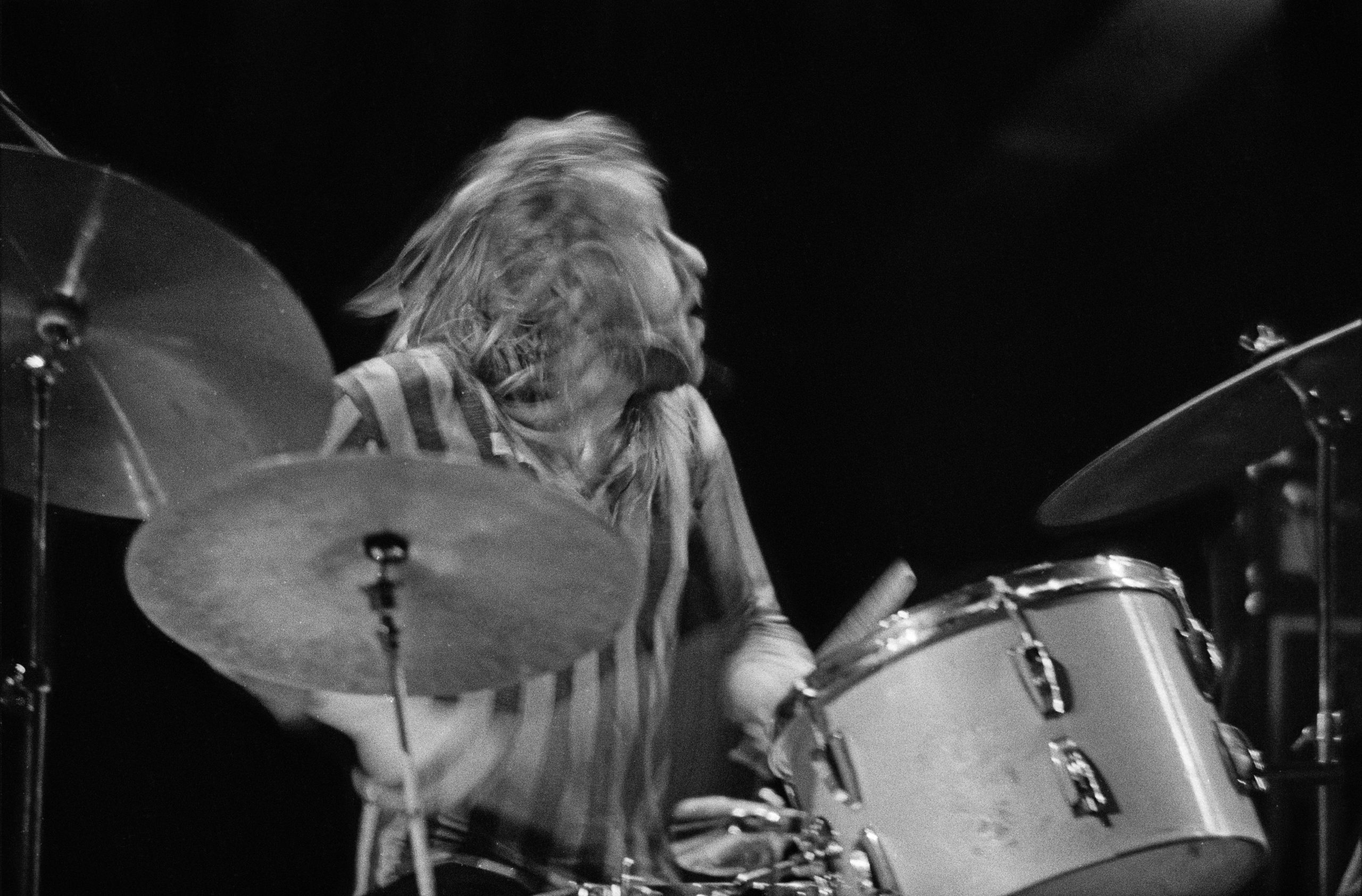
Drummer Robert Wyatt performs live on stage with Matching Mole at the Roundhouse in London in 1971. (Credit: Fin Costello via Redferns.)

In April 2012, I went to see Tony Herrington interview the musician Robert Wyatt at Café Oto in Dalston. All these years later I can still remember quite a lot of what he said, for example about his admiration of Miles Davis, who he often strived to imitate (‘Would Miles be trying to flog CDs and t-shirts on the door after his concerts? Would he fuck!’), and about how his wife, the artist Alfreda Benge, had saved his life (‘That didn’t seem like a figure of speech, either,’ said my girlfriend at the time, as we made our way home). I also remember Wyatt’s bemused reaction to the tendency of some critics to describe his work as being distinctively English, despite the internationalism that is so clearly central both to his music and his outlook more generally.

As well as ‘English’ (or sometimes ‘British’), there is another term that is habitually applied to Wyatt, often at the same time and by the same people: both the Guardian and the BBC have dubbed him a ‘Great British Eccentric’. Wyatt’s musical output can be whimsical and even strange, so the epithet is not completely undeserved. At the same time, though, the term ‘eccentric’ seems vaguely dismissive, as if Wyatt was not only a highly original artist, but oddly wayward, with only a tenuous connection to the rest of us.

Exploring the eccentricity of Wyatt’s music offers a way of elucidating this concept’s broader implications. This is worth doing because the idea of English eccentricity is profoundly political. By understanding it, we on the British Left can gain a new perspective on our predicament, including both the difficulties that we face and the resources that remain available to us. At the same time, though, the aim of this article is to clarify the significance of Wyatt’s contribution. By thinking seriously about him, and by using him to think about the world, I mean to pay tribute to someone whose career has combined political commitment and integrity with creativity in a way that is extremely rare.
Blues in Bob Minor

Wyatt was born in Bristol in 1945, but grew up in London and Canterbury. His parents were middle-class, bohemian types: Honor Wyatt was a BBC journalist and radio broadcaster from a prominent artistic family; George Ellidge was a music critic and a classical pianist. When they met in Majorca during the early 1930s, as participants in the island’s expatriate literary scene, Honor and George were both married to other people, and for the first six years of his life Wyatt was raised by his mother alone. By the time he and his father were reunited, George had retrained as an industrial psychologist.

It was through him that Wyatt was first exposed to Jazz. George favoured the music of Fats Waller and Duke Ellington, in particular, but this influence was both compounded and counterbalanced by that of Wyatt’s half-brother Mark, George’s son from his previous marriage, whose tastes were more modern. Wyatt began learning the trumpet and then graduated to percussion. Meanwhile, other young beatniks were appearing all over the country. Canterbury, in fact, was a hotspot, and in 1966 Wyatt formed the band Soft Machine, named after the novel by William Burroughs, with three fellow Jazz fans: Mike Ratledge, Daevid Allen, and Kevin Ayers.

The group soon found themselves at the hedonistic forefront of the British counterculture. As with the Grateful Dead in the US, their semi-improvised, exploratory performances resonated strongly in the era of high psychedelia. In 1968, at the crest of the hippy wave, they joined the Jimi Hendrix Experience on two North American tours. By now, though, Wyatt was drinking heavily, and this eventually led to him being sacked from the band. More serious still, he suffered a life changing injury, a fall from a fourth story window in which he was paralysed from the waist down.

Wyatt’s career as a progressive rock drummer was over, but this was also the start of a new chapter. With no band anymore, Benge became his key collaborator. While occasionally referenced in Wyatt’s songs, she was far more than just a muse, contributing both lyrics and artwork for his releases, playfully surrealist work that is now hard to conceive of separately from the music, and vice versa. Wyatt’s later output was also strongly shaped by his political commitments, which grew in depth and coherence after the accident. This marked the beginning of what might be called his ‘red period’, something which was to last for the rest of his creative life.

It was in 1979 that Wyatt officially became a communist. In some ways this was the logical conclusion of his leftist upbringing, followed by his exposure to politically radical elements within the counterculture. Still, Wyatt stands out among his generation of post-war left-wingers because of his decision to join the Communist Party of Great Britain (CPGB), rather than one of the Trotskysist groups that were generally more popular with this cohort. His anti-racist and internationalist commitments seem to have played a key part in this decision: he was particularly inspired by the prominence of Communist leaders like Joe Slovo in Umkhonto we Sizwe (‘Spear of the Nation’), the armed wing of the African National Congress.

With Margaret Thatcher’s Conservative Party mere months from taking power, though, Wyatt was out of step with the times. ‘It was certainly a lost cause,’ he remembered to his biographer Marcus O’Dair, ‘The Party, I mean, not the aspiration or the analysis. But it was a lost cause for a reason. By then, the CP, like the Labour Party — like the entire left, in fact — was either trying to deny its past or, in a Blairish way, dressing to the left while fighting tooth and nail for the Right.’

Wyatt himself was certainly no revisionist. In ‘The Age of Self’, a track from the album Old Rottenhat (1985), he refutes the arguments of the influential circle around Marxism Today to insist on the continued relevance of a politics centred on class struggle: ‘It seems to me if we forget our roots and where we stand,’ runs the chorus, ‘the movement will disintegrate like castles built on sand.’ One of the verses singles out Martin Jacques, the editor of Marxism Today, for playing with ‘printer’s ink’, even as ‘the workers round the world still die for Rio Tinto Zinc’ (a British-Australian mining company).

If this approach to songwriting seems hectoring or dogmatic, it combines with the other aspects of Wyatt’s style, especially his restless experimentalism, to great effect. For a sympathetic or even just an open-minded listener, Wyatt’s most explicitly political work has much to offer. Indeed, while his solo career was punctuated by periods of depression, its peaks included several highly acclaimed records, notably Rock Bottom (1974), Cuckooland (2003), and Comicopera (2007). He retired from music in 2014.
The Peculiarity of the English

The Hungarian philosopher Georg Lukács supplies the starting point for a theory of eccentricity in his book on the writer Aleksandr Solzhenitsyn. Less than a hundred pages long, Solzhenitsyn (1969) comprises two essays, one focussing on A Day in the Life of Ivan Denisovich (1962), and the other comparing The Cancer Ward (1966) with The First Circle (1968). Lukács, one of the twentieth century’s most prominent Marxists, might be expected to treat the right-wing Solzehnitsyn with some hostility, but in fact he was full of praise, presenting him as the inheritor of a ‘critical realism’ whose most successful exponent, fifteen years dead by the time of writing, was Thomas Mann.

The discussion of eccentricity here is incidental to Lukács’ main argument, a brief aside prompted by his close reading of The First Circle. Nevertheless, his insistence on this concept’s wider social significance is arresting:


… [O]ne is used to regarding eccentricity, or the making of unimportant whims into the point around which life revolves, as a psychic peculiarity of certain people. This approach is wrong […] For eccentricity is a certain attitude on the part of the subject which arises from the specific nature of reality and the potentiality of his own social praxis. More precisely, it arises from the fact that a character may well be inwardly capable of denying certain forms of the society in which he is forced to live […] in such a way that his inner integrity (which they threaten) remains intact; however, the conversion of this rejection into a really individual praxis […] is rendered impossible by society and therefore he must remain enmeshed in a more or less abstractly distorted inwardness. In this process his character acquires crochety eccentricity.

For Lukács, eccentricity consists in a kind of inverted dissent. It is not that he politicises this concept, exactly: instead, what Lukács emphasises is the failure of eccentricity to become political, its inability to develop into ‘a really individual praxis’. While it does entail a refusal (the subject’s negation of ‘certain forms of the society in which he is forced to live’), this defiant gesture is made in a totally unconducive context, hemmed in by the overbearing reality of the status quo. The eccentric thus emerges as simultaneously heroic and pathetic, a Don Quixote figure who, unwilling or unable to accept the world as it is, must pay the price of becoming ridiculous.

Why, then, should eccentricity be so closely associated with Englishness, if only by the English themselves? To answer this question, Lukács’ theorising must be grounded in history. Indeed, to understand the deeper significance of the idea of English eccentricity requires us to confront another key component of the national ideology: the idea of Britain as a fundamentally conservative, non-revolutionary society.

This claim will already be familiar to many readers. Not only does it circulate widely in centrist and right-wing discourses, but it also echoes in some of the British Left’s foundational texts. For example, it plays an important role in ‘Origins of the Present Crisis’, the 1964 article in which Perry Anderson first advanced the influential complex of ideas that has since become known as the ‘Nairn-Anderson Thesis’.

In the mid-1960s, the journal New Left Review became the venue for a highly significant reinterpretation of British history. Anderson, its lead editor, along with the Scottish theorist Tom Nairn, wanted to understand why Britain seemed to have entered a period of relative economic decline. Drawing on the theoretical perspective developed by Antonio Gramsci in his prison notebooks, they alighted on the following explanation: unlike other European countries, Britain had never fully modernised its politics and culture. More specifically, the British bourgeoisie had failed to make good on its historic task of displacing the aristocracy and thereby instituting a capitalist republic. Britain’s revolution, better known as the English Civil War, was premature and incomplete: in its wake it left a lopsided polity full of feudal atavisms that continued to frustrate historic progress.

There is not space here to account for the various criticisms that have been levelled at the Nairn-Anderson thesis, though this includes important contributions from Ellen Meiksins Wood and, more recently, David Edgerton. What matters is Anderson’s insistence that ‘capitalist hegemony in England has been the most powerful, the most durable and the most continuous anywhere in the world’. Paradoxical as it may seem, for him the failure of the bourgeoisie to become fully dominant ultimately strengthened the hand of British capitalism against its opponents. This is because this failure led to a situation in which there was no coherent liberal ideology for the working class to seize upon and transform, preventing the emergence of a revolutionary tradition alike to those of mainland Europe.

This part of Anderson’s argument, too, has been challenged, nowhere more vociferously than in E.P. Thompson’s essay ‘The Peculiarities of the English’ (1965). Among other things, Thompson takes Anderson to task for omitting the 1920s and 1930s from his account. This was the historic height of the British communist movement, which, though never strong in numbers, functionated like the ‘alter ego of the Labour and trade union Left’. To ignore this fact was, for Thompson, akin to writing Wuthering Heights without a Heathcliff, creating a version of British history that lacked an awkward and otherworldly but nonetheless central antagonist. In fact, Thompson saw the CP as just one part of a long tradition of British radicalism, seriously underplayed by Anderson, that reached back to the Social Democratic Federation and the National Council of Labour Colleges, and forward to the Campaign for Nuclear Disarmament.

Anderson’s case, then, is somewhat overstated. Still, the fact that Britain’s radical left could conceivably be overlooked by him is itself symptomatic. Even Thompson was forced to admit that the passing of a motion in favour of unilateral disarmament at the Labour Party conference of 1960 was an exceptional moment of triumph in a period marked by general retreat. While 1968 saw the beginning of a resurgence in Republican politics in the north of Ireland, followed in the 1970s by a reinvigorated trade unionism and the spread of movements for Black, gay and women’s rights, it remains true that, compared to countries like France and Italy, in Britain capitalism continued to be relatively secure.

Hence the significance of English eccentricity. While other countries could muster revolt and even revolution, here, where the grip of capital was especially tight, it sometimes seemed as though the best that we could manage was to be strange. This futile form of individualised dissent was even celebrated as an amiable vice, like binge drinking or griping about the weather. The English eccentric is an avatar of enduring resistance, yes, but most of all this figure registers the confidence with which such resistance has been nullified and contained by the powers that be.
The Politics of Nonsense

One reason why Wyatt has been deemed eccentric, then, is because of his stubborn refusal to conform to this hostile political climate. From the perspective of the status quo, he appears as a quixotic ‘Yesterday Man’, or, as another of his song titles has it, an ‘Anachronist’, still espousing a revolutionary politics that even his supposed comrades in the modernising wing of the Communist Party considered outdated. Defensively, but with an assurance and ease that speaks to the immense power of British capitalism and its beneficiaries, Wyatt was rendered eccentric because of his Marxism.

But there is far more than this to Wyatt’s multi-layered oddness. Eccentricity was not only something projected onto him as a way of neutering the political tradition with which he was allied: it was also something that he actively embraced. There are various aspects of Wyatt’s creative output that might usefully be viewed through this lens, from his engagement with Jazz to the persistent theme of ‘madness’, which is especially prominent on Cuckooland. Most revealing of all, however, is his reworking and revolutionising of the literary genre of nonsense writing.

‘There has never been a strong surrealist tradition in England,’ writes the British essayist Adam Phillips, ‘but there has of course been a unique tradition of nonsense.’ Instead of the continental movement led by André Breton, whose participants volubly self-identified as revolutionaries in their proselytising manifestoes, and were often sympathetic to (or actually members of) the French Communist Party, in conservative Britain there was only Lewis Carroll and Edward Lear, ‘The Owl and the Pussy-Cat’ and Alice in Wonderland. Indeed, Phillips’ remarks seem to echo Nairn and Anderson’s assessment of British political history as a whole: just as they positioned the English Civil War as a ‘premature’ version of the French Revolution, nonsense writing appears here as a relatively feeble anticipation of the more developed revolt against rationalism that was yet to break out in mainland Europe.

Nevertheless, while nonsense writing is not as ideologically developed as Surrealism, its political dimensions have certainly not gone unnoticed. Nonsense is often seen to embody an anarchic sensibility that rejoices in flaunting rules, inverting power relationships and generally turning the world upside down: the main antagonist in Alice in Wonderland is, after all, the Queen of Hearts, a bloodthirsty, despotic monarch (‘Off with their heads!’). The French philosopher Jean-Jacques Lecercle, on the other hand, characterises nonsense as a ‘conservative-revolutionary genre’, blending an excessively strict adherence to linguistic norms with wild negations of rationality (think of how the grammatical propriety of Carroll’s ‘Jabberwocky’ is combined with a richly suggestive but ultimately impenetrable lexicon). In this way, Lecercle sees nonsense writing as foregrounding the same dialectic that lies at the heart of all human communication: the fact that even as we speak language into existence, this language also shapes, moulds and ‘speaks’ us in turn.

Nonsense thus emerges from the same stunted and foreclosed form of opposition as eccentricity. In such an unconducive environment as late-nineteenth-century Britain, revolt degrades into whimsy. While the Surrealists wanted to bring the unconscious out onto the barricades, Alice’s battle with the Queen of Hearts is safely contained within her dream on the riverbank. Likewise, Lear’s nonsensical poetry is ultimately ordered into strict taxonomies. The ‘lands where the Jumblies live’ and the adventures of the Owl and the Pussy-Cat are pointedly confined to far off places. That’s not the way we do things here.

‘The Duchess’, a song from Wyatt’s 1997 album Shleep, serves to demonstrate the influence of nonsense on his work, though in truth this can be felt almost everywhere. Sung to the tune of ‘The Grand Old Duke of York’, its lyrics combine punning, paradox and playful opacity in a way that strongly recalls Lear’s poetry:


Oh my wife is tall and short
She won’t do what she ought
She never lies, but then again
She lies down all day long.

As in nineteenth-century nonsense writing, it is immediately clear that Wyatt’s wordplay is laden with destabilising social implications. The speaker is presumably identical with the duke of the original nursery rhyme. While his grace has no discernible difficulties taking charge of ‘ten thousand men’, though, women seem to be a different matter. The duchess is composed of contradictions (‘tall and short’, ‘old and young’, ‘sour and sweet’), and in this way she seems to lie beyond his verbal grasp. She is also contradictory in the sense of talking back to and disobeying her husband. In the second stanza she even silences him completely, if only for a moment:


Oh my wife is fat and thin
She’s generous and mean
She’s –––––, and
Her secret’s safe with me

In the recording, Wyatt mumbles and hums his way through the third line. As if to demonstrate her ‘meanness’, the duchess confiscates his words, taking control of the song’s very form. Later she is emphatically identified with the criminalised working class (‘on her evenings off she blackmails toffs’), and perhaps more specifically with sex workers (‘she hangs out down the port’). Once again, her greeting (‘hello sailor, how’s your dad?’) suggests a bold rejection of aristocratic respectability, combined with an unabashed sexual confidence.

Nor is all this counterbalanced, as in traditional nonsense writing, with more conservative elements. The most that could be said in this regard is that the duchess retains her title, and by extension her affiliation with the aristocracy. But the strict metre of ‘Jabberwocky’ is nowhere to be seen, and the delivery and instrumentation are markedly undisciplined. The song barely hangs together. Keyboards, violins, saxophone and voice all occasionally seem out of key, moving at different tempos. At the end the vocals simply tail off as the accompaniment dissolves into electronic squelching and frenetic scales on the piano. The overall effect, however, is not unpleasant. Throughout the song we grow accustomed to the dissonance, which never builds to a crescendo. Like much of Wyatt’s work, ‘The Duchess’ is radical without being alienating, combining experimentation with palpable human warmth.

The crux of Wyatt’s approach to nonsense, then, is to preserve and heighten its progressive implications, while stripping away any residual deference towards established forms. If the fact that this genre first emerged at the same time as Marxism seems to hint at a deeper radicalism, then Wyatt’s music makes good on this promise, allowing it finally to achieve its revolutionary potential. Here and elsewhere, the literary tools furnished by this tradition are unequivocally deployed by him in the service of a socialist and feminist sensibility.
Dialectics of Eccentricity

Wyatt’s music itself seems to enact the same critique of English eccentricity that I have extrapolated from Lukács, Anderson, and Thompson. His work de-sublimates the politics that underlie this concept, making explicit what is at stake in the eccentric’s denial of ‘certain forms of the society in which he lives’. Wyatt’s communist eccentricity reveals the strangeness attributed to this figure as a way of stigmatising non-alienated ways of being and ensuring that they do not become sufficiently widespread to threaten the status quo.

On the other hand, Wyatt’s engagement with the tradition of nonsense writing complicates this picture. As much as the idea of eccentricity is a way of containing his intolerably un-English politics, it also appears to offer him a set of tools that can be adapted to advance precisely the same project. Wyatt’s eccentricity, in other words, is dialectical: it is both a formidable weapon wielded against him by those who would defend the prevailing social arrangements, but also something that he succeeds in using against the system itself, in turn.

It can be risky to reduce art to a set of political lessons or a mechanism through which to develop analysis and strategy. Nevertheless, Wyatt’s music has something important to teach the British Left. While some lament our apparent inability to be ‘normal’, assimilating into the imagined style and values of working-class people, Wyatt’s example might encourage us, on the contrary, to embrace oddness. After all, collectivist politics must inevitably appear strange in a place like this, where capital has held sway for so long. Perhaps the only way to get beyond communist eccentricity is to go through it.


Contributor

David Hobbs holds a PhD from the University of Manchester on prison writing and the British New Left.
Industrial Action Love Story

By Juliet Jacques
02.02.2025


Set against the backdrop of occupied Korea in the 1920s and 1930s, a newly translated book updates the nineteenth-century educational workers’ novel to punchy and defiantly unsubtle effect.


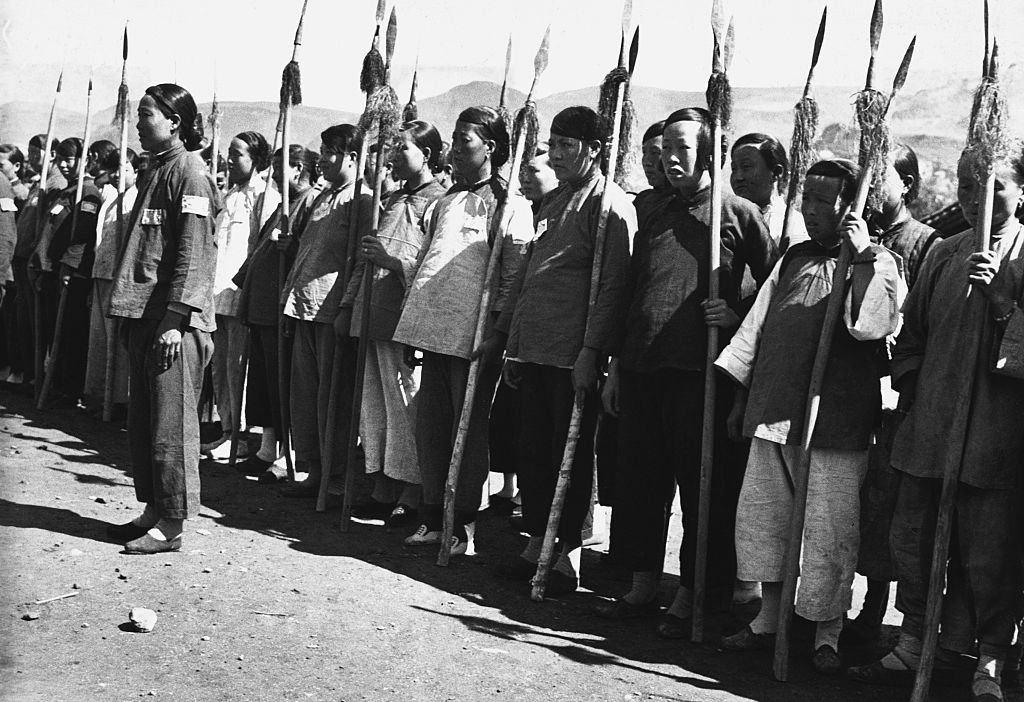
A group of guerrilla fighters in China, circa 1935.
 (Hulton-Deutsch Collection / Corbis via Getty Images)


Although it may not sound like it from its (instantly memorable) title, Park Seolyeon’s new novel is a love story. Translated by Anton Hur, Capitalists Must Starve fictionalises the biography of Kang Juryong, whose marriage to Choi Jeonbin leads her first into the fight for Korean liberation from Japanese rule and then into the struggle for socialism, as she leads her colleagues in a rubber factory into their first industrial action (a high-altitude protest against their working conditions atop Eulmil Pavilion in Pyongyang). The book appears in English after a successful fundraiser by Tilted Axis Press (which publishes literature from Asia, Africa, the Caribbean, and Latin America), its title taken from one of Kang’s speeches.

Capitalists Must Starve, which won the Hankyoreh Literature Award in 2018, extends the tradition of the educational socialist novel, which stretches back to the mid-nineteenth century with Nikolai Chernyshevsky’s What Is to Be Done? and into the twentieth century with The Jungle by Upton Sinclair and The Ragged Trousered Philanthropists by Robert Tressell. It is set in the 1920s and 1930s, written in a similar realist style to that of Sinclair and Tressell, and centred on Kang’s emotional journey from nationalism to socialism as she educates herself and others. The old tension between urban intellectuals and workers who have not been able to access higher education — for reasons of class and/or sex — becomes a major plot point, as the Communist Party tries to bring Kang into the fold.

This raises other concerns, seemingly ubiquitous to left-wing organising across time and place: how much to trust the party? When and how to act? And to what extent can or should one person use headline-grabbing actions as a catalyst to speed up change? Park’s characterisation of Kang places her firmly on the side of the workers — although there is an awkward, gradual reconciliation with the party, and one particular official, even if her dedication to the rubber factory strike means that it does not develop into a romance as complicated as the one she shares with Choi.

Park dramatises Kang’s relationships with her family, friends, and colleagues sharply, as conflicts arise (over her choice of man and her involvement in subversive political activity) that pit her against the state and her employers. This is not an exceptionally subtle novel — nor should it be — but the reader is invited to feel Kang’s sadness and frustration at seemingly smaller moments where she is sidelined or belittled because she is a woman (just as much in the Left movement as in the nationalist one), and her fury at how the male factory owners abuse their female staff. The twists in her relationship with Choi are handled skilfully: it begins to collapse over behaviour that seems to him to be mindfulness of her safety, and to her like a revelation of how little he regards her capabilities, typical of how Park brings a feminist slant to the classic workers’ novel.

This emphasis on Kang, with all other people and struggles seen through her (told by an omnipotent narrator rather than first person), puts Capitalists Must Starve on the side of a maverick individual who takes bold action, although it does follow her efforts to adapt her personality to the slow task of workplace organising as well. Her personal qualities — diligence, resilience, willingness to rebel if she thinks circumstances demand it — come to the fore in a novel that asks: what makes a good radical, a good leader, and a good radical leader?

Writing this story as a novel rather than a biography has undoubtedly helped Park to bring Kang’s story to an international audience. It helps that Park’s narrative is expertly paced, condensing the key details from Kang’s (tragically short) life into a compact 200 pages. It begins in adulthood, giving us several scenes with Kang’s parents without delving into her childhood, suggesting that the challenges she meets are social and political, rather than (primarily) psychological. There is plenty of trauma in the book, with the scenes of factory bosses bullying and beating the women being just as violent and harrowing as anything Kang endures with the First Regiment of the Unified Korea Council. Far more than the colonial occupation, this injustice forms the core of Capitalists Must Starve: it is the one Kang feels most able to address, making a difference on a local level, and her relationships with her colleagues and comrades prove ultimately more rewarding than that with her husband.

It’s interesting to think about what a novel can access that other forms can’t: the ability to speculate about people’s motivations and feelings can allow an author to explore the psychological truth of political activism in a way that history or biography aren’t able to. This was true for Bill Broady’s excellent 2024 novel The Night-Soil Men, exploring the strategic and personal tensions within the Independent Labour Party through three figures (Victor Grayson, Philip Snowden, and Fred Jowett) with very different personalities and approaches, going deep into their private lives to build empathy with all of their positions and invite readers to draw their own conclusions about whose approach was best. With the focus entirely on Kang, Capitalists Must Starve doesn’t aim for that — instead, its potential lies in introducing a new generation to the concept of industrial action, preparing it for its frustrations, and asking it to think about a different kind of love that is far less often represented in culture than the search for romantic fulfilment.

Contributor

Juliet Jacques is a writer and filmmaker whose new short fiction collection The Woman in the Portrait is out now.