Friday, March 06, 2026

New Kazakhstan controls spur Canadian uranium explorer exit

Blair McBride | March 5, 2026 |
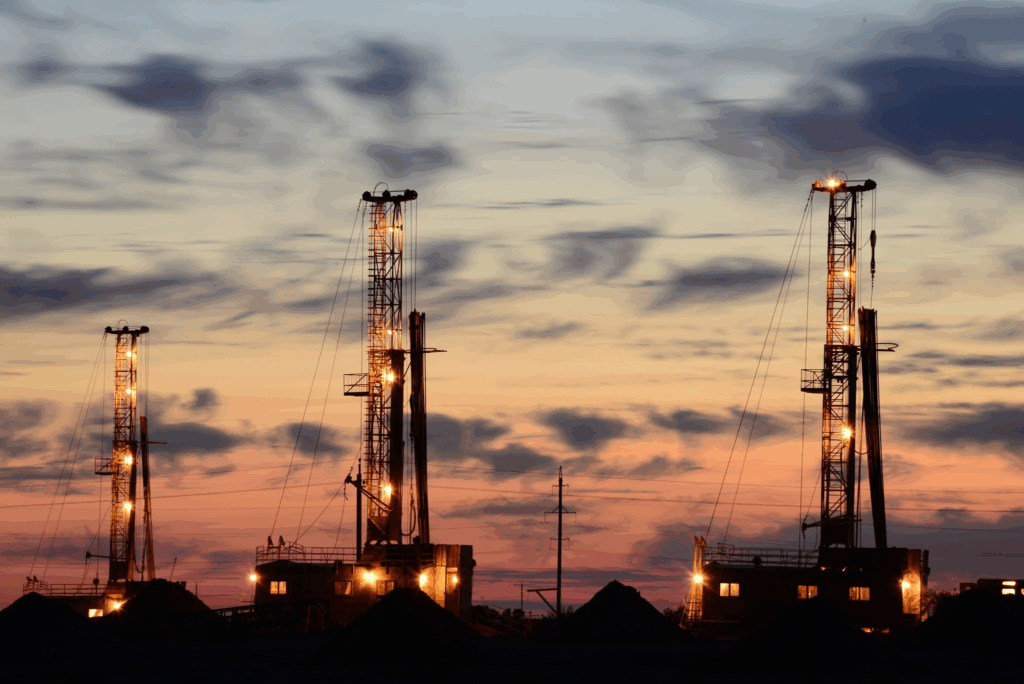


A Kazatomprom uranium exploration site in Kazakhstan. Credit: Kazatomprom

Laramide Resources (TSX, ASX: LAM), one of the few Western companies to explore for uranium in Kazakhstan in recent years, is leaving the country as regulatory changes tighten restrictions on foreign participation.


State miner Kazatomprom (LSE: KAP) – the world’s top uranium producer – confirmed in late December the Kazakhstan government changed its Subsoil Use Code, giving the miner priority rights to exploration licences in prospective areas. Most projects must be done in joint ventures and the new law states that Kazatomprom gets at least 75% in them.

“This rule is going to keep any company from wanting to explore in Kazakhstan, not that there were a lot before either,” Red Cloud Securities analyst David Talbot told The Northern Miner by email. The changes amount to “de facto nationalization of the uranium industry in Kazakhstan,” he said.

Kazakhstan, historically integrated into the Soviet system with production largely directed to Moscow, now supplies much of the Western uranium market. Its move to strengthen state control over the sector through legal channels is a potential risk to supply that could support higher prices.

Laramide’s hopeful entry

In 2024, Laramide entered a three-year option agreement with Kazakh company Aral Resources to explore on more than 5,500 sq. km in the Chu-Sarysu Basin in southern Kazakhstan. The site is adjacent to Kazatomprom’s Inkai JV mine it holds with Canadian producer Cameco (TSX: CCO; NYSE: CCJ) and the Budenovskoye JV the state miner holds with Russia.

On Dec. 24, the Toronto-based explorer received the final permits to start drilling its 15,000-metre program. But two days later, Kazakh President Kassym-Jomart Tokayev signed into law the Subsoil Use Code changes.

“We had three rigs ready to go, basically on standby, we had all the people ready to go, we had the targets and unfortunately we never went out and drilled anything and had to walk away,” Laramide CEO Marc Henderson told The Northern Miner in an interview. The company announced on Jan. 20 it had ended its option agreement with Aral.

Henderson had heard rumours about the legal changes for a while and he realized last fall that the “dramatic decision” was going to be enacted.

“It would be like Newmont going to the US government saying there’s a lot of gold here, why don’t you ban everyone else in Nevada except us. Except [in this case] it’s not for gold, it’s something critical that the world needs, like uranium.”

Asked to specify which part of the law spurred Laramide to leave the country, Henderson responded with a scenario where the company made a major discovery and approached Kazatomprom about its interest in a JV to potentially mine uranium.

“We thought the range that we were going to end up negotiating would be 30% to 50%,” he said. “[But] they made it law that the new terms that they had to have were between 75% and 90%. That was just a completely different deal.”
Why the amendments?

The code changes are “essential for the systematic modernization of Kazakhstan’s subsoil use regulations,” a Kazatomprom spokesperson told The Northern Miner by email. 

“The revisions are intended to optimize the management of strategic resources, providing the framework necessary to reinforce Kazakhstan’s global market presence.”

Henderson noted that Kazatomprom revealed its dwindling reserves in an investor’s presentation deck. A January deck showed that its production resource base would peak this year, then begin a rapid decline in a few years, with complete exhaustion by 2057.
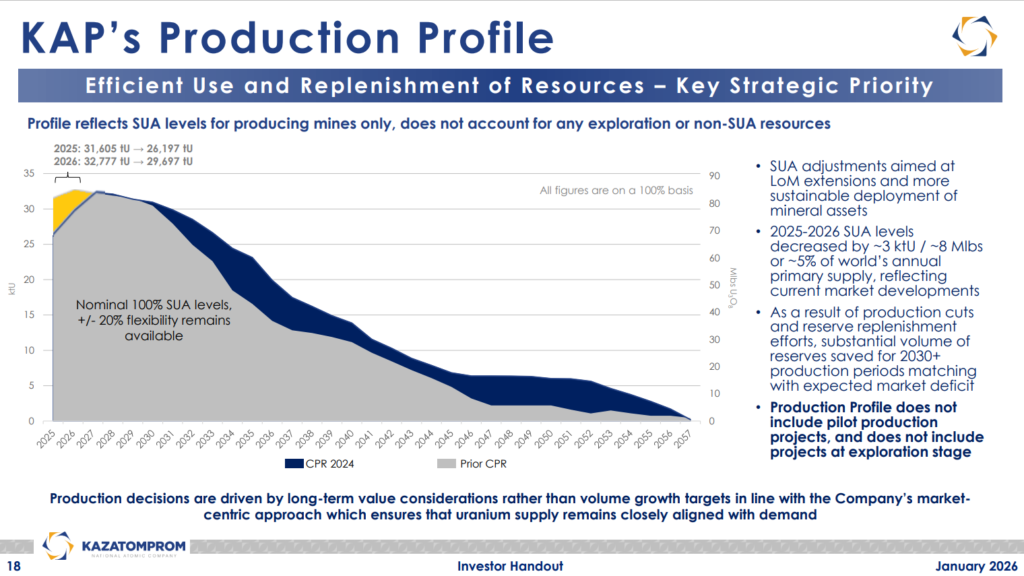
Credit: Kazatomprom

Kazatomprom board chair Meirzhan Yussupov suggested as much to the Central Asia-focused Kursiv business publication in December.

The amendments are needed, Kursiv reported, as higher prices could attract higher-cost producers, reducing Kazakhstan’s advantage and depleting its reserves.

In addition, Kazakhstan’s Atomic Energy Agency said it needs the underground use amendments so it has enough fuel sources for planned nuclear power plants, according to reporting from Radio Free Europe’s Russian service on Feb. 9.
Greenfield exploration loss

Laramide incurred no costs to leave Kazakhstan and for now plans to re-focus on its projects in Australia and the southwest US.

Still, Henderson thinks it’s a loss for global greenfield uranium exploration that one of the world’s most prospective jurisdictions is now effectively closed to Western investment.

“The uranium sector is woefully behind on greenfield exploration,” he said. “The prospectivity in uranium to find things of any scale is very, very small. And not all of those are jurisdictions where you want to go on vacation, or where you’re comfortable with the politics.”

Australia’s C29 Metals (ASX: C29) is another Western company that was exploring for uranium in Kazakhstan. It acquired the Ulytau project in 2024. But C29 announced it was ending operations there in late November after regulators rejected its application for exploration rights, according to Minex Forum, a U.K.-based mining conference platform focused on Eurasian markets. C29 did not respond to a request for comment from The Northern Miner.

How will producers fare?

Western majors like Cameco, France’s Orano and Japan’s Sumitomo Corp. and Kansai Electric Power could face similarly difficult conditions in Kazakhstan.

Cameco’s contract in the Inkai JV – in which it holds a 40-60 interest with Kazatomprom – ends in 2045. Orano is in a 51-49 interest arrangement with Kazatomprom in Katco, made up of the South Tortkuduk/Muyunkum operation.

While Kazatomprom said existing subsoil use agreements are unaffected, contract extensions or production increases would require Kazatomprom to hold at least 90% of the JV. Alternatively, the foreign partner could keep its interest by transferring uranium conversion and enrichment technologies to Kazatomprom and build downstream capacity.

Of the non-Western producers in the country, seven are Kazakh, two are Russian, two are Chinese and one is Kyrgyz. Most production projects are held in JVs.

“This is part of the ongoing expectation that Kazakh uranium will be increasingly destined for eastern destinations (Russia, China), and less available to the West,” Red Cloud’s Talbot said. “It would impact the Chinese, Russians, Orano, Cameco and others – essentially reducing their interest and production.”

A Cameco spokesperson said in emailed comments to The Northern Miner that the company’s subsoil use agreement in the Inkai JV is valid until 2045 and Cameco has transferred refinery and conversion technology to its partner.

“Foreign interests requiring a new subsoil use agreement or an extension of a current agreement will face the requirement to increase state ownership,” the spokesperson said. “While the change in legislation is certainly impactful more broadly in the market, our agreement remains in place for the next 20 years.”

Pivot to East, spot prices

Talbot noted that global production as such might not be affected by Astana’s legal changes, and he expects all long-term uranium sales contracts would be intact, “but future contracts would likely be focused to an even greater extent on Chinese and perhaps Russian customers.”

In terms of the uranium spot price, which soared about 33% from late November until late January, when it peaked at $101.55 per lb., Talbot suggested Kazakhstan’s policy change could play a bullish role.

“Uncertainty surrounding uranium security of supply is often a catalyst for rising uranium price,” he said. “This could be very good for uranium prices, and potential M&A as western producers scramble for future production.”


NexGen eyes summer 2026 build for huge Rook I uranium mine
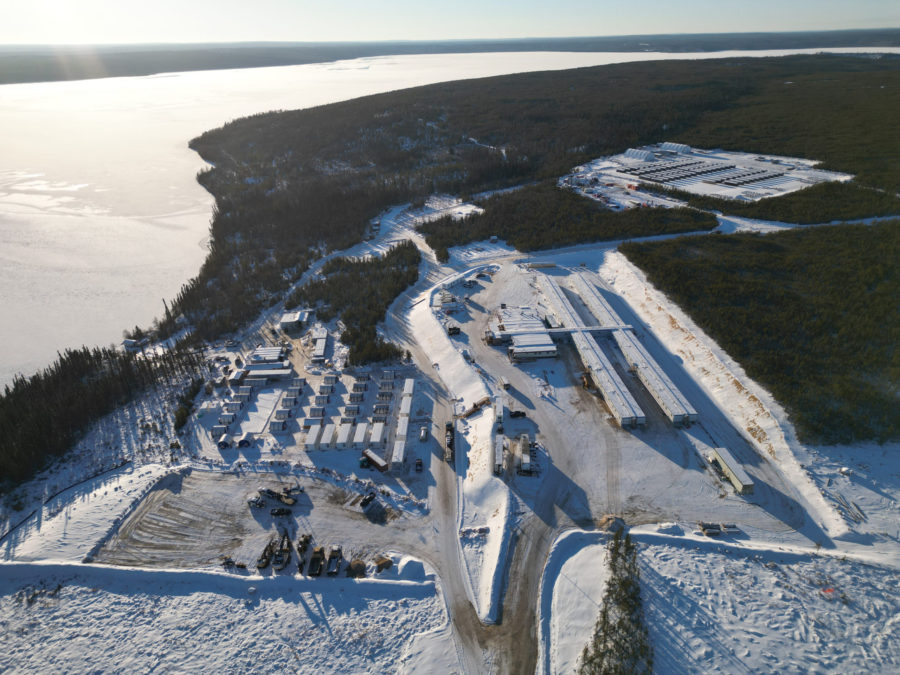

The Rook I uranium project in Saskatchewan’s Athabasca Basin. Credit: NexGen Energy

NexGen Energy (TSX, NYSE: NXE; ASX: NXG) said it will start construction this summer of its Rook uranium mine in northern Saskatchewan, the largest development-stage uranium deposit in Canada.

The C$2.2 billion capex build plan for Rook I comes on the same day the Canadian Nuclear Safety Commission (CNSC) approved NexGen’s environmental assessment and construction licence, and just weeks after the regulator’s two-part hearing process concluded.  Located in the uranium-rich Athabasca basin’s southwest, Rook I is about 900 km northwest of Regina.

“Current expectations are for a four-year construction period,” Canaccord Genuity Capital Markets analyst Katie Lachapelle said in a note on Thursday. “We expect NexGen to release a detailed construction schedule in the near-term.”

The approval follows one of the most rigorous regulatory processes conducted for a resource project in the world, NexGen CEO and founder Leigh Curyer said in a release.

“This milestone is the result of the NexGen team’s steadfast and unrelenting focus over 12 years understanding and delivering our objectives honestly and incorporating a culture of excellence,” he said.

Top uranium producer

Rook I, anchored by the high-grade Arrow deposit, could produce almost 30 million lb. of uranium oxide (U3O8) per year over the first half of its 11-year life, according to a feasibility study published in 2021.

That capacity would make it the top uranium mine by output in North America, ahead of Cameco’s (TSX: CCO; NYSE: CCJ) producing McArthur River and Cigar Lake mines in Saskatchewan.

NexGen’s construction milestone also coincides with other developments for uranium players in the province over the past several weeks.

Denison Mines (TSX: DML) last week announced the start of construction of its Phoenix mine, Canada’s first in-situ recovery operation for the nuclear fuel. Last month, Paladin Energy (TSX, ASX: PDN) received environmental impact statement approval from the Saskatchewan for its Patterson Lake South project.

All three projects would rank in the top five largest operations in the Athabasca basin by reserve size if they become producing mines.

C$6.3B value

NexGen shares fell 3% to C$16.77 apiece on Thursday afternoon in Toronto amid a broad market decline, valuing the company at C$10.1 billion ($7.4 billion).

In a uranium spot price case of $95 per lb., Rook I has a net present value (at an 8% discount) of C$6.32 billion and an internal rate of return of 45%. The Arrow deposit hosts probable reserves of 4.57 million tonnes grading 2.37% U3O8 for 240 million lb. of U3O8.


Rook I uranium project gets construction approval


NexGen Energy has received the final regulatory approval for the Rook I uranium project in northern Saskatchewan, and will begin construction later this year.
 
(Image: NexGen)

The Canadian Nuclear Safety Commission (CNSC) decision to issue the Licence to Prepare Site and Construct the proposed uranium mine and mill came 14 business days after the conclusion of the last part of the regulator's two-part hearing process. The licence - which is valid until 31 March 2036 - covers site preparation and construction activities under Canada's Nuclear Safety and Control Act: operation of the facility would need NexGen to submit another licence application which would be subject to a future licensing hearing and decision.

Rook I is described by NexGen as the largest development-stage uranium project in Canada. Centred on the Arrow deposit, a high-grade uranium deposit discovered by the company in 2014, the project is in the southern Athabasca Basin, about 155 km north of the town of La Loche. The project is situated on Treaty 8 territory, the Homeland of the Métis, and is within territories of the Denesųłiné, Cree, and Métis.

The Arrow deposit has a resource estimate of 357 million pounds U3O8 (137,319 tU) in the measured and indicated mineral resources category, grading 3.10% U3O8. Probable mineral reserves have been estimated at 240 million pounds U3O8, grading 2.37% U3O8. A 2021 NI 43-101 feasibility study for the project envisages production of up to 14 million kilograms of U3O8 annually for 24 years.

The project received environmental approval from the Province of Saskatchewan in November 2023, and, with all approvals now secured, NexGen said it is set to begin construction. A final investment decision has already been made, and the team, procurement, engineering, vendors, contractors and capital are in place to commence construction activities with advanced site and shaft sinking preparation. Construction will officially begin in this summer, the company said, and construction is expected to take four years to complete.

NexGen founder and CEO Leigh Curyer said the CNSC's approval "represents one of the most rigorous and comprehensive regulatory processes undertaken for a resource project globally" and, as well as acknowledging NexGen's team, expressed the company's "sincere gratitude" to its Indigenous Nation partners, local communities, Premier Scott Moe and the Government of Saskatchewan, Government partners, regulatory bodies, and stakeholders who have contributed to the advancement of the project over the past decade.

"The world is changing fast, and NexGen's Rook I is now ready to be a significant contributor to global requirements for nuclear energy and Canada's role as an energy superpower. As global demand for reliable, clean, baseload nuclear energy continues to accelerate at an unprecedented pace, uranium is the critical fuel for powering industrial electrification and the digital infrastructure of tomorrow. Simply put, energy is the key to our global growth," Curyer said.

In February, Reuters reported that NexGen had held preliminary talks with data centre providers about securing finance for a new mine. Speaking to investors in NexGen's fourth quarter conference call on 4 March - one day before the CNSC announcement - Curyer said the first 12 months of construction is expected to cost around CAD300 million (USD219 million). NexGen is well funded to begin construction thanks to already completed equity raises and offtake agreements. Further offtake agreements are already in advanced negotiation, with contracts expected to be announced this year, he said, but the start of construction or production will not be dependent on those new contracts being in place.

"We know exactly what we're doing every day of that 48-month process, who's doing it, who's responsible for it within NextGen," Curyer said. "And as I said, once we're in that basement rock, the highest risk around cost and schedule has been mitigated."

Curyer told investors the company would issue a detailed construction timeline once the licensing process had concluded.


Canada and India Sign Landmark Uranium Deal Worth $2.6B

  • Canada is expanding trade with India as Prime Minister Mark Carney seeks to reduce reliance on the U.S. after 2025 tariffs, aiming to double non-U.S. exports within a decade.

  • Major energy and commodities deals were signed, including a 10-year uranium supply agreement between Cameco and India.

  • Canada and India are pursuing deeper economic ties, with plans for a free-trade agreement targeting $70B in bilateral trade.

Ever since Donald Trump slapped tariffs on Canadian goods on Feb. 1, 2025, Prime Minister Mark Carney has been encouraging trade with nations other than the United States.

The former central banker turned politician wants to double non-US exports over the next decade.

Towards that goal, Carney met with Indian Prime Minister Narendra Modi in Delhi on Monday as part of a four-day trip to deepen trade and diplomatic ties.

The centerpiece was a deal between the Indian government and Saskatchewan-based uranium producer Cameco (TSX:CCO) to supply nearly 22 million pounds of uranium for nuclear energy generation between 2027 and 2035.

Also, British Columbia coal producer Elk Valley Resources — majority-owned by Glencore (LSE:GLEN) — will sell 1.2 million tonnes of coal to India worth hundreds of millions of dollars. (CBC News)

As reported by the National Post newspaper,

Emerging from a set of meetings with India Prime Minister Narendra Modi earlier in the day, Carney announced that a new $2.6-billion agreement had been struck between India and Saskatchewan that will see the Prairie province supply it with uranium, which India needs for nuclear power generation.

The 10-year deal, set to begin in 2027, is part of what the Prime Minister’s Office calls a new “strategic energy partnership,” which was one of the outcomes expected out of Canada’s renewed interest in working with India.

The uranium contract with Saskatoon-based Cameco was one of the 10 commercial deals, some of which were years and months old, that Carney’s office said totalled around of $5.5 billion that he touted as signs of a deepened relationship.

Many of them have to do with Canadian companies expanding into India and vice-versa.

The two leaders also announced plans for a new free-trade deal, where the goal is to double two-way trade to $70 billion over the next four years. Carney has appointed a chief negotiator and said he wants to see the agreement happen by the end of the year.Related: Trump’s Secret Weapon in the Rare Earth War

To that end, Carney’s office outlined how Canada and India signed five memorandums of understanding to commit to working towards deeper collaborations, with at least two dealing specifically with the areas of critical minerals and “diversifying supply chains.”

Carney has faced criticism at home for courting the Indian government, including inviting Modi to the G7 leaders’ summit in Alberta last year. During Carney’s trip to Delhi, Modi accepted an invitation to visit Canada. The Prime Minister’s Office reports that Canada and India have interacted more this year than in any of the last 20 years.

The diplomatic U-turn is welcome news to the Canadian business community, which likes the certainty of trade agreements.

Relations under former Prime Minister Justin Trudeau plummeted after he accused the Indian government of orchestrating violent crimes in Canada such as the killing of a prominent Sikh activist in 2023.

Some Indian diplomats were expelled from Canada, but India has denied any involvement in his death.

The Royal Canadian Mounted Police subsequently alleged India was behind incidents of extortion, mainly in BC, Alberta and Ontario.

Along with uranium and coal, Carney also touted current and upcoming LNG projects in British Columbia that could help meet India’s expected doubling of population by 2040.

Related: Magnet Wars: How the U.S. Plans to Break China’s Grip on Rare Earths

“Canada is well-positioned to contribute, as a reliable supplier of the world’s lowest-carbon, responsibly produced LNG (liquefied natural gas) from our West Coast,” he said in his remarks, via CTV News.

The trade news on India came the same day that the Canadian government announced it has secured 30 new critical mineral partnerships, unlocking $12.1 billion in mining project capital.

Made at the 2026 Prospectors & Developers Association of Canada (PDAC) annual convention in Toronto, the announcement is the second round of partnerships and investments under the Critical Minerals Production Alliance. The first round was announced in October 2025.

The Canadian Press reported that Deals include up to $7 million to Greenland Resources' Malmbjerg project in Greenland, $9.1 million to Cyclic Materials Inc.'s rare earths elements recycling centre in Kingston, Ont. and $16.7 million for First Phosphate's Bégin-Lamarche demonstration and feasibility project in Saguenay–Lac-Saint-Jean, Que.

By Andrew Topf for Oilprice.com


China’s state iron ore buyer summons traders on BHP restrictions


China’s state-backed iron ore buyer has summoned traders and urged them to refrain from buying new BHP Group cargoes to sell to buyers in the country after they were found to be flouting a restriction on the purchases.

China Mineral Resources Group Co. has signaled it will toughen enforcement in conversations with domestic and foreign traders in recent weeks, according to two people familiar with the matter. The group doesn’t have formal authority over Chinese steel mills that are taking the iron ore, but the order is effectively binding due to the body’s political clout.

CMRG and BHP have been caught in a months-long standoff in talks for long-term contracts on behalf of China’s mills. The state-backed buyer first ordered steel producers to stop buying Jimblebar blend fines, a type of iron ore, in September. It subsequently restricted purchases of all new products, which are denominated in dollars, from the company and then Jinbao, another variety of the steelmaking ingredient.

While CMRG is not considering a sweeping ban on other products, such as Mining Area C fines and Newman lumps, the renewed warning on dollar-denominated purchases could create fresh challenges for BHP when it seeks to market shipments for April, the people said, asking not to be named discussing private matters.

A spokesperson for BHP declined to comment on commercial matters. CMRG didn’t immediately respond to a request for comment.

Currently, steel mills are able to take Mining Area C fines and Newman lumps if the sales are via term contracts or CMRG. However, there’s a complete ban on Jimblebar fines and Jinbao. Inventories have been growing at Chinese ports since the curbs took effect, while some cargoes are being diverted to other markets.

(By Katharine Gemmell and Alfred Cang)


UPDATED

Maduro's son boasts "absolute hegemony" as Caracas bows to Washington

Maduro's son boasts
The pro-government demonstration where Maduro Guerra spoke represents one of several rallies organised by hard-line Chavistas demanding his parents' release.
By bnl editorial staff March 5, 2026

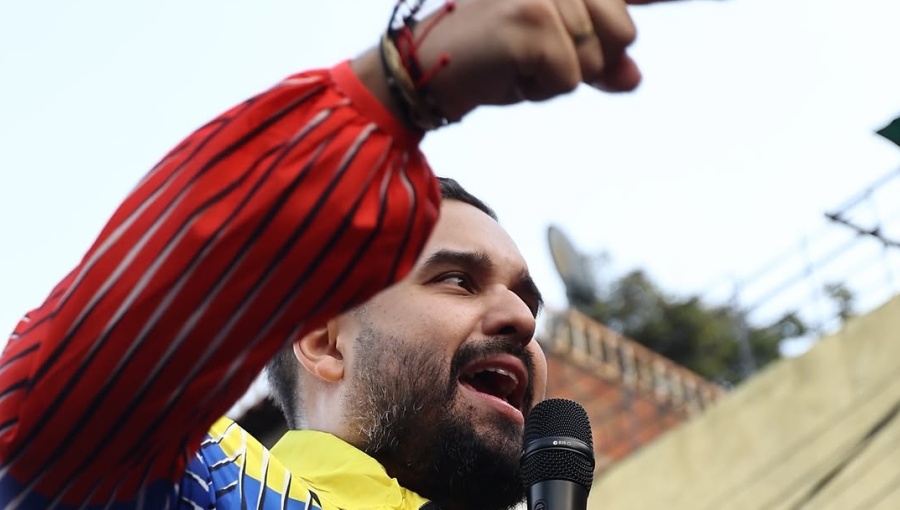
Venezuelan congressman Nicolás Maduro Guerra called on the ruling Chavista movement to "guarantee its absolute hegemony" in the country, marking two months since US forces captured his father, deposed president Nicolás Maduro.

Speaking at a pro-government march on March 3 demanding the release of Maduro and his wife Cilia Flores, who are being held in New York facing narco-terrorism charges, the younger Maduro acknowledged that Venezuela faces a "complex situation" but insisted the political movement remains in power under interim president Delcy Rodríguez, whom he described as loyal and capable.

He urged supporters to “remain organised” and follow the leadership's directives, conceding the country "has transformed" since the January 3 US military operation that extracted his father from a heavily guarded compound in Caracas.

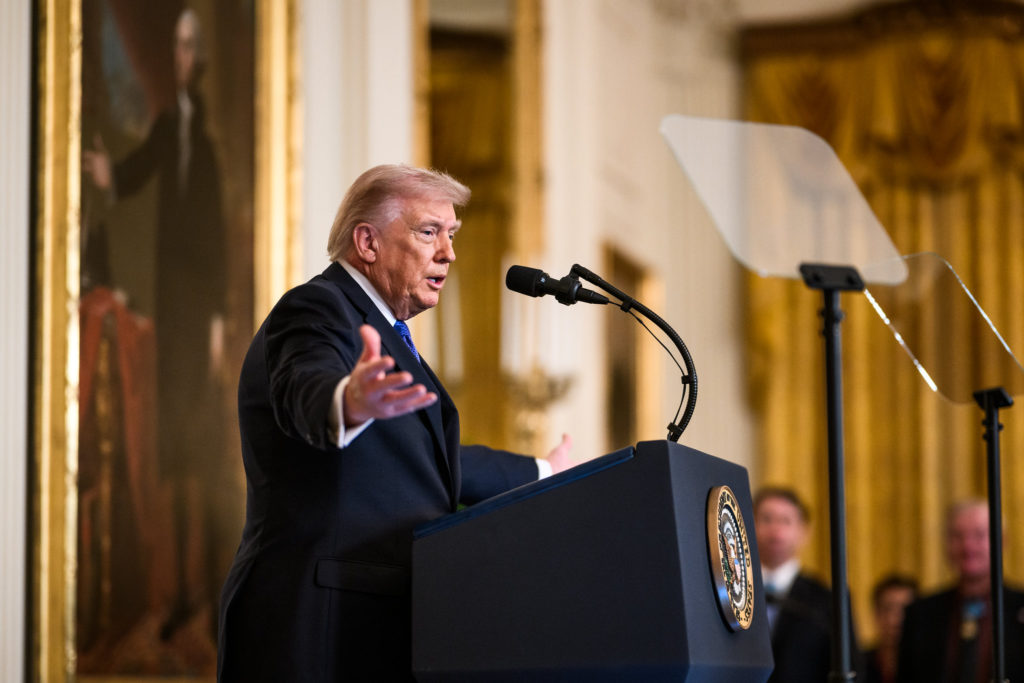
Yet the rallying call to die-hard Maduro loyalists sits uneasily with the reality of Rodríguez's interim government, which has systematically accommodated American demands. President Donald Trump has made clear Washington will "run" Venezuela during the transition period, maintaining explicit threats of further military intervention alongside economic leverage through control of oil revenues.

For her part, Rodríguez has proved willing to satisfy Trump's expectations. She has proposed legislation opening Venezuela's petroleum sector to private investment, removing restrictions that currently limit foreign participation in the country's vast oil reserves. Her government has released over 600 political prisoners since assuming power and passed amnesty legislation  though with exclusions designed to bar opposition leader María Corina Machado from benefiting  moves that align directly with American directives whilst maintaining a veneer of revolutionary rhetoric to preserve credibility amongst Chavistas.

Several senior US officials have visited Caracas in recent weeks to advance energy, minerals and security cooperation, including Energy Secretary Chris Wright in February and Interior Secretary Doug Burgum earlier this week, while US military officials held separate security talks with Venezuelan counterparts last month.

Maduro Jr.’s assertion of continued hegemony belies growing evidence of regime fractures. Venezuelan intelligence services detained Alex Saab, his father's former industry minister and alleged financial operator, in early February, a move suggesting Rodríguez is purging figures closely associated with the ousted leader.

The elder Maduro faces four criminal charges in the United States, including conspiracy to commit narco-terrorism and cocaine importation, whilst Flores faces similar accusations linked to drugs and weapons trafficking. Both appeared in federal court on January 5, where they pleaded not guilty.

Maduro's defence team has asked a federal court in New York to dismiss the case. His lawyer Barry Pollack argued that the US Treasury Department blocked use of Venezuelan government funds to cover legal fees after denying a licence from the Office of Foreign Assets Control (OFAC), which the defence contends violates Maduro's constitutional right to choose counsel.

Pollack maintained that proceeding to trial under such conditions would be unconstitutional, noting the licence was initially granted but revoked hours later, leaving the legal team without funding in a case that could result in decades of imprisonment for the former president.

The pro-government demonstration where Maduro Guerra spoke represents one of several rallies organised by hard-line Chavistas demanding the couple's release, though turnout has been modest compared to the massive mobilisations the movement commanded during Maduro's presidency.

The protests seek to project continued loyalty amongst the regime's ideological core even as Rodríguez's interim government charts a pragmatic course of cooperation with Washington that diverges sharply from the rabid anti-imperialist rhetoric that defined the socialist movement founded by former president Hugo Chavez for two decades.

US, Venezuela restore diplomatic relations as Washington pushes for access to minerals


Venezuela said Thursday it was committed to a “new stage” in relations with the United States "based on mutual respect" after both countries agreed to restore diplomatic ties. Acting President Delcy Rodriguez’s government said it was ready to pursue constructive dialogue grounded in sovereign equality and cooperation between the two nations.

Issued on: 06/03/2026 -
By: FRANCE 24

Venezuela's interim President Delcy Rodriguez met with US Interior Secretary Doug Burgum in Caracas. © Federico Parra, AFP

Venezuela and the United States are restoring diplomatic ties, the two countries announced Thursday, in a new sign of thawing relations after Washington ousted former president Nicolas Maduro.

The announcement came as US Interior Secretary Doug Burgum wrapped up a two-day trip to Venezuela, part of US President Donald Trump's push for greater access to the country's mineral wealth.

The re-establishment of diplomatic and consular relations "will facilitate our joint efforts to promote stability, support economic recovery, and advance political reconciliation in Venezuela", the US State Department said.

"Our engagement is focused on helping the Venezuelan people move forward through a phased process that creates the conditions for a peaceful transition to a democratically elected government."

Venezuela's foreign ministry said it would "move forward in a new stage of constructive dialogue, based on mutual respect, the sovereign equality of states and cooperation between our people", adding that the renewed ties would be "positive and mutually beneficial".

The announcement came hours after Burgum, a member of Trump's cabinet who leads the National Energy Dominance Council, said he had received assurances from Caracas that the government would ensure the security of foreign mining companies keen to invest there.
'Right kind of security'

Burgum, who held talks with interim president Delcy Rodriguez during his trip, said dozens of companies had expressed interest in investing in Venezuela.

"I think you're going to see this government very concerned about providing the right kind of security," Burgum said.

He told reporters his meetings were "fantastically positive", and predicted Venezuela would surpass its oil and gas production targets in 2026.

Trump's administration says it effectively runs Venezuela and controls the country's vast natural resources after toppling Maduro.

Burgum is the second senior US official to visit since the bombing raid on January 3 that left around 100 people dead and saw Maduro and his wife flown to New York for trial on drug trafficking charges.

Besides oil, Venezuela is rich in minerals such as gold and diamonds, as well as bauxite, coltan and other rare materials used to make computers and mobile phones.

READ MOREAfter oil, US moves to secure access to Venezuelan minerals

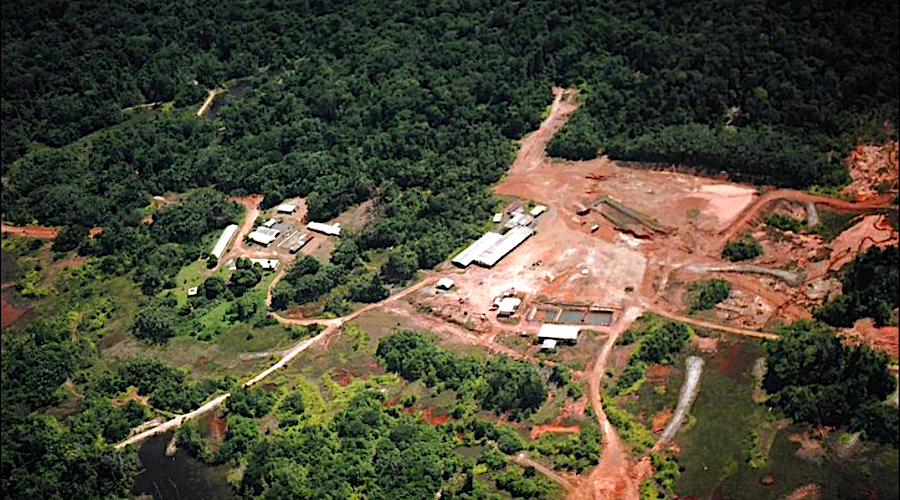
Mining activity is concentrated in a territory known as the Orinoco Mining Arc, where armed groups are active.

Burgum's visit follows that of US Energy Secretary Chris Wright, who pushed for a "dramatic increase" in Venezuela's oil output and talked up "tremendous opportunities" for both Washington and Caracas.

The enthusiastic assessments of both men, which echo Trump's stance, reflect the sea change in relations between Washington and Caracas since the capture of Maduro.

Trump has allowed Rodriguez, who was Maduro's vice president, to move up to interim leader so long as she grants US access to Venezuela's natural resources.

Venezuela has the world's largest proven oil reserves, and Rodriguez last month overhauled the state-controlled oil sector to enable a wave of private investment. She now has her sights set on updating the mining code.

(FRANCE 24 with AFP)

Trump woos Venezuela with potential deals as relations reset

Interior Secretary Doug Burgum was still flying back from Venezuela when the Trump administration made it official: The US would re-establish diplomatic relations with the South American country, seven years after suspending operations at its embassy in Caracas.

The formal step marked the culmination of Burgum’s two-day mission in Venezuela to drive policy reforms and investment meant to unlock the country’s oil and mining riches — with the promise of simultaneously nurturing greater political stability and improving living conditions.

It’s a kind of dollar diplomacy — with President Donald Trump using the lure of foreign investments to nudge along democratic reforms, just two months after the US captured former President Nicolas Maduro.

Critics say Washington is attempting to vassalize Venezuela, taking control of its crude, coal and critical minerals for its own gain. But Burgum and other Trump officials see a chance to foster friendly supply chains for oil and minerals that can’t be easily choked off, while making Venezuela more stable to the benefit of both residents and neighboring nations.

“Venezuela’s leadership is leaning in hard toward building a positive, strong, enduring relationship with the United States,” Burgum said. “They’re creating a framework that is going to mean more peace, more stability, more prosperity for the people of Venezuela.”

Burgum left Caracas after securing a promise from interim President Delcy Rodriguez that the country would advance mining law reforms seen as essential to luring foreign investment. He also presided over the signing of agreements helping Shell Plc restart oil and gas development with Venezuelan and American contractors.

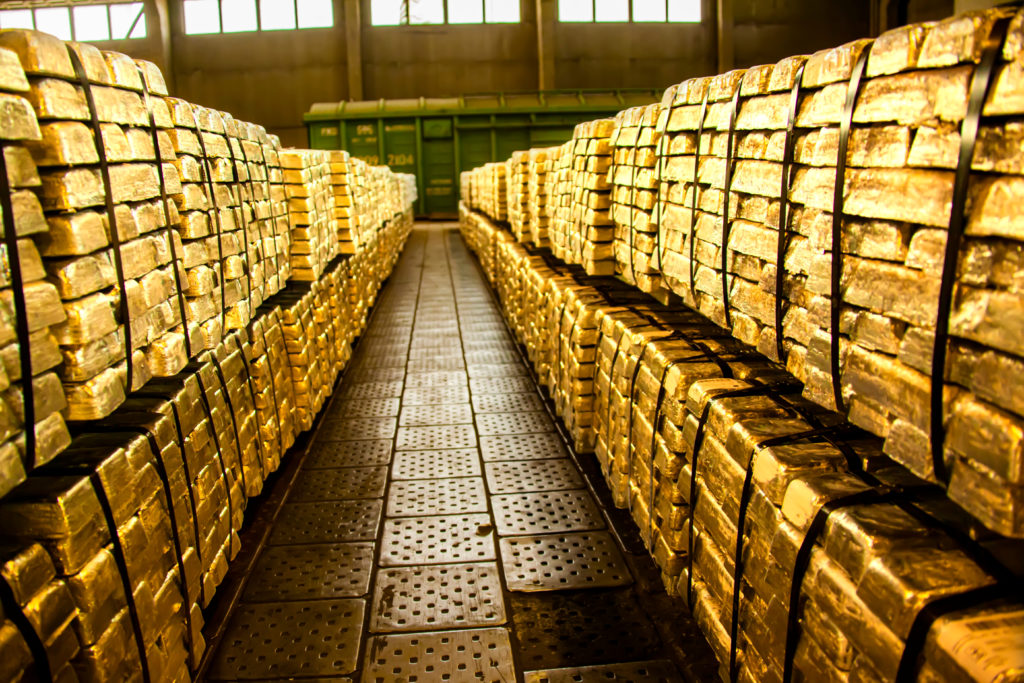
In the background, other deals were being honed, including a plan for Venezuela’s state mining company to sell as much as 1,000 kilograms of gold to commodities trader Trafigura Group — and then onto refineries in the US.

When Rodriguez announced one of those milestones — the planned mining law overhaul — it was to a phalanx of foreign and local journalists inside the Palacio de Miraflores, marking the first time independent local press had been allowed inside the palace for at least 15 years.

The developments fed a sense of ebullience among the dozens of oil executives, mining leaders and financiers that huddled with Burgum to sketch out opportunities and tick through potential obstacles to investment.

Enormous challenges

But while they gushed about the opportunities, some also expressed fear they wouldn’t last. The upside and potential is so great, it’s hard not to get excited, said one, before soberly adding: We could all end up in the same place again in a few years.

The challenges are enormous. Armed militias and guerrilla groups now control deposits of gold and the critical material coltan in Venezuela, where they are accused of human rights abuses and driving irreversible environmental damage. That stands as a major obstacle to mining companies that will be putting not just capital but human lives at risk in the region.

Burgum said mining executives asked Venezuelan officials about the risk, prompting an interior security official to read off crime statistics and promise that anyone coming to assess sites in the areas would be safe and secure. Rodriguez offered similar assurances, he said.

“They’re basically opening up the doors for travel for due diligence to these mining areas, and the highest levels of government are personally guaranteeing the security for people,” Burgum said. “They want people to create jobs. They want to get back to legitimate versus criminal organizations controlling their natural resources.”

Under the Trump administration’s theory of change — echoed by some of the potential investors — the entry of Western companies abiding by higher standards can help crowd in better practices and crowd out some of the bad actors and illegal mining.

“That activity filled an empty vacuum. It went in and it created an economic opportunity where there was none,” Burgum said. “But I think that if you have a superior economic opportunity” then “you’re going to see this government very concerned about providing the right kind of security.”

The US government has already begun unwinding sanctions that barred American firms from operating in Venezuela, beginning with general licenses targeting oil sales and crude production. Companies that still had trouble moving equipment and resources into the country under those broader authorizations have already been granted sanctions waivers to do so, Burgum said.

And there’s more to come, he said. The US government is already working on a similar set of general licenses that would cover “people that want to invest in mines, people that want to ship mining equipment, people that want new technology to come here,” Burgum said. “We want to open the door for those to come back in.”


Trump gives US gold buyers a way around Venezuelan sanctions


US President Donald Trump. Credit: The White House | Flickr

The Trump administration has opened the door for Venezuela to sell gold into the US in a major boost to a country facing crippling dollar shortages due to restrictions on oil exports.

The Treasury’s Office of Foreign Assets Control issued a license allowing US entities to undertake certain transactions involving Venezuelan-origin gold that would otherwise be prohibited under sanctions, according to a Friday notice. The authorization comes with several safeguards such as contracts governed by US law and payments being placed in US-controlled accounts.

The license doesn’t cover debt swaps or digital payments; transactions involving Russia, Iran, North Korea, Cuba, or China-linked entities; or mining or producing gold inside Venezuela.

The announcement comes after Interior Secretary Doug Burgum’s visit this week to Caracas as the US seeks to revive oil and mineral production in the South American nation, stepping up coordination with Venezuela’s interim government in the wake of the January capture of former President Nicolas Maduro. The US and Venezuela have agreed to re-establish diplomatic relations, seven years after the US suspended operations at its embassy in Caracas.

The US administration has already struck a deal that would see Venezuela’s state mining company sell as much as 1,000 kilograms of gold to commodities trader Trafigura, according to people familiar with the matter.

Over the years, Maduro resorted to selling tons of gold to illegal international buyers from the vaults of Venezuela’s central bank to help the country’s scant finances. The sales impacting the nation’s gold reserves came as oil production plummeted on years of mismanagement and graft, and lately US sanctions.

Bullion gained even more importance as a source of hard currency for Venezuela last year as the haven asset hit repeated record highs and the US government ratcheted up restrictions on its oil exports. The nation’s central bank sold nearly six tons of bullion in the second half, mainly in December when the US began seizing its oil tankers.

Venezuelan gold was mined in a hub envisioned by late Hugo Chávez, Arco Minero, located in the south of the country, approximately the size of Portugal. Over the years it has become a den for illegal mining activities and environmental degradation. The absence of state authority has given rise to criminal syndicates an armed groups, even though the military have been deployed in the area.

(By Jennifer A. Dlouhy and James Attwood)


Venezuela's Gas Potential Could Overshadow Its Famous Oil Reserves

  • While attention is often on Venezuela's vast oil reserves, many experts believe that exploiting its natural gas fields, which were previously neglected, presents a more immediate opportunity for economic success.

  • Developing Venezuela's gas industry will likely require an energy partnership with neighboring Trinidad and Tobago, as the island nation possesses the necessary infrastructure for processing and exporting the fuel that Venezuela lacks.

  • Major international companies like Shell and BP are pursuing key Venezuelan gas projects, such as the Dragon and Cocuina fields, a move facilitated by greater leniency on U.S. sanctions.

Following the United States intervention in Venezuela on 3rd January, which brought an end to President Nicolás Maduro’s 13-year dictatorship, all eyes have been on the South American country’s oil industry. Once one of the world’s biggest oil producers, output has waned in recent years. However, with U.S. President Trump setting his sights on Venezuelan crude, many are speculating just how quickly its resources can be tapped. While the focus is on Venezuela’s potential as an oil power, others think that more immediate success may be seen in the exploitation of its gas fields. 

Venezuela is home to the largest oil reserves in the world, with an estimated 300 billion barrels. However, years of underinvestment and mismanagement have led to a significant reduction in output. The recent U.S. intervention in the South American country has drawn new investor interest in its energy market, as President Trump vows to rapidly redevelop Venezuela’s long-neglected oil resources.

On 13th February, the White House published a press release that stated, “The Trump Administration is rapidly implementing President Trump’s vision to reopen and develop Venezuela’s oil industry for the shared benefit of the American and Venezuelan people. Thanks to President Trump’s leadership, the United States has already issued several general licenses at record speed for oil and gas companies?to make unprecedented investments in Venezuela’s energy infrastructure.”

The statement went on to say, “Venezuela holds tremendous economic potential, but years of instability, corruption, and economic mismanagement have limited?the nation’s?growth and prosperity. These general licenses invite American and other aligned companies to?play a constructive role in supporting economic recovery?and responsible investment.”

While the world eyes Venezuela’s untapped oil, some believe that there may be greater mid-term potential in exploiting its natural gas reserves. Most of Venezuela’s gas is trapped deep beneath the seafloor. While these reserves were first discovered several decades ago, ago, off the country’s eastern coast, along the border with Trinidad and Tobago, the Venezuelan government left them largely untouched as it focused its attention on oil production. 

Several oil majors, such as Shell, have previously approached Venezuela for a stake in its gas business, even when interest in the country’s oil industry was waning due to geopolitical instability and U.S. sanctions. For years, U.S. sanctions on Venezuela’s government and its state-owned oil company, Petróleos de Venezuela, have restricted the development of its gas industry. In addition, developing its natural gas industry would require cooperation with neighbouring Trinidad and Tobago. 

Trinidad and Tobago already has the necessary infrastructure to transport fuel onshore and export it, which Venezuela does not. If the two countries established an energy partnership, Trinidad’s pre-existing infrastructure could help Venezuela to develop its gas industry more rapidly. However, the two powers, which are separated by language (Spanish and English), have had a strained relationship in recent years. Trinidad and Tobago has generally sided with the United States when it comes to Maduro’s presidency and the decision to impose sanctions on Venezuelan energy. 

Venezuela’s biggest natural gas prospect is the giant Dragon oil field, as it is the closest to being developed. The Venezuelan government previously conducted exploration activities in the field but was unable to retrieve the gas buried there due to a lack of funding to continue exploration. These efforts were further undermined by the sinking of an exploration rig in 2010.

In 2023, the Venezuelan government made a deal with Shell, allowing the foreign firm to explore the Dragon field. The plan was to construct a short pipeline between Dragon and Shell’s existing infrastructure on the island of Trinidad, rather than to start from scratch in Venezuela. 

If Shell develops Dragon, the field is expected to generate around $500 million a year in revenue, based on current natural gas prices, of which at least 45 percent is expected to go to Venezuela in the form of taxes and royalties. “These are opportunities that could potentially be activated within months, with potentially a few billion dollars of investments and production in the next couple of years,” Shell’s CEO, Wael Sawan, told CNBC.

U.S. Energy Secretary, Chris Wright, said that developing a regional natural gas collaboration could be “a real potential win-win for Trinidad and Tobago, a win for the global L.N.G. market, a win for Venezuela.”

Meanwhile, BP is pursuing another Venezuelan gas project, a field known as Cocuina, which greater leniency on U.S. sanctions may make possible. In late February, the U.S. Treasury Department appeared to give oil and gas firms greater leeway to negotiate with Venezuela and operate in the South American country. “They are splicing together an environment that allows the existing players to operate,” said Rachel Ziemba, an adjunct senior fellow at the Centre for a New American Security.

While President Trump is eyeing long-term oil industry development in Venezuela, some international oil majors may be more interested in the South American country’s natural gas potential. Developing the resource will likely require collaboration with neighbouring Trinidad and Tobago, and could lead to the development of a new regional Latin America-Caribbean energy hub. 

By Felicity Bradstock for Oilprice.com 


Gold Reserve, other miners receive US license to negotiate Venezuela return

Brisas project camp. (Image courtesy of Gold Reserve.)

Gold Reserve said on Thursday the US Treasury’s Office of Foreign Assets Control has issued a 30-day license allowing certain companies, including the miner, to negotiate with Venezuela.

Shares of the company rose nearly 11% in early market trading.

US Interior Secretary Doug Burgum arrived in the South American country on Wednesday with more than two dozen US mining and minerals companies, which he said could represent billions in investment and thousands of high-paying jobs for Venezuela.

Gold Reserve said the delegation met with Venezuelan acting President Delcy Rodriguez to discuss the conditions necessary to enable foreign investment and support the resumption of mining operations in the country.

The company plans to resume mining in Venezuela, marking a return to the country nearly 17 years after the Venezuelan government seized control of the company’s Brisas gold mine.

The company operated the Brisas gold mine in Venezuela’s Orinoco Arc until 2009.

(By Dharna Bafna; Editing by Shailesh Kuber)


Trafigura said to strike deal to buy Venezuela gold in US pact

Stock image.

The Trump administration has struck a deal that would see Venezuela’s state mining company sell as much as 1,000 kilograms of gold to commodities trader Trafigura, according to people familiar with the matter.

Venezuelan-owned Minerven will sell 650 kilograms to 1,000 kilograms of gold dore bars to the trading house, the people said. The gold will then be sold on to refineries in the US, they said.

The Treasury’s Office of Foreign Assets Control is issuing a license to enable the sale, according to the people. The deal comes as part of Interior Secretary Doug Burgum’s visit to Caracas this week as the US seeks to revive oil and mineral production in the country and step up coordination with Venezuela’s interim government after the January capture of former President Nicolas Maduro.

Final details are still being hammered out, the people said. Other similar deals are expected to follow, one person said.

For Trafigura, the purchase marks another step in its deeper push into precious metals, which have been on a record-breaking multiyear rally. Rival trading houses have also been seeking to push into the space, spying an opportunity to finance gold production in developing economies mostly shunned by banks who fear compliance risks.

A spokesperson for Trafigura declined to comment on the transaction.

Axios first reported the sale on Wednesday. The report came after a Wednesday meeting between Burgum and Venezuela’s interim President Delcy Rodriguez to discuss mining reforms and mineral extraction. Rodriguez told Burgum, along with mining executives and metals traders at the gathering, that her country would move “Trump speed” to help them unlock Venezuela’s mineral wealth.

Bullion gained even more importance as a source of hard currency for Venezuela last year as the haven asset hit repeated record highs and the US government ratcheted up restrictions on its oil exports. The nation’s central bank sold nearly six tons of bullion in the second half, mainly in December when the US began seizing its oil tankers.

Gold mining in the South American nation picked up after the 2016 creation of a southern area for large-scale mineral extraction called the Orinoco Mining Arc. The measure aimed to offset oil declines, although much of its production is informal or illicit, linked to armed groups and dirty practices. While the government promotes gold for revenue and reserves, transparency remains limited.

A chunk of Venezuela’s current gold position is held at the Bank of England. However, the country cannot access these funds because the UK has not recognized its government since 2019. That position has remained unchanged following Maduro’s capture by US forces.

(By Jennifer A. Dlouhy, James Attwood and Jack Ryan)


Venezuela to ensure security of mining companies, US Interior Secretary says


Reuters | March 5, 2026 

US Interior Secretary Doug Burgum said a new mining law in Venezuela will create opportunities for companies, licenses allowing them to operate are on the horizon and the interim government of Delcy Rodriguez has promised to ensure their security, sounding an optimistic note at the end of a two-day visit.


Burgum, who also heads the US National Energy Dominance Council, has hailed efforts by Rodriguez to open the South American country to foreign investment in oil and minerals, echoing praise by US President Donald Trump.

Burgum is the second cabinet secretary to visit Venezuela since a January US raid that captured President Nicolas Maduro. US Energy Secretary Chris Wright visited in February.

Despite having massive reserves of minerals from gold to iron ore, bauxite and coltan, Venezuela’s output is at a fraction of capacity as plants urgently need major repairs and investment for expansions and upgrades. The country’s main conglomerate, CVG, remains cash-strapped and under US sanctions, as does state mining company Minerven.

Following nationalizations under late President Hugo Chavez, foreign investment has been minimal in the last decade. Some experts now see room for an immediate export recovery, particularly for gold, but have warned that massive investment – even higher than for the oil industry – is needed, along with renewed efforts for exploration.

Burgum brought more than two dozen mining and minerals companies with him on the visit, he said, and met on Thursday morning in Caracas with major foreign oil and gas companies as well as the heads of large Venezuelan companies and banks.

Asked about corruption and security issues – including armed groups which participate in illegal mining in some regions – Burgum said the companies interested in coming into or returning to Venezuela have proven track records of integrity, and the new law will be an opportunity for them to create jobs.

“I think you’re going to see this government very concerned about providing the right kind of security. We heard assurances in the meeting today and yesterday that if companies wanted to get to these areas, do due diligence, think about reopening mines, maybe even getting back to mines that they themselves were running 15 or 20 years ago, that this government would ensure their security,” Burgum said.

“I’m feeling very optimistic about an environment where investment is going to flow, not just to offshore oil and gas, not just to Caracas but actually to the interior where these enormous resources exist,” he added.

There will soon be a set of general licenses for the mining industry to allow them to operate despite enduring sanctions, similar to some already issued for oil producers, Burgum added.


Oil production

Rodriguez has said that an oil reform passed in January – which lowered taxes, expanded the oil ministry’s decision-making power and granted autonomy for private producers, among other measures – is the model for the law to change mining regulations, which the government has said will be sent to lawmakers soon.

The law, the draft of which has not been made public, is expected to include provisions that would allow foreign companies to exploit gold, diamonds and rare earths, and is likely to pass given the ruling socialist party’s control of the national assembly.

Venezuela’s current mining legislation dates to 1999. The country owes billions of dollars to industrial conglomerates, oil and mining companies after the deep wave of nationalizations that prompted many to leave the country.

Exploration has not yet taken place in Venezuela to confirm reserves of rare earths, a grouping of 17 metals used to make magnets that turn power into motion. Rare earths are a subset of critical minerals, the global supply of which is dominated by China.

Burgum added that he is sure Venezuela will exceed its oil production goals for this year, adding that Chevron, which has maintained a special license to operate in Venezuela despite sanctions, said in a meeting earlier in the day it had reached record production at its project in the country on Wednesday.

Oil major Shell inked several oil agreements with the Venezuelan government, it said Thursday, spanning offshore gas and onshore oil and gas opportunities.

(By Sarah Kinosian, Vivian Sequera, Mayela Armas, Marianna Parraga and Julia Symmes Cobb; Editing by Stephen Coates)

Venezuela mining reform coming soon, acting president says


Venezuela’s interim President Delcy Rodriguez said on Wednesday a reform of the country’s main mining law will be submitted in coming days to the country’s legislature, after a meeting in Caracas with US Secretary of the Interior Doug Burgum, where the two officials hailed cooperation on minerals and a shared desire to pave the way for investment.

Burgum, who also heads the US National Energy Dominance Council, arrived in the South American country earlier on Wednesday with more than two dozen US mining and minerals companies, which he said could represent billions in investment and thousands of high-paying jobs for Venezuela.

The visit is part of a US push to open Venezuela to American investment, especially in oil, gas and mining, as the Trump administration tries to exert more control over the country following a January US raid that captured President Nicolas Maduro. It is the second visit by a US cabinet secretary since the ouster of Maduro, who courted the likes of China and Russia as allies.

In public, Trump has heaped praise on Rodriguez for cooperating with the US and hailed her again on Wednesday, saying she is “doing a great job” and that oil was beginning to flow from the country. Rodriguez thanked Trump in her joint remarks alongside Burgum at the Miraflores presidential palace after their meeting.

Despite the public support, behind the scenes, the Trump administration has been applying pressure to achieve its objectives. US officials are threatening a legal case against Rodriguez that could include corruption and money laundering charges, Reuters reported Tuesday, citing four people familiar with the matter, and Washington is also pushing her to arrest or detain several former high-level party officials it may want extradited.

Deputy Attorney General Todd Blanche wrote on X that the Reuters story was completely false. Venezuela’s communications ministry did not respond to requests for comment on the report.

Mining law changes expected

The mining law, expected to include provisions that would allow foreign companies to exploit gold, diamonds and rare earths, will be proposed in the coming days, Rodriguez said, adding she hopes it will be passed swiftly.

“We want the successful models of the hydrocarbons law to also be reflected in the mining sector,” she said.

Rodriguez said the meeting built on previous work with US Energy Secretary Chris Wright, who visited the country in February. She said the agenda focused on “metallic minerals, non‑metallic minerals, strategic and non‑strategic minerals”. Energy topics would be covered in meetings on Thursday, she added.

Her brother Jorge Rodriguez is the head of the National Assembly and has already ushered through changes to oil regulations meant to stoke investment.

Burgum is expected to meet with oil and gas companies on Thursday to discuss expansion and investment, two sources earlier told Reuters.

“The opportunities for collaboration and synergy between our two great countries of Venezuela and the United States are unlimited,” Burgum said. “I know Delcy (Rodriguez), like President Trump, wants to move to cut the red tape to allow that capital investment to flow.”

Rare earths unconfirmed

Venezuela’s current mining legislation dates to 1999.

The South American country owes billions of dollars to industrial conglomerates, oil and mining companies after deep waves of nationalizations two decades ago, including to Crystallex, Gold Reserve and Rusoro Mining.

Exploration has not yet taken place in Venezuela to confirm reserves of rare earths, a grouping of 17 metals used to make magnets that turn power into motion. Rare earths are a subset of critical minerals, the global supply of which is dominated by China.

A report from the Venezuelan government in 2018 on mineral deposits used key mining industry terms like reserve and resource interchangeably, making it difficult to ascertain what the true measurements are. An official map published in 2021 showed reserves of antimony, copper, nickel, coltan, molybdenum, magnesium, silver, zinc, titanium, tungsten and uranium, but did not list volumes.

As part of bilateral agreements, Iranian companies in past years have explored for mining resources in the country, but the work did not lead to investments.

(By Marianna Parraga; Editing by David Gaffen)

Venezuelan opportunities are vast, Trump official tells miners


Trump administration officials told mining executives and metals traders gathered in Venezuela that the US wants to help them unlock the South American country’s mineral wealth.

“You all understand how rich the resources are,” US Interior Secretary Doug Burgum told the business leaders Wednesday. “Working together, we can create the right economic conditions for capital and technology and talent to flow in partnership.”

Burgum spoke to roughly two dozen executives from Peabody Energy Corp., Hartree Partners, Trafigura and other mining and commodities companies on the 17th floor of a downtown Caracas hotel. The gathering underscored the seriousness of the US bid to bring private companies into Venezuela to revive oil production and tap mineral resources following the capture of former President Nicolás Maduro.

Venezuela boasts vast mineral wealth, including coal, gold, diamonds and critical minerals such as bauxite, copper and coltan, a metallic ore that can be refined to extract tantalum and niobium.

Those reserves could support the Trump administration’s bid to reduce US dependence on China for minerals used in mobile phones, batteries, jet engines and other products. The administration has already taken steps — including buying stakes in mineral companies and exploring price floors to support production — to wean the US off supplies from Beijing after a trade spat last year halted the flow of some materials.

Burgum, who also leads President Donald Trump’s National Energy Dominance Council, emphasized that the conflict in the Middle East — which has vividly illustrated how quickly key energy supplies can be disrupted by political disputes — underscores the need to diversify.

“With the events in the last week, I think we realize, again, having having diversification of supply chains matters,” Burgum said. “However attractive Venezuela might have been a week ago, it’s probably looking even more attractive right now, and I’m sure all of you and the firms and the capital that you represent understand that as well.”

The US ambassador to Venezuela, Laura Dogu, described a Venezuelan interim government that’s open to development.

“You will see when you talk to the president, if you haven’t ever done that recently, that she is all in,” Dogu said. “Venezuela is open.”

Dogu conceded that doesn’t mean the path will always be “perfectly smooth,” but she offered assurances: “We are here to support anything you need.”

The executives in the room included Peabody chief executive officer Jim Grech, Lundin Mining Corp. CEO Jack Lundin, Orion CMC co-founder Frank Fannon, mining billionaire Robert Friedland’s son Govind Friedland, Paulson & Co. partner Marcelo Kim as well as executives from Caterpillar Inc.

(By Jennifer A. Dlouhy)