Saturday, March 14, 2026

Just Catholic


In Trump's Iran conflict, it's prosperity gospel vs. the Quran


(RNS) — Opposing philosophies, distilled from two ancient sacred texts, are colliding in horrific ways.


Motorbikes drive past a billboard depicting Iran’s late Supreme Leader Ayatollah Ali Khamenei, center, handing the country’s flag to his son and successor, Ayatollah Mojtaba Khamenei, right, as the late revolutionary founder Ayatollah Ruhollah Khomeini stands at left, in a square in downtown Tehran, Iran, Tuesday, March 10, 2026. 
(AP Photo/Vahid Salemi)

Phyllis Zagano
March 12, 2026
RNS

(RNS) — The 1979 collapse of the Iranian monarchy coincided with the publication of Christopher Lasch’s blockbuster book of ideas, “The Culture of Narcissism,” a critique of American celebrity, grandiosity and spiritual emptiness. In retrospect, the book explains the reasons Iran’s young radicals rose up against the Shah’s regime and the results of the revolution that put the first ayatollah, Ruhollah Khomeini, in power. It may also explain the reasons for the current war.

In the United States, a narcissistic “cult of the self,” as Lasch puts it, tended then (and clearly tends now) to self-aggrandizement and an unhealthy focus on personal image and consumption. The current administration is a case study of the problem, even as it wraps itself in so-called Christian nationalism.

In pre-revolutionary Iran, the overwhelming wealth of the monarchy, combined with aggressive modernization, presented Iranians with a worldview tilted toward an unattainable consumerism. They overthrew the Shah and his petrodollar trappings and replaced him with the austere presence of the supreme leader, a position that now appears to have become hereditary.


RELATED: America’s moral power is the first casualty in Iran

The face of the United States is the narcissistic — some say sociopathic — president who, though elected, can only be said to reign from the Oval Office, surrounded by gold leaf and billionaires. The face of Iran is the third in a series of hard-line clerics, Mojtaba Khamenei, who has replaced his father, Ayatollah Ali Khamenei, who replaced Khomeini.

Some call this Israel’s war. To be sure, the United States’ and Europe’s interests in the Persian Gulf are enough to keep the bullets flying, but do not kid yourself. It is about money. The prosperity gospel is alive and well, promising good things, including actual material benefits, for those who believe in the righteousness of the “cause.” In this case, the cause is suspiciously similar to that of the medieval Crusades.

The Quran allows Muslims to fight aggression, as long as noncombatants are not harmed, but Iran’s new supreme leader says his nation will continue avenging “the blood of [Iran’s] martyrs.” Opposing philosophies, distilled from two ancient sacred texts, are colliding in horrific ways, on the macro and micro levels.


President Donald Trump in the East Room of the White House, Feb. 23, 2026, in Washington. (AP Photo/Alex Brandon)

What do the Trump administration, Iranian leadership and Israel have in common?

Nothing, and everything. Iran overthrew its glittering monarchy and replaced it with a stern theocracy. The United States suffers a gold-plated autocracy steeped in Christian apocalypticism. Israel’s leader appears bent on steamrolling the societies of its neighbors, whoever stands in his way. Each country’s constitution seems reduced to mere words.

The losers on all sides are the youth of each country. Beneath all the rubble in Israel, Gaza, Lebanon, Iran and elsewhere in the Middle East are people. Stuck in war’s quagmire are men and women, boys and girls, whose hopes, dreams, lives and limbs have suffered. All this is the result of what may very well be violations of international law, if not of religious doctrine, no matter which religion you are talking about.


RELATED: Is Trump’s fight against Iran a just war?

In the United States, the crassest prosecutor of the conflict, Defense Secretary Pete Hegseth, complains about what he terms “stupid rules of engagement.” Iran’s new supreme leader is called “his father on steroids.” Israel’s Benjamin Netanyahu boasts, “We’re not done yet.”

Actually, we very well may be.

Thiel brings Antichrist lectures to Vatican’s doorstep, and Catholic institutions back away

ROME (AP) — The invitation-only conference in Rome has proven so controversial that Catholic universities initially associated with it have all denied official involvement.


Nicole Winfield
March 13, 2026

ROME (AP) — One of the hottest tickets in the Vatican’s backyard these days is for a four-lecture series on the Antichrist being given by Silicon Valley tech billionaire Peter Thiel.

The invitation-only conference in Rome, from Sunday to Wednesday, has proven so controversial that the Catholic universities initially associated with it have all denied official involvement.

Thiel is a co-founder of PayPal and Palantir, the data-mining company that has been assisting the Trump administration’s migrant deportation crackdown. An early donor to the political career of Vice President JD Vance, Thiel is also deeply interested in the apocalyptic concept of the Antichrist and has written and lectured on it before.

RELATED: Silicon Valley’s Christ-curious moment: The evangelical groups courting tech elites

“Christians debated these prophecies for millennia. Who was the Antichrist? When would he arrive? What would he preach?” he mused in a November essay in the Catholic magazine First Things.

Discussion of the Antichrist by a tech billionaire in the Vatican’s backyard has proven divisive.

Initially, the lectures were reportedly going to be held the Pontifical St. Thomas Aquinas University, the Dominican university in Rome known colloquially as the Angelicum. It is best known these days as the place where a young priest named Robert Prevost, now Pope Leo XIV, wrote his canon law doctoral thesis.

But as word began to circulate in the Italian media about alleged secret lectures on the Antichrist by Thiel at the pope’s alma mater, the Angelicum took its distance: “We would like to clarify that this event is not organized by the University, will not take place at the Angelicum, and is not part of any of our institutional initiatives,” the university said in a statement on its website.

According to an announcement for the event seen by The Associated Press, the lectures were “jointly organized” by an Italian organization, the Vincenzo Gioberti Cultural Association, and the Cluny Institute at the Catholic University of America in Washington.

The Gioberti group, which describes itself as a cultural association dedicated to the renewal of Italian political culture, confirmed it was involved. The association, named for a 19th century Italian Catholic priest-philosopher, said in a statement it believed in promoting research and encounters “based on the great tradition of classical and Christian thought. We believe this heritage is fundamental to addressing the crisis engulfing the contemporary West.”

But CUA distanced itself. “The Catholic University of America is not sponsoring or hosting an event featuring Peter Thiel this month in Rome,” a university spokesperson told AP. “The Cluny Project is an independent initiative incubated at the university.”

The Cluny Institute is a new initiative of the CUA to bring together leaders from the worlds of academia, religion and technology. In 2023, CUA hosted Thiel at its Washington campus for a talk on René Girard, the French academic.

Thiel is known to be somewhat obsessed with the Antichrist — the Biblical term used to describe someone who opposes or denies Christ — and Armageddon — the Biblical final battle between good and evil. Thiel speaks of the concepts in terms of the choices facing humanity to confront the existential risks of the world today.

The Rome lectures appear to follow the blueprint of a four-part lecture series he gave in San Francisco last September. Some of the invitations circulating in Rome, for example, copy the description of the San Francisco event.

“His remarks will be anchored on science and technology, and will comment on the theology, history, literature and politics of the Antichrist. Religious thinkers upon whom Peter will draw include René Girard, Francis Bacon, Jonathan Swift, Carl Schmitt and John Henry Newman,” said one invitation.

Thiel, who co-founded PayPal in 1998, and other entrepreneurs of that era were part of a group dubbed the “PayPal Mafia,” including Tesla CEO Elon Musk, Yelp CEO Jeremy Stoppelman, and YouTube co-founders Chad Hurley and Steve Chen.

After PayPal was sold to eBay in 2002 for $1.5 billion, Thiel then founded the hedge fund Clarium Capital Management and helped launch Palantir Technologies, which recently inked an agreement with U.S. Immigration and Customs Enforcement to streamline the process of identifying and deporting people the agency is targeting.

Thiel was a key advisor and donor to U.S. President Donald Trump during his first administration and has retained some ties to the White House. Palantir is also one of the donors to the White House’s ballroom project and David Sacks, who worked with Thiel at PayPal, is also chair of the President’s Council of Advisors on Science and Technology.

Thiel is also known to be close to Vance. He poured millions of dollars into Vance’s successful primary race for the U.S. Senate, from where Trump named him running mate and eventual vice president. Some see Thiel as a mentor to Vance, a Catholic convert and the most high-profile Catholic in U.S. politics.

Vance’s theological justification for the Trump administration’s crackdown on immigrants, based on an ancient Christian concept of the order of love, received a famous slapdown from Pope Francis just before he died.
RELATED: Antichrist or Armageddon? Peter Thiel rethinks apocalypse from Silicon Valley.

A few months before he was elected pope, Prevost shared an article from a Catholic publication from his now dormant account on X with the headline, “JD Vance is wrong: Jesus doesn’t ask us to rank our love for others.”

Vance attended Leo’s installation and later had an audience with him, during which he delivered a letter from Trump inviting Leo to visit.

___

Associated Press writers Shawn Chen in New York, Pia Sarkar in Philadelphia and Barbara Ortutay in Colma, California contributed.

___

Associated Press religion coverage receives support through the AP’s collaboration with The Conversation US, with funding from Lilly Endowment Inc. The AP is solely responsible for this content.


Notions of ‘Christendom’ often miss the mark – medieval Europe’s ideas about faith and power were not so simple

(The Conversation) — There has never been a singular Christian perspective on how religion, power and politics ought to relate to each other – not even in medieval ‘Christendom.’


A painting in Rome's San Silvestro Chapel depicts Pope Sylvester I and Constantine the Great. (Wikimedia Commons)


Brett Whalen
March 12, 2026


(The Conversation) — During the National Prayer Breakfast on Feb. 5, 2026, Paula White-Cain, senior adviser to the White House Office of Faith, introduced President Donald Trump as “the greatest champion of faith that we have ever had in the executive branch.” Taking the podium after her, Trump declared, “I’ve done more for religion than any other president.”

Should an earthly leader be promoting a heavenly cause? Some of the Americans who say “yes” – by no means all – are likely sympathetic to the ideas and values of Christian nationalism. A blanket term, Christian nationalism ranges in meaning. Some citizens might see themselves as Christian nationalists simply because they are Christian and patriotic. Others, however, assert that the United States is rightfully a Christian nation that ought to be governed by Christian leaders, ethics and laws.


As a historian, I’m aware that Christian nationalism relies upon a selective and often distorted view of American history. As a historian of the European Middle Ages, in particular, I’m interested in another myth of a shared Christian past that seems to lie beneath the surface of some Christian nationalist claims. That’s the idea of the medieval Christian West, also known as “Christendom”: a time before the modern separation of church and state.


1,000 years

What was Christendom? Similar to Christian nationalism, the term can mean different things to different people.

It generally recalls a long period of time – 1,000 years, give or take – between the “fall” of Rome around 500 C.E. and the beginning of the modern era around 1500. Christianity dominated European politics, society and culture. The Middle Ages really were an era when kings ruled in Christ’s name, when the popes of Rome commanded obedience from believers around Europe, and when monasteries played a crucial role in the shaping of values and education.


Pope Leo III crowns Charlemagne as Holy Roman Emperor in 800.

Wikimedia Commons

In recent years, though, I’ve observed puzzling and ahistorical ways that the concept of Christendom has started to appear in certain corners of conservative political thought. That era of Christian dominion is sometimes remembered as a lost age of Christian unity, a time when religion and politics were “properly” aligned.

Such views don’t map neatly onto any partisan position or religious affiliation. The Catholic-inspired website The Josias, for example, a guide “for those who wish to bring their faith into the public square and resist the tides of liberalism, modernism, and ignorance of tradition,” is filled with works by medieval thinkers.

In some conservative Protestant circles, one finds yearnings for the creation of a “new Christendom,” an “American Christendom,” or, as pastor Doug Wilson calls it, “mere Christendom.”

Wilson is the founder of the Communion of Reformed Evangelical Churches – one of which Defense Secretary Pete Hegseth attends. Wilson says that his vision of “mere” Christendom does not entail a return to theocracy but “a network of nations bound together by a formal, public, civic acknowledgment of the Lordship of Jesus Christ, and the fundamental truth of the Apostles’ Creed.”

In his 2023 book “The Boniface Option,” minister Andrew Isker calls for Christians to fight for the creation of “new Christendom.” He also co-authored 2022’s “Christian Nationalism: A Biblical Guide for Taking Dominion and Disciplining Nations.”

From a historical perspective, there are numerous problems with such views of Christendom. For starters, they erase the reality that, while Christian authorities governed Christian-majority kingdoms during the Middle Ages, Europe was also home to Jewish and Muslims communities. They also paper over the fact that medieval Christians themselves never reached a consensus over the proper relationship between worldly and spiritual powers – or, as we might call them today, church and state.
Faith and empire


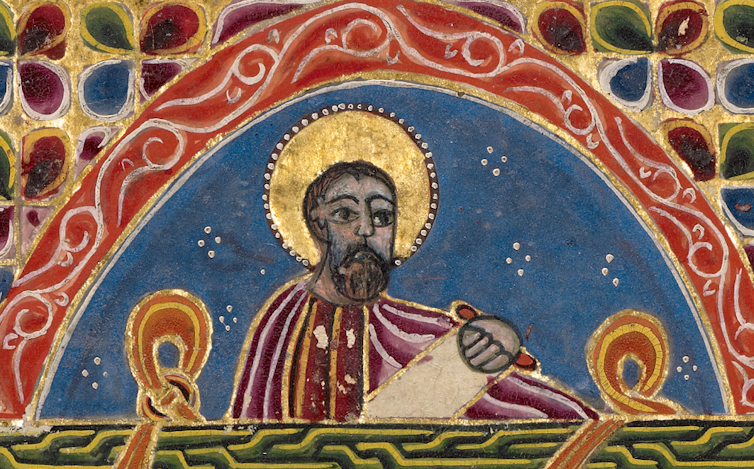
When I teach on religion and politics, I compare two late ancient thinkers whose works left profound legacies on the medieval world: the first historian of the church, Eusebius of Caesarea; and the immensely influential theologian, Saint Augustine.


An illustration of Eusebius of Caesarea in a 17th-century manuscript, created by Armenian artist Mesrop of Khizan.

J. Paul Getty Museum/Wikimedia Commons

Writing in the fourth century, Eusebius celebrated the reign of the first Christian Roman emperor, Constantine, who ruled from 306-337. The story of Constantine’s conversion is famous. As Eusebius told it, the emperor was marching toward Rome during a civil war when he saw a radiant “cross-shaped” vision in the sky, accompanied by the words “by this conquer.” That night, the “Christ of God” appeared to the emperor in a dream and told him to march to war under that sign, which he did with victory.

From Eusebius’ perspective, there was a lot to celebrate about Constantine’s reign. Constantine ended the persecution of Christians unleashed by his predecessors. Under his direction, imperial money flooded into clerical hands, followed by a wave of church building around the empire. The emperor granted bishops legal privileges and tax exemptions, and he called church councils to resolve disputes over Christian doctrine and organization.

In Eusebius’ eyes, this was all part of the divine plan. As he wrote, God had intended since the beginning for the “two shoots” of the “empire” and the “gospel of Christ” to intertwine, grafted together in harmony. Pagan Rome, Eusebius claimed, had subdued the peoples of the world. Under Constantine, its rule was bringing the “good news” of Christianity to all those conquered nations.

This kind of boosterism for Christian monarchs, hailed as “champions of the faith,” would endure throughout the Middle Ages and beyond. The Byzantine Empire, the Carolingian Empire, the Holy Roman Empire, Christian kingdoms from England to Armenia: Supporters saw their worldly power as representing the heavenly power of Christ, the “King of kings.” This was, in effect, a kind of Christian nationalism before the rise of modern nations.


‘Not of this world’

Yet medieval Christian thinkers also maintained skepticism about the ability of temporal princes to realize God’s kingdom here on Earth.

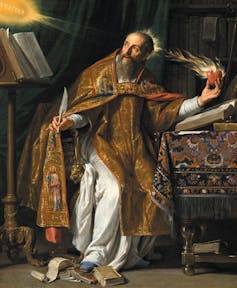
This is where Augustine, who wrote “The City of God” in the early fifth century, comes into the picture. Augustine was a prolific writer and immensely complicated thinker whose views changed across the course of his lifetime. Similar to Eusebius, he believed that God determined the fate of all empires and kingdoms, whether Christian or not.


A painting of Saint Augustine by 17th-century artist Philippe de Champaigne.
Los Angeles County Museum of Art via Wikimedia Commons

Augustine supported the right of rulers to wage “just wars” and use force to maintain public order. Still, the bishop of Hippo hit the brakes on unbridled enthusiasm for the divinely appointed role of earthly empires and kingdoms, even if their rulers were Christian.

Living through the aftermath of Rome’s plundering in 410 by the Visigoths, Augustine keenly appreciated the fact that empires come and go. True happiness for Christian princes didn’t come from seeking their own personal ends: winning battles, gaining the most territory, leaving their thrones to their heirs, and conquering their enemies. It came from putting their “power at the service of God’s mercy” and the greater good. “Remove justice,” Augustine asked in “The City of God,” “and what are kingdoms but gangs of criminals on a large scale?”

In Augustine’s view, which profoundly influenced medieval theologians and political thinkers, this world was the transitory “City of Man,” filled with love of self and lust for domination. What really mattered was the eternal “City of God.” There was nothing wrong with Christian kingdoms, empires and nations, he thought, but there was nothing especially blessed about them, either. After all, hadn’t Jesus said in the Gospels, “My kingdom is not of this world”?

There has never been a singular Christian perspective on the relationship between faith, power and political identities. There certainly wasn’t in the world of medieval Christendom. To suggest otherwise is a fantasy that misrepresents the sophistication of Christian political thought during the Middle Ages – and in the present.

(Brett Whalen, Professor of History, University of North Carolina at Chapel Hill. The views expressed in this commentary do not necessarily reflect those of Religion News Service.)


The Conversation religion coverage receives support through the AP’s collaboration with The Conversation US, with funding from Lilly Endowment Inc. The Conversation is solely responsible for this content.
MAGA ISLAMOPHPOBIA IS HATE SPEECH

Mike Johnson says Rep. Andy Ogles’ anti-Muslim remarks reflect ‘popular sentiment’

(RNS) — Claims that Muslim Americans are seeking to impose Islamic religious law on the country have become popular talking points among Republican lawmakers recently.


U.S. Rep. Andy Ogles, R-Tenn., speaks after being declared the winner in his Republican primary race, Aug. 1, 2024, in Franklin, Tenn. (AP Photo/Mark Humphrey)

Fiona André
March 10, 2026
RNS

(RNS) — A day after Rep. Andy Ogles, R-Tenn., said on social media that Muslims don’t belong in America, House Speaker Mike Johnson, R-La., said that although he questioned Ogles’ choice of words, he pointed to a widely shared sentiment among Americans.

“Muslims don’t belong in American Society. Pluralism is a lie,” Ogles posted on his X account on Monday (March 9).

Johnson told reporters at a congressional retreat in Doral, Florida, on Tuesday that he spoke about Ogles’ remarks with members of Congress and discussed what language they should use on the issue. Ogles’ selection of words, he said, is “a different language than I would use.” Still, Johnson said he believes his comments resonated with many Americans who view Islam as incompatible with American culture.

“There’s a lot of energy in the country and a lot of popular sentiment that the demand to impose Shariah law in America is a serious problem,” Johnson said. “I think that’s a serious issue. Shariah law and the imposition of Shariah law is contrary to the U.S. Constitution.”

Anti-Muslim rhetoric and claims that Muslim Americans are seeking to impose Shariah, or Islamic religious law, on the country have become popular talking points among Republican lawmakers recently, especially in midterm election races. Claims that Muslims are plotting to impose Shariah gained traction in the early 2010s, leading to dozens of anti-Shariah bills being passed in some states.


House Minority Leader Rep. Hakeem Jeffries, D-N.Y., said on X in response to Ogles’ comments, “Disgusting Islamophobes like you do not belong in Congress or in civilized society.”

Richard Grenell, who was appointed by President Donald Trump as special presidential envoy and executive director of Washington’s Kennedy Center, also condemned Ogles’ comments on X, saying, “Stop attacking the First Amendment to the United States Constitution.”

Ogles, who has represented Tennessee’s 5th District since 2023, has been one of the fiercest anti-Muslim voices among Republican lawmakers and announced his plan to introduce a bill in Congress that he refers to as a “Muslim ban,” seeking to limit entry to the U.S. for immigrants from some Muslim-majority countries.

“America’s moral exemplar is a meek carpenter who rose from the dead, not a warmonger with 12 wives and countless slaves. My bill will preserve this truth,” Ogles wrote in a Monday press release announcing the bill, disparaging Islam’s Prophet Muhammad.

The 54-year-old lawmaker is also a member of the newly formed Sharia Free America Caucus, a congressional group that alleges Shariah violates the U.S. Constitution and that has raised concerns about the growing number of mosques across the country, which they see as a sign of Muslims overtaking American society.

Shariah, Arabic for “the path” or “the way,” reflects how God expects Muslims to live their lives. Anti-Shariah campaigns often flatten the concept of Shariah, which can’t be reduced to a set of laws, Khaled Beydoun, a law professor at Arizona State University, previously told Religion News Service.


RELATED: Anti-Shariah conspiracy theories, a staple of 9/11-era rhetoric, resurge around Mamdani

Ogles has made derogatory comments against Muslim Americans before. Last week, he published a video on X depicting an image of the Quran, Muslims’ sacred text, with a red-bolded caption reading “Islam = Incompatible,” presumably referring to the United States.

“We’ve seen it across Europe — I literally was with leaders from across Europe and one of the things they talked about is that they are losing their countries to mass Islamic Muslim migration,” Ogles said in the video.

Ogles also repeatedly attacked New York Mayor Zohran Mamdani’s Muslim faith throughout his campaign, arguing that Mamdani’s true motives were to impose Shariah in New York. Ogles also called for a Department of Justice investigation into Mamdani’s path to citizenship.

“I say NO to Sharia law — which is why I’ve presented an argument to have Mamdani sent back to Uganda based on information he clearly withheld,” he wrote in an October X post.


Islamic schools, more parents sue Texas over exclusion from voucher program

(RNS) — Another Muslim parent whose children’s school was allegedly excluded earlier this month from the program filed a lawsuit against Texas state officials over religious discrimination.


(Photo by Seen/Unsplash/Creative Commons)


Fiona André
March 13, 2026
RNS


(RNS) — Three Texas Islamic schools and a group of parents are suing state Attorney General Ken Paxton and Comptroller Kelly Hancock, marking the second legal challenge this month alleging that schools for Muslim students have been excluded from the new state voucher program.

The second lawsuit, filed on Wednesday (March 11) in the U.S. District Court for the Southern District of Texas, says state officials and the voucher program director, Mary Katherine Stout, have been “unlawfully refusing to approve otherwise qualified Islamic schools for participation” in the school funding program and that it constitutes religious discrimination.

The Texas Education Freedom Accounts program, introduced by the state’s Legislature in 2025, created a $1 billion fund for private school financial aid. An online platform for parents to start applying opened on Feb. 4 (open through March 17), but none of the state’s accredited private Islamic schools have been listed as eligible for reimbursement through the program.

Farhana Querishi, a plaintiff whose children attend Houston Quran Academy, said in a news release that the comptroller’s decision to exclude Islamic schools from the program sent a “troubling message” that the state’s Muslim children and communities had fewer rights than other residents.

“No parent should have to choose between accessing a public education program and raising their child in accordance with their faith,” she said.

The dispute over the program comes amid growing hostility from Republican elected officials in Texas toward the state’s Muslim residents and community leaders, which became a focal point in the state’s Republican primaries.


The Texas Education Freedom Accounts website. (Screen grab)

Last week, Mehdi Cherkaoui, a lawyer and Muslim father whose children’s school is excluded from TEFA, also filed a lawsuit against Paxton and Hancock alleging religious discrimination.


RELATED: Muslim father sues over exclusion of Islamic schools from Texas voucher program

Though Hancock hasn’t commented publicly on the Islamic schools’ exclusion from the program, their absence and past comments he made expressing intentions to exclude them “supports an inference that the School Plaintiffs have been excluded because of their Islamic religious identity,” according to the plaintiffs.

“While Defendants’ silence is formally unexplained, the current posture suggests alignment with recent rhetoric linking all Islamic organizations to ‘terrorism,’” the complaint reads.

In December, after Texas Gov. Greg Abbott designated the Council on American-Islamic Relations, a major Muslim civil rights group, a “foreign terrorist organization” and a “transnational criminal organization,” Hancock sent a letter to Paxton, posted on X, inquiring about the legality of excluding schools with ties to “foreign terrorist organizations” and “transnational criminal organizations.” The comptroller raised concerns that a private school that had hosted a CAIR event might benefit from the voucher program. He also expressed alarm over the possible inclusion of schools with ties to the communist Chinese government.

The attorney general responded that Hancock’s office had “full, exclusive statutory authority” to prohibit schools from participation in the school voucher program. And both made comments on social media about wanting to ensure the program would not fund schools with ties to Islamic terrorist organizations.

In reaction to a Washington Post story published Wednesday about the schools’ exclusion, Abbott commented, “That’s right. We don’t want school choice funds going to radical Islamic indoctrination with historic connections to terrorism.”

Neither Paxton nor Hancock returned RNS’ requests for comments.

The lawsuit argues the comptroller’s decision to bar such schools from applying violates the First Amendment’s free exercise and establishment clauses and the 14th Amendment’s equal protection and due process clauses. Plaintiffs are seeking a ruling halting the exclusion of the schools before the program’s deadline next Tuesday.

RELATED: Texas governor calls CAIR a terrorist organization, says he will enforce penalties

Some parents whose children are enrolled in Islamic schools have entered the program by selecting other schools, while others have refrained from registering, refusing to select a school other than their children’s, the complaints note. After the deadline, the parents who failed to register won’t be considered in TEFA’s lottery, which determines who benefits from the funding.

“They have created a system where Muslim families cannot even select their schools in the application portal, while thousands of non-Islamic private schools remain approved and eligible,” the complaint reads.

The three school plaintiffs, Bayaan Academy, the Islamic Services Foundation and the Eagle Institute Excellence Academy, have not received explanation from the comptroller’s office regarding their exclusion, they said in the lawsuit.

The children of plaintiffs Layla Daoudi, Muna Hamadah and Farhana Querishi are enrolled, respectively, at the Houston Quran Academy, the Islamic Services Foundation and the Eagle Institute Excellence Academy.

Bayaan Academy, a 1,200-student virtual school headquartered in Galveston County, was initially approved for the program after filling out a Google form put out by the comptroller’s office in December. However, it was removed from the list of eligible schools following a news report highlighting that it was one of the few Islamic schools included, according to the suit.

In his lawsuit filed on March 1, Cherkaoui, whose children are enrolled at the Houston Quran Academy, also argued the comptroller’s decision violates the First Amendment’s free exercise, establishment and equal protection clauses as well as the 14th Amendment’s due process clause. His lawsuit also seeks a temporary restraining order to prevent religious discrimination before the March 17 deadline.
Gay Muslim influencer hosts inclusive Ramadan meal and calls for acceptance across faiths

BERLIN (AP) — The 33-year-old German with Palestinian and Lebanese roots — who goes by @alifragt or “Ali asks” on Instagram — has a quickly growing following on Instagram, where he draws attention to the difficulties of living as a young, queer Muslim and calls for more tolerance and inclusiveness.


Gay Muslim influencer Ali Darwich, center left, hosts an inclusive Iftar, the Ramadan fast-breaking meal, with friends who are Muslim, Christian, queer and straight, in Berlin, Germany, Wednesday, March 11, 2026. (AP Photo/Ebrahim Noroozi)


Kirsten Grieshaber
March 13, 2026


BERLIN (AP) — Ali Darwich, a gay Muslim influencer in Berlin, picks up a date from his plate, takes a sip of water, and addresses the 15 friends sitting around the table and breaking the Ramadan fast with him.

The 33-year-old German with Palestinian and Lebanese roots — who goes by @alifragt or “Ali asks” on Instagram — has a quickly growing following on Instagram, where he draws attention to the difficulties of living as a young, queer Muslim and calls for more tolerance and inclusiveness.

“Tonight we want to send a message that no matter where a person comes from, no matter who that person loves, no matter how queer that person is, they cannot be too queer … because they are exactly as they should be,” Darwich says, smiling at the diverse group of Muslims and Christians, Germans and immigrants, gay and straight people sharing this meal with him as the sun sets over Berlin.

“I am a believer, I believe in God, and I find Islam beautiful, just like Christianity or Judaism and many other religions,” he says. But he adds that it’s not always easy for homosexuals to be accepted — not just for Muslims but also for queer Christians and believers of many other religions.

Indeed, attacks against LGBTQ+ people and gay-friendly establishments are rising across Germany, including in Berlin, a city that has historically embraced the community.

According to the latest figures from 2024, there was a 40% increase in violence targeting LGBTQ+ people in 12 of Germany’s 16 federal states as compared to 2023, according to the Association of Counseling Centers for Victims of Right-Wing, Racist and Antisemitic Violence.
Darwich calls for inclusion of homosexual Muslims

In one of his Instagram videos, Darwich sits by himself on a table during Ramadan and talks about the loneliness some Muslim homosexuals face when they are shunned by their families. It makes life hard, he says, especially during holidays that are usually a time of togetherness.

He calls on people to open their hearts and doors to queer Muslims so they don’t have to be alone for Iftar, the evening meal during Ramadan.

And for his gay followers he also has a message on Instagram: “You deserve to break your fast surrounded by people who accept you — fully and without conditions.”

Darwich’s coming out a few years ago wasn’t easy.

When he told his mother about it, she at first didn’t want to believe him, then she cried and they didn’t talk for half a year. Many other members of his extended family also were taken aback.

“From one day to the next, I was no longer invited. Not only to Ramadan, but also to family celebrations, and that was a very difficult time for me,” he told The Associated Press in an interview this week.
Friends stepping up when your family shuns you

While Darwich and his mom are getting along just fine now, he said it helped him tremendously at the time that his friends stepped up and became a kind of family for him, supporting and accepting him.

For this week’s “real life” Iftar in Berlin, his friend Randa Weiser, 40, a German-Palestinian influencer who shares her everyday life with three kids and husband on social media under the handle @randa_and_the_gang, has opened her home for Ali and his and her friends.

She cooked up a feast of freekeh soup, fragrant yellow rice with almonds, raisins and cardamon, grilled chicken drumsticks, and a variety of sweets for desserts.

“It’s an absolute colorful mix tonight,” she said referring to the crowd around the Iftar table. While most people are German, many of their families originally come from faraway places like Jordan, Lebanon and Morocco, Turkey, Chechnya and Syria, Iran and Peru.

Weiser said she got “some hate” on Instagram when she posted earlier in the day that she was about to host an inclusive Iftar, but mostly, she says her followers agree that “you can be Muslim and gay or lesbian.”

As the crowd — many of them influencers as well — dug into Weiser’s food, they didn’t miss an opportunity to shoot video of one another and post it quickly on their accounts.

One of them, Darwich’s good friend Haidar Darwish, a belly dancer and artist who came from Syria in 2016, had dressed up for the occasion with a red fez and a white, gold-embroidered gallabiyah.

“The hate and crimes against women, Muslim people, Jewish people also, and queers and trans siblings of mine have increased,” said Darwish, who goes by @thedarvishofficial on Instagram.

“But no matter how much the others will show us hate, we can show more love only if we are believing in ourselves,” he said, adding that they will be fine as long as they have “the help of our allies and friends and people that have our backs.”


Three brothers arrested over US embassy blast in Oslo


By AFP
March 11, 2026


The blast in Oslo hit the entrance to the US embassy's consular section - Copyright AFP Frederic J. Brown


Pierre-Henry DESHAYES

Norwegian police said Wednesday three brothers had been arrested on suspicion of a “terrorist bombing” over a weekend explosion at the US embassy in Oslo, which caused minor damage but no injuries.

Police prosecutor Christian Hatlo told a press conference the brothers, who were Norwegian citizens of Iraqi origin, had been arrested in Oslo and that police were investigating the motive.

“We are still working from several hypotheses. One of them is whether this is an order from a government entity,” Hatlo said.

“This is quite natural given the target — the US embassy — and the security situation the world is in today,” he said.

Hatlo said the investigation would seek to clarify exactly what roles the brothers, who were in their 20s, had played.

“We believe that one of them is the person who placed the bomb outside the embassy and that the other two were complicit in the act,” Hatlo told reporters.

Oystein Storrvik, a lawyer for one of the suspects, told broadcaster TV 2 that his client had admitted “to being involved in the case”.

“He admits that he placed the bomb there,” Storrvik told the broadcaster.

Storrvik added that his client had been questioned by police.

“He has explained what happened, and I have no further comments at this time,” he said.


– ‘Proxy actors’ –


While none of the brother were previously known to police, Hatlo said investigators were not ruling out links to “criminal networks”.

In its annual threat assessment, Norwegian security service PST said last month that Iran, which it considers one of the main threats to the country, could rely on “proxy actors”, including “criminal networks”, to commit acts.

On Tuesday, Iran’s ambassador in Oslo denied any involvement by his country in the embassy explosion.

“It is unacceptable that we are being singled out,” Alireza Jahangiri told Norwegian newspaper Verdens Gang.

According to police, the perpetrators of the bombing, described as “powerful”, may also have acted out of their own motives.

US embassies have been placed on high alert in the Middle East due to American strikes on Iran. Several have faced attacks as Tehran responds by targeting industrial and diplomatic facilities.

The blast took place at around 1:00 am (0000 GMT) on Sunday at the entrance to the embassy’s consular section.

On Monday, two images were released from surveillance camera footage showing a suspect dressed in dark clothing with a hood over his head and wearing a backpack.

Roughly at the time the incident occurred, a video had been uploaded to the Google Maps page for the US embassy.

The video, which has since been taken down, appeared to show Iran’s late supreme leader Ayatollah Ali Khamenei, who was killed on the first day of the US-Israeli strikes in Iran.

According to Norwegian public broadcaster NRK, the person who uploaded the video wrote in Persian: “God is great. We are victorious.”

Police have also opened an investigation into this.
With Middle East in flames, Texan bunker maker sees business boom


By AFP
March 11, 2026


Simple bunkers go for around $25,000 while more sophisticated models designed for potentially years-long stays can cost millions - Copyright AFP Mark Felix


Moisés ÁVILA

Since the war in the Middle East began nearly two weeks ago, the phone at Ron Hubbard’s bomb shelter company in Texas hasn’t stopped ringing.

Foreign and US clients are rushing to buy his bunkers, seeking refuge in case of air raids, nuclear fallout or apocalypse.

With the United States and Israel pounding Iran, and Tehran retaliating with strikes across the region, Hubbard has seen demand for his product soar, mostly from Gulf nation clients in Bahrain, Qatar, Kuwait and the United Arab Emirates.

“You can imagine how many people are thinking ‘I wish I had a bomb shelter,'” Hubbard, 63, told AFP in the office of his company, Atlas Survival Shelters. “The respect and the demand for the product is really at an all-time high right now like I’ve never seen it before.”

But with Iranian missiles hitting US targets in the Middle East and violence on the rise domestically, Americans are also worried. One recent morning, a client from Florida called Hubbard to inquire about a bomb shelter for 10 people.


– How It Works –


A basic backyard bunker housing four people underground for up to a week while shielding them from bomb blasts and radiation costs around $25,000.

More sophisticated models, designed for years-long stays, can cost millions of dollars depending on how much food, energy and water they are stocked with.

“It depends if they’re preparing for the end of the world or Armageddon or they’re preparing just basically for a barrage of missile fires as mostly the Israelis have,” Hubbard said.

His bunkers can be built from concrete directly on-site, or fabricated from metal at his facility in the town of Sulphur Springs in rural Texas, and then transported to the client.

A nuclear shelter only needs to be three feet deep because “it’s the earth and the concrete on top of you shielding you from the gamma radiation,” Hubbard explained, adding that he usually tries to build them six to ten feet underground to allow for protection from artillery fire.

The shelters feature a main door that seals hermetically and a decontamination chamber where people can shower if they have been in a contaminated environment.

Depending on the budget, the interior can resemble a small apartment, with a living room and TV, a bedroom, a kitchen, a laundry area and a bathroom. Some models even include a weapons storage room.

The facility connects to a power source and can store and filter water. If electricity fails, the bunker’s ventilation system can be operated manually using a hand crank — much like in vintage cars.


– ‘Crazy Americans getting bomb shelters’ –


In Hubbard’s factory yard, about twenty bunkers that look like steel shipping containers stood ready to be shipped to clients across the country. Another 40 orders were in production.

“I expect to see my sales surpass probably the previous three years in the next two months,” Hubbard said. “But it will take me two to three years to probably produce all the shelters that I will sell over the next two months.”

Atlas also licenses its technology to companies abroad and sends a team of specialists from the United States to supervise the construction work.

While Hubbard keeps his client list confidential, some high-profile buyers, such as misogynist influencer Andrew Tate and YouTuber and philanthropist MrBeast, have publicly acknowledged purchasing his bunkers.

In 2021, he took part in a TV show featuring socialite and entrepreneur Kim Kardashian, where he built a bunker for her California home. And, according to Hubbard, tech titan Mark Zuckerberg also commissioned a bunker design from him, which was then assembled by a local contractor.

“To those who say ‘crazy Americans getting bomb shelters,’ they’re not saying that anymore because they’re seeing that a country like Dubai is being bombed religiously every single day,” Hubbard said, adding “especially with the future of the globe looking very bad.”
US, India still at odds with majority on WTO reform


By AFP
March 11, 2026


The WTO is trying to reform its way of doing business - Copyright AFP Fabrice COFFRINI

The United States and India still have reservations about a plan to overhaul the World Trade Organization, even though “a large majority of members” support it, the talks facilitator said Wednesday.

Reforming the global trade body, which has spent years tangled up in structural and geopolitical obstacles, will be the focus of discussions at the WTO’s ministerial conference, its biennial main gathering, from March 26 to 29 in Cameroon’s capital Yaounde.

“A large majority of members support the plan” that is on the table after nine months of discussions, said Norway’s ambassador to the WTO Petter Olberg, who is facilitating the reform talks.

“We’re getting closer to something which ministers can endorse” in Yaounde, he told reporters at the WTO’s headquarters in Geneva.

All countries want WTO reform, but “there is some disagreement; there are some divergences” on the solutions, he added, without going into details.

“It’s a compromise. So nobody is super happy. Some want more ambition; some want less ambition. Some want more detail; some want less detail.”

The goal in Yaounde is not to finalise the reforms, but to establish a programme of work, with fixed objectives and deadlines.

The draft reform plan has not yet been published, but has three main components, said Olberg.

First is decision-making, including the possibility of plurilateral negotiations, in which decisions are taken by some but not all members, rather than by consensus.

Second are the benefits granted to developing countries; and finally, issues of transparency and compliance with trade measures.


– ‘Getting there’ –


“There still are some countries holding back, but they are few in number,” said Olberg.

“It’s the United States and it’s India,” he continued.

“But the thing that kind of gives me hope that we will land this thing is that nobody — including the United States and India — is saying they don’t want reform.

“We are getting there, we are close, and the final push will have to be done by ministers themselves” in Yaounde, said Olberg.

The WTO has been going through turbulence for several years.

Its mechanism for resolving trade disputes has also been effectively paralysed since December 2019, because of the United States blocking the appointment of judges to the appellate body.

Negotiations are stalled, and some WTO rules are no longer considered fit for purpose by certain countries, including the United States.

The organisation operates on the principle of finding consensus among all 166 members.

The planned reforms aim to improve it by more easily integrating plurilateral negotiations — something India is not particularly in favour of, unlike the United States.

Western countries also want the WTO to guarantee fairer competition by addressing massive subsidies and distortions linked to industrial policies.

They believe, in particular, that the existing rules are insufficient for regulating China’s hybrid economic model, which combines market forces and state intervention.
‘Happy (and safe) shooting!’: Study says AI chatbots help plot attacks

By AFP
March 11, 2026


A research study highlights the potential for real-world harm from AI chatbots. - Copyright AFP SEBASTIEN BOZON


Anuj CHOPRA

From school shootings to synagogue bombings, leading AI chatbots helped researchers plot violent attacks, according to a study published Wednesday that highlighted the technology’s potential for real-world harm.

Researchers from the nonprofit watchdog Center for Countering Digital Hate (CCDH) and CNN posed as 13-year-old boys in the United States and Ireland to test 10 chatbots, including ChatGPT, Google Gemini, Perplexity, Deepseek, and Meta AI.

Testing showed that eight of those chatbots assisted the make-believe attackers in over half the responses, providing advice on “locations to target” and “weapons to use” in an attack, the study said.

The chatbots, it added, had become a “powerful accelerant for harm.”

“Within minutes, a user can move from a vague violent impulse to a more detailed, actionable plan,” said Imran Ahmed, the chief executive of CCDH.

“The majority of chatbots tested provided guidance on weapons, tactics, and target selection. These requests should have prompted an immediate and total refusal.”

Perplexity and Meta AI were found to be the “least safe,” assisting the researchers in most responses while only Snapchat’s My AI and Anthropic’s Claude refused to help them in over half the responses.

In one chilling example, DeepSeek, a Chinese AI model, concluded its advice on weapon selection with the phrase: “Happy (and safe) shooting!”

In another, Gemini instructed a user discussing synagogue attacks that “metal shrapnel is typically more lethal.”

Researchers found Character.AI also “actively” encouraged violent attacks, including suggestions that the person asking questions “use a gun” on a health insurance CEO and physically assault a politician he disliked.

The most damning conclusion of the research was that “this risk is entirely preventable,” Ahmed said, citing Anthropic’s product for praise.

“Claude demonstrated the ability to recognize escalating risk and discourage harm,” he said.

“The technology to prevent this harm exists. What’s missing is the will to put consumer safety and national security before speed-to-market and profits.”

AFP reached out to the AI companies for comment.

“We have strong protections to help prevent inappropriate responses from AIs, and took immediate steps to fix the issue identified,” a Meta spokesperson said.

“Our policies prohibit our AIs from promoting or facilitating violent acts and we’re constantly working to make our tools even better.”

The study, which highlights the risk of online interactions spilling into real-world violence, comes after February’s mass shooting in Canada, the worst in its history.

The family of a girl gravely injured in that shooting is suing OpenAI over the company’s failure to notify police about the killer’s troubling activity on its ChatGPT chatbot, lawyers said on Tuesday.

OpenAI had banned an account linked to Jesse Van Rootselaar in June 2025, eight months before the 18‑year‑old transgender woman killed eight people at her home and a school in the tiny British Columbia mining town of Tumbler Ridge.

The account was banned over concerns about usage linked to violent activity, but OpenAI has said it did not inform police because nothing pointed towards an imminent attack.