Saturday, March 14, 2026

LIBERTARIAN ANTI IMPERIALISM / MILITARISM

Washington’s 47-Year War Against Iran


by  | Mar 13, 2026 | 

The irony of the Big Lie about Iran’s alleged “47-Year War On America” is that the imperatives of Empire caused Washington to take actions in the decades after the February 1979 Iranian Revolution that amounted to the opposite – a relentless five decades long Washington instigated war on Iran.

First, as we showed in Part 1, Washington’s foolish refusal to extradite the Shah and meet the reasonable demands of the hostage-holding students facilitated the takeover of the Revolution by theocratic hardliners; and then in rapid fire succession Washington launched successive overt and covert attacks on the Khomeini-dominated government that caused it to permanently harden its stance against the US government.

The primary and defining battering ram of Washington’s post-1979 attack on the new Iranian government was its extensive aid to Saddam Hussein during his eight year war on Iran. Anyone with at least a passing knowledge of the hundreds of thousands of death and sweeping economic devastation that this war brought to the Iranian people might well understand why the ritual chant “death to America” took hold during these early days of the Islamic Republic.

As it happened, Saddam Husein launched his war in September 1980 partly out of fear that the Islamic revolution in Shiite Iran would spillover into Iraq, where 35% of the population was Shiite; and also because he opportunistically recognized that Iran’s regular military had been badly impaired owing to sweeping purges of suspected pro-Shah officers by the new regime.

Moreover, Hussein also recognized another even more important Iranian strategic disability: Namely, that the new regime had inherited a sophisticated military arsenal largely equipped with U.S.-made hardware from the Shah’s era, including F-14 Tomcat fighters, M-60 tanks, Hawk missiles, and various artillery systems, but that this formidable arsenal had been largely sidelined by lack of maintenance and spare parts.

Again, the Washington keepers of the Empire were the culprit. Determined to show that they would not be pushed around by a rag-tag band of 400 students holed-up in the US Embassy, the Carter Administration imposed a wide array of sanctions and trade embargoes on Iran. These actions included suspensions of arms export licenses, cancellation of pending arms sales and an Executive Order in the spring of 1980, which initiated a trade embargo that stopped the flow of most civilians goods as well as US military exports and spare parts to Iran.

Again, there was no reason for Washington’s hostile act of economic warfare against the incipient Islamic Republic except the imperatives of Empire. If anything, the fall of the Shah should have been a wake up call to Washington to get the hell out of the region because nothing of importance regarding America’s Homeland Security was at stake – even as the new found oil-wealth pouring into these nations and statelets had inherently become an engine of political turmoil and economic dislocation.

In any event, Washington’s embargo on weapons spare parts tilted the balance heavily against Iran when Saddam Hussein invaded the latter in September 1980. Lack of access to essential maintenance components had resulted in the grounding of much of Iran’s air force and rendered most of its ground-based armored units inoperable. By 1982, up to 70-80% of Iran’s U.S.-sourced equipment was non-functional due to lack of parts, forcing the military to cannibalize operational vehicles and aircraft for spares and repairs.

The US embargo not only isolated Iran from its primary supplier but also pressured allies and third-party nations to withhold support, thereby exacerbating the degradation of its conventional capabilities.The Reagan administration intensified these Carter restrictions in 1983 with Operation Staunch, a global diplomatic campaign aimed at blocking arms sales and spare parts to Iran, particularly for its legacy US planes, tanks and other weaponry.

The Reagan initiative involved lobbying other governments to halt exports of dual-use technologies and military items, effectively creating a de facto international blockade on Iran’s resupply efforts. The impact was profound: Iran’s air force, once boasting over 400 combat aircraft, dwindled to fewer than 100 operational planes by the mid-1980s, as engines, avionics, and munitions became unobtainable.

Similarly, tank fleets suffered from mechanical failures without replacement tracks, engines, or electronics, leading to stalled offensives and defensive vulnerabilities. Iran attempted workarounds through black-market smuggling and reverse-engineering, but these were insufficient and costly, often resulting in subpar performance of the legacy US weaponry upon which its regular military had been built by the Shah.

Yet the arms and spares embargo wasn’t even the half of it. The embargo’s left Iran’s regular army (Artesh) in a state of chronic disrepair, unable to match Iraq’s Soviet- and French-supplied forces in mechanized warfare. So faced with these equipment shortages, Iran’s military leadership shifted to desperate improvisations, most notably the infamous“human wave” attacks employed from 1982 onward.

With limited artillery, disabled air support, and drastically reduced armored mobility, the regime mobilized the Islamic Revolutionary Guard Corps (IRGC) and the Basij volunteer militia. The latter especially was comprised of poorly trained civilians and youths as young as 12 years, which were literally deployed as cannon fodder to overwhelm Iraqi positions through sheer numbers.

This tactic involved waves of lightly armed infantry charging across open terrain, clearing minefields with what became their body parts. Consequently, Iran absorbed staggeringly heavy casualties to breach the Iraqi lines, as seen in operations like Beit-ol-Moqaddas (1982) and Karbala-5 (1987).

Thus, during the 1982 offensives, 90,000 Basij, including 12-year-olds bound by ropes, charged minefields, clearing paths at what was estimated to be 40% or higher casualty rates. Yet without spare parts, Iran’s mechanized advances had completely faltered, thereby compelling reliance on what amounted to ideological fervor and demographic advantages. This resulted in staggering losses, of course, estimated at over 200,000 Iranian military deaths owing to the human wave tactic alone.

In the midst of this carnage, Washington made an outright pivot to active support of Saddam Hussein in 1982, albeit on a not very well concealed “covert” basis. So doing, Washington provided crucial battlefield intelligence and operational aid that eventually tilted the balance against Iran.

This utterly pointless intervention, moreover, occurred after Iran’s successful 1982 offensives threatened Iraq’s collapse. Yet owing to the hostage crisis’s fallout and the alleged Carter “weakness”, which caused Washington’s prolonged humiliation during that 444 day ordeal, the keepers of Empire on the banks of the Potomac plunged ahead. They convinced President Reagan to sign National Security Directive 114 in November 1983, authorizing support to prevent Iraq’s defeat.

And yet and yet. In the hindsight of history the winner of that war astride the Persian Gulf made not a damn but of difference to the Homeland Security of America. Nevertheless, the Warfare State apparatchiks on the banks of the Potomac determined to rescue the clear aggressor in this case—-Saddam Hussein – only to pave the way for two successive wars designed to remove the Iraqi leader barely a decade later.

Of course, the American public and its so-called representative in the US Congress long ago forgot about Washington’s rescue of Saddam, but, alas, neither the the mullahs, the regime in Tehran nor the Iranian people suffer from any such memory failure. That’s because the aid provided to Iraq under the 1982 executive order led to horrific battlefield casualties owing to US directed chemical warfare attacks on the badly equipped Iranian forces and barely armed and totally untrained Basij volunteers and others.

In this instance, the US supplied real time satellite imagery, becoming Iraq’s “eyes in the sky.” From 1984 onward, the CIA and Defense Intelligence Agency (DIA) provided Baghdad with high-resolution photos from KH-11 satellites, detailing Iranian troop movements, supply lines, and defensive positions.

This “spotting help” enabled precise Iraqi counterattacks. For instance, during Iran’s 1984 Majnoon Islands offensive, U.S. imagery helped Iraq target Iranian concentrations, inflicting heavy losses. By 1986, daily intelligence briefs included satellite-derived maps, radar data, and signals intercepts, allowed Iraq to anticipate human-wave assaults. One declassified CIA memo from 1984 noted U.S. assistance in “battlefield interdiction,” which involved hitting Iranian forces with chemical strikes informed by American intel.

Despite knowing of Iraq’s CW use since 1983, Washington continued sharing intelligence that aided targeting for gas attacks. A 1984 DIA report confirmed mustard and tabun use but prioritized preventing Iranian victory. In 1988, amid Iraq’s Anfal campaign against Kurds, U.S. satellites tracked Iranian-Kurdish movements, indirectly enabling the infamous Halabja gassing.

Finally, the Reagan Administration normalized relations with Iraq in 1984, removing it from the terrorism list and provided $1 billion in agricultural credits, some diverted to military use.

At the end of the day, of course, Washington ‘s so-called “tilt” to Iraq during the 1980-1988 war left a huge scar on America’s image in Iran, to put it mildly.

During the years after 1984 the war stagnated as the Iranian forces suffered massive casualties and losses of what battlefield equipment they had left. Accordingly, when Iraq’s 1988 Tawakalna offensives, aided by U.S. intel and CW, recaptured the strategic Fao Peninsula, Iran was forced to accept UN Resolution 598 which ended the war.

But it also amounted to a quasi-surrender. In fact, Supreme Leader Khomeini called it “poison,” but economic collapse and staggering losses compelled it.

The war’s toll cannot be underestimated. It included upwards of 500,000 Iranian dead and more than $600 billion in Iranian economic losses. And more importantly, it entrenched the IRGC in power and fueled anti-US sentiment widely across the nation’s populace.

Indeed, the US aided gassing of Iran’s child soldiers symbolized how the actual war between the US and Iran arose, and most definitely they did not start it 47 years ago.

Moreover, it was in the context of Washington’s decisive tilt to Iraq that the 1983 bombing of the US Marine barracks in Beirut occurred. And what happened there, not surprisingly, is not nearly what its cracked up to be by the neocons and warmongers, as we will amplify in Part 3.

David Stockman was a two-term Congressman from Michigan. He was also the Director of the Office of Management and Budget under President Ronald Reagan. After leaving the White House, Stockman had a 20-year career on Wall Street. He’s the author of three books, The Triumph of Politics: Why the Reagan Revolution FailedThe Great Deformation: The Corruption of Capitalism in America, TRUMPED! A Nation on the Brink of Ruin… And How to Bring It Back, and the recently released Great Money Bubble: Protect Yourself From The Coming Inflation Storm. He also is founder of David Stockman’s Contra Corner and David Stockman’s Bubble Finance Trader.


The War on Iran Is Dumb. Here’s Why.


A familiar script with higher stakes

by  | Mar 13, 2026 | 

War with Iran is being sold as “strategy,” but it looks a lot like habit. A familiar pattern repeats: vague objectives, elastic legal theories, and a confident promise that the costs will be contained. Then the bill arrives anyway, in blood, money, and credibility.

In this round, the costs are already visible in the most predictable place: energy. Fighting that threatens traffic through the Strait of Hormuz does not just “hurt the other side.” It shakes a chokepoint that, in 2024, carried about 20 million barrels per day of oil, roughly 20% of global petroleum liquids consumption. Markets do not care about speeches. They price risk, and they pass it along to households and firms.

Calling this “a small price” is not analysis. It is marketing. Economies, including America’s, still operate inside a global price system for energy and shipping, and officials themselves acknowledge the conflict has pushed energy markets and prices higher.

The China excuse is bad strategy and worse economics

One of the more fashionable rationales for attacking Iran is the “China angle”: Iran trades with China, so breaking Iran breaks China. This is the kind of logic that sounds plausible until you compare it to reality.

Start with the basic arithmetic. U.S. goods and services trade with China totaled about $658.9 billion in 2024, according to the Office of the U.S. Trade Representative. That is not a footnote. It is a structural feature of the world economy. When two economies are connected at that scale, “hurting” one is not a neat chess move. It is self-inflicted collateral damage.

The International Monetary Fund has spent years warning about what happens when states turn economic integration into a weapon. In its words, greater trade restrictions “could reduce global economic output by as much as 7 percent” over the long run. That is not a slogan. It is a forecast about costs that do not vanish because a strategist wants them to.

Now add the Iran-specific detail that is supposed to make the “China angle” sound clever. China does buy large volumes of Iranian crude; much of it routed through sanctions-evasion channels. The Columbia Center on Global Energy Policy estimates that China imported about 1.38 million barrels per day of crude from Iran in 2025, around 12% of China’s total crude imports, and that China purchases about 90% of Iran’s oil exports.

But if your plan is to use war to interrupt an adversary’s energy supply, you have chosen the most globally contagious lever imaginable. The same chokepoint logic that supposedly pinches Beijing also squeezes everyone else. When shipping slows, insurance premiums jump, freight rates rise, and oil prices move. That is not a “China problem.” It is a world problem.

There is another flaw, even more basic. Treating China as the villain for “hedging” against U.S. power is rich coming from a government that has used economic sanctions and financial restrictions as routine tools of statecraft for decades. Great powers teach others how to behave. If the lesson is that supply chains are weapons, do not be surprised when other countries build armor, stockpiles, and alternative routes.

The nuclear lesson: if you want fewer bombs, stop rewarding them

War advocates fall back on a familiar cliffhanger: Iran is “weeks away” from a nuclear weapon, so bombs today prevent a bomb tomorrow. Politics loves a deadline, especially one that cannot be audited in real time.

But the intelligence picture has often been less theatrical. The U.S. intelligence community’s 2025 Annual Threat Assessment states plainly that Iran “is not building a nuclear weapon,” a judgment echoed by other reporting about intelligence assessments.

History is even less convenient for the war pitch. The declassified key judgments of the 2007 National Intelligence Estimate concluded, “with high confidence,” that Tehran halted its nuclear weapons program in fall 2003. Over time, international inspectors also documented unresolved safeguards issues, including concerns about “possible military dimensions” raised in a 2011 International Atomic Energy Agency report. Put those pieces together, and a harder truth emerges: the “imminent bomb” story is often political persuasion, while the technical reality is a long-running mixture of capability, ambiguity, and monitoring disputes. Bombs do not erase know-how, they rearrange incentives.

That nuance matters, because the most damaging effect of “preventive” war is not what it destroys. It is what it teaches.

North Korea is the world’s bluntest tutorial. It is brutal, impoverished, and internationally isolated, yet it has purchased a form of strategic immunity. The same U.S. threat assessment describes Kim Jong Un’s strategic weapons programs as a “guarantor of regime security,” and notes he has “no intention of negotiating away” those programs. Scholars of nuclear strategy have long stressed the same basic point: nuclear weapons are mainly useful for deterrence and self-defense, not for clean, controllable coercion.

This is the incentive structure the Iran war reinforces. If a state without nuclear weapons can be attacked on suspicion, while a state with nuclear weapons is handled with cautious rituals and careful language, the lesson is not subtle. Scott Sagan’s classic framework for proliferation points to security threats as a central driver pushing states toward nuclear capability. When fear rises, so does the appeal of the ultimate insurance policy.

The irony is that even “successful” strikes can make the problem worse. U.S. strikes in June 2025 targeted Iran’s three main nuclear sites, and Donald Trump declared them “obliterated.” Subsequent U.S. assessments reported by major outlets described uneven damage, with at least one assessment concluding only one of the three sites was destroyed while others sustained limited damage and could potentially resume sooner. A campaign that offers, at best, a temporary delay teaches every threatened state to hide better, disperse more, and work faster.

If the goal is fewer nuclear weapons in the world, the worst advertisement is a war that tells every nervous government: negotiate slowly, enrich quickly, and never be caught without a deterrent.

Diplomacy without credible commitments is theater

Diplomacy is not a therapy session. It is bargaining, and bargaining only works when commitments have weight. The Iran war is an advertisement for the opposite.

In February 2026, the United States and Iran held talks on Iran’s nuclear program with Oman mediating. Oman publicly described progress, even while noting the talks occurred under the shadow of military pressure. Days later, airstrikes and escalation swallowed the diplomatic track. As the war unfolded, Omani officials publicly urged an immediate ceasefire and argued that “off-ramps” still existed. Whatever one thinks of either side’s sincerity, the signal to the world is ugly: negotiations can proceed right up until the moment they are discarded.

The deeper problem is not optics. It is record.

The Joint Comprehensive Plan of Action was an attempt to convert Iran’s nuclear program into a monitored, limited enterprise in exchange for sanctions relief. The International Atomic Energy Agency later reported that between January 16, 2016, and May 8, 2019, it verified and monitored Iran’s implementation of its nuclear-related commitments under the deal. The United States withdrew in May 2018, and the IAEA also reports that from May 2019 onward Iran began stopping implementation of commitments on a step-by-step basis. In plain English, a major agreement was treated as reversible policy, and the reversal was visible to every other capital watching.

Nor is this an isolated episode. Washington has exited major security agreements before, from the Anti-Ballistic Missile Treaty to the Intermediate-Range Nuclear Forces Treaty and the Open Skies Treaty. You can debate each case on its merits. The cumulative effect is harder to debate: other governments rationally discount U.S. promises, because they have learned that the next election can rewrite them.

Political science has a term for what happens when a future cannot be bound by a present promise. James Fearon called it a commitment problem, and it sits at the center of why bargaining can fail even when war is costly. When the other side doubts you can, or will, stick to a deal, the incentives tilt toward hedging and preemption.

That is the real “future angle,” and it is the one war advocates treat like an afterthought. Today’s target is Iran. Tomorrow’s crisis will not be. One day, the standoff will involve a peer competitor with submarines, space assets, and nuclear forces. In that world, diplomacy is not optional. It is a safety mechanism. Burning it down for a short-term campaign is not toughness. It is negligence.

The bill comes due

Iran is not a pinprick. The World Bank puts its population above 91 million in 2024. A conflict involving a large society does not stay tidy simply because pundits want it tidy. Even without an invasion, protracted war creates an attrition dynamic: asymmetric attacks, regional spillover, pressure to escalate when “limited” strikes do not produce political surrender, and the slow accumulation of obligations that are hard to unwind.

Americans do not need theory to understand how this ends. The Afghanistan war ran for two decades, and the U.S. Department of Defense has marked that 20-year conflict and the thousands of American service members and personnel who died in it. Costs of War at Brown University estimates that post-9/11 wars cost roughly $8 trillion and were associated with more than 900,000 deaths, and that long-term veterans’ care costs are projected into the trillions more.

War with Iran is dumb because it confuses motion with strategy. It risks global economic shock to score points on a geopolitical whiteboard. It incentivizes the nuclear outcomes it claims to prevent. It tells the world that U.S. signatures expire with U.S. elections. And it does all of this while pretending that costs are optional.

The sober alternative is not utopian. It is mundane: stop treating military force as the default policy tool, stop turning economic interdependence into a weapon, and stop teaching every threatened state that the fastest route to safety is a nuclear deterrent.

Alan Mosley is a historian, jazz musician, policy researcher for the Tenth Amendment Center, and host of It’s Too Late, “The #1 Late Night Show in America (NOT hosted by a Communist)!” New episodes debut every Wednesday night at 9ET across all major platforms; just search “AlanMosleyTV” or “It’s Too Late with Alan Mosley.”


Origins of the Current US/Israeli War on Iran


DV coeditor Faramarz Farbod, who teaches Political Science at Moravian University, is the guest on Berks Community TV’s “Centering on Peace” program. In this episode titled “Origins of the Current US/Israeli War on Iran,” Farbod traces the origins of the current war from the beginnings of the 20th Century to today. The host is John Hoskyns-Abrahall. The program was recorded on March 9 and aired on March 10.


Faramarz Farbod, a native of Iran, teaches politics at Moravian College. He is a DV coeditor and is the founder of Beyond Capitalism a working group of the Alliance for Sustainable Communities-Lehigh Valley PA as well as being the editor of its publication Left Turn. He can be reached at farbodf@moravian.eduRead other articles by Faramarz.


The Inner Cabinet and the Outer Media


“One thing was certain, that the white kitten had had nothing to do with it — it was the black kitten’s fault entirely.” Lewis Carroll, Through the Looking-Glass


PRE SCHRODINGERS CAT


Anyone who is not sick at heart and raging over the slaughter of over 165 young Iranian girls at a school by the American-Israeli monsters waging war on Iran is depraved and evil. It sickens me to state something so obvious, but I am afraid it is true that many are not distraught by the news. A nod to “how terrible” and on with the war is a common response for those who even know about it, not just because of moral indifference, but because of the acceleration of digital news reporting that disappears today before it has become tomorrow. The young girls are forgotten with each passing day in the U.S. and Israel – but not in Iran. For war criminals Trump and Netanyahu, the death of those children is a joy on the way to further slaughter of the innocent.

On the other hand, there are many in this functionally illiterate U.S.A., with its functionally illiterate president, who have probably never heard of this war crime. And U.S.-Israeli war crimes are so common that they come and go like ripples on a stream, like a scroll through a “smart phone.” Little penetrates the propaganda bubble, and when it does, it is quickly replaced by the illusion that once these bad guys are swept out of office, these wars will end because our good guys will return in the game of musical chairs to make all copacetic. Peace will reign, as in Iraq, Libya, Syria, Ukraine, Gaza, etc.

I repeat a question I have asked before, but to what avail, I know not: Why do Americans think the United States has 750+ military bases in over 80 countriessupported by a bipartisan consensus? The answer is blatant except for idiots and those willfully blind, and there are plenty of both.

The United States is an imperial warfare state, and these bases exist to wage wars around the world, as the U.S. has done.  End of story.

The Jeffrey Epstein Files release, aside from diverting the public’s attention from Iran, Ukraine, etc., has caused many people to contemplate how certain rich and connected people conspire behind the scenes for nefarious sexual purposes, but also to manipulate financial and political matters. To the most naïve, the naming of so many prominent people – university presidents, politicians, bankers, et al. – in this criminal club is very surprising.

Yet, more perversely, the Epstein long-running serial (not the reality for the victims of the sexual abuse) is entertainment in Neil Postman’s sense of Amusing Ourselves to Death, the title of his prescient 1985 book wherein he argued television had redefined the modern sense of reality, truth, and intelligence; had achieved the status of myth, “a way of thinking so deeply embedded in our consciousness that it is invisible”; that had turned everything into entertainment. Narcoticized by their technological obsession, he argued, people were losing themselves in a fantasy world of unending diversions, as television news was becoming entertainment and all a show, the business of show business. In Postman’s words: “Americans are the best entertained and quite likely the least well-informed people in the Western World.” Facts, data, and the delusive “news of the day” were abundant, but all in the fragmented and pseudo context of televised amusement.

One can only scream in accord when contemplating today’s digital internet Screen Society in which mini-televisions accompany people everywhere in the form of cell phones, keeping them constantly entertained with pointillistic nanosecond “news” catered to their personal tastes and devoid of any context.

While the inner workings of the imperial ruling class might not usually involve as much sexual abuse as the Epstein Serial, or what the journalist Pepe Escobar calls “the Epstein Syndicate,” its members have long conspired to control their wealth, power, and political domination of the masses. Waging wars, globalizing their control (which began in earnest circa 1985), and filling the coffers of the military-industrial complex they own are prime goals. Many of these vile creatures, of course, in their hubris, thinking they are in full control, have entered a trap of international espionage and sexual blackmail, as is evident in the Epstein case, where the presumed controllers are the controlled.

Despite their wealth and power, their little boy minds and sexual avidities have drawn them to “pleasure islands” where they have been exposed as jackasses braying their little boy innocence. They thought Epstein and his intelligence handlers in Israel, Britain, and the U.S were offering them deeper access to the Syndicate’s Inner Cabinet, but they failed to see the trap doors. Yet now that the Epstein “scandal” has received partial exposure, aside from the few that must be sacrificed to appease the public, most skate and profit mightily. It’s an old game of propaganda as a palimpsest.

Just the other day, I had coffee with a friend whose family ties to these imperial ruling class criminals go back more than a century. We discussed his life as a dissident within his wealthy family’s connections to the CIA, the Rockefellers, Morgans, Harvard, the Kennedy assassinations, the industrial corporations essential to the warfare state and massive profits (G.E., General Dynamics, Lockheed, etc.), Wall Street, the banks, corporate media, Big Tech, and so on ad infinitum. Many details of a gross world of privilege, betrayal, and endless lies, where all the insiders know and associate with each other despite different political parties; what, if you were a sensitive child with a conscience, would repulse you, as it did my friend.

We could call it the Old School Wasp Ruling Class, except that old is new, and White Anglo Saxon was never just that, but connected early on to Zionism and its wealthy supporters in and out of government, here and in Israel. Endless connections that most people alive today know nothing about. The hypocrisy involved is appalling and staggering.

The moneyed elite’s hatred for ordinary people is extreme, and their use of the word “democracy” to cover their crimes is routine. Their proclivities have been inculcated in them within the unreal bubble of filthy lucre and its cultural trappings by their parents and reinforced by those toadies who kiss their asses for access to their worlds of ease and glitz. The same is true for the new billionaires who have recently joined the club and are surrounded by sycophants and tongue-hangers.

One of the saddest realities of political life is the way people are fooled again and again by the propaganda these people and their media at the entertainment circuses that they own, and that pass lies for news feed them. That it is the same slop, dished out endlessly by different media cooks, means nothing. The conservative media simply shout for war and more war, while the liberals play both sides (anti-war and pro-war) against the middle in a hypocritical manner to support the wars that the U.S. wages endlessly. The most insidious garbage is swallowed by those who consider themselves “intellectuals” and highly educated.

When my friend mentioned one of his parents’ famous associates, Walter Lippmann, who would stay at their home when he was young, I was reminded of Edward Bernays and others who laid the foundations for today’s mind control. Lippmann, a prominent journalist termed the “Father of Modern Journalism,” and Bernays, the so-called “Father of Public Relations,” were two heavyweight insiders who, beginning in the 1920s, laid the groundwork for U.S. government and corporate propaganda as it exists today. Their work extended into the 1970s. Bernays, the paradigm for the propagandist on the inside, and Lippmann, the model for the slick journalist on the outside, each worked his side of the invisible fence.

The conscious and intelligent manipulation of the organized habits and opinions of the masses is an important element in democratic society. Those who manipulate this unseen mechanism of society constitute an invisible government which is the true ruling power of our country. . . .
     We are governed, our minds are molded, our tastes formed, our ideas suggested, largely by men we have never heard of. Our invisible governors are, in many cases, unaware of the identity of their fellow members in the inner cabinet. (my emphasis)

Edward Bernays penned those words in 1928 to open his book, Propaganda. They perfectly summarize the truth of how the U.S. is ruled.

Bernays was Sigmund Freud’s double nephew (his mother was Freud’s sister, and his father was Freud’s wife’s brother). He was born in Vienna, Austria, but his family moved to New York when he was very young. He worked as a propagandist for the U.S. government during World War I. He coined the term “the engineering of consent,” and for many decades worked behind the scenes for the major corporations (General Electric, the American Tobacco Company, United Fruit, etc.), politicians, and the U.S. government to manipulate the public’s mind – e.g. convincing women to smoke by calling cigarettes “torches of [women’s] freedom” and helping the CIA in its 1954 coup in Guatemala against the democratically elected President Jacobo Árbenz, and so much more. He was a master shadowy manipulator and anti-democrat who served the interests of the imperial ruling class and was highly respected by it for his techniques of propaganda and mind control that rendered reality “virtual” in the service of power.

Lippmann, while considered a journalist and public intellectual, and who, unlike Bernays who worked almost exclusively behind the scenes as a member of the “inner cabinet,” labored for “the inner cabinet” mostly from the outside-in through his newspaper columns. In books that the average newspaper reader didn’t read, he advocated a similar elitist credo to Bernays, advocating that the government use symbols and movies to prevent the public from independent thought and to control them emotionally. In an early book, Drift and Mastery: An Attempt to Diagnose the Current Unrest (1914), whose words could have been written today by snide elitists, the CIA and its assets (and have in similar words), he wrote:

The sense of conspiracy and secret scheming [among the public] which transpires is almost uncanny. ‘Big Business,’ and its ruthless tentacles, have become the material for the feverish fantasy of illiterate thousands thrown out of kilter by the rack and strain of modern life. It is possible to work yourself into a state where the world seems a conspiracy and your daily going is beset with an alert and tingling sense of labyrinthine evil. Everything askew – all the frictions of life are readily ascribed to a deliberate evil intelligence, and men like Morgan and Rockefeller take on attributes of omnipotence, that ten minutes of cold sanity would reduce to barbarous myth.

Both Lippmann and Bernays thought of ordinary people as nasty creatures that had to be controlled through lies and deception. They were pioneers of the inside-outside technique of propaganda, which has long been used by the government and its media allies to confound ordinary people. By inside-outside, I mean that for propaganda to be effective, those using it need to have many working secretly to develop and exercise techniques of deception like Bernays and the CIA, and public media figures like Lippmann, who reinforce the lies but in a seemingly “reasonable” way from the outside. The latter group is employed by large media companies that are either owned outright by the very rich or by massive international media monopolies. The CIA and other American intelligence agencies secretly develop propaganda techniques and have their people placed within all departments of the government (see Understanding Special Operations123 ff.) and throughout the mass media to work the public from the outside. Of course, as is evident from the Israeli genocide in Gaza and its joint evil war with the U.S. against Iran, Israel and its Mossad play a large part in this as well, not only influencing Trump and the U.S. Congress, but also much of the U.S. government and media, where they have placed many assets.

A homely basketball analogy is apt for describing how the propaganda game is played: One successful basketball strategy, known as “Inside-Out,” is to have players drive to the basket to begin the game, which forces the defense to contract near the basket, in turn opening up scoring opportunities from the outside. It is simple but effective, depending, of course, on the players’ ability to shoot and make some baskets.

Enter Trump, who seems to be and may be clinically insane or just plain evil like his Israeli counterpart, Netanyahu, and who, on the face of it, seems to contradict much of this inside-out approach to controlling the masses. Like a bull escaped from a pen, he just bellows threats and wages wars at home and abroad, seemingly not caring whether or not he convinces the population that his actions are just and in their interest. It’s as if he is announcing to all who voted for him that they were fools to believe for a moment that he wouldn’t start any new wars and would end America’s “endless wars,” and to those who didn’t vote for him, “Fuck you, too.”

In the past, presidents felt compelled to try to justify through propaganda the wars and coups they waged, from Vietnam to Iraq to Libya, etc. No matter how obvious their lies, like Colin Powell holding up a little vial to show how Iraq had weapons of mass destruction (which he later said was a mistake and not a lie to cover his complicity), they told them and used all the propaganda at their disposal to make them sound true, having “journalist” friends and assets provide justifications. Trump seemingly doesn’t care.

Some say it is because he is a complete anomaly and managed to become president twice by some strange twist of fate. If that is so, it would be the first and second time in modern history that it happened. A man with no political experience, a comical reality TV joke, a bombastic fat party boy with weird dyed hair who talks like a version of an East Coast Valley Girl, a womanizer, a very wealthy New York real estate wheeler and dealer, etc. gets the votes of middle Americans who are losing their farms and factory jobs and are angry at the government. All sorts of explanations have been given for this “anomaly,” except that it was not one, except in appearance.

Before Trump was first elected in 2016, it was accepted that one could never be elected president of the U.S. unless one checked off a list of boxes approved by the inner controllers of the Democratic and Republican parties. Independent or small party candidates like Ross Perot, Ralph Nader, and Jesse Jackson were never given a real chance but were viewed as spoilers. In 2000, Trump entered the primaries seeking the Reform Party’s nomination but dropped out. He had no chance, even if he had won it, and he knew it. Then came sixteen years of burnishing his establishment credentials. So by 2016, and then again in 2020 and 2024, he was the Republican Party’s nominee, clearly a member of the establishment’s two-party club that had (and has) a lock on the presidency. He was an insider.

So if this insider is no longer following the traditional propaganda script of inside/outside, it is highly likely that those who control the political parties for the imperial ruling class have invented a new technique of mind control to serve their purposes. Since more and more people are starting to question the conventional propaganda as U.S. society cracks up, a new technique must be added to the old – a turning of things inside-out and further out, so to speak. Give Trump free range to say and do the most outlandish things, the things that many have come to suspect were previously said only by the hidden manipulators like Bernays and the CIA, and one side of the western “free press/media” will rip him for his grotesquely brazen mouth and actions, while the other will praise him. The latter will claim that he has finally liberated the country, while the former will rip him as a maniac. Both, however, are owned by the same imperial ruling class that might disagree over tactics but not U.S. long-term strategy, and knowing Trump got elected because he is a political insider, which they must deny, will be satisfied that the masses are confused, angry, and divided, and therefore more easily controlled.

They call it “transparency,” and no one has to answer the question of why, under Republican and Democratic presidents, the U.S. has 750+ military bases in over 80 countries all around the world from which they have been waging wars for many decades, some of which have recently been attacked by Iran, after the U.S./Israel waged the current savage war of aggression against it in a continuation of The Great Game.

Orwell called it Doublethink in Nineteen Eighty-Four:

To know and not to know, to be conscious of complete truthfulness while telling carefully constructed lies, to hold simultaneously two opinions which cancelled out, knowing them to be contradictory and believing in both of them, to use logic against logic, to repudiate morality while laying claim to it, to believe that democracy was impossible and that the Party was the guardian of democracy, to forget whatever it was necessary to forget, then to draw it back into memory again at the moment when it was needed, and then promptly to forget it again: and above all, to apply the same process to the process itself — that was the ultimate subtlety: consciously to induce unconsciousness, and then, once again, to become unconscious of the act of hypnosis you had just performed. Even to understand the word ‘doublethink’ involved the use of doublethink.

Yes, we are through the looking-glass, but even Alice finally woke up before it was too late.

Edward Curtin: Sociologist, researcher, poet, essayist, journalist, novelist....writer - beyond a cage of categories. His new book is At the Lost and Found: Personal & Political Dispatches of Resistance and Hope (Clarity Press). Read other articles by Edward, or visit Edward's website.

To Stop US Militarism and Criminal Wars, We Need Universal Conscription


Millions of parents and at-risk young people facing a draft would, like Margery Taylor Greene, be shouting, “Over my dead body!!!!”


Driving home from my coffee at the local food co-op in a suburb just north of Philadelphia, I passed by the gas station at the local 7-ll store. Now owned by a Japanese company, 7-11 is one of the largest gas chains in the US.

I found myself thinking how back in the early years of this century, when Venezuela was headed by the hugely popular radical leftist President Hugo Chavez, a brash and charismatic former junior officer in the Venezuelan Army who was elected and re-elected four times to lead the county. Some Americans boycotted the chain’s petrol pumps because they used gas from Citgo, a company majority owned by Venezuela. Others like myself, began only filling my car’s tank at 7-11s even if a cheaper gas station was across the street. The reason for both groups’ decisions was that Chavez, a leftist nationalist who nationalized the country’s long US-owned oil companies, and who had been briefly captured in a US-backed but short-lived military coup in 2002, had in 2006 denounced then former president and one-time CIA director George H. W. Bush at the United Nations General Assembly, saying, “Yesterday, the devil came here. Right here. Right here. And it smells of sulfur still today, this table that I am now standing in front of.” He followed by making a sign of the cross and then looking up at the ceiling, his hands held together in prayer.”

Chavez had good reason for denouncing Bush, as in 2002 a military coup backed by the CIA and the US government had taken him captive, holding him at a Venezuelan military base, only to release him when a mass movement of ordinary Venezuelans spontaneously poured into the streets along with many enlisted soldiers all demanding his release and return to the presidential palace.

Both right-wing Republicans and leftists like myself had compelling reasons for making our competing points of view using our wallets.

I’m reminded of that time because at least many Americans were paying attention back then to what the US government was doing in our names in other parts of the world.

These days, not so much.

Today, fully half of this country’s military aircraft fleet and 41 percent of available ships in the US Navy are stationed in and around Iran, which is being bombed and struck by missiles by the US and its US ally Israel. More bombs are were likely dropped on that country of 92 million by just one of the B-52 strategic bombers being used for this unprecedented onslaught than all the explosives expended by both sides during the entire 11 years of the the US Revolutionary War.

Yet wherever I go, in the supermarket, at the Post Office, in Home Depot — even in the food co-op! —there is little evidence that the US is at war with Iran, or even much awareness that it is a war that was launched by the US and Israel (which, because of the US’s provision of $4 billion a year of free weapons, is such a subsidiary of the Pentagon it might as well have an annex there).

In some ways the lack of discourse in the aisles or on the street, the seeming normalcy of the neighborhoods I drive through, which display the vista of a total absence of yard signs denouncing war or calling for peace, resembling the decade of likewise ignored US war on Iraq and Afghanistan.

The US war Vietnam was different. Nearly all people or families and communities then were personally impacted by it, especially by 1965, when I was 16, there was conscription, and the number of US troops fighting in that country, and the number of them coming home in body bags to cities, towns and villages all across the nation was rising. Whether it was young men facing being drafted, or if they had college deferments, their friends who didn’t, their parents, the young wives or girl friends of those drafted or at risk of being drafted, that war was never long out of people’s minds.

President Nixon realized the price he was paying in his popularity for the continuing draft and so, also faced with impeachment and possible conviction for war and election crimes, he ended it in 1973.

A draft resister since I turned 18 in 1967, when I committed myself to refusing military service or even “alternative service,” I was elated by the end to conscription at the time as was most of the anti-war movement, But as I look at the passivity of most of this country’s population during this current conflict—a military action in which the US is the aggressor—I’m rethinking my position.

If, with the White House in the hands of a psychopath who cannot even admit to being to blame as Commander in Chief for a targeted missile strike in the first minutes of his war which flattened a girls’ elementary school, killing 200 people, including teachers and young girls aged 7-12, we aren’t seeing millions of people piling into the streets to demand a halt, I think we really need to return to a military composed

primarily of conscripts. Every American family needs to have a personal stake (for the health and safety of their children) in US foreign policy, and because the trillion-dollar-a-year military budget has such a huge impact on social spending in the US), in domestic policy, too.

The Trump White House is refusing to rule out a draft, and also won’t rule out sending current all-volunteer troops into Iran, and look at the hue and cry that has arisen from the likes of former Trump backer Rep.Margery Taylor Greene: “Not my son! Over my dead body!!!!” With conscription, most mothers and fathers would be saying the same thing.

As long as the only thing angering Americans about Trump’s war crime of launching an illegal war of aggression against Iran is the rising cost of oil, we need to make it clear that the cost of war is paid no for oil but in blood.

Only a universal draft can do that.

Dave Lindorff has written for the NY Times, Nation, FAIR, Salon, London Review of Books and Rolling Stone. Dave cofounded the LA Vanguard, ran the LA Daily News county bureau and was a BusinessWeek Asia correspondent. He currently writes a Substack: ThisCantBeHappening!Read other articles by Dave.
Women of the Rosenstrasse protest challenged the Nazi regime for their detained Jewish husbands’ freedom – and won

(The Conversation) — Couples in interfaith marriages came under intense pressure in Nazi Germany. But women’s protests in February 1943 may have helped save their husbands.


A sculpture by Ingeborg Hunzinger commemorates the Rosenstrasse protest in Berlin. (NikiSublime/Flickr via Wikimedia Commons, CC BY)

Nathan Stoltzfus and Danielle Wirsansky
March 12, 2026

(The Conversation) — On the cold evening of Feb. 27, 1943, Charlotte Israel gathered with a small crowd of women on the Rosenstrasse, a narrow street in central Berlin. They were not Jewish, but their husbands were, and the men had just been arrested in a sweeping roundup of more than 9,000 Berlin Jews. Heinrich Himmler, leader of the SS and an architect of the Holocaust’s murder of 6 million Jews, called this arrest a “de-judaization of the Reich.”

Nearly 2,000 of those arrested had non-Jewish wives and were crammed together in a building on the Rosenstrasse. Israel and the other women who had gathered outside resolved to return the next day. Early the next morning, as she approached Rosenstrasse in search of her husband, Annie Radlauer heard a chorus of voices growing louder as she drew nearer: “Give us our husbands back!” The vigil, which sometimes grew into collective protests, continued off and on until March 6.

This protest still raises questions about how Hitler ruled and about attempts to rescue German Jews.


Families under pressure


Under the Nuremberg Laws of 1935, Nazi Germany banned marriage and sexual relations between Jews and people it considered “Aryans,” and it ratcheted up pressures for already married couples to divorce.

In most of these marriages, the non-Jewish partners were Christian women who faced enormous social stigma and political threats. Their households were considered “Jewish,” and the Gestapo could storm their homes, day or night, in a terrifying search.

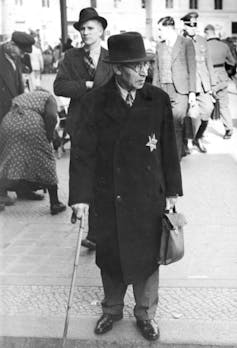
Jewish women married to gentile men, on the other hand, lived under the protection of an “Aryan household,” and virtually all were exempted from wearing the yellow star that Jews in Germany were required to wear from 1941 onward. Yet their husbands were pressured by restrictions to their careers.

Jews married to Christians did face persecution, and at least hundreds of them were murdered in the Holocaust. The Gestapo deported Jews whose spouses had divorced them to labor and death camps, intending that they would never return.


Over the decade leading up to Rosenstrasse, however, as many spouses refused the pressure to divorce, the regime created temporary exemptions. Intermarried couples with Christian children were classified as “privileged” Jews, for example, exempt from wearing the yellow star. And until Himmler’s February 1943 campaign, even “non-privileged” Jews who did wear the star were “temporarily” held back from deportations.


Courage on the street


That February’s mass arrests are sometimes referred to as the “Factory Action,” since many Jews were arrested at work. But others were snatched from home or from the street if seen wearing the star.


Laws in Nazi Germany forced Jewish people to wear a yellow Star of David badge from 1941 onward.
Bundesarchiv, Bild 183-R99993/German Federal Archives via Wikimedia Commons, CC BY-SA

The women and girls who gathered on Rosenstrasse were not political activists. They were wives, mothers and children trying to keep their families together under a murderous dictatorship. Their protest was unusual for its public visibility, since non-Nazi public gatherings were outlawed. Eyewitnesses recalled the women shouting for the release of their husbands and moments when guards threatened to shoot if protesters did not clear the street.

Most of the imprisoned Rosenstrasse Jews were released on March 6. American intelligence reported that Himmler’s action was discontinued “because of the protest which such action aroused.”

Meanwhile, 7,000 other Jews arrested in the same roundup – Jews not shielded by family relationships with non-Jews – were deported to Auschwitz, with many murdered.
Weighing the impact

Some scholars see the protest as tipping the balance to save the 2,000 men’s lives – based, in part, on events leading up to Rosenstrasse.

On Dec. 6, 1942, Adolf Hitler had authorized Joseph Goebbels, in his role as district leader of Berlin, to “ensure that the unprivileged full Jews are taken out of Germany,” likely to be murdered. And Nazi officials had promised Auschwitz’s Buna work camp thousands of skilled Jewish laborers – a quota that was not met because of the Rosenstrasse Jews’ release.


But Germany’s defeat in the Battle of Stalingrad by February 1943, coinciding with an increase in Allied bombing raids, sent public morale plunging. That made public opposition a bigger concern for the regime, especially for Goebbels, the propaganda minister. On March 6, he wrote that he had discontinued the deportation of the Rosenstrasse prisoners because “large throngs” gathered to side with the Jews.

During the decade since Hitler took power, women married to Jewish men defied scornful social, economic and political pressure, day after day. Some historians see their refusal to comply – even putting their lives on the line for their families – as causing Hitler to make a series of concessions.

Other scholars, however, say this runs “a danger of dramatically underestimating the power of the Nazi regime.” Gestapo terror suppressed all outward resistance, they argue, and a street protest could not have influenced policy.

This interpretation holds that the regime never intended to send the Rosenstrasse Jews to Auschwitz or elsewhere in the east but was holding the men to register them and select some for labor in Berlin.

Never before or after did the regime imprison Jews for such purposes. In any case, these protesters could only have had influence because they were not Jewish. Any Jewish resistance, such as the famous Warsaw Ghetto Uprising that started that April on the eve of Passover, was violently suppressed.

‘We stuck together’

Our research sees intermarriage and the Rosenstrasse protest as significant for several reasons.


First, they highlight how gender shapes expectations about protest and resistance. Nazi society cast women primarily as wives and mothers. Christian women wishing to reunite their families without calling for Hitler’s demise, or the release of all Jews, were harder for the regime to portray as political enemies or criminal agitators.

Today, a pillar commemorates the women’s protest.
Adam Carr/English Wikipedia via Wikimedia Commons

Second, the protest underscores the importance of visibility. Much of Nazi persecution relied on secrecy and masking genocide with bureaucratic language and routines. In Germany, deportations to killing sites or forced labor camps were often carried out quickly, with limited public exposure. A protest in the center of Berlin made secrecy impossible.

Third, the Rosenstrasse protest illuminates the range of responses available, in certain circumstances, to ordinary people living under Hitler. While armed resistance movements have received extensive attention, protests rooted in family and community operated differently. For example, Hitler compromised with German women who publicly protested orders to leave their families in order to evacuate cities being bombed by the Allies. Nazi officials appeased protesters opposing the removal of crucifixes from German schools.

The Rosenstrasse protest has become part of wider conversations about women-led resistance in World War II – alongside actions such as sheltering their Jewish neighbors, serving as couriers for underground networks or using workplaces and churches to quietly obstruct Nazi policies.

Decades later, Holocaust survivor Margot Graebert remembered what was at stake on Rosenstrasse. Her father and sister were held there, and her mother brought her to the protest. In the years before, “We’d seen so many families (of intermarriage) split up … and we stuck together.”

Rosenstrasse was not only a public protest but also a struggle to keep families from being torn apart: Above all, the women were fighting for the return of their own husbands and relatives. Its outcome does not change the scale of Nazi persecution or suggest that the regime tolerated dissent. But we argue that Rosenstrasse and its testimonies still matter today – not as a simple story of triumph but as a revealing debate about what protests could and could not accomplish under Nazism.

Nathan Stoltzfus is co-founder of the Rosenstrasse Civil Courage Foundation.

(Danielle Wirsansky, Ph.D. Candidate in Modern European History, Florida State University. Nathan Stoltzfus, Dorothy and Jonathan Rintels Professor of Holocaust Studies, Florida State University. The views expressed in this commentary do not necessarily reflect those of Religion News Service.)


The Conversation religion coverage receives support through the AP’s collaboration with The Conversation US, with funding from Lilly Endowment Inc. The Conversation is solely responsible for this content.