Obamacare Won’t Work: Time for Medicare for All
Our healthcare ‘system’—with or without the Affordable Care Act—is unsustainable: we have reached the end of the line.
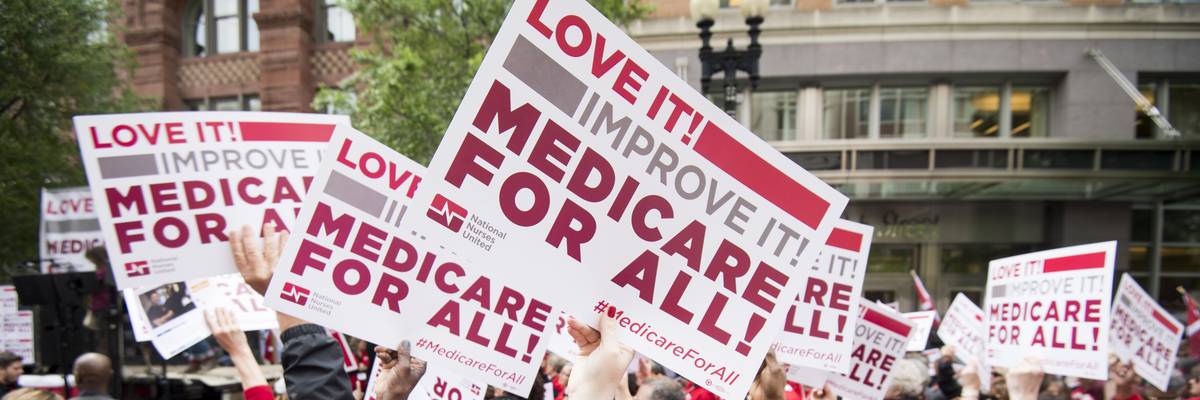
Members of National Nurses United union members wave “Medicare for All” signs during a rally in front of the Pharmaceutical Research and Manufacturers of America in Washington calling for “Medicare for All”
(Photo By Bill Clark/CQ Roll Call)Common Dreams
Those without employer sponsored insurance (or Federal insurance like Medicare or the VA) in Red states, who signed up for the Affordable Care Act (aka Obamacare), are now learning what they voted for: higher premiums for health insurance, maybe unaffordable. Meanwhile, premiums continue to rise relentlessly for employers and employees.
Our healthcare “system” is unsustainable: we have reached the end of the line.
Americans pay more for healthcare (about18 percent of GDP) than any other developed country, with mediocre outcomes. Yet the other countries, with better outcomes, have universal coverage.
It is time for change. Extend traditional Medicare to all Americans (gradually, over the course of several years). Medicare is familiar; it works. Private for profit-health insurance, less than a century old, makes no sense today.
Sick and injured patients have turned to medicine—to healers—since time immemorial. Health insurance is new: Blue Cross started as a community non profit organization in 1929, to cover surgery in hospitals.
Private for profit-health insurance, less than a century old, makes no sense today.
Yes, we are a capitalist country, and markets are efficient at producing many things, like commodities: groceries, shoes, cars, even some insurance, when it is straightforward and highly regulated, like auto insurance. But for-profit health insurance does not work.
The idea of insurance is to spread risk over a maximum number of subscribers, each of whom is at the same low risk of unpredictable casualty, like fire. This was essentially the situation of Americans a century ago—illness and injury were acute and unpredictable, patients either recovered or died. Everyone was at similar risk, only surgery was expensive.
Today is different: illness is not only predictable, it can be chronic, even life long. Moreover, today’s scientific care is expensive. The social determinants of health—income security, education, adequate food and shelter, social support (your zip code, not your genetic code)—plus public health, keep healthy people healthy.
Medical care is for the sick.
For-profit health insurers maximize premiums, minimize cost (provider fees), keep the difference, and most important, avoid the sick. Insurers exclude those with “pre-existing” conditions whenever allowed (not under the ACA), deny “authorization” where they can. They tailor “plans” with carefully engineered restrictions you don’t discover until you file a claim. They are not even providing insurance: the payments from the Federal government are risk adjusted, so the insurers are paid more for riskier patients (and they are now illegally upcoding). The providers are not. Making this happen entails huge administrative expense, which adds no value for patients or providers, only massive returns to investors. United Health Group is the third largest company in the Fortune 500.
Healthy people don’t know what plan is “right for them”; they hate the annual “choice.” They only know what they can afford. (Sick people know what they need.) They do want to choose their doctor.
Traditional Medicare eliminates these problems for its beneficiaries: by law, everything medically necessary is covered. The Federal government determines fees for doctors and hospitals based on cost, as it did historically when markets didn’t work. Beneficiaries pay premiums based on income.
Fee-for-service works when we pay the right fees for the right services. Today, based on 1950’s medicine, Medicare pays too little for office visits, so-called ‘cognitive’ services (versus procedures) both primary and specialized, so there are too few providers, especially as Medicare rolls expand with retiring
Boomers. No office doctor can make a living from Medicare anymore. That is, however, easy to fix: pay providers more to care for the sickest people, who need the services only highly skilled, experienced physicians can provide. Pay surgeons less.
Best of all, Medicare is simple—ask your grandmother.
But where will the money come from?
Start by eliminating Medicare Advantage (MA) and Part D, while updating Medicare to cover prescription drugs, along with vision, hearing aids, etc. MA was supposed to save taxpayers money by providing care more efficiently. Instead, Medicare pays MA companies 20 percent more than traditional Medicare for comparable patients.
Then, require all employers (including those who currently don’t provide insurance) to pay premiums to Medicare based on payroll. Require employees to pay Medicare premiums based on wages. Just like Social Security (of which Medicare is technically a provision). The Federal government continues to pay a share.
Everyone pays, everyone gets the care they need and nobody is left out. People can choose any qualified provider. Providers remain private, and are paid enough to attract and sustain the clinicians we want and need.
We have tried every kind of private for profit health insurance there is: employer sponsored, government subsidized, market based, capitation, value-based, catastrophic, health savings accounts—it no longer works for employers, taxpayers, or the sick. This year premiums will go up, coverage will go down.
Americans’ health will suffer.
Americans need care, not coverage. We clinicians have dedicated our lives to providing it. Medicare has served millions of us well for 60 years. We cannot allow opportunistic capitalists to stand in the way for the rest.
Our work is licensed under Creative Commons (CC BY-NC-ND 3.0). Feel free to republish and share widely.
Caroline Poplin
Dr. Caroline Poplin is an attorney (Yale Law School), Board certified general internist, health policy analyst, and retired Federal career civil servant. She has published columns for McClatchy and Medpage, also articles in academic journals, one of which was quoted by Justice Brennan in a 1976 landmark civil rights Supreme Court case.
Full Bio >
As His Iran War Drives Up Oil Prices, Trump Orders Restart of California Offshore Drilling
“Mandating a restart of these defective oil pipelines won’t curb high gas prices, but it will put coastal wildlife at huge risk of another oil spill,” one advocate said.
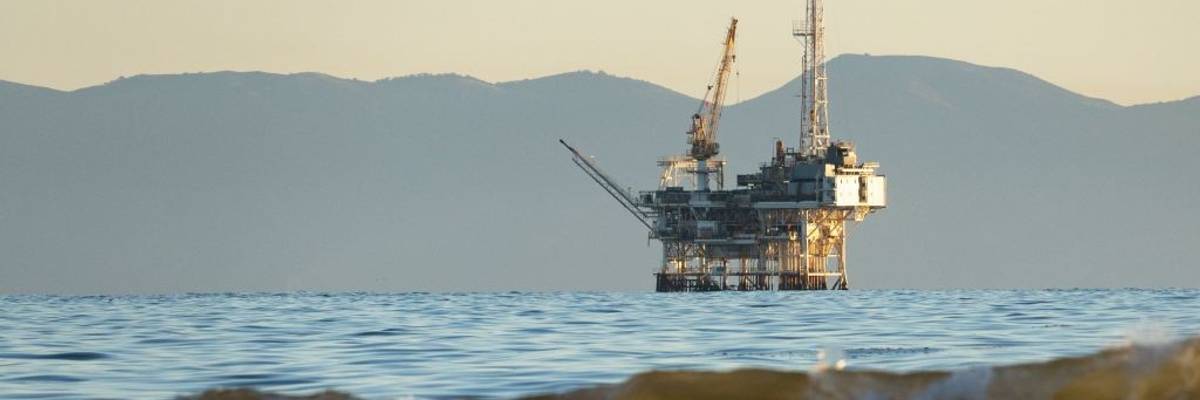
An offshore oil platform with Santa Cruz Island in the background is seen in Santa Barbara Channel, California.
(Photo by Marli Miller/UCG/Universal Images Group via Getty Images)
State leaders and environmental advocates responded with outrage after the Trump administration on Friday ordered the restarting of a California pipeline that caused one of the largest oil spills in the state’s history, a move that comes as oil prices have skyrocketed following President Donald Trump’s launching of an illegal war against Iran and Iran’s subsequent closure of the Strait of Hormuz.
After Trump issued an executive order on Friday authorizing the Department of Energy (DOE) to ramp up oil and gas development under the Defense Production Act, Energy Secretary Chris Wright ordered Sable Offshore Corp. to restart operations on the Santa Ynez Unit and Pipeline System, which include an offshore rig and a network of offshore and onshore pipelines along the Santa Barbara coast. Among them is a pipeline that ruptured in 2015, spilling around 450,000 gallons of oil into Refugio State Beach and killing hundreds of marine mammals and sea birds.
“Californians have repeatedly rejected dangerous drilling off our coast for decades,” Sen. Alex Padilla (D-Calif.) said in a statement on Saturday. “Now, after dragging the US into a war with Iran and driving up oil prices, the Trump administration is trying to exploit this crisis to further enrich the oil industry at the expense of our communities and our environment.”
In his statement, Wright emphasized the defense benefits of resuming drilling, arguing that “today’s order will strengthen America’s oil supply and restore a pipeline system vital to our national security and defense, ensuring that West Coast military installations have the reliable energy critical to military readiness.”
“Directing a private oil company to push its project through without safety checks and adherence to California laws that keep our coast safe is appalling and illegal.”
The DOE added that “Sable’s facility can produce approximately 50,000 barrels of oil per day, a 15% increase to California’s in-state oil production, that can replace nearly 1.5 million barrels of foreign crude each month.”
Yet, far from a novel response to an unexpected emergency, the order is actually an escalation in a preexisting battle between California and the Trump administration over the future of the pipeline system. The state’s Attorney General Rob Bonta sued to stop the administration from a federal takeover of two of the pipelines in January.
Sable also faces several lawsuits due to its attempts to restart the system after it purchased it from ExxonMobil in 2024, and has not yet cleared all of the state permitting requirements, according to the Center for Biological Diversity.
“In its latest brazen abuse of power, the Trump administration is attempting to seize exclusive federal control over two of California’s onshore pipelines,” Bonta said on social media Friday evening. “We will not stand by as this administration continues their unlawful all-out assault on California and our coastlines, and we are reviewing all of our legal options.”
California Gov. Gavin Newsom also spoke out against Wright’s announcement.
“Trump knew his war with Iran would raise gas prices,” he wrote on social media. “Now he wants to illegally resurrect a pipeline shut down by courts and facing criminal charges. And it won’t even cut prices. I refuse to let Trump sacrifice Californians, our environment, or our $51 billion coastal economy.”
The Center for Biological Diversity noted that this order would mark the first time that the Defense Production Act was used to force an oil company to restart out-of-use Infrastructure and to disregard the state permitting process.
“This is a revolting power grab by an extremist president. Trump is misusing this Cold War-era law just to help a Texas oil company skirt vital state laws that protect our coastline, and Californians will pay the price,” Talia Nimmer, an attorney for the center, said. “Mandating a restart of these defective oil pipelines won’t curb high gas prices, but it will put coastal wildlife at huge risk of another oil spill. Overriding state law to let an oil company restart pipelines sets a radically dangerous precedent. It’s clear that no state is safe from Trump.”
The center also promised to push back against the order.
“Directing a private oil company to push its project through without safety checks and adherence to California laws that keep our coast safe is appalling and illegal,” Nimmer said. “We’re exploring all legal avenues. This dangerous action should be swiftly blocked by the courts.”
A dizzying web points to who owns Trump and the depth of his treasonRAW STORY
LONG READ
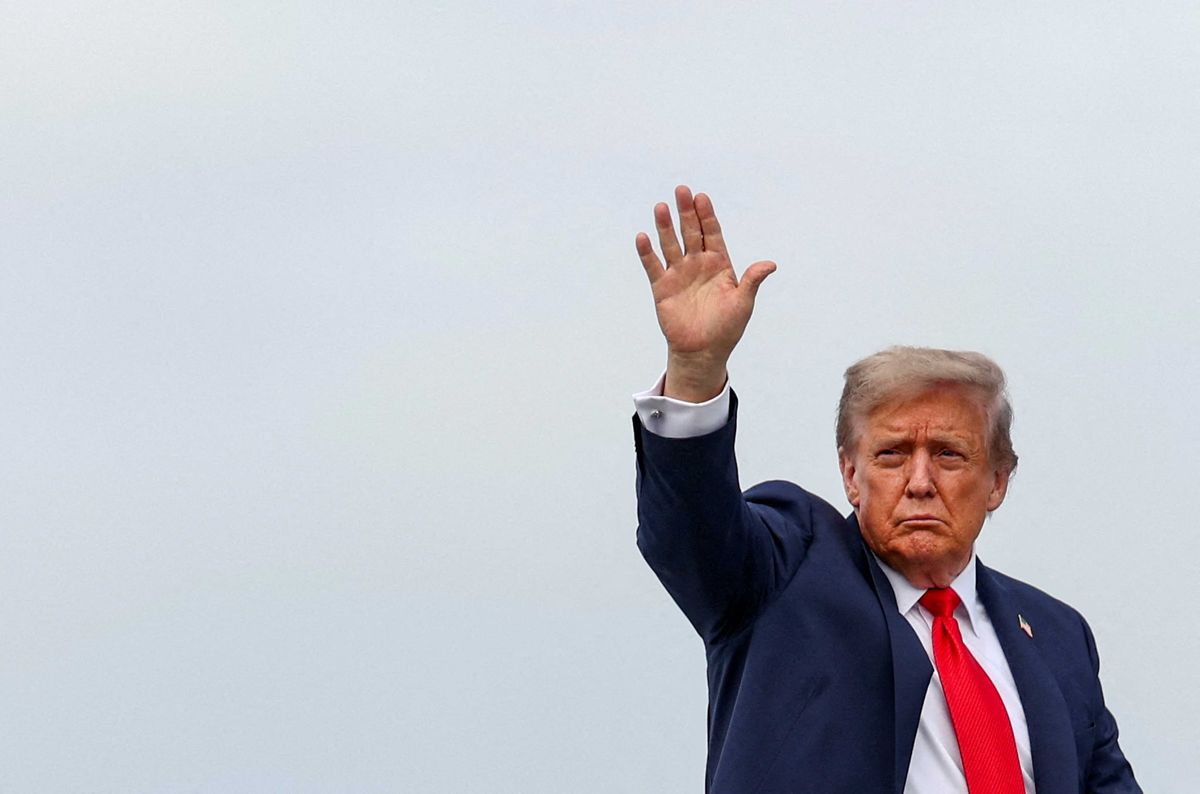
Donald Trump waves as he boards Air Force One in Alaska. REUTERS/Kevin Lamarque/File Photo
Eight of our American service members are dead and more than 140 wounded because Iran’s military has suddenly gotten really good at targeting our soldiers, airmen, and marines. News reports say they’ve been able to hit us with such precision because Russia is using their extraordinary spy satellite, spy plane, and advanced radar capabilities to help Iran’s military.
The Washington Post, which first reported on this, quoted a Russian military expert as saying that Iran is now “making very precise hits on early-warning radars or over-the-horizon radars,” seeming to validate the concern. The article added:
“Iran possesses only a handful of military-grade satellites, and no satellite constellation of its own, which would make imagery provided by Russia’s much more advanced space capabilities highly valuable — particularly as the Kremlin has honed its own targeting after years of war in Ukraine…”
When asked about the reports, Donald Trump — who’d just returned from the soldiers’ bodies’ dignified transfer — basically downplayed Russian efforts to hurt Americans, just like he did when he learned in 2020 that Putin was paying Afghan insurgents a bounty to kill our soldiers. He pointed out that the US had been sharing intelligence with Ukraine during the Biden administration, so apparently, according to him, Russia is justified in helping Iran kill American service members:
“They’d say we do it against them. Wouldn’t they say that we do it against them?”
His fellow real estate billionaire, Steve Witkoff (whose sons are making billions with Trump’s sons in the Middle East and who has been regularly traveling to Moscow for private meetings with Vladimir Putin) similarly shrugged off the report, telling CNBC:
“I can tell you that yesterday, on the call with [President Trump], the Russians said they have not been sharing. That’s what they said. So, we can take them at their word, but they did say that.” Witkoff later added, “Let’s hope that they’re not sharing.”
Putin himself, though, was nowhere near as circumspect, saying:
“On my part, I want to confirm our unwavering support of Tehran and our solidarity with our Iranian friends. Russia has been and will remain the Islamic Republic’s reliable partner.”
As if to confirm that Trump is Putin’s toady, just last week, in the wake of Iran shutting the Strait of Hormuz and cutting oil supplies to Asia and the Subcontinent, our president signed a waiver to our Russia sanctions so Putin can now sell unlimited amounts of Russian oil directly to India.
Every time Putin says “Jump,” Trump asks, “How high?”
Which raises the question: “Why? Why does Trump always give Putin whatever he wants and why is he so terrified of speaking out against him?”
Is it possible that Trump is actively working for Putin? What if Putin somehow owns him? Or is blackmailing him? And has been running him as an Russian asset since at least 2017?
That sort of treason would be more important than Russian agents Robert Hanssen (life without parole), Aldrich Ames (life without parole), or Ethel and Julius Rosenberg (death penalty).
And let’s not forget that right after Trump won re-election in November 2024, Russian state TV published explicit nudie pictures of Melania Trump and their anchors were laughing about it and at Trump. Was this Putin’s first assertion this cycle that he still owns Donald?
Jack Smith’s case in Florida was limited to Trump stealing sensitive documents and sharing them on two publicly known occasions (and didn’t even reference other known acts like Kid Rock’s allegation that Trump showed him Top Secret maps in the White House: this was apparently a regular thing for Trump).
That said, you can bet your bottom dollar that the FBI and other agencies worked as hard as they could to contain the damage done by Trump’s leaving documents that could cause “grave damage” to America in public places where spies could simply waltz in and take cell-phone pictures of them by attending a wedding or paying $200,000 for essentially unlimited access Club membership.
But what if it goes beyond that? What if Putin has owned him for years?
From Russian oligarchs laundering money through Trump’s operations — real estate is the most common device used worldwide for money laundering — to keeping him alive in his most difficult times, like those multiple bankruptcies in the 1990s when he almost lost everything?
Or perhaps blackmailing him?
What if Putin got him the presidency, and he knows that if America found out for sure, it would destroy him? Or has Jeffrey Epstein’s videos of Trump with underage girls? Or his own pictures, taken when Trump was in Moscow for one of his beauty pageants?
Which begs the question: exactly how much damage might Trump have already done to our nation, and what does he have planned for the next three years of this second term?
And is he getting ongoing day-to-day instructions from Putin, which explains why he’s so reluctant to discuss their conversations, as Rachel Maddow recently documented?
In 2019 the Washington Post revealed that throughout his last presidency, Trump was having regular secret phone conversations with Putin (more than 20 have been identified so far, including one just days before the 2020 election).
The Moscow Project from the American Progress Action Fund documents more than 270 known contacts between Russia-linked operatives and members of the Trump campaign and transition team, as well as at least 38 known meetings just leading up to the 2016 election.
The manager of his 2016 campaign, Paul Manafort — who was previously paid tens of millions by Vladimir Putin’s people to install a pro-Putin puppet as Ukraine’s president in 2010 — has admitted that he was regularly feeding secret inside-campaign strategy and polling information to Russian intelligence via the oligarch who typically paid him on their behalf.
Throughout the campaign, Manafort let Russian intelligence know where Trump needed help, and when, and it appears Russia jumped in to social media to provide the needed help.
Trump pardoned Manafort, which got him out of prison and ended any investigations. He’s still fabulously rich from his work for Russia.
As the New York Times noted in 2020:
“[I]nvestigators found enough there to declare that Mr. Manafort created ‘a grave counterintelligence threat’ by sharing inside information about the presidential race with Mr. [Konstantin] Kilimnik and the Russian and [pro-Russian] Ukrainian oligarchs whom he served.”
There is no known parallel to this behavior by any president in American history — one could argue it easily exceeds Benedict Arnold’s audacity — and bringing documents to Mar-a-Lago was just the tip of the iceberg.
The Washington Post reported in 2022 that Trump had a habit of carrying top-secret information that could severely damage our national security, leaving it in hotel rooms in hostile nations.
Was he bringing these documents with him to sell? Or just to show to leaders or oligarchs in those countries to impress them? Or because Putin, who has agents in those countries, told him to?
Trump doesn’t put all that effort into hauling things around unless it’s extraordinarily important to his ego or he thinks he can makes money off them. Or he’s scared.
“Boxes of documents even came with Trump on foreign travel,” the Post noted, “following him to hotel rooms around the world — including countries considered foreign adversaries of the United States.”
When Robert Mueller’s FBI team tried to investigate Trump’s ties to Russia and his possibly sharing sensitive military information with them, they were stonewalled.
The Mueller Report identified ten specific instances of Trump himself trying to obstruct the investigation, including offering the bribe of a pardon to Manafort, asking FBI Director James Comey to “go easy” on Gen. Michael Flynn after his dinner with Putin, and directing Attorney General Jeff Sessions to limit Mueller’s ability to investigate Trump’s connections to Russia.
As the Mueller Report noted:
“The President launched public attacks on the investigation and individuals involved in it who could possess evidence adverse to the President, while in private the President engaged in a series of targeted efforts to control the investigation.
“For instance, the President attempted to remove the Attorney General; he sought to have Attorney General Sessions un-recuse himself and limit the investigation; he sought to prevent public disclosure of information about the June 9, 2016 meeting between Russians and campaign officials; and he used public forums to attack potential witnesses who might offer adverse information and to praise witnesses who declined to cooperate with the government.”
It adds, detailing Trump’s specific Obstruction of Justice crimes:
“These actions ranged from efforts to remove the Special Counsel and to reverse the effect of the Attorney General’s recusal; to the attempted use of official power to limit the scope of the investigation; to direct and indirect contacts with witnesses with the potential to influence their testimony.”
There are, after all, credible assertions from American intelligence that when Trump was elected, members of Russian intelligence and Putin’s inner circle were literally partying in Moscow, celebrating a victory they believed they made happen.
And apparently Putin and his intelligence operatives had good reason to be popping the champagne in November 2016. They were quickly paid off in a big way.
In his first months in office, Trump outed an Israeli spy to the Russian ambassador in what he thought was going to be a “secret Oval Office meeting” (the Russians released the photo to the press), resulting in MOSAD having to “burn” (relocate, change identity of) that spy.
The undercover agent was apparently working in Syria that year against the Russians, who were embroiled in the midst of Assad’s Civil War and indiscriminately bombing Aleppo into rubble.
That, in turn, prompted the CIA to worry that a longtime American spy buried deep in the Kremlin was similarly vulnerable to Trump handing him over to Putin.
As CNN noted (when the story leaked two years later):
“The source was considered the highest level source for the US inside the Kremlin, high up in the national security infrastructure, according to the source familiar with the matter and a former senior intelligence official.
“According to CNN’s sources, the spy had access to Putin and could even provide images of documents on the Russian leader’s desk.”
The CIA concluded that the risk Trump had burned or was about to burn our spy inside the Kremlin was so great that — at massive loss to US intelligence abilities that may even have otherwise helped forestall the invasion of Ukraine — they pulled our spy out of Russia in the first year of Trump’s presidency, 2017.
Similarly, when they met in Helsinki on July 16, 2018, Trump and Putin talked in private for several hours and Trump ordered his translators’ notes destroyed; there is also concern that much of their conversation was done out of the hearing of the US’s translator (Putin is fluent in English) who may have been relegated to a distant part of the rather large empty ballroom in which they met.
The Washington Post reported, after a leak six months later, that when Trump met privately for those two hours with Putin the CIA went into “panic mode.” A US intelligence official told the Post:
“There was this gasp’ at the CIA’s Langley, Virginia headquarters. You literally had people in panic mode watching it at Langley. On all floors. Just shock.”
Three weeks after Trump’s July 16, 2018 meeting with Putin in Helsinki, Sen. Rand Paul (R-KY) made a solo trip to Moscow to personally hand-deliver a document or package of documents from Trump to Putin. Its contents are still unknown, although Paul told the press it was a “personal” letter of some sort.
Sen. Paul has also consistently taken Trump’s and Putin’s side with regard to the Ukraine war: he single-handedly blocked a $40 billion military aid package in the Senate. When the FBI searched Mar-a-Lago, he responded with a call for the repeal of the Espionage Act. He further suggested the FBI may have “planted” Secret documents at Mar-a-Lago.
Ten days after Paul’s trip to Moscow, The New York Times reported that the CIA was freaked out because their sources inside Moscow had suddenly “gone silent”:
“The full reasons the sources have gone silent are not known,” the Times reported, but Trump having intentionally given a man working for the FBI to Putin — a man whose job at that time was to find and reveal Russian agents involved in or close to the Trump campaign — may also have had something to do with it:
“[C]urrent and former officials said the exposure of sources inside the United States has also complicated matters,” noted the Times. “This year, the identity of an F.B.I. informant, Stefan Halper, became public after [Trump-loyal MAGA Republican] House lawmakers sought information on him and the White House allowed the information to be shared. Mr. Halper, an American academic based in Britain, had been sent to talk to Trump campaign advisers who were under F.B.I. scrutiny for their ties to Russia.”
Things were picking up the following year, in 2019, as Putin was planning his invasion of Ukraine while Trump was preparing for the 2020 election.
In July 2019, Trump had conversations with five foreign leaders during and just before a presidential visit that month to Mar-a-Lago; they included Putin and the Emir of Qatar.
In one of those conversations, according to a high-level US Intelligence source, Trump “made promises” to a “world leader” that were so alarming it provoked a national security scramble across multiple agencies.
As the Washington Post noted in an article titled, “Trump’s communications with foreign leader are part of whistleblower complaint that spurred standoff between spy chief and Congress”:
“Intelligence Community Inspector General Michael Atkinson determined that the complaint [against Trump] was credible and troubling enough to be considered a matter of ‘urgent concern,’ a legal threshold that requires notification of congressional oversight committees.”
On the last day of that month, July 31, Trump had another private conversation with Putin.
The White House spokespeople told Congress and the press that Trump said that he and Putin discussed “wildfires” and “trade between the nations.” No droids in this car…
But the following week, on Aug. 2, the Daily Beast’s Betsy Swan reported that Trump had that week asked the Office of the Director of National Intelligence for a list of all its employees (including all our “spies”) who had worked there more than 90 days, and the request had intelligence officials experiencing “disquiet.”
Perhaps just by coincidence, months after Trump left office with cases of classified documents, the New York Times ran a story with the headline Captured, Killed or Compromised: C.I.A. Admits to Losing Dozens of Informants:
“Top American counterintelligence officials warned every C.I.A. station and base around the world last week,” the Times’ story’s lede began, “about troubling numbers of informants recruited from other countries to spy for the United States being captured or killed, people familiar with the matter said.
“The message, in an unusual top secret cable, said that the C.I.A.’s counterintelligence mission center had looked at dozens of cases in the last several years involving foreign informants who had been killed, arrested or most likely compromised. Although brief, the cable laid out the specific number of agents executed by rival intelligence agencies — a closely held detail that counterintelligence officials typically do not share in such cables.”
And now, to complicate matters, it appears Elon Musk took with him access to the payroll records of all of our nation’s spies and other foreign intelligence agents. The Elon Musk who, the Wall Street Journal reports, has also reportedly been having his own secret conversations with Putin.
If it turns out the Trump has been acting as an agent for Russia, how long might this have been going on?
Czechoslovakia’s Státní bezpečnost (StB) first started paying attention to Trump back in 1977, as documented by the German newspaper Bild when the StB’s files were declassified, because Trump married Czech model Ivana Zelnickova, his first wife, recently buried on his golf course in New Jersey.
Czechoslovakia at that time was part of the Warsaw Pact with the Soviet Union, and Ivana and her family had been raised as good communists. Now that a Czech citizen was married into a wealthy and prominent American family, the StB saw an opportunity and started tracking Trump virtually from his engagement.
As 2016 and 2018 investigations by the Guardian found:
“Ivana’s father, Miloš Zelníček, gave regular information to the local StB office about his daughter’s visits from the US and on his celebrity son-in-law’s career in New York. Zelníček was classified as a ‘conspiratorial’ informer. His relationship with the StB lasted until the end of the communist regime.”
An investigative reporting breakthrough by Craig Unger for his book American Kompromat led Unger to Uri Shvets, a former KGB spy who’d been posted to Washington, D.C. for years as a correspondent for the Soviet news agency TASS.
Shvets told the story — from his own knowledge — of how Trump and Ivana visited Moscow in 1987 and were essentially recruited or seduced by the KGB, a trip corroborated by Luke Harding in his book Collusion: Secret Meetings, Dirty Money, and How Russia Helped Donald Trump Win.
Their trip was coordinated by Intourist, the Soviet travel agency that was a front for the KGB, and the Trumps’ handlers regaled Donald and Ivana with Soviet talking points, presumably about things like the horrors of NATO.
The KGB’s psychological profile of Trump had determined he was vulnerable to flattery and not much of a deep thinker, so they told him repeatedly how brilliant he was and that he should run for president in the US.
Much to the astonishment and jubilation of the KGB, Trump returned from Moscow to the US to give a Republican presidential campaign speech that fall in Portsmouth, New Hampshire.
He then purchased a large ad in the New York Times, the Washington Post, and the Boston Globe on Sept. 1, 1987 that questioned America’s ongoing support of Japan and NATO, both thorns in the side of the USSR and their Chinese allies.
Trump’s ad laid it on the line:
“Why are these nations not paying the United States for the human lives and billions of dollars we are losing to protect their interests? ... The world is laughing at America’s politicians as we protect ships we don’t own, carrying oil we don’t need, destined for allies who won’t help.”
As the Guardian reported in 2021:
“The bizarre intervention was cause for astonishment and jubilation in Russia. A few days later Shvets, who had returned home by now, was at the headquarters of the KGB’s first chief directorate in Yasenevo when he received a cable celebrating the ad as a successful ‘active measure’ executed by a new KGB asset.
“’It was unprecedented,’ [Shvets said.] … It was hard to believe that somebody would publish it under his name and that it will impress real serious people in the west but it did and, finally, this guy became the president.’”
Meanwhile, Putin was making friends with powerful influence over American foreign policy.
Turkish President Recep Tayyip Erdoğan, who flipped his nation into a strongman neofascist state following an unsuccessful attempted coup in 2016 (he imprisoned and tortured numerous journalists and political opponents), has been deepening his relationship with Putin ever since that US election year.
In 2017, Erdoğan apparently gained access to America’s deepest secrets by secretly paying off Gen. Michael Flynn even as Flynn became Trump’s National Security Advisor, who also had at least one secret phone conversation with Russian Ambassador Sergey Kislyak after Flynn started working in the White House.
Flynn pleaded guilty in December 2017 to “willfully and knowingly” making “false, fictitious and fraudulent statements” to the FBI about one of those conversations with Russian Ambassador Kislyak. Flynn was also an unregistered agent of a foreign government while working in the White House: he had taken about a half-million dollars from Erdoğan.
Around the time he was leaving office, Trump pardoned Flynn, essentially burying the entire story.
From campaigning to destroy NATO to selling out Ukraine to letting Russia help kill American soldiers in the Gulf region, Trump’s goal appears to be, to paraphrase Ron DeSantis, to “Make America Russia.”
The big question is, “Why?”
Warren Slams Trump for Iran War Costing ‘American Taxpayers $11,500 Per Second’
According to more recent Pentagon figures, it’s actually even worse.
Sen. Elizabeth Warren (D-Mass) talks with reporters after a Senate Armed Services Committee closed briefing on the Iran war, in the Capitol Visitor Center on Tuesday, March 10, 2026.
(Photo by Tom Williams/CQ-Roll Call, Inc via Getty Images)
Stephen Prager
Mar 13, 2026
COMMON DREAMS
Sen. Elizabeth Warren took President Donald Trump to task on Friday for making life “more expensive” with his war in Iran.
“It’s costing American taxpayers $1 billion a day to fund this war,” the Massachusetts Democrat said in a video posted to her social media accounts. “That is $11,500 every single second.”
This is, of course, not an exact amount. The figure is based on a preliminary estimate provided by Pentagon officials to Congress last week, estimating that the war would cost about $1 billion per day.
And so far, the war has actually been even more expensive than Warren initially claimed.
On Tuesday, according to the New York Times, the Pentagon gave a more comprehensive briefing, telling Congress that just the first six days of the war had exceeded $11.3 billion in cost, which puts the price tag at about $1.88 billion per day. That’s nearly $21,800 per second.
The Times noted that this was a low-end estimate and that the pricetag did not include many other costs, including those associated with the buildup of military hardware in the region before the war.
Using just these conservative estimates, a live ticker shows that as of Friday afternoon, the estimated cost of the war that began on February 28 is already fast approaching $19 billion, less than two weeks later.
“If we took the money that Donald Trump is demanding to fund the war with Iran and used that money here at home, instead, we could help cover healthcare costs for millions more Americans all across this country,” Warren said.Indeed, an analysis published last week by the Institute for Policy Studies’ National Priorities Project (NPP), based on the $1 billion-per-day figure, found that on an annual basis, the cost of the war is “higher than the appropriated budget of any federal agency except the Pentagon itself.”If all that money were spent domestically, it found, it would be enough to cover the daily costs of federal nutrition assistance for more than 40 million Americans, as well as daily Medicaid costs for the roughly 16 million people expected to lose health coverage due to the Republican budget package that Trump signed into law last year.As Warren pointed out, calculations of military spending do not even take into account the sharp hikes in gas prices Americans are facing as a result of the war, which has led Iran to retaliate by closing one of the world’s largest oil shipment routes, the Strait of Hormuz.According to the American Automobile Association’s (AAA) gas price tracker, US gas prices have leaped to $3.63 per gallon on average as of Friday, up from $2.94 a month ago.“We haven’t seen gas prices jump this much since Russia invaded Ukraine,” Warren said. “Some cities in Indiana and Ohio have already seen a jump of over 50 cents a gallon. In Texas and Virginia, prices are up by more than 65 cents.”Citing an image of a Chevron station in Los Angeles posted by a user on TikTok, Warren said: “California is seeing gas prices above $8.” According to AAA, the average cost of gas in the state is $5.42.Despite rising anger from voters—more than 7 in 10 of whom said in a recent Quinnipiac poll that they fear higher oil and gas costs as a result of the war—Trump has said carrying out his objectives in Iran “is far more important than having gasoline prices go up a little bit.”In a post to Truth Social on Thursday, the president framed higher prices as a positive: “The United States is the largest Oil Producer in the World, by far, so when oil prices go up, we make a lot of money,” he wrote.While this may be true for Americans who own oil and gas companies, most do not. For the average American, higher gas prices can raise the cost of transportation sometimes by thousands of dollars per year, cutting into spending on food, rent, medicine, and other essentials.“For someone who campaigned on lowering costs on day one, Donald Trump is constantly raising the bar for how expensive he can make it to live in this country,” Warren said.Referencing Republican opposition to extending Affordable Care Act subsidies that lowered healthcare premiums for more than 20 million Americans, Warren implored viewers to “never forget that Donald Trump said we just can’t afford to lower health care costs this year.”“These are about choices,” she said, “and Donald Trump is making the wrong ones.”
Trump's Iran conflict becomes de facto 'tax increase' on struggling Americans: report
RAW STORY
President Donald Trump's military actions in Iran are effectively functioning as a hidden tax on American households, economists warn, as soaring energy costs threaten to erase anticipated benefits from larger tax refunds this filing season.
Americans are poised to receive bigger refunds than last year, with the average federal tax refund reaching $3,742 as of late February—about 10.6% higher than 2025. However, the economic fallout from the Iran conflict is rapidly negating that windfall, according to a new report.
Since the U.S. military actions in Iran began, oil prices have skyrocketed, sending gas and diesel costs surging. The average price of unleaded gasoline jumped to $3.64 per gallon on Friday, roughly $0.72 higher than the previous month's average. Mortgage rates have also climbed sharply to 6.41% for a 30-year fixed-rate loan, up from 5.9% before the conflict.
"The Iran war acts like a tax increase on the consumer, except nobody voted for it," said Paul Dietrich, chief investment strategist at Wedbush Securities.
The burden falls disproportionately on lower-income Americans, who spend a larger percentage of their budgets on fuel and energy. As households redirect refund money toward gas and groceries rather than discretionary spending, the broader economy loses the boost that tax refunds typically provide.
Experts caution that while tax refunds could help insulate consumers from immediate shocks, the economic damage from elevated energy costs and inflation pressures will likely persist throughout 2026, undermining household purchasing power across income levels.
Read the full report here.
Iranians who backed Trump turn against him as president's wartime moves backfire
David McAfee
March 14, 2026
RAW STORY
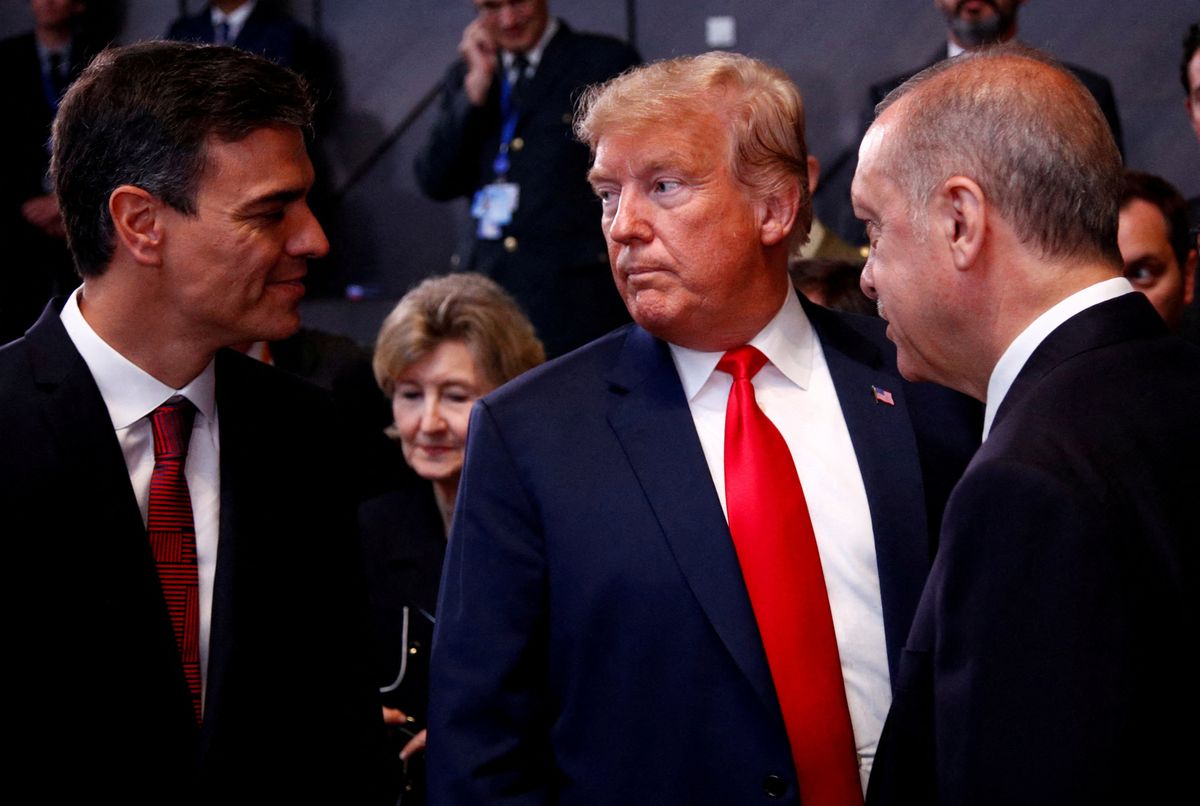
FILE PHOTO: Turkish President Tayyip Erdogan, U.S. President Donald Trump and Spain's Prime Minister Pedro Sanchez attend a meeting of the North Atlantic Council during a NATO summit in Brussels, Belgium July 11, 2018. REUTERS/Francois Lenoir/File Photo
Anti-regime Iranians who initially embraced President Donald Trump's promise to "rescue" them from their oppressive government are now expressing deep disillusionment with his military campaign, according to new reporting from The Guardian.
Many Iranian dissidents had harbored hope that Trump's administration would intervene militarily against the Islamic Republic. That hope transformed into despair after a fortnight of U.S. and Israeli airstrikes that have killed hundreds of civilians, destroyed critical infrastructure, and damaged irreplaceable cultural heritage sites.
"They are also lying! Like the regime has been lying to us," said Amir, a University of Tehran student and anti-regime protester, speaking to The Guardian. "You are all worse than each other."
The turning point came when Israeli forces struck fuel depots in Tehran, coating the capital in toxic oil rain and blackening the sky. The strikes also damaged ancient landmarks including the 14th-century Golestan Palace and the 17th-century Chehel Sotoon Palace in Isfahan.
"I genuinely believe now they [the US and Israel] didn't have a plan," Amir told The Guardian. "If the regime is what you want to hit, where do you draw the line? What about us, the ordinary Iranians? We rely on this civil infrastructure."
Many protesters now fear the conflict mirrors the 2003 U.S. invasion of Iraq, which promised liberation but delivered civil war. Other Iranian dissidents report viewing the bombing campaign as "carpet bombing" that has killed civilians indiscriminately.
"A significant portion of the people I've been speaking to, after witnessing the killing of civilians, have altered their perception of military intervention," one Tehran protester told The Guardian.
Read the full report here.
‘It hurts’: Trump travel ban blocks Oscar nominee from attending award ceremony
Alexander Willis
March 14, 2026
RAW STORY
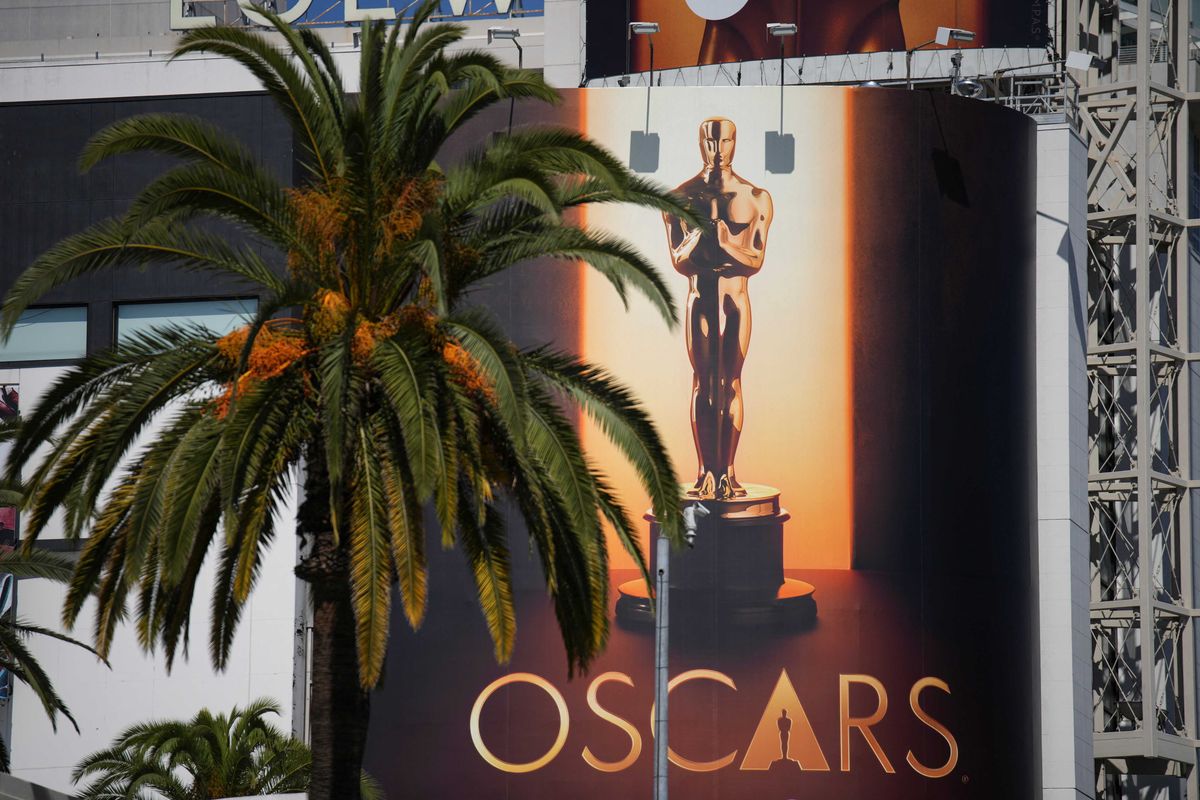
A large billboard sign featuring an Oscar statuette towers over Hollywood blvd as workers prepare for the 98th Academy Awards in Los Angeles, California, U.S., March 9, 2026. REUTERS/Daniel Cole
Oscar-nominated actor Motaz Malhees is barred from attending this Sunday’s Academy Awards due to President Donald Trump’s travel ban for certain foreign nationals, with the actor taking to social media Friday to express his disappointment.
Malhees played a prominent role in the 2025 film “The Voice of Hind Rajab,” a dramatization of the real-life killing of Hind Rajab, a five-year-old Palestinian girl who was killed in 2024 when Israeli troops fired hundreds of rounds into a vehicle carrying her and her family. An Israeli tank reportedly fired on first responders attempting to reach her.
The film was nominated for Best International Film by the Academy Awards last December, but Malhees – who is Palestinian – said on Friday he won’t be able to attend the ceremony.
“I will not be there. I am not allowed to enter the United States because of my Palestinian citizenship,” Malhees wrote in a social media post on Instagram.
“It hurts. But here is the truth: You can block a passport. You cannot block a voice. I am Palestinian, and I stand with pride and dignity. My spirit will be with the voice of Hind Rajab that night. Good luck to all of you. Our story is bigger than any barrier, and it will be heard.”
Trump signed a proclamation last December that added “full restrictions and entry limitations” to those holding passports issued to them by the Palestinian Authority. In a shocking move, the Trump administration has also issued a directive to subject Palestinian immigrants, regardless of their citizenship, to heightened scrutiny when applying for asylum, a move described by legal experts as unprecedented given its focus on an entire ethnic group.
'Wow': Observers horrified by 'scary' Trump brag showing he's following 'Putin's playbook'
David McAfee
March 15, 2026
RAW STORY
Donald Trump speaks to a large crowd at "An Address to Young America" an event hosted by Students for Trump and Turning Point Action. (Nuno21 / Shutterstock.com)
Donald Trump over the weekend posted a graphic that alarmed numerous political observers.
Trump took to his own social media site, Truth Social, to post the graphic, which is called, "President Trump is reshaping the media." The image celebrates that NPR, Stephen Colbert, Jim Acosta, and others in the media are "gone," while noting that CNN and the FCC have both been "reformed" by the president.
That graphic sent shivers down the spines of some onlookers, who took to X to express their concern.
Republicans against Trump noted, "Trump posted an image claiming he is 'reshaping the media,'" to which political science professor Michael McFaul replied, "Wow. Scary. Reminds me of Putin's early years of reshaping Russian media."
WaPo media reporter Scott Nover chimed in, "latest Truth Social posts includes a series of boasts about how he’s 'reshaping the media.'"
Garry Kasparov, founder of Renew Democracy, also added, "Fascism doesn’t sneak up on you. It boasts in your face about war, attacking 'internal enemies' and the free press, taking total power, and tells you that you must embrace it, not fight it. Consolidating and purging media into loyal hands is Putin's playbook."
One popular news curator, @SkylineReport, also noted that "Trump just posted a graphic bragging that he’s 'reshaping the media.'"
They added, "It literally lists journalists pushed out, public broadcasters 'defunded,' layoffs at major outlets, and regulatory pressure as 'wins.' Read that again. A president openly celebrating the use of political power to punish critics and pressure the press. That’s not media criticism. That’s media capture — the playbook authoritarian leaders use to bend the information system toward themselves. And the most dangerous part? He’s not hiding it anymore."
FCC chair signals license revocations for broadcasters critical of Trump's War
David McAfee
March 14, 2026
RAW STORY
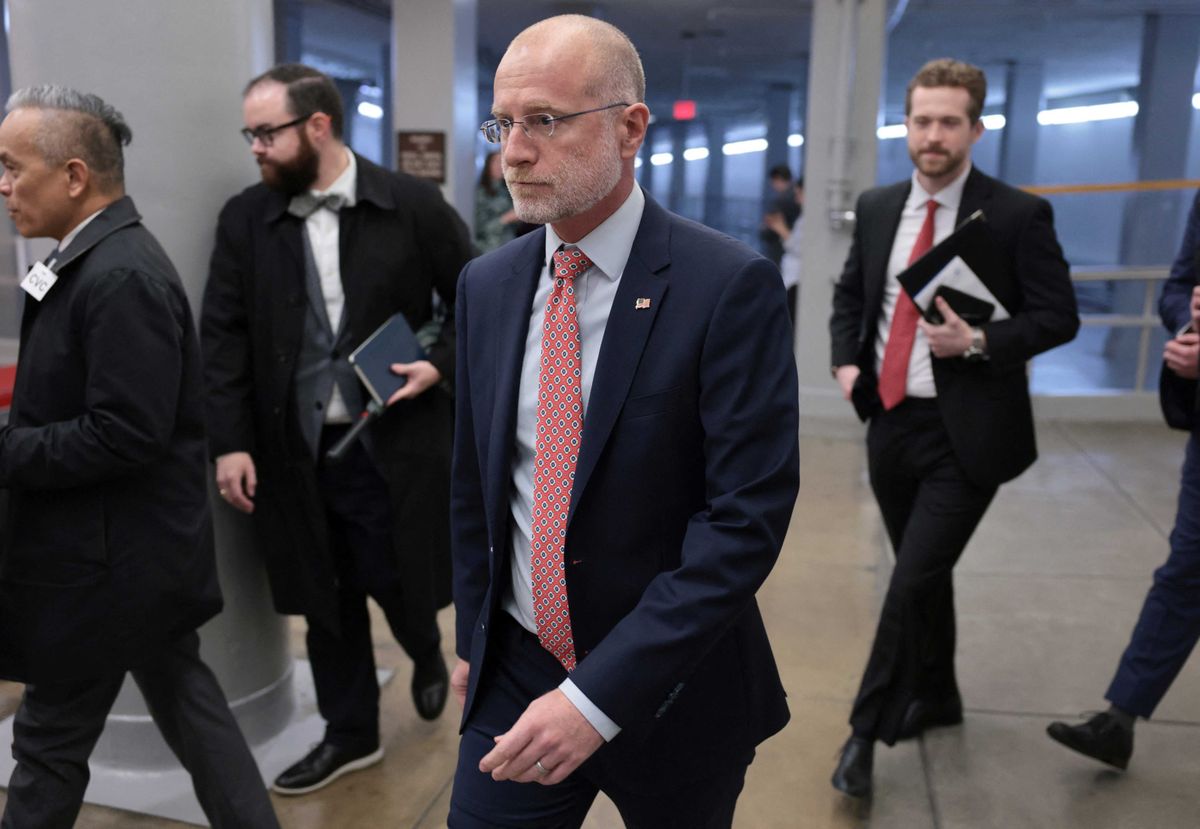
Federal Communications Commission (FCC) Chairman Brendan Carr walks through the subway system under the U.S. Capitol in Washington, D.C. on Dec. 2, 2025. REUTERS/Jonathan Ernst
Brendan Carr, chair of the Federal Communications Commission under President Donald Trump, issued a stark warning to television broadcasters on Saturday, threatening license revocation for what he characterizes as "hoaxes and news distortions."
In a statement, Carr declared: "Broadcasters that are running hoaxes and news distortions - also known as the fake news - have a chance now to correct course before their license renewals come up. The law is clear. Broadcasters must operate in the public interest, and they will lose their licenses if they do not."
Carr cited declining trust in legacy media, noting that "trust in legacy media has now fallen to an all time low of just 9% and are ratings disasters." He argued that broadcasters have been subsidized through free access to the nation's airwaves and suggested that changing editorial direction is in their business interests.
The FCC chief framed the issue as a matter of public confidence, stating: "When a political candidate is able to win a landslide election victory in the face of hoaxes and distortions, there is something very wrong. It means the public has lost faith and confidence in the media."
Carr concluded by calling for systemic change in broadcast journalism, declaring "Time for change!" His comments represent an unprecedented direct threat by a Trump administration official to use regulatory authority over media licensing as a tool to influence news coverage.
Trump’s FCC Chair Threatens to Pull Broadcast Licenses Over Negative Iran War Coverage
“Brendan Carr is threatening the media to cover the war the way the Trump regime wants. It’s one of the most anti-American messages ever posted by a government official,” one news network said.
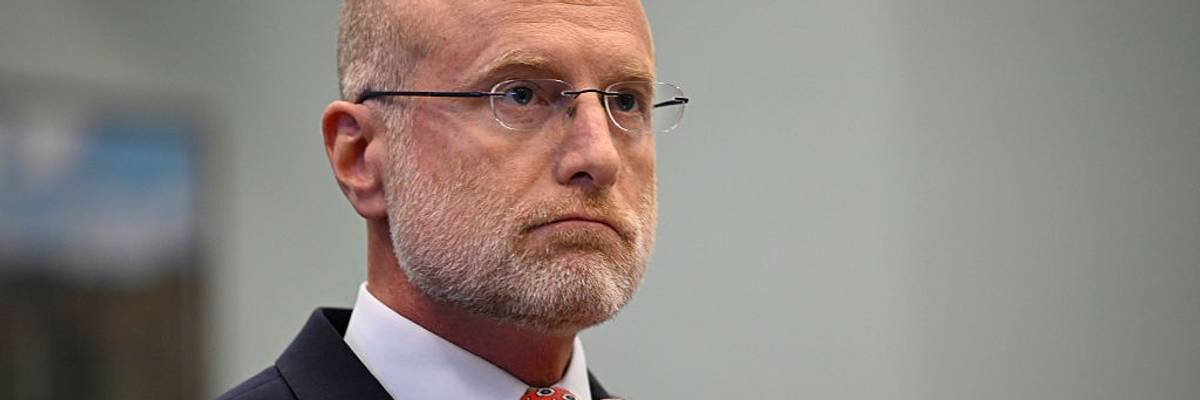
Federal Communications Commission Chairman Brendan Carr testifies before the House Appropriations Subcommittee on Financial Services and General Government at the Rayburn House Office Building on May 21, 2025 in Washington, DC.
(Photo by John McDonnell/Getty Images)COMMON DREAMS
In a move one administration critic described as “fragrantly unconstitutional,” Federal Communications Commission Chair Brendan Carr wrote a post on social media on Saturday that appeared to threaten the broadcast license of any media outlet that reported information concerning President Donald Trump’s war on Iran that the president did not like.
“Broadcasters that are running hoaxes and news distortions—also known as the fake news—have a chance now to correct course before their license renewals come up. The law is clear. Broadcasters must operate in the public interest, and they will lose their licenses if they do not,” Carr’s message began.
Carr also shared a screenshot of a Trump post on Truth Social complaining about “Fake News Media” coverage of five US Air Force refueling planes that were reportedly hit and damaged in an Iranian missile strike on Prince Sultan air base in Saudi Arabia.
“The[is] is the federal government telling news stations to provide favorable coverage of the war or their licenses will be pulled,” wrote Sen. Chris Murphy (D-Conn.) on social media in response to the post. “A truly extraordinary moment. We aren’t on the verge of a totalitarian takeover. WE ARE IN THE MIDDLE OF IT. Act like it.”
Several other media professionals, free speech advocates, and Democratic politicians understood Carr’s post as a threat.
“The truth is this war has been a failure of historic proportions. They don’t want Americans to know that.”
“The FCC is threatening the licenses of news stations that report on the effects of Iranian attacks on the American military,” wrote journalist Séamus Malekafzali.
Bulwark economics editor Catherine Rampell wrote, “FCC Chair Brendan Carr threatens broadcast licenses over Iran War coverage.”
Journalist Sam Stein posted, “The state doesn’t like the war coverage, threatens the license of the broadcasters.”
Independent news network MediasTouch wrote: “Brendan Carr is threatening the media to cover the war the way the Trump regime wants. It’s one of the most anti-American messages ever posted by a government official.”
“The truth is this war has been a failure of historic proportions. They don’t want Americans to know that,” the group continued.
“This is worse than the comedian stuff, and by a lot. The stakes here are much higher. He’s not talking about late night shows, he’s talking about how a war is covered.”
Several pointed out that such a threat would be in violation of the First Amendment of the US Constitution, which guarantees freedom of speech and of the press.
“Constitutional law 101: It’s illegal for the government to censor free speech it just doesn’t like about Trump’s Iran war,” Sen. Elizabeth Warren (D-Mass.) posted on social media. “This threat is straight out of the authoritarian playbook.”
Sen. Mark Kelly (D-Ariz.), who has faced scrutiny from the administration for advising service members to disobey illegal orders, wrote: “When our nation is at war it is critical that the press is free to report without government interference. It is literally in the Constitution. This is overreach by the FCC because this administration doesn’t like the microscope and doesn’t want to be held accountable.”
California Gov. Gavin Newsom wrote, “If Trump doesn’t like your coverage of the war, his FCC will pull your broadcast license. That is flagrantly unconstitutional.”
Aaron Terr, the director of public advocacy at the Foundation of Individual Rights and Expression, said: “The president’s hand-picked misinformation czar is at it again, singling out ‘fake news’ that conflicts with his boss’ political agenda. The First Amendment doesn’t allow the government to censor information about the war it’s waging.”
Free Press senior director of strategy and communications Timothy Karr responded to Carr with a screenshot of the First Amendment and the words: “Here it is—as it seems you’ve forgotten what you swore an oath to ‘support and defend.’”
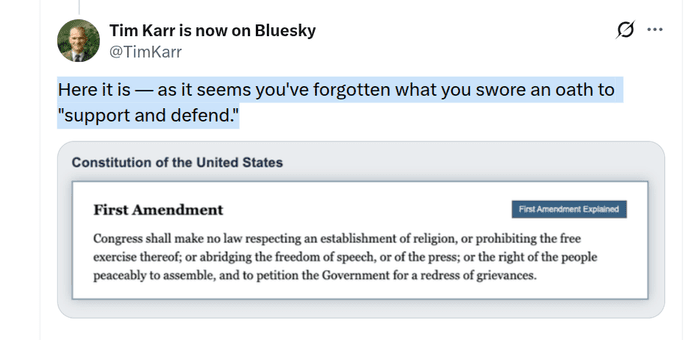
This is not the first time that Carr has been accused of putting his loyalty to Trump over his duty to the Constitution. In September, he pressured ABC to take comedian Jimmy Kimmel off the air over remarks Kimmel had made following the murder of Charlie Kirk.
While ABC eventually reinstated Kimmel’s show following public backlash, free speech advocates warned at the time that the Trump administration would not stop trying to censor opposing views.
“The Trump regime’s war on free speech is no joke—and it’s not over,” Free Press co-CEO Craig Aaron said at the time.
Indeed, Sen. Brian Schatz (D-Hawaii) wrote of Carr’s Saturday statement: “This is worse than the comedian stuff, and by a lot. The stakes here are much higher. He’s not talking about late night shows, he’s talking about how a war is covered.”
Carr’s note comes at a particularly urgent time for independent media coverage in the US, as Paramount Skydance, which is run by the son of pro-Trump billionaire Larry Ellison, is set to acquire Warner Bros. Discovery, which owns CNN. The Trump administration has often criticized CNN’s coverage, including of the war.
On Friday, Secretary of Defense Pete Hegseth told reporters, “The sooner David Ellison takes over that network, the better,” as he complained about a CNN report on how the Pentagon underestimated the risk that Iran would close the Strait of Hormuz in response to US aggression.
Carr has already spoken out in favor of the merger, telling CNBC he thought it was a “good deal, and I think it should get through pretty quickly.”
This piece has been updated with quotes from Sens. Chris Murphy, Elizabeth Warren, and Mark Kelly.
Experts alarmed as Trump FCC's new 'fascist' move dubbed 'truly extraordinary moment'
David McAfee
March 14, 2026 RAW STORY
Brendan Carr, chair of the Federal Communications Commission under President Donald Trump, stirred outrage when he issued a stark warning to television broadcasters, threatening license revocation for news coverage he characterizes as "hoaxes and news distortions."
"Broadcasters that are running hoaxes and news distortions—also known as the fake news—have a chance now to correct course before their license renewals come up," Carr stated. "The law is clear. Broadcasters must operate in the public interest, and they will lose their licenses if they do not."
The threat appears directed at media coverage of the Trump administration's Iran war, prompting immediate condemnation from media critics and Democratic lawmakers who characterized the remarks as an authoritarian attack on press freedom.
CNN senior political reporter Aaron Blake flagged the administration's approach: "The Trump administration is now threatening the licenses of broadcasters whose news coverage—apparently about the war—it deems to be 'fake.'"
Authoritarianism expert Ruth Ben-Ghiat responded to the threat with stark language. When Republicans Against Trump asked "What country are we living in?" Ben-Ghiat replied simply: "What authoritarians do."
Democratic Senator Chris Murphy issued an urgent warning, stating: "This is the federal government telling news stations to provide favorable coverage of the war or their licenses will be pulled. A truly extraordinary moment. We aren't on the verge of a totalitarian takeover. WE ARE IN THE MIDDLE OF IT. Act like it."
Senator Mark Kelly similarly condemned the FCC's overreach. "When our nation is at war it is critical that the press is free to report without government interference. It is literally in the Constitution. This is overreach by the FCC because this Administration doesn't like the microscope and doesn't want to be held accountable," Kelly said.
The threat represents an unprecedented use of federal regulatory authority to pressure media outlets based on their editorial coverage of government actions.
Dem hits Trump official with profanity-laden warning: 'You will be sued and you will lose'
David McAfee
March 14, 2026 RAW STORY+
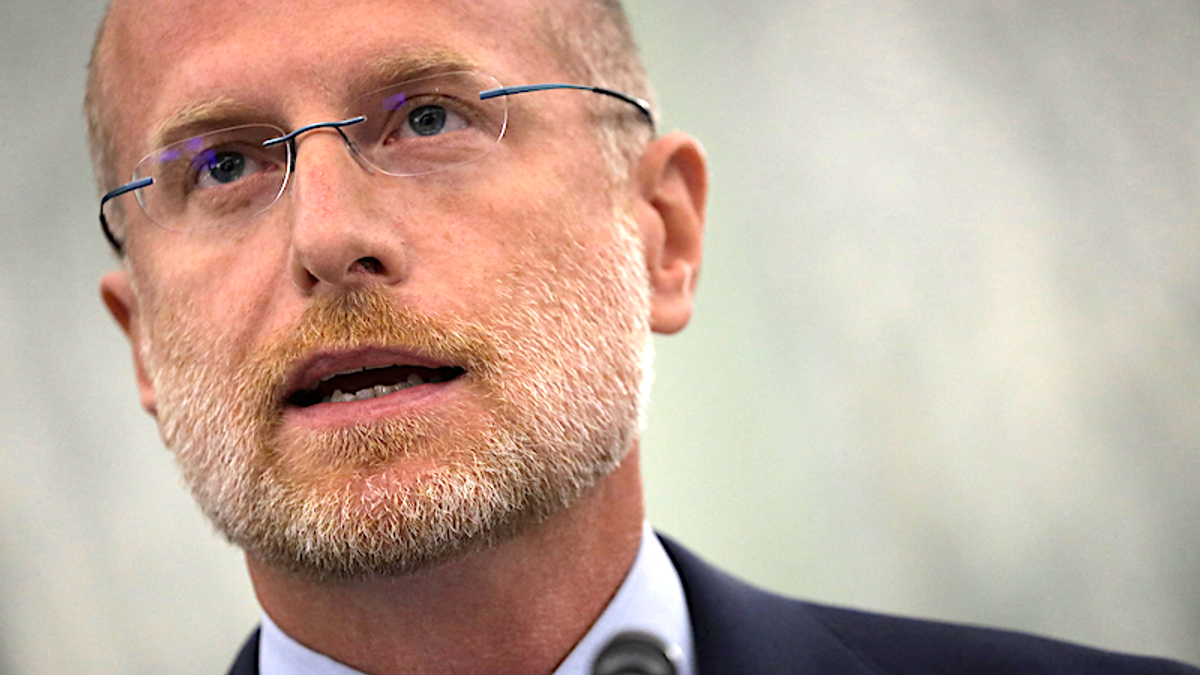
Commissioner of Federal Communications Commission Brendan Carr testifies during an oversight hearing held by the U.S. Senate Commerce, Science, and Transportation Committee to examine the Federal Communications Commission (FCC), in Washington, U.S. June 24, 2020. Alex Wong/Pool via REUTERS/File Photo
A Democratic congressman on Saturday issued a stern warning to a Trump official seen as threatening overreach on Free Speech in media.
Trump's pick, Commissioner of Federal Communications Commission Brendan Carr, over the weekend issued a warning of his own to broadcast media outlets. In a statement, Carr declared: "Broadcasters that are running hoaxes and news distortions - also known as the fake news - have a chance now to correct course before their license renewals come up. The law is clear. Broadcasters must operate in the public interest, and they will lose their licenses if they do not."
Carr's comments represented an unprecedented direct threat by a Trump administration official to use regulatory authority over media licensing as a tool to influence news coverage. One Democratic lawmaker pointed out as much in a post using some profanity.
Congressman Ted Lieu responded to the FCC head, writing, "Dear @BrendanCarrFCC: If you implement your flagrantly anti First Amendment actions, you will be sued and you will lose. And legal discovery will be awesome. Because the American people can then find out what the Administration keeps hiding."
Lieu then added, "Take your fascist s--- and shove it."


