Sunday, March 15, 2026

GOP Farm Bill Set to Unleash Pesticide Use and Strip Animal Welfare Protections

The bill protects agrochemicals producers from lawsuits, and overturns food and pesticide safety laws and statutes.
March 14, 2026

A crop duster flying low while spraying an alfalfa field near Tracy, San Joaquin County, California.Bill and Brigitte Clough / Design Pics Editorial / Universal Images Group via Getty Images


The “Farm, Food, and National Security Act of 2026” that is coming up for a House vote this spring is yet another GOP-led assault on the country’s food safety, warn public health organizations, environmental groups, and animal rights advocates, who are sounding the alarm over the five-year bill.

The House Committee on Agriculture passed the “Farm, Food, and National Security Act of 2026” on March 5 by a 34-17 vote. All 27 Republicans on the committee backed the bill, and seven Democrats crossed the aisle to join them. The legislation will now head to Congress.

The 800-page document is being praised by Big Agriculture and industry groups across the nation, and Rep. Glenn “GT” Thompson (R-Pennsylvania), chairman of the committee, has described it as “ a collaboration between Republicans, Democrats, and stakeholders.”

But public health advocates warn that the bill is set to further erode well-being and health in the U.S., further deepening the hypocrisy of Secretary of Health and Human Services (HHS) Robert F. Kennedy Jr.’s repeated promise to “Make America Healthy Again.”

“Rather than address the economic crises facing America’s family farmers, this Farm Bill is a thinly veiled gift bag for Big Ag and pesticide manufacturers. It’s a massive slap in the face to people across the political spectrum demanding a healthier food system,” said Jason Davidson, a senior food and agriculture campaigner with Friends of the Earth U.S.


RFK Jr. Supports Trump Push to Ramp Up Glyphosate Output, Angering MAHA Backers
“This executive order reads like it was drafted in a chemical company boardroom,” one MAHA critic said. By Chris Walker , Truthout February 19, 2026


Pesticides


Some of the most contentious sections of the bill concern pesticides.

Section 10205 blocks consumers and farmers harmed by pesticides from suing companies over inadequate safety labeling. Section 10206 would overturn all state and local laws that protect food safety. Section 10207 would repeal federal statutes created to protect people and animals from pesticides.

Rep. Chellie Pingree (D-Maine) introduced an amendment that would have stripped these sections from the bill, but the effort was rejected by the committee.

“Once again, the Trump Administration and Republicans in Congress are siding with chemical companies and choosing corporate profits over Americans’ health — while paying lip service to the ‘Make America Healthy Again’ movement. This Farm Bill is a gift to Big Chemical, plain and simple. It delivers exactly what giants like Bayer have spent years lobbying for: blanket immunity from lawsuits and the power to gut the state warning label laws that protect families, farmers, and children,” said the congresswoman in a statement.

Beyond Pesticides executive director Jay Feldman said the committee’s GOP majority have “passed a measure that has garnered across-the-board disapproval, except from those representing the vested interests of chemical companies and agribusiness.”

The push to shield chemical companies from liability is not occurring in a vacuum.

Shortly before the bill passed in committee, Bayer announced a proposed class settlement for the thousands of people who claim they developed non-Hodgkin lymphoma from exposure to the weedkiller Roundup. Those impacted had formerly sued Monsanto, but Bayer inherited the lawsuits when it acquired the company in 2018. The company is not admitting to any liability, but the proposed settlement totals $7.25 billion.

The herbicide at the center of those lawsuits is glyphosate, which the World Health Organization’s International Agency for Research on Cancer has classified as a “probable human carcinogen.” A day after the Bayer announcement, President Donald Trump invoked a wartime emergency authority to increase the domestic production of glyphosate. It’s a move that some insiders believe is directly connected to the lawsuits.

“The scope of this [litigation against Bayer] is way beyond anything we’ve ever seen in the pesticide context,” Nathan Donley, an environmental health science director at the Center for Biological Diversity, told Chemical & Engineering News. “We’re in a full-court press, basically, of Bayer trying to get out of its liabilities.”

When he ran for president in 2024, HHS Secretary Robert Kennedy Jr. called glyphosate “one of the likely culprits in America’s chronic disease epidemic.” However, he dutifully backed Trump’s order.

“Donald Trump’s executive order puts America first where it matters most — our defense readiness and our food supply,” said Kennedy in a statement. “We must safeguard America’s national security first, because all of our priorities depend on it. When hostile actors control critical inputs, they weaken our security. By expanding domestic production, we close that gap and protect American families.”

Kennedy’s shift has angered many in the “MAHA” community who have supported the Trump administration. “MAHA Moms Turn Against Trump” declares a recent New York Times headline.

“Women feel like they were lied to, that MAHA movement is a sham,” Turning Point USA podcaster Alex Clark told the paper. “How am I supposed to rally these women to vote red in the midterms? How can we win their trust back? I am unsure if we can.”


Animal Rights


Section 12006 of the farm bill looks to overturn animal welfare laws by effectively adopting the “Save Our Bacon” Act, a Republican congressional effort that’s failed to gather support from more than 10 percent of the House.

That legislation takes aim at California’s Prop 12 and Massachusetts’ Question 3, which place limits on the sale of meat and eggs from farms where animals are not granted enough room to turn around, stand up, lie down, and fully extend their limbs. Both measures were overwhelmingly approved by state voters, but Big Agriculture lobbyists have consistently pushed for both laws to be overturned.

A coalition of pork producers, meat companies, and farmers recently gathered in Washington to call for the “Save Our Bacon” Act to be removed from the farm bill.

“Voters made their voices heard, and we agree with them that animals deserve space to move,” said Missouri hog farmer Russ Kremer. “Prop 12 gives small farms like ours the opportunity to survive during a time when agriculture is heavily consolidated and independent farmers are being pushed out. If Congress rolls back Prop 12, that’s a move against family farmers.”

The fight to topple these state laws comes amid a Department of Agriculture push to speed up the kill lines across U.S. slaughterhouses. The new draft rules propose increasing kill line speeds for chickens from 140 a minute to 175, turkeys from 55 to 60, and pig slaughterhouses would have no limit. The department has also proposed eliminating annual workplace safety reports at the plants.

Let Them Eat Contaminated Meat

The proposed farm bill also doubles down on the Trump administration’s Dietary Guidelines, which recommend that Americans eat significantly more meat. Instead of basing these recommendations on scientific research, the Trump team relied on nine experts, seven of whom had direct connections to the meat industry.

In addition to improving public health and reducing pollution, a decrease in meat consumption would reduce the greenhouse gas emissions responsible for climate change. A 2025 report from the scientific journal Nature Climate Change found that 11 million tons of meat is consumed in U.S. cities annually, resulting in roughly 329 million tons of carbon emissions.

Democratic committee members proposed amendments to the farm bill aimed at addressing the devastating Supplemental Nutrition Assistance Program (SNAP) cuts from Trump’s “One Big Beautiful Bill Act,” but these were rejected.

“Every member of the House Agriculture Committee represents families with low incomes who need SNAP to afford groceries, and it is deeply disappointing to see all Republicans and some Democratic members of the House Agriculture Committee vote to advance a bill that fails to deliver for these constituents,” said the Center on Budget and Policy Priorities in a statement.

Instead, Trump’s reinforced dietary guidelines designate animal protein as a SNAP “incentive food” allowing retailers to bolster meat consumption by offering it to SNAP recipients at a discount. What quality of meat would these consumers be eating? As previously mentioned, the bill would prohibit states from taking action to protect their constituents from drugs and pathogens in their food supply.

“If passed by the House, this Farm Bill will move to the Senate, but this proposal should be dead on arrival,” wrote Food & Water Watch’s Lauren Borsheim. “A Farm Bill that ignores devastating SNAP cuts, weakens vital conservation programs, subsidizes factory farms, and shields pesticide corporations from accountability betrays the Farm Bill’s purpose — serving farmers, consumers, and rural communities.”


This article is licensed under Creative Commons (CC BY-NC-ND 4.0), and you are free to share and republish under the terms of the license.


Michael Arria
Michael Arria is the U.S. correspondent for Mondoweiss. Follow him on Twitter: @michaelarria.

Secrets, sexism and hypocrisy: Inside the Murdochs' real succession drama


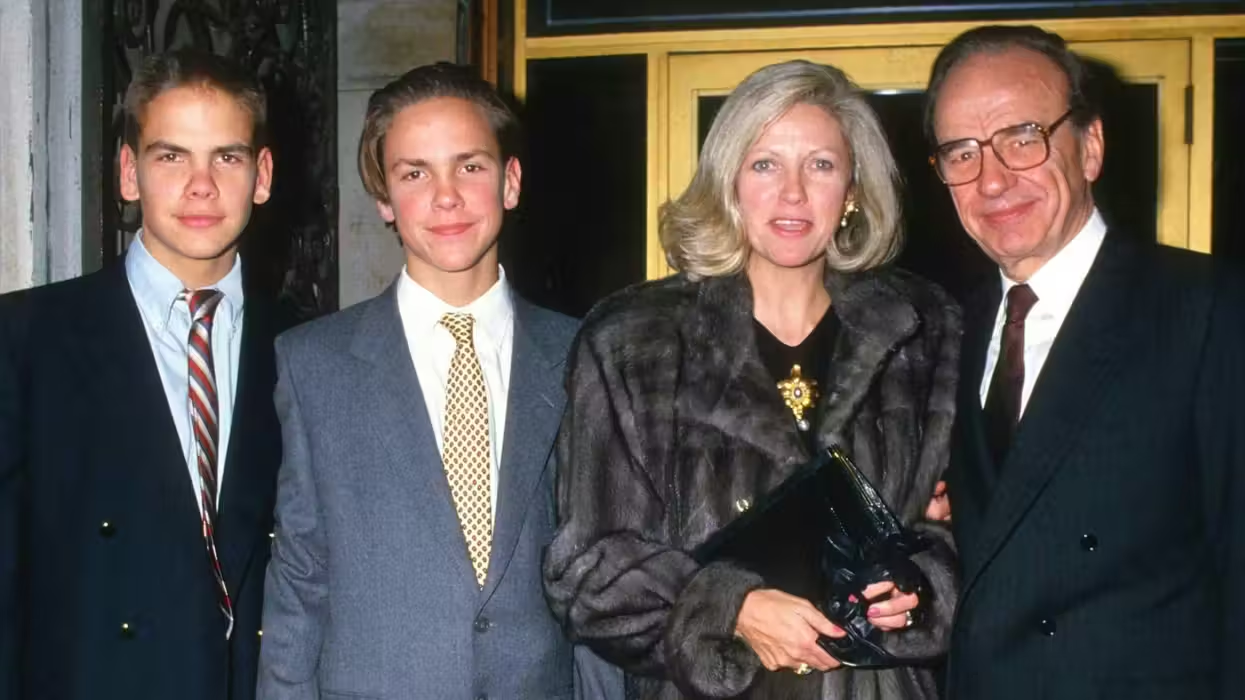
Ron Galella Ltd/Ron Galella Collection/Getty Images
March 13, 2026

Does the world need another biography of Rupert Murdoch? It depends what it has to say and who has written it.

Bonfire of the Murdochs, by journalist Gabriel Sherman, looks promising. He made his name with an exhaustively researched biography of long-running Fox News head and serial sexual harasser, Roger Ailes. The Loudest Voice in the Room (2014) has 98 pages of endnotes and a team of three fact-checkers. It was made into a series starring Russell Crowe as Ailes. Sherman was also the screenwriter of Donald Trump biopic, The Apprentice, which Trump fought hard to prevent being screened.

Promising credentials, yes, but what does Sherman add to the eight Murdoch biographies already published?

The first was Simon Regan’s business-oriented biography published in 1976. It has been forgotten, but not so George Munster’s A Paper Prince (1985), which laid out Murdoch’s deal-making modus operandi, nor William Shawcross’ 1992 semi-authorised work, which charted Murdoch’s creation of the first global media empire.

Michael Wolff’s The Man Who Owns the News (2008) painted the most vivid portrait of the Australian born media mogul. Flushed with the success of buying The Wall Street Journal, Murdoch agreed to more than 50 hours of interviews with Wolff and opened the doors of his notoriously secretive media empire to the Vanity Fair media columnist.

Wolff did report the Wall Street Journal takeover in detail, but he also retailed a breathtaking amount of industry and family gossip.

One example among many. He writes that Prudence, Murdoch’s daughter from his first marriage, gave him exasperated grooming advice after Murdoch botched a DIY makeover as he tried keeping up with Wendi Deng, his third wife who was the same age as his children.
“Dad, I understand about dyeing the hair and the age thing. Just go somewhere proper. What you need is very light highlights.” But he insists on doing it overthe sink because he doesn’t want anybody to know. Well, hello! Look in the mirror.Look at the pictures in the paper. It’s such a hatchet job.


Murdoch’s response? He told her she needed a face lift.

Murdoch’s response to Wolff’s biography was that it needed more than a face lift – it should not have been published with the errors it had. He did not sue for defamation, however. Wolff has since become an even more controversial figure: he is embroiled in suit and counter-suit with Donald and Melania Trump over Wolff’s claims about Trump’s relationship with convicted sex offender Jeffrey Epstein.

The long-running struggle for succession in the Murdoch family famously inspired the brilliantly coruscating fictional television series Succession (2018–2023). Sherman’s is the first biography to deal with its resolution, which happened only last September, when Rupert Murdoch and his eldest son, Lachlan, succeeded in changing the terms of an apparently irrevocable family trust.

The trust had been created when Rupert and his second wife, Anna, separated in 1998. (She died on February 17 this year.) It was her attempt to put a brake on Murdoch’s continual pitting of his children, especially his sons, against each other in the quest to succeed him as head of News Corporation.

It didn’t work. Rupert’s plan for Lachlan to lead the company, continuing its hard right position led by Fox News, eventually succeeded. To a greater or lesser degree, the other children from his first two marriages – Prudence, Elisabeth and James – loathed what Fox News had become and, reportedly led by James, were prepared to use their votes in the family trust to oust Lachlan after Rupert died.

In the end, though, they agreed to sell their shares in the family trust for US$1.1 billion each. Grace and Chloe, the two children from Murdoch’s third marriage, are part of a newly drawn family trust with their own shares in News.

The machinations behind this episode were reported last year in two extraordinary pieces of journalism, by Jonathan Mahler and Jim Rutenberg of The New York Times, who were leaked 3,000 pages of court documents about the case, and by McKay Coppins in The Atlantic magazine. He secured a long, revealing interview with James Murdoch, who was labelled in Rupert and Lachlan’s legal materials the “troublesome beneficiary”.

For those without subscriptions to these publications, my colleague, Andrew Dodd, and I discussed the case in The Conversation here and here.

An outstanding journalist

Sherman, another outstanding journalist, has been reporting on the Murdochs since 2008. Ailes threatened him with legal action and engineered a smear campaign over The Loudest Voice in the Room, as Sherman calmly detailed in “A Note on Sources” at the end of the book. It was Sherman who in 2016 broke the news about Fox News presenter Gretchen Carlson’s sexual harassment suit against Ailes that led to his ousting from the network.

In 2018, he revealed Murdoch came close to death after a fall on Lachlan’s maxi-yacht while sailing in the Caribbean.

Sherman also had the inside scoop on the end of Murdoch’s fourth marriage in 2022. The then 91-year-old mogul not only broke up by text with his wife, supermodel and actor Jerry Hall, but included in the divorce terms a demand she not give story ideas to the scriptwriters of Succession!

Hall later realised the marriage had ended, in Murdoch’s eyes, some time before, when he met Ann Lesley Smith, a 65-year-old former dental hygienist turned conservative radio host and follower of QAnon-style conspiracy theories. At a dinner at Murdoch’s ranch in Carmel, Smith gushed that Murdoch and Fox News were the saviours of democracy, and offered to clean his teeth for him.

Murdoch proposed to Smith in early 2023, but he soon called off the wedding after another dinner, where she told then Fox News host Tucker Carlson he was a messenger from God. Hall felt humiliated by Murdoch’s treatment of her but told friends she took satisfaction in making an effigy of him, tying dental floss around its neck and burning it on the barbecue.

All these disclosures, and gossip, are included in Bonfire of the Murdochs. Indeed, Sherman’s reporting, for New York and Vanity Fair magazines, forms a good deal of the book. If you have already read his lengthy articles, there is not much new here. But if you haven’t, or if you are confused by the countless deals and complex financial/political transactions of Murdoch’s seven-decades-plus career in media, this biography is well worth reading.

‘Destroyed everything he loved’

At 241 pages, it has the virtue, as well as the shortcoming, of being the shortest of the Murdoch biographies. Sherman has a gift for succinctly summarising key themes.

The first is that more than most, Murdoch’s media empire is secretive. Remember, his plan to change the family trust was supposed to be heard behind closed doors. We only know about it because The New York Times was leaked the court records, which revealed Murdoch’s testimony. As Sherman puts it: “Rupert crafted narratives in the shadows, but the courtroom would require him to do it in the open.”

Initially, it did not go well for Murdoch. Under cross-examination, his determination to get his way no matter what and his sexism towards his daughters was revealed.

The second theme is the extent to which Murdoch will ignore the stated mission of his media outlets – report what is happening accurately – if it aligns with his commercial goals. During the global pandemic, while Fox News hosts fulminated about lockdowns and advocated dubious treatments like hydroxychloroquine, Murdoch followed the science and, Sherman reports, was one of the first in the world to be vaccinated, in December 2020.

“He was scared for himself and was very careful,” a person who spoke to Murdoch at the time recalled for Sherman. Questioned about the disconnect between his network’s coverage and his own behaviour, Murdoch would deflect responsibility for the presenters’ commentary, even though this seeming passivity contrasted sharply with his history of editorial interference.

As Sherman comments: “The hypocrisy revealed something essential about Rupert’s worldview: he had always been able to separate his personal beliefs from his business interests.” He adds that Murdoch thought then president, Donald Trump, grievously mishandled the pandemic but refused to use his position as head of Fox to pressure the president to treat it seriously.

Nor did Murdoch take any responsibility when a friend told him the channel was killing its elderly audience. According to one of Sherman’s sources, he replied: “They’re dying from old age and other illnesses, but COVID was being blamed.”

The biographer quotes other sources who say the quid pro quo was that Murdoch had successfully lobbied Trump in his first term to take action against Facebook and Google, who were winning advertising revenue from News (along with other legacy media companies) and to open up land for fracking, which was to boost the value of Murdoch’s fossil fuel investments.

The third theme is that Murdoch built the world’s first global media empire but has always run his companies as a family business, with him as the first and ultimate decision-maker. Nimbleness is the advantage of this approach. As with any autocratically run organisation, though, there are disadvantages. Among them is that no one has a perfect strike rate for success.

Along the way, talented executives such as Barry Diller, former chief executive at Twentieth Century Fox or Chase Carey, former top executive at 21st Century Fox, knew – or found out – that their path to the top was blocked not only by the company’s head, but by Murdoch’s desire to advance or protect family members. Murdoch once told shareholders complaining about nepotism: “If you don’t like it, sell your shares.”

From the 1950s, when Murdoch was the “boy publisher” of the afternoon newspaper he inherited from his father, the Adelaide News, he behaved, Sherman writes, as though “promises were like inconvenient facts: fungible when they got in the way of profit.” The newspaper’s editor, Rohan Rivett, was the first among several, alongside numerous politicians, who learnt this to their cost.

The fourth theme is that Murdoch has always wanted his children involved in his business, but only on his terms. “Growing up,” Sherman writes, “the children’s relationship to their father was expressed through the business, making them equate paternal love with corporate advancement.”

Where earlier writers have drawn parallels with Shakespeare’s King Lear, Sherman thinks King Midas is a more appropriate comparison.
Like the mythical monarch whose touch turned everything to gold, Rupert built a $17 billion fortune but destroyed everything he loved in the process. His media outlets stoked hatred and division on an industrial scale, and amassing that wealthrequired him to damage virtually anything he touched: the environment, women’srights, the Republican Party, truth, decency – even his own family.


The weakest part

These are potent themes that resonate with those of us living in the country of Murdoch’s origin, which brings us to the book’s shortcoming. Australia features early on, but this is the weakest part of the book. Murdoch’s early years are well covered in Munster and Shawcross’s biographies and more recently have been given detailed attention in Walter Marsh’s Young Rupert (2023).

There are basic errors: The Daily Mirror in Sydney, which Murdoch bought in 1960, is misnamed The Mirror, while the Herald and Weekly Times Ltd., which he bought in 1987, becomes the Herald Times Group. Nor does it help that on the book’s final page, Sherman writes “Rupert was with his fourth wife while his children were scattered across the globe” – when Murdoch had discarded Jerry Hall in 2022 and was now married a fifth time, to Elena Zhukova.

Fourth, fifth? It’s easy to lose count. More seriously, in buying the HWT, Murdoch became the dominant newspaper owner in Australia, but his control did not account for 75% of the market, as Sherman writes. It is more like 60% to 65%, depending on whether you use circulation or number of newspapers as a measure.

Murdoch’s early years in Australia are briskly dealt with in chapter one, before he moves on in his relentless quest to acquire more media properties in the United Kingdom and the US. This is true as far as it goes, but once Murdoch does head north, his biographer loses almost all interest in how Australia is faring – even, or especially actually, after Murdoch acquires the HWT.

The same is true to a lesser extent with Sherman’s treatment of the UK. The phone hacking scandal is covered, of course, but not much else is once Murdoch arrives in New York in the mid-seventies.

What is lost, then, in Sherman’s compression, is context for events. Such as: where did the phone hacking culture come from? What lengths did News go to in denying the practice went beyond two “rogue reporters” or in obstructing official inquiries? Why have they since paid so much money settling with phone hacking victims, rather than going to court?

Missing, too, is any sense of the connections between Murdoch’s media outlets in the three main countries in which News operates. Has the hostile coverage of trans people been imported from Fox News to Sky News Australia? What affect has his media outlets’ campaigning against action on climate change had across these three countries?

These, and others, are relevant questions to ask about a global media empire. Rupert Murdoch may have handed over the company to Lachlan in 2023, but he led it for 70 years, he created its culture and he still wields influence. In case it passed you by, it was Rupert Murdoch – not Lachlan, according to the reports – who in February had a private dinner at the White House with US president Donald Trump.


Matthew Ricketson, Professor of Communication, Deakin University

This article is republished from The Conversation under a Creative Commons license. Read the original article.
\
Report reveals fundamentalist extremism spreading through Trump's Pentagon


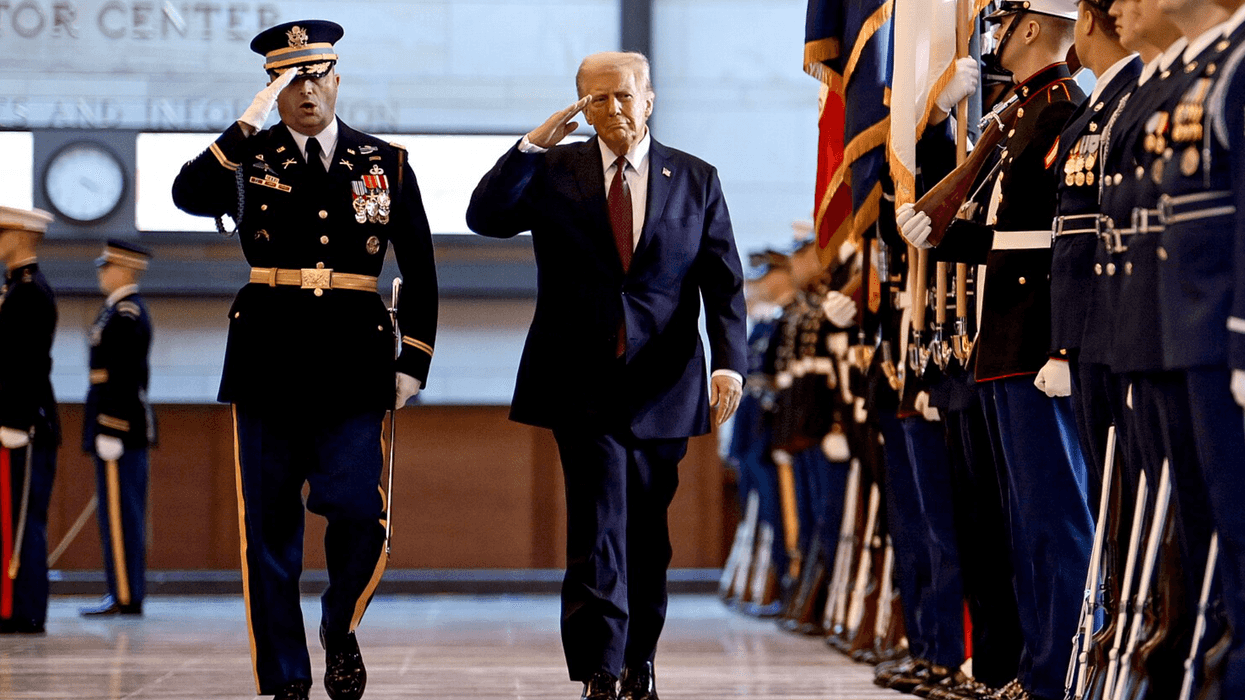
President Donald Trump reviews the troops in Emancipation Hall in Washington, D.C., during his Inauguration ceremony on Jan. 20, 2024. GREG NASH/POOL VIA REUTERS

March 13, 2026
ALTERNET


At a Pentagon recent press briefing, Defense Secretary Pete Hegseth closed his remarks with a reading from the Bible’s Book of Psalms, ending with “Amen.”

That was not the first time Hegseth has used prominent Christian declarations in public, and it’s apparently bleeding over to others in the military. Some members of Congress are now calling for a Department of Defense investigation into military officers allegedly invoking the Bible in pursuit of the Iran war.

What is clear is that Hegseth and others are putting an evangelical Christian nationalist spin on a range of things, from Charlie Kirk's murder to the military and Iran. That is fraught with implications during a war with a nation where the main religion is Islam.

Hegseth has been hosting monthly worship services, overlaying Scripture on images of fighter jets and missile systems, and telling assembled troops the country needed to be “on bended knee, recognizing the providence of our Lord and Savior Jesus Christ.”

That, says the Religion News Service (RNS) “raises the uncomfortable question” of what the language of Christianity means for the DoG while at war.

Diving into that question, the RNS repeated an interview that aired last year on the podcast “Complexified” between host Amanda Henderson and RNS reporter Jack Jenkins.

Jenkins said that historically, religious expression in the U.S. military is not uncommon. “We’ve had many a military leader reference God or Christianity at some point in some sort of vague ways that are often kind of considered part of what’s referred to as the civil religion of the United States — kind of these more vague appeals,” Jenkins said. The Pentagon, Jenkins notes, has chaplains, hosts Mass five times a week, and houses a chapel that regularly holds worship services for a myriad of different faith traditions.

But Hegseth’s approach seems to center his form of Christianity, Jenkins said.

Hegseth spoke at the Charlie Kirk memorial and once again seemed to center his own version of Christianity rather than the more traditional vague invocations, Jenkins said.

“He again made this overt appeal to Americans to also embrace the specific kind of Christianity that he was modeling,” Jenkins said. Now, he’s not saying, like, ‘Join my denomination.’ But it’s very clearly coming from an evangelical Christian space.”

Another way that is being demonstrated is in military recruitment videos. Many of the promotional videos for the U.S. military overlay imagery of weapons of war and service members with a Bible verse.

That raises the question of whether they’re intentionally trying to recruit people “with the idea that the U.S. military is also something that can be held in concert with one specifically evangelical Christian faith,” Jenkins said.

Whether there has been pushback on this overt religion trend is unclear, Jenkins said. But given its ongoing presence in the public proclamations, an order to halt is unlikely.


THE EPSTEIN CLASS


Newsmax freaks after Whoopi Goldberg claims Trump launched war to distract from Epstein

Alexander Willis
March 15, 2026 
RAW STORY


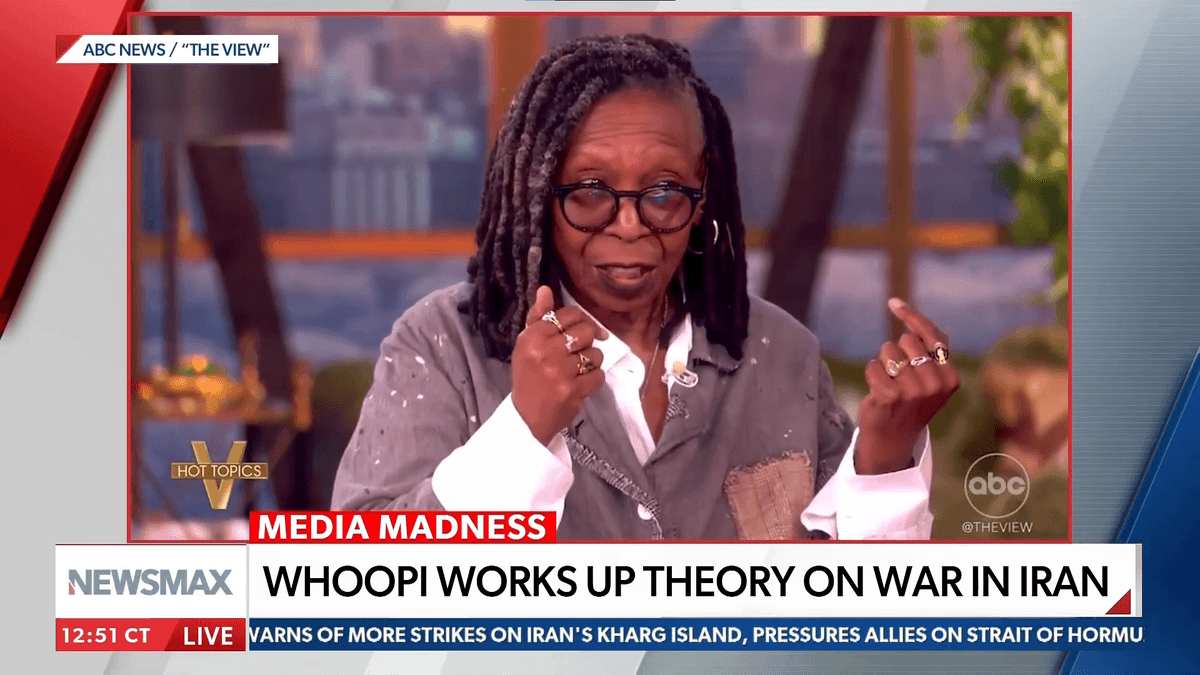
Whoopi Goldberg speaks on ABC's "The View" in a clip aired by Newsmax on March 15, 2026. (Screengrab / Newsmax)

The View’s Whoopi Goldberg sparked outrage on Newsmax Sunday after accusing President Donald Trump of launching war against Iran partly to distract from his administration’s botched handling of the Jeffrey Epstein files.

“The liberal media doing what they do best: spin the narrative!” noted one Newsmax host.

Goldberg’s comments were made last week on ABC’s The View, where she wondered out loud why discussions around both Epstein and the disappearance of Nancy Guthrie, the 84-year-old mother of “Today” co-host Savannah Guthrie, had chilled since the Trump administration launched its attack on Iran.

“Why haven’t we been talking about Savannah Guthrie and what's going on there, why have we not been talking about the Epstein files?” Goldberg said, her question sparking applause. “This is meant to get us so worked up that we are unable to see anything else.”

Goldberg’s suggestion – that Trump launched strikes on Iran to distract Americans from the Epstein scandal plaguing his administration – is supported by a majority of Americans, who in a recent poll said by a margin of 52-40 that they believe Trump was “at least partly motivated to take military action against Iran in order to distract from the Jeffrey Epstein scandal,” Drop Site News reported.

Nevertheless, another Newsmax anchor characterized the suggestion as a conspiracy theory before asking Curtis Houck, conservative news analyst and guest on the network, for their take on Goldberg’s comments.

“There's no new information about Nancy Guthrie, unfortunately, so that doesn't make any sense,” Houck said. “Of course, Epstein is the other example that's going on out there.”


'Everybody knew' what was happening on that island: ex-Epstein architect


Epstein's architect and interior designer Robert Couturier (YouTube Screengrab)

March 13, 2026
ALTERNET


CNN reporter Kyung Lah provided an exclusive interview with architect and interior designer Robert Couturier, who was hired by convicted sex-trafficker Jeffrey Epstein to work on his infamous island. CNN reports Couturier backed out of the project after a few months and then alerted the FBI of what Epstein had requested he build.

“There's no mistaking,” Couturier told Lah. “You don't put women on bunk beds. I'm sorry. Everybody knew what was happening on that island. Even his staff people worked for him.”

When Couturier first noted all the puzzling bunk beds he asked who they were for.

“There were bunk beds and I said to him, I said, ‘oh my god, are you expecting grandchildren?’ And he said, ‘no, these are for my — these are for the girls.”

Lah reports a former staffer said the main home had “many pictures of young girls, some topless, looking about 15 to 16 years old” in room after room of the island home.

According to CNN, files show “visible signs of something off,” including Epstein in his kitchen chasing girls or young women, which his staff noticed. A former chef, said Lah, claimed every hour Epstein would take a girl down to his master bedroom then order his maid to clean up. Another staffer worried about Epstein’s guests.

“He described seeing an unnamed man with girls who did not look 18, and they were all naked,” said Lah. “He also told the FBI he saw then Prince Andrew grinding against some young girl in the pool. UK authorities arrested Andrew last month saying they're reviewing claims he shared sensitive government information with Epstein.”

CNN reports Virgin Islands prosecutors say Epstein coerced girls as young as 12 into sexual activity.

“One victim said she was trapped on the island and tried to escape Epstein and the others by trying to swim off [the island] after spending the day being raped,” said Lah.

“The girls and young women went on the island were basic prisoners,” said Couturier. “You couldn't leave.”


'Disaster': Ann Coulter slams Trump’s 'utterly pointless' Iran blunder


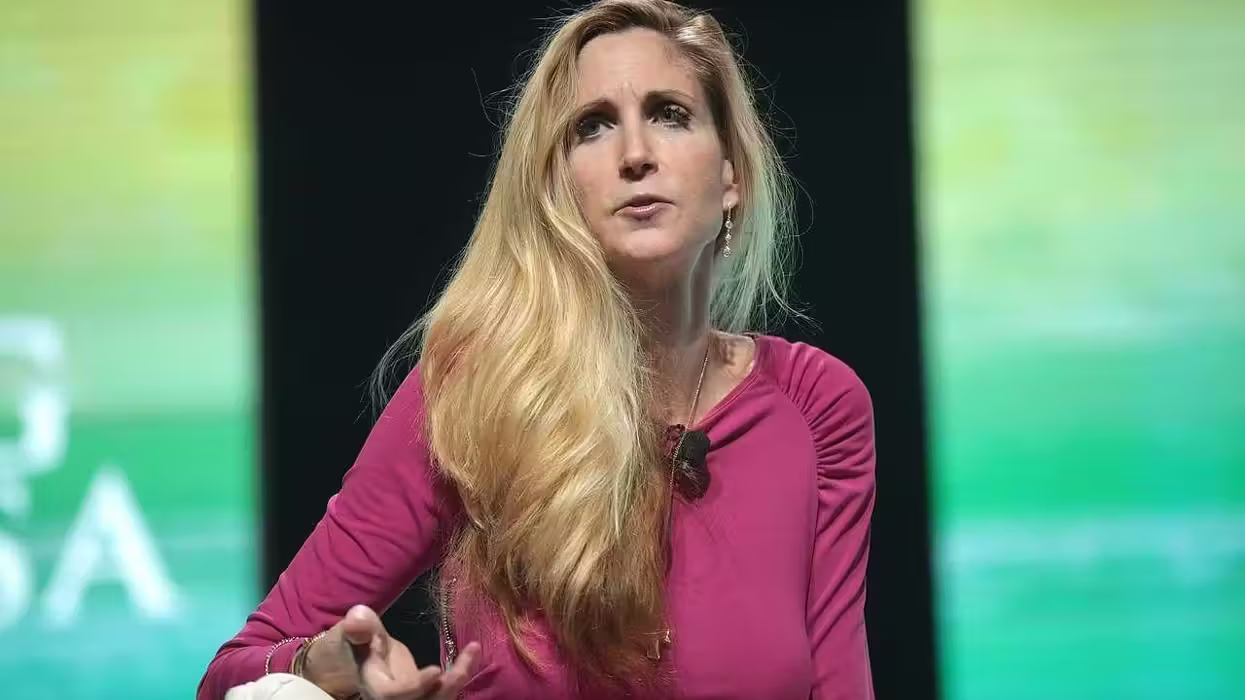
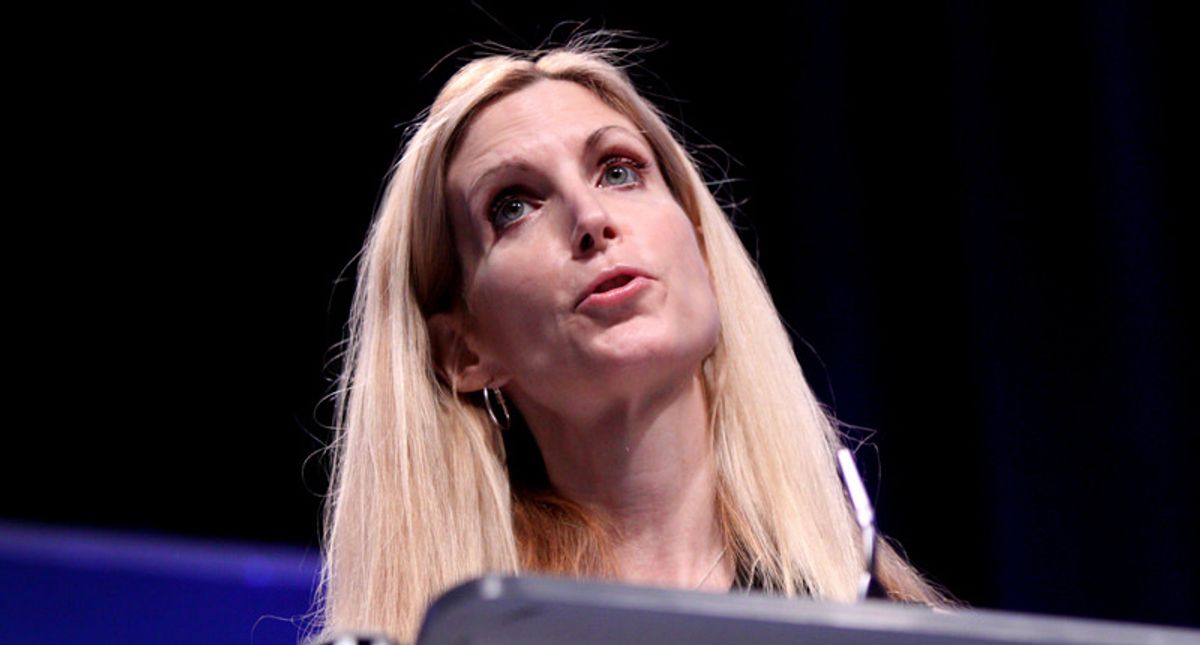
Ann Coulter at the 2019 Student Action Summit, hosted by Turning Point USA, in West Palm Beach, Florida on December 20, 2019 (Gage Skidmore/Flickr)
March 13, 2026
ALTERNET

When the 2024 GOP presidential primary got underway, far-right author Ann Coulter was quite bullish on Florida Gov. Ron DeSantis — who, she argued, would be a much stronger candidate than Donald Trump. Coulter attacked Trump as a RINO (Republican In Name Only), arguing that he wasn't nearly as powerful within the Republican Party as many of his critics said he was. But DeSantis ended up dropping out of the race and endorsing Trump, who became the GOP nominee and narrowly defeated Democratic opponent Kamala Harris in the general election.

Now, almost 15 months into Trump's second presidency, Coulter — although not an outright Never Trumper — isn't shy about criticizing him. And during a March 12 appearance on The First TV, a right-media media outlet, she offered scathing criticism of Trump's decision to go to war against Iran.

Asked "Why are you mad at Trump right now?," Coulter told host Jesse Kelly, "I think this war is a disaster. A disaster. Utterly pointless."

Coulter told host Jesse Kelly that Trump campaigned on "no more pointless wars" — a promise he is breaking now.

"Waging pointless wars around the world, being the world's policeman — how many times do we have to vote on this?," Coulter argued. "I mean, Trump was attacked for the things he said in 2016. Remember, he said… (Republicans) lied us into war, and the Wall Street Journal and New York Post assured us that was going to kill him in South Carolina…. We have voted on this over and over and over again."

Coulter continued, "So now, we've had, how many Americans — seven — die? Not to mention 166 schoolchildren in our name for a war in our name that does not make one American safer."


Conservative commentator shocks with new attack on Trump's Iran war move

David McAfee
March 15, 2026 
RAW STORY


Conservative commentator and author Ann Coulter speaking at CPAC 2011 in Washington, D.C. (Gage Skidmore/Flickr

Conservative commentator Ann Coulter presented a stark hypothetical scenario to illustrate what she characterizes as a double standard in the Trump administration's approach to civilian casualties in the Iran conflict.

Coulter posed a thought experiment: "Suppose Iran dispatched operatives to Mexico, where, from the Texas border, they fired a missile at an American base and, unintentionally but carelessly, demolished a nearby American school, killing 175 people."

She then escalated the scenario to include additional infrastructure strikes: "What if they then blew up fuel depots, showering a chemical rain on residents? Then struck homes, schools and clinics, as Iran's leader warned that 'death, fire and fury' would so pulverize America that it could never be rebuilt?"

Coulter's rhetorical point directly mirrors documented events from the actual Iran conflict. The U.S. military has been credibly accused of bombing an Iranian girls' school on the conflict's opening day, killing approximately 175 children. American strikes have also damaged fuel depots, resulting in toxic oil rain over civilian areas, and targeted residential neighborhoods and medical facilities.

"In that case, President Trump — and all of us — would howl at outrageous attacks on innocent civilians. And we'd be right," Coulter concluded, suggesting that identical actions warrant identical moral judgment regardless of which nation commits them.


'I’m a fool I guess': MAGA voter snaps after Trump attacks those questioning war


A woman at the "Million MAGA March" in Washington D.C. on December 8, 2020 (Image: Shutterstock)

Sarah K. Burris 
March 13, 2026 
ALTERNET

President Donald Trump is being asked frequently when the war against Iran will be over, because gas prices are adding further financial burden to Americans who were already strapped in the difficult economy.

"Short term oil prices, which will drop rapidly when the destruction of the Iran nuclear threat is over, is a very small price to pay for USA , and the World, Safety and Peace," he wrote on Truth Social last weekend. He then added in all capital letters "Only fools would think differently!"

That didn't sit well with one former Trump voter in Michigan, who joined a focus group hosted by the Engagious Marketing Agency.

"I'm a fool, I guess," said a woman only known as Lindsay. "Well, the prices were down slightly for a short period of time but currently, where I'm at, prices have jumped a dollar. So, for someone like me who is a working person, I mean, yeah, it's good for him to say who makes, you know $1 million a day or whatever, an hour. But on the other hand, it makes a very big difference to someone like me who has to fill in the gas tank every single week and go to work."

CNN journalist and political analyst, David Chalian noted it's the same concern a lot of people have including "every politician who's on the ballot this year is expressing right now. Chalen said those politicians are facing "the wrath of voters, especially in the Republican Party, given this was you know, President Trump's decision to launch [the war]."

There is a desire, he added, among Republicans, "to find a way to get out of this quickly. I don't think cleanly is an option anymore, obviously. But to find a way to get out of this quickly, declare some victory on objectives and start focusing the attention back on economic concerns."

CNN columnist Aaron Blake noted on the website Friday that this is the second year in a row that Trump has asked Americans to sacrifice "short-term pain for long-term gain." In 2025, it was about his tariffs, and now it's about his war.

Atlanta Journal-Constitution Washington Bureau Chief Tia Mitchell remarked that Blake's comments come as many Americans don't even understand the reasons behind both the war and the tariffs.

"And the Trump administration has provided several answers to that. And the answers seem to change day by day. Same with the tariffs," Mitchell added, recalling a 2025 promise Trump made that his tariffs would bring manufacturing back into the U.S.

"And so, I think, there are even voters who would like to give President Trump the benefit of the doubt, but it's hard to do that when they don't have a consistent message to kind of hang their hat on [as to] why they're there enduring the short-term pain," she said.

That sentiment was on display in the second clip of the focus group CNN showed.

Almost every answer as to why America went to war was different. Some said it was about regime change, others attributed it to Israel, while others said, "they attacked us first."

Associated Press reporter Seung Min Kim said that it perfectly captures the problem with Trump's failure to make the case to the American public why the war is necessary. The pressident announced the war after 3 a.m. EST on a Saturday morning, by posting a video to Truth Social from his country club in Florida.


Dark money group offers influencers cash to trash Illinois Democrat: report


Democratic Congress candidate Kat Abughazaleh was targeted by a dark money group. (Wikimedia Commons)

March 14, 2026 
ALTERNET

A dark money group offered at least two social media influencers $1,500 apiece for a single negative social media post about progressive Illinois Democrat candidate Kat Abughazaleh.

Abughazaleh is running against 15 other Democrats in their primary for the chance to replace retiring Representative Jan Schakowsky in Illinois’s 9th congressional district.

MS Now reports TikTok and Instagram influencer Amanda Informed was among those approached with the offer. The dark money group, Democracy Unmuted, requested an anti-Abughazaleh post. She declined and reported the approach to the media.

The memo sent to Amanda from Democracy Unmuted asked influencers to “encourage voters to look past viral personalities and ask real questions about who is running and why.” They disparaged the candidate as being from a wealthy family who doesn’t know her district.

“Kat’s campaign appears designed for attention rather than impact,” it stated.

Amanda Informed said she turned it down because of the source’s anonymity.

“The money didn’t feel right coming from someone who’s not disclosing where the money is coming from,” Amanda Informed told MS NOW. “That’s not something that I want to be involved in. I want to make sure that it’s coming from a source that is not doing nefarious things like interfering with elections.”

However, others may not have turned down the bounty. A Missouri political influencer named Justin Kralemann, known as “The Woke Ginger” on social media, read Democracy Unmuted’s anti-Abughazaleh talking points word for word in a recent Instagram and TikTok post, MS Now reports.

He mispronounced Abughazaleh’s name, but later denied being paid for the video blast.

Democracy Unmuted just registered its website two weeks ago. It is reportedly a group of “individuals from the [Illinois] area who have served in the highest offices and been at top of their game in the media,” said Matt Anthes, founder of the digital political advocacy firm Advocators, to MS NOW.

Anthes was the facilitator of the dark money offer, but he refused to reveal details of just who is behind the group. “We don’t comment on or disclose the identity of our clients. What we can tell you is that all of our dealings and practices are fully compliant with FEC rules and regulations, including those at our creative agency partner, Upstart Factory.”

Abigail Bellows, senior policy director of anti-corruption at Common Cause, said weak campaign finance laws have made such social media attempts possible and completely legal.

“Dark money groups have grown to exercise tremendous influence.… With a lot of these competitive races, these groups can spring up overnight,” Bellows said to MS-NOW. “These dark money groups use these shadowy vehicles for political participation that really undercuts voters.… It just breeds distrust.”

Abughazaleh’s campaign has called the claims defamatory.

“We have become aware of a coordinated influencer campaign attacking Kat Abughazaleh that appears to be funded through opaque entities exploiting loopholes in federal election law. The materials being circulated are filled with false and defamatory claims about Kat’s background and campaign,” the campaign statement read. “At a minimum, this raises serious questions about transparency and whether voters in Illinois’ 9th District are being targeted by undisclosed money and potentially foreign-linked actors across social media platforms.”
The real winners of Trump's war


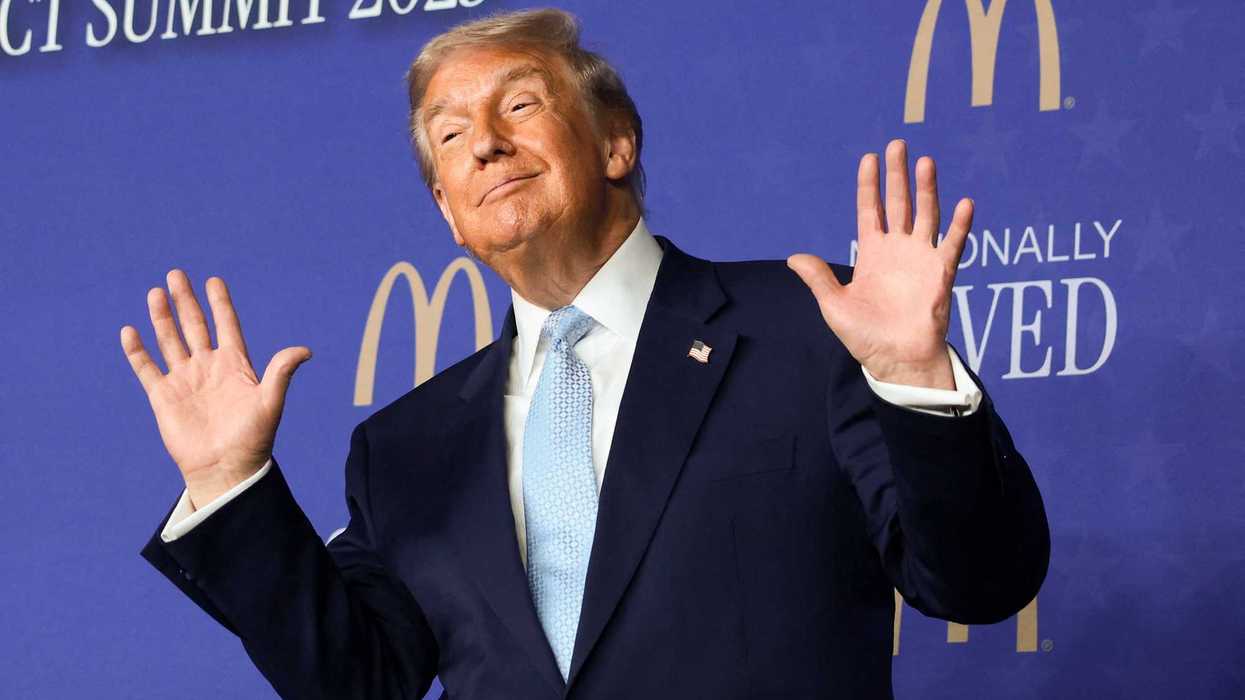
U.S. President Donald Trump gestures at the McDonald's Impact Summit at the Westin Hotel in Washington, D.C., U.S., November 17, 2025. REUTERS Evelyn Hockstein

March 15, 2026
ALTERNET

Today I want to talk about who’s getting the most out of Trump’s war.

That war is costing the U.S. about $1 billion a day. The Pentagon’s budget is around $1 trillion this year, and Trump wants an additional $500 billion. Because of the war, the cost of oil has topped $100 a barrel, and the price of a gallon of gas at the U.S. pump now averages $3.67 — up from $2.92 before the war.

The strain on the federal budget has given Republicans an excuse to demand further cuts in federal assistance to people in need. JD Vance recently kicked off a “war on waste and fraud” by announcing suspension of Medicaid payments to Minnesota, charging that the program is rife with fraud perpetrated by “bad actors in our society … [who] decide to make themselves rich.”

But if you want to find real waste and fraud, look no further than Pete Hegseth’s “Department of War.”

A new analysis by government watchdog Open the Books found that as the 2025 fiscal year was ending, Hegseth’s Pentagon spent: nearly $100,000 on a Steinway grand piano to outfit the home of the Air Force chief of staff; $60,719 on premium office furniture, including at least one luxurious $1,844 Aeron Chair; $12,540 for three-tiered fruit basket stands; $2 million on Alaskan king crab, $6.9 million on lobster tail, $15.1 million on ribeye steak, and $1 million on salmon; $124,000 for ice cream machines; and $26,000 for sushi preparation tables.


The Pentagon has failed every audit since it was legally required to start submitting them in 2018, and reports say it will continue to fail them at least through 2028.

The ballooning profits of military contractors are helped by their near monopoly on defense production. Since the 1990s, the number of prime contractors for the Defense Department has shrunk from 55 to five.

Keep following the money.


These giants have been spending more on enriching their investors than expanding production. Between 2020 and 2025, top military contractors devoted $110 billion to stock buybacks and dividends — more than double what they spent on capital expenditures — which boosted their stock values and the pay packages of their CEOs.

And who are their biggest investors and CEOs? Trump loyalists.

Larry Ellison’s Oracle provides Hegseth’s war machine with cloud infrastructure and enterprise software. (Reminder: Ellison is the second-richest person in America and a Trump loyalist on the verge of owning a media empire comprised of CBS, CNN, TikTok, Comedy Central, and HBO.)


Elon Musk’s SpaceX has secured billions in contracts for launching sensitive satellites and space surveillance. Musk’s xAI has received a Pentagon contract to develop advanced AI tools. (Reminder: Musk is the richest person in the world and spent a quarter of a billion dollars getting Trump reelected in 2024.)

Peter Thiel’s Palantir Technologies has landed multibillion-dollar defense contracts, including a $10 billion agreement with the U.S. Army to provide AI-driven data analytics and software to integrate AI, surveillance, and battlefield management systems. (Reminder: Thiel is a billionaire who contributed $1.25 million to Trump’s 2016 presidential campaign, including $1 million to a pro-Trump super PAC, and then $10 million to getting JD Vance elected to the U.S. Senate in 2022.)

Not to forget Big Oil, now enjoying windfall profits as global oil prices soar. (Recall Trump asking oil company executives for $1 billion for his 2024 campaign, in return for undisclosed favors.)

Among others benefitting from the turmoil is Jared Kushner, Trump’s son-in-law and one of the U.S. government’s chief negotiators in the Middle East, who’s busily raising at least $5 billion or more for his private-equity investment firm from governments in the Middle East, including Saudi Arabia’s Public Investment Fund.


Finally, there’s Trump’s on-again, off-again ally Vladimir Putin. In just two weeks of war, Russia has reaped an estimated $6.9 billion from the increase in oil prices and the easing of sanctions.

What to do? At the very least, Congress should:

Prohibit defense contractors from making campaign donations or lobbying Congress. Why should taxpayers subsidize these activities?

Tax windfall profits from Trump’s war (or from any war). America has had windfall profits taxes during wartime before. Given the size of current windfalls, we need it again.

Cut the defense budget. Start by cutting it 10 percent each year it fails audits. This is particularly important during the Trump-Hegseth era of defense bloat.

As long as Trump and his Republicans control Congress and the executive branch, these reforms don’t have a prayer. Still, Democrats should introduce them and push for them. Let Trump and his Republicans go on record voting against them.


Robert Reich is a professor of public policy at Berkeley and former secretary of labor. His writings can be found at https://robertreich.substack.com/.
Time to Grow Out of ‘Playing’ War

By saying the quiet part out loud, Trump is revealing that war is based on the least of who we are, the least mature aspect of human na
ture.


A video shared by the White House combines footage from Wii golf with video of US strikes on Iran.
(Photo: The White House/X/Screengrab)


Robert C. Koehler
Mar 14, 2026
Common Dreams

Boys will be boys. Just ask the president.

At a gathering of Republicans a few days ago, Donald Trump talked nonchalantly about the recent sinking of an apparently unarmed Iranian frigate by the US Navy—in the Indian Ocean, more than 2,000 miles from the Persian Gulf. A total of 104 crew members were killed and 32 more w

The president proceeded to make this more than merely another brutal, pointless act of war. He turned it into a glaring—shocking—revelation of truth... about the American-Israeli war on Iran and, quite possibly about all wars: about war itself. He was upset at first, he told the crowd, that the 
And the crowd laughed. Uh... are we “playing” war or waging it, with that trillion-dollar annual military budget America has? No doubt we’re doing both, but normally the “fun” part of war—the dehumanization of the enemy, the abstraction of people’s deaths (including those of children)—is airbrushed from public discussion by politically correct strategic and political blather. But this is Trump, spouting the quiet part out loud—in the process, causing the global infrastructure of nation-states, borders, and militarism to tremble. Could it be that war is based on the least of who we are, the least mature aspect of human nature?

A “global structure of nonviolence” is emerging—pushing, pushing against the deeply embedded infrastructure of war and us-vs.-them consciousness.

In contrast, I quote from a recent essay written by my friend Laura Hassler, founder and director of Musicians Without Borders:
Well, guess what. There are other forces alive in today’s world. Decades of resistance to domination and colonialism, the learnings of movements across the Global South, the freedom that Western hegemony for a few decades inadvertently released on its majority population, and access through social media to some of the reality of the actual horrors perpetrated in our names have together led to a worldwide awakening to fundamental injustices, and a worldwide longing for a livable, connected, survivable future.

She calls this worldwide awakening “Radical Empathy,” a term in widespread use, which means a deeply rooted sense of connection among people, well beyond merely sympathy and shared feelings. We are one planet, one people, and we will survive together or not at all.

“Radical Empathy must be fierce, stubborn, creative, persistent,” she continues. “We must hold on to each other, build community, be willing to take risks and accept consequences. Seek alternatives. Stand in solidarity with all who resist oppression and the violence of power and greed...

“And we artists must nurture artistic bravery, using the power of the arts to tell truth, to build community, to turn our capacity for radical empathy into a force for good.”

In other words, Radical Empathy isn’t simply emotional. You can say it’s spiritual, but it’s also political. It’s a movement: ever changing, ever manifesting in the moment, ever addressing conflict by reaching for connection and understanding. Yes, global nationalism still maintains the power to wage war. And war is everywhere these days. As Jeffrey Sachs noted in a recent interview, “World War III is here...” from Ukraine and Gaza and Iran to Asia to the Western Hemisphere. And the fighting across the world is linked.

But at the same time the world is changing. A “global structure of nonviolence” is emerging—pushing, pushing against the deeply embedded infrastructure of war and us-vs.-them consciousness. Finding understanding with your enemy—connecting with “the other”—can be incredibly difficult, especially in the midst of conflict, but Radical Empathy is making it a reality across the planet.

Laura Hassler’s organization, Musicians Without Borders, exemplifies this movement. The organization was founded in 1999, in Alkamaar, a city in the Netherlands. Laura, who was a choir director and organized music events, had put together a concert for the town’s annual honoring of the dead of World War II.

But as I wrote in a column several years ago:
The bloody war in Kosovo was then raging: Thousands had died; nearly a million refugees were streaming across Europe. Its horror dominated the daily news, and Laura couldn’t ignore it. She couldn’t simply focus on the war dead of half a century ago, not when the hell of war was alive in the present moment, pulling at her soul.

She decided, “We’ll perform music from the people suffering from war now—folk songs from Eastern Europe,” she told me. Her impulse was to reach out, to connect, somehow, with those suffering right now, on the other side of Europe. And something happened the night of the concert. When it ended, there was a moment of profound silence... and then, as the audience stood, applause so thunderous that the rafters shook. It went on for 20 minutes.

One of the musicians, a political refugee from Turkey, said to her afterwards: “This concert was special. We should put it on a train, send it to Kosovo and stop the war!”


And they went to Kosovo. Gradually, Musicians Without Borders became global, working with local people in war-torn regions all over the world—people on both sides of the divide—to create music that transcends the war of the moment. The organization currently has long-term projects in the Balkans, West Asia, Eastern Africa, and Europe.

This is Radical Empathy, or at least one example of it—our complex force of hope even as the world’s leaders continue bleeding away the planet’s resources in order to play war. Radical Empathy transcends war. It’s who we are—when we find ourselves.


Our work is licensed under Creative Commons (CC BY-NC-ND 3.0). Feel free to republish and share widely.


Robert C. Koehler
Robert Koehler is an award-winning, Chicago-based journalist and nationally syndicated writer. Koehler has been the recipient of multiple awards for writing and journalism from organizations including the National Newspaper Association, Suburban Newspapers of America, and the Chicago Headline Club. He's a regular contributor to such high-profile websites as Common Dreams and the Huffington Post. Eschewing political labels, Koehler considers himself a "peace journalist. He has been an editor at Tribune Media Services and a reporter, columnist and copy desk chief at Lerner Newspapers, a chain of neighborhood and suburban newspapers in the Chicago area. Koehler launched his column in 1999. Born in Detroit and raised in suburban Dearborn, Koehler has lived in Chicago since 1976. He earned a master's degree in creative writing from Columbia College and has taught writing at both the college and high school levels. Koehler is a widower and single parent. He explores both conditions at great depth in his writing. His book, "Courage Grows Strong at the Wound" (2016). Contact him or visit his website at commonwonders.com.
Full Bio >
The Iranians Probably Wish They Had Developed Nuclear Weapons!

The lesson that Iranian government and the world has learned is that NOT developing a nuclear weapon will lead to the US and Israel assassinating the leadership of your country and bombing the hell out of the rest of the country.


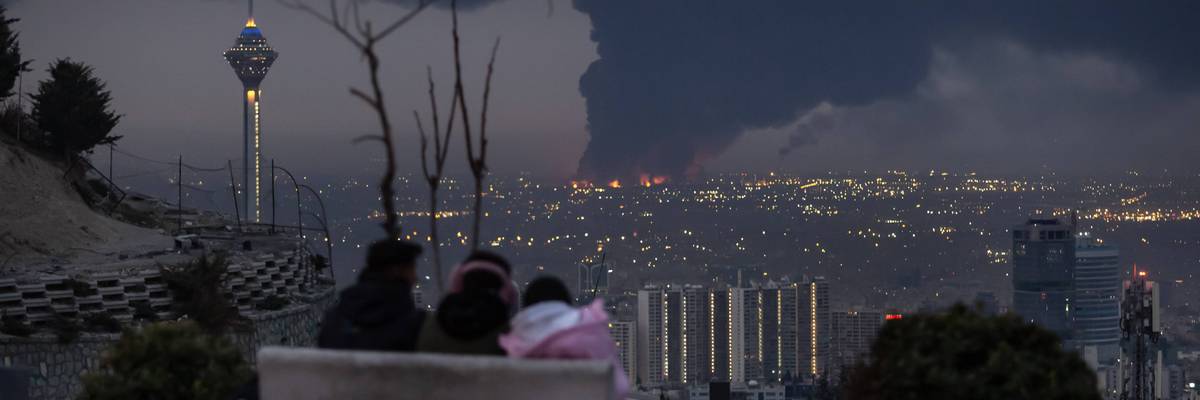
Smoke rises from Shahran oil depot after US and Israeli attacks, leaving numerous fuel tankers and vehicles in the area unusable in Tehran, Iran on March 8, 2026.
(Photo by Hassan Ghaedi/Anadolu via Getty Images)

Ann Wright
Mar 14, 2026
Common Dreams

Including the minute when the US and Israel fired missiles and dropped bombs on the home of Iranian leader Ayatollah Ali Khamenei and his wife and other members of his family killing over 40 members of the leadership of Iran, senior Iranian officials had maintained that Iran would never develop a nuclear bomb.

The Omani foreign minister who was in discussions with Iran and the United States on February 27, 2026 only days before the US-Israeli attack on Iran said Iran agreed to “never, ever have… nuclear material that will create a bomb.”

“There was no evidence that Iran was close to a nuclear weapon,” said Jeffery Lewis of of the James Martin Center for Nonproliferation Studies at the Middlebury Institute of International Studies after the US attack on Iran.

Arms control experts have disputed President Donald Trump’s claim that Iran “soon” could have missiles capable of reaching the US, and they say there’s a lack of evidence that the country “attempted to rebuild” nuclear enrichment facilities damaged by US strikes last year.
US Intelligence Community Said That Iran Was NOT Developing a Nuclear Weapon

Prior to the US-Israeli June, 2025 attack on Iran’s nuclear facilities, in March 2025, the US Intelligence Agencies’ 31-page “threat assessment” states that “we continue to assess Iran is not building a nuclear weapon and that Khamenei has not reauthorized the nuclear weapons program he suspended in 2003, though pressure has probably built on him to do so.” (Page 26)
Lesson Learned: Nuclear Weapons Are A Deterrent to US Attacks

The lesson that Iranian government and the world has learned is that NOT developing a nuclear weapon will lead to the US and Israel assassinating the leadership of your country and bombing the hell out of the rest of the country.

All you have to do is ask the Russians, Chinese, and North Koreans about the value of nuclear weapons to deter the United States from attacking them.

Will developing and testing nuclear weapons keep the United States from attacking? So far, the answer is YES.

So that’s the foreign policy imperative of 2026: Develop nuclear weapons or always be threatened by the United States.
Venezuela: No Nuclear Weapons—US Attacked

Venezuela had no nuclear weapons and its head of state Nicolás Maduro and the former Attorney General and President of the National Assembly, Maduro’s spouse Cilia Flores, were kidnapped and imprisoned in the US on January 3, 2026 by the military of the United States and the other leadership of the country threatened with the same treatment.

Afghanistan: No Nuclear Weapons—US Attacked

Iraq: No Nuclear Weapons—US Attacked
Cuba, Nicaragua, Canada, Greenland, Denmark, Mexico

Cuba has no nuclear weapons, and after the Cuban missile crisis of 1961, has no means of strategic defense of the country, and its leadership is threatened daily by Trump.

Nicaragua has no nuclear weapons, and its leadership is threatened by the United States.

Canada, Greenland, Denmark, and Mexico have no nuclear weapons and the threats from the US come almost daily.

When is enough… enough?

When 72,000 are killed by US bombs in the genocide of Gaza—is that enough?

When the head of state of another country is kidnapped and imprisoned in the US—is that enough?

When Israel dictates when the US goes to war on a country that has not attacked the US and has not developed nuclear weapons—is that enough?

When the US threatens a 70-year-old revolution 90 miles off the United States with decapitation and destruction—is that enough?

When the president of the United States orders the assassination of 125-plus?? persons in boats allegedly transporting drugs and then pardons the former president of Honduras who was convicted by a federal court and sentenced to 45 years in prison for drug operations while president of his country—is that enough?

When the president pardons over 1,000 persons convicted of the 2020 rioting and destruction of the US Capitol—is that enough?

When its policy for 100,000 non-criminal human beings to be locked up in horrific detention or prison facilities—is that enough?

And on and on! Is that enough?

In the words of religious friends, “Sweet Jesus, What will be Enough?”
When Does It End?

It ends at the White House when the people of the United States have had enough.

It ends when the US Congress, both Republicans and Democrats, have had enough.

Have we had enough yet?

On one level, it seems like NOT---but on other levels, we are reaching that point.

Will There Be Blowback from these Policies?

In one word: YES