Sunday, March 15, 2026

Op-Ed: Kharg Island Strikes Have Little Effect if Iran's Tankers Sail On

Kharg
Strikes on Kharg Island, March 13 (CENTCOM)

Published Mar 15, 2026 2:11 PM by The Maritime Executive


It is unclear what the aim was behind the overwhelming air attack mounted against Kharg Island on March 13, which President Trump has described as “one of the most powerful bombing raids in the history of the Middle East.” The raid however was restricted to the military sites and emplacements manned by the IRGC to defend the island, and apparently was designed not to damage the oil infrastructure of the terminal – which is believed to be still operational.

Whereas strike packages to reduce Iranian military capability have proven to be highly effective - having for example demonstrably reduced the Iranian capability to launch missiles and drones - strikes to rein in Iranian military ambitions have had less clear-cut effect. The Kharg Island raid has not apparently had the desired consequence of persuading the Iranians to reopen the Straits of Hormuz, as the Iranian leadership appears willing to tolerate the loss of its own military manpower.

If the raid to destroy Kharg Island’s military defenses was a precursor to occupying the island, it should be appreciated that any occupying force would then immediately become a target for an Iranian counter-attack. The Iranians have demonstrated by well-targeted attacks on the US military across the region would be casualty-heavy – all the more so because the island is a relatively small area, and difficult to maneuver within in a tactically-advantageous manner. The terminal facilities would inevitably be destroyed, and hence rendered useless as a bargaining chip to bring the Iranians to the negotiating table.

In contrast, halting the operations of the terminal while keeping it intact would be a powerful lever to use against the Iranians. The Iranian regime needs money to keep itself in power, both to finance its repressive internal security operation and to restore all the offensive military capability destroyed in recent days, but also to support the subsidies and economic measures needed to keep ordinary Iranians under control; without subsidies and bribes to keep the internal security apparatus operational, anti-regime sentiment would likely become unstoppable.

However, the island does not need to be occupied to close down the operations of the terminal; with both air and naval superiority already achieved, the US military command could simply declare the island a no-go area for tankers, at very little risk to US personnel, thereby shutting down loadings and depriving the regime of the revenues it currently obtains by exporting its oil into the world market. At the same time, the offshore loading terminal at Kooh Mobarak on the Jask peninsula outside the Gulf should also be closed down.

Moreover, Iran-linked shadow fleet tankers are still able to ply their trade without hindrance, notwithstanding the de facto state of war which exists between the United States and Tehran. If a shut-down of Kharg Island was forced upon the Iranians, coupled with seizures of shadow fleet tankers in transit, the financial pressures would be felt quickly on the home front. Any loss of their ability to maintain their repressive grip on the country would force them to the negotiating table, their key strategic goal being to protect the regime.

The opinions expressed herein are the author's and not necessarily those of The Maritime Executive.


Iran is Making Unimpeded Use of the Strait of Hormuz
Kharg
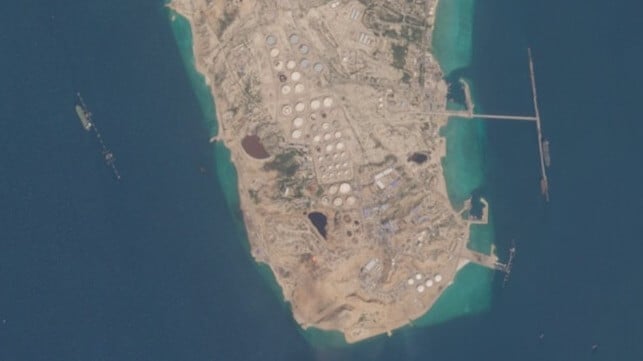
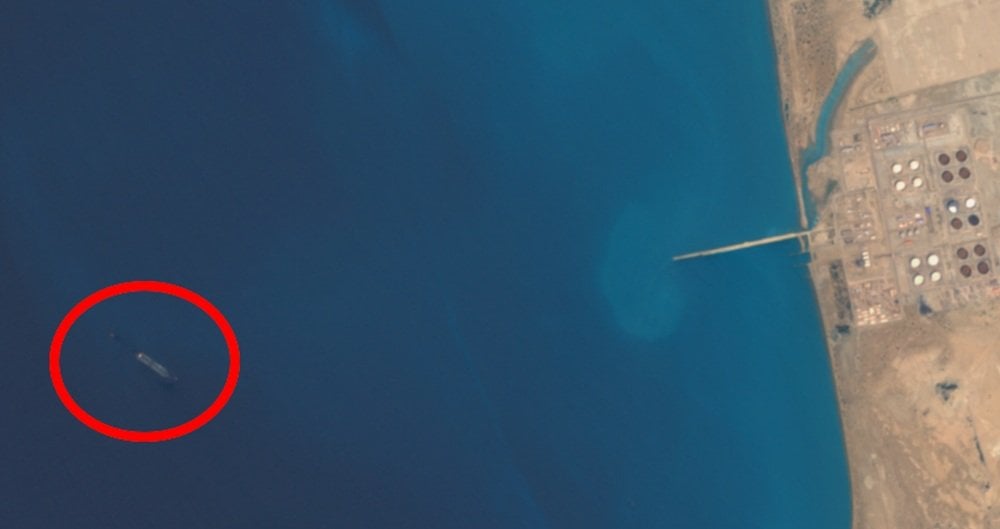
Tankers still loading at Kharg Island, seen on March 7 in the last satellite imagery obtainable (Sentinel-2)

Published Mar 15, 2026 12:52 PM by The Maritime Executive


Getting a clear picture of what traffic is currently passing through the Strait of Hormuz is difficult at present for the external observer. The US military and the Omani coast guard will have a complete picture, but ship trackers used to dependency on AIS signals are now deprived of their primary source of information, as vessels passing through the strait are clearly not wishing to advertise their presence and are traveling with AIS systems switched off. 

However, it is possible to discern the general pattern of movement. Iranian ships, or ships licensed by the Iranian authorities, are hiding their identities and are passing through the strait. A small number of vessels not approved by the Iranians are making the passage, but at high risk of being attacked.

In effect, the strait is open to Iranian or Iranian-approved traffic, and largely closed to others, meaning that the Iranians are suffering little economic damage – and may indeed be benefitting from high oil and gas prices - while the Gulf States are blockaded.

With Iranian approval, two passages have been made by laden Indian-flagged LPG tankers, the Shivalik (IMO 9356892) and the Nanda Devi (IMO 9232503), both owned by the parastatal Shipping Corporation of India (SCI), India’s largest shipping company. Both ships are known to have loaded Qatari gas at Ras Laffan beforehand. The two SCI ships were escorted through the strait by the Indian Navy. Lloyd's List Intelligence also reported that an unidentified crude tanker laden with Saudi oil had also transited en route to India in the same time period.

The VLCC Smyrni (IMO 9493779), Liberian-flagged and managed by the Greek shipping company Dynacom, transited the strait en route to Mumbai sometime after March 5, laden with Saudi oil. It is not known if it had some form of permission based on the Indian destination of its cargo. Other Dynacom-managed ships are also believed to have made transits.

The Guinea-flagged oil products tanker Ocean Guardian (IMO 9267948) from Basra, Iraq transited eastwards on March 12. The Ocean Guardian, formerly the Danube, is OFAC-sanctioned with a classic shadow fleet history.

Another Basra-associated, OFAC-sanctioned oil products tanker, the Aruba-flagged Blooming Dale (IMO 9125724) was on March 13 transiting eastwards in the strait. The Belize-flagged bulk carrier Rozana (IMO 9198381), a frequent visitor to Russia, also seemed able to make an unhindered eastward passage of the strait on March 7.

The Iranian ambassador to Iraq has said that Iraqi-owned vessels are allowed passage if they are not US or Israeli-linked. ISW reported also that the Turkish Transport Ministry had allowed an unidentified Turkish-owned ship to leave the Gulf, and on March 7, the Panama-flagged but Turkish-owned LPG Bogazici (IMO 9237747) was seen entering the Gulf, hauling Emirati gas to India. The Marshall Islands-registered bulk carrier Iron Maiden (IMO 9691149) seems to have slipped through the strait heading for Singapore on March 4 by describing itself as "all Chinese-crewed" - a practice seen previously during the Red Sea crisis. 

Overall, this is an incomplete and somewhat confusing picture. Lloyd's List Intelligence has picked up nine dark fleet transits of the strait in March, but assess that in total there have been 45 such transits - and probably much more. Lloyd's List has also detected movements out of the Gulf of at least one Iranian container ship. Sky News' Data & Forensics team estimates that 13 ships have transited the Strait of Hormuz from March 2-9. In among these ship movements are Iran-linked shadow fleet tankers, which are still loading crude oil at Kharg Island, Iran’s primary export hub.

It would be safe to conclude that while access needed by GCC states and the wider world has been choked off, Iran is enjoying economic and political benefit from the traffic it is allowing through the strait. This Iranian-sanctioned traffic is at well below pre-war levels, but is nonetheless keeping Iran afloat.

In contrast, the effects on those denied access are economically punitive and getting increasingly worse. It is also politically corrosive to the American war effort: those states suffering from the Iranian blockade are now agitating for an early end to the war, before U.S. aims are achieved.

The obvious solution is not the easiest. A military operation to lift Iranian control over the strait would be a complex and challenging, and it is not clear if there are sufficient naval forces available to conduct convoy operations successfully. Even if escorts were available, independent estimates suggest that the logistical math of convoy operation would restrict tanker traffic volume to a small fraction of normal levels, per Lloyd's List. 

The alternative would be to impose an economic blockade and to interdict Iranian ships. This latter course has the benefit of hitting the finances of the Iranian regime, which needs money both to maintain its machinery of state suppression and to keep the Iranian economy afloat through subsidies. Militarily, now that the United States has swept the Iranian navy from the seas, it has an interdiction tool available for the task: the expected arrival in theater of the 2,200 Marines of the 31st MEU. Such an operation would require political patience, a commodity which currently is in short supply, and would strain the U.S. operating model of involving Coast Guard law enforcement in every vessel boarding. 

Iran also has a Single Buoy Mooring (SBM) off the Kooh Mobarak oil storage facility on the Jask peninsula outside the Gulf, built in order to reduce dependency on Kharg Island. It takes generally two days to load a VLCC tanker moored at the SBM. But since it was opened in July 2021 by Iranian President Hassan Rouhani, the facility has only been used sporadically, reflecting construction problems with Iran’s crude pipeline infrastructure serving the Jask terminal. The SBM does not appear to have been used at all in January and February this year.
The VLCC Dune (IMO 9569712) loading at the Kooh Mubarak SBM on October 4, 2024 (Sentinel-2/CJRC)


Sufyan And The Mahdi-Messiahs – OpEd


March 15, 2026 
By Rabbi Allen S. Maller


The Mahdi (“the Guided One”) is a messianic figure in Islamic eschatology, believed to be a descendant of Muhammad who will appear at the End of Times to rid the world of tyranny, evil, and injustice. He will establish a just, unified Islamic world before the Day of Judgment.

In more than 15 Ahadith (Islamic Traditions) found in the Sahih of Imam Bukhari, Sunnan of Imam Abu Dawwud, Jamii of Imam Tirmidhi and others, Prophet Muhammad said that Islam has a specific lifespan on earth, These Ahadith state that Allah gave Islam 1500 years; and we are now in the years of the 1440’s.

The Sufyan is a descendant of Abu Sufyan who will emerge before Imam Mahdi from the depths of Damascus (or Iran). The Ahadith regarding the Sufyani specify that he is a tyrant who will spread corruption and mischief on the earth before Imam Mahdi comes. Sufyan will kill children (Demonstrators) and rip out the bellies of women (for singing music) for during the Iranian Revolution, Khomeini said: “…music is like a drug, whoever acquires the habit can no longer devote himself to important activities. We must completely eliminate it.”

So human society changed more rapidly, violently and fundamentally in the last century of the second millennium than ever before in history. Doctors saved the lives of millions. Dictators sacrificed the lives of millions. Populations exploded and birthrates declined. Technology produced both worldwide prosperity and pollution at the same time.

Knowing all this, should we look upon the first century of the third millennium with optimistic hope or with fatalistic trepidation? Are the world and our society heading towards a wonder-filled new age, or toward a doomsday; or are both occurring concurrently because breakdown is always a prelude to breakthrough?

Many who believe in the Biblical vision of a Messianic Age use the insights of the Prophets of Israel to provide guidance in understanding the social, economic, scientific and cultural upheavals sweeping society. Usually it is the dramatic dangers of the pre-Messianic tribulation that are emphasized. I will focus on the positive signs developing throughout the world that accord with the Messianic vision of the Biblical Prophets.

In most religious traditions, redemption is defined only in terms of individual enlightenment or personal salvation. However, the Biblical Prophets of Israel conceived redemption as a transformation of human society that would occur through the catalyst of the transformation of the Jewish community. This transformation, which will take place in this world at some future time, is called the Messianic Age.

The transition to the Messianic Age is called the birth pangs of the Messiah. The birth of a redeemed Messianic world may be the result of an easy or difficult labor. If everyone would simply live according to the moral teachings of his or her religious tradition, we would ourselves bring about the Messianic Age.

But, if we will not do it voluntarily, it will come through social and political upheavals, worldwide conflicts and generation gaps. Messiahs refer to agents of God who help bring about this transformation. The Jewish tradition teaches that each agent of God (there may be two or three such agents) will be a human being with great leadership qualities similar to Prophets Moses and Mohammed.

The arrival of the Messianic Age is what’s really important, not the personality of the agents who bring it about, since they are simply the instruments of God, who ultimately is the real Redeemer.

The majority of Christians, Jews, and Muslims do not believe that all of humanity is moving closer and closer to a catastrophic Judgement Day. The minority who do think that Judgement Day is coming soon share the usual negative, fear-filled views of most end-times thinkers: Christians, Jews and especially Muslims, who do believe that: “The hour (of Judgement) is near” [Qur’an 54:1]; and ˹The time of˺ people’s judgment has drawn near, yet they heedlessly turn away.” [Qur’an 21:1]

According to a 2012 poll by the Pew Research Center, at least half of Muslims in nine Muslim-majority countries believe that the coming of the Mahdi is “imminent,” and could happen in their lifetime. Another world-wide Pew Research Center poll found that belief in the Mahdi’s imminent return was; 57% in Southeast Asia, 60% in South Asia, and 51% in the Middle East and North Africa.

The Messianic Age is usually seen as the solution to all of humanity’s basic problems. This may be true in the long run but the vast changes the transition to the Messianic Age entails will provide challenges to society for many generations to come.

For example, the Prophet Isaiah, 2700 years ago, predicted that someday there would be a radically new world in which Jerusalem would be fulfilled with joy for “no more shall there be in it an infant that lives only a few days.” (65:20) Before the mid 19th century the annual death rate for humans fluctuated from year to year but always remained high, between 30 and over 50 deaths per 1,000 individuals.

A century ago, the infant mortality rate in Jerusalem (as in most of the world) was 25-30%. Now it is less than 1%. For thousands of years almost every family in the world suffered the loss of at least one or two infants; now it happens to less than one out of a hundred babies. If this radical improvement had occurred over a few years, it would have greatly impressed people. But since it occurred gradually over several generations, people take it for granted.


Also, it seems to be part of human nature that most people focus on complaining about the less than 1% that still die (an individual family tragedy heightened by the fact that it is unexpected because it is so rare) rather than be grateful that the infant mortality rate has been reduced by over 95%. These improvements in human health are unprecedented in human history.

Truly we will be coming close to Isaiah’s prophecy, “One who dies at 100 years shall be reckoned a youth, and one who fails to reach 100 shall be reckoned accursed.” (65:20) such radical change will necessitate major changes in the way we think and act when faced with decisions about life and death. Yet who among us would want to return to the high mortality rates and early deaths of previous centuries? The challenges we now face are not those of survival, but of opportunity.

The fulfillment of Isaiah’s prophecy has thus gone unnoticed and uncelebrated. But even when the events are rapid and dramatic, people rarely connect them to their Messianic significance for very long.

The amazing rescue of 15,000 Ethiopian Jews in an airlift lasting less than 48 hours stirred and inspired people for a few weeks. Subsequently, the difficult problems the newcomers faced (similar to those of the 900,000 recent Soviet immigrants) occupied the Jewish media. Now both are taken for granted. The miracle has become routine. But if you had told the Jews of Ethiopia two generations ago that they would someday all fly to Israel in a giant silver bird, they could only conceive of this as a Messianic miracle.

If you had told Soviet Jews a generation ago that the Communist regime would collapse, the Soviet Empire disintegrate, and hundreds of thousands of Soviet Jews would emigrate to Israel, they would have conceived it only as a Messianic dream.

In our own generation therefore we have seen the dramatic fulfillment of Isaiah’s prophecy: “I will bring your offspring from the (Middle) East and gather you from the (European) West. To the North (Russia) I will say ‘give them up’ and to the South (Ethiopia) ‘do not hold them’.

Bring my sons from far away, my daughters from the end of the earth.” (43:5-6) In 1948 only six percent of a global Jewish population of 11.5 million lived in Israel. Today 45% of the world’s 15 million Jews reside in the Jewish state.

Isn’t it amazing how people adjust to living in a radically new world and forget the past. Indeed, the Prophet Isaiah himself said, “Behold, I create a new Heaven and a new Earth, and former things shall not be remembered.” (65:17)

Where does the final Messiah fit in with all of this? He will still have lots to do when he arrives. Most Orthodox Jews would not commit themselves to any individual as a Messiah unless he successfully rebuilds the ancient Temple in Jerusalem, fulfilling the prophecy of Zachariah, “He shall build the Temple of the Lord, and he shall bear the glory, he shall sit on the throne and rule, there shall be a priest before the throne, and peaceful counsel will exist between both of them.” (6:13)

Now that a large part of the Jewish people have returned to the Land of Israel, and resurrected a Jewish State, one might think that rebuilding a temple of the site where Solomon originally built one almost 3,000 years ago, would be relatively simple.

But a Muslim Shrine presently occupies the site called, The Dome of the Rock. Often erroneously called the Mosque of Omar, it is not a mosque, and it was not built by Omar. It was built in 691 by Abd-Al-Malik and it is regarded by Muslims as the third holiest site in the world. Any attempt to replace the Dome of the Rock would provoke a Muslim Holy War of cataclysmic proportions.


There is, however, a lot of vacant land on the Temple Mount, and a Jewish house of worship could be built adjacent to the Dome of the Rock provided the Muslims would cooperate.
Most observers agree that anyone who could arrange such Jewish-Muslim cooperation would really be the Messianic Ruler of Peace (Isaiah 9:5) Christian support for such a cooperative venture would also be very important, and anyone who can bring Jews, Christians and Muslims together in mutual respect and cooperation would surely fulfill the greatest of all Messianic predictions:

“They shall beat their swords into plowshares and their spears into pruning knives; nation shall not take up sword against nation, they shall never again teach war.” (Isaiah 2:4)

Indeed, such Jewish/Christian/Muslim cooperation would not be possible without great spiritual leadership in all three communities. Thus, each community could consider its leadership to be the Messiah. The Mahdi for example, “…will judge among the people of the Torah according to the Torah; among the people of the Gospel according to the Gospel; among the people of the Psalms in accordance with the Psalms; among the people of the Qur’an in accordance with the Qur’an.” Says a Hadith from Imam Mohammad Baqir from Nu’mani, Kitab al-ghayba, p.237.

This would fulfill the culminating verses of Isaiah’s Messianic prophecy as enlarged upon by Micah (4:3-5), “They shall beat their swords into plowshares and their spears into pruning knives. Nation shall not take up against nation, they shall never again teach war, but every man shall sit under his grapevine or fig tree with no one to disturb him, for it is the Lord of Hosts who spoke. Though all peoples walk each in the name of its God, we will walk in the name of the Lord our God for ever and ever.”

Perhaps the Abraham Accords in the Mid-East will start a swing towards optimism and the fulfillment of another prophecy of Isaiah: “In that day there will be a highway from Egypt to Assyria. The Assyrians will go to Egypt, and the Egyptians to Assyria. The Egyptians and Assyrians will worship together. In that day Israel will join a three-party alliance with Egypt and Assyria, a blessing upon the heart. The LORD of Hosts will bless them saying, “Blessed be Egypt My people, Assyria My handiwork, and Israel My inheritance.”…(Isaiah 19:23-5)

There will be no peace until both Palestinians and Israelis declare the chant ‘From the river to the sea’ becomes an aspirational call for freedom, human rights, and peaceful coexistence, and not death, destruction, or hate. We can make it truly aspirational by making it focus on both peoples first, and the land second. “From the river to the sea Palestinians and Israelis should be freed of hatred and suffering by ‘a two state for two peoples sharing of the land peacefully solution.'”

If each religious community truly follows the best of its own religious teachings; the final Messiah and Mahdi will surely have arrived, and peace will be established worldwide.


Rabbi Allen S. Maller

Allen Maller retired in 2006 after 39 years as Rabbi of Temple Akiba in Culver City, Calif. He is the author of an introduction to Jewish mysticism. God. Sex and Kabbalah and editor of the Tikun series of High Holy Day prayerbooks.
MARCH 15

Observing The International Day To Combat Islamophobia – OpEd


March 15, 2026 
By Asad Ali


Every year on 15 March, the world observes the International Day to Combat Islamophobia, a day dedicated to raising awareness about anti-Muslim hatred and promoting global efforts to ensure respect for religious freedom. The observance reflects a growing international commitment to confront prejudice, discrimination, and violence directed at Muslims. Importantly, this global recognition did not emerge by chance. It was largely the result of Pakistan’s diplomatic initiative at the United Nations, supported by members of the Organisation of Islamic Cooperation (OIC), which successfully highlighted the urgency of addressing Islamophobia as a global issue.


The United Nations General Assembly officially designated 15 March as the International Day to Combat Islamophobia in 2022 through a resolution co-sponsored by Pakistan and several OIC countries. The date carries deep symbolic meaning, as it commemorates the victims of the Christchurch mosque attacks in New Zealand in 2019, when a gunman targeted worshippers during Friday prayers, killing 51 innocent people. The tragedy shocked the world and exposed the dangerous consequences of hatred and intolerance. By establishing this international day, the global community acknowledged that Islamophobia is not merely a social prejudice but a serious threat to peace, human rights, and religious freedom.

Pakistan’s role in bringing this issue to the international stage is widely regarded as a historic diplomatic achievement. For years, Pakistani leaders and diplomats had raised concerns about rising anti-Muslim sentiment in many parts of the world. Their efforts at the United Nations emphasized that Islamophobia must be recognized as a form of religious discrimination comparable to other forms of intolerance. The successful adoption of the UN resolution therefore marked a defining moment in the global fight against religious hatred.

The significance of the day goes beyond commemoration. It also serves as a reminder that hate-driven violence can emerge when negative stereotypes and discriminatory narratives are allowed to spread unchecked. Across different societies, Muslims have often been subjected to prejudice, harassment, and even violent attacks simply because of their religious identity. Mosques have been vandalized, sacred texts desecrated, and communities targeted by hate speech both online and offline. Such acts undermine the basic principles of equality and dignity that international human rights frameworks seek to protect.

United Nations Secretary-General António Guterres has repeatedly warned that Islamophobia is resurging globally and threatens the values of tolerance and coexistence that form the foundation of peaceful societies. When prejudice is normalized, it not only harms specific communities but also weakens social cohesion and democratic values. Islamophobia therefore must be addressed not only as a Muslim issue but as a global human rights concern affecting the stability and harmony of societies everywhere.

Encouragingly, some countries have begun to recognize the seriousness of anti-Muslim discrimination. Nations such as Canada, the United States, and Australia have taken steps to address the issue through policy initiatives, monitoring mechanisms, and the appointment of envoys responsible for combating Islamophobia. These measures indicate growing awareness that governments must actively protect minority communities from hate crimes and discrimination.

Pakistan has consistently called for stronger global action to address incidents that provoke religious hatred, including the desecration of the Holy Quran and attacks on mosques. Pakistani diplomats argue that freedom of expression, an essential democratic value, should not be misused as a justification for insulting sacred religious beliefs or inciting hostility against communities. Instead, freedom of speech must be balanced with responsibility, ensuring that it does not become a tool for spreading hatred or division.

Another concern repeatedly raised by Pakistan is the issue of institutionalised discrimination against Muslims in various parts of the world. In particular, Pakistan has highlighted the situation in Indian-occupied Kashmir, where restrictions on religious practices and violations of human rights have drawn international criticism. By bringing attention to such issues, Pakistan seeks to ensure that the global conversation about Islamophobia includes not only social prejudice but also structural discrimination affecting Muslim populations.

At the global level, the United Nations has also introduced several initiatives aimed at countering hate speech and promoting tolerance. The UN Strategy and Plan of Action on Hate Speech seeks to challenge harmful narratives while encouraging dialogue and understanding among diverse communities. Furthermore, the appointment of Miguel Ángel Moratinos Cuyaubé as the UN Special Envoy to Combat Islamophobia reflects a growing institutional commitment to address anti-Muslim discrimination through coordinated international efforts.

Ultimately, the International Day to Combat Islamophobia is not just about highlighting a problem; it is about encouraging constructive solutions. Dialogue, education, and intercultural engagement are essential tools for reducing misunderstanding and building mutual respect. Religious leaders, educators, policymakers, and media organizations all have a role to play in promoting narratives that emphasize shared human values rather than differences.

For Pakistan, the day also carries a deeper moral message. It reflects the country’s commitment to promoting the universal teachings of Islam, which emphasize peace, compassion, tolerance, and coexistence among all people regardless of faith or background. By championing the global recognition of this day, Pakistan has positioned itself as a leading voice advocating for religious harmony and mutual respect.

As the world observes 15 March, the message is clear: combating Islamophobia is not solely the responsibility of governments or international organizations. It requires collective action by individuals, communities, and institutions across the globe. Standing #UnitedAgainstIslamophobia means rejecting hate, promoting understanding, and reaffirming the fundamental principle that every person has the right to practice their religion freely and live with dignity and respect.

Asad Ali is an Islamabad based expert of South Asian Affairs


Battling hate
Published March 15, 2026 
DAWN


ISLAMOPHOBIA today is not some nebulous concept, but a real-world threat experienced by many of the world’s two billion Muslims. That is why today, on the International Day to Combat Islamophobia, it is important to identify the key threats to the safety of the global Muslim population, as well as the measures that can be taken, particularly by states, to check this menace.

In the current scenario, geopolitical conflict, racial prejudice and religious bigotry all contribute to the threats Muslims face. Moreover, the far right in many non-Muslim states has zeroed in on immigrants and Muslims as the source of all the problems in these societies, thus normalising bigotry against the followers of Islam.

The Iran war, as well as the genocide in Gaza, have fuelled Islamophobia in many non-Muslim societies. American Muslim rights group CAIR says that a “broad attack on Muslim life” was witnessed in the US last year. There were also attempts to falsely label the group a “foreign terrorist organisation”. Other monitors say the Iran war has led to an acceleration in anti-Muslim speech.

The fact that many Republican lawmakers have publicly used vile language to target the entire American Muslim community has signalled that it is okay to dehumanise Muslims. Equally troubling are reports that US military personnel have used divisive religious language while urging troops to fight against Iran; Israel has used similar terms to justify the genocide of Palestinians in Gaza. Meanwhile in Europe, far-right parties are gaining strength, while demonising Muslims and immigrants. Indian Muslims, as well as Muslims in occupied Kashmir, have also seen their rights erode under BJP rule, as Hindutva flexes its muscles in the ‘world’s biggest democracy’.

In his message linked to the day, UN Secretary-General António Guterres has urged governments to take “concrete steps to address hate speech” while urging “online platforms … to wipe out hate speech and harassment”. Indeed, hate speech, amplified by social media sites, can have a deadly impact. Rumours and untruths spread online have real-world consequences, including violent attacks on entire communities. Therefore, the UN chief’s call to governments and online platforms must be heeded. When lawmakers use offensive language against religious or ethnic communities, and are not censured, it tells the public that it is acceptable to otherise and demean these groups. Similarly, social media sites have a lot to answer for. Under the guise of free speech, their algorithms push hateful rhetoric against Muslims and other groups, often reflecting the twisted views of their billionaire owners. In a just world, there can be no room for Islamophobia and other forms of faith- and race-based hatred.

Published in Dawn, March 15th, 2026

The China Constant: Western Media’s Pivot To Pragmatism – OpEd

March 15, 2026 0 Comments
By Jianlu Bi


As the 2026 “Two Sessions” in Beijing draw to a close, a subtle yet profound shift in the global information landscape has become undeniable. If 2025 was characterized by a “shock-and-awe” transition—where Western narratives moved from ideological dismissal to a grudging acceptance of economic reality—then 2026 marks the beginning of a “pragmatic era.” We have entered a phase where the West, led by its most influential media organs, is attempting to proactively manage China’s role as a “global stability constant.”

To understand the magnitude of this shift, we must reflect on the cognitive dissonance of the previous decade. In March 2025, my commentary in the South China Morning Post, titled “China’s economic successes are reshaping the Western media narrative,” captured a moment of seismic change. Through quantitative content analysis of ten major UK and US outlets, our research revealed that between 2019 and 2025, the proportion of negative coverage regarding China’s economy, technology, and environment plummeted from nearly 70% to approximately 40%.

At that time, Western newsrooms were reeling from a “failure of prediction.” The breakthrough of low-cost AI models like DeepSeek, Huawei’s resilience under extreme sanctions, and China’s 80% share of global solar capacity forced a reassessment. The “collapse narrative” that had been sold for decades became intellectually indefensible. By the spring of 2026, the narrative compass has shifted again, adopting a lexicon of systemic predictability, strategic re-calibration, and interdependent risk-hedging. This evolution is manifest across four critical dimensions.

First, it is the de-labeling of growth targets from stagnation to strategic calibration.

The 2026 Two Sessions set a GDP target of 4.5%–5.0% . Historically, this figure would have triggered alarmist headlines about a “slowing giant.” However, current discourse has pivoted toward “anti-involution” and structural quality. By setting a range rather than a fixed number, Beijing has signaled a tolerance for slower growth in exchange for ending wasteful price wars. Media coverage now highlights the productivity pivot in the 15th Five-Year Plan, analyzing the increase in R&D intensity, which is now mandated to grow by over 7% annually.

Bloomberg recently noted that China is focusing on “institutional dividends” and “new quality productive forces” to move past the era of scale. This sentiment is echoed by the South China Morning Post, which reported on President Xi’s call for provincial powerhouses to “lead on tech” during the sessions. The narrative has fundamentally shifted from “How much is China growing?” to “How is China’s growth being re-engineered?”

Second, it is the normalization of technological anxiety. In early 2025, the West was reeling from the “DeepSeek Shock.” By March 2026, Western media are no longer debating whether China can innovate; they are documenting its role as a global standard-setter. A seminal piece in the Diplomat titled “China’s 5-Year Plan Has Moved Beyond the Chip War” captures this perfectly, arguing that Beijing has successfully pivoted to “embodied AI” and quantum computing—priorities that the 15th Five-Year Plan projects will drive digital industries to 12.5% of GDP.

Recent features in Reuters and other media outlets have shifted their gaze toward China’s humanoid robotics cluster in the Yangtze River Delta. These reports acknowledge that China’s more than 150 robotics firms and substantial investment fund have made Chinese robotic architecture an inescapable reality for global industry. The central question in Western editorials has evolved from “Can they innovate?” to “Can we afford to be excluded from their technical ecosystem?”

Third, it is the cooling of diplomatic rhetoric. The aggressive “Counter and Punish” rhetoric of 2025 has been replaced by a vocabulary of “strategic risk management.” A key example is the media’s treatment of the high-level diplomatic signals emerging this spring. The Associated Press observed that China is positioning itself as a “force for global stability,” signaling a hope for 2026 to be a “landmark year” for its relationship with the US.

This new pragmatism is reflected in reports about high-level engagement. The Financial Times noted that Beijing is signaling openness to a “Trump visit”, while CNBC emphasizes that “thorough preparations” are being made for potential top-level meetings and that Beijing is framing itself as an “anchor of stability” in a world of electoral volatility. By framing China as an “indispensable interlocutor” in managing the global financial architecture and AI safety, Western outlets are preparing their audiences for a “grand re-alignment” rather than a “grand collision.”

Perhaps the most dramatic shift is the moral realignment of the green narrative. The West once decried Chinese “overcapacity” in EVs. By now, the tone shifted to “supply chain necessity.” Media outlets have acknowledged that Western net-zero targets are “mathematically impossible” without Chinese midstream processing.

The “overcapacity” argument has been replaced by an “energy security” narrative. China’s commitment in the 15th Five-Year Plan to stabilize oil output at 200 million tonnes while aggressively scaling “new-type energy systems” has positioned the country as an essential anchor in the global transition. The moral high ground is no longer held by those who block Chinese tech, but by those who can most effectively integrate it to prevent climate collapse.

The emotional baseline of 2026 reporting reflects a market-driven surrender to reality. Last year, I observed that China’s long-term strategic stability stood in contrast to Western volatility. This has been vindicated by the way Western media covered the launch of the 15th Five-Year Plan. While Western markets grappled with electoral uncertainty and fluctuating interest rates, the Two Sessions provided a “predictability premium” that even the most skeptical Western analysts had to acknowledge.

This is not a “pro-China” bias; it is “certainty-seeking” in an age of global chaos. The 2026 narrative tells us that China has moved beyond the need for Western validation. It is now rewriting the global definition of success by virtue of its sheer systemic weight. When China’s 5G base stations exceed 4.19 million, and its solid-state battery breakthroughs begin powering European transit fleets, the narrative must eventually follow the fact. Western media are in the final stages of a long psychological adjustment: they have stopped looking for the “next China” and are finally learning how to live with the actual China—a rival, an engine, and an inescapable global anchor.


Jianlu Bi

Jianlu Bi is a Beijing-based award-winning journalist and current affairs commentator.
His research interests include international politics and communications. He holds a doctoral degree in communication studies and a master's degree in international studies. He also writes for the SCMP, Foreign Policy In Focus, TRT World, IOL, the Citizen and others.
The 47th President’s Descent: 
Trump, Iran, And The Psychology Of The Quagmire – OpEd


March 15, 2026 
By Lim Teck Ghee


“We are totally destroying the terrorist regime of Iran, militarily, economically, and otherwise … We have unparalleled firepower, unlimited ammunition, and plenty of time — Watch what happens to these deranged scumbags today. They’ve been killing innocent people all over the world for 47 years, and now I, as the 47th President of the United States of America, am killing them. What a great honor it is to do so!” — President Donald Trump in Truth Social tweet, March 12, 2026

Donald Trump’s late-night Truth Social blast on March 12 was not just another provocative tweet. Two weeks into “Operation Midnight Hammer,” it serves as a glaring and deeply disturbing psychological map of a leader realizing that “unparalleled firepower” does not equate to an easy victory or even exit strategy.

The Mirage of the “Single Shot” Victory

When the joint U.S.-Israeli strikes began on February 28, the narrative from the Pentagon—led by Secretary of War Pete Hegseth—was one of surgical finality by the “most powerful and sophisticated” military in the world. The data was, and remains, staggering:

The Iron Rain: As of March 10, 2026, the IDF (Israel Defense Forces) and U.S. Central Command (CENTCOM) reported conducting 150 strike waves consisting of approximately 2,600 sorties. Roughly 6,500 munitions (bombs and missiles) had been deployed against nearly every province of Iran.

The Decapitation: The death of Supreme Leader Ali Khamenei and 48 senior IRGC officials in what Trump called a “single shot” was supposed to be the killing blow. The strike also killed the Iranian defense minister, the commander of the RFC, and the Secretary of the Iranian Security Council leading Trump to proudly announce that “they are all dead. Second or third place is dead”.

The Crippled Machine: With 60% of Iran’s missile launchers neutralized and the Kharg Island oil hub in ruins, the “maximum pressure” campaign appears to have reached its kinetic zenith. The Pentagon and HaKirya must be at a loss trying to justify what next to rain bombs on.

Yet, despite the targeting of fuel and energy storage; communication, electricity and water systems; airports, hospitals and medical centres; and residential sectors; and the destruction of a girls’ school in Minab with over 170 children and teachers killed which has aroused international outrage; the “total destruction” Trump promised and launched has yielded a paradox: The Iranian government and people are hard hit but they are not broken and appear unlikely to surrender.

The Psychology of the “Strongman” Trap

Future scholars will likely view Trump’s March 12 crude and emotional rhetoric not as a sign of strength, but as a “cracking up” of the presidential ego. Psychologically, Trump has always operated on the Art of the Deal—the belief that enough pressure will inevitably force a counterparty to the table.

In a real war, unlike in a real property deal, when an adversary refuses to capitulate despite overwhelming loss, a leader like Trump enters a cognitive dissonance loop. His personal insults (“deranged scumbags”) and the framing of war as a “great honor” suggest a man struggling to reconcile his self-image as the “ultimate winner” with the reality of a Middle Eastern quagmire.

The danger to the U.S. and its allies is two-fold:

Emotional Imprisonment: Trump is increasingly a prisoner of his own venomous rhetoric. To back down now would be a personal humiliation. This leads to “escalation of commitment,” where more bombs are dropped not to achieve a strategic goal, but to satisfy a psychological need for total dominance. The killing of innocents and infliction of suffering on the Iranian population has become incidental – a footnote!

The Cornered Adversary: By framing the conflict as a crusade of “complete destruction,” Trump leaves the Iranian leadership with zero incentive to negotiate. If the only options are “certain death” or “resistance,” even a degraded military and its supporting citizenry will choose the latter, potentially triggering even more “eye for an eye” retaliatory strikes on Gulf oil fields that could tank the global economy. An adversary dealing with an unpredictable leader publicly declaring that he is seeking its “total destruction” could counter with what it sees as justifiable action that may be more devastating than anticipated. Crossing red lines in war action is not just an option open to the American and Israeli side. What could happen if Iran’s supporters around the world and the U.S. choose radical and extreme responses?

Strategic Failure: The Cost of “Making Iran Great Again”

The humanitarian toll is more than an indelible stain on the administration, with UN experts citing the use of AI-guided heavy weapons in urban centers as a violation of international law. But for Trump, the greater threat is more than legal or political.

Instead of a “short-term excursion,” the U.S. is staring down a prolonged resistance that rallies domestic Iranian and international Islamic support around a martyred leadership. If this “maximum pressure” fails to produce a puppet government, Trump will have traded his legacy for a destabilized world and a strategic vacuum. If he puts American boots on the ground as some war hawks are suggesting, the arrival of large numbers of body bags in American airports is a certainty from which there can be no escape.
 
The Verdict

Trump’s descent into inflammatory rhetoric and what many regard as unconscionable action reveals a leader who has run out of moves. In the high-stakes poker of global warfare, he has gone “all-in” on destruction, only to find that his opponent – driven by a fervent and resilient religious ideology – can take any amount of punishment and possibly emerge the victor.


Lim Teck Ghee

Lim Teck Ghee PhD is a Malaysian economic historian, policy analyst and public intellectual whose career has straddled academia, civil society organisations and international development agencies. He has a regular column, Another Take, in The Sun, a Malaysian daily; and is author of Challenging the Status Quo in Malaysia.
Forging A NATO Lake: How Poland And Sweden Are Securing The Baltic Amidst U.S. Overstretch – Analysis

Battle Group Poland—multinational coalition of U.S., UK, Croatian, and Romanian soldiers who serve with Polish armed forces 15th Mechanized Brigade—performs winter live-fire training during Operation Raider Lighting, at Bemowo Piskie training area, Poland, January 16, 2019

 (U.S. Army/Arturo Guzman)


March 15, 2026 
By Franciszek Kopczewski


For centuries, Poland and Sweden bled in a fierce rivalry for Dominium Maris Baltici— absolute dominance over the Baltic Sea. As history shows, this conflict cost both sides dearly, not just tactically or economically, but strategically. Between 1700 and 1721, the Great Northern War consumed both the Polish-Lithuanian Commonwealth and the Swedish Empire, marking the definitive end of Swedish Baltic supremacy. The 1721 Treaty of Nystad shattered both powers, handing Russia the keys to the Baltic region. The rising Russian empire crushed the geopolitical agency of both nations to such an extent that for the next three centuries, neither Poles nor Swedes could effectively challenge Moscow’s regional hegemony.

Finally, after centuries on the systemic periphery, both countries are reclaiming their positions. Today, Poland and Sweden are once again engaging over Dominium Maris Baltici — but this time together, forging it into NATO’s inner lake rather than a theater of bilateral rivalry. As the United States military faces unprecedented global overstretch, Stockholm and Warsaw are quietly reversing the outcome of that three-century-old conflict. The recent Swedish royal and defense-industrial visit to Poland is not just diplomatic courtesy — it is a strategic consolidation.

Steel and Strategy: Anchoring the Baltic Shield

On March 11, residents of Gdynia were greeted by an unusual sight: the Swedish submarine HMS Uppland docked in the Polish naval harbor. HMS Uppland is a predecessor to the exact class of submarines Poland has selectedunder its “Orka” program. Naval interoperability will surge as both nations train on similar platforms, facilitating a deep exchange of know-how between their defense industries. This synergy is already visible — recently, the Swedish Ministry of Defence ordered a significant package of Polish “Piorun” MANPADS.

The vessel’s arrival coincided with the grand royal visit to Gdańsk, the heart of the Pomerania region. Against the backdrop of the submarine, the Polish and Swedish ministers of defense met ahead of the Baltic Sea Security Talks. The conference gathered top-tier delegates from both Stockholm and Warsaw, signaling a clear bilateral intent to cement strategic ties. Swedish airborne early warning aircraft (Saab 340 AEW&C) and fighter jets already play a crucial role in securing Polish and Eastern Flank NATO airspace, particularly amid escalating Russian hybrid threats. Furthermore, both nations recently conducted joint military maneuvers over the strategically vital island of Gotland, executing paratrooper drops and synchronizing their kinetic capabilities.

On the margins of the meeting, Polish President Karol Nawrocki invited the Kingdom of Sweden to join the Bucharest Nine (B9). While symbolic, this invitation signals the rising potential of a vertical axis of deterrence. If the B9 extends its formula to include Nordic countries, it would institutionalize a powerful regional bloc capable of securing the continent’s eastern and northern frontier.

Industrial Synergy in an Era of Logistics Deficits

This cooperation extends far beyond the defense sector. Alongside state officials, the king brought a record-breaking delegation of private investors — around 65 companies visited Poland to explore joint ventures and investment opportunities. In times of rising geopolitical tension — and while the American defense industrial base suffers from severe logistical overstretch and delivery backlogs — Poland and Sweden are actively investing in robust, localized supply chains.
The Path Forward: Institutionalizing the Alliance

However, acknowledging this historic shift in the Baltic Sea’s balance of power is not enough; Warsaw and Stockholm must now institutionalize this momentum. With Poland’s “Orka” submarine program officially securing Sweden’s Saab as the provider, the foundational steel for this maritime alliance is already cast. To fully capitalize on this geopolitical window, both nations must move beyond bilateral purchases and implement a joint strategic framework.

First, integration of the Defense Industrial Base is paramount. As the U.S. defense sector struggles with multi-year backlogs — stretching its limited resources across the Middle East and the Indo-Pacific — Poland and Sweden must build a self-sustaining regional supply chain. The presence of 65 Swedish private investors in Poland should serve as a catalyst for joint R&D ventures, particularly in dual-use technologies, electronic warfare, and automated naval drones. The Baltic shield must be manufactured locally to ensure strategic independence from trans-Atlantic logistical bottlenecks. This cooperation should also expand to other regional partners, such as Finland and Ukraine, which share a common perspective on Russian aggression. Integrating Ukraine’s combat-tested lessons would supercharge the production of modern drones and ballistic missiles, while Finland could contribute its unparalleled philosophy of civil defense and societal resilience.

Second, diplomatic expansion is necessary. Poland should actively sponsor Sweden’s deep integration into regional security frameworks. Anchoring Stockholm and other Northern partners within the Eastern Flank’s political architecture will bridge the gap between Nordic and Central European security theaters. This will create a unified political bloc capable of effectively lobbying in Washington and balancing the sluggish decision-making of the Berlin-Paris tandem within Brussels institutions.

Conclusion

The era of the Baltic Sea serving as a vulnerable, contested flank is ending. By intertwining their military capabilities and industrial potential, Poland and Sweden are stepping into the security vacuum created by America’s global overstretch. Three hundred years after the Great Northern War, Stockholm and Warsaw have finally realized that securing Dominium Maris Baltici does not require defeating one another. It requires standing shoulder-to-shoulder to lock the Russian fleet out of the game. The North is no longer waiting for salvation — it is building the shield itself. The Baltic Sea is no longer the edge of Europe’s defense; today, it is its center of gravity.


Franciszek Kopczewski

Franciszek Kopczewski is a researcher and analyst specializing in asymmetric warfare, geopolitics and strategic studies. He studies International Relations at Nicolaus Copernicus University (UMK) in Toruń, Poland, and is currently completing a certification in the Politics and Economics of International Energy through Sciences Po. He is a contributor to national geopolitical outlets, including "Układ Sił".

 Hungary pre-election showdown draws crowds amid foreign interference claims


By AFP
March 15, 2026


Orban has sought to portray opposition leader Magyar as a 'puppet' of Brussels and Kyiv - Copyright AFP Attila KISBENEDEK


Géza MOLNAR, Andras ROSTOVANYI

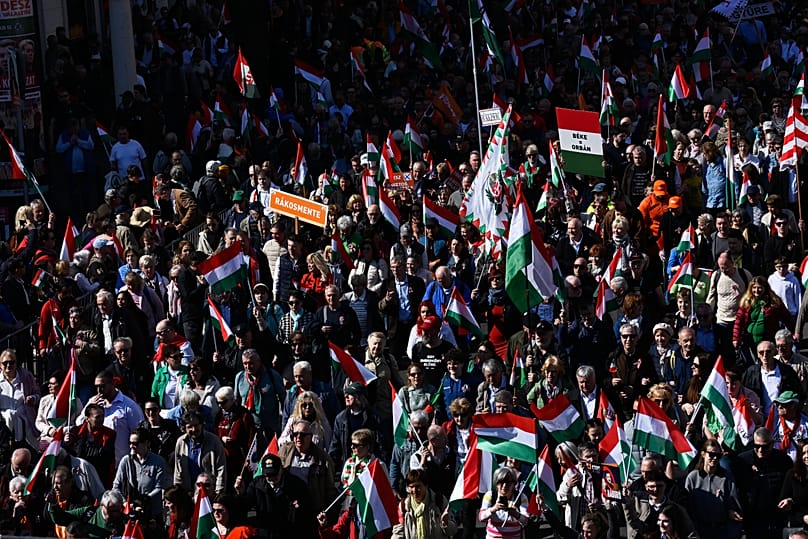
Huge crowds joined rival marches staged by Hungarian premier Viktor Orban and his main opponent Peter Magyar in Budapest on Sunday, as both push allegations of foreign interference just four weeks before tightly-fought elections.

Orban — who faces an unprecedented challenge to his 16-year rule — has sought to portray the opposition leader as a “puppet” of Brussels and Kyiv, while Magyar has accused the Moscow-friendly premier of seeking the Kremlin’s help to stay in power ahead of the April 12 elections.

The nationalist leader in his speech Sunday urged Ukraine to stop “attacking” the central European country.

In a heated spat, he has accused Kyiv in past weeks of blocking a key pipeline transporting Russian oil through Ukraine to Hungary.

Magyar, in turn, accused Orban on Sunday of seeking to curb Hungary’s freedom by “inviting Russian agents” to “interfere in the elections”.

This follows reports by regional investigative outlet VSquare and the Financial Times of a covert Russian social media campaign to boost Orban and weaken the opposition.

Tens of thousands of people attended both rallies, according to AFP journalists on site.


– ‘ We will not be a Ukranian colony’ –


Hungarians from around the country travelled to Orban’s rally dubbed a “peace march” on the country’s national day, many using buses rented by a group close to Orban’s Fidesz party.

“There is unrest all over the world, and here in our little country we want to preserve peace, calm and security. And Viktor Orban ensures that for us,” said Sandorne Pista, 60, who came from the southern university town of Pecs.

“We will not be a Ukrainian colony,” read one of the banners carried ahead of the crowd, which later chanted “Viktor, Viktor” as the Hungarian premier took the stage in front of the parliament.

“Give us our oil, then roll your trucks over to the cash register in Brussels to collect money from the West, since they can’t say no,” Orban said in reference to the ongoing oil dispute with Kiyv.

Orban’s party has been trailing in polls since last year, and he has recently centred his campaign on attacking Ukrainian President Volodymyr Zelensky.

Tensions between Zelensky and Orban reached new heights last week, when Zelensky appeared to issue a direct threat against Orban and Hungary detained and then expelled a group of Ukrainian bank employees.

Orban told supporters that either he or the Ukrainian leader will form Hungary’s next government.

Zelensky, whose country has been battling a Russian invasion since 2022, in a fresh statement Sunday accused Hungary’s government of spreading “anti-Ukrainian sentiment”.

“We are ready to work amicably (with any Hungarian leader), provided this person is not an ally of (Russian President Vladimir) Putin,” he said.


– ‘Russians go home’ –


Opposition supporters marched behind horsemen dressed as hussars — Hungary’s historic light cavalry formation.

Many have dismissed the government accusations against Magyar’s party.

“They’re trying to divert attention away from the scandalous state of public affairs,” Noemi Kiss, a 28-year-old communications manager, told AFP.

Amid recurring chants of “Russians go home,” Magyar promised the crowd that his party would achieve a “victory so great” that “it will be visible… even from the Kremlin.”

He also vowed that his government will bring an end to “hatred, division and fear” in public discourse.

Billboards against Zelensky have sprung up in recent weeks across Hungary, using images of the Ukrainian leader next to Magyar.

“Orban is doing everything he can to rev up the war psychosis that brought him a fourth supermajority in 2022” after Russia invaded Ukraine, Robert Laszlo, an election specialist at the think-tank Political Capital, told AFP.


'Orbán betrayed Hungarian freedom': Magyar accuses PM of inviting Russian agents to rig the vote


By Sandor Zsiros
Published on 

Opposition leader Péter Magyar called Viktor Orbán a traitor at a Budapest rally, accusing him of enlisting Russian agents to interfere in Hungary's 6 April elections, as polls show Tisza ahead of Fidesz.

Hungary's opposition leader Péter Magyar branded Prime Minister Viktor Orbán a traitor and accused him of enlisting Russian agents to interfere in the country's upcoming parliamentary elections.

Magyar delivered the remarks at a rally in central Budapest marking Hungary's national day, which commemorates the 1848 uprising against Habsburg rule, a revolt that was ultimately crushed by the Russian Empire.

Hungary goes to the polls on 12 April. Magyar's Tisza Party leads Orbán's Fidesz in most opinion polls. Fidesz has governed Hungary with an absolute parliamentary majority since 2010.

"Orbán invited the most skilled Russian agents to our country to interfere in the elections and once again rob us of our most sacred possession, Hungarian freedom, for which our ancestors gave their lives," Magyar said.

He was referring to press reports alleging that Russia has deployed a team of agents from its Budapest embassy to influence the electoral campaign in Orbán's favour. Russia has denied the allegations.

"Lies, deception and harassment, that is what they have in store for us. Viktor Orbán betrayed Hungarian freedom for thirty pieces of silver, for himself and his dynasty. Shame, shame, shame," Magyar said.

Magyar also took direct aim at Orbán's campaign narrative, in which the prime minister portrays himself as the guarantor of peace and stability while casting the opposition as willing to drag Hungary into war.

"To provoke war, to threaten war, to incite war — this is his last weapon against the Hungarians, deployed to keep himself in power," Magyar said. His Tisza Party, he added, stands firmly against any form of military involvement.

"We don't want war, we don't want war," he said.

Opposition focuses on the cost of living

Magyar also devoted a significant portion of his speech to economic issues, pledging to improve living standards and address the cost-of-living pressures facing Hungarian households.

"Viktor Orbán is a traitor who betrayed our common future. He did not build a country, but his own dominion. He did not elevate the homeland, but made it the poorest and most corrupt country in the EU," Magyar said.

He added that his future government aims to bring back EU funding earmarked for Hungary, currently frozen over concerns about corruption and the rule of law.

Magyar also promised to prioritise the repair of public services if his party wins the election.

"Citizens are entitled to the best available public healthcare, wherever they live. They are entitled not to die prematurely from preventable diseases, and not to wait years for a routine examination," Magyar said.

The opposition leader also pledged to introduce a two-term limit on the office of prime minister should Tisza come to power.


'Our sons will not die for Ukraine,' Orbán tells supporters ahead of crucial April elections

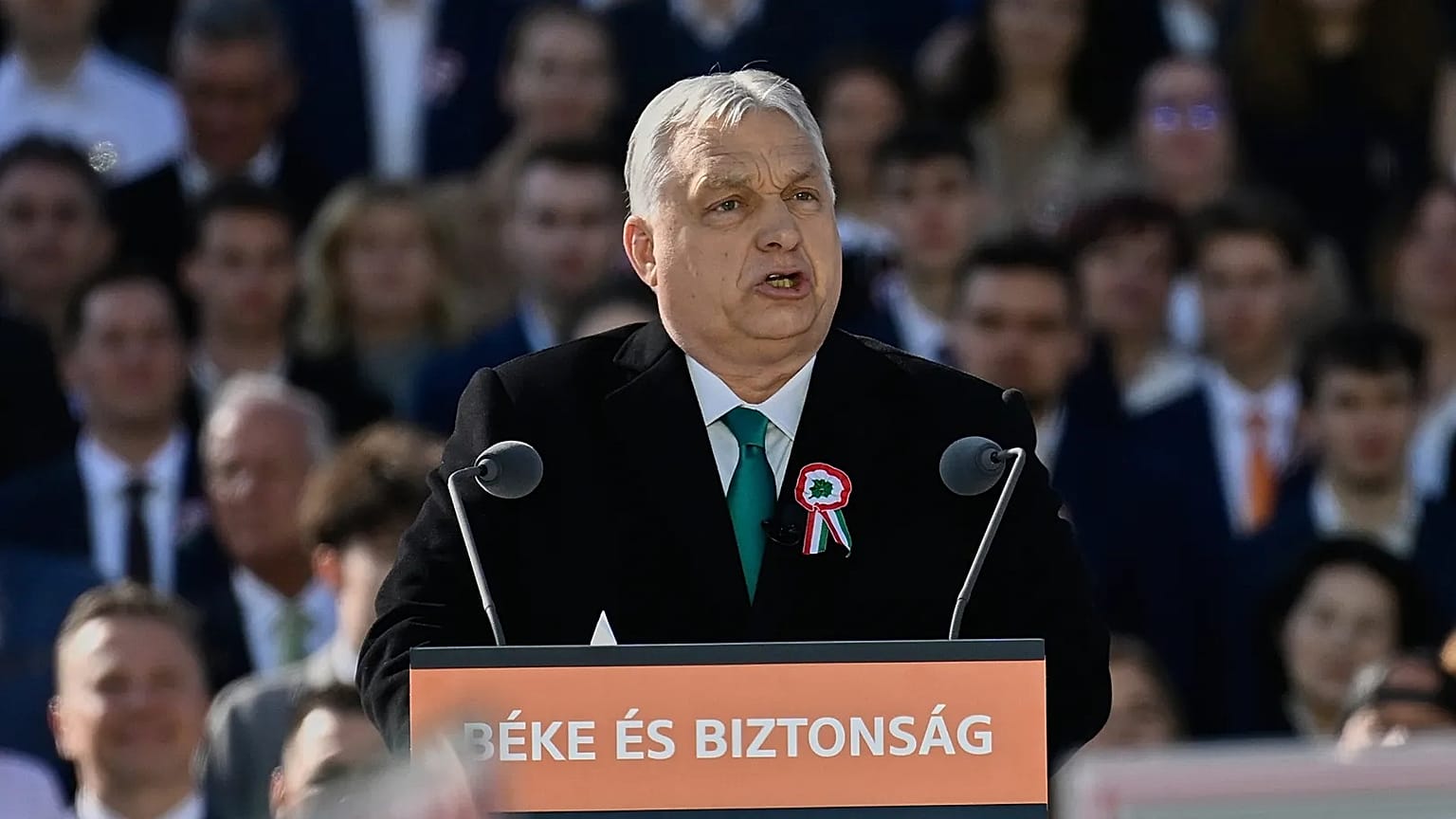
Hungary's Prime Minister Viktor Orbán addresses supporters during a march in Budapest, 15 March, 2026
Copyright MTI

By Sandor Zsiros
Published on 

Hungarian PM Viktor Orbán rallied supporters in Budapest, framing April's election as a choice between peace and war, while lashing out at Ukraine's Zelenskyy and the EU over the Druzhba pipeline dispute.

Hungarian Prime Minister Viktor Orbán declared that Hungary's upcoming parliamentary elections represent a choice between peace and war, casting his government as the guarantor of stability.

Orbán made the remarks at a rally in central Budapest marking Hungary's national day, which commemorates the country's 1848 revolution against Habsburg rule.

Hungary goes to the polls on the 12th of April in a vote widely regarded as the most serious challenge to Orbán's grip on power since he took office in 2010.

Péter Magyar, leader of the opposition Tisza Party, is currently ahead of Orbán's Fidesz in opinion polls.

Supporters of Hungary's Prime Minister Viktor Orbán at a march in Budapest, 15 March, 2026 AP Photo

Orbán said Brussels and Kyiv seek to unseat him

Orbán also accused Ukraine of interfering in the electoral campaign, alleging that Kyiv was siding with the opposition and the European Union in an effort to unseat him.

Budapest and Kyiv are locked in a bitter dispute over the shutdown of the Druzhba pipeline, which carries discounted Russian oil to Hungary via Ukraine. Budapest has blocked the EU's €50 billion loan package to Ukraine until the pipeline is restored.

The row has also taken on a personal dimension, with sharp exchanges between Orbán and Ukrainian President Volodymyr Zelenskyy.

"Do you see this, Ukrainians? Do you see this, Zelenskyy? This is the thousand-year-old Hungarian state. And you think you can scare us with an oil blockade, blackmail and threats against our leaders? Be smart and stop this," Orbán said.

Campaign overshadowed by diplomatic spat with Ukraine

Last week, Zelenskyy said he would allow his troops to phone a European leader who was blocking EU aid to Ukraine, a statement the Hungarian government condemned as a direct threat to Orbán.

"Don't you have enough trouble on the eastern front? Why did you attack us? We are a peace-loving people. Give us our oil, and then roll your vans to Brussels for Westerners' money," Orbán said, in an apparent reference to the seizure of two Ukrainian cash-transport vehicles near Budapest a fortnight ago.

Hungary raided two Ukrainian vehicles from Ukraine's Oschadbank, and confiscated $40m, €35m, and 9kg of gold in a money laundering probe. Ukraine said the transport was legal and accused Hungary of state terrorism. The incident triggered a diplomatic dispute between the two countries.

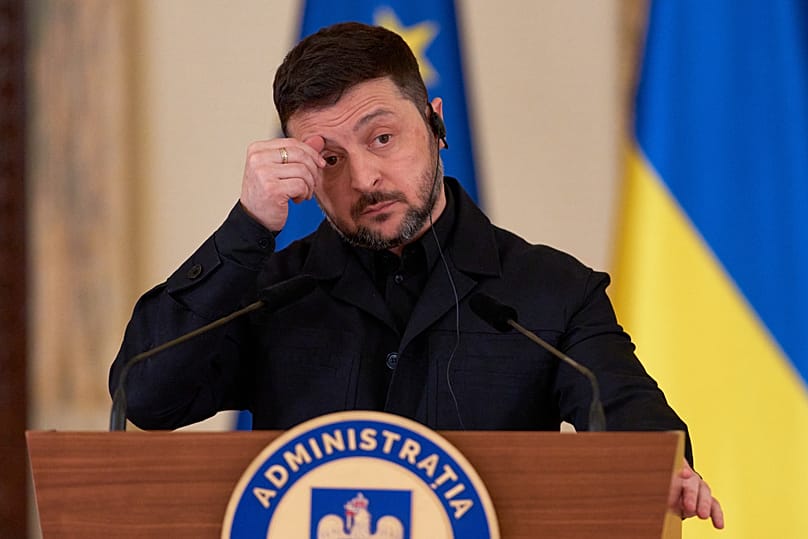
Ukrainian President Volodymyr Zelenskyy gestures during a news conference in Bucharest, 12 March, 2026 AP Photo

Orbán frames elections as choice between peace and war

Framing the vote as existential, Orbán portrayed the upcoming elections as a stark choice between peace and war. He frequently depicts the European Union as a pro-war bloc that is escalating the conflict in Ukraine through financial support and talk of deploying ground troops.

"It is time for Kyiv and Brussels to understand that our sons will not die for Ukraine, they will live for Hungary," Orbán said.

"We must choose who should form a government, me or Zelenskyy? I offer myself, with due modesty," he added.

Orbán also alleged that both Ukraine and the EU have a vested interest in a change of government in Hungary, and called on his Fidesz party to outperform its result from four years ago, setting a target of at least three million votes.