Friday, March 27, 2026

Indian Navy is Quietly Guiding the Country’s Ships Through Strait of Hormuz
Indian Navy
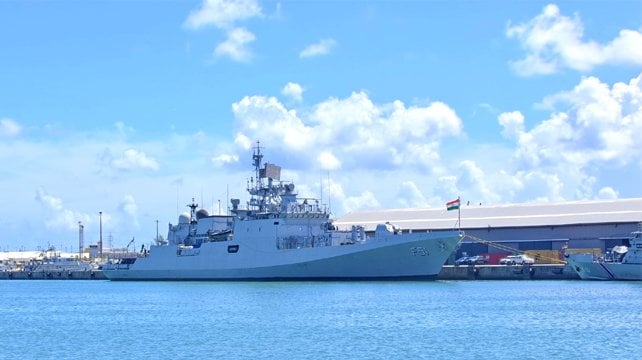
Indian has sent destroyers and frigate to instruction ships through the Strait of Hormuz and to provide protection (Indian Navy file photo)

Published Mar 26, 2026 8:18 PM by The Maritime Executive


Indian government officials confirmed in media reports that the country continues to quietly guide its ships out of the Persian Gulf. The reports indicate that after contact with the Iranians to ensure safe passage, the government launched “Operation Urja Suraksha” to guide and protect critical shipping out of the region.

The IANS News Service detailed the operation with confidential information from government sources. According to the report, the operation is underway with the “highest degree of caution and minimal publicity” to ensure the safe evacuation of the Indian-flagged ships.

India’s Shipping Ministry had said there were 22 Indian-flagged vessels with over 600 seafarers in the western Persian Gulf. There were also three ships with an additional 76 Indian seafarers east of the Strait of Hormuz. According to the latest report, India identified 20 of the vessels as high-priority as they were carrying LNG, LPG, and crude oil.

More than five Indian warships have been dispatched, and they are leading the first element of the support operation. While none of the warships have entered the Strait of Hormuz, they remain above the Gulf of Oman near the terminus and are in constant communication with the merchant ships. 

After securing permission from Iran for the ships to transit the Strait, the warships are providing guidance on the route. They are reported to be providing instruction as well as the procedures the ships should follow. This is considered to be critical as Iran is forcing the ships to take a different route from the Traffic Separation Scheme and closer to its coastline. Ships are being individually guided with precise instructions.

Once a ship clears the Strait of Hormuz, it is met by a series of destroyers and frigates. The support extends through the Gulf of Oman with additional warships and logistics in place.

IANS reported that two additional vessels loaded with approximately 92,000 tons of LPG were due to reach Indian ports on March 25 and 26. This comes about 10 days after the first vessels, LPG carriers Shivalik and Nanda Devi, as well as crude oil tanker Jag Laadki, cleared the Gulf and reached Indian ports with badly needed cargoes.

The Ministry of Ports, Shipping and Waterways, along with the Directorate of Naval Operations, are reported to be closely coordinating in the effort.



India adopts multi front fertiliser strategy as West Asia crisis unfolds

India adopts multi front fertiliser strategy as West Asia crisis unfolds
/ Jagamohan Senapati - UnsplashFacebook
By bno Chennai Office March 27, 2026

India has been actively managing the threat of scarcity of essential commodities born out of the ongoing conflict in West Asia, between Iran on one side and the US and Israel on the other.

Just as in the 2022 supply chain shock which manifested with the disruption in hydrocarbon shipments at the outset of Russia’s full scale invasion of Ukraine and then impacted other essential commodities such as fertilisers and grain shipments, such has been the case in the ongoing conflict in the Persian Gulf.

The biggest short term vulnerability for Indian energy security is liquified petroleum gas (LPG) used in cooking - of which India imports over half of its consumption demand via the Strait of Hormuz and from the countries of the Persian Gulf littoral region.

However a related commodity liquified natural gas (LNG) has also been affected, which apart from its direct fuel role in industrial processes for India also plays a major part in being a precursor chemical input for the production of fertilisers. Ammonia which is another key precursor used in fertiliser production has also been hit in the ongoing supply chain disruption.

While India has ample fertiliser stocks for its upcoming planting season according to a press briefing by India’s Ministry of External Affairs(MEA) on March 19 2026, that ensures availability only till late summer and that too if usage projections done with conservative consumption levels remain relevant.

India relies both on precursor chemical imports for domestic production as well as ready to use fertiliser imports from foreign sources to supply its farmers. The fertilisers supplied to farmers are also heavily subsidised and are a major column in the exchequer’s balance sheet under the category of social goods.

India’s grain crops countrywide but especially in its bread basket states of Punjab and Haryana depend on the steady supply of around 40mn tonnes of Urea which is a nitrogen based fertiliser, a report by the BBC says.

According to a press release by India’s Press Information Bureau, India had 61.11mn metric tonnes of Urea, 2.42mn metric tonnes of Diammonium Phosphate (DAP), 5.72mn metric tonnes of Nitrogen Phosphorus and Potassium (NPK), 2.48mn metric tonnes of Single Superphosphate (SSP) and 1.26mn metric tonnes of Muriate of Potash (MOP) in stock nationwide as of March 19 2026.

In the press briefing MEA spokesperson Randhir Jaiswal revealed that the Government of India had anticipated the supply chain disruptions and had already issued tenders globally to stock up on fertiliser stocks, and that they “expect the bulk of the quantities ordered from a variety of sources to arrive by the end of March”.

According to an official gazette notification on March 9 2026 by the Government of India, the country has vowed to supply fertiliser plants “with at least 70% of their average natural gas consumption based on the last six months.”

Furthermore, according to a report by MoneyControl, the Indian government has also asked domestic fertiliser manufacturing facilities to alter their maintenance schedules to accommodate higher levels of production and be available as the risk of imported supplies of ready to use products may become scarce.

In addition, according to a report by CRISIL Ratings, India could also be looking at an over 10-15% yearly dip in production of Urea and other complex chemical fertilisers if the disruption in precursor chemical supply chain extends to around 90 days.

Citing unnamed senior officials in the Indian government the MoneyControl report also paints China as India’s main alternate source, if supplies from its traditional partners are lower for any reason.

While China is certainly a surplus producer of both precursor chemicals and ready to use fertilisers, New Delhi would also be sourcing from traditional partners and vendors from Russia, Morocco, Canada and Togo which can potentially redirect fertiliser or precursor chemical cargos to India via maritime routes bypassing Strait of Hormuz.
India striving to keep trade pace with Pakistan, reaching out to Central Asia

India striving to keep trade pace with Pakistan, reaching out to Central Asia
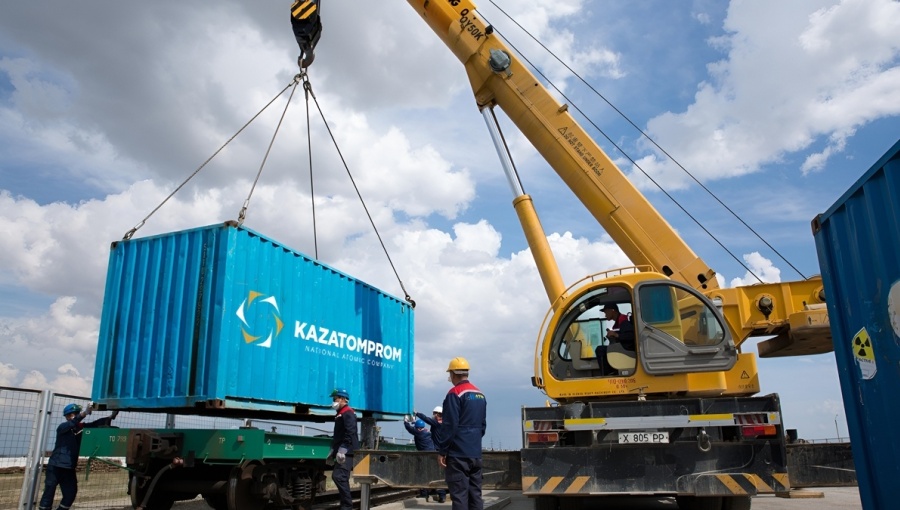
Kazakhstan is considering a multi-billion-dollar deal with India for natural uranium concentrate. / KazatompromFacebook
By Eurasianet March 26, 2026

In the wake of recent efforts by Central Asian leaders to open new trade routes to Pakistan, India is stepping up its diplomatic engagement with regional governments.

Trade volume between India and the five Central Asian states totalled close to $2.5bn in 2025, roughly triple that of Pakistan. But regional leaders have articulated plans in recent months to rapidly increase trade with Islamabad.

That seems to have provided impetus for a flurry of Indian diplomatic activity. Over the past 10 days, Indian officials have held talks with officials from Kyrgyzstan, Tajikistan, Turkmenistan and Uzbekistan looking to diversify commercial ties beyond primarily the energy and pharmaceutical sectors. No specific deals have been announced. 

Regional observers are expecting an upcoming meeting of Indian-Uzbek Intergovernmental Commission on Trade, scheduled for April in Tashkent, to catalyse deal-making. In connection with that meeting, Uzbek officials and representatives of India’s Chamber of Commerce have discussed the organisation of two business forums, one in the Uzbek capital and another in Samarkand. 

Elsewhere, India’s envoy to Turkmenistan, Bandaru Wilsonbabu, held talks with various top Turkmen government officials about developing trade in such sectors as chemicals, fertilisers, transportation and telecoms. Ashgabat continues to work on the long-sought construction of a pipeline to enable Turkmen natural gas to traverse Afghanistan and reach markets in Pakistan and India.

On the sidelines of an international conference sponsored by India’s Ministry of Power on March 22, Indian officials discussed potential electricity-sector cooperation with Tajik and Kyrgyz officials. The Tajik government is exploring potential deals with Tata Power (TATAPOWER.BO), a component of the Indian conglomerate, to develop renewable energy capacity and improve the efficiency of the country’s electricity distribution network. 

Kyrgyzstan, meanwhile, is interested in attracting Indian investment in the long-standing Casa-1000 hydropower project that would enable the export of electricity generated in Central Asia to Afghanistan, Pakistan and India.

Meanwhile, Kazakhstan, currently India’s second largest individual trade partner among Central Asian states, is considering a blockbuster agreement involving the export of large amounts of uranium concentrate to India. The deal is potentially worth upwards of $3bn. The Kazakh nuclear energy agency, Kazatomprom, has scheduled a vote of its stakeholders for April 7. Approval is widely expected, given that the state-run sovereign wealth fund Samruk-Kazyna, a majority shareholder in Kazatomprom (KAP.L), is reportedly favouring the deal.

India’s outreach appears motivated in part by recent Central Asian efforts to upgrade relations with New Delhi’s arch-rival Pakistan, a country that can offer the landlocked region much-desired access to a seaport, enabling an expansion of trade with the broader world. Over the past four months, the presidents of KazakhstanKyrgyzstan and Uzbekistan have all made ground-breaking visits to Islamabad. In early February, Uzbekistan set a target of increasing bilateral trade turnover from roughly $400mn in 2025 to $2bn by 2030.

This article first appeared on Eurasianet here.


Ocean Carriers Adapt to Hormuz Shutdown With Overland Routes

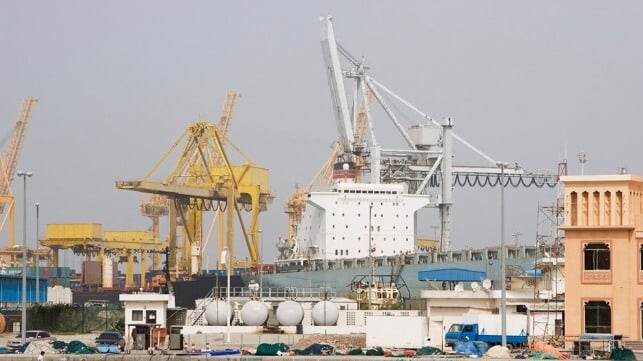
Port of Khor Fakkan, UAE (iStock / IPGGutenbergUKLtd)

Published Mar 25, 2026 7:47 PM by The Maritime Executive


The Strait of Hormuz shutdown has focused the world's attention on the flow of commodities out of the Arabian Gulf, including 20 percent of the world's oil and 30 percent of its fertilizer. But just as importantly, cargo shipments are not getting in, and the region is dependent upon imports for most of its food. 

Most of the world's leading container lines have suspended cargo bookings into the Gulf market because they cannot get past the Strait. Alternatives exist overland through Saudi Arabia and the UAE, but capacity is limited and costs are high. On Wednesday, Maersk chairman Robert Maersk Uggla said that there was a "pressing need" for food imports into the Gulf market, including cold chain deliveries. "As the Strait of Hormuz is closed for now we try to find other ways to bring the cargo into the Gulf," he told Reuters. 

China Cosco, the world's number-four container line, announced Wednesday that it would resume accepting bookings into the United Arab Emirates, Saudi Arabia, Bahrain, Qatar, Kuwait, and Iraq - all of the nations (save Iran) affected by the shutdown. 

Though widely reported as an announcement of resumption of transits through Hormuz, it appears that Cosco does not intend to dispatch ships to service Gulf destinations. An accompanying Chinese-language map for Cosco's announcement suggests that containers would be discharged at Fujairah and moved overland, a development confirmed by multiple Chinese freight commentators. The service mirrors arrangements made previously by CMA CGM to move cargo overland through neighboring ports on the Gulf of Oman, Arabian Sea and Red Sea. 

Cosco said that the service remained subject to change based on future developments in a "volatile" security situation. 

These alternative routes into the Gulf may include one maritime component as part of an intermodal chain. Gulftainer has reached an agreement with Mawani, the Saudi port authority, to set up a feeder service connecting Khor Fakkan to Sharjah, then onwards by sea to Dammam. The connection simulates most of an all-water voyage from the Indian Ocean to the key Saudi seaport, but substitutes a short land bridge across the UAE to bypass the Strait of Hormuz. 


Hapag Issues Difficult Outlook Saying War is Creating Unsustainable Burden

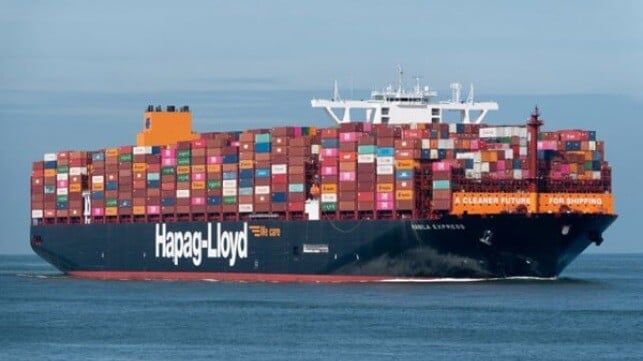
Hapag-Lloyd containership
Hapag-Lloyd warned of challenges that could see it post a loss (EBIT) in 2026 (Hapag-Lloyd)

Published Mar 26, 2026 10:32 PM by The Maritime Executive


Hapag-Lloyd became the first of the major carriers to offer a glimpse into the impact the industry faces as the war with Iran continues. The company finalized its strong results for 2025 and, while maintaining its outlook, issued a dire forecast for 2026.

Speaking during a press briefing on Thursday, CEO Rolf Habben Jansen said the company and the industry are “grappling with a big challenge,” as the war disrupts shipping in the Middle East. Hapag reports it has six vessels with 150 crewmembers trapped, and while saying they are safe, they remain a top concern for the company.

Jansen said the company is incurring additional costs of between $40 and $50 million per week due to the ongoing conflict. He described this as a burden on the company that is “not sustainable for a long time.” It comes as they were already facing uncertain demand and a strong decline in freight rates. He said average rates were down eight percent per TEU, for an operation that handled 13.5 million TEU last year.  Now, costs are also rising, especially with fuel.

Last year was a good one for Hapag-Lloyd, in part driven by the launch of the Gemini Cooperation with Maersk that started in February. The company volume was up eight percent. Its Liner Shipping segment saw revenues increase to $20.6 billion, while it also saw strong growth as it works to grow its terminal operations. Group EBITDA was down but still came in at $3.6 billion, and the Group EBIT was at $1.1 billion, while the Group profit amounted to $1.0 billion.

It warned that its outlook for 2026 remains subject to considerable uncertainty due to the highly volatile development of freight rates and the conflict in the Middle East. It warned that on an EBIT basis, the company could record as much as a $1.5 billion loss or a profit as high as $500 million. EBITDA was forecasted in a range of $1.1 to $3.1 billion.

Hapag’s caution for the industry came as industry trade group BIMCO also issued its container shipping market overview and outlook. It calculates that around 130 containerships, totaling 1.5 percent of the global fleet capacity is stranded in the Gulf. It estimates that as much as 5 percent of global ship demand has been impacted by the war, while saying that with the broader impact out to areas including India and Pakistan, it estimates that nearly 10 percent of the global fleet has been impacted by the war.

BIMCO forecasts that global demand is expected to fall by five percent in 2026. It expects as the war drags on and Persian Gulf shipping is impacted, carriers will be laying up vessels that would have operated in the region as opposed to transferring them to other routes. It expects the weakening of the global supply/demand balance will continue into 2027.

Equinor Begins Drilling At Raia, Its Largest International Project Ever

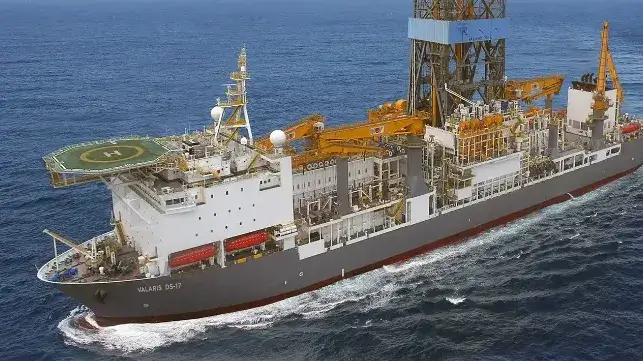
File image courtesy Valaris

Published Mar 24, 2026


Equinor has begun drilling on its largest international project ever, the $9 billion Raia development off the coast of Rio de Janiero. The gas field complex contains at least one billion barrels of oil equivalent, and should be able to supply about 15 percent of Brazil's daily demand for natural gas.


Raia sits in the prolific Campos Basin region, and includes three gas discoveries in the pre-salt layer (so-called for its location, trapped underneath a thick salt crust in ancient deposits below the seabed). The quality of the gas reserve is good enough that Equinor plans to process it offshore and pipe it directly to Brazil's gas transmission system, with no further onshore processing required. Gas is the main product, but the Raia FPSO also has storage and offloading capacity for the project's associated oil.

Drilling got under way on March 24 aboard the Valaris drillship DS-17. The campaign encompasses six wells in 2,900 meters of water depth.

Construction of the FPSO for the project is well under way, led by MODEC, which holds the EPCI contract and will operate the installation for the first year in service. The project has a high degree of local content: the FPSO is being built at the Seatrium shipyard at Angra dos Reis, Rio de Janiero, and the pipe for the export pipeline is almost all Brazilian-made.

Raia is co-owned by Equinor (as operator); a Repsol/Sinopec joint venture; and Petrobras. It is on track to start up in 2028.


Denmark Wins Approval from EU as it Seeks to Convert to CfD Wind Licenses

Denmark offshore wind
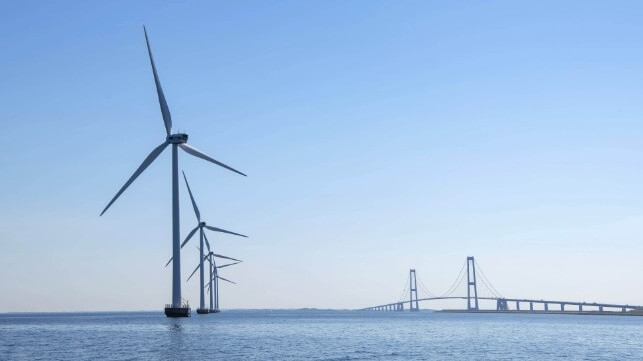
Denmark was a pineer in offshore wind energy farms and now has European approval to use CfD contracts

Published Mar 25, 2026 7:03 PM by The Maritime Executive


Denmark received a critical approval from the European Commission for its subsidy plan fr the next phase of the country’s development of offshore wind energy projects.  After failing to receive bids in a December 2024 auction, the country’s Energy Agency pushed the government to adopt the two-way contract for difference (CfD) model, following the successful approach in the UK, which is gaining popularity in Europe.

The European Commission announced it has approved a €5 billion Danish scheme to support offshore wind energy, which it asserts is in line with the objectives of the EU’s Clean Industrial Deal. The measure, which was adopted in 2025, supports projects that will contribute to the transition towards a net-zero economy and to reaching the 2030 renewable energy target set at the EU level. 

Denmark’s program will run for 20 years, encouraging the construction and supporting the operation of two offshore wind farms: Hesselø and North Sea I Mid. The Danish Energy Agency announced last November that it was starting the new tender for the projects and would include the CfD structure. Under the now-approved plan, the project operators will receive payments when the reference price is below this bid price and will have to pay the Danish authorities when the reference price is above the bid price. The state said there would be a cap of $8.5 bllion on the payments over the life of three projects it planned as the first CfD contracts.

Both of the wind farms are expected to be in operation by 2032. The Hesselø wind farm is expected to have a capacity of at least 800 MW and to generate around 3.2 TWh per year. It will be located east of Denmark and must establish a so-called “nature-inclusive” design. That requires the developer to integrate elements into the structures to create habitats that benefit marine life, such as artificial reefs or havens for species such as fish and shellfish.

The North Sea I Mid wind farm, to be located west of Denmark in the North Sea, is expected to have a minimum capacity of 1 GW and to generate around 4.6 TWh per year.  The deadline for submitting proposals in the tender is May 2026.

The combined annual production of these two wind farms will represent the equivalent of around 25 percent of last year's total electricity production in Denmark. 

The European Commission concluded that the Danish scheme is necessary, appropriate, and proportionate to accelerate the transition towards a net-zero economy and facilitate the development of the projects. While the industry welcomed Denmark’s transition to CfD contracts, it has raised concerns with existing development that do not have the subsidy contracts and onshore projects, which will not be eligible for CfDs. 

Denmark has a long heritage in wind energy and was the pioneer in offshore wind power, launching its first offshore wind farm in 1991. The agency reported in April 2024 that Denmark had a total installed capacity of 2.7 GW of offshore wind power, with one additional wind farm under construction to add another 1 GW in 2027. Denmark was one of eight North Sea countries in October 2025 that recommitted to a pledge to build 120 GW of offshore power by 2030 and at least 300 GW by 2050. Denmark has a target for 14 GW of capacity by 2030.


Chevron Plans to Buy Oil From Sable's Controversial Santa Ynez Unit

Dreamyshade
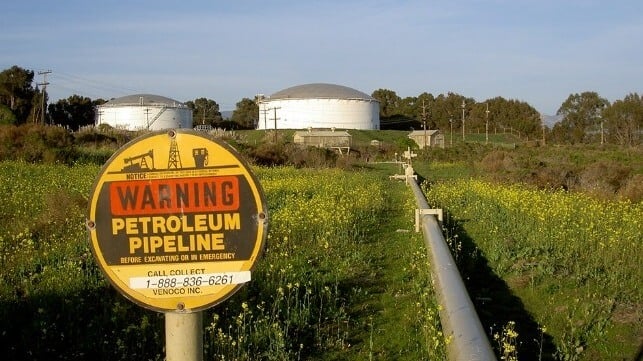
Oil storage tanks at Ellwood Beach, Goleta, California (Dreamyshade / CC BY SA 4.0)

Published Mar 26, 2026 12:30 AM by The Maritime Executive


Houston-based Sable Offshore, owner of the Santa Ynez platform complex and pipeline in Santa Barbara County, has a buyer for its production. Chevron says that it will begin buying 20,000 barrels per day from Sable now that the Trump administration has approved a restart of the former Santa Ynez pipeline, the oil major announced Tuesday. 

"We’re going to run Sable’s crude at El Segundo in April," Chevron president of downstream Andy Walz told Bloomberg. "We’re taking American crude oil, putting it in American pipelines, running an American refinery and selling those products to American motorists — and it’s going to be cheaper than importing."

The former Santa Ynez pipeline was shut down in 2015 after a significant oil spill caused by corrosion (under previous ownership). Sable bought the entirety in 2024 and has been seeking state permission to restart the line, now known as the Las Flores pipeline. In an executive order signed last Friday, the White House invoked the Defense Production Act to overrule California state regulators and allow Sable to bring production and pipeline exports back online. 

California has filed suit to block the executive order and keep the pipeline shut down. The state claims that the White House decision "illegally asserts exclusive jurisdiction over two California onshore oil pipelines," which the state government has not given permission to restart. On Saturday, for extra measure, California's parks department ordered Sable to physically remove the pipeline from Gaviota State Park, which the line crosses. Environmental nonprofits have also filed suit to block the line's operations; the Environmental Defense Center (EDC) of Santa Barbara alleges that the aging pipeline is corroded, and should be more rigorously inspected before operations begin. 

California has the highest gasoline and diesel prices in the lower 48 states, thanks to refinery closures, isolation from the rest of the U.S. energy market, and exposure to the demand signal from critically-undersupplied East Asian markets. 

The state is heavily dependent upon imported oil, receiving more than 60 percent of its crude from foreign producers. It cannot source refined products or crude via pipeline from the rest of the country, and its isolated market has higher pricing, intrinsically linked to the Asia-Pacific refineries where California gets one-fifth of its refined fuel. Asia and Oceania currently face a serious energy crunch due to the disruption in the Mideast, with supply outages and rationing measures reported in Thailand, Sri Lanka and other localities. In a free-trading Pacific market, California competes with Asian buyers, with an effect on price: diesel prices at the pump in the state now average more than $7 per gallon, and climbing. 

Top image: Dreamyshade / CC BY SA 4.0


Carrier USS Ford Pulls Into Port at Crete for Fire-Damage Repairs

USS Ford
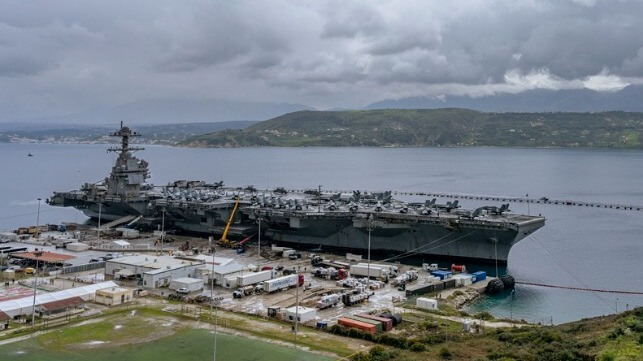
USS Ford at Souda Bay (USN)

Published Mar 25, 2026 5:30 PM by The Maritime Executive


The carrier USS Gerald R. Ford has pulled into Souda Bay, Crete for repairs after a serious fire that started in a laundry room. The blaze damaged berthing areas, already in short supply on board a carrier designed for a smaller crew, and raised concerns about the effects of a nine-month deployment on a vessel designed for six-month service intervals. 

Ford arrived in Souda Bay on the 23rd, and will be in Crete for an indeterminate period for "efficient assessment, repairs, and resupply," U.S. 6th Fleet said in a statement. The vessel's deployment continues, the command emphasized, despite reports that the ship may soon be relieved for a return voyage to Norfolk. 

A copy of the Pentagon's latest internal testing review of Ford suggests that the $13 billion ship's issues may extend beyond fire damage, according to Bloomberg. Nine years after Ford's delivery, and four years after her first trial-scale overseas deployment, the Department of Operational Testing & Evaluation remains uncertain about her "operational suitability." Launch & recovery, radar capability, defenses against incoming threats, and the functioning of her weapons elevators (a longstanding issue) all remain unproven in the department's eyes due to "insufficient data."

For its part, the Navy has expressed satisfaction with Ford's recent operational performance, and says that it has put the ship's first few years of difficulties in the past. Former commanding officer Capt. Rick Burgess called Ford the "most capable, adaptable, and lethal combat platform in the world" at his departure in 2025, extolling the ship's "exceptional performance."

The USS George H.W. Bush Carrier Strike Group is now winding up for a deployment to join operations in the Mideast, potentially to relieve FordBush's destroyer escorts got under way on Wednesday, including USS Mason, USS Donald Cook and USS Ross

The threat picture in the region is serious, according to President Donald Trump. On Tuesday night, during a press conference about the prospects for a deal with Iran, Trump told reporters that Iranian forces had fired more than 100 missiles at the carrier USS Abraham Lincoln during operations off the coast of Oman. Trump celebrated the Navy's ability to conduct air defense at such a significant scale. 

"They shot 100 missiles at one of our aircraft carriers, the Abraham Lincoln," Trump said. "And out of 101 missiles shot, every single one of them was knocked down into the sea. Think of that."

On March 25, the day after Trump's comments, Iranian news sources confirmed the launch of an unspecified number of cruise missiles at Lincoln.


Ukrainian Drone Strike Hits Russian Oil Port of Ust-Luga

Ust-Luga
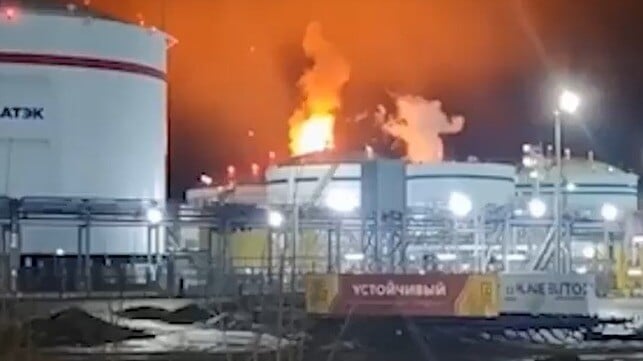
Fire at Ust-Luga, March 24-25 (Russian social media)

Published Mar 24, 2026 11:04 PM by The Maritime Executive


A drone strike has been reported at a petroleum installation in the Russian port of Ust-Luga, just one day after a Ukrainian attack damaged infrastructure at the nearby port of Primorsk. Together, the two ports have a combined loading capacity of 1.7 million barrels per day, and they handle most of Russia's Baltic Sea oil exports.

Leningrad Oblast Governor Aleksandr Drozdenko confirmed Tuesday night's attack on Ust-Luga and said that Russian air defenses had shot down 33 drones. Firefighting efforts at the port are under way, and no casualties have been reported, he said. 

Overnight March 22-23, an even larger barrage of Ukrainian drones swept through the region and targeted the Transneft terminal at Primorsk. Satellite footage of the scene shows effects on multiple storage tanks, and Ukraine's general staff reported hits on oil loading infrastructure as well. Governor Drozdenko confirmed the attack on Primorsk and the tank fire at the terminal. 

Operations at Ust-Luga were not interrupted for long after the March 22-23 attack, which centered on Primorsk, but confirmation of the ongoing fire on March 24 suggests that the impact will be more significant this time. 

Initial public reports indicate that a drone strike also hit the Russian port of Vyborg, including the local shipyard. One vessel known to be under construction at this yard, the ice-class patrol ship Purga, may have been affected: photos in circulation among open-source intelligence accounts suggest that the brand new vessel has taken on a list.

Russia depends upon petroleum export revenues to finance its ongoing war in Ukraine, and that has made Russian oil a primary target for Ukrainian defenders. The incentive to strike Russia's energy infrastructure is currently heightened because of spiking global oil prices, a consequence of the conflict in the Arabian Gulf and the closure of the Strait of Hormuz. In a tight market, the U.S. has eased its sanctions on Russian oil that is already afloat - widely perceived as a prelude to increased Russian oil sales writ large. On Tuesday, the European Union also deferred an expected law that would have banned the last imports Russian oil from the bloc; its unveiling has been postponed indefinitely, though the European Commission says that it remains committed to the legislation. In this context of loosening Western restraints on Russian energy, Ukraine has extra motivation to pursue "sanctions" of its own on Russia's oil ports.


Activists Hound MSC Ships Accused of Transporting Raw Material for Israel Military

MSC containership in port
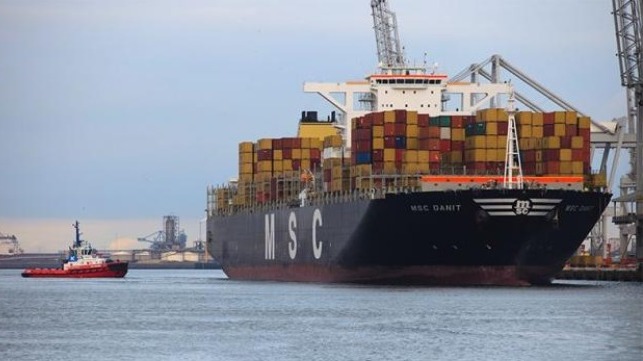
Activists are pursuing MSC containerships with allegations that they are transport raw materials for the Israeli military

Published Mar 25, 2026 5:05 PM by The Maritime Executive


A group of protestors aligned with the BDS movement (boycott, divestment, and sanctions) launched a new effort this week, hounding MSC Mediterranean Shipping containerships, which they allege are transporting raw materials for the Israeli military. They were calling on trade unions, civil society, and political parties to join an effort to pressure the governments and authorities from Italy to Greece to Spain to respond to the alleged shipments.

The group was targeting two of the company’s vessels operating in the Mediterranean. The MSC Vega was traveling to Greece, Turkey, Italy, and Spain. The MSC Danit was arriving in the Mediterranean from India and making calls in Portugal and Egypt. 

The allegations were that the MSC Danit had about eight containers, which they claimed were carrying Indian steel bound for armament manufacturers in Israel. They also asserted that a previous shipment had consisted of 23 containers carrying 600 tons of military steel. 

The activists claimed that they were successful in prompting a cargo inspection in Italy. They also said the Greek dockworkers had said they would not handle any containers with military cargo bound for Israel. The MSC Danit arrived in Israel on March 23, but the local authorities declined to comment on any action that might be taken.

The same issue has hounded the shipping companies in recent years, including after Israel started its attacks in Gaza. Activists targeted a series of ships that they also said were carrying explosives or other military-related cargo. Several Maersk Line Ltd. ships, which operate with U.S. government contracts to move cargo, had diverted from planned calls in Spain when activists claimed they were carrying military equipment to Israel. The U.S. Federal Maritime Commission reported it was investigating the instances and could penalize Spain.

Shareholders of AP Moller Maersk were also confronted with the issue as activist shareholders placed issues on the company’s shareholder ballot. Shareholder activist group Kritiske Aktionærer filed a proposal in 2025 to stop Maersk from shipping military cargoes to Israel. It was voted down by the shareholders. 

The group filed a new proposal in 2026 saying that the company must stop all shipments of military equipment, including parts for F-35 fighter jets, to Israel. Maersk responded that it transports military equipment, including for NATO countries, in compliance with regulations, international standards, and commitments, with increased levels of due diligence in conflict-affected areas. The board did not support the proposal, and the results of today’s shareholder meeting confirmed that the resolution was again voted down by the shareholders.


UK Completes Legal Review to Allow Dark Fleet Seizures

US tracking shadow fleet tanker
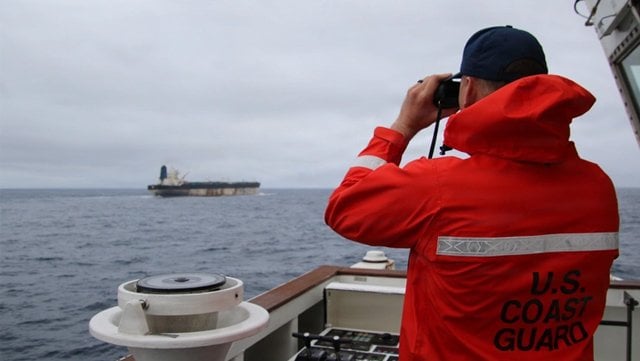
UK until now has only tracked tankers and aided the U.S. and French in their seizures (USCG)

Published Mar 26, 2026 11:30 AM by The Maritime Executive


A mystery has been solved this week, explaining why the United Kingdom has been forward-leaning in providing support both to the United States and to France in their interceptions of dark fleet tankers - without participating in these seizures themselves.  

The UK aided both the U.S. chase of the Russian-flagged Marinera (IMO 9230880) and the French seizures of the Comoros-flagged Grinch (IMO 9288851) in January and the Mozambique?flagged Deyna (IMO 9299903) last week. Similarly, while Finland, Sweden, and Estonia are actively seizing suspect ships in the Baltic, Russian dark fleet tankers have continued to sail unmolested through the heavily used English Channel, where tracking the movements of tankers is relatively easy. In January alone, Lloyd's List tracked 23 dark fleet tanker transits through the English Channel. Moreover, while the United Kingdom is not seizing dark fleet tankers, it is morally not possible to call upon others to do so, particularly those countries in whose waters the dark fleet anchors up and concentrates.

According to a report in the Daily Telegraph, the Royal Navy is about to commence the seizure of dark fleet tankers, now that a legal review has taken place and a legal framework has been put in place. The legal framework has not needed new legislation to supplant laws already in place since 2018, so it is not clear why this has not been done beforehand. But the framework now sets out the legal justification and the necessary procedures for seizures in a variety of circumstances, depending on the particulars of each vessel encountered. The scheme appears to cater for the legal processes both to seize cargoes for resale, and to prosecute masters and crews for health, safety, manning, and registration breaches.

The UK could certainly improve the effectiveness of its anti-sanctions activity. Although making much of the large numbers of ships and entities cited, connected with both Iran and Russia, since the present government came to power in July 2024, the UK Treasury's Office for Financial Sanctions Implementation (OFSI) has levied fines totaling only £1,410,500 ($1.88 million). These six meager penalties were all associated with breaches of Russian sanctions, and none penalized those breaching Iranian-linked sanctions. In comparison, the U.S. Treasury's OFAC levied fines totaling $262.64 million in 2025 alone. Heavy reliance on “voluntary” compliance means that the UK is neither bearing down on state-sponsored sanctions-evasion networks nor on those unscrupulous entrepreneurs who deliberately set out to evade sanctions as a route to bumper profits.

This procedural approach to dark fleet seizures is characteristic of many strands of policy driven by the current UK government, which is led by a lawyer whose closest political ally is his long-standing friend, the Attorney General Richard Hermer, a strong advocate for international law. This legalistic approach to government is reflected in a number of maritime-flavored areas, for example, the drive to surrender the British Indian Ocean Territory to Mauritius, methodologies for stopping cross-Channel small boat crossings, and limiting direct involvement in the current war with Iran.

Nonetheless, a legalistic approach to dark fleet tankers may have some merit if it overcomes some of the obstacles that the more active nations have already encountered in their own courts when implementing seizure policies. Moreover, finding an additional and alternative source of finance for Ukraine would help circumvent obstacles put up to government aid packages by Russian sympathizers in both Europe and North America. But the UK faces another particular problem in implementing a tougher policy: will there be any Royal Navy ships or crews available to carry out the seizures at sea? Perhaps some of the prize money raised by selling off impounded cargoes ought to be used instead to buy a few more ships for the Royal Navy.