Friday, March 27, 2026

NWT CANADA

Curtain falls for Rio Tinto’s Diavik diamond mine

By Michael Thompson


Rio Tinto Officially Closes Diavik Diamond Mine After 25 Years of Operations

Rio Tinto, one of the world’s largest mining companies, has officially closed its Diavik diamond mine in the Northwest Territories of Canada, marking the end of a quarter-century operation that produced some of the world’s highest-quality diamonds. The closure, which took effect in late 2023, represents a significant milestone for the industry and reflects broader shifts in the global diamond market and the economics of remote mining operations.

The Diavik mine, located approximately 300 kilometers south of Yellowknife in Canada’s remote north, began commercial production in 2003 and operated for roughly 25 years. Throughout its operational history, the facility became known for producing premium diamonds with exceptional clarity and quality, contributing meaningfully to Rio Tinto’s portfolio and Canada’s position as a major global diamond producer. The mine consistently ranked among the world’s top diamond producers by volume and value, at its peak generating annual revenues worth hundreds of millions of dollars.

Rio Tinto’s decision to wind down operations came as the company determined that continuing production was no longer economically viable. The primary factors driving the closure included declining ore grades—a common issue in mature mining operations where the richest deposits are extracted first—and the substantial costs associated with maintaining operations in one of the world’s most challenging and remote locations. Operating in the Northwest Territories requires significant infrastructure investment, specialized logistics, and premium labor costs to attract skilled workers to the isolated site. These operational expenses had increasingly outweighed the financial returns as the ore body depleted.

The global diamond market has also faced headwinds in recent years, contributing to the company’s calculus. Demand for natural diamonds has faced competition from lab-grown diamonds, which have gained significant market share among younger consumers and in certain jewelry segments. Additionally, broader economic uncertainty and fluctuating commodity prices have pressured profitability across the sector. These market dynamics gave Rio Tinto additional incentive to exit a marginal operation rather than invest further capital in extending mine life or processing lower-grade ore.

The closure has substantial implications for Canada’s diamond industry, which has become increasingly important to the country’s resource sector. Canada is the world’s third-largest diamond producer by value, after Russia and Botswana, and the closure of Diavik represents a meaningful reduction in the nation’s production capacity. The mine employed hundreds of workers—both directly at the operation and indirectly through supply chains and support services—making its shutdown an economic shock for the Northwest Territories and surrounding communities that depended on the facility for employment and government revenue.

From Rio Tinto’s perspective, the closure reflects a broader strategic realignment within the company. The mining giant has increasingly focused on commodities deemed essential for the energy transition and modern technology, including copper, lithium, and other battery metals. Diamonds, by contrast, represent a smaller portion of Rio Tinto’s overall portfolio and lack the growth narrative that battery metals provide. This shift in strategic priorities has led the company to divest or wind down operations in commodities that don’t align with emerging market demands or long-term corporate objectives.

The decommissioning and closure process itself represents a complex undertaking. Rio Tinto must address environmental remediation, safely dismantle infrastructure, and manage workforce transitions. The company has committed to environmental restoration of the site and has established protocols to minimize the lasting impact on the surrounding ecosystem in the Arctic region. These closure activities themselves require substantial investment and typically extend over multiple years.

The Diavik closure also raises questions about the future of other major diamond mines globally. Several facilities worldwide face similar pressures from declining ore grades, market challenges, and operational costs. Industry observers suggest that consolidation in the diamond mining sector may accelerate, with only the most profitable operations continuing to operate in coming years. This could reshape the competitive landscape of the global diamond industry, potentially concentrating production among fewer players with more favorable geology or lower operational costs.

For workers and communities dependent on the Diavik operation, the closure presents challenges but also opportunities for economic diversification. Territorial and federal governments have emphasized the need to develop alternative economic drivers in the Northwest Territories, including renewable energy, tourism, and other resource sectors. The skilled workforce trained at Diavik may transition to other mining operations or industries in the region.

Rio Tinto’s decision to close Diavik ultimately reflects the harsh realities of mining economics: even well-established, high-quality operations cannot escape the mathematics of resource depletion and market conditions. As the company pivots toward commodities aligned with global megatrends, the curtain has fallen on one chapter of Canadian mining history, while questions about the industry’s future in the Arctic continue to linger.


SAGA Metals acquires titanium property from Rio Tinto


Aerial view of the Lac Tio mine pit in Havre-Saint-Pierre, Quebec. Credit: Canadian Institute of Mining, Metallurgy and Petroleum

Canadian critical minerals explorer SAGA Metals (TSXV: SAGA) has acquired a prospective titanium asset in Quebec from Rio Tinto’s (ASX: RIO) Canadian subsidiary.

The property, called Garneau, comprises 120 claims covering 64.5 sq. km within the Havre-Saint-Pierre anorthosite complex, a district known for hosting significant titanium-bearing deposits such as Rio Tinto’s Lac Tio mine, which is located 80 km away.

SAGA Metals’ CEO Michael Garagan called the transaction a” significant strategic advancement” for the company, citing its location within Quebec’s premier ilmenite district and in proximity to Rio Tinto’s world-class Lac Tio operation.

In a press release Thursday, Garagan noted that the geophysical signature of Garneau represents a “clear target for further exploration”, highlighting its basin-like morphology directly comparable to that of Lac Tio — one of the highest-grade hard rock titanium operations globally.

Having been in operations for over 70 years, Lac Tio now produces ore that is 60-80% hemo-ilmenite, with titanium as the main commodity mined, and iron and rare earth elements as economic byproducts.

‘Drill-ready’ opportunity

Rio, which holds several operations in Quebec, assembled the Garneau property as part of its broader exploration strategy targeting iron–titanium (Fe–Ti) mineralization within the Havre-Saint-Pierre complex. In 2022, it completed a first-pass exploration program, which defined a 4.5 km by 7.5 km magnetic anomaly within the anorthosite complex.

Subsequent fieldwork by Rio Tinto led to the identification of a large, massive ilmenite boulder, confirming the presence of Fe–Ti mineralization within the system. The top grab sample returned assays of 32.4% TiO2 (titanium oxide).

The source of the magnetic anomaly, however, has yet to be identified to this day. At the end of Rio’s work, the Garneau project remained at an early exploration stage, with no drilling completed and limited bedrock exposure across the property.

According to SAGA, the past work by Rio effectively “advanced the property from regional targeting to a defined, drill-ready opportunity,” leaving the key test of subsurface mineralization to future exploration.

The Garneau project joins the Radar property in Labrador as the second titanium–vanadium–iron asset held by SAGA. At Radar, where the company has identified an oxide layering across more than 20 km of strike, a systematic drilling program is currently underway at the Trapper zone in support of an initial resource estimate.

Infrastructure advantage

To acquire the Garneau project, SAGA will incur exploration expenditures amounting to C$434,298 that Rio Tinto was otherwise required to incur on the former’s Legacy lithium project in the James Bay district as part of a 2024 joint venture agreement, which has now been terminated.

Rio will retain 2% net smelter returns royalty on the Garneau project and reimburse SAGA about C$60,000 in costs.

Along with the project’s geologic potential, the company also highlighted its infrastructure advantages, namely the recently completed Romaine hydroelectric complex and the new Hydro-Québec access road located 4.5 km from the property.

Moreover, as a port city, Havre-Saint-Pierre functions as the coastal logistics hub for the region, supported by established rail access from Lac Tio and marine access along the North Shore, SAGA said.

The Rio Tinto mine itself remains an important part of the global titanium feedstock supply chain and continues to underpin the district’s industrial relevance, it added.

Shares of SAGA Metals advanced nearly 2% on the acquisition, taking its market capitalization to C$43.3 million ($31.3 million).


Ivanhoe Atlantic secures Liberia approval for iron ore transport


The ESIA approval is a major milestone in advancing the Kon Kweni iron ore project. Credit: Ivanhoe Atlantic

Ivanhoe Atlantic has secured approval to use Liberian transport and logistics infrastructure as part of its efforts to mine and export high-grade iron ore from its Kon Kweni project in Guinea.

On Wednesday, the Africa-focused miner founded by Robert Friedland announced that the government of Liberia has accepted the environmental and social impact assessment (ESIA) submitted for Phase 1 project activities.

The ESIA approval, says Ivanhoe Atlantic executive chairman Peter Pham, underscores the company’s “strong and collaborative relationship with the government of Liberia” while reinforcing its commitment to developing “multi-user infrastructure that generates long-term economic value.”

The milestone follows the ratification of an agreement for Ivanhoe Atlantic to access Liberian multi-user rail and port infrastructure last December. The company has said it expects to pay the African nation about $1.4 billion in rail user fees, plus $600 million in other taxes and charges.

Meanwhile, final approvals with the government of Guinea will be progressed in coming weeks, Ivanhoe said.

Infrastructure development

Liberia and Guinea have a bilateral agreement that promotes shared use of transport infrastructure. The Kon Kweni project is situated 16 km from the nations’ borders and 46 km from the northern end of the Yekepa-Buchanan railway.

The ESIA, conducted by local environmental and social advisory firm Earthtime Group, evaluates the potential impacts of the Phase 1 project development on the Liberian side, namely the establishment and operation of multi-user rail and port infrastructure to support ore exports from Kon Kweni.

The deposit, which is 85% owned by Ivanhoe Atlantic and 15% by the Guinean government, holds a resource totalling 751.9 million tonnes in direct ship ore, of which 209 million is high-grade ore at 67.8% iron.

During its first phase, mining will start at 2 million tonnes a year, then ramping up to 5 million tonnes. Construction of the Phase 1 mine is expected to begin this quarter. Further phases have been planned, including a Phase 2 that is slated to begin in 2029 to bring the capacity up to 30 million tonnes.

These future expansion phases, said Ivanhoe Atlantic, will be subject to separate regulatory approvals and environmental and social assessment processes.

GM-backed EnergyX to launch Texas lithium facility


Smackover lithium plant rendering from EnergyX.

EnergyX, a startup backed by General Motors, said on Thursday it has commissioned a lithium production facility at its project Lonestar, located in the Smackover formation in Texas.

Lithium demand has been surging globally, driven by the role of lithium-ion batteries in electric vehicles, portable electronics and increased adoption of renewable energy storage solutions.

The Lonestar demonstration plant is operational and will produce roughly 250 metric tons per year of battery-grade lithium carbonate equivalent, the company said.

EnergyX expects production to scale to more than 100,000 metric tons per year.

Lithium refining remains a bottleneck in the US, with China controlling about 70%-75% of global lithium chemical conversion capacity.

The reliance on China for battery-grade lithium chemicals has kept margins low for domestic producers, undermining the economics of most non-Chinese projects, EnergyX said.

The company said the facility enables it to further optimize system design, validate process economics, and provide 5-25 ton samples of battery grade lithium to customers for qualification.

The Smackover formation is an underground geological formation stretching from Florida to Texas and could contain more than 4 million metric tons of lithium.

Companies aiming to extract lithium from the Smackover will need to use direct lithium extraction, a process that has yet to be widely proven at a commercial scale, with most projects still in pilot or early deployment.

(By Dharna Bafna)


Investors rip $11 billion from commodity ETFs in record exodus


Stock image.

Exchange-traded fund investors have been pulling money out of commodities products at the fastest clip on record as the conflict in the Middle East continues to rattle markets.

Roughly $11 billion has been yanked from roughly 100 ETFs spanning precious metals and broad commodity funds. While March is not over yet, the amount marks the largest monthly withdrawal, according to Bloomberg Intelligence data going back to at least 2005.

The biggest outflows concentrated in gold-focused funds like the SPDR Gold Shares (GLD), which has seen more than $7 billion withdrawn, as well as other metals. Silver ETFs also saw redemptions of about $1.4 billion in outflows.

Given gold’s strong run before the war, “people were jittery to get out and lock in those gains,” said Bloomberg Intelligence analyst Athanasios Psarofagis. “Most investors are probably up on it, and that’s who sold hardest.”

Gold’s weak performance during the Iran conflict can partly be explained by a dash for cash, as the war sees investors ditch their relatively liquid and profitable positions. Expectations of higher interest rates and a stronger dollar have also added to headwinds for non-yielding bullion.

Commodities markets have been upended since the US and Israel started attacking Iran on Feb. 28, with the Strait of Hormuz effectively closed off.

Oil and gas markets have contributed to heightened volatility across broader financial markets. Brent oil topped $104 on Tuesday. Energy-linked products have this month experienced inflow and outflow rates not seen in years.

For some market watchers, the historic outflows from the commodities cohort come as a surprise given that many of these funds are typically viewed as safe havens during periods of economic uncertainty.

“Commodity ETFs are seeing record outflows during this market selloff — an unusual twist given their typical role as inflation and risk hedges,” Psarofagis added. “What’s striking is that the move is being driven largely by gold and silver, not oil ETFs.”

The United States Oil Fund (USO), for instance, has seen an infusion of around $400 million so far this month.

March marks a big reversal for commodity ETFs, metals in particular. In February, the funds drew in nearly $7 billion, attracting money for the ninth straight month, BI data show. The last time investors pulled money from the group was in May 2025, when easing trade tensions cut into demand for havens like gold.

“Many of the metals buyers experienced buyer’s remorse after taking a quick, large haircut and are now looking for the next move,” said Carley Garner, senior commodity strategist and broker at DeCarley Trading. “We are in an extremely dysfunctional environment.”

Chile antitrust watchdog approves Codelco-Anglo American mining plan


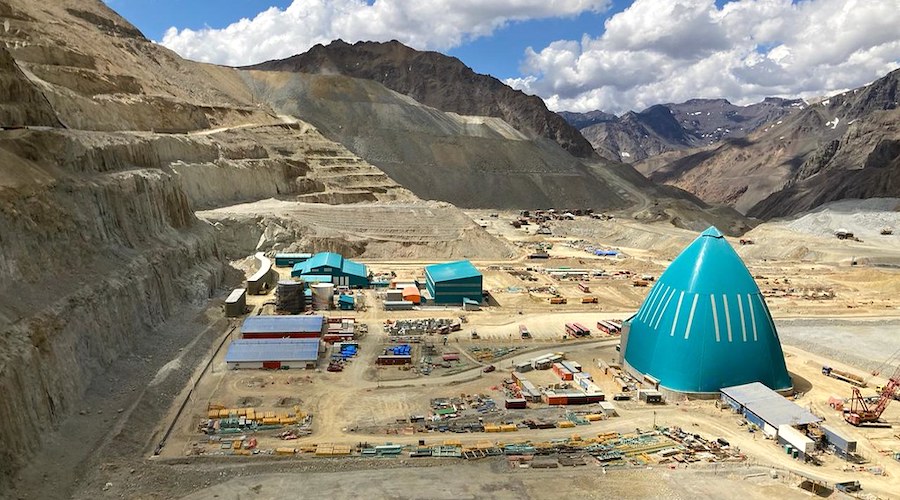
Andina mine in Chile. (Image courtesy of Codelco | Flickr.)

Chile’s state copper miner Codelco said on Wednesday its joint mining plan with Anglo American at the Andina-Los Bronces project has received a green light from the South American nation’s antitrust regulator.

Chile is the world’s top producer of copper and Anglo American is a major operator in the Andean country.

“The project continues to advance with its regulatory approval process, while preparations are underway for the environmental permitting process and the establishment of the entity that will coordinate the joint operation,” Codelco said.

Codelco and Anglo American finalized their agreement to jointly operate their neighboring copper mines last September, a deal that aims at generating at least $5 billion from higher production and cost savings.

The plan looks to bring together certain operations at Codelco’s Andina mine and Anglo American’s Los Bronces mine in the Andes mountains of central Chile, boosting production by 120,000 metric tons of copper a year.

(By Fabian Cambero; Editing by Iñigo Alexander and Natalia Siniawski)

Chile’s government sacks head of state miner ENAMI

Iván Mlynarz, head of ENAMI. Credit: ENAMI

The Chilean government said on Thursday that it had removed the head of state miner ENAMI, Ivan Mlynarz.

The company advisory sent to the local securities regulator was signed by Javiera Estrada, interim executive vice president.

ENAMI, while much smaller than other state miner Codelco, is looking to tap Chile’s lithium reserves in coming years through a partnership with Rio Tinto.

(By Fabian Cambero; Editing by Sarah Morland)

PAKISTAN

Barrick delays Reko Diq project amid Middle East concerns


The Reko Diq deposit is located in the Balochistan province. (Image courtesy of Barrick Gold.)

Barrick Mining (TSX: ABX, NYSE: B) says it will slow its development of the Reko Diq deposit in Pakistan’s Balochistan province and extend the project’s review period, citing security concerns in the Middle East.

The decision, first reported by the Financial Times on Thursday, adds further uncertainty to the buildout of what is considered to be one of the world’s largest undeveloped copper-gold projects.

Shares of Barrick edged lower on the news, trading within a narrow range between $37.70 and $38.97 in New York. It has a market capitalization of nearly $67 billion.

The delay follows preliminary findings from a review announced by Barrick last month to examine all aspects of the project, including capital allocation. The review, according to the company, will now be extended for 12 months from July amid recent escalation in security issues caused by the Iran conflict.

Barrick, which has been developing the project in partnership with the governments of Pakistan and Balochistan for years, initially planned for the project to come online in 2028, subject to financing. The cost for Phase 1 of the project alone would be upwards of $5.6 billion.

Once operational, the mine is forecast to generate over $70 billion in free cash flow and $90 billion in operating cash flow over a 37-year lifespan.

The extended timeline will allow Barrick to further assess potential risks and refine its delivery strategy for the project, the Toronto-headquartered miner said in a statement.

Barrick has viewed Reko Diq — with an estimated 15 million tonnes of copper reserves — as a key pillar of its strategy to become a Tier 1 producer of the metal.


Macquarie says copper is oversupplied and overpriced


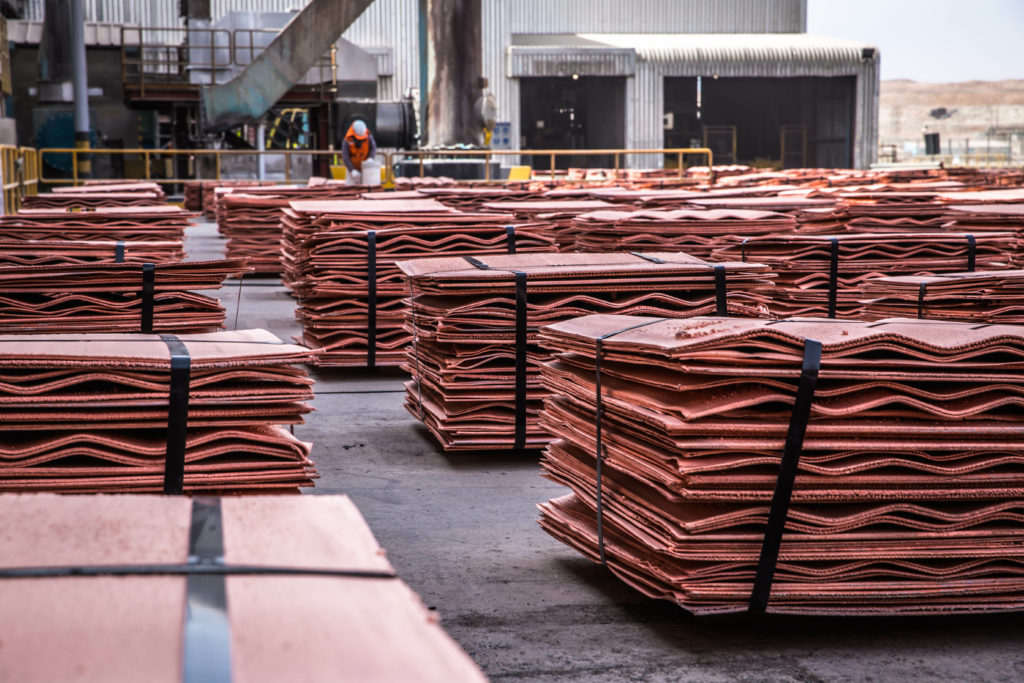
Piling up. Stock image.

Copper ended Thursday down 1.5% from the previous close and May futures were last worth 5.47 per pound or little over $12,000 a tonne. Copper has given up more than 16% or $2,400 per tonne from its all-time high struck at the end of January, a day before the start of the Iran war. 

In a new analysis from Macquarie Strategy, the bank’s 11 analysts in locations including Geneva, Houston, London, Shanghai and Singapore argue that copper’s extraordinary run since December was less about fundamentals and largely driven by investor flows into base metals. Shanghai futures exchange trading volumes in base metals in January was up 80% over December for instance.  

Macquarie also points out aggregate open interest in copper contracts across New York, London and Shanghai swelled by $9.5 billion across December and January before reversing course, with a $24.6 billion decline through February and March accompanying the price correction. 

In Macquarie’s view, the rally has left the market “overpriced, oversupplied and over the pond,” with little evidence of genuine tightness in physical supply. 

Visible global inventories have risen sharply, increasing by more than 1 million tonnes since the start of 2025. Stocks on the LME have climbed to six-year highs, while inventories on COMEX have reached unprecedented levels. The bank also estimates that a further 480,000 tonnes of copper is sitting off-exchange in the United States, drawn in by arbitrage opportunities between CME and LME pricing. 

Much of the excess metal has accumulated in the US, creating what Macquarie describes as an artificial sense of scarcity elsewhere. As for arb: COMEX premiums reached unheard of levels of more than $2,000 a tonne in December and January but has now compressed to more historic levels. 

Nevertheless, the CME-LME arbitrage continues to pull metal into the US says Macquarie as traders position ahead of a potential Section 232 decision on copper imports, expected by June 30, 2026. While recent developments in US critical minerals policy may have reduced the likelihood of tariffs, Macquarie cautions that the outcome remains uncertain and continues to influence trade flows.

As prices have eased Chinese consumers have begun to return, with a notable drawdown in inventories reported in the latest week. Outside China, however, demand remains subdued. Spot premiums are well below contract levels and there is limited appetite for physical metal, suggesting that elevated prices have dampened consumption across key regions. 

This weakening demand backdrop comes even as supply continues to build, reinforcing Macquarie’s estimate that the market was already in a surplus of roughly 602,000 tonnes last year.

Macro factors are likely to remain the dominant driver of prices in the near term. The bank expects copper to trade with heightened volatility, influenced more by investor positioning and geopolitical developments than by underlying supply-demand. 

A resolution to tensions involving Iran could provide short-term support, but such gains would likely be sentiment-driven rather than rooted in fundamentals.

Ultimately, Macquarie sees mounting downside risks and warns that the market lacks fundamental support at current price levels. 

The recent pullback may prove to be an early indication that copper’s rally has run ahead of reality, leaving prices vulnerable to a deeper correction as the year progresses.


MARAD Offers $488M in Revamped Port Grant Program

Alaska
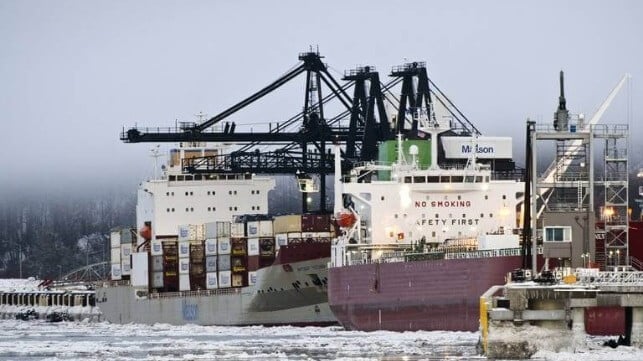
Alaska's Don Young Port in Anchorage received $50 million from PIDP in the past for a new terminal (Alaska)

Published Mar 26, 2026 9:03 PM by The Maritime Executive


The U.S. Department of Transportation’s Maritime Administration (MARAD) announced that it will be providing $488.6 million in funding grants designed to restore American maritime dominance and revitalize American ports, shipyards, and maritime capabilities. The grants are made under the Port Infrastructure Development Program (PIDP), which was authorized by Congress in 2010, and, under MARAD’s management, PIDP selects projects that meet its criteria for the annual grants.

According to Transportation Secretary Sean Duffy, the grants are being linked to the administration’s focus on restoring the nation’s maritime dominance. He said they are refocusing on revitalizing ports with the latest technology and infrastructure.

Duffy said the grant program’s criteria have been revamped and include new priorities for projects located in Qualified Opportunity Zones, projects that incorporate innovative technology, and projects that support national multimodal freight goals.

They note that the U.S. has more than 300 ports operated by states, counties, municipalities, and private corporations. PIDP aims to modernize America’s ports and strengthen our supply chains, helping reduce time and costs for shippers. In the past, it has been used to fund projects such as the development of new ports, intermodal terminals, and electrification. 

MARAD in November 2024 announced nearly $580 million in grants being used to fund projects at 31 ports in 15 states and one U.S. territory. The prior year, November 2023, MARAD announced $653 million in grants to fund 41 port improvement projects, which included $172.8 million for 26 small ports. The Bipartisan Infrastructure Law, signed by Joe Biden in November 2021, allocated $2.25 billion to improve port infrastructure.

This year, the PIDP program will also allocate at least 25 percent of the available funding—totaling $122,157,000—for “Small Projects at Small Ports.” 

Eligible applicants include port authorities, states, local governments, indigenous Tribal nations, counties, and other entities. The deadline for filing applications is June 27, 2026.


USCG Requests Proposals to Replace Outdated Light Icebreakers

USCG Light Icebreaker
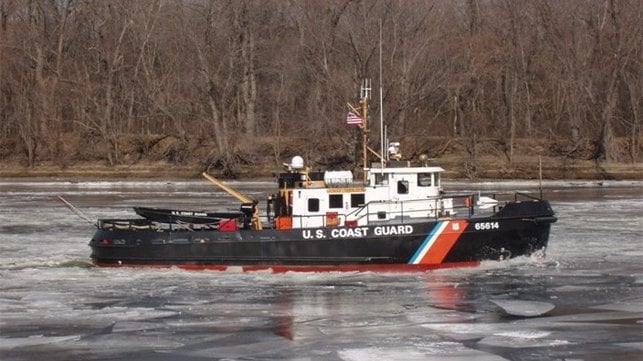
The current Light Icebreaker fleet dates to the 1960s (USCG)

Published Mar 26, 2026 9:56 PM by The Maritime Executive


The U.S. Coast Guard is looking to urgently move forward with its planned replacement program for its badly outdated Light Icebreaker class that dates to the 1960s. It posted a Request for Information providing just two and a half weeks for responses while saying it contemplates streamlined approaches related to contract design, reduced government oversight, source selection, and contract requirements. 

Icebreakers proved even more vital in 2026 in a winter that saw a deep freeze overtake much of the eastern United States. While much is made of the icebreaker efforts on the Great Lakes, equally important operations keep the harbors and vital waterways of the Northeast from Maine to Virginia functional. In New York City, for example, passenger ferry service was disrupted this winter on several occasions due to ice flows in the Hudson River and surrounding waterways, with the Coast Guard called in to aid.

In its fleet assessment, USCG notes that the aging fleet of 65-foot light icebreaking tugs (WYTLs) were commissioned into service between 1961 and 1967 and are well beyond their planned end of service life. A fleet of 15 boats was built, with the last commissioned in May 1967, and they continue to operate along the East Coast and several inland locations.

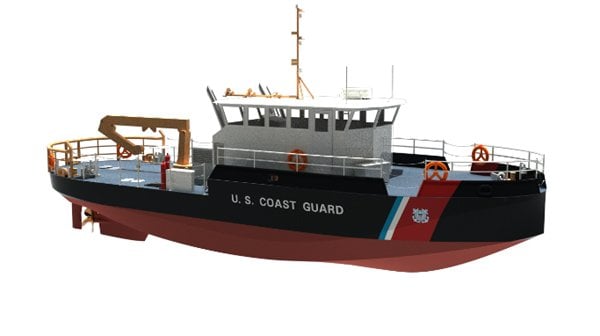
The new design, known as the Homeland Security Cutter Light Icebreakers (HSC-L), will replace these critical assets along with the current 49-foot buoy utility stern loading boats (BUSLs). It will be a new class, dual-capability platform, maintaining year-round access to smaller ports and harbors.


Concept design for the new vessel, which will be an icebreaker and handle buoys (USCG)


The proposal calls for vessels at 70 feet or less in length with 7 feet or less of draft. The vessel will be capable of independently breaking freshwater ice with a thickness of 12 inches at a continuous speed of 3 knots. In addition, it is to be capable of deploying, retrieving, and stowing at least three buoys with moorings. As such, the Coast Guard says the new vessels will be able to perform vital tasks such as quickly restoring damaged or missing navigational aids after storms or accidents. The Coast Guard plans to build seven HSC-Ls. 

The current RFI follows a prior step last October. The Government anticipates a requirement for the production-ready design, production engineering, construction, test, and delivery of up to seven HSC-L vessels. The Government has developed a Contract Design (CD) baseline, which will require further maturation by the contractor to a production-ready design, followed by vessel construction and delivery.

While much of the attention has gone to the replacement heavy icebreakers and the Trump administration’s recent contracts for up to 11 large icebreakers, these small vessels play an equally critical role. The Coast Guard is anxious to replace these vessels, but it also recognizes the need to replace its aging medium icebreakers, comprised of the 140-foot Bay-class icebreaking tugs, which were commissioned into service between 1978 and 1988. It anticipates building 11 of these vessels, which are used primarily on the Great Lakes and along the Atlantic seaboard and can also be used to support search and rescue operations.