Friday, April 03, 2026


MOL and Hitachi to Study Converting Old Ships to Floating Data Centers
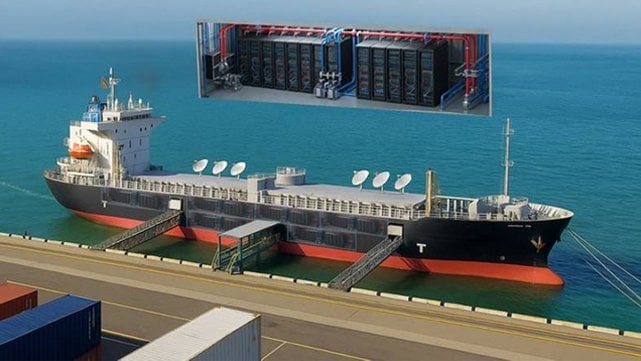
floating data center repurposing old ship
MOL's latest rendering shows a repurposed bulker while in the past they have shown a car carrier (MOL)

Published Mar 30, 2026 6:20 PM by The Maritime Executive


Japan’s Mitsui O.S.K. Lines and Hitachi plan to explore the use of old ships as a means of meeting the strong demand and technical concerns of developing data centers. The companies have signed an agreement that will see them pursue a feasibility study of their concept of floating data centers, as well as verify the demand and technical specifications required for the concept.

The companies point to the strong demand for data centers, in part due to the rapid proliferation of generative AI. However, developing these centers comes with key technical challenges, ranging from their power requirements to the need for robust cooling systems due to the heat generation from high-performance AI servers. Companies have been exploring the use of small nuclear reactors for data center power, while water cooling is increasingly being viewed as an option to dissipate the heat. MOL and Hitachi also point out the space requirements for the centers and local limitations and opposition in some areas.

The repurposing of older ships, they believe, presents a strong option and creates a strong financial case with significant cost savings versus building a land-based center. MOL notes that a ship can be converted in one year, versus the three or more years it could take to build one of the centers. The company highlights that a typical car carrier has 54,000 square meters of space that rivals one of Japan’s largest onshore data centers in terms of floor area. The new rendering, however, shows a repurposed bulk carrier.

They believe ships would have lower construction costs and could also reuse existing onboard systems, meaning they would require a reduced initial investment requirement. As floating structures, they could utilize seawater or river water for cooling and could be relocated based on future demand.

MOL will leverage its expertise in vessel conversion and maintenance as well as its experience in coordinating with port authorities. It will be responsible for defining the marine aspects of such a conversion, while Hitachi will leverage its expertise with existing data centers. It will be responsible for the technical studies exploring elements such as installation, IT infrastructure requirements, security, and customer acquisition.

The goal is to possibly launch their first conversion to commence operations in 2027 or later. They said they will focus on Japan, where Hitachi has operational experience, as well as Malaysia and the United States for the initial projects.

It is not the first time MOL has reported that it would look at repurposing its older car carriers into floating data centers. In July 2025, MOL announced it was working with Kinetics, an initiative from Karpowership, to explore floating data centers. They said it would focus on a 9,700 gross ton car carrier and planned to develop the concepts by 2026 so that a conversion could begin. It was targeting its first operations in 2027.


Cyber Risk in Shipping: From Technical Threat to Business Reality
Marcura ship

Published Mar 30, 2026 2:12 PM by Taher Afridi


Cybersecurity in shipping is still too often framed as a technical issue, something for IT teams to manage in the background. From Marcura’s position across financial, operational and compliance workflows, it is increasingly clear that it has become something far more fundamental: a question of business resilience, financial integrity, and trust across an increasingly complex global ecosystem.

Few organizations sit closer to that reality. I see first-hand how cyber risk manifests in day-to-day shipping and where some of the industry’s assumptions still fall short.

The real weakness isn’t technical

For all the investment in firewalls, monitoring systems and infrastructure, many of the most significant vulnerabilities still sit within everyday workflows and human interaction.

Cyber incidents rarely begin with highly sophisticated technical breaches. More often, they exploit gaps in processes, communication, or decision-making under pressure. This is not about individuals being careless, but about how systems are designed, how information flows, and how people are supported to identify and respond to risk.

In maritime operations, this often takes the form of business email compromise. A bad actor may gain access to a trusted email account, such as that of a port agent, and insert fraudulent banking details into an otherwise legitimate disbursement request. The process appears routine, the parties are familiar, and the timing is often urgent, making the manipulation difficult to detect without the right controls in place. The financial consequences, however, can be immediate.

This is something we see play out repeatedly across global port operations. In fact, over recent years, Marcura has prevented more than 100 fraud attempts, protecting over US$10 million in customer funds by implementing controls around disbursement workflows and payment verification. These are not isolated incidents, but part of a consistent pattern across global port disbursement workflows.

The lesson is clear: cyber risk is no longer about whether systems are secure in isolation. It is about whether entire business processes, and the people operating them, can withstand manipulation.

An ecosystem problem, not a company problem

Shipping is uniquely exposed because it does not operate as a closed system. Every voyage depends on a network of agents, suppliers, port authorities, financial institutions and service providers; many of whom operate with vastly different levels of cyber maturity.

This creates concentrated points of failure, or clusters of risk at critical operational touchpoints.

Port agents, for example, are often small, local businesses with limited cybersecurity investment. Yet they sit directly within high-value financial workflows. A compromised agent email account can be enough to trigger fraudulent disbursement payments, with legitimate stakeholders unknowingly cut out of the loop.

The probability of breach in maritime is high because of the number of actors involved, and not all of them have invested in security. The industry’s fragmentation and global nature create a structural challenge: even if large organizations strengthen their internal controls, they remain exposed through trusted external relationships.

Cyber risk, in other words, is only as strong as the weakest link in the chain.

Following the money

Another shift shaping the threat landscape is the motivation behind attacks. While early cyber incidents were often driven by curiosity or reputation, today’s attacks are overwhelmingly commercial.

Most breaches today are financially motivated, and the question attackers are asking is simple: where is the money, and what is the easiest path to get to it?

Digitalization has made that path significantly easier. Where physical bank robberies once required coordination and risk, today’s attackers can operate remotely, targeting financial flows through phishing, credential theft and social engineering.

Crucially, these attacks do not require deep technical sophistication. The barrier to entry has lowered dramatically, and is falling further.

AI is accelerating both sides                                                                           

Artificial intelligence is now reshaping cybersecurity at speed, and not just for defenders.

On one hand, AI is enabling advanced detection capabilities, allowing organizations to process vast volumes of data and identify anomalies that would be impossible for human analysts alone. On the other, it is making attacks more scalable and convincing.

The guidance we used to give, such as looking for bad grammar or spelling in phishing emails, is no longer relevant. AI has removed those signals overnight.

Attackers can now generate highly personalized, context-aware communications at scale. Combined with automation, this creates a 24/7 offensive capability, one that continuously probes for vulnerabilities.

The result is a widening gap: defenders are still reacting, while attackers are increasingly proactive.

Awareness doesn’t mean readiness

There is no doubt that awareness of cyber risk has improved across shipping. Regulatory pressure, customer scrutiny, and insurance requirements are all driving the issue higher up the agenda.

However, awareness does not necessarily translate into readiness.

One of the most persistent challenges remains training and behavior. While most organizations now run cybersecurity awareness programmes, measuring their effectiveness is far more difficult.

Marcura, for example, has implemented structured training over more than a decade, alongside phishing simulations and internal reporting processes. Yet even with high completion rates, the question remains: are people truly internalising the risks, or simply ticking a compliance box?

Cybersecurity is not the responsibility of one person or one team, but of the organization as a whole. Changing behavior at scale is one of the hardest problems.

For shipowners and operators, this means rethinking cyber risk not as a compliance function, but as a control layer embedded across financial and operational workflows.

From cost center to commercial enabler

One of the more significant shifts underway is how cybersecurity is being perceived at a leadership level. Historically viewed as a cost centre, it is increasingly becoming a commercial differentiator.

Large customers, including major shipping companies, financial institutions and energy firms, now expect robust cybersecurity credentials as a prerequisite for doing business. Certifications, audit reports and demonstrable controls are no longer optional; they are part of the commercial conversation.

In practice, this has translated into sustained investment, not just for compliance, but as a means of enabling trusted service delivery at scale. Cybersecurity is not simply about risk avoidance; it is about unlocking business opportunities.

Towards collective resilience

Despite these advances, one structural issue remains unresolved: the lack of effective information sharing across the industry.

Cyber threats are not competitive, yet responses often are. Organizations tend to manage incidents in isolation, limiting the sector’s ability to learn collectively.

There’s no central mechanism for sharing lessons in cybersecurity. We often hear about incidents too late, or without enough detail to make a meaningful difference.

For an industry as interconnected as shipping, this limits the sector’s ability to build collective resilience.

Improving resilience will require a shift from isolated defense to shared intelligence, where insights from one part of the ecosystem can strengthen the whole.

A business imperative

Cybersecurity in maritime is no longer a future concern. It is already shaping financial outcomes, operational continuity, and competitive positioning.

Organizations that recognize this, and treat cyber risk as a business issue rather than a technical one, will be better placed to navigate an increasingly complex threat landscape.

In a sector built on global interdependence, resilience is not just about protecting systems, it is about protecting trust across every transaction and interaction.

Taher Afridi is Deputy Chief Compliance Officer and Head of Information Security at Marcura, the sponsor of this message. 

The opinions expressed herein are the author's and not necessarily those of The Maritime Executive.

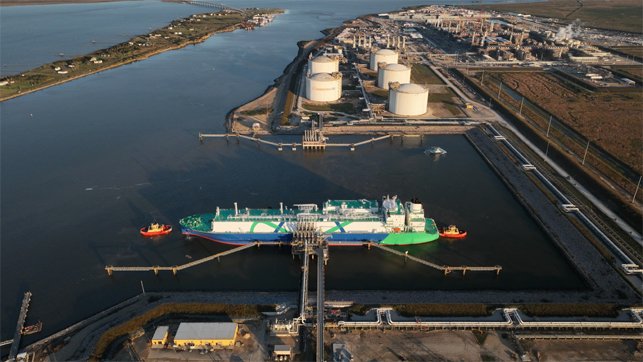
 

QatarEnergy’s U.S. LNG Plant Achieves First Production at Critical Time

US LNG export terminal at Sabine Pass
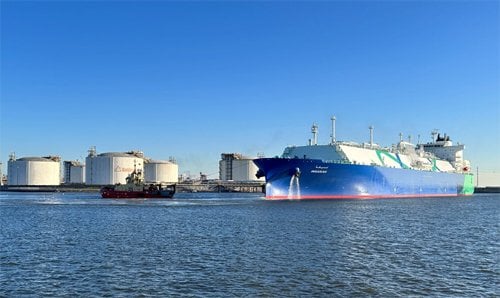
Golden Pass achieved its first production and is preparing for the start of exports (Golden Pass LNG)

Published Apr 1, 2026 8:04 PM by The Maritime Executive


Just as the world is looking for alternative sources of LNG, Golden Pass LNG in Texas reported it has achieved first production. The project, which has been in planning and development for 15 years, is set to start export shipments in the second quarter, coming online to help fill some of the shortfall from Qatar and the Middle East.

The United States is already setting records for LNG shipments and has been rivaling Qatar for the title of the largest producer/exporter. The U.S. Energy Information Administration reported the U.S. was the largest export country in 2025 with over 100 million tons of LNG, further establishing its position after strong exports in 2024. LSGE reports that the U.S. set another new all-time high in March, exporting 11.7 million metric tons, versus the previous record of 11.5 million tons just four months ago. 

Global supply fell by as much as 20 percent in March as hostilities with Iran grew. QatarEnergy reported that it had suspended its operations at Ras Laffan after it was struck by the Iranians, and it warned that its operations could be reduced by as much as 12 million metric tons per year for up to five years while it completes repairs. Qatar had expected to pull ahead in the global race as it commissioned its new North Field.

Golden Pass had been in the application and permitting phase from 2012 to 2017. It is a joint venture with Qatar owning 70 percent and ExxonMobil holding the other 30 percent. The two companies made their final investment decision in February 2019, reporting they would invest approximately $10 billion for the development of Golden Pass LNG.


Cool down cargo arrived in December 2025 (Golden Pass)


“Golden Pass LNG is part of a wider QatarEnergy strategy for international investments that we have been planning over the past decade,” said Saad Sherida Al-Kaabi, the Minister of State for Energy Affairs, and the President and CEO of QatarEnergy. “It also represents a significant part of the plans announced by QatarEnergy in 2018 to invest 20 billion dollars in the U.S. energy sector.”

The project had received its cool down cargo in early December aboard one of QatarEnergy’s new LNG carriers. The company is taking delivery on a massive new fleet with its shipping partners after what was billed as the largest shipping building project. The ships are being built in both South Korea and China.

“First LNG is of particular importance for one of the largest single investment decisions in U.S. LNG history,” commented the minister. “The operational phase and market entry of Golden Pass LNG will come at an important time when global energy security ranks very high on energy agendas worldwide.”

The project is located 10 miles south of Port Arthur, Texas, and close to the Louisiana border. The project highlights that it has a unique advantage in its location with a large, deep-water port. EIA notes it has been just 10 years since the U.S. launched Sabine Pass as an LNG export hub.

The first of three trains at the new site is now in production at the Sabine Pass Terminal. The company said it is now focusing on the delivery of its first cargo, achieving sustained liquefaction operations, and moving to meet its commercial and strategic objectives.

When the project is completed, the three trains will have a total capacity of 18.1 million tons per year. It also includes five 155,000 m³ LNG storage tanks and two marine berths. It will be able to accommodate the largest LNG carriers in the world and become one of North America’s largest LNG export terminals.


Fincantieri, Fraser, Donjon Shipyards Support Shipbuilding in Great Lakes

Fincantieri Marine Group

Published Apr 2, 2026 10:13 PM by The Maritime Executive\


[By: Fincantieri Marine Group]

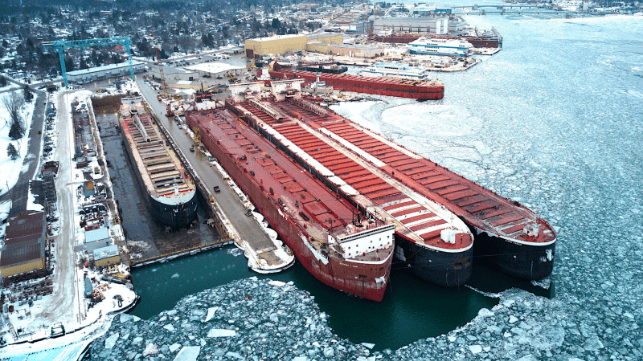
Fincantieri Marine Group and two Great Lakes shipbuilders, Fraser Shipyards (Superior, Wis.) and Donjon Marine (Erie, Pa.), have established a collaborative framework to bring new shipbuilding programs and technology to the ‘Fourth Coast’ in keeping with President Trump’s and his administration’s efforts to rapidly increase domestic shipbuilding.  

These three well positioned shipyards will join forces to compete for a contract to build a new Homeland Security Cutter - Light icebreaker for the U.S. Coast Guard.  Fincantieri is ready to lead such an effort and work together with its fellow Great Lakes shipbuilders and all those ready to join this emerging ecosystem.

Fincantieri CEO George Moutafis said: “Our initial goal is to provide the Coast Guard with a ready-to-build solution for its seven new light icebreakers, and we welcome others to join us on this and other potential projects as we collectively bring significant work to the Fourth Coast. The alliance of these accomplished shipbuilders remains open to other Great Lakes companies, especially those with maritime technology and manufacturing expertise.” 

Fraser Shipyards CEO Patrick Kelly offered: “This Great Lakes Shipyard alliance will encourage quick mobilization and collaboration among shipbuilders and maritime companies operating in the region as we adopt new ship building technologies. The Trump Administration has proposed Maritime Prosperity Zones to facilitate stronger relationships among industry partners and communities to increase industrial capacity at a time of renewed investment in domestic shipbuilding.”

John Witte, Jr., President and CEO of Donjon Marine Co. added: “Donjon Shipbuilding is excited to stand alongside Fincantieri Marine Group and Fraser Shipyards in building a stronger future for American shipbuilding on the Fourth Coast. This alliance reflects the kind of collaboration required to expand domestic industrial capacity and deliver important national shipbuilding programs.”

Fincantieri operates three Great Lakes shipyards in Northeast Wisconsin that have successfully worked as a system of yards on multiple shipbuilding programs for nearly two decades. Fincantieri is confident that their system of shipyards can serve as the blueprint for linking multiple production sites and a revitalized domestic supply chain throughout the Fourth Coast to expedite the delivery of important classes of ships.  

The products and services herein described in this press release are not endorsed by The Maritime Executive.


Ukraine Lines Up Plans to Sell a Sanctioned Politician's Yacht

Royal Romance
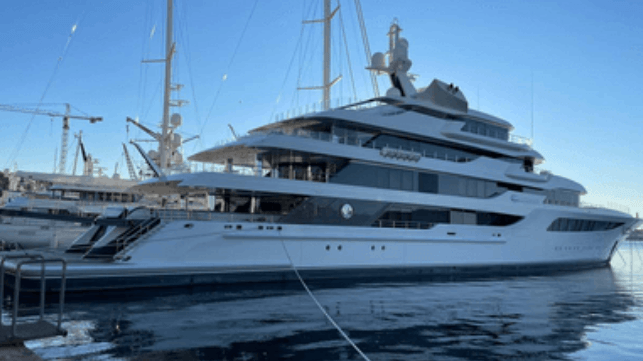
Royal Romance (ARMA)

Published Apr 2, 2026 4:25 PM by The Maritime Executive


The government of Ukraine is lining up plans to sell a yacht that formerly belonged to Viktor Medvedchuk, the pro-Russian politician who was captured in Kyiv in the early days of the Russian invasion.

Medvedchuk, a pro-Soviet lawyer by background, served a variety of leadership roles in pro-Russian political circles in Ukraine through the 2000s and 2010s. As head of the Ukraine's Choice party, he opposed pro-EU popular protests of 2013-14, the Euromaidan movement. In 2021, he was sanctioned by the National Security and Defense Council of Ukraine for allegedly funneling money from his business in Russia to the pro-Russian paramilitary groups in the breakaway regions of Donetsk and Luhansk. Several months later, he was charged with high treason and placed under house arrest. 

In the runup to the invasion, Medvedchuk disappeared, and he was widely believed to be Moscow's preferred candidate to replace President Volodymyr Zelensky, the end goal of a plan for Russian forces to capture the capital and remove Zelensky from office. The Russian invasion stalled before reaching Kyiv, Zelensky remained in office, and Medvedchuk was tracked down and arrested by the Security Service of Ukraine (SBU) in April 2022. He was traded to Moscow in a prisoner-of-war swap five months later, part of a package deal for the return for 215 Ukrainian POWs. 

While in exile in Russia, Medvedchuk has been accused of continued involvement in pro-Russian bribery and influence operations in Europe - notably an alleged $50,000 bribe to a British politician to make pro-Russian statements.

Medvedchuk's yacht is a 92-meter Feadship named Royal Romance. It has an elevator, a substantial pool, and accommodations for 14 guests. Croatian authorities arrested it on a request from Ukraine in March 2022, then transferred its management to the Ukrainian asset-recovery agency ARMA (National Agency for Tracing and Asset Management) in 2024. The agency's objective is to appraise the yacht and sell it, in accordance with a Ukrainian court order. 

In a statement, ARMA said that the previous ownership is putting up "increased procedural resistance" to the sale, including attempts to slow the process down. "ARMA emphasizes that such resistance is an expected element of such processes, and the relevant risks have been brought to the attention of the competent authorities for an appropriate response," the agency said. Nonetheless, ARMA says that the sale process is "entering the final stage."


Taiwan Accuses Salvage Barge of Damaging Subsea Cable

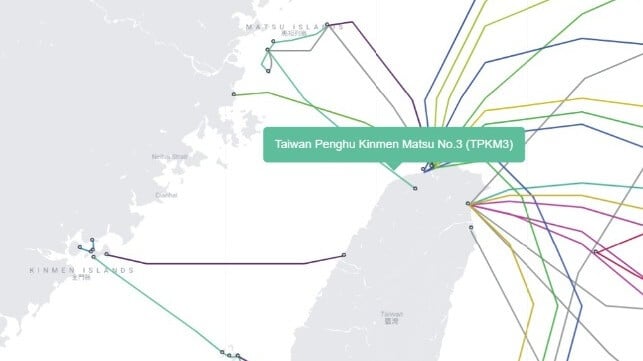
The submarine cable to the Matsu Islands damaged earlier this week (Submarine Cable Map / CC BY)

Published Apr 2, 2026 5:59 PM by The Maritime Executive


Taiwanese officials suspect that a Chinese salvage barge damaged a subsea cable off the coast of the Matsu Islands while recovering a grounded fishing vessel. The allegation carries national security implications: Chinese vessels have been accused of tampering with Taiwan's subsea cables before, and defense officials have concerns about China's abilities to target critical infrastructure with deniable methods, like dragging anchor. 

Last month, the barge Hai Hong Gong 66 was contracted to remove the Chinese fishing vessel Min Lian Yu 63896, which had been abandoned at sea and had drifted aground at Dongyin, a tiny island community located less than 30 nautical miles from the Chinese mainland. Taiwan's Matsu Islands are in close proximity to Chinese shores, and are a frequent flash point for encounters between the two nations' authorities. 

The appointed salvors compiled a response plan, including cable locations, and began work on removing the fishing boat on Monday. Early the same day, the operator of the subsea telecom cable connecting Dongyin to Beigan contacted the Coast Guard and reported that the Taiwan-Matsu Subsea Cable 3 had partially broken. The Taiwan Coast Guard halted the salvage and began an investigation; 11 crewmembers were detained and the captain was taken to shore for questioning. The agency has now forwarded its findings to the local prosecutor's office for further follow-up. 

The telecom line was partially cut, but part remains intact and the telecom connection remains in service, Taiwan's digital affairs agency told media. The agency has contracted with a cable ship operator to conduct a complete repair. 

Cable-damage cases are taken seriously in Taiwan, where the authorities have concerns about the possibility of covert Chinese sabotage operations. This week, a Taiwanese court sentenced a Chinese captain for his role in damaging a subsea telecom cable in 2025. The master of the aging freighter Hong Tai 58 allegedly ordered the crew to drop anchor in a marked cable zone; the ship then navigated in a zigzag pattern, dragging anchor and severing the cable Tai-Peng 3. A Taiwanese court found him guilty of intentionally damaging the cable, and sentenced him to three years in prison and $560,000 in restitution for the cable operator. 


Libya Says Tow Failed and Warns Wreck of Arctic Metagaz Is Out of Control

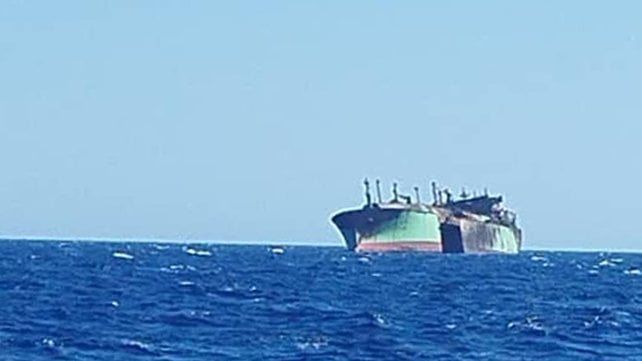
wreck of gs carrier Arctic Metagaz
Libyan's tugs lost control of the wreck during a storm in the Mediterranean (Libya's General Administration for Coastal Security)

Published Apr 2, 2026 1:35 PM by The Maritime Executive


Libya’s Ports and Maritime Transport Authority posted an urgent notice on Thursday, April 2, warning that the wreck of the Russian-flagged LNG carrier Arctic Metagaz is adrift and out of control. They had reported more than a week ago that they had been successful in getting a towline attached to the vessel, but the line has now parted, and weather conditions are preventing reattaching the line, according to the statement.

Over the weekend, the towline reportedly failed several times, but the tugs managing the wreck were able to reattach the line. An online video showed the crew climbing aboard the vessel in dangerous sea conditions. However, the authority is saying that as of 0400 on April 2, the vessel has broken free and is in “a state of complete drift out of control in the open sea.”

They are warning that conditions are severe due to a deep low-pressure system. They said winds were gusting to 40 knots and waves had reached 5 meters (more than 16 feet). The report said it was preventing the tug from controlling the wreck. The Egyptian tugboat Mardave reportedly was working the tow under contract with the Libyan National Oil Corporation.

The notice is warning ships to remain at least 10 nautical miles away from the wreck. They are also asking mariners to report any observed changes in the ship’s condition.

Reports vary on the likely path of the hulk. In Malta, they are saying the ship is likely being driven to the east, away from its search and rescue zone. If it moves toward the northeast, it could be driven back toward Italy.

Malta is reporting that the vessel’s lifeboat, which the crew had used to escape after the explosion on March 3, has now drifted into its waters. Transport Malta reportedly has control of the lifeboat, which the crew had abandoned when they were rescued by another vessel. The 30 crewmembers were transferred to Libya, where they were receiving medical care.

Libyan officials are reporting that salvage plans were still under discussion. Reports said they lacked the facilities in their ports to deal with the vessel. Libya’s goal was to move the vessel away from its offshore energy operations and keep it away from its coastline. The vessel is believed to have some of its LNG cargo still aboard, although they were also investigating if the gas was leaking from the tanks. The ship also has around 900 tons of fuel aboard.

The wreck has remained a concern for a month as it drifted back and forth mostly between Malta and Italy. Mediterranean countries had called for the IMO or the European Union to intervene and oversee the salvage operation. Italian authorities had warned that the ship could explode and said it was an environmental disaster waiting to happen.

Media reports said the Russian position has been that the wreck is the responsibility of the country where it ends up. They assert that Ukraine attacked the ship with a sea drone, and after the crew left the ship, under international law becomes the responsibility of the country where it is located. 

EU resources have been used to monitor the ship’s position. Both Italy and Malta previously said they have contingency plans if the wreck threatens their shores.

Four People Rescued by Vehicle Carrier Transiting the Bay of Biscay

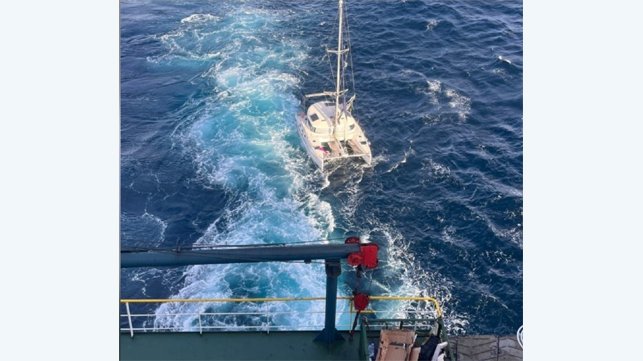
sailboat in distress
UECC reports the crew aboard its vessel was able to safely transfer four people from the sailboat (UECC)

Published Apr 2, 2026 6:23 PM by The Maritime Executive


Four people aboard a large sailboat were successfully rescued after their vessel began taking on water during a storm in the Bay of Biscay. UECC (United European Car Carriers), a 50:50 partnership between NYK and Wallenius Lines, is recounting the tale and saluting the seamanship of the crew aboard its vessel Autosun.

The company’s main business activity is the short sea transportation of new cars and light commercial vehicles. The Autosun, built in 2000 and registered in Madeira, was crossing the Bay of Biscay when the sailboat issued a mayday call. It is a 6,670 dwt RoRo with a capacity of 2,080 vehicles.

The vessel reported that it was encountering strong northerly winds and 3 to 4 meter (10 to 13 foot) swells. It worked in coordination with both the Spanish and French MRCC to ensure a coordinated response.


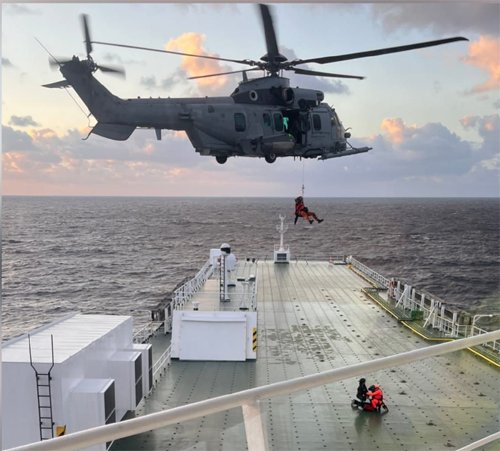
Four people who were rescued were later airlifted by a French rescue helicopter (UECC)


Preparing for the rescue operation, the vessel activated its man overboard (MOB) signal and general alarm to ensure the crew was ready for the operation. They determined to use the pilot door to bring the people aboard and rigged a pilot ladder for the recovery operation.

After a course alteration, it reached the boat in distress and maneuvered the 140-meter (459-foot) Autosun to create a lee. They reported that they were able to reduce the motion on the boat and provide sheltered waters, enabling the car carrier’s crew to safely transfer the four people within minutes aboard the ship.

The four individuals were provided a short medical assessment once aboard the Autosun

A French rescue helicopter was also dispatched. It was used to airlift the four individuals from the car carrier and transport them to shore.


Boxship Departing Taiwan Clips Docked Ship Sending Containers into Harbor

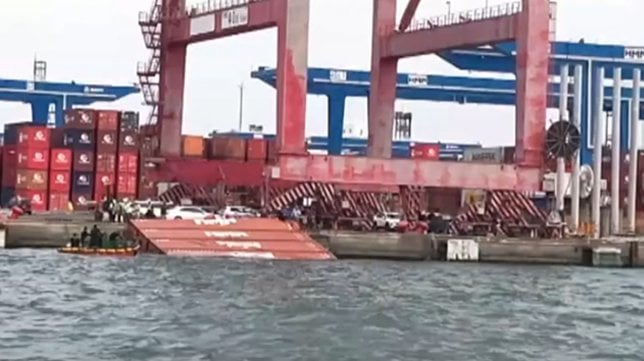
containers overboard on the harbor
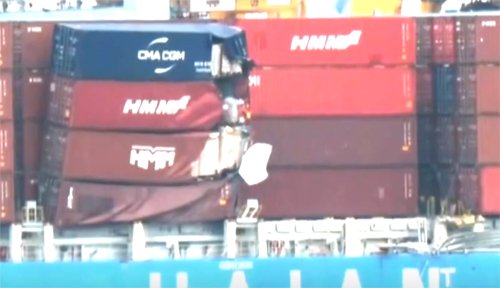
Four containers were floating after the departing ship clipped another containership on the dock (Taiwan TV)

Published Apr 2, 2026 7:16 PM by The Maritime Executive


Operations were briefly interrupted on Wednesday, April 1, at the Port of Kaohsiung, Taiwan, after a departing containership clipped a docked vessel. The port authority suspended operations while four containers that fell into the harbor could be secured.

The Port Authority reports the containership Zeal Lumos (158,097 dwt) had been cleared for departure at 1100 on the first. The vessel, which is managed by Zodiac Maritime and registered in the UK, is operating under charter to Ocean Network Express (ONE). The ship, which has a capacity of 14,952 TEU, was preparing to depart for Shekou, China.

According to the report, the vessel was assigned a pilot and two tugs to maneuver it away from the pier and assist in turning around in the port’s turning basin. The ship, which is 366 meters (1,200 feet), was underway when the navigation control center radioed the pilot to warn that the ship’s stern was approaching another docked containership.

The Zeal Lumos made contact with the Haian Opus, a 24,432 dwt feeder ship operated by HMM. The ship, which is registered in Panama, is 172 meters (564 feet) with a capacity of 7,781 TEU.


Damaged containers aboard the Haian Opus after the Zeal Lumos came too close while departing (Taiwan TV)


The contact caused four containers to fall from the Zeal Lumos into Kaohsiung harbor. Images on Taiwan TV showed several containers that were damaged on the deck of the Haian Opus.


The port ordered the Zeal Lumos to return to its berth for an investigation. 

At the same time, a nearby workboat, Feng Cheng No. 8, was requested to aid in towing the containers, which were floating in the harbor. Once the containers were secured, the port authority resumed operations in the port.
 

Archaeologists Uncover Danish Navy Flagship From the Battle of Copenhagen

Battle of Copenhagen
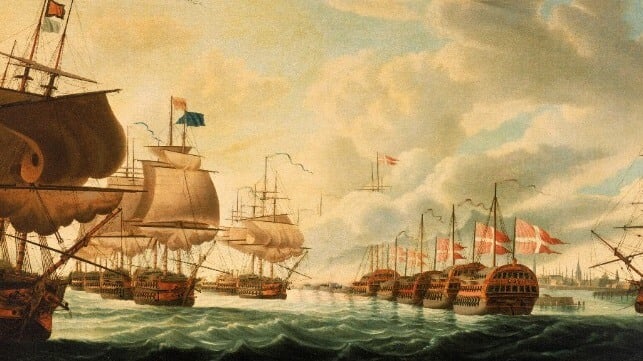
Battle of Copenhagen (

Published Apr 2, 2026 7:36 PM by The Maritime Executive


Marine archaeologists have discovered the wreck of a famous Danish warship on the bottom of Copenhagen's harbor, a reminder of the War of the Second Coalition and the 1801 Battle of Copenhagen. 

The battle was among the best-known victories of Admiral Horatio Nelson, who was tasked with seizing Copenhagen's harbor and compelling the Crown Prince of Denmark to abandon the new League of Armed Neutrality. This new Russian-Danish-Norwegian-Prussian-Swedish naval alliance threatened to undermine British control of the shipping lanes to and from France; Britain and France were at war, and the Royal Navy needed to maintain a naval blockade of French ports. 

A fleet of 12 British ships of the line - backed up by frigates and bomb vessels - sailed from Britain to convince Denmark to revise its alliance with Russia. Admiral Hyde Parker was in command, with then-Vice Admiral Horatio Nelson as his second-in-command. Nelson led the attack on the Danish fleet, which was anchored in a line along the harbor's edge at Copenhagen. In the manner of the time, Nelson arranged his ships in a line and anchored them within about one cable's length of the opposing force, then opened fire with cannon broadsides; the Danish ships, also anchored, returned fire for the next four hours. Each vessel in the stationary melee continued unless disabled or destroyed. Famously, Nelson ignored an order from Parker to withdraw and continued in the fight. The Danish fleet, though numerous, was overwhelmed by the more powerful British force, and the Danes ultimately agreed to a ceasefire. For his role in breaking up the League (among many other victories), Nelson was created Viscount Nelson of the Nile.

During the fighting, the Danish flagship Dannebroge caught fire; after the battle, it exploded and sank, killing more than 50 crewmembers and leaving 19 missing. The wreck rested on the bottom undiscovered for 225 years, surrounded by cannonballs and bar shot. But this year, pre-construction surveys linked to a planned expansion of Copenhagen's waterfront district unearthed the remains of the long-lost ship. Developers will soon begin reclaiming part of the harbor to build a new residential district, to be called Lynetteholm, and the work requires archaeological exploration first. 

“We are now gaining an archaeological body of sources on the Battle of Copenhagen, and that is something entirely new. It is not something that has previously been excavated or studied," said Otto Uldum, excavation leader at the site for the Danish Viking Ship Museum. “The dimensions of the timbers correspond exactly to the drawings of the ship that survive, and the dendrochronological dating matches the vessel’s year of construction in 1772. So we are stating this with a degree of certainty that borders on absolute."

Uldum believes that it is the first archaeological effort of any kind related to the Battle of Copenhagen. As the site is a war grave, the team is treating its finds with respect, including bones recovered that are believed to belong to crewmembers who went down with the ship. "We are far from finished sorting and analyzing the material, but we are bringing everything up," said Uldum. 


Russia Plans to Send Second Tanker Through U.S. Energy Blockade on Cuba

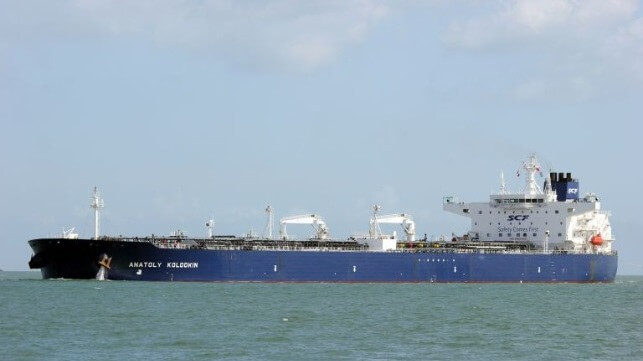
Anatoly Kolodkin
VesselFinder / Aart van Bezooijen

Published Apr 2, 2026 10:19 PM by The Maritime Executive


As a Russian tanker unloads in Matanzas, Cuba, breaking the de facto energy blockade imposed by the Trump administration, Moscow is said to be planning to dispatch a second tanker to repeat the much-needed crude oil delivery. 

The sanctioned tanker Anatoly Kolodkin arrived at a petroleum terminal in Matanzas on March 31, making one of the few deliveries of oil to reach Cuba since the U.S. replaced Venezuelan dsictator Nicolas Maduro in January. Under Maduro, Venezuela's government supplied Cuba with discounted oil, but under ew U.S.-selected leadership, Venezuela ceased sending cargoes to the island. The Trump administration has also turned away attempted tanker deliveries from Mexico. 

The de facto U.S. embargo on energy shipments to Cuba is aimed at weakening the current regime and initiating a transition to new leadership and new economic policies in the socialist-led island nation. Cuba is dependent upon fuel oil for much of its power generation, and the embargo has contributed to extended power outages and transport curtailment (even trash pickup). 

The Anatoly Kolodkin's delivery was prearranged with the Trump administration, according to the Kremlin. The president confirmed this week that he had let the vessel pass. "If a country wants to send some oil into Cuba right now, I have no problem. I prefer letting it in, whether it’s Russia or anybody else," he said at a press conference. 

The vessel's oil will provide Cuba some relief, but experts say that the effects will be small and slow to materialize. Crude delivered to Matanzas has to be refined in Havana, and must be trucked overland to get there. The process could take about three weeks to begin putting out usable products, Jorge Pinon of the University of Texas Energy Program told CNN, and the resulting supply would last Cuba about two weeks. 

More oil may soon be on the way. On Thursday, Russian Energy Minister Sergei Tsivilev said that another vessel would be dispatched to the island. "A second one is now being loaded. We will not leave the Cubans in trouble," Russian Energy Minister Sergei Tsivilev told state media on Thursday. 

Top image: VesselFinder / Aart van Bezooijen