Wednesday, April 15, 2026

DoorDash Grandma Delivering to Trump Doesn’t Change That No Tax on Tips Is a ‘Deceptive Ploy’

“The fact that a term like ‘DoorDash grandma’ exists should be a wake-up call,” said the head of One Fair Wage. “It should never exist in the first place.”
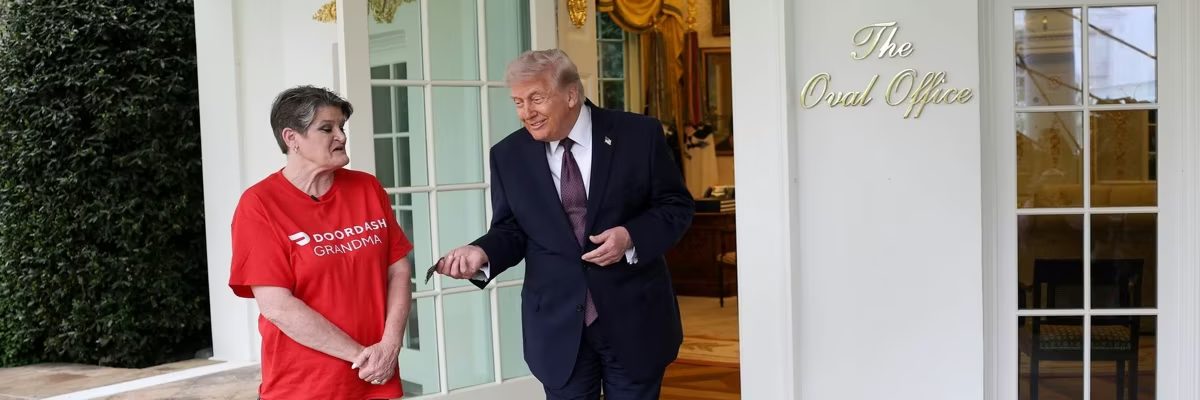

US President Donald Trump tips Sharon Simmons after receiving a DoorDash delivery of McDonald’s at the Oval Office of the White House in Washington, DC on April 13, 2026.
(Photo by Win McNamee/Getty Images)

Jessica Corbett
Apr 13, 2026
COMMON DREAMS

While “DoorDash Grandma” made the company’s first food delivery to the White House on Monday to promote President Donald Trump’s “no tax on tips” policy, the awkward encounter outside the Oval Office not only highlighted critiques of that provision of the GOP budget package but also sparked calls for a living wage and universal healthcare.

“A perfect image of the Trump era: A grandmother has to work at DoorDash in order to get by, while the president decorates his office in gold accent pieces,” said Democratic strategist Max Burns, sharing a photo of the delivery on social media.
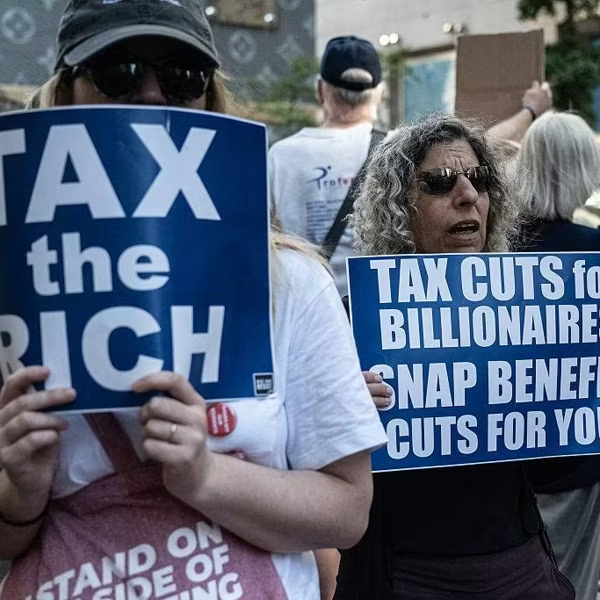

Top 1% to Get $117 Billion in Trump Tax Cuts This Year as Bottom 95% Pay More


Saru Jayaraman, president of worker advocacy group One Fair Wage, told Common Dreams that “it’s sad, and it’s a sign of a failing society—not something to celebrate or turn into a photo op. We’ve normalized an economy where older people are pushed into gig work just to survive. The fact that a term like ‘DoorDash grandma’ exists should be a wake-up call. It should never exist in the first place.”

“Corporations are paying poverty wages while policymakers offer Band-Aid solutions like ‘no tax on tips’ instead of paying a living wage,” Jayaraman continued. “At the same time, cuts to Medicaid and food assistance are stripping away the safety net workers rely on to get by. This is all pushing people into greater dependence on tips and unstable income. Workers don’t need gimmicks—they need living wages, corporate accountability, and real economic security.”


Trump and then-Vice President Kamala Harris latched on to the no tax on tips policy during the 2024 campaign, despite warnings from economists and others that it is a “deceptive ploy,” as the Economic Policy Institute’s David Cooper and Nina Mast put it last year.

“It does nothing to address the low wages, income instability, wage theft, and abuse tipped workers already face,” the pair reiterated in February. “Instead, it may undermine efforts to raise tipped minimum wages, push more workers into tipped jobs, increase workloads, and prompt customers to tip less if they believe tipped workers receive special tax treatment.”

After related legislation passed the US Senate last year, Jayaraman said that “for all the bipartisan celebration, this bill is a distraction from the real fight... If Democrats want to offer a true alternative, they need to say it loud and clear: It’s time to raise the minimum wage and end the subminimum wage once and for all.”

A no tax on tips policy was ultimately included in Republicans’ so-called One Big Beautiful Bill Act—which, as a recent Institute on Taxation and Economic Policy analysis details, featured tax breaks that primarily benefited wealthy individuals and corporations while cutting programs that serve working families, such as Medicaid and the Supplemental Nutrition Assistance Program.

Specifically, last year’s GOP budget package established a temporary federal income tax deduction for tips, capped at $25,000 per year, through 2028. In a February report, the libertarian Cato Institute estimated that “the roughly 3% of tax returns projected to claim the tips deduction in 2026 will receive an average tax cut of about $1,370,” and “as a share of after-tax income, the tips deduction broadly benefits those in the middle of the income distribution.”

“These provisions also add to the already large number of tax deductions and credits that shield vastly uneven amounts of income from taxation based on family size and childcare arrangements,” the Cato report notes. “In addition to the income limits, the tips deduction is only available to occupations that ‘customarily and regularly received tips’ before 2025.”

Sharon Simmons, who wore a red shirt that read “DoorDash Grandma” while delivering McDonald’s bags at the White House on Monday, told Trump that she benefited from the policy. In a statement, the company identified her as an Arkansas-based grandmother of 10 who “started dashing in 2022 to earn income while keeping control of her schedule.”

During the delivery, the president asked Simmons whether she voted for him—“uh, maybe,” she said—and about banning transgender women from competing in sports in line with their gender identity, on which she said she did not have an opinion.

Labor reporter ‪Michael Sainato‬ pointed out that Simmons previously lived in Nevada and advocated for the no tax on tips policy to the US House Ways and Means Committee last year. He also questioned her comments to Trump about having saved over $11,000 on her most recent tax bill.


While Trump staff and congressional Republicans shared footage of Simmons’ delivery to Trump to promote the budget package provision in the lead-up to tax day, US Rep. Dina Titus (D-Nev.) stressed on social media Monday that the president’s “policy is severely limited and sunsets in 2028.”

“We must make it permanent and increase the minimum wage to support our nontipped workers like childcare, fast food, and retail. We can do both by passing my LIFT Act,” said Titus, whose Labor Income Fairness and Transparency Act is backed by One Fair Wage.

“Cutting taxes on tips might make for a good sound bite, but on its own, it’s a hollow fix that ignores the real crisis: Wages so low that two-thirds of restaurant workers don’t even earn enough to pay federal income taxes,” Jayaraman said last year, when Titus introduced the bill. “In a time of skyrocketing costs, workers are drowning and need more than political gimmicks—they need a raise.”

“Tips should be a bonus, not a substitute for a living wage,” she argued. “By ending all subminimum wages and requiring that all workers be paid a full livable wage with tips on top, the LIFT Act addresses what working people need most: a fair wage, a level playing field, and the dignity that comes with being able to provide for their families.”

Some observers on Monday also noted Simmons’ appearance on Fox News, during which she acknowledged the financial burden of her husband’s 2025 cancer diagnosis.


“Grandma shouldn’t have to rely on DoorDash tips to make up for Republicans doubling the cost of healthcare,” declared Democrats on the House Ways and Means Committee, sharing a clip of the interview on social media.

Melanie D’Arrigo, executive director of Campaign for New York Health, which advocates for universal, single-payer healthcare, emphasized that “'no tax on tips’ does not make up for the fact that no one can afford healthcare.”

Historian Timothy Snyder said, “So let’s have universal healthcare and help people live in dignity.”
These Proposals Would Make Life Better for Millions of People—And Most Americans Support Them

“That the US Congress is not debating or introducing bills to address the issues presented here represents a breakdown of democracy,” said an economic justice think tank.


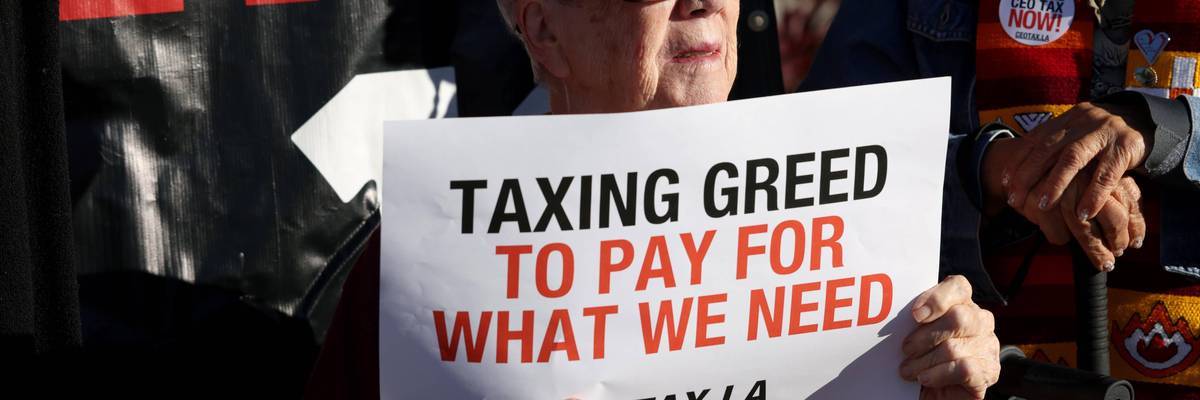
Sister Diane Smith, with CLUE (Clergy and Laity United for Economic Justice), joins The Fair Games Coalition to announce the launch of the Overpaid CEO Tax Initiative in front of the Tesla Diner in Los Angeles on January 14, 2026.
(Photo by Genaro Molina/Los Angeles Times via Getty Images)

Julia Conley
Apr 13, 2026
COMMON DREAMS

A new report by an economic think tank takes aim at the broadly accepted idea that Americans are divided on the major issues affecting millions of people every day—the question of how to ensure everyone can get the healthcare they need without going bankrupt, how the government can ensure working people make enough money to live, and whether the US should take more aggressive climate action.

As it turns out, the Center for Economic and Policy Research (CEPR) suggested Monday, there’s far more agreement on those and more issues across the political spectrum than the corporate media and establishment politicians from both sides of the aisle would have the public believe.

Lawmakers who push for good, fair-paying jobs for all workers; raising the chronically stagnant federal minimum wage; guaranteeing healthcare for all Americans; clean energy investments; and ending the influence of corporations and billionaires on US elections would not be advocating for policies that are just popular on the left, the report says, but would actually be promoting a “Majority Agenda.”

“It may feel like Americans agree on nothing right now, but recent polling tells a different story,” said CEPR on social media. “From raising the minimum wage and strengthening Social Security to affordable housing and healthcare reform, these progressive policies are broadly popular despite the political establishment continuing to ignore them.”

The group pointed to one 2024 poll by the American Communities Project that showed more than 60% of Americans agreed that the economy “is rigged to advantage the rich and the powerful,” while 62% disagreed with the idea of cutting social programs to lower taxes.

Another 2024 poll by The Associated Press found that 91% of Americans supported equal protection under the law and 88% supported the right to privacy, while a 2020 poll by the Carr Center for Human Rights at Harvard Kennedy School revealed that 89% of Americans expressed strong support for affordable healthcare, 85% felt people have the right to a job, and 93% thought the right to clean air and water is essential.

Analyzing those surveys and other data, CEPR advised policymakers to consider the Majority Agenda as a “roadmap” to passing policies that large majorities of Americans view as major priorities to improve their quality of life.

The report is divided into three sections: Good Jobs, Strong Infrastructure, and Fair Play.

To push for fair, well-paying employment, said CEPR, lawmakers should support policies including:Increasing unionization‚ supported by 68% of Americans in one recent poll, through the Protecting the Right to Organize (PRO) Act, cracking down on retaliation against union members, and repealing or reforming the Taft-Hartley Act;
Raising the $7.25 federal minimum wage, supported by 86% of Americans; and
Setting a floor for paid time off from work by strengthening the Family and Medical Leave Act.

The section on strengthening US “infrastructure” looks beyond the traditional definition of the term regarding physical infrastructure projects, pushing for stronger policies that can help working people thrive by ensuring their healthcare, housing, and other basic needs are met.

A stronger infrastructure, said CEPR, would include:Guaranteed healthcare for everyone in the US through the passage of the Medicare for All Act, which has been introduced in the US House and Senate numerous times, and a corporate practice of medicine law to stop the corporatization of healthcare;
A reversal of the trend of federal housing policy directing “too much funding to the wealthy and too little for everyone else,” by ending federal restrictions on the creation of new federal public housing instead of investing in mortgage interest deductions for wealthy homeowners and the Low-Income Housing Tax Credit, whose benefits are greater for wealthy investors than for low-income renters; and
An investment in clean energy by reinstating Biden-era regulations and strengthening the Clean Air Act and other environmental protection laws in order to meet the demands of 59% of Americans who view the climate crisis as “very or extremely dangerous,” according to a 2021 poll by the University of Chicago.

CEPR pointed to three areas in which lawmakers could increase “fair play” for Americans:Strengthening and supporting Social Security, which Republicans frequently attack as rife with fraud and on the verge of going broke, by diverting some among of general revenue to the program and increasing monthly benefits modestly;
Passing a constitutional amendment to allow the government to regulate campaign fundraising and spending both by campaigns and outside individuals and artificial entities; and
Raising taxes on large businesses and the wealthy, as large majorities of Americans believe government should, and restoring funding to the Internal Revenue Service to ensure proper collection of taxes.

“That the US Congress is not debating or introducing bills to address the issues presented here represents a breakdown of democracy, one that comes at a considerable cost to the betterment of life for large swaths of Americans. At the same time, the access to and influence over our democratic processes by the monied class has upended our system of government, and all too often the tyranny of the wealthy minority has reigned,” reads the CEPR report.

“We hope this report stands as a reminder that even in a fraught political moment,” said CEPR, “there is a range of straightforward, broadly popular policy choices that could improve the lives of millions of people.”

New study reveals what the White House doesn't want you to know about prices


FILE PHOTO: Federal Reserve Chair Jerome Powell looks at U.S. President Donald Trump holding a document during a tour of the Federal Reserve Board building, which is currently undergoing renovations, in Washington, D.C., U.S., July 24, 2025. REUTERS/Kent Nishimura/File Photo

April 13, 2026 
ALTERNET

President Donald Trump insists the US economy has never done better than under his second term, but a right-leaning magazine just published an article claiming the opposite is true — indisputably so.


“Tariffs implemented last year by President Donald Trump's administration are entirely to blame for the recent surge in prices for consumer and household goods,” wrote Reason's economic policy reporter Eric Boehm on Monday. ”Those tariffs have raised core goods prices by 3.1 percent, according to a new study by a trio of economists at the Federal Reserve. Those higher consumer prices were the result of retailers passing the cost of tariffs along the supply chain.”

As of two months ago, Trump’s tariffs entirely account for the excess inflation of core goods that Americans have felt since the start of his second term.


"Our estimates indicate that tariff effects on prices gradually build over time, with cumulative effects seven months after implementation consistent with our theoretical measures of full dollar-for-dollar pass-through,” the economists wrote. Boehm added that “the study used the personal consumption expenditures price index (PCE), which is published quarterly by the federal Bureau of Economic Analysis and differs in some small ways from the monthly consumer price index published by the Department of Labor.”

“High prices causes real wages to fall, reversing the gains made since last summer in 2025,” former Special Assistant to President Joe Biden on the National Economic Council Mike Konczal wrote earlier this month regarding prices and tariffs under Trump. A former adviser to President Barack Obama, Betsey Stevenson, similarly wrote that "wars mean declining living standards for everyone,” referencing Trump's unprovoked conflicts against Venezuela and Iran.


Trump’s “tariff shock” has especially hit America’s auto industry, with car magazine WardsAuto reporting last month that “General Motors projects a tariff hit of $3.5 to $4.5 billion in 2025. Ford absorbed an $800 million second-quarter blow. Volkswagen is bracing for a €5 billion impact. Cox Automotive estimates the industry has collectively accumulated more than $25 billion in tariff obligations through just the first seven months of the year — roughly $5,200 per imported vehicle. For vehicles built in Mexico, a critical manufacturing hub, the added cost runs to approximately $4,800 per unit, effectively turning the build-in-Mexico business model upside down.”

As Americans continue to struggle economically because of Trump’s tariffs conservatives like Mona Charen of The Bulwark worry that Republicans will lose in future elections because of the economy.

“Voters are rarely able to connect policy to outcomes, but they have done so in the case of tariffs,” Charen wrote in February. “Back in 2024, Americans were about equally divided on the question of trade, with some favoring higher tariffs and roughly similar numbers opting for lower tariffs. Experience has changed their views.”


She concluded Democrats could win if they embrace as their campaign message, "Tariffs bad—full stop.”


Trump Labor Official Who Used to Represent Amazon Is About to Give the Company a Huge Gift

Crystal Carey, general counsel at the National Labor Relations Board, represented Amazon during her time at one of the biggest management-side law firms in the country.


Jake Johnson
Apr 13, 2026
COMMON DREAMS

National Labor Relations Board General Counsel Crystal Carey proposed a settlement on Sunday that would unwind a major case against the e-commerce behemoth Amazon—a company that Carey represented when she worked in the private sector for corporate clients.

Carey, whom President Donald Trump nominated after firing the Biden-era NLRB general counsel last year, sent her proposed settlement terms to the judge overseeing the labor agency’s case against Amazon, which originated in the final year of the Biden administration. According to Bloomberg, Carey proposed that Amazon provide two weeks’ worth of pay to dozens of drivers who were previously employed by Battle-Tested Strategies (BTS), formerly one of Amazon’s delivery service partners (DSPs).
Amazon, in turn, would not be required to admit to unfair labor practices or be “found liable as a joint employer.” The Biden-era NLRB argued that Amazon was a joint employer of the BTS delivery drivers and thus required to recognize and collectively bargain with their union—something Amazon has refused to do.

Bloomberg noted that, if decided against Amazon, the case Carey wants to settle “could have led for the first time to an agency judge, the NLRB members in Washington, and, eventually, federal appeals court judges ruling that Amazon was the joint employer of drivers for one of its delivery service partners.”

“Amazon contracts with thousands of such partners to manage hundreds of thousands of delivery workers,” Bloomberg observed.

Before Trump nominated her to replace labor champion Jennifer Abruzzo as general counsel of the NLRB, Carey was a partner at Morgan Lewis, one of the biggest management-side law firms in the country. The Economic Policy Institute noted following Carey’s Senate confirmation last year that Morgan Lewis “represents corporations known for violating workers’ rights, including Amazon, SpaceX, Apple, and Tesla.”

“Morgan Lewis is also pursuing the legal challenge that the NLRB is unconstitutional, despite several former NLRB members being employed at the firm,” EPI noted. (Amazon has also argued in court that the labor board is unconstitutional.)

Amazon donated $1 million to Trump’s inaugural fund, and the company’s founder, mega-billionaire Jeff Bezos, attended the inauguration ceremony alongside other big-name tech executives.

Despite her ties to Amazon via her tenure at Morgan Lewis, Carey argued that she was not required to recuse herself from the case she’s working to settle. According to Bloomberg, Carey said in an interview that “because a year had passed since she herself represented Amazon and because Morgan Lewis wasn’t representing the company in the [ongoing joint employer] case, she didn’t need to recuse herself.”
‘Epitome of Crony Capitalism’: Hollywood Stars Come Out Swinging at Paramount-Warner Bros. Merger

“The result will be fewer opportunities for creators, fewer jobs across the production ecosystem, higher costs, and less choice for audiences.”


Mark Ruffalo attending the Crime 101 UK gala screening at the Odeon Luxe in Leicester Square, London. Picture date: Wednesday January 28, 2026.
(Photo by Ian West/PA Images via Getty Images)

Brad Reed
Apr 13, 2026
COMMON DREAMS

A group of Hollywood actors, directors, and producers on Monday published an open letter demanding the proposed merger between Paramount and Warner Bros. Discovery be blocked.

In their letter, the Hollywood heavyweights outlined the harms that would come from allowing Paramount—which is owned by David Ellison, son of billionaire Trump donor Larry Ellison—to acquire Warner Bros. Discovery.


FCC Approval of Latest Megamerger Accelerates ‘Creation of State Media’ Under Trump, Critics Warn


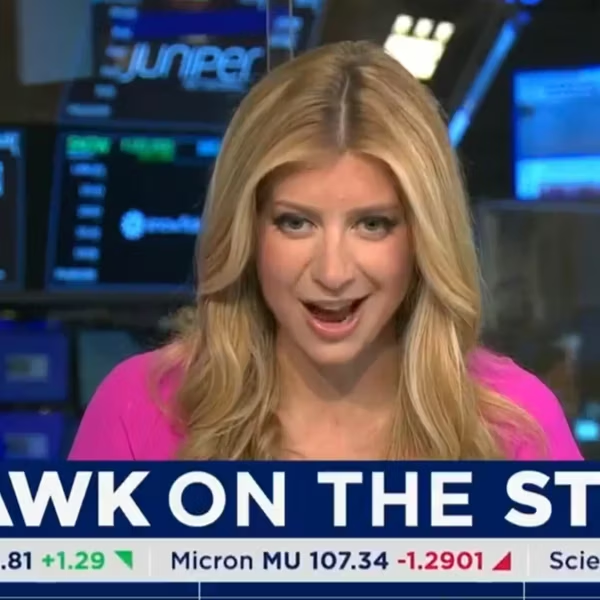
‘What Stage of Corporate Media Is This?’: CNBC Anchor Mulls Investor ‘Upside’ of Trump Genocide Threat

“This transaction would further consolidate an already concentrated media landscape, reducing competition at a moment when our industries—and the audiences we serve—can least afford it,” the letter states. “The result will be fewer opportunities for creators, fewer jobs across the production ecosystem, higher costs, and less choice for audiences in the United States and around the world. Alarmingly, this merger would reduce the number of major US film studios to just four.”

The letter goes on to describe how consolidation in the entertainment industry has already “accelerated the disappearance of the mid-budget film, the erosion of independent distribution, the collapse of the international sales market, the elimination of meaningful profit participation, and the weakening of screen credit integrity.”

Looking at the bigger picture, the letter notes that “competition is essential for a healthy economy and a healthy democracy,” then goes on to praise California Attorney General Rob Bonta and other state AGs for filing legal actions aimed at blocking the merger amid fears that the Trump administration could rubber-stamp it.

“We are grateful for their leadership,” the letter concludes, “and stand ready to support all efforts to preserve competition, protect jobs, and ensure a vibrant future for our industry, for American culture, and for our single most significant export.”

Actor Mark Ruffalo, a signatory of the letter, published an article on his Substack page outlining his own reasons for opposing the merger, which he described as “the epitome of crony capitalism and the oligarchs consolidating more corporations and media power to shape the outcome of their business interests.”

Ruffalo also said he’s spoken with others in Hollywood who were reluctant to sign the letter over concerns about retaliation from Trump or Ellison should the attempt to block the merger fail.

“The people pushing monopolies such as this one use fear to keep the workers in line,” Ruffalo said. “I have heard it time and time again from my fellows, they are afraid of retribution. Some didn’t want to sign because they are afraid. How sad is that? In America the artists are afraid to speak out against power.”

Actress Jane Fonda, founder of the modern Committee for the First Amendment, said that the proposed Paramount-Warner Bros. merger “would be one of the most destructive threats to free speech and creative expression in our history,” because it would put “unprecedented power in the hands of a single corporation that already appears to have proven itself willing to sacrifice integrity for political favor.”

The letter earned praise from democracy and antitrust advocates, who argued that blocking the merger was necessary to stopping President Donald Trump’s ambitions for a right-wing takeover of US media.

“The future of free media and a strong entertainment industry in America is at stake here,” said Norm Eisen, co-founder and executive chair of Democracy Defenders Fund. “This proposed merger would not only harm competition and creativity, it would erode the very bedrock of our democracy.”

Matt Stoller, director of research at the American Economic Liberties Project, noted that “consolidation in Hollywood has been a disaster, and has led to the weak state of the industry,” and said the Paramount-Warner Bros. merger needed to be blocked to prevent further damage.

“Not only does this kind of concentration hollow out creative markets,” said Stoller, “it concentrates control over culture and information in the hands of a few unaccountable executives, and in this case totalitarian Gulf countries, undermining a free and pluralistic media ecosystem that democracy depends on.”
‘A Constitutional Emergency’: Psychiatric Experts Say Congress Must Confront Mentally Unstable Trump

“We recognize the gravity of what we are asking. We ask it because the gravity of the situation demands it.”


Protesters in opposition to the US war on Iran gather outside of Lafayette Park across from the White House on April 7, 2026.
(Photo by Andrew Leyden/Getty Images)


Jake Johnson
Apr 14, 2026
COMMON DREAMS

A group of four psychiatrists warned congressional leaders on Monday that US President Donald Trump has recently exhibited “every behavioral sign of a personality in acute crisis,” presenting a “constitutional emergency” that demands immediate action from lawmakers and members of the administration.

In a letter to the top Republican and Democratic lawmakers in both chambers of Congress, the psychiatrists and Columbia University professor Jeffrey Sachs—who helped organize the letter—pointed to Trump’s recent genocidal threats to wipe out Iran’s “whole civilization” and bomb the country “back to the stone ages” as examples of rhetoric that has “crossed a threshold.”

“President Trump exhibits what forensic mental health experts have, across dozens of independent assessments, identified as the ‘Dark Triad’ of personality traits: narcissism, Machiavellianism, and psychopathy,” the letter states. “Rather than constituting a clinical diagnosis, this trait-based assessment is grounded in behavioral observation and is particularly useful for assessing the level of danger an individual poses in a political leadership position. We do not offer this as a clinical verdict. We offer it as the considered judgment of a substantial body of professional opinion, based on well-researched evidence that is consistent, accumulating, and impossible to dismiss.”

The psychiatrists who signed the letter are James Gilligan, clinical professor of psychiatry at New York University; Prudence Gourguechon, former president of the American Psychoanalytic Association and former vice president of the World Mental Health Coalition; Bandy Lee, president of the World Mental Health Coalition and former professor at Yale School of Medicine; and James Merikangas, clinical professor of psychiatry and behavioral science at George Washington University.

The experts’ letter came amid growing calls from congressional Democrats for Trump’s removal from office, whether through the impeachment process or the pathways offered by the 25th Amendment.

The psychiatrists stop short of demanding Trump’s immediate removal. Rather, they urge Congress to reestablish its constitutional authority over war in response to the president’s unauthorized assault on Iran; convene “urgent consultations” with top administration officials to prevent Trump from escalating “toward catastrophe, including the potential use of nuclear weapons”; and “formally initiate consultation” with Vice President JD Vance and Cabinet members “regarding the president’s fitness for office under Section 4 of the 25th Amendment.”

“We recognize the gravity of what we are asking. We ask it because the gravity of the situation demands it,” the letter states. “A president who publicly threatens to destroy a foreign civilization, who launches a bombing campaign and then imposes a naval blockade without congressional authorization, and who shows every behavioral sign of a personality in acute crisis is not merely a political problem. He is a constitutional emergency. The mechanisms for addressing such an emergency exist. They were placed in the Constitution and its amendments for moments precisely like this one.”

The letter was released days after Rep. Jamie Raskin (D-Md.), the top Democrat on the House Judiciary Committee, wrote to White House physician Sean Barbabella requesting an “immediate and comprehensive cognitive and neurological evaluation of President Donald Trump, along with full public disclosure of the findings,” in response to his “increasingly volatile, incoherent, and alarming public statements,” specifically regarding the war on Iran.

“This is plainly out of the realm of normal politics,” Raskin wrote. “When the president of the United States threatens to extinguish a civilization on social media, rants about combat missions with children at the Easter Egg Roll, and drops profane tirades on Easter morning, we have indisputably entered the realm of profound medical difficulty and concern.”

‘We Are at a Dangerous Precipice’: Raskin Bill Would Create Commission to Examine President’s Fitness

“We have a solemn duty to play our defined role under the 25th Amendment by setting up this body to act alongside the vice president and the Cabinet.”


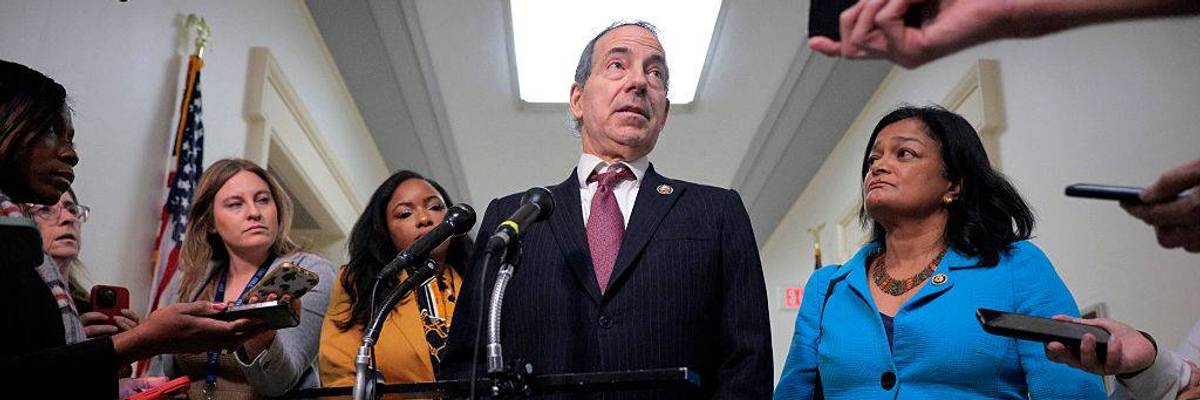
Rep. Jamie Raskin (D-Md.) speaks to the media as Rep. Jasmine Crockett (D-Texas) and Rep. Pramila Jayapal (D-Wash.) look on December 17, 2025 in Washington, DC.
(Photo by Chip Somodevilla/Getty Images)

Brad Reed
Apr 14, 2026
COMMON DREAMS

Rep. Jamie Raskin (D-Md.) on Tuesday unveiled legislation that would establish a congressional commission tasked with determining whether the president is able to continue executing the duties of the office.

The bill, titled the Commission on Presidential Capacity Act, would also set up “expedited” emergency procedures under which Congress could activate the newly created commission and fast-track its consideration of presidential fitness.


‘A Constitutional Emergency’: Psychiatric Experts Say Congress Must Confront Mentally Unstable Trump


As envisioned by Raskin, this commission would act as a legislative counterpart to the US vice president and the president’s Cabinet, which the text of the 25th Amendment grants the power to declare the president incapacitated. The 25th Amendment also gives that power to a majority “of such other body as Congress may by law provide.”

“The Constitution explicitly vests Congress with the authority to create a body that will guarantee the successful continuity of government by responding to presidential incapacity to discharge the powers and duties of office,” said Raskin. “We have a solemn duty to play our defined role under the 25th Amendment by setting up this body to act alongside the vice president and the Cabinet.”

Raskin pointed to Trump’s recent erratic behavior to argue that Congress needed to take a more assertive role in determining whether he has the mental capacity to serve in the most powerful office in the federal government.

“Public trust in Donald Trump’s ability to meet the duties of his office has dropped to unprecedented lows,” the Maryland Democrat said, “as he threatens to destroy entire civilizations, unleashes chaos in the Middle East while violating Congressional war powers, aggressively insults the pope of the Catholic Church, and sends out artistic renderings online likening himself to Jesus Christ.”

Raskin went on to warn that “we are at a dangerous precipice, and it is now a matter of national security for Congress to fulfill its responsibilities under the 25th Amendment to protect the American people from an increasingly volatile and unstable situation.”

Fifty House Democrats signed on as original co-sponsors of Raskin’s bill, which is unlikely to pass the Republican-controlled US House of Representatives.

Calls for invoking the 25th Amendment to remove Trump from office grew louder last week after Trump declared that “a whole civilization will die tonight, never to be brought back again,” unless Iran agreed to meet his demands.

In a letter sent to congressional leaders on Monday, four psychiatrists warned that Trump’s “behavior and rhetoric... have crossed a threshold that demands the immediate and bipartisan attention of Congress.”

The psychiatrists added that Trump “exhibits what forensic mental health experts have, across dozens of independent assessments, identified as the ‘Dark Triad’ of personality traits: narcissism, Machiavellianism, and psychopathy.”

‘Beyond Mentally Unstable’: Dems Urged to Force Vote to Impeach Increasingly Deranged Trump


“He’s a clear and present danger to America and the world,” wrote one critic. “We’ve got to do whatever we legally can to remove him from office.”


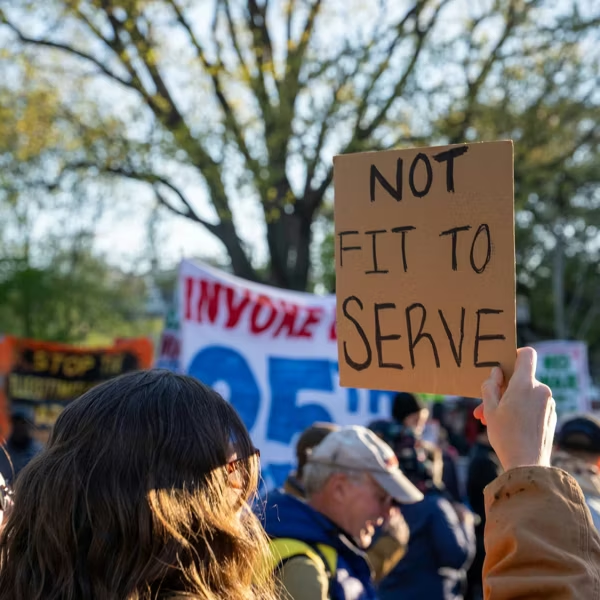
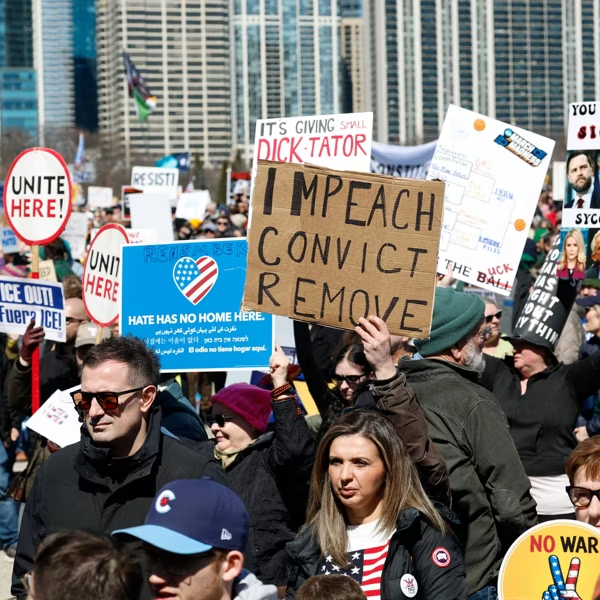
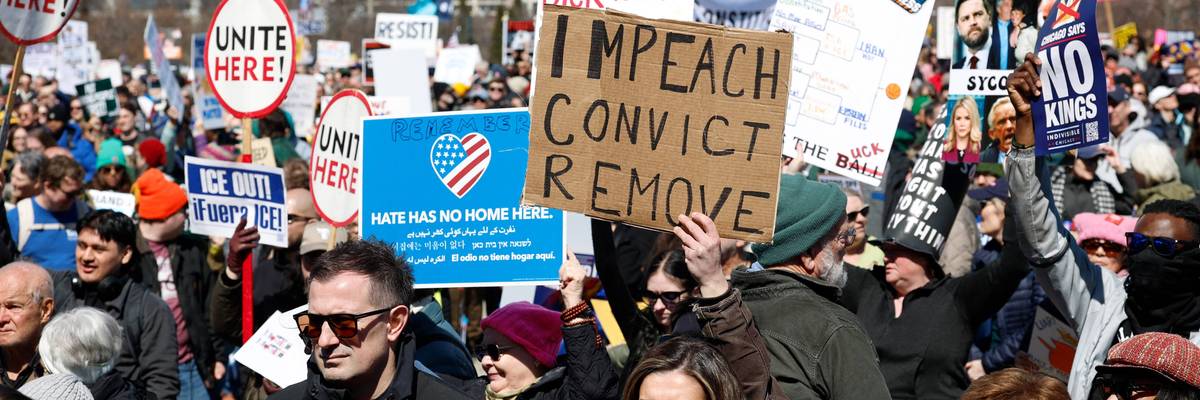
A person holds a sign reading “impeach, convict, remove” as they rally at Grant Park during the “No Kings” national day of protest in Chicago on March 28, 2026.
(Photo by Kamil Krzaczynski/AFP via Getty Images)

Jake Johnson
Apr 13, 2026
COMMON DREAMS


US President Donald Trump’s flurry of increasingly deranged late-night social media posts over the weekend—combined with his continued violent belligerence overseas—prompted fresh calls on Monday for congressional Democrats to immediately force an impeachment vote.

Rep. John Larson (D-Conn.) introduced 13 articles of impeachment against Trump last week, accusing the president of usurping congressional war powers by waging unauthorized assaults on Iran and other nations, illegally deploying National Guard troops in US cities, unlawfully detaining and deporting citizens and immigrants on the basis of their political views, lawlessly dismantling worker- and consumer-protection agencies, and other offenses.

In a statement on Monday, constitutional attorney John Bonifaz applauded Larson for introducing the impeachment articles but said that “we need the congressman to now take the next step and force an immediate floor vote on these articles at this critical hour for our nation.”

“And, Democratic leaders in the Congress should stop standing in the way of such a vote,” said Bonifaz, co-founder and president of Free Speech for People (FSFP). The group’s petition urging the US House to impeach Trump a third time has received more than a million signatures, but the Democratic leadership has so far shown no willingness to push ahead with another impeachment process—which would require some Republican support to be successful.

“Momentum is on the side of action,” FSFP said Monday, warning that “further delay only emboldens the president.”

Bruce Fein, a constitutional scholar who served in the Reagan Justice Department, said Monday that the “impeachment of President Donald Trump is urgent.”

“How can any decent person indulge Mr. Trump’s Hitler-like declaration that ‘a whole civilization will die tonight’ with our tax dollars-paid weapons?” asked Fein, referring to the US president’s genocidal threat against Iran last week.

By one count, more than 85 Democrats in the Republican-controlled US House have called for Trump’s removal via the impeachment process or the 25th Amendment in recent days. Last week, Rep. Jamie Raskin (D-Md.) said he would introduce legislation to establish a commission tasked with removing the president if he is deemed unfit to serve.

“This is plainly out of the realm of normal politics,” said Raskin, the top Democrat on the House Judiciary Committee, urging the White House physician to immediately evaluate Trump’s cognitive fitness. “When the president of the United States threatens to extinguish a civilization on social media, rants about combat missions with children at the Easter Egg Roll, and drops profane tirades on Easter morning, we have indisputably entered the realm of profound medical difficulty and concern.”

Growing calls for Trump’s impeachment and removal came after the president launched into an unhinged social media tirade late Sunday, hours after high-level talks with Iran ended without an agreement to halt the war that the US president and his Israeli counterpart started in late February.


Trump said Sunday that he would impose a naval blockade on the Strait of Hormuz—an illegal act of war—and is reportedly considering a resumption of aerial strikes on Iran.

After the talks concluded, Trump posted a lengthy attack on Pope Leo XIV, a vocal critic of the war on Iran. The president then posted an artificial intelligence-generated image depicting himself as a Jesus-like figure.

“Beyond mentally unstable,” Rep. Yassamin Ansar (D-Ariz.) wrote in response to Trump’s post.

Robert Reich, the former US labor secretary, wrote in a blog post on Monday that “the president of the United States is stark-raving mad.”

“He’s a clear and present danger to America and the world. The American public is beginning to see it,” Reich continued. “We’ve got to do whatever we legally can to remove him from office. The 25th Amendment would be useful if Trump’s Cabinet and key advisers had any integrity, but they don’t. They’re ambitious, unprincipled traitors. Which leaves impeachment.”

As Trump Pushes Privatization, Mexico’s Sheinbaum Embraces Healthcare as a Human Right

Healthcare is neither a commodity nor the exclusive privilege of the wealthy—it is a human right. Far from “outrageous,” guaranteeing healthcare to all is about ensuring that everyone can live a rich and fulfilling life.


President of Mexico Claudia Sheinbaum speaks during the daily morning briefing at Palacio Nacional on April 7, 2026 in Mexico City, Mexico.
(Photo by Jeannette Flores/ObturadorMX/Getty Images)


Jordan Liz
Apr 15, 2026
Common Dreams


On April 6, the Trump administration announced it will increase payments to privately-run Medicare Advantage, or MA, plans by 2.48% in 2027—this will result in more than $13 billion in additional payments to companies like UnitedHealth, CVS Health, and Humana. Unsurprisingly, following this announcement, shares of those companies rose by more than 9%.

MA plans have been a significant source of growth and profit for insurance companies. As the Medicare Rights Center reports, this profitability is driven by enormous overpayments, including from fraudulent billing practices such as “upcoding.” This involves submitting billing codes that make patients appear sicker than they really are to secure higher government payments than are warranted. Despite this, the Trump administration is currently considering a policy that would automatically enroll seniors into MA plans as the “default enrollment option”—a proposal outlined in the Heritage Foundation’s extremist Project 2025.


The Center for American Progress estimates that making MA the default option would generate nearly $2 trillion in overpayments over 10 years, while significantly jeopardizing traditional Medicare’s financial stability. It would give for-profit corporations more control to restrict patient choices and deny doctor-recommended care.

Instead of more privatization that puts profits over people, we should embrace Medicare For All (M4A). Yet, President Donald Trump contends that paying for our current safety nets is already too much for the wealthiest nation on Earth. He remarks: “It’s not possible for us to take care of day care, Medicaid, Medicare, all these individual things. They can do it on a state basis. You can’t do it on a federal. We have to take care of one thing: military protection. We have to guard the country.”

Sheinbaum’s embrace of universal healthcare—as well as her support of Cuba—shows us what is possible when the well-being of people is championed unconditionally.

For Trump, spending billions in an illegal war takes precedence over providing healthcare for Americans. His 2027 budget calls for a 10% reduction in all nondefense spending, including reducing funding to the Department of Health and Human Services by $15.8 billion. This, at the same time, that a measles outbreak sweeps the nation, uninsured rates continue to climb, and the prevalence of children with chronic conditions grows to unprecedented levels.

While Trump prioritizes death and destruction, Mexican President Claudia Sheinbaum offers a different vision. On April 7, she issued a presidential decree establishing the Universal Health Service (Servicio Universal de Salud), which will allow patients from across Mexico to seek free care at any public health institution. Universal access will be rolled out in phases starting with emergency care and continuity of care in early 2027. Radiotherapy, laboratory tests, imaging studies, and other specialized services will be added later that year. Finally, in 2028, universal prescription fulfillment and hospitalization will be consolidated. For Sheinbaum, “The goal is that when we leave the government [in 2030], any Mexican man or woman can go to any health institution for treatment for any ailment and be received.”

The transition to universal healthcare began on April 13 when Mexicans aged 85 and older were eligible to register for their new Universal Health Credential. As Deputy Health Minister Eduardo Clark notes, these new credentials are “the guarantee of the right to healthcare” for Mexican citizens and eligible foreign residents.

This is the fundamental difference. In Mexico, healthcare is recognized as a human right enshrined in their Constitution. In 2023, then-Secretary of Foreign Affairs Alicia Bárcena said before the United Nations General Assembly, “In Mexico, we believe that coverage must be universal, public and free, starting with the most marginalized areas and prioritizing, as always, the poorest.” She continued: “It is unacceptable to profit from illness. In Mexico, we know that public health is not for sale. It is a public and universal good, and we defend it.”

By contrast, for Trump, healthcare is a privilege meant solely for those who deserve it. During his first presidential campaign, he remarked: “Where I come from, you have to prove your worth. You have some guy with no college degree working a minimum wage job; no ambition, no goals, nothing to show for it. Yet for some reason, the current [Obama] administration believes he—and millions of people like him, should have access to health insurance. It’s outrageous.” While Mexico starts with “the poorest,” Trump finds it “outrageous” to provide healthcare to minimum wage workers.

Trump’s position is immoral and vile. Healthcare is neither a commodity nor the exclusive privilege of the wealthy—it is a human right. Far from “outrageous,” guaranteeing healthcare to all is about ensuring that everyone can live a rich and fulfilling life.

For most (if not everyone), lacking healthcare will prevent them from living the kind of life they desire. Those suffering from untreated illness may struggle to spend time with their loved ones, pursue the opportunities they desire, and exercise their political rights. Since, at some point, everyone will eventually get sick, healthcare is a universal good that benefits each of us. Moreover, as the Covid-19 pandemic made clear, our individual health is not solely a personal issue. My health impacts the lives of others around me just as their health impacts mine. Healthcare is thus a collective and communal good.

Still, one might object that even if healthcare is not a commodity, the market is still the best mechanism to allocate scarce resources; Trump’s push toward privatization will be better than Sheinbaum’s universal care.

Such blind faith in the market is misguided. Despite spending far more than other countries with universal coverage, more than a quarter of Americans report skipping consultations, tests, treatments and follow-ups because of costs. Roughly 21% report skipping medication for the same reason. Studies consistently find that universal care provides more access, better quality, and lower costs than privatized healthcare.

Ironically, Trump once understood this. In his 2000 The America We Deserve, he writes, “We must have universal healthcare. Just imagine the improved quality of life for our society as a whole if the issue of access to healthcare were dealt with imaginatively. With more than 40 million Americans living day to day in the fear that an illness or injury will wipe out their savings or drag them into bankruptcy, how can we truly engage in the ‘pursuit of happiness’ as our Founders intended?”

Trump was right. What we need is not more privatization that exploits the sick and dying, but rather a politic that works to radically defend life, liberty, and pursuit of happiness. What is needed is the imagination to rethink how we use (and misuse) our country’s wealth and resources. Sheinbaum’s embrace of universal healthcare—as well as her support of Cuba—shows us what is possible when the well-being of people is championed unconditionally.

A better future is possible—already, in the US, support for M4A continues to grow, and several 2026 midterm candidates have made it an explicit part of their platforms. Together, by embracing life and rejecting capitalism, we can make America great


Our work is licensed under Creative Commons (CC BY-NC-ND 3.0). Feel free to republish and share widely.


Jordan Liz
Jordan Liz is an Associate Professor of Philosophy at San José State University. He specializes in issues of race, immigration and the politics of belonging.
Full Bio >


‘A Sign of What’s to Come’: Super Typhoon Sinlaku Slams Into Remote US Islands in Pacific

The latest storm continues a trend of “unprecedented battering” by Category 4s and 5s for US territories.


Super Typhoon Sinlaku makes landfall the North Pacific Ocean, as seen in a satellite photo captured on April 13, 2026.
(Photo by NASA Earth Observatory/Michala Garrison)


Brad Reed
Apr 14, 2026
COMMON DREAMS

Super Typhoon Sinlaku slammed into the Northern Mariana Islands on Tuesday, causing severe damage to the US-controlled territories that are home to roughly 50,000 people.

According to a Tuesday report from The Associated Press, the typhoon that struck the islands of Tinian and Saipan was the strongest storm recorded so far this year, delivering sustained winds of up to 150 miles per hour.


‘We Lost Everything’: Hawaii Swamped by Worst Flooding in 20 Years


Saipan Mayor Ramon “RB” Jose Blas Camacho told the AP he was concerned about how the storm’s severity was hindering local rescue operations.

“It’s so difficult for us to respond with this heavy rain, heavy wind to rescue people,” he said. “Objects are just flying left and right.”

Marko Korosec, a storm chaser and weather forecaster, analyzed satellite images of the storm and predicted the Northern Mariana Islands would be hit with “violent, destructive winds, catastrophic storm surges, giant waves, and flooding rain.”

“The damage,” he wrote, “will be extreme.”

An analysis of the storm written by hurricane scientist Jeff Masters and published by Yale Climate Connections projected that “damage from Sinlaku will be severe on both islands.”

Masters also said Sinlaku was just the latest in what he described as an “unprecedented” number of Category 4 and Category 5 typhoons over the last decade, which he attributed to “a combination of natural variability and climate change.”

“Beginning in 2017, the US has gotten absolutely hammered by high-intensity Category 4 and 5 hurricanes,” Masters explained. “Seven have hit the continental US, one has hit Puerto Rico, and now two have hit the Northern Mariana Islands. That’s as many US Cat 4 and Cat 5 landfalls as had occurred in the prior 57 years.”

Later in his analysis, Masters pointed out that 10 of the 13 strongest tropical typhoons to make landfall in the last 80 years have occurred since 2006.

A Washington Post analysis of the typhoon published Tuesday noted that it’s “unusually early” for a superstorm of this caliber to form in the Pacific, warning it “may be a sign of what’s to come” this season.

“The season is expected to be anomalously active because of a burgeoning El Niño, which induces a warming of water temperatures,” explained the Post. “That helps air to rise, generating more, and stronger, storms.”

The Post added that Sinlaku is “the last in rare set of triplet cyclones that formed this month,” which it said is an “unusual pattern” that is “also contributing to a burst of winds that is expected to greatly boost the odds of a super El Niño later this year, pushing warm water west-to-east across the Pacific.”
‘Enough Is Enough’: Sanders Moves to Force Votes Against Trump Arms Sales to Israel

“The United States must use the leverage we have—tens of billions in arms and military aid—to demand that Israel ends these atrocities,” said Sen. Bernie Sanders.


US Sen. Bernie Sanders (I-Vt) speaks at a town hall event on February 20, 2026
 in Stanford, California.
(Photo by Benjamin Fanjoy/Getty Images)


Jake Johnson
Apr 15, 2026
COMMON DREAMS

US Sen. Bernie Sanders plans to force votes Wednesday on a pair of resolutions that, if enacted, would block the sale of roughly half a billion dollars of weaponry to the Israeli government, citing its bombardment and invasion of Lebanoncontinued assault on the Gaza Strip, and accelerating annexation of the West Bank.

In a statement previewing the Senate votes, Sanders (I-Vt.) said that “US taxpayers have spent tens of billions of dollars in support of the racist, extremist Netanyahu government. Enough is enough.”

“The United States must use the leverage we have—tens of billions in arms and military aid—to demand that Israel ends these atrocities,” the senator continued.

Sanders’ two resolutions would bar the sale of over $150 million worth of 1,000-pound gravity bombs and related support services, as well as the sale of nearly $300 million of Caterpillar bulldozers, which Israel uses to demolish homes in the illegally occupied Palestinian territories, Lebanon, and Syria.

“The arms sales in question violate the criteria laid out in the Foreign Assistance Act and the Arms Export Control Act,” Sanders’ office said Tuesday. “Secretary [of State] Marco Rubio signed an emergency determination just six days into the war with Iran in an attempt to bypass the statutory congressional notification period and immediately transfer these weapons.”

The resolutions face long odds in the Republican-controlled US Senate. But last year, a majority of the Senate Democratic caucus backed Sanders-led resolutions aimed at blocking earlier Trump administration sales of 1,000-pound bombs, assault rifles, and other military equipment to Israel.

“Polls show that over 70% of Democratic voters want to halt arms sales to Israel,” noted Dylan Williams, vice president for government affairs at the Center for International Policy. “Lawmakers should not be in positions of party leadership—or hope to be its presidential nominee—if they vote against their base to give Israel the bombs and bulldozers it uses to commit war crimes.”

Elizabeth Rghebi, Middle East-North Africa advocacy director at Amnesty International USA, urged Americans to call their senators at 202-224-3121 and demand that they support the new Sanders resolutions.

“Amnesty International has documented a clear and ongoing pattern by Israeli forces committing serious violations of international law, including war crimes, genocide, and apartheid,” Rghebi wrote Tuesday. “This includes evidence that Israeli forces have repeatedly carried out war crimes in Lebanon and Iran and the crime of genocide against Palestinians in the occupied Gaza Strip. Amnesty has also been able to identify the use of US-origin weapons, including a 1,000-pound bomb, in the occupied Gaza Strip.”

“All senators must take urgent action to ensure that the U.S. immediately suspends the supply, sale, or transfer to Israel of all weapons, munitions, and other military and security equipment, including the provision of training and other military and security assistance,” Rghebi added. “Supporting measures such as the Joint Resolutions of Disapproval is essential to stopping genocide and ensuring that the U.S. is not providing arms and equipment to Israel that can be used to carry out war crimes and genocide.”

Sanders’ resolutions have also received support from the pro-Israel liberal advocacy group J Street, which said in a policy memo earlier this week that “the United States should phase out direct financial support for arms sales to Israel and treat Israel as it does other wealthy US allies” rather than giving the country “unquestioning, blank-check support.”

In a social media post endorsing Sanders’ resolutions, J Street wrote that “at a moment of fragile ceasefires and continued violence across the region, approving these transfers would be seen as an American endorsement of the US and Israeli war with Iran and Israeli actions in Lebanon, Gaza, and the West Bank.”

“The weapons transfers being voted on include 1,000-pound bombs and D-9 bulldozers, which have been used by the Israeli government in ways that raise serious legal and moral concerns,” the group wrote. “Congress has a clear responsibility to ensure that US-supplied weapons are not contributing to civilian suffering or undermining the chances for diplomacy, de-escalation, and peace.”

With Congress Back in DC, Sanders Plans Another Vote on Blocking US Weapons to Israel Over Genocide


“The extremist Netanyahu government that has committed genocide in Gaza does not need more military support from American taxpayers.”

Jessica Corbett
Apr 13, 2026
COMMON DREAMS

With members of Congress returning to Washington, DC, Sen. Bernie Sanders on Monday pledged that he will, yet again, force a vote aimed at cutting off the flow of US weapons to Israel over its genocide against Palestinians in the Gaza Strip.

“I will be forcing a vote on legislation to block the sale of nearly half a billion dollars worth of bombs and bulldozers to the Israeli military,” Sanders (I-Vt.) said on social media, taking aim at Israeli Prime Minister Benjamin Netanyahu, who is wanted by the International Criminal Court over the mass slaughter in Gaza.

“The extremist Netanyahu government that has committed genocide in Gaza does not need more military support from American taxpayers,” declared Sanders, who has forced multiple votes on measures targeting US arms to Israel since it began bombarding Gaza in retaliation for the Hamas-led October 7, 2023 attack.

The next vote, which could come as soon as Wednesday, follows a similar effort last July, when a majority of the Senate Democratic Caucus backed his resolutions disapproving of the Trump administration’s sale of 1,000-pound bombs, Joint Direct Attack Munition guidance kits, and tens of thousands of assault rifles to the Israeli government. Previous votes had garnered less support.

“The American people do not want to spend billions to starve children in Gaza,” Sanders said last summer, after the resolutions failed. “The Democrats are moving forward on this issue, and I look forward to Republican support in the near future.”

Republicans currently have narrow majorities in both chambers of Congress, though Democrats aim to flip both in the November midterm elections.

According to a Pew Research poll released last week, 60% of US adults have an unfavorable view of Israel, up from 53% last year, and 59% have little or no confidence that Netanyahu will do the right thing regarding world affairs, up from 52% in 2025.

Although much of the world’s attention has been focused on Netanyahu and President Donald Trump’s war on Iran—and Israel’s related assault on Lebanon—in recent weeks, Israeli forces have also continued to kill Palestinians in Gaza, despite an October 2025 ceasefire agreement.

As of Monday, Gaza officials put the death toll at 72,333, with another 172,202 wounded, though global experts have warned the true figures could be far higher. Over 750 deaths and 2,100 injuries have been recorded since the ceasefire took effect, with another 760 bodies recovered during that time.

“At least two children a day have been killed or injured in the six months since the ceasefire for Gaza was agreed,” said Save the Children International CEO Inger Ashing last week, as her group and others released a report marking six months since the deal was reached. “This is not peace for children in Gaza. The ceasefire agreement has not translated into meaningful protection for children or created conditions for recovery.”

Among the children killed was Ritaj Rihan, a 9-year-old girl reportedly shot by Israeli forces in front of her third grade class at Abu Ubaida bin al-Jarrah School in Beit Lahiya last week. The Gaza Ministry of Health said that “it was not an isolated incident, but a direct extension of a systematic policy targeting the Palestinian people.”


‘Talk Is Cheap’: 100 Arrested at Sit-In Demanding Schumer, Gillibrand Vote No on More Arms for Israel

“We call on Senators Schumer and Gillibrand to follow the will of New Yorkers and vote to block weapons and bulldozer sales to Israel.”


An anti-war protester is carried away from a demonstration in New York City against funding for Israel’s military on April 13, 2026.

(Photo by Zachary Schulman/Jewish Voice for Peace)

Julia Conley
Apr 14, 2026
COMMON DREAMS


Whistleblower Chelsea Manning, MPower Change founder Linda Sarsour, and actor Hari Nef were three of around 100 people who were arrested outside the New York City offices of Senate Minority Leader Chuck Schumer and Sen. Kirsten Gillibrand on Monday after the activists joined hundreds of anti-war campaigners in demanding the two Democrats vote against more weapons for Israel and block the Pentagon’s $100 billion request to fund President Donald Trump’s deeply unpopular war on Iran.

More than 300 people assembled outside the two US senators’ offices, holding signs that read, “Fund People, Not Bombs” and “Stop Arming Israel.”

“Schumer, Gillibrand, talk is cheap,” the organizers chanted. “You’re sending bombs, how can you sleep?”


Jewish Voice for Peace (JVP), one of the groups that organized the protest, said descendants of Holocaust survivors were among those who were arrested for speaking out against the Israeli government and the unprovoked US-Israeli war on Iran, which has killed more than 3,300 people in the Middle Eastern country, according to Iranian officials, and has spread to countries including Lebanon and Iraq.

In Lebanon, which Israel has insisted is not covered by a ceasefire deal reached last week, Israeli officials have said they are using their destruction of Gaza as a “model” as they bomb heavily populated areas, healthcare facilities, and other civilian infrastructure. At least 2,089 Lebanese people have been killed since March 2.

Meanwhile, Israel has continued attacking Gaza, killing more than 700 Palestinians since a ceasefire deal was reached six months ago as it joins the US in bombing Iran.

The protest was held as Sen. Bernie Sanders (I-Vt.) planned to bring Joint Resolutions of Disapproval up for a vote this week to block the transfer of bulldozers and hundreds of millions of dollars in weapons to the Israeli military.


JVP joined the Palestinian Youth Movement, Democratic Socialists of America, Sunrise Movement, Jews for Racial and Economic Justice, and other groups in demanding “yes” votes from Schumer and Gillibrand, who last July voted in favor of more weapons shipments to Israel.

“The Joint Resolutions of Disapproval is a crucial effort to stop the US from committing war crimes in Iran and aiding and abetting war crimes in Palestine and Lebanon,” said Manijeh Moradian, a founding member of Raha Iranian Feminist Collective and a member of the Feminists For Jina Global Network, which also helped to organize the action. “As an Iranian American with loved ones who have survived more than a month of aerial bombardment, I am profoundly grateful to everyone in the United States who takes a stand and refuses to normalize the logics and instruments of mass death.”

Artists who have been outspoken in their support for Palestinian and Iranian people and their criticism of Israel were among those who joined the civil disobedience action, including actors Hannah Einbinder and Taylor Trensch. US congressional candidate Darializa Avila Chevalier and New York City Council members Alexa Avilés and Sandy Nurse also participated, and Chevalier and Avilés were among those arrested by the New York Police Department.


A poll taken by Quinnipiac University last year found that 60% of Americans want the US to suspend weapons transfers to Israel, and multiple surveys have recently found public support for Israel plummeting. The US-Israeli war in Iran is also broadly unpopular with Americans, with nearly six in ten saying late last month that it had gone too far.

“Our actions matter in shaping the course of history,” said Manning. “Senators Schumer and Gillibrand have repeatedly supported weapons sales to Israel that are being used to commit atrocities across Palestine, Lebanon, and Iran. We call on Senators Schumer and Gillibrand to follow the will of New Yorkers and vote to block weapons and bulldozer sales to Israel.”