Tuesday, September 09, 2025


How to find a cryptic animal: Recording the elusive beaked whale in the Foz do Amazonas Basin


While finding the creatures takes a lot of work, the results are worth it.


American Institute of Physics

A beaked whale sighting in the Foz do Amazonas Basin 

image: 

A beaked whale sighting from the researchers’ field study in the Foz do Amazonas Basin.

view more 

Credit: Machado et al.


WASHINGTON, Sept. 9, 2025 – Whale watching is a popular pastime on coastlines around the world. Cetaceans like blue whales, humpbacks, and orcas can be seen in the wild, and their characteristics are well categorized in science and popular culture. Other cetaceans, however, are less outgoing, preferring to stay out of the limelight.

Beaked whales are considered one of the least understood mammals in the world, which is due to their cryptic behavior and distribution in offshore waters. Predation pressure from their predators may be one of the factors driving these whales to exhibit inconspicuous surface behavior. They are also the deepest diving mammal on record, able to dive around 3,000 meters below the surface for over two hours.

In JASA, published on behalf of the Acoustical Society of America by AIP Publishing, researchers from Instituto Aqualie, Juiz de Fora Federal University, Mineral Engenharia e Meio Ambiente, and Santa Catarina State University set out to record these elusive whales.

“The motivation for this research arose from the need to expand knowledge on cetacean biodiversity in Brazilian waters, with particular attention to deep-diving species such as beaked whales,” said author Raphael Barbosa Machado.

Beaked whales, currently represented by 24 species, produce sounds that differ from those of other toothed whales, using echolocation pulses that enable them to perceive their surroundings. However, these pulses are generally not emitted at the surface, posing a challenge for reliably associating the sound with a visually confirmed species.

Machado and his colleagues began their search in 2022 in the Foz do Amazonas Basin off the coast of northern Brazil. Using passive acoustic monitoring, hydrophones, and autonomous recorders operating at 192-384 kilohertz, they were able to capture nine audio recordings, visually spotting the whales four separate times. After analyzing the data, they found they had recorded at least three different beaked whale species.

“This study provides the first documentation of acoustic parameters of beaked whales in Brazilian waters, while also contributing new information on cetacean biodiversity in northern Brazil,” said Machado.

Their results also demonstrated that acoustic monitoring is a viable strategy for categorizing evasive sea creatures. Machado and his team intend to continue studying the biodiversity of the western South Atlantic Ocean, which remains poorly studied to this day.

“As the number of detections increases — particularly simultaneous visual and acoustic records — our ability to reliably associate specific acoustic signals with visually confirmed species will also improve,” said Machado. “Addressing these knowledge gaps is essential for informing public policies and guiding conservation and management efforts aimed at safeguarding these elusive species.”

###

The article “Finding beaked whales in the Foz do Amazonas Basin: Visual and acoustic records of a deep diving cetacean” is authored by Raphael Barbosa Machado, João Pedro Mura, Giovanne Ambrosio Ferreira, Franciele Rezende de Castro, Natália de Souza Rodrigues-Soares, Larissa Kelmer de Lima Kascher, Barbara Stefânea da Silva, Gabrieli Messias Rodrigues, Lúcia Alencar, Yasmin Viana, Daniela Ferro de Godoy, Pedro Volkmer de Castilho, and Artur Andriol. It will appear in The Journal of the Acoustical Society of America on Sept. 9, 2025 (DOI: 10.1121/10.0038973). After that date, it can be accessed at https://doi.org/10.1121/10.0038973.  

ABOUT THE JOURNAL

The Journal of the Acoustical Society of America (JASA) is published on behalf of the Acoustical Society of America. Since 1929, the journal has been the leading source of theoretical and experimental research results in the broad interdisciplinary subject of sound.  JASA serves physical scientists, life scientists, engineers, psychologists, physiologists, architects, musicians, and speech communication specialists. See https://pubs.aip.org/asa/jasa.

ABOUT THE ACOUSTICAL SOCIETY OF AMERICA

The Acoustical Society of America (ASA) is the premier international scientific society in acoustics devoted to the science and technology of sound. Its 7,000 members worldwide represent a broad spectrum of the study of acoustics. ASA publications include The Journal of the Acoustical Society of America (the world's leading journal on acoustics), JASA Express LettersProceedings of Meetings on Acoustics, Acoustics Today magazine, books, and standards on acoustics. The society also holds two major scientific meetings each year. See https://acousticalsociety.org/.

###

Amazon bets on Rappi to take on MercadoLibre in Latam

Amazon bets on Rappi to take on MercadoLibre in Latam
Rappi, known as a "super-App", operates across nine countries from Mexico to Chile, offering 10-minute grocery deliveries and financial services, including credit cards and savings accounts through its fintech branch RappiPay.
By Cynthia Michelle Aranguren Hernández September 9, 2025

Amazon has acquired a stake in Colombian delivery platform Rappi through a $25mn convertible note, Bloomberg reported.

The transaction grants the Seattle-based retailer warrants to purchase up to 12% of Rappi, positioning the US giant to challenge MercadoLibre's long-standing dominance across Latin America's rapidly expanding digital commerce landscape.

The deal represents Amazon's latest effort to penetrate the region's last-mile delivery market, where infrastructure challenges have historically limited international expansion. Rappi, known as a "super-App", operates across nine countries from Mexico to Chile, offering 10-minute grocery deliveries and financial services, including credit cards and savings accounts through its fintech branch RappiPay.

According to PCMI estimates, Latin America's e-commerce market is projected to reach $769bn in 2025, posting 21% growth year-on-year, with Brazil and Mexico alone commanding a combined regional market share of 75.2%. Amazon already operates logistics centres in the region's first and second economies, but lacks the hyper-local delivery infrastructure that has made Rappi ubiquitous in urban centres.

The investment strengthens existing commercial ties, as Rappi utilises Amazon Web Services for cloud computing whilst offering Prime members free deliveries in Mexico. However, regulators may scrutinise the partnership given its implications for both the payments and logistics sectors.

For now, MercadoLibre remains the regional leader with established payment rails through Mercado Pago and logistics network Mercado Envios. The Argentine-founded platform attracted 321mn shoppers in February alone, surpassing Amazon Brasil by 11%.

Rappi co-founder Simón Borrero stated the company is preparing for a New York listing in 2025, having secured a $100mn loan from Santander and Kirkoswald Capital Partners. While the Amazon partnership may complicate these IPO plans, it could potentially accelerate regional consolidation.

For the US tech behemoth, this modest investment provides optionality in a market where traditional warehouse-centric models have struggled against super-app ecosystems that integrate commerce, payments and rapid delivery.

Salvaged shipwreck porcelain gets new life in Malaysia

Ampang (Malaysia) (AFP) – Chinese porcelain shards salvaged from a famous shipwreck are being reimagined in Malaysia, hundreds of years after the Portuguese vessel is said to have sunk in battle.


Issued on: 10/09/2025 - FRANCE24

Smashed crockery from the historic 400-year-old Portuguese Wanli shipwreck was almost consigned to the scrap heap before Malaysian artist Alice Chang saw the potential to transform the shattered plates and cups © Mohd RASFAN / AFP

The smashed 17th-century crockery was almost consigned to the scrap heap before Malaysian artist Alice Chang saw the potential to transform the shattered plates and cups.

After chancing upon a social media post selling the porcelain fragments, the 57-year-old bought about 50 kilograms (110 pounds) for more than 10,000 ringgit ($2,370).

Her recent solo exhibition "Me, Then Blue" at her studio in Ampang, a suburb of the capital Kuala Lumpur, turned the porcelain into sculptures representing submerged dreamscapes.


A creation by Malaysian artist Alice Chang made from shards of porcelain rescued from the historic 400-year-old Portuguese Wanli shipwreck at a gallery in Ampang, Malaysia's Selangor state © Mohd RASFAN / AFP


Her materials are fragments of a once-great cargo of blue-and-white pottery made in Jingdezhen, China's renowned porcelain capital.


The cargo was carried by a Portuguese merchant vessel that sank around 1625, likely due to a battle off Malaysia's coast.

It was discovered in 1998 after pottery appeared in fishermen's nets, with the vessel then named the Wanli after the Ming Dynasty emperor who ruled when the ship sank.

It was hailed as one of the most significant maritime finds in Southeast Asia and is now recognised under UNESCO's Silk Roads Programme.

Smashed crockery from the historic 400-year-old Portuguese Wanli shipwreck was almost consigned to the scrap heap before Malaysian artist Alice Chang saw the potential to transform the shattered plates and cups © Mohd RASFAN / AFP

But while intact porcelain pieces were preserved in museums, Chang said the broken shards were "cast aside as useless".

"The 400 years of broken porcelain tell a story of our past and a look into our future. If nobody wanted them, they would be thrown away, and that is such a waste," said Chang.

She used the shards to create the "ambience of this exhibition like it's immersed in the deep blue sea", Chang told AFP.

"This is part of Malaysia's history... its maritime legacy often goes unrecognised, and this discovery felt like a forgotten chapter waiting to be told," she said.
'Beauty in brokenness'

At the heart of Chang's exhibition stood 11 sculptures, adorned with salvaged shards, accompanied by 20 oil paintings.

Malaysian artist Alice Chang holds shards of porcelain rescued from the historic 400-year-old Portuguese Wanli shipwreck at a gallery in Ampang, Malaysia's Selangor state © Mohd RASFAN / AFP


Working with the broken porcelain pieces was "deeply personal" for Chang, a second-generation Malaysian with Chinese roots who often felt culturally unmoored.

"Through the Wanli shipwreck and working with the pieces, I feel reconnected... I have been told I'm not very Chinese because I'm married to an Italian. So I'm neither here nor there," she chuckled.

"This project reconnected me to my Chinese roots. I actually travelled to China to search and understand my culture."

Some of her sculptures evoked ornate vases while others resembled cascading waves, with mirrors beneath them mimicking the glimmering seabed.

They show "the beauty in brokenness", Chang said.

"Depending on your perspective, you can turn brokenness into something beautiful."

© 2025 AFP
Australia to deploy fleet of underwater strike drones

Sydney (AFP) – Australia said Wednesday it will deploy a US$1.1 billion fleet of "Ghost Shark" underwater attack drones to bolster its firepower in a "threatening" regional landscape.

MAKING IT MORE THREATENING


Issued on: 10/09/2025 - FRANCE24

The first "Ghost Shark" underwater attack drone belonging to the Royal Australian Navy will enter service in January © Rodney Braithwaite / AUSTRALIAN DEFENCE FORCE/AFP

The Royal Australian Navy will arm itself with dozens of the home-developed, cutting-edge autonomous drones, with the first entering service in January, it said.

Australia is in the midst of a major military restructure, equipping its navy with long-range strike capabilities in an effort to balance China's expanding military might in the Pacific.

The government said it had signed a Aus$1.7 billion (US$1.1 billion) five-year contract with Anduril Australia to build, maintain and develop the extra-large, uncrewed undersea vehicles, creating 150 jobs.

"This is the highest tech capability in the world," Defence Minister Richard Marles told a news conference, saying it would have a "very long range" as well as stealth capabilities.


"Australia is leading the world in terms of autonomous underwater military capabilities and Ghost Shark is capable of engaging in intelligence, surveillance, reconnaissance and strike," he said.

'Threatening' landscape


The drones, which can be launched from shore or warships, will complement Australia's strategic enhancements to its submarine and surface fleets, the minister said, declining to provide the exact number to be built.

"Australia faces the most complex, in some ways the most threatening strategic landscape that we have had since the end of the Second World War," Marles said.

"All that we are doing in terms of building a much more capable Defence Force is to deter conflict and to provide for the peace and stability of the region in which we live."

Australia aims to acquire stealthy, nuclear-powered submarines in a multi-decade 2021 AUKUS agreement with Britain and the United States.

In the United States, however, critics have questioned why Washington would sell nuclear-powered submarines to Australia without stocking its own military first.

US President Donald Trump's administration has put AUKUS under review to ensure it aligns with his "America First agenda".

Marles said he was confident that the "Ghost Shark" drones and future nuclear-powered submarines would provide a "fundamentally critical" military capability.

Last month, Australia said it would also upgrade its navy with 11 Mogami-class frigates built by Japan's Mitsubishi Heavy Industries, first entering service by 2030.

Billed as one of Japan's biggest defence export deals since World War II, Australia has agreed to pay US$6 billion over the next 10 years to acquire the fleet of stealth frigates.

Mogami-class warships -- advanced stealth frigates equipped with a potent array of weapons -- are to replace Australia's ageing fleet of Anzac-class vessels.

© 2025 AFP


Seven workers trapped following mudflow at Indonesian mine


/ ISS Crew Earth Observations - PD
FacebookTwitterLinkedInTelegramFlipboardFeedly


By bno - Jakarta Office September 10, 2025


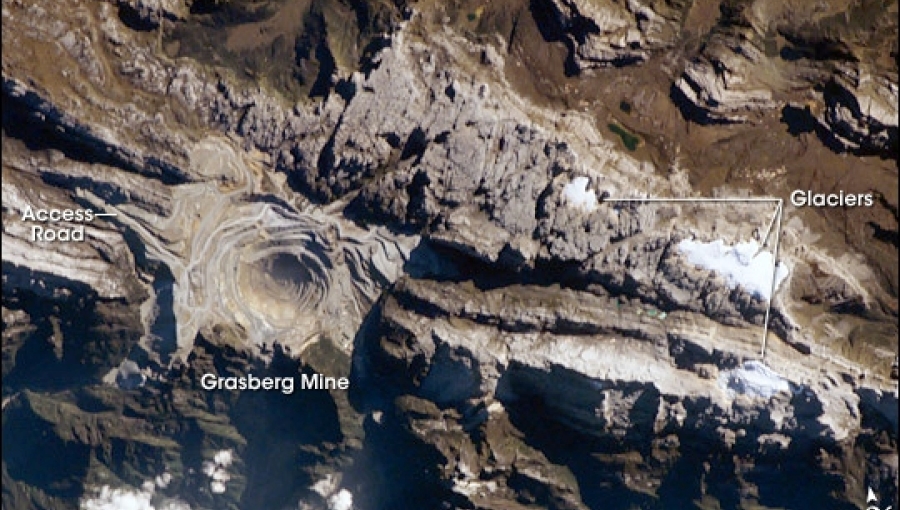
A mudflow struck PT Freeport Indonesia’s Grasberg Block Cave underground mine in Tembagapura, Central Papua, leaving seven workers trapped, according to Kompas. Freeport, one of the world's largest copper and gold mining operators, immediately suspended operations to allow emergency teams to focus on evacuation efforts.

The incident occurred on September 8, at around 10 pm local time. By September 9, rescue teams made up of Freeport’s Emergency Response and Preparedness unit alongside the Underground Mine Rescue team were still working to clear access routes and reach those affected.

According to Katri Krisnati, Vice President of Corporate Communications at PT Freeport Indonesia, the evacuation has been complicated by blocked passages underground. Nevertheless, she stressed that the trapped workers remain safe. Supplies are being delivered while crews attempt to restore access. Katri confirmed that all other employees are unharmed and that operations will not resume until the seven workers are safely evacuated.

Mimika Police Chief, Commissioner Billyandha Hildiario Budiman, stated that his office continues to coordinate closely with the company during the emergency response.

Kompas also reports that similar natural hazards disrupted Freeport’s mining activities in the past. In February 2023, flooding damaged processing plants, conveyor systems, tunnels, and roads, although 14 workers were successfully evacuated without injury. However, two illegal miners outside the company’s concession lost their lives in the disaster. In August 2017, a landslide in the same mining district during heavy rain killed two workers.

These recurring incidents underline the need for Freeport to place equal priority on protecting its workforce and addressing the long-term environmental consequences of decades of large-scale extraction in the region.


Hong Kong legislature to vote on same-sex partnerships bill

Hong Kong (AFP) – Hong Kong lawmakers are expected to vote Wednesday on whether to grant limited rights to same-sex couples, as fears grow in the LGBTQ community that even this narrow equality bid could be sunk by conservative pro-Beijing voices.


Issued on: 09/09/2025 - FRANCE24

A 2023 survey carried out jointly by three universities found 60 percent of those polled in Hong Kong supported same-sex marriage 
© Philip FONG / AFP/File

Hong Kong's government proposed legislation this summer to recognise some rights for same-sex partners, but only for those whose unions are registered abroad.

Despite LGBTQ activists decrying its limitations, the proposal drew near-universal criticism from the pro-Beijing politicians that dominate Hong Kong's legislature.

Only around a dozen lawmakers within the 89-member council have publicly declared their support so far.

"While branding itself as a free, open... world city that attracts global talent, the Hong Kong government has not only failed to keep pace with the regional trend toward equality... it has also proposed a Bill that falls significantly short of international human rights standards," rights group Amnesty International said in a Tuesday statement that nevertheless urged lawmakers to adopt it.

The city's top court ordered the government to create an "alternative framework" for LGBTQ couples when it quashed a bid to recognise same-sex marriage in 2023.

Officials have stressed marriages in Hong Kong will remain between a man and a woman, but in July proposed a registration system for same-sex couples whose partnership is legally recognised abroad.

Registered couples will enjoy more rights in medical-related matters and after-death arrangements -- for example, visiting a partner in hospital or claiming their body after death.

"For same-sex couples like my partner and me, (the bill) offers a much-needed layer of legal recognition and protection," read a letter addressed to legislators, one of more than 10,000 gathered in July.

In another, a writer named Gallam Zhang asked lawmakers to widen the proposal to those not able to go overseas.

"Because of my physical condition, I cannot afford travelling and living abroad for a long period of time," Zhang wrote.

'Stable and harmonious'

The current batch of Hong Kong lawmakers has never shot down a government bill.

But in a rare rift, the proposal has been condemned by the city's top three pro-establishment parties, who say it defies traditional family values.

Same-sex marriage is not legal in China and social stigma is widespread.

Hong Kong is a special administrative region of China with its own legislature and a mini-constitution that guarantees a "high degree of autonomy".

However, the city's once vibrant political opposition and civil society has been effectively silenced since Beijing introduced a sweeping national security law in 2020.

In July, an annual carnival promoting LGBTQ rights was cancelled after organisers were denied a venue "without explanation".


Authorities gave the public seven days to write in with their views on Wednesday's bill, which coincided with a period of line-by-line vetting done by a small committee of lawmakers.

Of the 10,800 submissions received, 80 percent were against, according to the government.

However, advocacy group Hong Kong Marriage Equality said around half the opposing submissions used templates that indicate "strong mobilisation by specific groups".


"(The government) must not allow people with ulterior motives to wield slogans of equality to threaten Hong Kong's stable and harmonious society," read one.

The government's findings contrast with a 2023 survey carried out jointly by three universities that found 60 percent of those polled in the city supported same-sex marriage.

A joint letter issued Monday and signed by 30 Asian LGBTQ rights groups called on the government to "publicly disclose a contingency plan" and introduce a revised proposal if the bill is vetoed.

© 2025 AFP


Obese surpass undernourished youths for first time, UN warns

United Nations (United States) (AFP) – Obesity has skyrocketed among children and adolescents bombarded by "unethical" marketing of junk food, outpacing undernourishment to become the leading form of malnutrition worldwide for the first time among those age five to 19, UNICEF warned Tuesday.


Issued on: 10/09/2025 - FRANCE24

UNICEF, which conducts nutrition programs in developing nations, says obesity in 2025 is surpassing undernourishment as the leading form of malnutrition for youths age five to 19 © Rizwan TABASSUM / AFP/File

In a dire report, the United Nations children's agency projected that nearly one in 10 individuals within that age group will be living with the chronic disease in 2025, fueled by easy availability of ultra-processed foods "even in countries still grappling with child undernutrition."

Today "when we talk about malnutrition, we are no longer just talking about underweight children," UNICEF chief Catherine Russell said in a statement on the report's release.

"Ultra-processed food is increasingly replacing fruits, vegetables and protein at a time when nutrition plays a critical role in children's growth, cognitive development and mental health."

The fight to reduce world hunger is bearing fruit in some areas, with prevalence of underweight youths on a downward trend, falling from 13 percent to 10 percent between 2000 and 2022 among 5-19 year olds, according to data collected in 190 countries.

But over the same period, overweight numbers in the age range have soared, doubling between 2000 and 2022 from 194 to 391 million.

The spike is even more pronounced for obesity, a more serious form of overweight associated with metabolic disorders such as diabetes, certain cancers, anxiety and depression.

In 2022, eight percent of those 5-19 worldwide, or 163 million, were obese, compared to three percent in 2000.

'Failure of society'

Given the distinct trends, UNICEF believes "a historic turning point" was reached this year, with the global prevalence of obesity at 9.4 percent of the age group surpassing that of underweight, at 9.2 percent.

According to the projections, 188 million children and adolescents are obese.

UNICEF bluntly described the primary culprit not as poor nutrition decisions by families, but unethical business practices designed to generate profits.

Children "are being bombarded by... unhealthy food marketing of junk foods," especially at school where they are exposed to sugary drinks and salty snacks, Katherine Shats, a UNICEF legal expert in nutrition, told AFP.

Such products are often cheaper than fresh foods like fruits, vegetables and proteins, which are being steadily replaced in families' diets.

UNICEF stresses the fault lies neither with children nor their families, but "a failure of society to protect the environments that children grow up in."

It also criticized what it called the false narrative that participating in sports can offset unhealthy diets.

"It is impossible to 'outrun' the health consequences of a diet high in free sugars, refined starches, salt, trans-fats, harmful additives and excessive energy through physical activity alone."

Urgent measures

Historically, levels of overweight have been higher in more developed nations. They remain high for example in Chile, at 27 percent in the 5-19 age group, and the United States at 21 percent.

But since 2000, the gap between rich and poor countries has narrowed, with obesity rates soaring in some Pacific islands where imports are replacing traditional products.

In tiny Nieu, the age group's obesity rate has reached 38 percent, with the Cook Islands topping 37 percent.

For some nations, it is a double curse as they grapple with both undernutrition and growing obesity.

Shats laments that in certain conflict zones or areas with humanitarian crises, large food and beverage companies are taking advantage of such situations and donating ultra-processed foods to promote their own image and their marketing tactics.

So while children lack the availability of nutritional food, what they do gain access to is "this very unhealthy food because of these really predatory tactics from the industry," she said.

UNICEF is urging governments to take binding measures, including advertising restrictions, taxes on sugary drinks and unhealthy foods, and policies that encourage production of fresh produce.

© 2025 AFP
Australia approves chlamydia vaccine for koalas

Sydney (AFP) – Australian regulators have approved a chlamydia vaccine for koalas, researchers said Wednesday, as they seek to stamp out a sexually transmitted disease responsible for about half of all deaths of the fluffy marsupial in the wild.


Issued on: 10/09/2025 - FRANCE24

Chlamydia is responsible for about half of all koala deaths in the wild © Saeed KHAN / AFP/File
For a decade, scientists at the University of the Sunshine Coast trialled the chlamydia vaccine in controlled settings.

But approval from the veterinary medicine regulator means the single-dose shot can be nationally rolled out.

Lead researcher Professor Peter Timms said the disease was driving wild koalas to extinction, particularly in southeast Queensland and New South Wales.

In those areas, "infection rates within populations are often around 50 percent and in some cases can reach as high as 70 percent," he said.

Trials of the vaccine showed it reduced the likelihood of the herbivores developing chlamydia during breeding age and decreased deaths in wild populations by at least 65 percent.

Antibiotics were previously the only treatment for the chlamydia-ridden tree-dwellers but it disrupted their digestive abilities and did not protect against future infections.  

Chlamydia was first observed in koalas about 50 years ago.

The bacterial infection causes blindness, bladder infections, infertility and death.

The disease has taken a heavy toll on Australia's koala population.

The native species are shy and notoriously difficult to count, but the government considers the animal as endangered along the east coast.

Australia's official national monitoring programme estimates between 95,000 and 238,000 koalas live in the eastern states of Queensland, New South Wales and the Australian Capital Territory.

Another 129,000 to 286,000 of the marsupials are estimated to be living in Victoria and South Australia.

Expanding cities, land clearance and the spread of chlamydia are devastating the populations of one of Australia's most well-loved animals.

Scientists believe Australia has the highest rate of mammal extinction in the world, with about 100 of the country's unique flora and fauna species wiped out in the past 123 years.

Australia halted logging in a large stretch of the eastern coast on Sunday to create a retreat for koalas and save the local population from extinction.

© 2025 AFP


Kidnapped academic Elizabeth Tsurkov released in Iraq

Baghdad (AFP) – Iraqi Prime Minister Mohammed Shia al-Sudani and US President Donald Trump announced Tuesday the release of Israeli-Russian academic Elizabeth Tsurkov who was kidnapped in Baghdad in March 2023.


Issued on: 10/09/2025 -

A file photo from 2017 of Israeli-Russian academic Elizabeth Tsurkov who was kidnapped in Baghdad in March 2023 
© Ahmad Mohamad / Ahmad Mohamad/AFP/File

While Iraq said a "group of outlaws" kidnapped Tsurkov, Trump announced she was released by the powerful pro-Iran Kataeb Hezbollah group.

"As a culmination of extensive efforts exerted by our security services over the course of many months, we announce the release of the Russian citizen, Elizabeth Tsurkov," Sudani said on X.

Trump posted on his Truth Social platform that Tsurkov "was just released" by Kataeb Hezbollah "after being tortured for many months" and was now at the US embassy in Baghdad.

Sabah al-Numan, the military spokesman for the Iraqi prime minister, said later in a statement that "following extensive and high-level security and intelligence efforts... authorities succeeded, on September 9, in locating and reaching the site of her detention."

Tsurkov was delivered to the US embassy to "facilitate her reunion with her sister, a US citizen," he added.

The former captive's sister, Emma Tsurkov, thanked Trump, his special envoy Adam Boehler, the US embassy in Baghdad and the non-profit group Global Reach for their roles in securing the release.

"My entire family is incredibly happy. We cannot wait to see Elizabeth and give her all the love we have been waiting to share for 903 days," she posted on social media

Numan said Tsurkov was kidnapped by a "group of outlaws" without naming any party, and added that Iraq's security forces "will continue to pursue all those involved in this crime and ensure they are held accountable."
Phd candidate

Tsurkov, a doctoral student at Princeton University and fellow at the New Lines Institute for Strategy and Policy, went missing in Iraq in March 2023.

She had likely entered Iraq on her Russian passport and had travelled to the country as part of her doctoral studies.

She was active on Twitter, where she has tens of thousands of followers and describes herself as "passionate about human rights".

In Baghdad, she had focused on pro-Iran factions and the movement of Iraqi Shiite leader Moqtada Sadr as part of her research on the region.

She was abducted as she was leaving a cafe in the Iraqi capital's Karrada neighbourhood, an Iraqi intelligence source told AFP in 2023.

Israeli authorities blamed Kataeb Hezbollah for her disappearance, but the group implied that it was not involved.

Kataeb Hezbollah?

Kataeb Hezbollah did not claim in 2023 the abduction, but a source in the group told AFP Tuesday Tsurkov was released to spare Iraq any "conflicts".

She "was released according to conditions, the most important of which was to facilitate the withdrawal of US forces without a fight and to spare Iraq any conflicts or fighting," the source said.

"She was released and not liberated. No military operation was carried out to free her," the source added.

Like other armed groups trained by Iran during the war against the Islamic State group (IS), Kataeb Hezbollah were integrated into the regular security forces as part of the Hashed al-Shaabi or the Popular Mobilisation force (PMF).

However, the faction has developed a reputation for sometimes acting on its own.

The group and other Iran-backed Iraqi factions have been calling for the withdrawal of US troops deployed in Iraq at Baghdad's invitation as part of the anti-IS coalition.

US forces in Iraq and neighbouring Syria were repeatedly targeted by Kataeb Hezbollah and other pro-Iran groups following the outbreak of the Gaza war in October 2023.

They have responded with heavy strikes on Tehran-linked targets, and the attacks have halted.

The US and Iraq have announced that the anti-IS coalition would end its decade-long military mission in federal Iraq in 2025, and by September 2026 in the autonomous Kurdistan region in the country's north.

© 2025 AFP
Nepal's parliament burns as PM gives in to protesters' call to resign

Nepal’s prime minister stepped down Tuesday amid escalating protests sparked by a short-lived social media ban, which quickly grew into widespread unrest targeting his government and allegations of corruption within the country’s political elite. Furious protesters, some of them armed, set the parliament ablaze as security forces targeted them with water cannons.


Issued on: 09/09/2025 -
By: FRANCE 

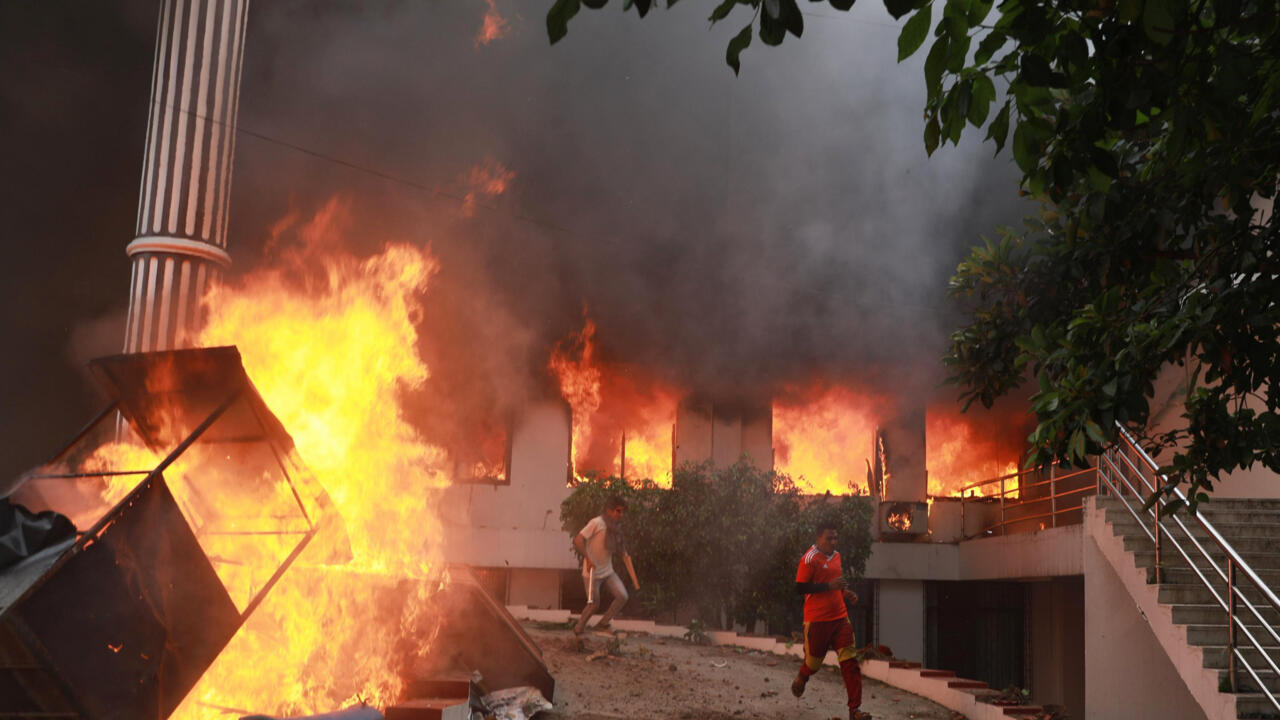
Protesters run from the burning Nepali Congress Party office in Kathmandu on September 9. © Prabin Ranabhat, AFP
01:51


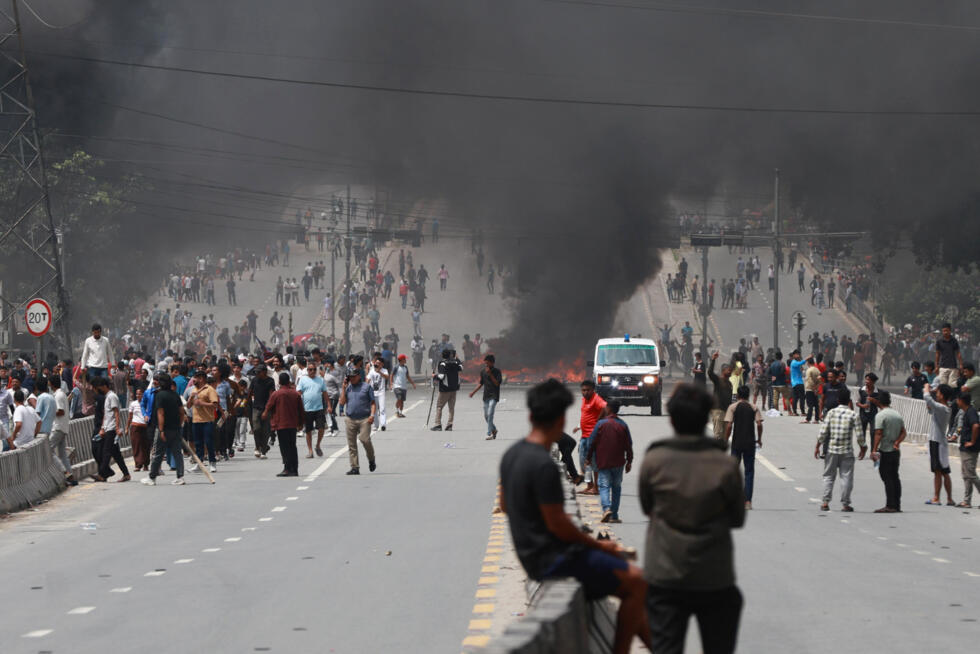
Nepali youth protesters set fire to parliament on Tuesday as the veteran prime minister gave in to furious crowds' calls to quit, a day after one of the deadliest crackdowns in years in which at least 19 people were killed.

The protests, which began on Monday with demands that the government lift a ban on social media and tackle corruption, reignited despite the apps going back online.

Demonstrators on Tuesday attacked and set fire to KP Sharma Oli's house, the 73-year-old, four-time prime minister and leader of the Communist Party.

Shortly after, chanting protesters – some wielding assault rifles, according to an AFP reporter at the site – gathered outside main government buildings.


Plumes of smoke also covered Nepal's parliament as demonstrators set the building ablaze.

"Hundreds have breached the parliament area and torched the main building," Ekram Giri, spokesman for the Parliament Secretariat, told AFP.

The United Nations rights chief voiced alarm at the escalating violence.

UN High Commissioner for Human Rights Volker Turk is "appalled by the escalating violence in Nepal", and insists that "dialogue is the best and only way to address the concerns of the Nepalese people", he said in a statement.

Protesters, mostly young men, were seen waving the country's national flag as they dodged water cannons deployed by the security forces.

Other demonstrators targeted the properties of politicians and government buildings.

Kathmandu's airport remains open, but some flights were cancelled after smoke from fires affected visibility, airport spokesman Rinji Sherpa said.


An AFP journalist saw some protesters wielding rifles. © Prabin Ranabhat, AFP


"I have resigned from the post of prime minister with effect from today ... in order to take further steps towards a political solution and resolution of the problems," Oli said Tuesday in a statement.

His political career stretched nearly six decades, a period that saw a decade-long civil war, with Nepal abolishing its absolute monarchy in 2008 to become a republic.

First elected as prime minister in 2015, he was re-elected in 2018, reappointed briefly in 2021, and then took power in 2024 after his Communist Party forged a coalition government with the centre-left Nepali Congress in the often-volatile parliament.

His resignation followed that of three other ministers, and came despite the government repealing the ban.

Bringing social media back online "was among the Gen Z's demands", Minister for Communication Prithvi Subba Gurung told AFP, referring to young people aged largely in their 20s.

KP Sharma Oli resigned after days of deadly protests sparked by a ban on social media. 
© Bikash Karki, AFP


The ban fed into existing anger at the government in a country with a youth bulge.

People aged 15-40 make up nearly 43 percent of the population, according to government statistics – while unemployment hovers around 10 percent and GDP per capita is just $1,447, according to the World Bank.


Live ammunition

Slogans demanding accountability from the authorities have been a feature at the protests.


A burning baricade on a road in Kathmandu on September 9. © Prabin Ranabhat, AFP


"Nearly 20 people were murdered by the state – that shows the scale of police brutality," said 23-year-old student Yujan Rajbhandari.

Several social media sites – including Facebook, YouTube and X – were blocked on Friday in the Himalayan nation of 30 million people, after the government cut access to 26 unregistered platforms.

Amnesty International said live ammunition had been used against protesters on Monday, and the United Nations demanded a swift and transparent probe.

Since Friday, videos contrasting the struggles of ordinary Nepalis with the children of politicians flaunting luxury goods and expensive vacations have gone viral on TikTok, which was not blocked.

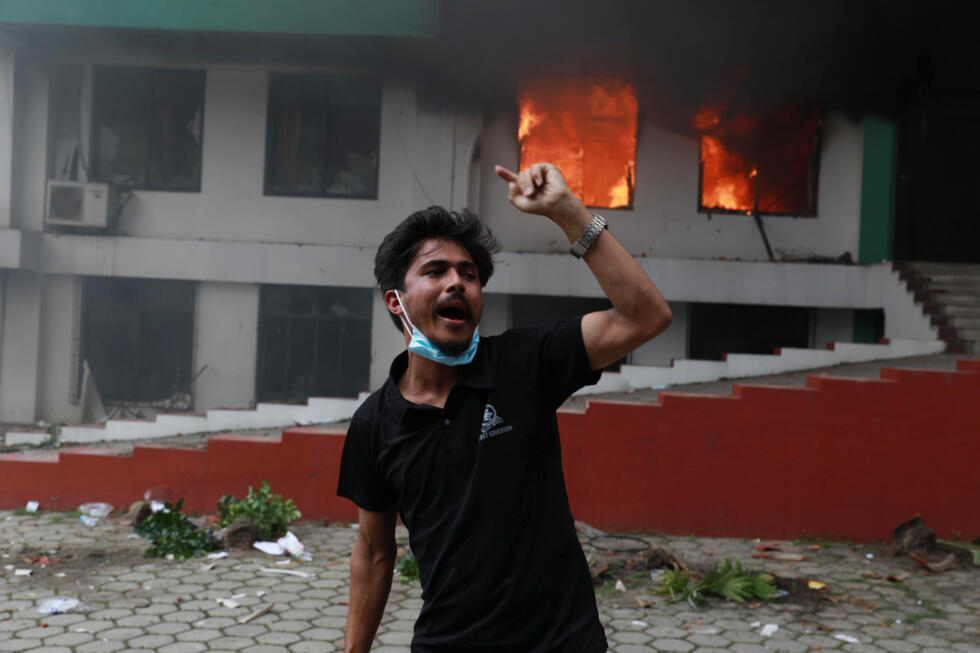
A protester celebrates outside the burning Nepali Congress Party office in Kathmandu.
 © Prabin Ranabhat, AFP


Popular platforms such as Instagram have millions of users in Nepal who rely on them for entertainment, news and business. Others rely on the apps for messaging.

"This isn't just about social media – it's about trust, corruption, and a generation that refuses to stay silent," the Kathmandu Post newspaper wrote.

"Gen Z grew up with smartphones, global trends, and promises of a federal, prosperous Nepal," it added.

"For them, digital freedom is personal freedom. Cutting off access feels like silencing an entire generation."

It lifted a nine-month ban on TikTok last year after the platform agreed to comply with Nepali regulations.

(FRANCE 24 with AFP)