It’s possible that I shall make an ass of myself. But in that case one can always get out of it with a little dialectic. I have, of course, so worded my proposition as to be right either way (K.Marx, Letter to F.Engels on the Indian Mutiny)
State-owned Chinese oil giant CNPC continues to produce and export oil from a newly expanded oilfield in Niger despite ongoing disputes with the local authorities, Reuters reported on Friday, quoting sources familiar with the situation.
CNPC set foot in Niger in the early 2000s, developed the Agadem oilfield there, built a refinery in southern Niger and a pipeline to a port in Benin. The Chinese oil giant, which has invested over $5 billion in Niger’s oil industry so far, started production at the Agadem oilfield in 2011, at a rate of 20,000 barrels per day (bpd).
The field’s capacity has been recently increased to 90,000 bpd.
CNPC continues to export Nigerien crude via Benin, and total export sales have reached $2 billion, according to Reuters’ sources.
The crude production and exports continue despite the dispute with the military junta, which took power in a 2023 coup that ousted the elected President, Mohamed Bazoum.
The military junta leader, General Abdourahmane Tchiani, was sworn in in March 2025 as Niger’s President for a transitional period of five years.
The junta seeks to exert more control over Niger’s natural resources. Niger is estimated to hold significant oil reserves, as well as deposits of uranium, gold, and coal.
The military leadership, however, expelled Chinese expatriates earlier this year and insists that CNPC hire more local workers who are to account for 80% of the workforce at CNPC-led projects in Niger. Currently, the share of Nigerien workers at CNPC’s oil facilities in the country is below 30%.
The new regime also wants CNPC to bridge the gap in pay between local workers and Chinese expatriates.
Despite the dispute and ongoing talks, crude from the Agadem oilfield continues to flow to the local Soraz refinery and to Benin for exports on the international market, according to Reuters’ sources.
Ghana’s Tema Oil Refinery (TOR) will resume crude oil refining before the end of October, officials said, marking a major step in reviving the country’s long-idle state refinery and reducing dependence on imported fuel.
TOR, once Ghana’s flagship energy facility, has been largely inactive for years, functioning mainly as a storage depot for fuel importers rather than refining crude, reports Daily Graphic.
But a comprehensive Turnaround Maintenance Project, now 98% complete, is set to restore full operations within days, according to Godwin Mahama, TOR’s Corporate Affairs Officer.
“The new management has made it a point that the company goes back to its main core mandate by the end of this month,” Mahama told Onua FM in Accra. “TOR will start refining crude in this country. We have started what we call the turnaround maintenance to put all the equipment back into shape.”
The restart follows months of maintenance and restructuring work aimed at rehabilitating TOR’s key processing units, including its 45,000 bpd crude distillation plant, which has been idle since 2021 due to technical faults and financial constraints.
Officials said crude feedstock for the initial restart will be sourced under a new supply arrangement with the Sentuo Oil Refinery and the Bulk Oil Storage and Transportation (BOST) company, while discussions continue with international traders for longer-term crude procurement.
TOR, located east of Accra, has faced chronic underinvestment, high debt, and equipment failure in recent years, leading to periodic shutdowns. A previous public-private partnership (PPP) plan involving Torentco Asset Management was cancelled earlier this year after the government cited transparency concerns.
Mahama said the refinery’s Turnaround Maintenance Committee will hand over the plant to the production unit by Friday (October 17), paving the way for final inspections. “Before the third week of this month, the first crude will arrive in the country, and refining will begin,” he added.
For several years, TOR survived by renting out its large storage tanks to bulk oil distribution companies (BDCs) that import finished products into Ghana. The revival of refining operations, Mahama said, will “restore the refinery’s core function and create jobs.”
Mahama credited the refinery’s comeback to the leadership of Managing Director Edmund Kombat and the support of President John Mahama, under whose administration the state enterprise has been prioritised for rehabilitation.
“President Mahama has consistently reiterated that TOR must work again because when TOR works, it brings employment and strengthens our foreign exchange position,” he said.
He added that restoring TOR’s refining capacity would significantly reduce Ghana’s reliance on imported petroleum products and help stabilise the national currency.
“Currently, almost all our finished products are imported, but if TOR can meet about 60% of the local market demand, we’ll save foreign currency, strengthen the cedi, and complement the government’s economic stabilisation efforts, including those by the Finance Ministry and GOLDBOD,” Mahama noted, referring to the country’s gold board.
Ghana, a net oil producer since 2011, has long struggled to translate its crude output into refined fuel security. Successive governments have pledged to revive TOR, which has faced years of debt, mismanagement, and technical breakdowns.
Ghana is a mid-tier oil producer in West Africa with output of roughly 145,000–160,000 bpd of crude oil. If the relaunch proceeds as planned, TOR’s restart will mark the first time in nearly a decade that the country processes its own crude oil domestically.
Commercial oil production began in 2010 from the Jubilee Field, operated by Tullow Oil (LSE:T LW) and partners Kosmos Energy (NYSE:KOS), PetroSA, and the Ghana National Petroleum Corporation (GNPC). Since then, two additional deep-water developments—TEN (Tweneboa-Enyenra-Ntomme) and Sankofa-Gye Nyame—have come onstream, consolidating Ghana’s offshore hub along the western coast near Takoradi.
Multiple Units Go Offline at BP’s Whiting Refinery in U.S.
The biggest refinery in the Midwest, BP’s Whiting facility, had multiple units offline on Friday, market sources told Reuters, quoting data from energy consultancy Wood Mackenzie.
The refinery was also actively flaring early on Friday, according to one of Reuters’ sources.
The Whiting, Indiana refinery “experienced a fire that was put out and was actively flaring with alarms heard in vicinity last night,” Patrick De Haan, head of petroleum analysis at GasBuddy, said on Friday.
The still unknown issue at Whiting occurs two months after the massive 440,000-barrel-per-day refinery was forced into flaring in the middle of August following severe thunderstorms that dumped heavy rain across northwest Indiana, flooding the site and surrounding neighborhoods.
The Whiting refinery, perched on the southern edge of Lake Michigan just outside Chicago, is critical to regional fuel supply, producing gasoline, diesel, and jet fuel for much of the Midwest. Any disruption at Whiting, which is BP’s biggest refinery anywhere in the world, typically ripples quickly into regional fuel markets, where inventories are already leaner than normal this summer.
The disruption this time happens after a large fire at Chevron’s El Segundo refinery in California in early October forced units offline and threatens regional supply in the West.
Commenting on the El Segundo refinery incident, GasBuddy’s De Haan said at the time that “While OPEC again agreed over the weekend to boost oil production for November, the real story for motorists has been regional variation — especially in areas served by California’s supply system.”
“Though the damage from the fire appears limited, the West Coast is likely to see prices climb, while most other areas can expect relative stability or slight declines,” De Haan wrote on X.
The national average gasoline price is nearing the below $3 per gallon mark as the U.S. benchmark oil price, WTI Crude, fell below $60 per barrel last week, De Haan said early this week.
Governments and policy makers need to pay more attention to hydropower as a major source of low-emission flexible power generation in the age of booming electricity demand, Fatih Birol, the executive director of the International Energy Agency (IEA), said on Friday.
Hydropower “remains the forgotten giant of electricity,” Birol wrote in a LinkedIn post, calling for greater role for the “forgotten” clean energy source in the global electricity systems.
Hydropower accounted for about 14% of total global electricity supply in 2024. This share of hydropower is similar to “all the power produced worldwide by solar and wind combined, and 50% more than the amount generated from nuclear plants,” the head of the IEA said.
Of all power sources, hydropower is the third largest source of power generation worldwide after coal and natural gas, he added.
Some countries have large hydropower generation as a share of power supply, including Brazil and Norway. But worldwide, this power source has stayed at the background, obliterated by the surge in solar and wind capacity installations and power generation.
“Hydro is frequently an afterthought in global energy policy discussions. As I said, a forgotten giant,” Birol wrote.
“Now, as decision-makers around the world contend with how to meet renewed strong growth in electricity consumption, I believe it’s high time to give hydropower the attention it deserves.”
As global electricity demand is set to soar in the coming decades, “Hydropower can help meet this increasing power consumption as populations and economies grow, electrification advances and investment pours into digital infrastructure like data centres,” the IEA’s Birol said.
Moreover, hydropower provides “unmatched flexibility”, which can be indispensable for countries looking to integrate rising levels of solar and wind into their electricity systems, according to the executive, who calls for moving hydropower up on the energy policy agenda.
Large computing power consumers have turned to hydropower to support their operations with low-emission electricity.
Earlier this year, Google struck a landmark deal to buy more than $3 billion worth of hydroelectric power from Brookfield Asset Management to supply its data centers, with the potential to scale up the agreement to 3,000 megawatts — making it the largest corporate hydropower deal ever signed.
President Milei is tearing down decades of regulation to turn the country’s vast shale reserves into an export engine.
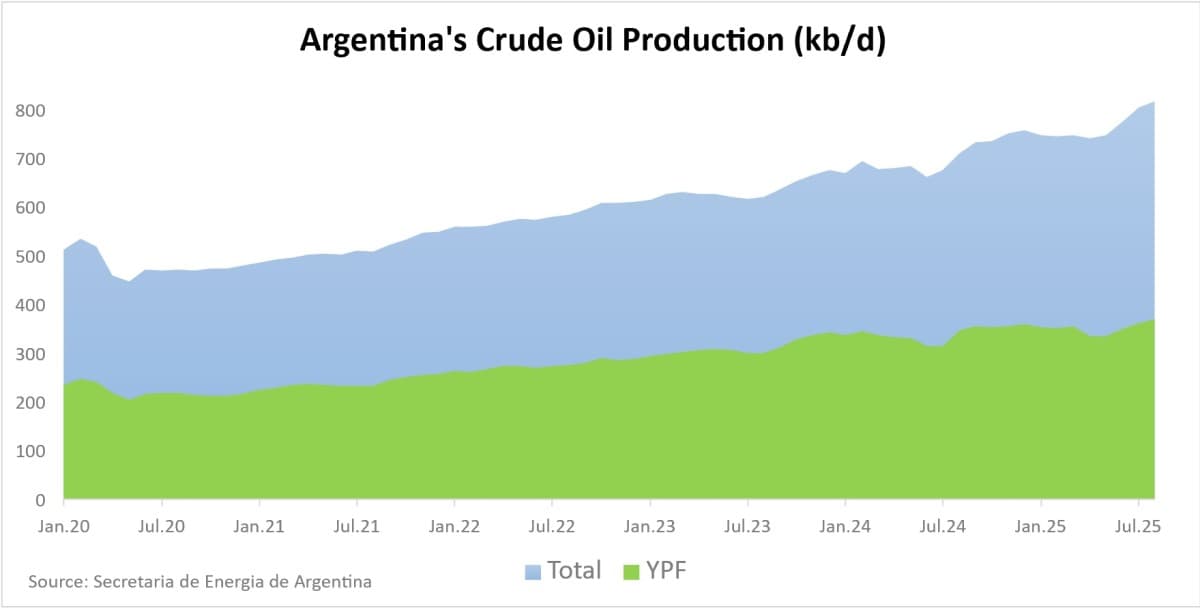
Argentina’s crude output is rising to 815,000 b/d, but weak prices, high costs, and underdeveloped infrastructure of the Vaca Muerta basin threaten to stall the momentum.
With President Trump’s credit lines propping up the peso, Milei’s political survival now determines the fate of Argentina’s energy outlook.
After years of currency chaos and regulatory paralysis that drove oil majors out of Argentina, President Javier Milei has set out to remake the country into a regional energy powerhouse. His sweeping deregulation freed up oil exports, attracted foreign capital, and revived activity in Vaca Muerta, one of the world’s largest shale formations. Yet the path to energy independence remains fragile. Falling oil prices, rising costs, and unfinished infrastructure threaten to stall progress, while the peso’s stability now depends on unprecedented U.S. financial support.
For more than a decade, Argentina’s oil industry was paralyzed by policy mismanagement and financial instability. Oil majors from around the world – once attracted by the promise of the vast Vaca Muerta shale basin – had left the country, discouraged by the impossibility of converting peso-denominated revenues into hard currency. The volatility of Argentina’s national currency, driven by inflation rates that routinely exceeded 200%, made Argentina one of the most challenging environments in the global energy sector. Profits earned in pesos lost value before they could be repatriated, eroding investor confidence and leaving oil producers without tangible profits.
That narrative shifted sharply after President Javier Milei took office in December 2023. His 2024 reform package, built around the ‘Megadecreto’ and ‘Ley de Bases’ (Basic Law), removed restrictions on trade, investment, and foreign-exchange access that had paralyzed the energy sector. The Megadecreto scrapped dozens of controls on oil exports and capital movements, while the Ley de Bases (enacted in July 2024) legally guaranteed free hydrocarbon exports, barred government price interference in domestic fuel markets, and fast-tracked approvals for pipelines, refineries, and ports. Together, the measures formed the backbone of Milei’s liberalization policy, turning Argentina from a country with a heavily regulated energy landscape into potentially Latin America’s most open investment environment.
The intention of the Milei government was to trigger a sustained surge in oil output and exports, transforming Argentina from a marginal self-centred producer into a regional energy exporter. At the core of that ambition lies Vaca Muerta, the country’s most important energy asset and one of the world’s largest shale formations. According to the U.S. Energy Information Administration (EIA), Vaca Muerta holds an estimated 16 billion barrels of technically recoverable shale oil and 308 trillion cubic feet of natural gas. The formation currently accounts for around 65% of Argentina’s total oil production, in large part through operations led by YPF, the state-controlled energy company nationalized from Spain’s Repsol in 2012 under former President Cristina Fernández de Kirchner.
Production growth over the past two years has been steady. As of August 2025, Argentina produced approximately 815,000 b/d of crude, a 10% increase year-on-year, with growth driven by new wells and midstream capacity additions in the Neuquén Basin. Yet in October 2025, analysts foreshadowed a slowing production trend, as falling global crude prices challenge the profitability of fracking activity, aggravated by rising labour and service costs. Fracking activity slowed down, and oil-service firms reported fewer wells and smaller volumes of injected water and chemicals with smaller operators having suspended drilling. As the Argentinian peso’s been strengthening modestly, export revenues in dollar terms fell, further tightening margins. The government’s long-term goal is to lift output to 1.5 million b/d by 2030, positioning Argentina alongside Brazil and Guyana as South America’s emerging oil exporters. Markets make the goal harder to reach, but they’re not the biggest problem.
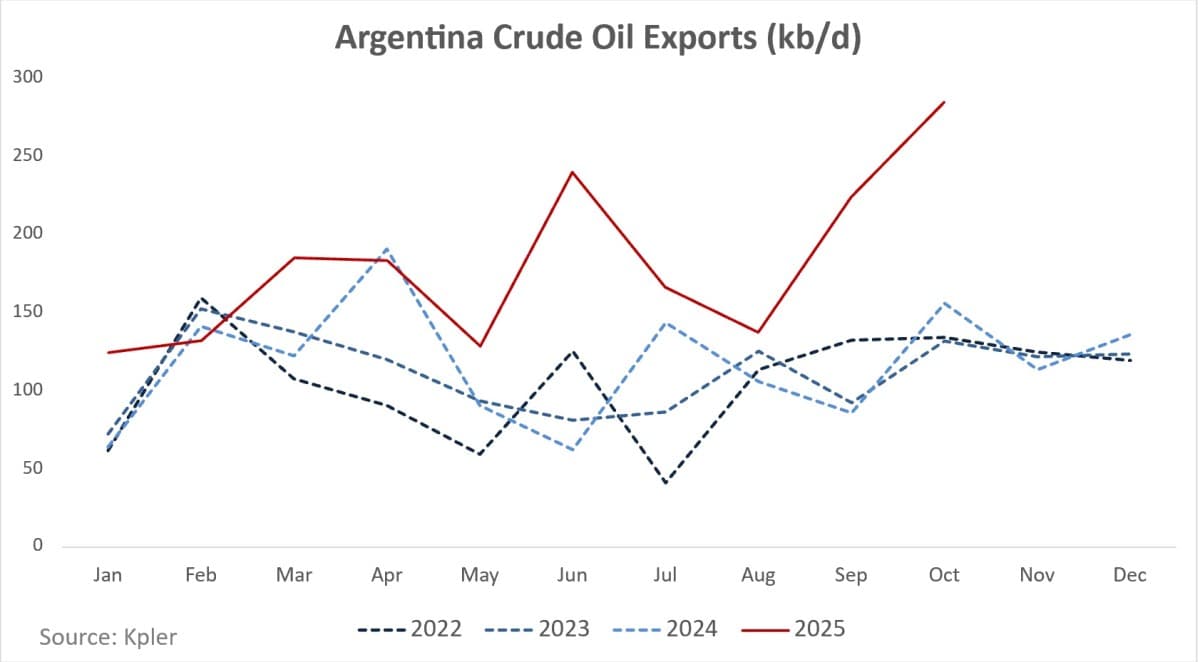
The critical challenge lies in infrastructure: the crude has nowhere to go without the pipelines and transport links, thus Argentina’s crude export potential remains modest relative to its reserves. Between 2024 and 2025, average total exports hovered near 110,000 b/d, constrained by logistical gaps. Earlier in 2025, the inauguration of the Duplicar pipeline – adding 300,000 b/d in capacity and expanding the total throughput of the region to almost 550,000 b/d – marked a turning point. The expansion helped relieve transport bottlenecks that had constrained field production and immediately boosted export flows. In April 2025, Argentina exported about 120,000 b/d of its flagship Medanito crude grade (produced in the Vaca Muerta basin), but already by September that figure had surged to 210,000 b/d, largely due to the expanded pipeline network.
Two additional pipeline projects are under development. The Duplicar Norte expansion is slated to begin construction in November 2025, adding 220,000 b/d of capacity by March 2027. The largest undertaking, the $2.7 billion Vaca Muerta Sur pipeline, will connect Loma Campana with the Punta Colorada export terminal, designed to move up to 700,000 b/d of crude once completed by 2030. However, both projects are still in their early stages, with construction yet to advance significantly.
Beyond pipelines, the lack of road infrastructure continues to impede full-scale development. To address this, Neuquén Province –working with private operators – has launched a 51-kilometer road project to improve internal access within Vaca Muerta. Yet most routes to Argentina’s Atlantic ports remain underdeveloped, raising costs and lengthening delivery times.
Above all, stabilizing the peso remains Argentina’s hardest task. After the removal of capital controls, President Milei liberated the peso and achieved what many thought impossible: a rapid decline in inflation from nearly 300% at the end of 2023 to under 20% by early 2025. Yet that achievement has proved fragile. A political setback in September 2025 municipal election – when Milei’s Libertad Avanza party lost by 14 pp in Buenos Aires – made the peso immediately lose more than 6%, prompting the Central Bank to intervene with $1.1 billion in reserve sales to prevent the further downfall of the exchange rate.
The peso’s recovery now rests largely on US Treasury intervention, which has become its principal source of stability. On September 24, it pledged a $20 billion credit swap line to support the Argentinian peso through its Exchange Stabilization Fund. In mid-October, President Donald Trump unveiled a second $20 billion swap line but made it clear the aid came with strings attached: Washington’s generosity would shrink if Milei lost in the upcoming elections. Argentina’s dependence on US financial backing has become stark: even a single social-media post by US Treasury Secretary Scott Bessent about supporting peso stability has been enough to lift Argentina’s ten-year government-bond prices 5 times this year.
These swap lines complement broader multilateral aid: Argentina has already received $20 billion from the IMF (making the country the single largest borrower from the IMF), $12 billion from the World Bank, and $10 billion from the Inter-American Development Bank. Together, these programs have stabilized the peso in the short term, but analysts warn they risk entrenching dependency on foreign support.
Despite financial fragility, President Milei’s reforms have undeniably revived Argentina’s oil sector. In the pre-Milei years, YPF has almost unilaterally driven upstream growth in Argentina – from January 2020 up until the beginning of President Milei’s legislature in late 2023, YPF‘s production growth was equivalent to 95% of Argentina’s increments in crude oil output. Now, with export infrastructure expanding, global majors are finally reactivating their projects in Neuquén and joining YPF in their shared quest to maximize shale output. However, for operators such as Chevron, TotalEnergies, Tecpetrol, and even for the state-owned YPF, the reforms remain incomplete. They continue to press for unrestricted exports, more flexible labour rules, and full access to U.S. dollars for dividends and imports.
Vaca Muerta now mirrors both the promise and fragility of Milei’s economic experiment. Beneath it lies one of the world’s largest untapped oil reserves; above it, a government betting its credibility on free markets and fiscal discipline. Milei’s deregulation drive has given Argentina’s energy sector a second wind, but its success depends on whether he can anchor stability and restore investor trust. However, by tying Argentina’s financial stability to President Trump’s conditional credit lines, Milei has placed the country under a double threat: if he loses the upcoming elections, Argentina could lose its main source of external support – hardly a promise of stability for the investors. If Milei’s plan to navigate through these restless waters delivers, Vaca Muerta could turn Argentina into a major global exporter. If he fails, it will remain what it has long been — a symbol of untapped wealth trapped by political and economic instability.
By Natalia Katona for Oilprice.com
Ontario government announces streamlined mining permit process
Ontario Energy and Mines Minister Stephen Lecce announced the One Project, One Process framework, at a news conference Friday morning. (Photo from video)
The Ontario government has announced a new process aimed at speeding up mine exploration and development in the province.
Ontario Energy and Mines Minister Stephen Lecce announced the One Project, One Process framework, at a news conference Friday morning.
Lecce said change was needed because the current system has taken up to 15 years to approve a single mine, creating delays that have been holding back access to critical minerals like nickel, lithium and cobalt.
Ontario’s mining sector supports an estimated 28,000 direct jobs and 46,000 indirect jobs through associated mineral processing and supply services. (Photo from video)
“There are 10 mines right now actively working through the permit process,” Lecce said.
“Every Canadian knew months ago, post-President (Donald) Trump, that we had to move with speed to realize our economic potential and that economic self-reliance starts with our ability to move resource projects forward.”
Under the new process, mining projects will be managed by a mine authorization and permitting delivery team, with the Ministry of Energy and Mines acting as a single point of contact to coordinate approvals within two years.
“We will take that permit and then essentially shepherd it right across the enterprise of government, ministry by ministry, to get it approved within that baseline,” Lecce said.
The goal of the new system is to slash review times by 50 per cent. The Crown’s duty to consult with First Nations will continue.
There are 36 active mines in Ontario contributing $24 billion to the province’s gross domestic product. (Photo from video)
“We agree that efficiency must never compromise responsibility,” said Priya Tandon, president of the Ontario Mining Association.
“A shared, consistent framework, including a unified list of communities to engage with, would provide clarity not only for industry but for Indigenous partners and government, as well.”
Jason Jessup, CEO of Sudbury-based Magna Mining, said the company has four projects in the pipeline.
Jessup said the new process is a “great step forward” for Ontario and puts the province on the path to becoming the premier jurisdiction for new mine development. Providing more certainty
The new streamlined permitting process, he said, will help Magna when looking at greenfield projects and will “provide more certainty” on when deposits can be moved into production.
“We think that’ll open up a lot more opportunity here for us in the Sudbury basin,” Jessup said
.
With strong global demand for copper, Sudbury-based Magna Mining says it quickly raised the money it was looking for to develop a promising ore body at the former Levack Mine. (Supplied)
“With the mineral endowment we have in this province, having this certainty on the ability to get mines permitted and into construction will attract a lot more capital and, ultimately, will help us build a lot more mines in Ontario.”
The legislation gives the Doug Ford government power to suspend provincial and municipal laws for projects in areas it deems to have economic importance, citing the need to speed up mine development.
The bill sparked anger from First Nations and environmental groups.
The environmental group Ontario Nature said Friday it’s “not necessarily concerned” with the new process. Devil in the details
However, officials wonder how experts from other provincial ministries that were previously part of the review process will be able to comment on new proposals and what standards will be required or met.
“What the government’s putting out in terms of the guidance and the process, there’s a lot of lack of clarity and transparency on how this will actually unfold,” Tony Morris, Ontario Nature Conservation policy and campaigns director, told CTV News Friday afternoon.
Environmental groups are demanding Bill 5 be scrapped because it streamlines mine approvals by repealing Ontario’s existing Endangered Species Act, which passed in 2007, and replacing it with a new version called the Species Conservation Act. They argue it would be detrimental to protecting wildlife.
“There’s a big risk to our species at risk, and in fact, any permitting process won’t actually assess potential impacts to those species in their habitat,” Morris said.
There are 36 active mines in Ontario contributing $24 billion to the province’s gross domestic product.
Ontario’s mining sector supports an estimated 28,000 direct jobs and 46,000 indirect jobs through associated mineral processing and supply services.
The expansion of a major electric vehicle battery project in Bécancour, Que., is being indefinitely paused, while a nickel sulfate plant meant to supply it has been cancelled.
In March 2022, General Motors and South Korea's POSCO Chemical announced a partnership, known as Ultium Cam, to build a plant in Quebec producing cathode active materials for GM's Ultium batteries.
But now, Quebec Economy Minister Christine Fréchette, who was in Mirabel, Que., Thursday for an unrelated announcement, confirmed that the second phase of the project was not going ahead.
"My hope is that this pause will be of a limited duration, and that in the near future we'll be able to relaunch the project," she said.
The first phase of the project is under construction, with a $600-million facility in Bécancour expected to start production in 2026.
"I am confident that Phase 1 will move forward," Fréchette said, noting it's already underway.
Phase 2, meanwhile, focused on increasing production with construction of a plant to manufacture the main ingredient for cathode active materials — a mixture of nickel sulfate and other elements.
As a result of the pause, Vale Base Metals scrapped its own plans for a nickel sulfate plant that would have supplied Ultium Cam.
In a statement to The Canadian Press, Vale Base Metals said GM "will not need nickel sulfate in Quebec at this time."
Fréchette blamed the current situation on a global slowdown affecting the EV battery industry.
She said, however, that the sector remains promising and one in which Quebec was positioning itself and pointed to other battery projects in Bécancour that are moving forward.
The news comes less than two months after Quebec closed the chapter on Northvolt and the province's controversial plans to build a $7-billion EV plant outside of Montreal, losing a $270-million investment in the process.
The federal and provincial governments have together funded about $300 million of the first phase of the Ultium CAM project, including a $152-million, partly forgivable loan from Quebec.
Earlier this week, GM reported it will record a negative impact of $1.6 billion US in its next quarter after tax incentives for electric vehicles were slashed by the U.S. and rules governing emissions are relaxed.
Written by Annabelle Olivier, with files from Radio-Canada and The Canadian Press