THE EPSTEIN CLASS

7 March, 2026
Left Foot Forward
If Epstein’s networks helped broker access or funding for political movements, it’s a matter of public concern. These aren’t insinuations, but a matter of accountability, and in the unresolved story of Brexit, accountability remains in short supply.
When the latest tranche of documents linked to Jeffrey Epstein was released earlier this year, much of the British reaction focused on familiar establishment names, notably Peter Mandelson and former Prince Andrew. Given the seriousness of the allegations surrounding them, that scrutiny is understandable.
But the spotlight has been too narrow.
Buried within the correspondence and contact lists are connections that reach into Britain’s hard-right networks and intersect with the political forces that drove Brexit. Yet, these connections have largely been overlooked or ignored by mainstream media.
Epstein was not merely a disgraced financier cultivating proximity to power, he was enthusiastic about Britain’s departure from the EU and celebrated the nationalist turn in Western politics.
Inclusion in Epstein’s files does not, in itself, imply wrongdoing. Yet the context of those mentions, the political projects being discussed, the money being courted, and the alliances being enriched, is a matter of public interest.
If the disclosures are to mean anything beyond lurid scandal, they must prompt a broader examination of how wealth, influence and political power intervene in modern Britain.
Brexit as “just the beginning”
Among the material are emails in which Epstein discusses Brexit with tech billionaire Peter Thiel. In one exchange, Epstein describes Britain’s vote to leave the European Union as “just the beginning,” heralding a “return to tribalism,” a “counter to globalisation,” and the forging of “amazing new alliances.”
Such remarks suggest that Brexit was viewed in certain elite circles not merely as a domestic democratic event, but as part of a broader ideological realignment across the West.
Thiel’s footprint in the UK has grown steadily in recent years. As Left Foot Forwardreported in 2022, his data analytics firm Palantir Technologies secured multiple UK government contracts during the pandemic and has undertaken extensive work with the Ministry of Defence, including a £10 million contract in March 2022 for data integration and management.
A report by Byline Times described a “Thiel network” seeking to influence debates around free speech in academia, and part of a broader effort to normalise anti-liberal ideas among British intellectuals and policymakers.
Some figures linked to these debates, including right-wing commentator Douglas Murray and a British Anglican priest and life peer Nigel Biggar, who regularly rages against ‘woke’ culture, have also been associated with initiatives such as the Free Speech Union, founded by perennial culture warrior, Toby Young.
Thiel’s influence also extends through his Thiel Fellowship programme, which has backed entrepreneurs including Christian Owens, founder of the UK payments “unicorn” Paddle.
None of this proves a coordinated “Thiel–Epstein Brexit plot,” but it does point to something subtler, and arguably more consequential. As the New World observed in an analysis about the Epstein files and the Brexit connection, “while millions voted Leave to strike back at a remote elite, parts of that same elite were calmly gaming out how the resulting disorder might be useful to them.”
That tension alone warrants scrutiny.
Nigel Farage and Steve Bannon
The Reform UK leader appears dozens of times in the Epstein files, though many references reportedly stem from duplicated email chains or attached news articles. Farage has denied ever meeting or speaking with Epstein.
Yet the context in which his name arises is important.
Steve Bannon, a former White House chief strategist to Donald Trump, described brilliantly by the New World’s Steve Anglesey as “the sweaty MAGA insider/outsider who once fancied himself a Brexit architect and dreamed of setting up a pan-European far right movement that would ultimately destroy the EU,” appears in thousands of exchanges with Epstein. In one message, Bannon boasts about his relationship with Farage. In another, he writes: “I’ve gotten pulled into the Brexit thing this morning with Nigel, Boris and Rees Mogg.”
The correspondence shows Bannon attempting to tap Epstein for support and funding to bolster far-right movements in Europe. He discussed raising money for figures such as Italy’s deputy prime minister Matteo Salvini and France’s Marine Le Pen, showing the transnational nature of these networks.
Again, mention does not equal misconduct, but when a financier later exposed as a serial abuser is simultaneously being courted as a potential backer of nationalist political movements, the public is entitled to ask questions about access, influence and intent.
Tommy Robinson and the “backbone of England”
The files also contain references to UK far-right activist, Tommy Robinson.

Bannon has never shied away from sharing his support for Robinson. At the 2024 Conservative Political Action Conference, when on stage with Liz Truss, he described the founder of the English Defence League as a “hero” and Truss appeared to agree with him. “That is correct,” she said.
When Robinson was released from prison in 2018, Epstein messaged Bannon: “Tommy Robinson. !! good work.” Bannon responded: “Thanks.”
In July 2019, after Epstein shared an article reporting Robinson’s contempt of court conviction for live-streaming defendants in a child sexual exploitation trial, Bannon replied by calling Robinson the “backbone of England.”
The significance here is not that Robinson appears in correspondence, but that discussions around him sit within a wider ecosystem, that is wealthy financiers, American political strategists and European nationalist figures exchanging messages about funding, media and mobilisation.
Nick Candy, Reform UK and transatlantic links
Nick Candy, luxury property mogul and now treasurer of Reform UK, is also mentioned numerous times in the files, in discussions that appear to concern the potential sale of Epstein’s New York mansion.
In 2024, Candy left the Conservative Party to join Reform. He later attended a strategy meeting at Trump’s Florida residence alongside Farage and tech billionaire Elon Musk. All three men appear within the tranche of documents released by the Department of Justice.
Some messages reference Candy in connection with Ghislaine Maxwell, though the full context of those exchanges remain partially redacted – we’ll come on to redaction shortly.
The files also reveal previously underreported contact between Musk and Epstein in 2012 and 2013, including discussions about a possible visit to Epstein’s private island. The visit does not appear to have taken place.
Like Bannon, Musk has actively involved himself in European politics. He has repeatedly got into spats with politicians including Keir Starmer.
“Civil war is inevitable” … “Britain is going full Stalin”… “The people of Britain have had enough of a tyrannical police state,” are just some of his comments on X in recent years.
And he’s used his own platform X to amplify voices on the right and far-right online, including sending a heart emoji to Tommy Robinson, who said Musk had funded his defence for a charge related to counter-terrorism law.
“A HUGE THANK YOU to @elonmusk today. Legend,” Robinson wrote.

It bears repeating, appearing in Epstein’s files does not establish criminality. Guilt by association is not journalism, nor is it justice.
But context is not smearing, it’s scrutiny. Examining who communicated with whom, how often, and in what capacity is a legitimate part of understanding how power operates.
There’s also the question of redaction. Many of the documents released have been heavily blacked out, names, photographs, email addresses and other identifying details obscured. In sensitive criminal cases, redaction is both necessary and appropriate, particularly to protect victims.
In some instances in the Epstein files, the reasons are obvious. Yet, as the Conversation has observed, “the absence of any reason for the redaction has simply added fuel to the fire, with spectators filling in the blanks themselves.” When transparency is partial and unexplained, it can deepen suspicion rather than resolve it.
The public release of the Epstein files was presented as a milestone for transparency. Instead, it has prompted further questions: about how sensitive material was handled, about the criteria used to withhold information, and about the extent of Epstein’s connections to powerful political figures, including figures on the far-right in the UK. If Epstein’s networks provided introductions, cross-border access, or even financial pathways into political movements, that is a matter of legitimate public interest.
More broadly, the scandal raises structural concerns. What channels enable wealthy outsiders to cultivate influence across government, academia and media? How rigorously are those relationships scrutinised? And what safeguards exist to ensure political outcomes are not quietly shaped by individuals whose interests diverge sharply from the public good?
These are not questions of insinuation, but of accountability, and in the unresolved story of Brexit, accountability remains in short supply.

Gabrielle Pickard-Whitehead is author of Right-Wing Watch
Misogyny, Epstein and Reform’s cultural agenda
6 March, 2026
From Epstein’s web to Reform’s proposed raft of policy ideas, creeping misogyny now risks redefining women’s rights in Britain
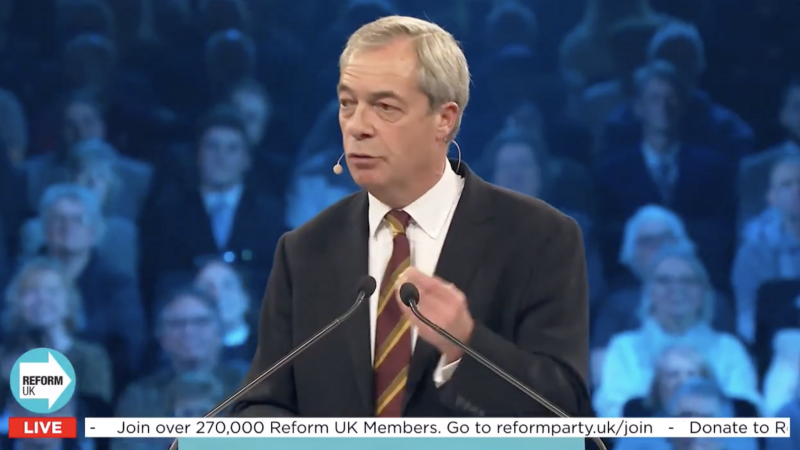
Pampered by the press as ‘the next government in waiting’, Reform continues to poll strongly. We’re familiar with how the party fosters racism through its hostile rhetoric and flagship immigration stance, but its ubiquitous misogyny receives less attention. A Reform win at the next general election will be partly because enough people either didn’t know, or didn’t care, about its views on females. For International Women’s Day, I’d like to explore these views through the lens of the Epstein files.
The octopus
The web of Epstein’s influence, in all its vast complexity, is now coming into full view, like a multi-armed, gigantic octopus being lifted from the seabed. We’re seeing Epstein the enabler, matchmaker, wheel-oiler, and co-ordinator extraordinaire in a multidimensional kleptocratic network of corporate, political, cultural and sexual interest.
You’d need a 3-D modeller to trace the complex inter-connections he orchestrated between climate denialists, fossil fuel industries, political lobbyists (Brexit, the Kremlin) the tech broligarchy, racists, eugenicists, Israeli intelligence, and more, all whilst supplying a deadly pipeline of women and child victims to the depraved subculture he cultivated. It’s all coalescing into one repulsive integrated whole.
Network participation is layered like an onion with peripheral involvement shading into roles that have varying degrees of knowledge and whistle blowing capacity on Epstein’s darkest activities. We may never know all the players or precisely which layers Epstein’s UK friends occupied. But only the outer layer is free of guilt by association of colluding with a monster.
The web of Epstein’s influence, in all its vast complexity, is now coming into full view, like a multi-armed, gigantic octopus being lifted from the seabed. We’re seeing Epstein the enabler, matchmaker, wheel-oiler, and co-ordinator extraordinaire in a multidimensional kleptocratic network of corporate, political, cultural and sexual interest.
You’d need a 3-D modeller to trace the complex inter-connections he orchestrated between climate denialists, fossil fuel industries, political lobbyists (Brexit, the Kremlin) the tech broligarchy, racists, eugenicists, Israeli intelligence, and more, all whilst supplying a deadly pipeline of women and child victims to the depraved subculture he cultivated. It’s all coalescing into one repulsive integrated whole.
Network participation is layered like an onion with peripheral involvement shading into roles that have varying degrees of knowledge and whistle blowing capacity on Epstein’s darkest activities. We may never know all the players or precisely which layers Epstein’s UK friends occupied. But only the outer layer is free of guilt by association of colluding with a monster.
Creeping patriarchy
The island of Little Saint James was the black heart of Epstein’s misogyny, but the objectification and dehumanisation of females there was driven by a culture of extreme patriarchy – the presumed superiority and dominance by males over females. Patriarchal attitudes are tightly embedded in far-right thinking and are central to viewpoints such as Christo-fascism where they fuse with Christianity, authoritarianism and white, right-wing nationalism.
This regressive ideology lurks in Project 2025, in the Christian nationalism of JD Vance, Stephen Miller and in far-right parties across central and eastern Europe. It calls for a return to a traditional Christian heterosexual, patriarchal family model in which the primary responsibilities of females are homemaking, procreation and subservience to the male family head. For ‘guidance’, listen to pastor Dale Partridge’s homily on, amongst other things, why a women’s vote must never cancel her husband’s.
Handmaids UK
Extreme patriarchy is also spreading its tentacles in the UK via organisations such as Jordan Peterson’s Alliance for Responsible Citizenship (ARC). Linked to the right-wing think tank Legatum, ARC emphasises traditional gender roles and women’s duties as breeders.
Patriarchy is very much alive and kicking within Reform. Its intrepidly retrograde Christian nationalist policy creators, James Orr, Danny Kruger and Matthew Goodwin, are currently defining Reform’s cultural agenda in patriarchal terms straight from the wider Christo-fascist comfort zones they share.
Orr opposes abortion in all cases and pushes the pro-natalist policy of families having more children “to boost birth rates”. Kruger, also a keen pro-natalist, personally supports the reversal of no-fault divorce. He wants a ‘reset to sexual culture’ and challenges the rights of pregnant women to ‘absolute bodily autonomy’. Goodwin wants a “biological reality check” for girls and tax increases for childless couples.
Securing the property
Goodwin recently opined that the “sexual exploitation of women and girls is because of open borders”. This devious but false claim uses a supposed threat to females s to attack the liberal left, but arguably, also suggests unspoken proprietorship – we must ‘protect our women and girls’ to end foreign interference with our property.
In an equally stunning patriarchal vein, Farage, who endorsed Andrew Tate as an “important voice”, describes men as ‘more willing than women to sacrifice family life for career’, and objects to the 24 week abortion limit as “ludicrous”.
To enshrine women’s demotion to second class citizens, Reform has pledged to drop the 2010 Equalities Act which provides legal recourse for maternity leave, sexual assault, domestic abuse and employment discrimination. Reform also plans to ditch the ECHR thus thwarting its use by women as another court of appeal. You can hear the sound of doors closing.
All these narratives call for controls on women’s mental, physical and developmental freedom and autonomy and constitute a clear attack on women’s rights.
‘But’, the Reform curious wail, ‘we want change – migrants and Labour must be punished and removed. So, we’ll take the US route and ignore Reform’s misogyny as non-serious, or too unpopular to survive’. Left-leaning progressives join the dismissive fray, insisting that culturally, Britain has moved on from this hopelessly backward-facing misogyny.
Yet Reform is unashamedly pushing back with their patriarchal narratives. Why?
One reason is sheer manospheric arrogance combined with the belligerence of a party looking set for power – the macho ‘just try stopping us’ mindset.
Another is that Reform’s ideas are still camouflaged. ‘Resetting sexual culture’ could mean any number of abuses of women’s rights once Reform is in power, but, for now, can be trained on DEI and LGBTQ issues which reverberate with the right-wing electorate. Similarly, ‘reversing no-fault divorce’ is just Kruger’s “personal view” – for now. Farage’s abortion concerns only imply the need for minor tweaking – for now. And pro-natalism links nicely with great replacement anxieties whilst sounding mildly patriotic – heroic Brits can keep non-whites at bay by breeding more.
The ambiguity of Reform’s statements provides space for moderation whilst simultaneously positioning the party for much more full-throated future iterations of misogynist ideas. Orr’s advice that Reform should “hold its cards close to its chest” and keep certain operations under wraps before entering government reminds us that the party’s position isn’t static.
Yet Reform is unashamedly pushing back with their patriarchal narratives. Why?
One reason is sheer manospheric arrogance combined with the belligerence of a party looking set for power – the macho ‘just try stopping us’ mindset.
Another is that Reform’s ideas are still camouflaged. ‘Resetting sexual culture’ could mean any number of abuses of women’s rights once Reform is in power, but, for now, can be trained on DEI and LGBTQ issues which reverberate with the right-wing electorate. Similarly, ‘reversing no-fault divorce’ is just Kruger’s “personal view” – for now. Farage’s abortion concerns only imply the need for minor tweaking – for now. And pro-natalism links nicely with great replacement anxieties whilst sounding mildly patriotic – heroic Brits can keep non-whites at bay by breeding more.
The ambiguity of Reform’s statements provides space for moderation whilst simultaneously positioning the party for much more full-throated future iterations of misogynist ideas. Orr’s advice that Reform should “hold its cards close to its chest” and keep certain operations under wraps before entering government reminds us that the party’s position isn’t static.
Human shields
Reform can challenge accusations of misogyny by pointing to women in its senior party roles. But this defence has no more clout than Trump trying to deny his own blatant misogyny but listing the fawning Barbie doll chatbots in his administration. Arguably, women in Reform are serving, like Reform’s non-white cabinet members, as useful pre-election human shields for a party that’s essentially riddled with racist and misogynistic elements.
The misogynist attitudes driving Reform are reason alone for women across the political spectrum to heed what supporting Reform might mean for them, and to recognise what a dangerous backward step it would be.
But we should also recognise that Reform’s misogyny sets a cultural tone of readiness for Epsteinian abuse by providing a direct pathway from regressive, patriarchal policies to sexual exploitation.
Epstein’s network reveals how the corrupting influence of power is a gateway drug for depravity. With excess power, whether as elites or via the privileges of patriarchy, players disengage from norms and stray further afield. Favours, financial rewards and the secrecy of illicit deals create useful bonds for kompromat and further corruption.
Epstein’s network is a forum for experimentation and risk taking, both financially and morally. ‘Getting away with it’ by stepping beyond legal red lines is a self-substantiating way for the patriarchal order to continually reassert control, dominance and virility. The Trump regime’s coercion of leaders and nations, like the abuses on Epstein’s island, are all ways of exercising the same male supremacist drive across different spheres. Epstein’s sex traffickers and guests parallel Trump’s sadistic geopolitical harassment of Greenland and Volodymyr Zelenskyy – ‘you will suffer (more) if you disobey’.
Life support machines
Reform policy is being forged against a transnational backdrop of extreme patriarchy. This framework is the quiet kick-off for Epstein’s darker world.
The research is clear that patriarchal conceptions of women’s role are intimately linked with sexual abuse. Patriarchal values are ingrained in power dynamics, gender hierarchy, and societal norms which drive gender-based iniquities and contribute to the perpetuation of sexual violence (Murnen et al, 2002; Spencer et al, 2023; Trottier et al, 2019).
The Epstein files are strewn with heinous crimes against females, including “sexual slavery, reproductive violence, enforced disappearance, torture, and femicide”. It’s a world in which, as Virginia Giuffre’s memoir testifies, women and children are discardable commodities and legitimacy is given to ‘those who get high on making others suffer’.
The determination of Reform’s policy setters to weaken the infrastructure underpinning women’s equality and rights over their own bodies, once realised, risks dehumanising and corralling women back into their historical dual roles of procreation and sexual pleasure. Projects like pronatalism come together with Epstein in the perception of females as essentially abusable life support machines for babies and vaginas.
I’m not, for a moment, implying that Kruger and co indulge in Epsteinean depravity. But I am asserting that he, along with Goodwin, Farage and other Reform policy creators, are re-positioning society in ways that orientate male thinking towards a future of increased sexual abuse.
Pushback vs forward movement
We should be as deeply alarmed by Reform’s misogynist elements as we are by its racist tendencies, climate denialism and attacks on workers. Women are directly affected because Reform potentially poses an acute, existential threat directly to them.
Epstein was not an aberration. Both he and Reform’s policy makers are hitching a ride with a far more ancient, long-standing misogynistic mindset spanning human history. Reform is part of a clamour across the global far right to push back against threats to white male supremacy. If Reform wins power, regressive misogyny risks being normalised again, encouraging chauvinist males to push boundaries ever further, taking advantage of new norms and tolerance levels.
The issue is not about whether parliament would retain the power of veto over the roll out of Reform’s misogynist policies. It’s about how dangerous it is even to give these ideas any traction in the first place by letting Reform win power. These are not battles that 21st century Britain, as a supposed beacon of human rights, should be having. Women must come together on International Women’s Day and beyond to halt this menace.
This article was first published on the Bearly Politics Substack on 4 March 2026

.jpg)
.jpg)


