“The Trump-Rubio interventions, with the collaboration of the Bolsonaro clan, have made the Flávio campaign into another US regime change operation. This should be defeated.”
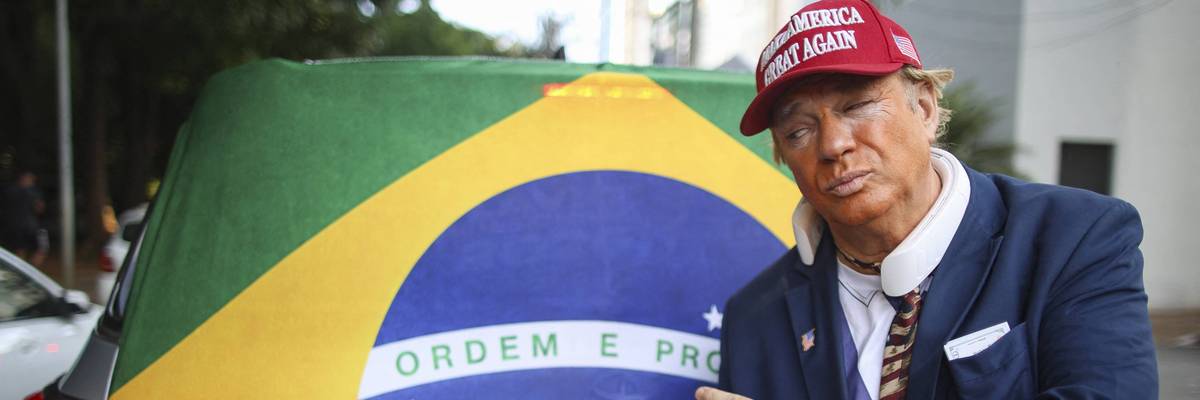
A man wearing a mask depicting US President Donald Trump attends a rally of Brazilian right-wing presidential candidate Flavio Bolsonaro in Goiania, Brazil, on September 27, 2026.
(Photo by Sergio Lima/AFP via Getty Images)
Jake Johnson
Sep 30, 2026
COMMON DREAMS
Brazilian officials, pro-democracy advocates, and US lawmakers are growing increasingly concerned about apparent efforts by President Donald Trump and Secretary of State Marco Rubio to interfere in the Latin American country’s upcoming election.
Reuters reported Wednesday that Brazil’s spy agency “confirmed the existence of interference from the United States as well as Russia” in the presidential election, the first round of which will take place on October 4. Brazilian President Luiz Inácio Lula da Silva is running for reelection against Sen. Flavio Bolsonaro, the son of former far-right President Jair Bolsonaro—who is currently serving a 27-year prison sentence under house arrest for orchestrating a coup attempt in 2022.
Democratic lawmakers in the US have raised alarm about the Trump administration’s election meddling in Brazil in recent days as the contest approaches. Earlier this week, Democratic Sens. Jeanne Shaheen (NH), Peter Welch (Vt.), and Tim Kaine (Va.) wrote in a letter to Rubio that “over the course of President Trump’s second term, we have seen US officials engage in a campaign of interference and destabilization in Brazil.”
“The administration’s most recent actions point toward an effort to interfere with, and potentially undermine, Brazil’s general election in October,” the lawmakers wrote. “Senator and presidential candidate Flávio Bolsonaro’s recent Oval Office meeting with President Trump, undertaken while attempting to mitigate a domestic political scandal, underscores the administration’s willingness to insert itself in the election.”
The senators’ letter followed a separate demand by more than 30 Democrats in the US House that Rubio “confirm whether the administration will commit to respecting Brazil’s electoral process and to recognizing its certified outcome.” The House Democrats demanded a response from the Trump administration by October 1.
“Particularly given the tragic history of US involvement in the 1964 military coup against Brazil’s democratically elected government at the time, as well as subsequent US support for the resulting military dictatorship,” the lawmakers wrote, “the United States has a responsibility to support the democratic institutions that so many Brazilians, across generations, struggled to build.”
Trump has been a vocal defender of Flávio Bolsonaro’s father, saying he is “not guilty of anything” and describing his prosecution as a “witch hunt”—echoing Trump’s attack on investigations into his own effort to subvert the 2020 election in the US. Last year, Trump hit Brazil with a 40% tariff, accusing the country’s leaders of “persecuting former President of Brazil Jair Bolsonaro.”
“It was not just a trade maneuver,” political scientist Octavio Amorim Neto said of the tariff in an interview published Thursday, noting that “Bolsonarism explicitly applauded [Trump’s economic attack], while Brazil’s traditional right did not vigorously defend national sovereignty, saying that everything was Lula’s fault.”
Over the summer, Brazil denied visas to two top US State Department officials “whom the Trump administration planned to dispatch on a mission to cast doubt on the fairness and integrity of the country’s electoral system,” The Washington Post reported in July.
Mark Weisbrot, co-director of the Center for Economic and Policy Research, wrote in an op-ed for The Los Angeles Times earlier this week that Trump’s intervention in Brazil’s electoral process “undermines a basic and generally cherished right to self-determination, as well as the right to democracy itself.”
“It is even clearly illegal under the Charter of the Organization of American States, to which the United States is a signatory,” wrote Weisbrot. “The Trump-Rubio interventions, with the collaboration of the Bolsonaro clan, have made the Flávio campaign into another US regime change operation. This should be defeated, for the sake of Brazil and the whole hemisphere.”
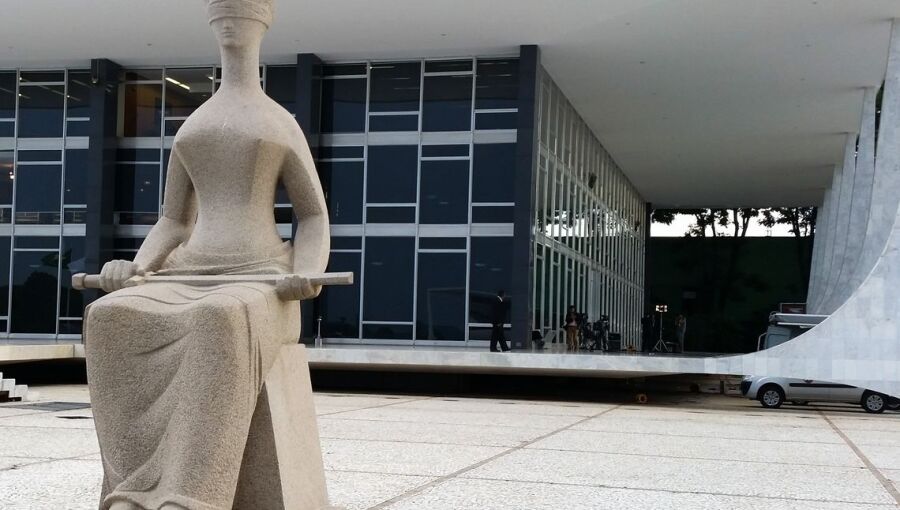
Brazil has asked federal police to investigate a $1mn US State Department grant aimed at its Supreme Court, just days before a presidential election in which President Luiz Inácio Lula da Silva faces right-wing senator Flávio Bolsonaro in a tight race.
Attorney General Jorge Messias filed the request with the Federal Police and Prosecutor General Paulo Gonet on October 1, a day after The Guardian reported that the Trump administration had steered money from the department's Human Rights and Democracy Fund (HRDF) into a programme titled "Countering Lawfare and Censorship in Brazil". It would fund civil-society groups opposing what the programme calls judicial overreach and censorship by the court.
Foreign meddling "cannot be tolerated", Messias said, calling the revelation "an important alert for Brazilian sovereignty".
"The information is especially serious in light of Brazil's electoral process and the recent episodes of external pressure on our institutions," he said.
The complaint, signed by Messias and three other officials of the Attorney General's Office (AGU), argues that the money was explicitly intended to finance groups working to destabilise and undermine Brazil's judiciary. It asks investigators to identify those responsible and whoever received the funds inside the country.
The grant lands in the final days of a campaign already dominated by claims of US interference. The row dates back to July 2025, when Donald Trump slapped 50% tariffs on Brazilian goods over what he called a "witch hunt" against Flavio's father, former president Jair Bolsonaro, who was later sentenced by the Supreme Court to 27 years in prison for plotting a coup following his 2022 election defeat. Washington also sanctioned Supreme Court Justice Alexandre de Moraes, who oversaw the case, after lobbying by Jair Bolsonaro's younger son Eduardo, before dropping Moraes from the sanctions list in December.
The Brazil award is one of 43 controversial grants worth a combined $176.9mn, which the State Department obligated on September 30, hours before the money was due to lapse at the end of the US fiscal year, according to a source cited by The Guardian. Together they take up most of the $205mn Congress appropriated for the whole fund. The largest, $40mn, goes to a consortium led by the anti-communist Victims of Communism Memorial Foundation. Other awards support a group promoting white Afrikaner rights in South Africa and early-warning networks for Christians in Nigeria, while a $2mn programme titled "Promoting Western Civilization Allies" aims to boost far-right groups in Central Europe and the Balkans.
Senator Jeanne Shaheen, the top Democrat on the Senate Foreign Relations Committee, had held up $22mn of the awards, including those focused on Brazil, South Africa and Nigeria. Secretary of State Marco Rubio personally signed a memo to disregard her holds, a Democratic congressional aide told the paper. Sources said senior administration figures had lobbied for the awards personally.
The new grants are overseen by Samuel Samson, a deputy assistant secretary of state. In July, Brazil refused visas to Samson and Assistant Secretary Riley Barnes ahead of a planned trip to Brasilia that Washington said would cover "election integrity" and freedom of expression.
Brasilia has spent the campaign building defences against outside pressure. Its intelligence agency ABIN raised its assessment of the risk of US interference to a "critical level" in a confidential report in late August, and in September briefed French and German counterparts on alleged US and Russian meddling. President Lula da Silva used his UN General Assembly speech on September 22 to warn world leaders against foreign interference in the vote.
The government is also holding informal talks with diplomatic missions from Canada, Japan, Australia and EU countries on a joint response once results are announced, The New York Times reported on September 28, citing three senior foreign diplomats. Brazilian officials told the paper that any US help for Flavio Bolsonaro, who met Trump at the White House in May, could include new measures designed to damage Lula's image. The Trump administration denies trying to interfere.
In line with the Trump administration's renewed focus on the Western Hemisphere, which has helped elect right-wing leaders across most Latin American nations in recent years, Rubio has underscored the stakes of the vote by stating that Brazil "is our next challenge." Brazil and Mexico are the only two major countries in the region still led by leftist leaders.
Meanwhile in Washington, three Democratic senators including Shaheen have urged Rubio to commit to recognising whoever wins.
Lula goes into the October 4 vote with a narrow lead. A Datafolha poll for Folha de S.Paulo and TV Globo, carried out from September 29 to October 1, gives the 80-year-old leftist incumbent 45% of valid votes against 40% for Flavio Bolsonaro, up from 43% and 39% a week earlier. That leaves both short of the 50% plus one needed to win outright.
In a simulated runoff, Lula has 48% to Flavio Bolsonaro's 45%, a technical tie given the poll's two-point margin of error. Both candidates are rejected by 45% of voters, and 17% say they could still change their minds. The second round would be held on October 25.
As part of a string of last-minute pre-election moves, Lula issued a provisional measure banning online betting on September 25, a week after a 15% increase in Bolsa Família welfare payments. His support among women, the main target of the betting ban according to the campaigns, rose from 42% to 45% of total votes in a week. A fake post claiming Flavio Bolsonaro would strip Our Lady of Aparecida of her title as Brazil's patron saint coincided with a rise in Lula's support among Catholic women from 45% to 50%, while the senator gained five points among evangelicals, where he now leads Lula 52% to 26%.
Both frontrunners pulled out of the campaign's final debate, set for October 1, which TV Globo then cancelled, citing "legal uncertainty" after rulings by the electoral court and the Supreme Court. Flavio Bolsonaro blamed "censorship imposed by the electoral court", which had barred the broadcaster from keeping an empty seat on stage for Lula, who appeared on a popular podcast instead.
The same day, police arrested a man who tried to climb the Supreme Court's fences and threw a backpack onto a bus stop, before ruling out a bomb threat. The court has spent the campaign under attack from the right over Bolsonaro's conviction, and is itself mired in the Banco Master scandal, which has pushed public distrust in it to a record high.

No comments:
Post a Comment