There are still three weeks until the next round, and Lula could still win, but it’s gonna take a massive fight. Part of that fight is changing how the international media covers things.
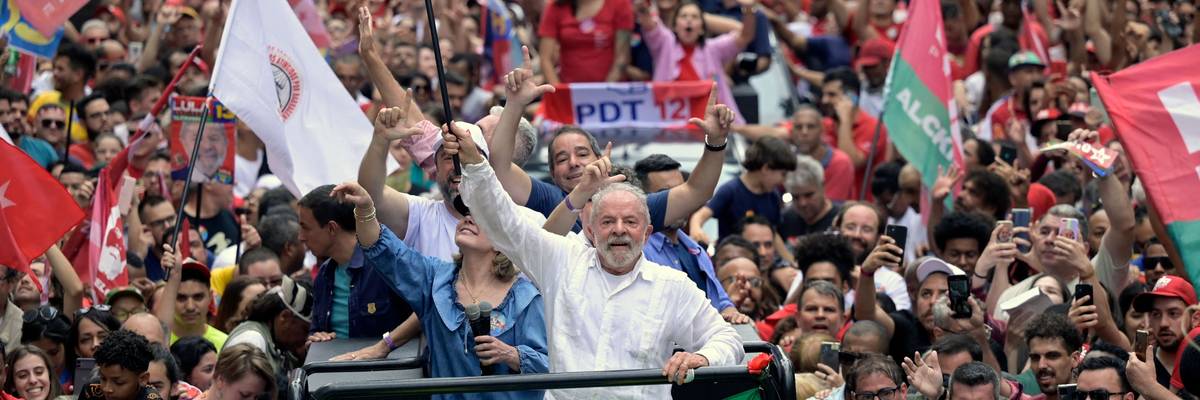
Brazil’s former President (2003-2010) and then-presidential candidate for the leftist Workers Party (PT) Luiz Inacio Lula da Silva waves a national flag during a campaign rally in Belo Horizonte, Minas Gerais state, Brazil on October 9, 2022.
(Photo by Douglas Magno / AFP via Getty Image)
Mike Elk
Oct 05, 2026
Payday Report
With the Brazilian presidential election headed to a runoff, Luiz Inácio Lula da Silva is down 47% to 45% and faces a massive fight ahead. I wanted to give a quick analysis of what happened and where things are going next.
With the Brazilian presidential election headed to a runoff, Luiz Inácio Lula da Silva is down 47% to 45% and faces a massive fight ahead. I wanted to give a quick analysis of what happened and where things are going next.
Lula Could Still Win if He Can Consolidate Support from Third Parties
Lula lost by only 2%, and several third-party candidates, who took a combined 8% of the vote, have publicly indicated they would not endorse Flávio Bolsonaro in the second round.
Likewise, 29 million Brazilians did not vote in this round of the runoff and may be persuaded to vote for Lula in the second round if they fear Bolsonaro.
While Brasil defeated Jair Bolsonaro narrowly in 2022, it swung right again, much like the United States. Voters are upset, and they are taking it out on the party in power.
On Tuesday, the Brazilian Senate is scheduled to vote on a measure that would shorten the Brazilian workweek from six days to five days. Bolsonaro has opposed this measure, and Lula could use the vote to mobilize workers’ support against the Bolsonaro team.
It’s a tough road ahead for Lula, but not impossible.
What Hurt Lula in the First Round?
Three primary factors hurt Lula in the first round. First, Lula’s age and the fact that the Workers’ Party (PT) has held the presidency in Brazil for 18 of the last 24 years.
The second is that the Brazilian corporate media constantly manufactured scandals against Lula.
Finally, the role that US President Donald Trump played in training and validating the right-wing in Brasil, while not decisive, provided critical support. Here’s what went wrong for Lula.
1. Lula is 80 & His Party Ruled Brasil for 18 of the Last 24 Years
Like former US President Joe Biden, one problem Lula faces right now is that he is 80 years old. He doesn’t look as sharp as he used to, while Flávio Bolsonaro is nearly half his age—45 years younger.
Additionally, Lula’s party, the Workers’ Party (PT), has held the presidency for 18 of the last 24 years. Lula and Dilma, both members of the Workers’ Party (PT), held the presidency from 2002 to 2016. Lula was reelected in 2022 for his record third term. No Brazilian has ever won a third term.
Although the PT has rarely controlled Congress, it is seen as the ruling party because it has held the presidency for 18 of the last 24 years. Voters are likely to associate any problems in the country with the PT, which has held the presidency for so long.
While Brasil defeated Jair Bolsonaro narrowly in 2022, it swung right again, much like the United States. Voters are upset, and they are taking it out on the party in power.
Even worse, Lula failed to recruit young candidates, who may have excited voters to turn out in tight races. In what should have been a competitive Senate election in Rio de Janeiro, the PT recruited 84-year-old Bendedita da Silva, who lost in a landslide to Bolsonaro allies.
Last week, Lula skipped the presidential debate; so did Bolsonaro and its unclear how much this decision might have hurt him.
Lacking excitement, nearly 29 million Brazilians did not vote despite it being obligatory in Brasil.
2. Brazilian Media Manufacturing Scandals Against Lula
The Brazilian media market is extremely consolidated, and the heads of major networks like Globo have been going after Lula hard. They have been accused of manufacturing scandals against Lula.
Last November, the financial institution Banco Master collapsed amid allegations of massive fraud. The bank was being run like a Ponzi scheme, resulting in the largest financial collapse in Brazilian history, with nearly $8 billion in investors’ funds lost.
Despite Banco Master CEO Daniel Vorcaro being a very vocal Bolsonaro supporter, the Brazilian media has repeatedly tried to link the scandal to Lula’s Workers’ Party, as Vorcaro cultivated political ties on both sides of the aisle.
Every attack on Lula by the Trump administration generated headlines in Brasil and validated the wild claims made by Bolsonaro allies of a flawed Brazilian justice system.
Lula’s son, businessman Fábio Luís da Silva, commonly known as “Lulinha,” was scrutinized over large bank accounts worth millions of dollars. For months, Lulinha has offered to open his books and has claimed that he received no special favors from Banco Master. Still, the media repeatedly raised questions about Lulinha’s alleged impropriety.
At one point, media giant TV Globo made a giant infographic web with arrows, showing a complex network linked to Lula. Other reporters widely ridiculed the conspiracy theory map, and TV Globo eventually had to apologize publicly on air.
Then, in May, The Intercept Brasil released a WhatsApp message from Flávio Bolsonaro to Vorcaro, asking him for more than $26 million to fund a strange English-language biopic named Dark Horse, about his father. In the film, Jair Bolsonaro is portrayed by right-wing American actor Jim Caviezel, who played Jesus in the controversial 2004 film The Passion of the Christ.
Polling throughout the spring and summer showed Lula leading as the scandal remained fresh in people’s minds. Then, the Brazilian corporate media went into high gear to attack Lula. They went after Supreme Court Justice Alexandre de Moraes, who led the prosecution that jailed Bolsonaro.
Moraes has accused Brazilian Supreme Court Justice André Mendonca, a Bolsonaro appointee, of failing to follow proper procedure in his handling of the Banco Master scandal, leaking information to the press on Lula’s political allies while hiding information on Bolsonaro’s allies.
Moraes asked the Brazilian Federal police to investigate Mendonça’s violation of federal investigation procedures and for selectively leaking information to the press that would make Lula allies look bad while suppressing information on Bolsonaro allies.
Moraes accused Mendonça of attempting to “steer the production of evidence toward falsely accusing Supreme Court justices of crimes, expressly naming Justices Gilmar Mendes, Dias Toffoli, Luiz Fux, Alexandre de Moraes, and Nunes Marques, as well as the prosecutor general and the director-general of the Federal Police.”
3. Trump Trained and Emboldened Bolsonaro Allies
While I don’t want to underestimate the strength of fascists within Brasil, it’s important to note that Trump and his operatives did help the Bolsonaro family pull off an impressive comeback.
In March 2025, Eduardo Bolsonaro fled to the United States rather than face prosecution in Brasil for his role in trying to orchestrate a coup, and he was granted permanent residency status in July. While in the United States, Eduardo Bolsonaro has worked closely with Trump officials, including Special Presidential Envoy for Special Missions Richard Grenell, to oust Lula from power.
“It was a privilege to speak with Ambassador Richard Grenell at President Trump’s residence at Mar-a-Lago,” Eduardo Bolsonaro wrote on Instagram following a meeting with Grenel in 2025. “The conservative movement is global—and we are just getting started.”
Eduardo Bolsonaro worked closely with top Trump aides like Brad Parscale, Trump’s director of digital strategy, to learn the social media strategy that led Trump to win reelection.
As president, Trump worked hard to attack Lula. He placed punitive tariffs on Brazil for convicting Jair Bolsonaro, Eduardo’s father, for attempting to assassinate Lula and overthrow his government in 2022. These tariffs hurt Brasil’s economy.
More importantly, Trump’s constant denunciation of the jailing of Bolsonaro validated conspiracy theories of right-wingers that the justice process was flawed. When Alexandre de Moraes, who led Bolsonaro’s conviction, was implicated in the Banco Master scandal, it only reinforced these conspiracy theories.
Ahead of the Brazilian presidential election, the Trump administration has labeled Brasil as a major distributor of cocaine and attempted to paint Lula as weak on taking on drug gangs.
In June, the Trump administration labeled two gangs as “terrorist organizations,” something which the Lula administration has repeatedly resisted because of fears of how the Trump administration could intervene in law enforcement and military matters in Brasil.
Still, every attack on Lula by the Trump administration generated headlines in Brasil and validated the wild claims made by Bolsonaro allies of a flawed Brazilian justice system.
On Friday, the Trump administration closed its embassy in Brasil and all of its consulates in a move that many saw as a scare tactic designed to interfere once again in the Brazilian presidential election.
The same day, the Brazilian federal police and intelligence service ABIN were warning of a possible US coup attempt. It was already known that Trump operatives were training operatives in Brasil, and the Brazilian federal police report described in depth how much Trump’s intervention had shifted things in Brasil.
International Media Failed to Check Brazilian Media
Finally, the international media completely ignored the Brazilian presidential election, allowing corporate media within Brazil to dominate the conversation without any accountability from the international media.
There are still three weeks until the next round, and Lula could still win, but it’s gonna take a massive fight. Part of that fight is changing how the international media covers things.
Payday Report can help play a small role in getting the US press more involved. The Washington Post once cited Payday Report in a front-page story for changing the way the pandemic strike wave was discussed, and maybe we can play a small role in getting American reporters to pay attention.
Donate to help Payday Report cover the fight ahead.
This work is licensed under a Creative Commons Attribution 4.0 International License
Mike Elk
Mike Elk is the senior labor reporter at Payday Report and member of the Washington-Baltimore NewsGuild. He previously served as senior labor reporter at POLITICO and at In These Times Magazine.
Full Bio >
Lula Heads to Presidential Runoff Against Bolsonaro’s Son as Trump Accused of Election Meddling
Ahead of Sunday’s contest, Brazil’s government and Lula’s presidential campaign called for investigations into alleged Trump administration efforts to interfere in the Latin American country’s politics.
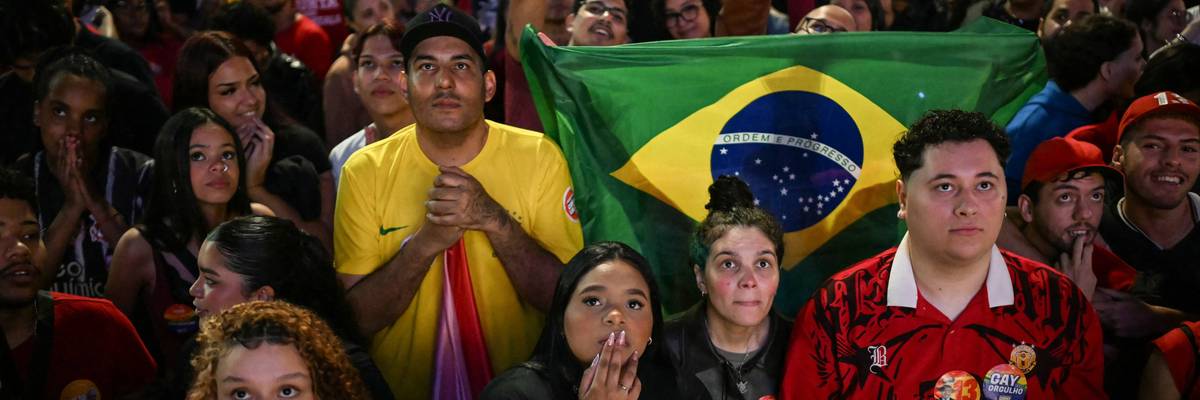
Supporters of Brazilian President Luiz Inácio Lula da Silva react after the first results of the presidential election in São Paulo, Brazil on October 4, 2026.
(Photo by Luis Robayo/AFP via Getty Images)
Jake Johnson
Oct 05, 2026
COMMON DREAMS
Brazil’s presidential election headed to a runoff on Sunday after neither incumbent President Luiz Inácio Lula da Silva nor challenger Flávio Bolsonaro—the son of former President Jair Bolsonaro and ally of US President Donald Trump—received enough votes to win outright.
The younger Bolsonaro, whose father is serving a 27-year prison sentence under house arrest for orchestrating a coup attempt in 2022, led Lula by two percentage points in the first round, with the final tally standing at 47% to 45%. The runoff will take place on October 25.
Sunday’s results—which included major conservative wins in down-ballot contests—heightened fears of another far-right victory in Latin America, where candidates backed by Trump have swept to power in recent elections, including in Colombia, Peru, and Chile. Ahead of Sunday’s contest, Lula’s campaign, Brazil’s intelligence agency, and outside observers accused the Trump administration of meddling in the high-stakes election in an effort to oust Lula and return an ally to the nation’s presidency.
Just days before the election, Lula’s team called for an investigation after the Trump administration halted US consular services in Brazil, citing “security concerns.”
Additionally, Lula’s government is calling for a probe of “alleged efforts by the United States to interfere in the country’s domestic politics through the diversion of funds to far-right causes,” Al Jazeera reported last week.
“Attorney General Jorge Messias called for the probe on Thursday, one day after the British newspaper The Guardian published a story suggesting that the administration of United States President Donald Trump planned to award $1 million to right-wing civil groups opposing the Brazilian Supreme Court,” the outlet noted. “Messias stated in a social media post that foreign meddling ‘cannot be tolerated’ and that the report represented ‘an important alert for Brazilian sovereignty.’”
Mark Weisbrot, co-director of the US-based Center for Economic and Policy Research, called the Trump administration’s interference “another US regime change operation,” pointing to the aggressive tariffs Trump imposed on Brazilian goods last year and the US State Department’s attempt to send two top officials to “cast doubt on the fairness and integrity of the country’s electoral system,” as The Washington Post reported earlier this year.
Trump, who hosted Flávio Bolsonaro at the White House in May, said last week that he was following the Brazilian election “very closely” and described the contest as “very important.” A key Trump ally in the region, Argentine President Javier Milei—whose austerity agenda has fueled an increase in poverty in his country—traveled to Brazil in July to support Bolsonaro’s campaign against Lula.
Flávio Bolsonaro, a sitting senator, wasn’t the only member of the Bolsonaro family seeking greater political power in Sunday’s elections. Jair Bolsonaro’s wife, Michelle, and his second son, Carlos, both won seats in Brazil’s Senate.
The Guardian reported that “of the 54 senators elected, 34 were from the right or far-right.”
Following the results, Lula told supporters in Sāo Paulo on Sunday that “we have just had a lesson in Brazilian democracy.”
“The result is often unexpected. We can never get everything we wanted. I confess to you that I was convinced I was going to win the election in the first round,” said Lula. “But we have a second round.”
“From tomorrow we will launch a new campaign,” Lula added, “a campaign with only two candidates [where] we will be able to show the difference between our proposals for Brazil.”
Ahead of Sunday’s contest, Brazil’s government and Lula’s presidential campaign called for investigations into alleged Trump administration efforts to interfere in the Latin American country’s politics.
Supporters of Brazilian President Luiz Inácio Lula da Silva react after the first results of the presidential election in São Paulo, Brazil on October 4, 2026.
(Photo by Luis Robayo/AFP via Getty Images)
Jake Johnson
Oct 05, 2026
COMMON DREAMS
Brazil’s presidential election headed to a runoff on Sunday after neither incumbent President Luiz Inácio Lula da Silva nor challenger Flávio Bolsonaro—the son of former President Jair Bolsonaro and ally of US President Donald Trump—received enough votes to win outright.
The younger Bolsonaro, whose father is serving a 27-year prison sentence under house arrest for orchestrating a coup attempt in 2022, led Lula by two percentage points in the first round, with the final tally standing at 47% to 45%. The runoff will take place on October 25.
Sunday’s results—which included major conservative wins in down-ballot contests—heightened fears of another far-right victory in Latin America, where candidates backed by Trump have swept to power in recent elections, including in Colombia, Peru, and Chile. Ahead of Sunday’s contest, Lula’s campaign, Brazil’s intelligence agency, and outside observers accused the Trump administration of meddling in the high-stakes election in an effort to oust Lula and return an ally to the nation’s presidency.
Just days before the election, Lula’s team called for an investigation after the Trump administration halted US consular services in Brazil, citing “security concerns.”
Additionally, Lula’s government is calling for a probe of “alleged efforts by the United States to interfere in the country’s domestic politics through the diversion of funds to far-right causes,” Al Jazeera reported last week.
“Attorney General Jorge Messias called for the probe on Thursday, one day after the British newspaper The Guardian published a story suggesting that the administration of United States President Donald Trump planned to award $1 million to right-wing civil groups opposing the Brazilian Supreme Court,” the outlet noted. “Messias stated in a social media post that foreign meddling ‘cannot be tolerated’ and that the report represented ‘an important alert for Brazilian sovereignty.’”
Mark Weisbrot, co-director of the US-based Center for Economic and Policy Research, called the Trump administration’s interference “another US regime change operation,” pointing to the aggressive tariffs Trump imposed on Brazilian goods last year and the US State Department’s attempt to send two top officials to “cast doubt on the fairness and integrity of the country’s electoral system,” as The Washington Post reported earlier this year.
Trump, who hosted Flávio Bolsonaro at the White House in May, said last week that he was following the Brazilian election “very closely” and described the contest as “very important.” A key Trump ally in the region, Argentine President Javier Milei—whose austerity agenda has fueled an increase in poverty in his country—traveled to Brazil in July to support Bolsonaro’s campaign against Lula.
Flávio Bolsonaro, a sitting senator, wasn’t the only member of the Bolsonaro family seeking greater political power in Sunday’s elections. Jair Bolsonaro’s wife, Michelle, and his second son, Carlos, both won seats in Brazil’s Senate.
The Guardian reported that “of the 54 senators elected, 34 were from the right or far-right.”
Following the results, Lula told supporters in Sāo Paulo on Sunday that “we have just had a lesson in Brazilian democracy.”
“The result is often unexpected. We can never get everything we wanted. I confess to you that I was convinced I was going to win the election in the first round,” said Lula. “But we have a second round.”
“From tomorrow we will launch a new campaign,” Lula added, “a campaign with only two candidates [where] we will be able to show the difference between our proposals for Brazil.”
Lula Campaign Asks to Probe Sudden US Shutdown of Consular Services as ‘Interference in Brazilian Elections’
“Often at the request of the Bolsonaro family, the US has engaged in a pressure campaign to weaken the Lula government,” explained one analyst.
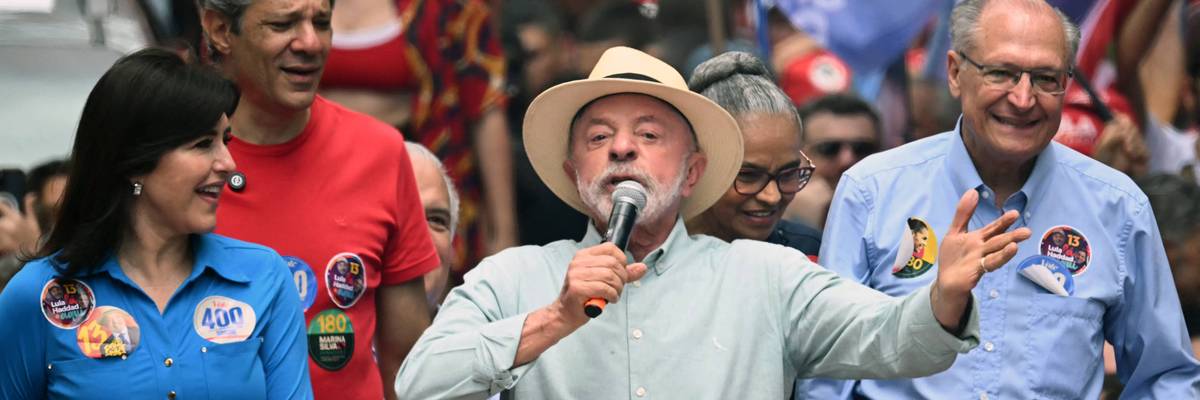
Brazil’s President and presidential candidate Luiz Inacio Lula da Silva (C) addresses supporters during a campaign rally on the eve of the general election, in Sao Paulo, Brazil on October 3, 2026.
(Photo by Luis Robayo/AFP via Getty Images)
Stephen Prager
Oct 03, 2026
COMMON DREAMS
Just two days before Brazil’s closely watched presidential election, the campaign of its left-wing president, Luiz Inácio Lula da Silva, has asked the nation’s top election court to examine the sudden shutdown of US consular services as part of a broader investigation into alleged election “interference” by the Trump administration.
On Friday night, the US suspended in-person consular services at its embassy and consulates across Brazil on Friday and advised Americans to avoid US diplomatic facilities, citing unspecified “security concerns.”
In a petition filed to Brazil’s Superior Electoral Court, Lula’s campaign said taking such an action just days before Brazilians vote “projects instability over the electoral environment,” something it said was part of a larger “infrastructure of external intervention in the Brazilian electoral process.”
In recent days, Brazil’s intelligence agency said it confirmed the existence of interference by the US in Brazil’s election to support Sen. Flavio Bolsonaro, the son of former far-right President Jair Bolsonaro—who is currently serving a 27-year prison sentence under house arrest for orchestrating a coup attempt in 2022.
“Although Trump has not formally endorsed him, Bolsonaro is undoubtedly Washington’s preferred candidate,” explained Nick Cleveland-Stout, a research associate at the Quincy Institute for Responsible Statecraft, on Friday. “Often at the request of the Bolsonaro family, the US has engaged in a pressure campaign to weaken the Lula government, sparking fears of further interference.”
Trump responded with hostility to the prosecution of the disgraced ex-president—imposing tariffs of up to 50% on Brazilian imports in retaliation, sanctioning the Supreme Court justice overseeing the case, and threatening to use American “military might” against Brazil.
He’s also designated two Brazilian crime groups as “narcoterrorist” organizations, invoking a similar pretext Trump used to justify his invasion of Venezuela to kidnap its leader Nicolás Maduro in January.
As the election has approached, Trump has appeared to put his thumb on the scale in an effort to stop Lula from achieving what would be an unprecedented fourth term.
In July, the US consulate in São Paulo invited right-wing pro-Bolsonaro social media influencers to a closed-door roundtable meeting to discuss “freedom of expression and the digital environment.”
The Guardian reported on Thursday that the State Department was also diverting $1 million from its human rights fund to oppose “judicial overreach and censorship” by Brazil’s Supreme Court, an apparent reference to the court’s actions against Bolsonaro and his allies.
The Brazilian government has denied visas to two State Department officials whom it said were seeking to discuss “election integrity,” which it perceived as an effort to “undermine the electoral system.”
Trump and his allies have previously spread baseless conspiracy theories to cast doubt upon Lula’s victory in 2022, which helped to fuel the failed coup. They’ve done the same with the victories of other left-wing candidates in Latin American elections—including Bolivia’s Evo Morales in 2019 and Guatemala’s Bernardo Arévalo in 2023.
Lula’s campaign said the sudden US suspension of consular services was “yet another extremely serious development in the interference in Brazilian elections by the US government,” alleging that it was “coordinated, by all indications, directly by the brothers Flávio and Eduardo Bolsonaro.”
The filing noted that even “the legislative branch of the foreign state itself… recognizes the pattern of external pressure.” It pointed to a letter sent earlier this week by Democratic US Sens. Jeanne Shaheen (NH), Peter Welch (Vt.), and Tim Kaine (Va.) to Secretary of State Marco Rubio, which said that “the administration’s most recent actions point toward an effort to interfere with, and potentially undermine, Brazil’s general election in October.”
“Often at the request of the Bolsonaro family, the US has engaged in a pressure campaign to weaken the Lula government,” explained one analyst.
Brazil’s President and presidential candidate Luiz Inacio Lula da Silva (C) addresses supporters during a campaign rally on the eve of the general election, in Sao Paulo, Brazil on October 3, 2026.
(Photo by Luis Robayo/AFP via Getty Images)
Stephen Prager
Oct 03, 2026
COMMON DREAMS
Just two days before Brazil’s closely watched presidential election, the campaign of its left-wing president, Luiz Inácio Lula da Silva, has asked the nation’s top election court to examine the sudden shutdown of US consular services as part of a broader investigation into alleged election “interference” by the Trump administration.
On Friday night, the US suspended in-person consular services at its embassy and consulates across Brazil on Friday and advised Americans to avoid US diplomatic facilities, citing unspecified “security concerns.”
In a petition filed to Brazil’s Superior Electoral Court, Lula’s campaign said taking such an action just days before Brazilians vote “projects instability over the electoral environment,” something it said was part of a larger “infrastructure of external intervention in the Brazilian electoral process.”
In recent days, Brazil’s intelligence agency said it confirmed the existence of interference by the US in Brazil’s election to support Sen. Flavio Bolsonaro, the son of former far-right President Jair Bolsonaro—who is currently serving a 27-year prison sentence under house arrest for orchestrating a coup attempt in 2022.
“Although Trump has not formally endorsed him, Bolsonaro is undoubtedly Washington’s preferred candidate,” explained Nick Cleveland-Stout, a research associate at the Quincy Institute for Responsible Statecraft, on Friday. “Often at the request of the Bolsonaro family, the US has engaged in a pressure campaign to weaken the Lula government, sparking fears of further interference.”
Trump responded with hostility to the prosecution of the disgraced ex-president—imposing tariffs of up to 50% on Brazilian imports in retaliation, sanctioning the Supreme Court justice overseeing the case, and threatening to use American “military might” against Brazil.
He’s also designated two Brazilian crime groups as “narcoterrorist” organizations, invoking a similar pretext Trump used to justify his invasion of Venezuela to kidnap its leader Nicolás Maduro in January.
As the election has approached, Trump has appeared to put his thumb on the scale in an effort to stop Lula from achieving what would be an unprecedented fourth term.
In July, the US consulate in São Paulo invited right-wing pro-Bolsonaro social media influencers to a closed-door roundtable meeting to discuss “freedom of expression and the digital environment.”
The Guardian reported on Thursday that the State Department was also diverting $1 million from its human rights fund to oppose “judicial overreach and censorship” by Brazil’s Supreme Court, an apparent reference to the court’s actions against Bolsonaro and his allies.
The Brazilian government has denied visas to two State Department officials whom it said were seeking to discuss “election integrity,” which it perceived as an effort to “undermine the electoral system.”
Trump and his allies have previously spread baseless conspiracy theories to cast doubt upon Lula’s victory in 2022, which helped to fuel the failed coup. They’ve done the same with the victories of other left-wing candidates in Latin American elections—including Bolivia’s Evo Morales in 2019 and Guatemala’s Bernardo Arévalo in 2023.
Lula’s campaign said the sudden US suspension of consular services was “yet another extremely serious development in the interference in Brazilian elections by the US government,” alleging that it was “coordinated, by all indications, directly by the brothers Flávio and Eduardo Bolsonaro.”
The filing noted that even “the legislative branch of the foreign state itself… recognizes the pattern of external pressure.” It pointed to a letter sent earlier this week by Democratic US Sens. Jeanne Shaheen (NH), Peter Welch (Vt.), and Tim Kaine (Va.) to Secretary of State Marco Rubio, which said that “the administration’s most recent actions point toward an effort to interfere with, and potentially undermine, Brazil’s general election in October.”
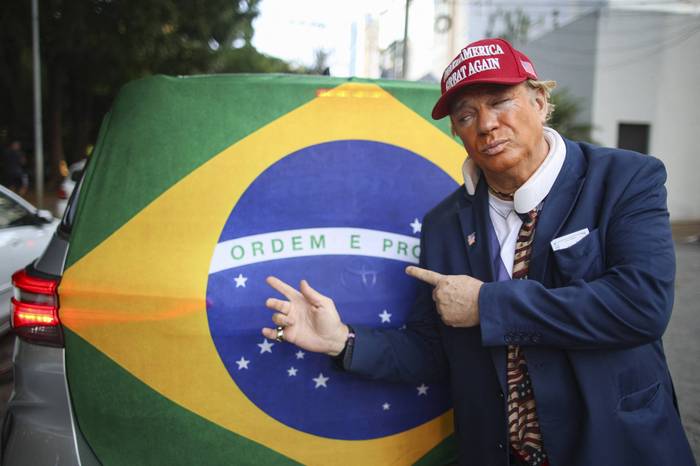
A man wearing a mask depicting US President Donald Trump attends a rally of Brazilian right-wing presidential candidate Flavio Bolsonaro in Goiania, Brazil, on September 27, 2026. (Photo by Sergio Lima/AFP via Getty Images)
The first round of Brazil’s election will begin on Sunday. Should neither candidate receive 50% of the vote, a runoff between the top two candidates will be held on October 25. Several major polls show Lula with a narrow first-round lead entering Sunday, although others have the race effectively tied or Bolsonaro slightly ahead.
But Lula has also seized upon Trump’s meddling to portray Bolsonaro as a tool of foreign powers, drawing on a history of US-backed coups and election interference that have undermined Brazilian democracy.
“Flávio Bolsonaro is Trump’s candidate and what Trump wants is to colonize Brazil, take our riches, steal our future and leave us in the dust,” said a campaign ad that began airing last week.
The Trump administration, for its part, has continued to double down on public overtures toward imperialist ambition. On Thursday, an official US State Department social media account reposted a video created in August glorifying the 19th-century Monroe Doctrine and declaring that “American dominance in the Western Hemisphere will never be questioned again.”
Dov H. Levin, a political scientist at the University of Hong Kong who recently published research on the effects of foreign election interference, told the Brazilian newspaper Folha de S. Paulo that, if too overt, Trump’s intervention could backfire.
“There are cases of failure,” he said, “and cases where the reaction provoked by the intervention harms precisely the side it intended to help.”
The first round of Brazil’s election will begin on Sunday. Should neither candidate receive 50% of the vote, a runoff between the top two candidates will be held on October 25. Several major polls show Lula with a narrow first-round lead entering Sunday, although others have the race effectively tied or Bolsonaro slightly ahead.
But Lula has also seized upon Trump’s meddling to portray Bolsonaro as a tool of foreign powers, drawing on a history of US-backed coups and election interference that have undermined Brazilian democracy.
“Flávio Bolsonaro is Trump’s candidate and what Trump wants is to colonize Brazil, take our riches, steal our future and leave us in the dust,” said a campaign ad that began airing last week.
The Trump administration, for its part, has continued to double down on public overtures toward imperialist ambition. On Thursday, an official US State Department social media account reposted a video created in August glorifying the 19th-century Monroe Doctrine and declaring that “American dominance in the Western Hemisphere will never be questioned again.”
Dov H. Levin, a political scientist at the University of Hong Kong who recently published research on the effects of foreign election interference, told the Brazilian newspaper Folha de S. Paulo that, if too overt, Trump’s intervention could backfire.
“There are cases of failure,” he said, “and cases where the reaction provoked by the intervention harms precisely the side it intended to help.”

No comments:
Post a Comment