IMPERIALIST WAR CRIME
Saudi-backed forces run over surrendering Houthis with trucksAkhtar Makoii
Mon, October 5, 2026
Saudi-backed Yemeni forces ran over surrendering Houthi fighters with armoured vehicles, video showed on Monday, as intense clashes raged over control of a key Red Sea shipping lane.
In one video clip, a group of Houthi fighters can be seen raising their hands to surrender moments before an armoured vehicle drives over them. The driver is heard shouting "Allahu Akbar".
Another video shows an armoured vehicle driving over several wounded fighters who had raised their hands while lying on the ground. A third shows Houthi fighters, wading through shallows, being run over. Some also appeared to be gunned down.
The images emerged as Yemeni government forces, backed by Saudi air power, pressed an offensive to drive the Iran-backed Houthis from the Bab el-Mandeb strait, which the rebels seized in a lightning offensive last month.
Both sides have reported heavy casualties in fighting along the coast of the Red Sea, which is vital for global shipping, and around the city of Taiz.
The Geneva Conventions of 1949, which Yemen has ratified, bars violence against combatants who are "hors de combat" – out of the fight – including those who have surrendered or been incapacitated by wounds.
Intense clashes broke out on Monday over one of the world's most important shipping lanes.
Plumes of smoke were seen rising over the Houthi-controlled capital, Sanaa, after Saudi jets struck at least one location in the city.
Yemeni military sources on the ground told The Telegraph that the operation began with waves of Saudi-led air strikes and a ground push by government units towards the strait.
Houthi rebels said they were fighting back, and denied that government forces had advanced.
Were Yemen's forces to wrestle back control of the strait, it could provide a significant security boost for shipping through the narrow oil and gas chokehold.
The Saudi-backed forces said they had seized large parts of the Dhubab district, which overlooks Bab el-Mandeb.
Brig Gen Majid al-Nuzaili, a spokesman for the Saudi-backed forces, said troops had tightened control of the area and that some besieged Houthi fighters had fled by boat.

If the Yemeni government retook the Bab el-Mandeb strait, it could provide a significant security boost for global shipping - Reuters
He described the operation as a "strategic offensive operation" that utilised "modern capabilities". More than 1,000 strikes were said to have been carried out since dawn.
A Yemeni defence minister said that forces had taken "full control of Bab al-Mandeb and Mayun Island".
The assault is part of a broader campaign, called Operation Dawn of Yemen, announced on Sunday by the country's internationally recognised government.
As night fell, Saudi-backed forces said they had captured the strategic coastal city of Mokha and were pushing north towards the Red Sea towns of Yakhtul, Jiran, Maushij and Al-Khaukhah.
Mokha, the historic coffee trading port that gave mocha its name, had been seized by the Houthis last month in their lightning sweep down the coast.
Yemen's pro-government Saba news agency quoted a military source as saying government forces had retaken the city, west of Taiz province, and were securing it.
If confirmed, the capture would be one of the government's most significant gains since the offensive began on Monday morning, handing it a foothold on the coast and paving the way for an advance up the shoreline toward Hodeidah, the Houthis' main Red Sea port, while loosening the fighters' grip on the waters around Bab el-Mandeb.
Rashad al-Alimi, the chairman of the presidential leadership council, ordered forces to retake all Houthi-held territory and vowed to fight "until the country is liberated from the grip of the terrorist militia".
He set the recapture of Sanaa as the ultimate goal to help move Yemen "towards a new dawn of freedom, peace, and stability".
The Saudi-led coalition said more than 320 "high-value targets" had been struck since the operation began, with more than 100 jets taking part on Monday alone.
"We are providing air support to back the Yemeni armed forces on the ground around the clock," Maj Gen Turki al-Maliki, the coalition spokesman, said.
The government army said 1,747 Houthi fighters had been "neutralised" and more than 360 military vehicles destroyed in some 1,100 operations across Saada, al-Jawf and Taiz provinces and the western coast.
The Telegraph could not independently confirm casualty and equipment figures because the situation on the ground was rapidly changing on Monday afternoon local time.
The Houthis have pressed their own advances. A source said the group had driven government forces from the al-Mawasit district of Taiz province, reaching Mr al-Alimi's home area.
The military said the rebels had pushed along strategic hilltops near Taiz and cut the last road linking the besieged city to Aden, the government's interim capital.
The fighting has thrust another global energy artery into jeopardy. Bab el-Mandeb, the narrow passage linking the Red Sea to the Gulf of Aden, has gained importance as an alternative to the Strait of Hormuz, effectively closed by the Iran war.
The Houthis seized much of the Red Sea coastline last month, and the renewed combat has pushed up global oil prices.
The latest fighting has deepened what the United Nations has described as one of the world's worst humanitarian crises.
Afrah Al-Zouba, the Yemeni foreign minister, appealed for more international support, saying it was "in the world's interest" for the country to be stable.
"The latest flare-up threatens to be absolutely devastating," said Matthew Hollingworth, a senior World Food Programme official, adding that Yemen imported roughly 90 per cent of its food.
Across Yemen, 18.3 million people face severe food insecurity, including 2.2 million acutely malnourished children under the age of five.

The Houthis seized much of the Red Sea coastline last month - Getty Images/Mohammed Hamoud
More than 149,000 people have been uprooted by the latest fighting, the International Organisation for Migration said, and more than 3,700 have fled across the strait to Djibouti.
Saudi Arabia led an Arab coalition into Yemen in 2015 and fought the Houthis to a bloody stalemate.
US Backs Major Saudi-Led Offensive as Yemen Slides Back Toward All-Out War
The US is providing military advisers and helping the Saudis choose targets in a war that has already displaced nearly 150,000 people and put much of the country on the brink of acute food insecurity.
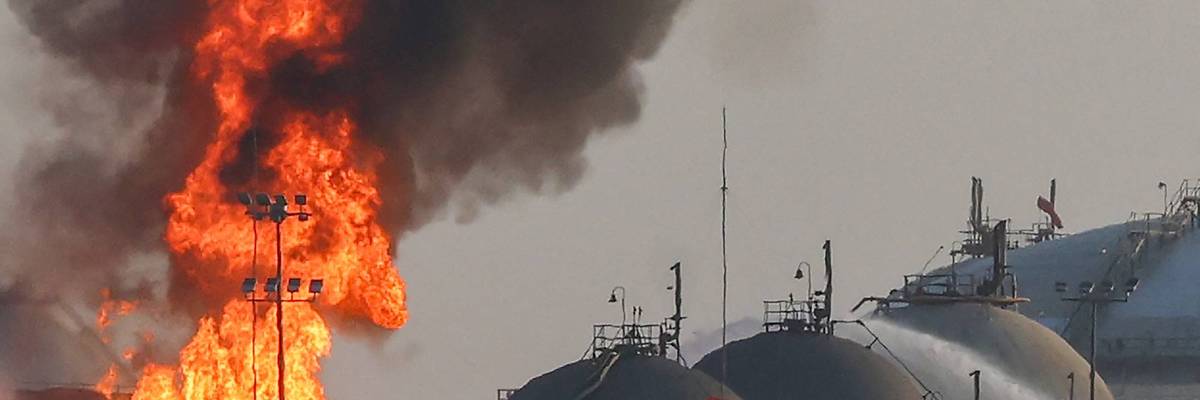
Flames burn at a facility belonging to Saudi oil giant Aramco south of Riyadh following retaliatory strikes from Yemen’s Houthis on October 3, 2026.
(Photo by AFP via Getty Images)
Stephen Prager
Oct 04, 2026
COMMON DREAMS
Yemen is spiraling back toward full-scale war after its Saudi-backed government launched a major offensive on Sunday to retake territory captured by the Iran-backed group Ansar Allah, also known as the Houthis.
President Rashad al-Alimi said the armed forces would seek to retake all Houthi-controlled territory, which is home to about 70% of Yemen’s population, including the capital Sanaa. He said the offensive would continue “until the country is liberated from the grip of the terrorist militia.”
Houthi officials said Saudi forces have launched 50 air and missile attacks in the last 12 hours. As al-Alimi announced the new offensive, the Houthis responded by launching ballistic missiles and drones at Saudi Aramco oil facilities, including one near Riyadh that was engulfed in flames.
Last month, the Houthis captured major strategic areas along the Red Sea coast, giving them unprecedented leverage over one of the world’s busiest shipping routes and adding to the economic stranglehold Iran is asserting by restricting travel through the Strait of Hormuz in response to US-Israeli attacks.
Earlier this month, it was reported that President Donald Trump had rebuffed Saudi Crown Prince Mohammed bin Salman’s request for the US to launch airstrikes against the Houthis.
However, US officials told Axios on Friday that the military is providing Saudi Arabia with “everything short of direct combat, mainly intelligence and targeting data.”
While the Saudis conduct a new campaign of airstrikes, Yemen’s government could reportedly mobilize as many as 100,000 troops, one of the largest military buildups since the 2022 truce that halted the nation’s brutal eight-year civil war.
That war, in which the US also provided extensive military support to a merciless Saudi air campaign, is estimated by the United Nations Development Program to have caused about 377,000 excess deaths by the end of 2021: 154,000 from the fighting itself and 223,000 from indirect effects such as hunger, disease, and the collapse of healthcare and basic infrastructure. An estimated 259,000 of those deaths were of children under 5.
Even before Sunday’s escalation, renewed fighting was already fueling a major displacement and hunger crisis. More than 149,000 people have been driven from their homes, according to the International Organization for Migration. Meanwhile, the World Food Program says fighting has disrupted food delivery routes, placing 18.3 million Yemenis at risk of acute food insecurity.
The US and Israel have repeatedly bombed the group, yet it still controls much of the country.
On the other side of the Arabian Peninsula, Maj Gen Ali Abdollahi, the chief of staff of the Iranian armed forces, warned on Monday that any new war against Iran would spiral out of control and "engulf everyone".
On Monday evening, Turkey and Pakistan vowed to send troops to Saudi Arabia under a newly signed defence pact.
The "rapid deployment" of soldiers was announced in a joint statement by Pakistan's foreign ministry as it praised Riyadh's "vigilance" in countering Houthi attacks.
The Mecca joint defence agreement, modelled on Nato's Article 5, was signed in August by the three majority-Sunni nations and agreed an attack on one was an attack on all.
In the statement, Islamabad and Ankara condemned the "attempted targeting" of Mecca and Medina, two of Islam's holiest sites, by the Iran-backed Shia Houthi.
Turkey's foreign minister added: "We also discussed what could be done to resolve the issue peacefully through dialogue. Saudi Arabia has adopted a very constructive approach to resolving the issue."

No comments:
Post a Comment