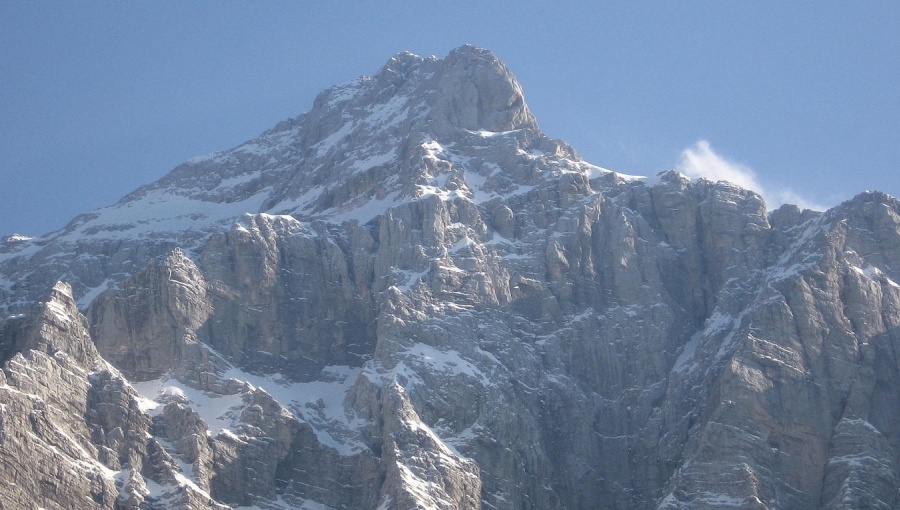
Slovenia’s Triglav Glacier, one of the country’s most recognisable natural landmarks, has shrunk to just a few square metres, with researchers warning that its remaining ice could disappear completely by the end of this year’s melting season, Gorenjskainfo reported last week.
The last visible remnant of the glacier’s main section has continued to retreat in recent weeks amid unusually high temperatures, in line with predictions by researchers that the glacier could vanish entirely this autumn.
Researchers from the Anton Melik Geographical Institute at the Scientific Research Centre of the Slovenian Academy of Sciences and Arts have monitored the glacier since 1946.
They said in late August that it had been reduced to isolated patches of ice for several years and that the remaining ice was very likely to disappear by the end of the 2026 melting season.
The melting season typically runs from early May to the end of October, when the average monthly temperature at nearby Kredarica, at 2,513 metres above sea level, is above freezing.
However, temperatures have been exceptionally high this year. The average temperature at Kredarica in September was more than 3C above the 1991-2020 long-term average, while June and August were similarly warm. Daily temperatures exceeded 12C in the final days of September.
“This year's and also the last melting season will almost certainly be the warmest since 1955,” researcher Miha Pavšek said.
The remaining ice is located on the slopes of Mount Triglav at around 2,470 metres, below the face of Mali Triglav. In recent days, the remnant measured about five metres along its longer side and was only around half a metre thick at its thickest point.
The glacier has undergone a dramatic reduction in recent decades. Its fragmented ice patches in this section have covered less than 0.2 hectares in recent years, compared with around one hectare a decade ago.
Researchers can still see markings used over decades to record the glacier’s former boundaries. The exposed bedrock also contains thin carbonate crusts formed beneath the glacier.
Dating of these deposits indicates that glacial ice has occupied the location since the end of the Pleistocene, nearly 12,000 years ago.
According to Pavšek, the carbonate crust is highly unstable on geological timescales and can disintegrate within decades to several hundred years after a glacier disappears. Its continued presence therefore provides evidence that much of the Triglav foothills remained covered by ice for most of the Holocene.

No comments:
Post a Comment