“After everything our people have endured, this moment gives us renewed hope for justice, dignity, and a better future,” said one Rohingya refugee.
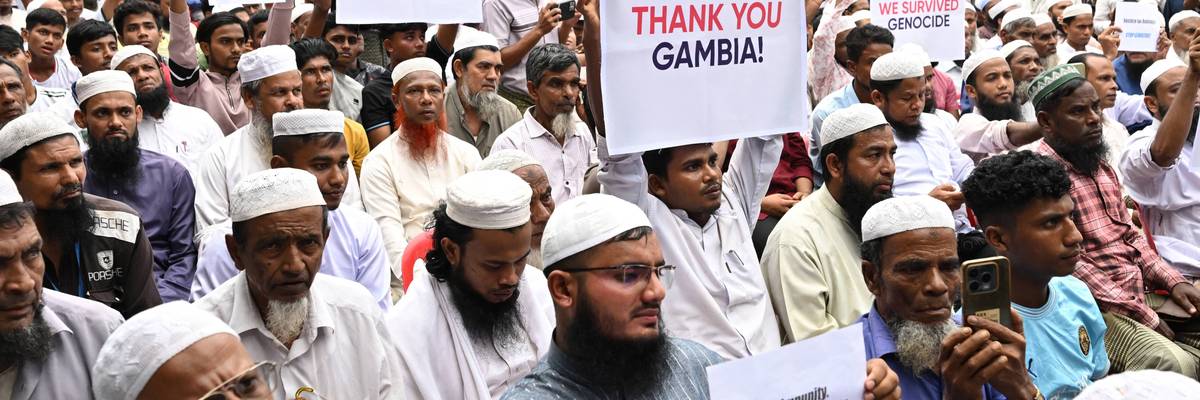
Rohingya refugees watch the International Court of Justice (ICJ) ruling over whether Myanmar committed genocide against Rohingya Muslims, on a screen at a camp in Bangladesh’s Cox’s Bazar on November 19, 2026.
(Photo by Salahuddin Ahmed/AFP via Getty Images)
Stephen Prager
Nov 19, 2026
COMMON DREAMS
In a historic ruling, the International Court of Justice on Thursday found Myanmar’s government responsible for committing genocide against the Rohingya Muslim minority during its brutal military campaign in 2017.
It is the first time in the ICJ’s 80-year history that it has found a state responsible for committing genocide under the 1948 Genocide Convention, with the court ruling in a 9-6 vote that “the only reasonable inference that can explain Myanmar’s actions is an intention to destroy a substantial part” of the Rohingya population.
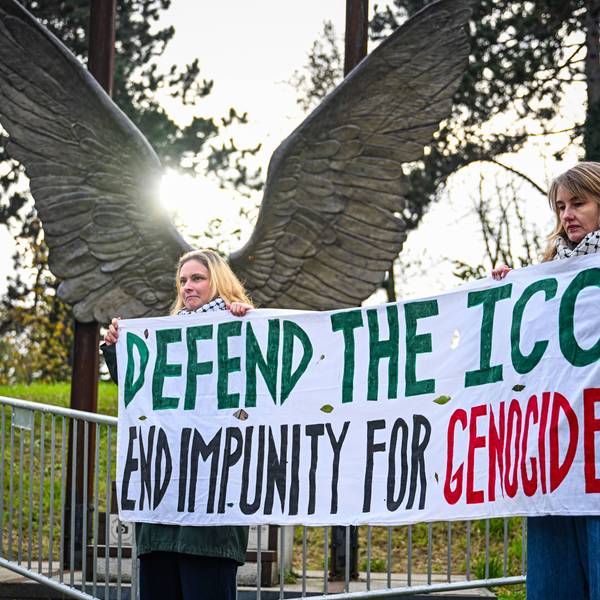
US Taxpayer Coalition Urges ICC to Issue Arrest Warrants for Trump, Rubio Over Gaza Genocide
ICJ President Yuji Iwasawa said the court found that during Myanmar’s military campaign that began in northern Rakhine State in August 2017, “security forces killed thousands of Rohingya civilians, perpetrated widespread acts of sexual violence, as well as acts of extreme violence against children, and attacked fleeing Rohingya as they sought to flee in large numbers.”
In the case brought by the West African nation of The Gambia, the court found that the evidence supported UN investigators’ estimate that at least 10,000 Rohingya were killed, including women and children. It also showed soldiers committed widespread rape and sexual violence. The ICJ additionally found that Rohingya villages were systematically burned and destroyed while neighboring villages belonging to other ethnic groups were spared. In all, more than 700,000 Rohingya were forced to flee into neighboring Bangladesh.
The court ordered Myanmar to investigate, prosecute, and punish suspects, and enact laws implementing the Genocide Convention to prevent future violations. It also ordered the country to facilitate the voluntary return of displaced Rohingya, help locate missing people, return or replace lost or damaged property, provide rehabilitation for victims, and ensure protection against discrimination. Myanmar must also compensate the Rohingya for harm done with an amount to be determined later, the ICJ said.
The ruling was celebrated by human rights advocates. Amnesty International’s Secretary General Agnes Callamard called it “a historic and authoritative recognition of the atrocities committed against the Rohingya and a rare moment of justice for survivors, victims and their families.”
She said the ruling “must serve as a wake-up call to the international community” and “must not simply be ignored,” especially since those who committed the atrocities are still in positions of power.
“The man who oversaw a campaign of crimes against humanity and other crimes under international law against the Rohingya, the former head of the armed forces, Senior General Min Aung Hlaing, is now Myanmar’s president following engineered elections,” she said. “Governments should not welcome him on the international stage, especially as grave violations continue unchecked inside Myanmar. Instead, they should stop any transfer of all weapons, security and surveillance equipment, and military and security assistance to Myanmar.”
Maria Elena Vignoli, senior international justice counsel at Human Rights Watch, said that in addition to being a “long-awaited recognition of the suffering the Rohingya have endured from Myanmar’s military,” it also “provides a significant precedent for victims of genocide, and other grave crimes, across the world in their own quest for justice.”
Nimer Sultany, a law professor at the University of London’s School of Oriental and African Studies, said the ruling had massive implications for the December 2023 genocide case brought before the ICJ against Israel over its military campaign in Gaza.
“The court’s application of the law to the facts in Myanmar makes it highly likely it will reach a similar conclusion in the case of Israel, given the scale of its crimes in Gaza,” he said, adding that the ruling “breathes new life into the Genocide Convention.”
Amid systematic attacks against international law led by the Trump administration, which has waged war on institutions such as the International Criminal Court (ICC), Antonio Guterres, the United Nations secretary-general, said the ruling against Myanmar “is a demonstration of international justice & a reaffirmation that impunity for such horrific acts must not stand.”
While the ICJ’s rulings are legally binding, it has no independent means of compelling Myanmar to comply.
University of Manitoba law professor and genocide scholar Kjell Anderson argued that while the ruling “will not immediately change the situation on the ground,” it may help to “mobilize attention and support for the Rohingya.”
“This should also help to create some moral clarity for states in the region—like Malaysia, Thailand, India, and China—that are cozying up to the Myanmar government, and, in some cases, sending Rohingya back into a tremendously dangerous situation.”
Anderson shared a message he received from a Rohingya friend living in the Kutupalong camp in Bangladesh.
“Today is a deeply emotional and historic day for the Rohingya,” they said. “After everything our people have endured, this moment gives us renewed hope for justice, dignity, and a better future and return to the homeland.”

No comments:
Post a Comment