As we honor Native Heritage Month and wrap up COP31, I am called upon by my ancestors to remember the inseparable tie between body and earth, and the destruction caused by governments and extractive industries upon both.
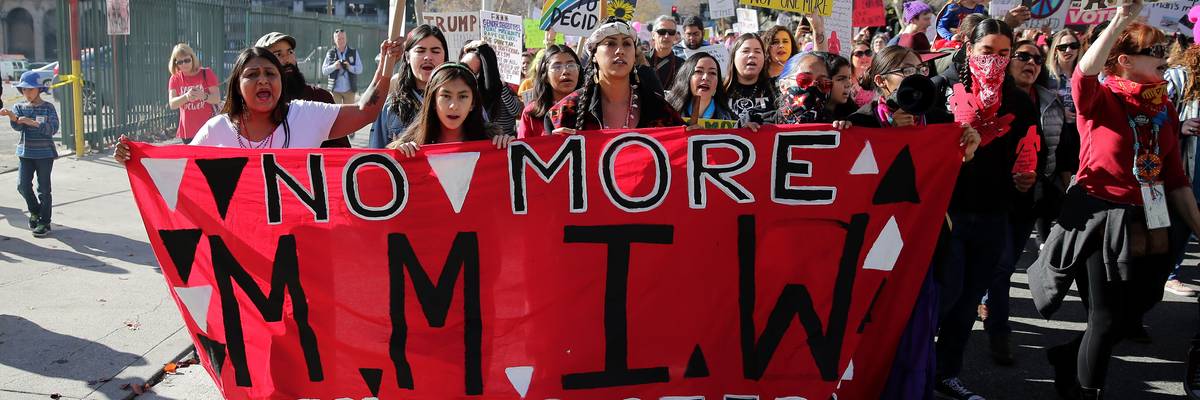
Activists march for missing and murdered Indigenous women at the Women’s March California 2019 on January 19, 2019 in Los Angeles, California.
(Photo by Sarah Morris/Getty Images)
Amory Malin
Nov 19, 2026
Common Dreams
As I write, the kwi’neì kulám [oak tree relatives] shimmer their brilliant vibrancies across the white spotted sky. With firm certainty, their strong bases plunge past where my eyes can see. We are not, altogether, different,
kwi’neì kulám and I.
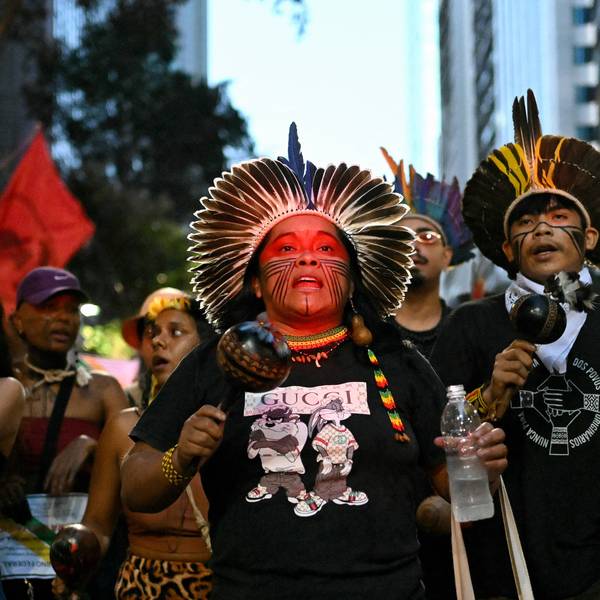
‘Without Demarcation, There Is No Climate Solution,’ Brazilian Indigenous Leader Tells COP31
Our bodies carry the story of our relationship with the land, to the waters, and with one another. Our bodies carry the story of our ancestors. This relationship tells us that our bodies and our land are not two separate things.
I join my relatives in the pursuit of healthy land, safety for Native women and girls, and self-determination for all Indigenous peoples.
Mohawk grandmother and traditional midwife Katsi Cook’s teachings describe “the undeniable connection between the health of our bodies and the health of our planet.” She has said, “Violence that happens on the land is intimately connected to the violence that happens to our bodies.”
As we honor Native Heritage Month and wrap up this year’s United Nations Climate Change Conference (COP31), I am called upon by my ancestors to remember the inseparable tie between body and earth, and the destruction caused by governments and extractive industries upon both.
The United States’ failed genocidal colonial project has always been about conquering our land by erasing our bodies. Environmental destructive industries are disproportionately located close to Native reservations. The United Nations has condemned areas where low-income and marginalized groups bear the disproportionate burden of exposure to pollution and toxic substances as “sacrifice zones.” In the US, this practice is commonplace—the health and safety of marginalized people is viewed as expendable.
Many Native scholars take this argument a step further, demonstrating the strategic and systematic ways that the US government oppresses Indigenous people through Land Violence, which is defined as “a tactic that seeks to eliminate Indigenous peoples in order to gain access to land and waters.” Deliberate exposure to pesticides, uranium mining, toxic pollution, chemicals produced by extractive industries—such as coal, mineral, oil, and tar sands—are settler tactics that have been continuously used against Native people.
Amnesty International’s recent report “We’re Here to Protect Mother Earth: Indigenous Rights and Nevada’s Lithium Boom,” found that an estimated 79% of all known US lithium reserves lie within 35 miles of Tribal reservations. The report found that lithium mining significantly restricted Tribal Nation’s access to traditional foods, medicines, gathering places, and sacred sites. In tandem, they created significant health concerns for Native people due to chemical hazards. The effects of land violence perpetrated by extraction industries, such as lithium or uranium mines, are often invisible until years later. These health concerns include harms to the reproductive system, as illustrated in the report “Violence on the Land, Violence on our Bodies,” which connects proximity to extraction sites to high levels of toxins in breast milk, infertility, miscarriages, premature births, premature menopause, reproductive system cancers, and an inability to produce healthy children—a cruel and intentional attack on our next generation.
When our land suffers, we suffer. My hand grazes kwi’neì kulám [oak tree relatives], feeling their textured surface. With firm warmth, we stand heart to heart until we weep.
The violence against Native people is not an epidemic, it is a deliberate and political attempt to control our land, bounded by colonial oppression. Violence against Native women, in particular, is an urgent matter and a human rights crisis: More than 4 in 5 Native American women experience violence in their lifetime, and 56.1% of Native American women have experienced sexual violence in their lifetime. Homicide is the third leading cause of death among Indigenous women ages 10-24. In some reservations, Indigenous people are murdered at more than 10 times the national average.
Areas with extractive industries are intertwined with heightened levels of violence against Native women and girls, including serious concerns around sexual violence. Companies build temporary housing for large numbers of non-Indigenous and predominantly male workers near extractive industry sites. These “man camps” have been linked to a rise in violent crimes, including sexual violence, against Native women and girls living near extractive project sites. Despite ample evidence of increased sexual violence, there is little done by governments or industries to prevent such violence.
We cannot live healthy and safe lives when our bodies and lands undergo violence. We have a responsibility to protect our kwi’neì [relatives] and demand accountability from the US government in its colonial efforts to erase our bodies, while attempting to conquer our land.
The United Nations Declaration on the Rights of Indigenous Peoples (UNDRIP) affirms the right for Indigenous peoples to self-determination, including to give or withhold consent to projects affecting their land and resources. It is time for the United States to codify these principles into domestic law so that we as Native people can protect ourselves in the way we know best; through love and accountability to all of our relatives—the waters, plants, animals, and each other.
The United States cannot fulfill its human rights obligations to Indigenous people without confronting its own history of settler violence. Violence against Native women is not traditional—it is the direct result of colonization. The US perpetuates systemic violence against Native women and girls through settler colonial tactics. It is time the US government provide Tribal authorities with the resources and funding needed for Tribes to protect and seek justice for their citizens—including rape kits and training for administrators, flexible funding for Tribal shelters, increased cooperation with Tribal law enforcement, and enhanced jurisdiction for Tribal Courts.
This Native Heritage Month, and as global climate leaders return from COP31, I join my relatives in the pursuit of healthy land, safety for Native women and girls, and self-determination for all Indigenous peoples. Great Michi Saagiig Nishnaabeg scholar Leane Simpson asks of us:
Rebel against the permanence of settler colonial reality and not just “dream alternative realities” but to create them, on the ground in the physical world, in spite of being occupied. If we accept colonial permanence, then our rebellion can only take place within settler colonial thought and reality.
I make a promise to you, kwi’neì kulám [oak tree relatives,] that as I dream and rebel, your voice will join me.
Our work is licensed under Creative Commons (CC BY-NC-ND 3.0). Feel free to republish and share widely.
Amory Malin
Amory Malin is a citizen of the Cow Creek Band of Umpqua Tribe. She is the Indigenous Rights fellow at Amnesty International USA. Her work is concentrated on research and polices impacting the safety and sovereignty of Indigenous women, Two-Spirit relatives, and children. The knowledge shared in this op-ed is not new. Generations of Native people have been fighting for our right to safety and sovereignty, and we will continue to do so until the end of time.
Full Bio >
As I write, the kwi’neì kulám [oak tree relatives] shimmer their brilliant vibrancies across the white spotted sky. With firm certainty, their strong bases plunge past where my eyes can see. We are not, altogether, different,
kwi’neì kulám and I.
‘Without Demarcation, There Is No Climate Solution,’ Brazilian Indigenous Leader Tells COP31
Our bodies carry the story of our relationship with the land, to the waters, and with one another. Our bodies carry the story of our ancestors. This relationship tells us that our bodies and our land are not two separate things.
I join my relatives in the pursuit of healthy land, safety for Native women and girls, and self-determination for all Indigenous peoples.
Mohawk grandmother and traditional midwife Katsi Cook’s teachings describe “the undeniable connection between the health of our bodies and the health of our planet.” She has said, “Violence that happens on the land is intimately connected to the violence that happens to our bodies.”
As we honor Native Heritage Month and wrap up this year’s United Nations Climate Change Conference (COP31), I am called upon by my ancestors to remember the inseparable tie between body and earth, and the destruction caused by governments and extractive industries upon both.
The United States’ failed genocidal colonial project has always been about conquering our land by erasing our bodies. Environmental destructive industries are disproportionately located close to Native reservations. The United Nations has condemned areas where low-income and marginalized groups bear the disproportionate burden of exposure to pollution and toxic substances as “sacrifice zones.” In the US, this practice is commonplace—the health and safety of marginalized people is viewed as expendable.
Many Native scholars take this argument a step further, demonstrating the strategic and systematic ways that the US government oppresses Indigenous people through Land Violence, which is defined as “a tactic that seeks to eliminate Indigenous peoples in order to gain access to land and waters.” Deliberate exposure to pesticides, uranium mining, toxic pollution, chemicals produced by extractive industries—such as coal, mineral, oil, and tar sands—are settler tactics that have been continuously used against Native people.
Amnesty International’s recent report “We’re Here to Protect Mother Earth: Indigenous Rights and Nevada’s Lithium Boom,” found that an estimated 79% of all known US lithium reserves lie within 35 miles of Tribal reservations. The report found that lithium mining significantly restricted Tribal Nation’s access to traditional foods, medicines, gathering places, and sacred sites. In tandem, they created significant health concerns for Native people due to chemical hazards. The effects of land violence perpetrated by extraction industries, such as lithium or uranium mines, are often invisible until years later. These health concerns include harms to the reproductive system, as illustrated in the report “Violence on the Land, Violence on our Bodies,” which connects proximity to extraction sites to high levels of toxins in breast milk, infertility, miscarriages, premature births, premature menopause, reproductive system cancers, and an inability to produce healthy children—a cruel and intentional attack on our next generation.
When our land suffers, we suffer. My hand grazes kwi’neì kulám [oak tree relatives], feeling their textured surface. With firm warmth, we stand heart to heart until we weep.
The violence against Native people is not an epidemic, it is a deliberate and political attempt to control our land, bounded by colonial oppression. Violence against Native women, in particular, is an urgent matter and a human rights crisis: More than 4 in 5 Native American women experience violence in their lifetime, and 56.1% of Native American women have experienced sexual violence in their lifetime. Homicide is the third leading cause of death among Indigenous women ages 10-24. In some reservations, Indigenous people are murdered at more than 10 times the national average.
Areas with extractive industries are intertwined with heightened levels of violence against Native women and girls, including serious concerns around sexual violence. Companies build temporary housing for large numbers of non-Indigenous and predominantly male workers near extractive industry sites. These “man camps” have been linked to a rise in violent crimes, including sexual violence, against Native women and girls living near extractive project sites. Despite ample evidence of increased sexual violence, there is little done by governments or industries to prevent such violence.
We cannot live healthy and safe lives when our bodies and lands undergo violence. We have a responsibility to protect our kwi’neì [relatives] and demand accountability from the US government in its colonial efforts to erase our bodies, while attempting to conquer our land.
The United Nations Declaration on the Rights of Indigenous Peoples (UNDRIP) affirms the right for Indigenous peoples to self-determination, including to give or withhold consent to projects affecting their land and resources. It is time for the United States to codify these principles into domestic law so that we as Native people can protect ourselves in the way we know best; through love and accountability to all of our relatives—the waters, plants, animals, and each other.
The United States cannot fulfill its human rights obligations to Indigenous people without confronting its own history of settler violence. Violence against Native women is not traditional—it is the direct result of colonization. The US perpetuates systemic violence against Native women and girls through settler colonial tactics. It is time the US government provide Tribal authorities with the resources and funding needed for Tribes to protect and seek justice for their citizens—including rape kits and training for administrators, flexible funding for Tribal shelters, increased cooperation with Tribal law enforcement, and enhanced jurisdiction for Tribal Courts.
This Native Heritage Month, and as global climate leaders return from COP31, I join my relatives in the pursuit of healthy land, safety for Native women and girls, and self-determination for all Indigenous peoples. Great Michi Saagiig Nishnaabeg scholar Leane Simpson asks of us:
Rebel against the permanence of settler colonial reality and not just “dream alternative realities” but to create them, on the ground in the physical world, in spite of being occupied. If we accept colonial permanence, then our rebellion can only take place within settler colonial thought and reality.
I make a promise to you, kwi’neì kulám [oak tree relatives,] that as I dream and rebel, your voice will join me.
Our work is licensed under Creative Commons (CC BY-NC-ND 3.0). Feel free to republish and share widely.
Amory Malin
Amory Malin is a citizen of the Cow Creek Band of Umpqua Tribe. She is the Indigenous Rights fellow at Amnesty International USA. Her work is concentrated on research and polices impacting the safety and sovereignty of Indigenous women, Two-Spirit relatives, and children. The knowledge shared in this op-ed is not new. Generations of Native people have been fighting for our right to safety and sovereignty, and we will continue to do so until the end of time.
Full Bio >

No comments:
Post a Comment