OBITUARY: Strobe Talbott, Clinton's Russia hand who helped negotiate Ukraine's nuclear disarmament, dies at 80
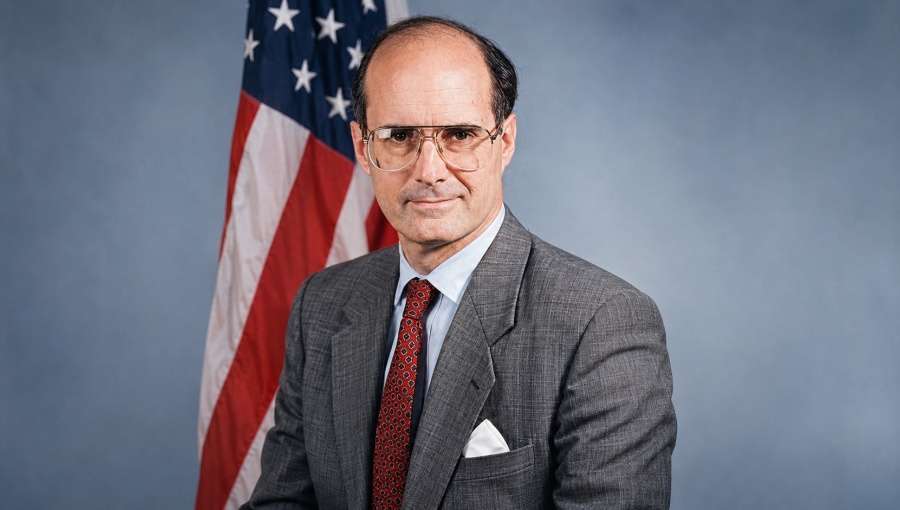
Strobe Talbott, the US diplomat who steered Bill Clinton's Russia policy and helped negotiate Ukraine's nuclear disarmament, died on November 26 aged 80.
His death has reopened an argument in Ukraine over the generation of Western Russia experts who shaped Washington's approach to the former Soviet Union in the 1990s. Their worldview "cost Ukraine dearly", the Ukrainian-American economist Roman Sheremeta wrote in a post on X on November 27, because it put a reforming Russia ahead of the security of its neighbours.
Talbott died peacefully after a long illness at his home in East Hampton, New York, his son Devin Talbott said, according to the Associated Press.
Talbot’s death comes at a time when the context of Russia’s relations with the West seem to be increasingly forgotten. German Chancellor Friedrich Merz put the cat amongst the pigeons last week suggesting that the 2008 Budapest summit’s failure to set out a clear course for Ukraine’s accession to Nato was a “mistake.”
Experts have pushed back at that suggestion saying even the vague promise that Ukraine could enter Nato that lacked any concrete details whatsoever was enough to put Russia on a collision course with the alliance and lead directly to the current conflict in Ukraine. As IntelliNews reported, the idea was suggested by then-president George W Bush but watered down by former German Chancellor Angela Merkel.
Talbot was an international relations expert and in Moscow often to meet with the Yeltsin administration as he tried to husband Russia’s transition for a totalitarian centrally planned state into the international community. He was of a generation where international relations with Russia in Washington was ruled by George Kennan’s doctrines, the diplomat who designed America's Cold War strategy of containing the Soviet Union, who warned that Nato expansion east would be a “tragic mistake” and trigger the “the beginning of a new Cold War.”
But by the time Talbot took over the world had changed and he was in the frontline of grappling with the realities of post-Soviet Russia that was grappling to come to terms with the realities of its new place in the world as a market economy.
He shared a flat with Clinton at Oxford and began his career at Time magazine, where translating the leaked memoirs of the Soviet leader Nikita Khrushchev won him a full-time job. Over 21 years there he covered US-Soviet relations and ran the Washington bureau. He joined the State Department in 1993 as ambassador-at-large for the newly independent states and served as deputy secretary of state from 1994 to 2001, before running the Brookings Institution from 2002 to 2017.
Clinton said in a statement that the two men had "made real progress building trust between two former adversaries", including through Nato's expansion and ending ethnic conflicts in the Balkans. "Together we laid the groundwork for greater cooperation while putting Russia on a path to democracy," he said. "Sadly, its current leader has taken the country in a different direction."
Sheremeta, a professor of economics at Case Western Reserve University and founding rector of the American University Kyiv, wrote that Talbott "cannot be described as a simplistic pro-Russian lobbyist or a Putin supporter". Talbott backed Nato enlargement and, after Russia annexed Crimea, was among the first to call for arming Kyiv. In February 2015 he co-signed a report by eight former US officials that urged Washington to send Ukraine $1bn a year in military aid, lethal defensive weapons included.
That, Sheremeta argued, is what makes the case revealing. Talbott was "a well-meaning Western liberal Russophile" who came to the region through Russian literature, and "the fundamental flaw of this school of thought was not hatred of Ukraine, but its invisibility within their worldview." In his memoir The Russia Hand, Sheremeta wrote, Talbott described Kyiv in 1993 as "the capital of an unhappy and nervous country that wasn't sure it would last much longer".
The most lasting result was Ukraine's nuclear disarmament, in which Talbott was a lead negotiator. Ukraine came out of the Soviet collapse holding the third-largest nuclear arsenal in the world. On January 12, 1994, Clinton stopped at Kyiv's Boryspil airport to meet President Leonid Kravchuk, and two days later the three presidents signed the Trilateral Statement in Moscow, under which Ukraine agreed to send its strategic warheads to Russia for dismantling.
Clinton and Secretary of State Warren Christopher put "intense pressure" on Kravchuk at the airport as soon as Kyiv tried to secure real security guarantees instead of vague assurances, Sheremeta wrote, drawing on Talbott's own account. The process ended in the December 1994 Budapest Memorandum, under which Ukraine relinquished the weapons in return for assurances from the US, the UK and Russia that "imposed no meaningful obligations on anyone", in Sheremeta's words.
"The most dangerous figures in the West turned out to be not those who openly supported dictators in the Kremlin, but those who sincerely loved the 'other, liberal Russia'," he wrote. "Despite four years of full-scale war, this worldview has still not entirely died out in Western capitals."

No comments:
Post a Comment