Turkey courts Libya's Haftar after Ukraine strikes Russian ships in Benghazi
IntelliNews summary:
- Russia plans upgrades at six Libyan airbases and runs its Africa Corps airbridge to the Sahel and Sudan from Haftar's territory;
- In Syria Russia still supplies about 60,000 bpd of oil, but Qatar has committed $1.2bn and raised household power supply from two to 10 hours a day;
- Russian fuel shipments to Libya fell 91% to about 5,000 bpd this year as Italy became the biggest supplier;
- UN sanctions on Libya, including the arms embargo, were renewed to August 2027 with only narrow exemptions.
____________________
Turkey is courting eastern Libya's strongman Khalifa Haftar, Russia's most important partner in the country, days after Ukrainian sea drones hit a Russian warship in his Benghazi harbour.
Haftar arrived in Ankara on November 24 on his first official visit to Turkey and met President Recep Tayyip Erdogan the next day, Al Jazeera reported. He brought two of his sons: Khaled, chief of staff of his Libyan National Army (LNA), and Belqasim, who runs Libya's Development and Reconstruction Fund. No official readout of the talks was published.
Six years ago Turkish drones and troops turned back Haftar's 2019-20 assault on Tripoli, and Ankara remains the main security backer of the rival Government of National Unity (GNU) in the west. Moscow has armed Haftar's forces for years and has turned his half of the country into its main military foothold in the Mediterranean since it lost its client in Damascus.
"Russia's grip on eastern Libya is suddenly under threat - and the reason isn't just Ukrainian drone strikes. The Turkey-Russia rivalry is also playing out, with Ankara seizing the moment to undercut Moscow," Alissa Pavia, a nonresident senior fellow in the Atlantic Council's North Africa programme, wrote on X on November 27. Ankara is "seizing the opening to poach Russia's most important Libyan partner", she added.
Turkey signed agreements with the LNA on military infrastructure and training in July, according to Al Jazeera. Foreign Minister Hakan Fidan met Haftar in Benghazi in August, and the eastern-based House of Representatives, which had opposed Turkey's 2019 maritime boundary deal with Tripoli since it was signed, ratified it on October 20. Erdogan is due in Tripoli on December 8-9 for a Turkey-Africa summit, his first visit to Libya in 15 years, and Ankara wants to broker the country's reunification.
Haftar is keeping his options open. On the day he flew to Ankara his son and heir apparent Saddam, the LNA's deputy commander, was in Doha meeting Qatar's minister of state for defence, Al Jazeera reported, while US mediators led by Massad Boulos, President Donald Trump's senior adviser for Arab and African affairs, are pushing a power-sharing plan that would make Saddam chairman of Libya's Presidency Council.
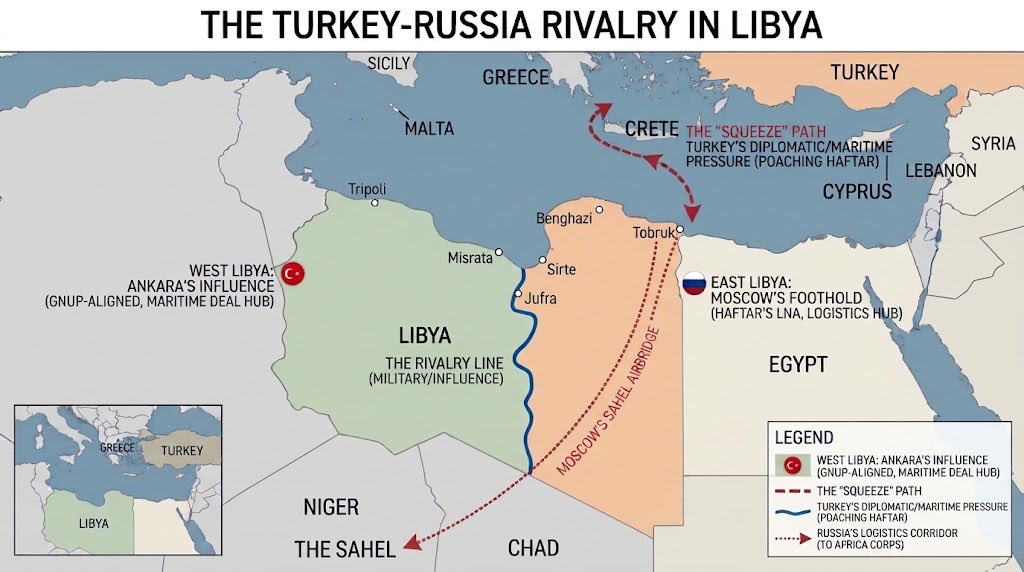
How the rivalry looks from the region: Turkish influence in the west, Russia's foothold and Sahel supply corridor in the east. Source: Alissa Pavia, via X
The trigger was a strike on November 22. Ukraine's security service (SBU) said its naval drones sank the corvette Merkury at its moorings in Benghazi, where it had docked to refuel under a military assistance agreement with the eastern authorities, and hit the navy supply ship Angara offshore. Two Libyan soldiers later died of their wounds, Al Jazeera reported. Italy's Corriere della Sera reported that an Iranian cargo ship, the Alvan, was also hit near Benghazi; the eastern authorities denied that any Iranian vessel had been attacked.
From Tartus to Tobruk
Libya's place in Russian strategy changed when Ahmed al-Sharaa's forces took Damascus in December 2024 and Bashar al-Assad fled to Moscow. The naval base at Tartus and the Hmeimim air base, Russia's only military facilities outside the former Soviet Union, suddenly depended on the goodwill of a government that Russian aircraft had spent nine years bombing.
Moscow started looking for a fallback within weeks. Satellite images in January 2025 showed Russia building a large base in southern Libya near the borders with Sudan and Chad. By May 2025 heavy weapons, armoured vehicles and Pantsir-S1 air defence systems were arriving through Tobruk and other ports under Haftar's control.
Russia now plans to finance and staff upgrades at six Libyan airbases - Al-Jufra, Al-Khadim, Al-Qardabiya, Brak al-Shati, Maaten al-Sarra and Tamanhent - and its personnel at Brak al-Shati have grown from 300 to 450 since December 2024, according to US National Geospatial-Intelligence Agency data cited by the Africa Defence Forum. The bases are the hub of an airbridge to the Africa Corps, the defence ministry force that replaced Wagner in the Sahel: in July 2025 two Russian Il-76 cargo planes were tracked flying from Kufra to territory held by Sudan's Rapid Support Forces. Libya has become the logistics spine of Russia's push into Africa, which the Kremlin promoted by hosting 48 African nations in Moscow at the end of October.
Benghazi became the resupply stop for Russia's Mediterranean ships. That is the arrangement the Merkury strike has put in doubt.
Syria: Moscow now has to compete
Moscow did not lose Syria outright, but it now has to compete there. Al-Sharaa has been to the Kremlin twice, in October 2025 and January 2026, and Vladimir Putin offered to help rebuild the country while Moscow sought to keep its bases. Russia became Syria's main oil supplier after Iran cut off crude when Assad fell, shipping about 46,000 barrels per day (bpd) in 2025 and an estimated 60,000 bpd this year, all of it on sanctioned tankers.
But Damascus is not relying on Moscow alone, and al-Sharaa takes help from all comers. The US pulled its last troops out of Syria in April, the EU is reviving its 2008 association deal, and the Gulf is paying for the power grid.
Qatar has committed $1.2bn to Syria since December 2024, a Qatari official told IntelliNews this week. When the money started flowing Syria was generating less than 1,000MW against needs of at least 7,000MW, he said. Qatari gas piped through Jordan came first, followed by Azerbaijani gas through Turkey, more than 3.4mn cubic metres a day that generates 800-1,000MW. "We increased the capacity per day from two hours to 10 hours per day for people, and almost 24 hours for commercial," the official said. A Qatar-led consortium also signed a $7bn deal in 2025 to add 5,000MW of capacity.
The lights are back on in Damascus: in mid-2025 most of Syria got two to three hours of electricity a day. The next step is money. Qatar is working with the US Treasury to bring Syria's central bank and four private banks up to the standard foreign correspondent banks demand, the official said. Asked whether Western banks were ready to finance companies such as Siemens in Syria now that UN, EU and US sanctions are being removed, he answered: "Not yet." The central bank has one stage of the Treasury's requirements left to clear, he said. "The opportunity is there. But first of all, let's finish that thing." Qatar hopes to close the banking project by the end of the year, he said.
Haftar takes from everyone
Haftar is playing the same game. He needs money, fuel and food, and he takes them from whoever offers.
Russia remains Libya's main wheat supplier, with roughly half of its imports; Libya buys nearly 90% of its wheat abroad. Moscow revived the joint governmental committee in January 2025 to win a bigger share of Libyan energy projects, and Russian drugmaker Pharmasyntez is using Libya as its entry point to sell medicines across Africa.
But Russia's commercial weight is shrinking. Russian refined fuel shipments to Libya fell 91%, from 56,000 bpd in 2024-25 to about 5,000 bpd this year, according to Kpler data reported by Reuters. Italy has replaced Russia as Libya's biggest fuel supplier, at 59,000 bpd.
Western and Turkish companies are moving into the oil and gas fields. Hungary's MOL entered Libya in February alongside Spain's Repsol and Turkey's state oil company TPAO, and Ankara was closing in on a gas exploration pact with the eastern authorities in August 2025. Chevron was in talks to expand in Libya in February. Washington has also supervised joint exercises between eastern and western forces through US Africa Command and welcomed Libya's first unified budget in more than 13 years. The EU has extended its Mediterranean naval mission, set up to police the UN arms embargo on Libya, to track Russia's shadow fleet.
Sanctions stay on
Unlike Syria, Libya is still under international sanctions, and they are being eased only at the edges. The UN Security Council renewed the Libya sanctions regime until August 2027 on April 14, keeping the arms embargo, the freeze on assets of the Libyan Investment Authority and the measures against illicit oil exports. It added narrow exemptions: the sovereign fund may change its global custodian bank under strict oversight, and member states may ask to give technical assistance and training to Libyan security forces. The vote was unanimous; Russia had abstained on the previous amendments in January 2025.
Ankara's gains may not be Europe's. "Ankara may simply replace Russian leverage with its own unilateral East Med agenda - a direct threat to EU solidarity over Greece and Cyprus's seabed rights," Pavia wrote. All 27 EU states called the Turkey-Libya maritime memorandum "null and void" after the eastern parliament ratified it, and on November 26 the European Parliament adopted a resolution saying the same. Turkey's foreign ministry rejected the resolution as biased and unfounded, saying the EU has no authority over maritime delimitation, TRT World reported.
Erdogan's visit to Tripoli will show how far the courtship has gone. Analysts quoted by Al Jazeera say he may try to bring Haftar and GNU Prime Minister Abdulhamid Dbeibah together, though no such meeting has been confirmed. Whatever happens there, Moscow's bargaining position in Benghazi is weaker than it was a week ago.

No comments:
Post a Comment