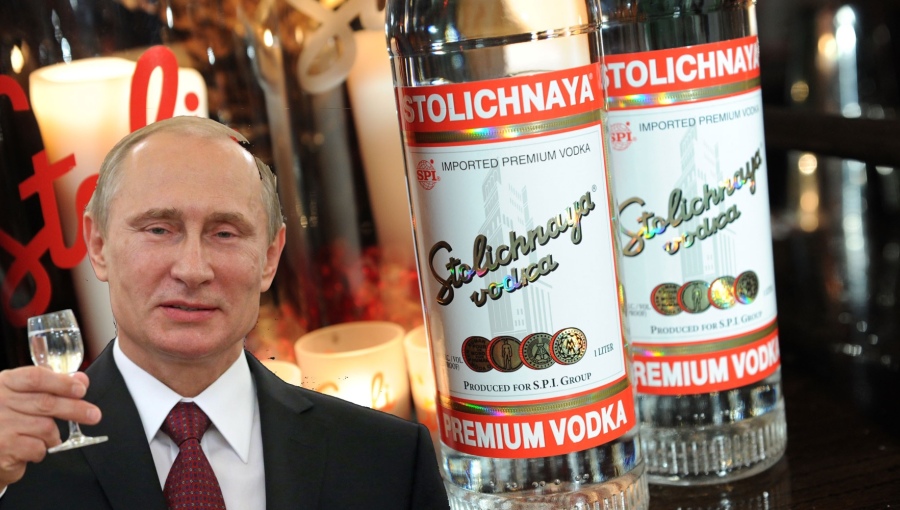
Russians, famous for their love of vodka, now drink less alcohol than Germans, Poles and the French, World Health Organization (WHO) estimates show.
The average Russian adult drank 10.4 litres of pure alcohol in 2024, against 10.9 litres in Germany, 11.2 litres in France and 11.5 litres in Poland, according to the WHO's Global Health Observatory, which counts both recorded sales and home-made, smuggled and other unrecorded drink. That puts Russia 22nd of the 51 countries in the WHO's European region.
The comparison went round social media after the X account UBERSOY posted a chart of WHO figures on November 26 under the line "Russia cut its drinking by 43% in 13 years". The WHO's own data bear out its main point and overturn one of the most durable stereotypes about the country. Two decades ago Russia was among the heaviest-drinking nations in the world, and alcohol was a main driver of the mortality crisis among Russian men that followed the collapse of the Soviet Union.
The 43% comes from a 2019 WHO Europe report on the effects of alcohol control on mortality and life expectancy in Russia. It found that total consumption per head fell by 43% between 2003 and 2016, with recorded consumption down 40% and unrecorded alcohol, "produced and sold outside governmental control", down 48%. Over 2003-2018 all-cause mortality fell by 39% among men and 36% among women, and life expectancy reached a then record of almost 68 years for men and 78 for women in 2018.
The WHO put the fall down to policy: the government raised excise duties step by step, introduced a minimum price for vodka in 2003 and later extended it to other drinks, built a real-time system to track the production and sale of every bottle, and banned shop sales of alcohol at night across the country.
The WHO's current database, which revises its earlier estimates, shows a smaller but still steep decline. Russian consumption per adult peaked at 15.3 litres in 2007 and has fallen by almost a third since. Germany's has come down far more slowly, from 13.4 litres in 2000 to 10.9 litres, and Russian consumption fell below Germany's in 2016.
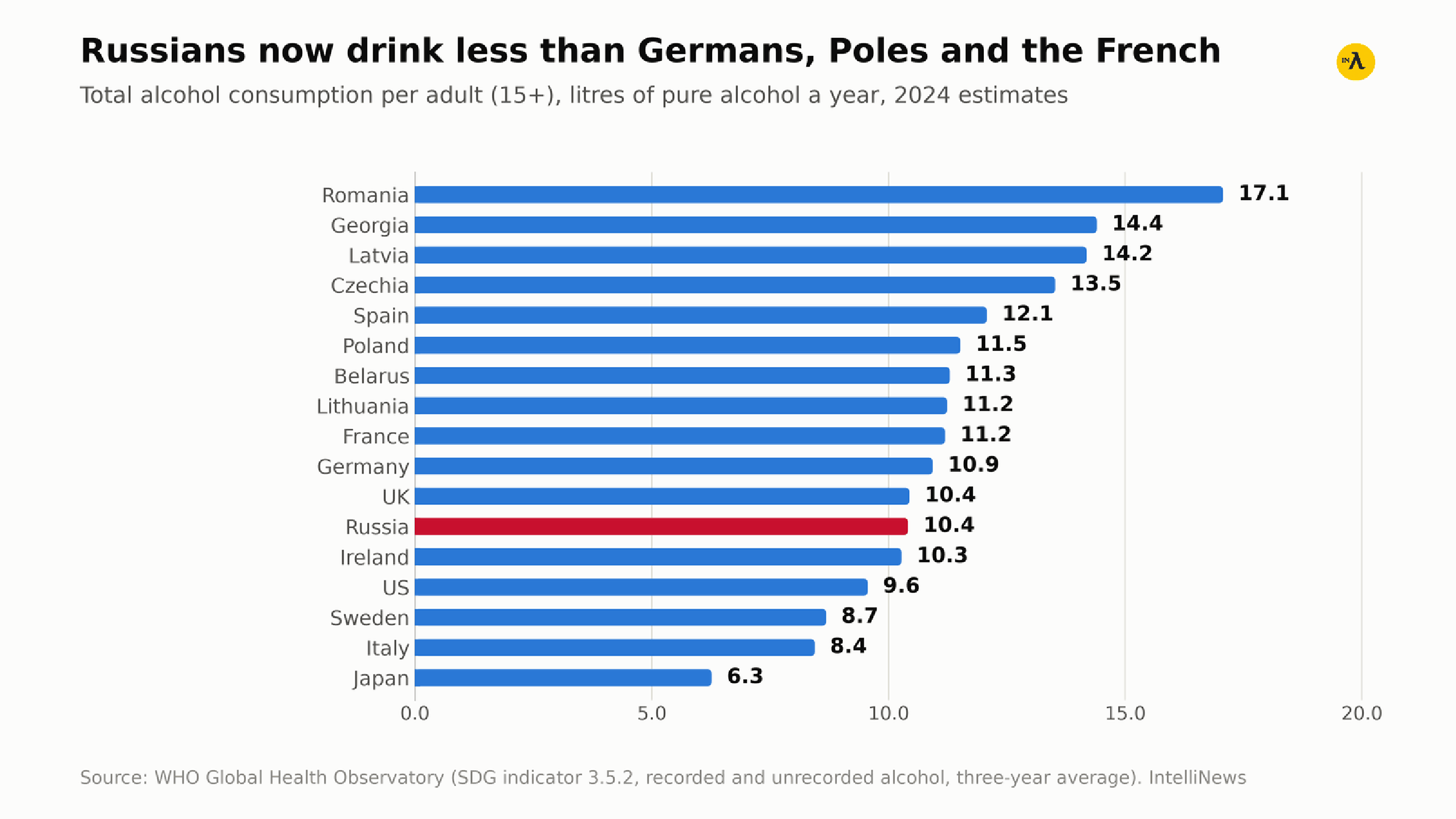
Total alcohol consumption per adult (15+), litres of pure alcohol a year, 2024 estimates. Source: WHO Global Health Observatory (SDG indicator 3.5.2). IntelliNews
| Litres of pure alcohol per adult (15+) | 2000 | 2003 | 2007 | 2010 | 2016 | 2018 | 2024 |
| Russia | 14.3 | 14.8 | 15.3 | 14.4 | 11.4 | 10.3 | 10.4 |
| Germany | 13.4 | 13.0 | 12.5 | 12.0 | 11.8 | 11.7 | 10.9 |
Source: WHO Global Health Observatory, SDG indicator 3.5.2 (recorded plus unrecorded consumption, three-year average). IntelliNews
The old Russian pattern was the weekend binge, and it killed. A study of Moscow death certificates for 1993-1995, published in the Journal of Epidemiology and Community Health in 1998, found significant rises in deaths from alcohol poisoning, accidents, violence and heart disease on Saturdays, Sundays and Mondays, most marked for sudden deaths. A later study of 151,000 adults in the Siberian cities of Barnaul, Biysk and Tomsk, published in The Lancet in 2014, found that male smokers who reported drinking three or more bottles of vodka a week ran a 35% risk of dying between the ages of 35 and 54, against 16% for those who drank less than a bottle.
Vodka has lost its grip. Russians drank 215mn decalitres of it in 2000 and less than half that by 2021, and the fall has not stopped: retail vodka sales slipped a further 0.7% y/y to 59.8mn decalitres in the first ten months of 2026, while sparkling wine and cider gained. As long ago as 2017, 39% of Russians said they did not drink at all, up from a quarter in 2009, according to the state pollster VTsIOM.
On its own measure the health ministry says consumption per head halved from 18 litres in 2009 to 8.8 litres in 2020, and the government wants it down to 7.8 litres by 2030, with a ban on discounted alcohol and tighter curbs on home distilling among the measures in the pipeline.
The heaviest drinkers in Europe are now elsewhere. Romania tops the WHO's European table at 17.1 litres per adult, well ahead of Georgia at 14.4 litres and Latvia at 14.2 litres. Czechia comes fifth at 13.5 litres, just behind Portugal, and its people remain the world's biggest beer drinkers: Czechs drank 148.8 litres of beer a head in 2024, the 32nd year in a row they have topped Kirin Holdings' annual ranking.
Czechs are not Europe's heaviest smokers, though. WHO estimates put the share of Czech adults who smoked at 28.8% in 2022, 18th of 50 countries in the region and far behind Serbia and North Macedonia at 39.6% and Bulgaria at 39.1%. The figure was 25.6% in Russia and 22.8% in Germany.
This article was produced with the help of the IntelliNews Lambda analytical tool

No comments:
Post a Comment