IntelliNews summary:
- US real exports end more than 40% below baseline and US GDP 15% lower, against about 13% for China.
- Mexico loses almost 23% of GDP and Hong Kong almost a quarter; Chile, Peru, Colombia and Brazil lose 16-20%.
- France and Germany lose about 9-10%, Saudi Arabia 9%, as their blocs keep most trade in-house or barriers low.
- Slower productivity, not lost trade, does most of the damage; inflation runs 1.5 points higher in South Africa and Vietnam.
____________________
A world split into seven rival trading blocs would leave global GDP 13% smaller by 2050, with the US hit harder than China, Oxford Economics said in a November briefing.
In the consultancy's Fractured World scenario, global growth averages 1.7% a year between 2026 and 2050, against 2.3% in its baseline, which already keeps today's US tariffs in place. World output still rises by about 49% over the period, against 71%. "No economy gains from a Fractured World," the briefing says: every economy it models ends 2050 below its baseline, mostly because productivity grows more slowly.
The scenario starts in 2027, when populist policies spread across the big economies, either because populists win power or because mainstream parties copy them. Geopolitical tension ranks among the biggest long-term risks in Oxford Economics' own business survey, and the US average effective tariff rate stood at 11% in November, its highest since the 1940s if 2025 is excluded. The consultancy first warned last year that US policy was pushing the world towards this outcome.
Seven blocs, permanent walls
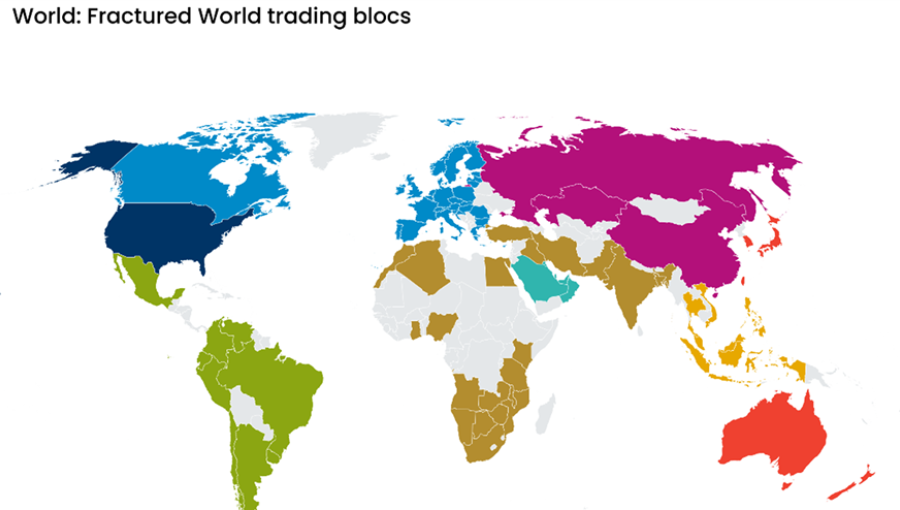
The blocs grow out of existing trade deals. The US, having declined to extend the USMCA agreement at its first review in 2026, abandons it and stands alone. Canada turns to Europe to form the "Western Allies", Mexico joins a Mercosur-based Latin American bloc, and Russia cements its place in a "China Sphere". The Gulf Cooperation Council, ASEAN and a "Democratic Asia-Pacific" group form the rest, while India, Turkey and most of Africa stay neutral.
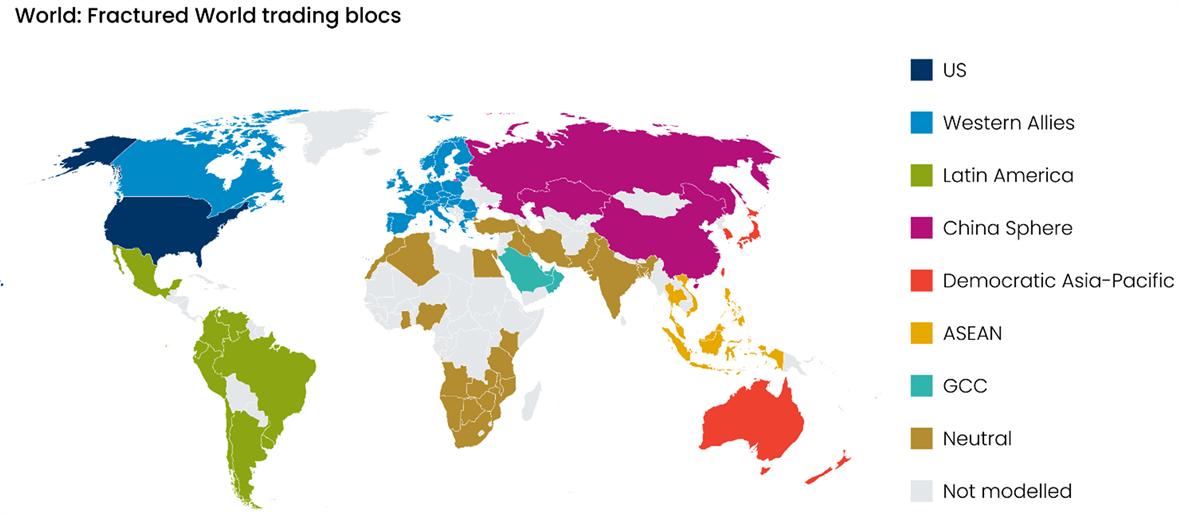
The seven trading blocs of Oxford Economics' Fractured World scenario. Source: Oxford Economics
Governments go well beyond tariffs, using quotas, local-content rules, subsidies and product standards. Barriers are highest between the US and the China Sphere, and the Western Allies face high barriers with both; trade among those three accounted for 16% of global exports in 2025. With World Trade Organization rules openly ignored, the walls cover all trade between two blocs and never come down, which leaves little room to reroute goods through third countries as bystanders did in the 2018-19 trade war.
World trade ends up about 20% below the baseline in real terms. Trade inside blocs falls 12% and trade between them 21%, so firms buy more from inside their own bloc, including from producers that would otherwise have lost out.
The US pays for standing alone
The US becomes the most isolated economy in the model. It faces high barriers with four of the six other blocs, which took about three-quarters of its exports in 2025, and its real exports end more than 40% below the baseline, the steepest fall of any bloc. US GDP is 15% below baseline by 2050, only a little worse than the world's, because trade was worth just a quarter of US GDP in 2025.
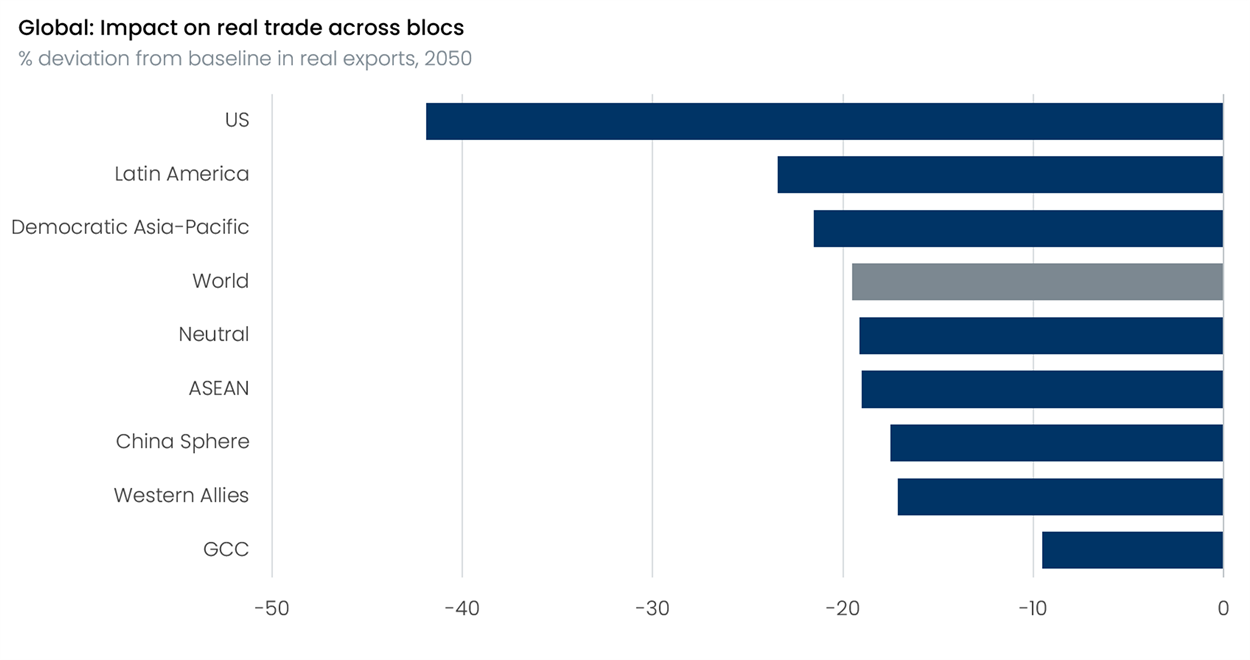
Real exports by bloc in 2050, % deviation from the Oxford Economics baseline. Source: Oxford Economics, TradePrism
China's GDP falls about 13%, close to the world average, because its barriers with Latin America, ASEAN, the Gulf and the neutral economies stay lower, and these took more than two-fifths of the China Sphere's exports outside the bloc. Direct trade between the two rivals suffers most: US exports to the China Sphere end 55% below baseline and Chinese exports to the US 39% lower. Both current-account imbalances shrink, the US deficit to 1.2% of GDP from 2.4% and China's surplus to 0.7% from 2.7%.
Emerging markets lose most
Mexico shows how costly it is to switch sides. The US took four-fifths of its exports in 2025, and its GDP in 2050 is almost 23% smaller than otherwise, the largest loss of any economy apart from Hong Kong, at almost a quarter. Canada loses 16%. Chile, Peru, Colombia and Brazil end 16-20% down, as Latin America sent only 8% of its exports to bloc partners and more than two-fifths to the US.
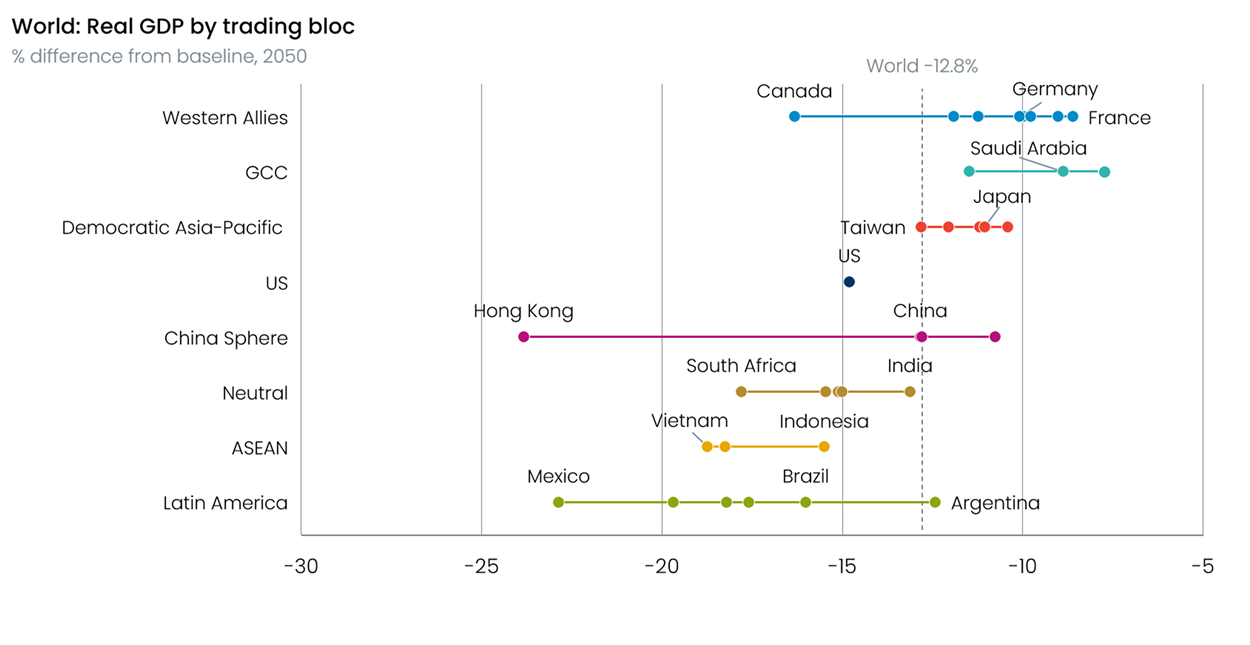
Real GDP in 2050 by trading bloc, % difference from the Oxford Economics baseline. Source: Oxford Economics
Western Europe gets off more lightly, because the Western Allies already send almost two-thirds of their exports to one another: French GDP ends about 9% below baseline and German about 10%. The Gulf keeps low barriers with every bloc, so its trade falls least and Saudi Arabia ends 9% down. Neutrality is no shelter. South Africa loses 18% and Nigeria 15%, more than their export losses alone would explain.
Most of the damage comes through productivity. Less trade and investment between rivals slows the spread of machines, management practices and ideas, and subsidies keep weak firms alive. US GDP per employee is 13% below baseline by 2050 and US investment 13% lower. Trade in AI-related goods is redirected towards bloc partners: chip-making machinery trade rises 22% inside blocs but falls only 2% across them, because a handful of specialised suppliers are hard to replace, which could raise the cost of innovation, especially for China.
Populist governments also loosen budgets and lean on central banks. Inflation runs about 1.5 percentage points a year above baseline in South Africa and Vietnam between 2027 and 2050, about one point in the UK and 0.8 points in the US, but only 0.2 points in the eurozone, where the ECB's independence is written into the EU treaties.
A single government can gain from raising barriers if others hold back, but not when everyone retaliates. "Restraint works best when it's coordinated," the briefing says, and deals that keep a few critical relationships open would matter most for Mexico and Canada, whose main partner ends up in another bloc.

No comments:
Post a Comment