IntelliNews summary:
• Solar capacity has grown 53-fold since 2014 to 150.26 GW, while wind has risen 2.7-fold to 56.09 GW.
• Only 164 GW of the 1,163.9 GW of gross wind potential lies in high-yield areas, by the national wind institute's estimate.
• Both offshore wind tenders were cancelled in August 2025 for lack of bidders, despite INR68.53bn ($739mn) of approved support.
• Turbine-making capacity of about 24 GW is nearly four times last year's installations.
____________________
India installed more wind in the year to March than ever, yet the record 6.05 GW falls well short of the 10 GW a year its 2030 target demands.
Wind capacity reached 59.20 GW at the end of September, about a fifth of the country's 299.25 GW of renewable capacity, according to a government factsheet published on November 18. The fleet stood at 21 GW in March 2014. The 2025-26 financial year's addition beat the previous best of 5.4 GW, set in 2016-17, and compared with 4.15 GW a year earlier, the Ministry of New and Renewable Energy (MNRE) said in its annual review on April 8.
Closing the 41 GW gap to 100 GW by the end of the decade means adding close to 10 GW a year, a pace India has never reached, and the goal after that is 156 GW by 2036. Both sit inside a wider plan for 900 GW of non-fossil capacity by 2035. The ministry expects 7.5-8 GW of new wind in the current financial year, and 3.11 GW went in between April and September, by its own figures. Some 28 GW is under implementation, but a pipeline is not a fleet until it is connected to the grid.
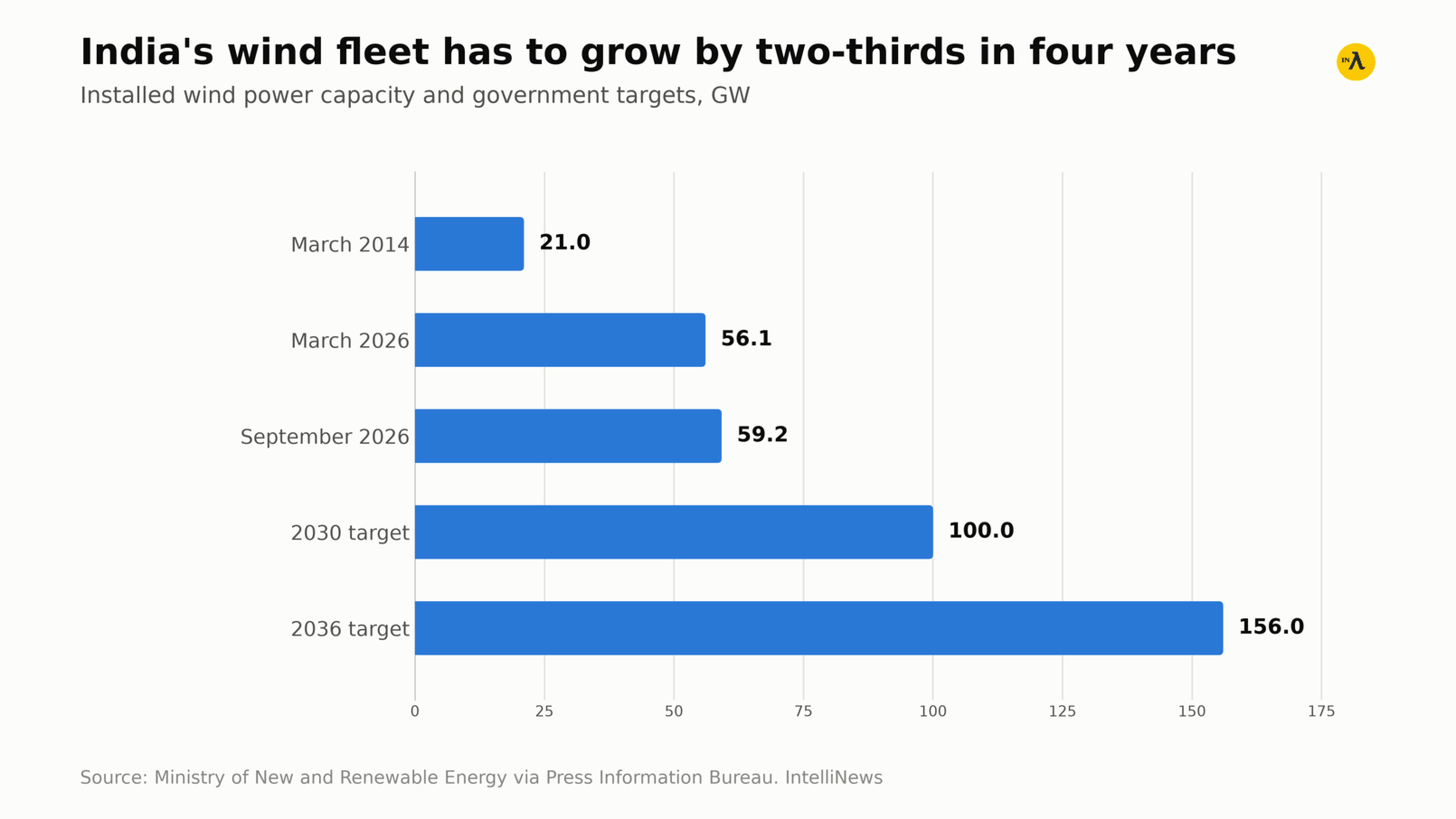
India's installed wind capacity and government targets, GW. Source: Ministry of New and Renewable Energy via Press Information Bureau. IntelliNews
Solar runs away with the mix
Solar has grown far faster. Its capacity rose from 2.82 GW in March 2014 to 150.26 GW in March 2026, a 53-fold increase, while wind went from 21.04 GW to 56.09 GW, the MNRE review shows. In electricity terms, wind produced 104 TWh in calendar 2025, or 5.6% of India's generation, against 206 TWh, or 11.0%, from solar, according to monthly data compiled by the think tank Ember.
Wind's case rests on timing rather than volume. The government says nearly 45% of wind output comes during peak-demand hours, when it can cover for solar. The supply is also heavily seasonal: wind provided 10.0% of generation in July 2026 and 9.7% in August, but only 3.3% in March, Ember's figures show, as the monsoon winds that drive most Indian turbines come and go.
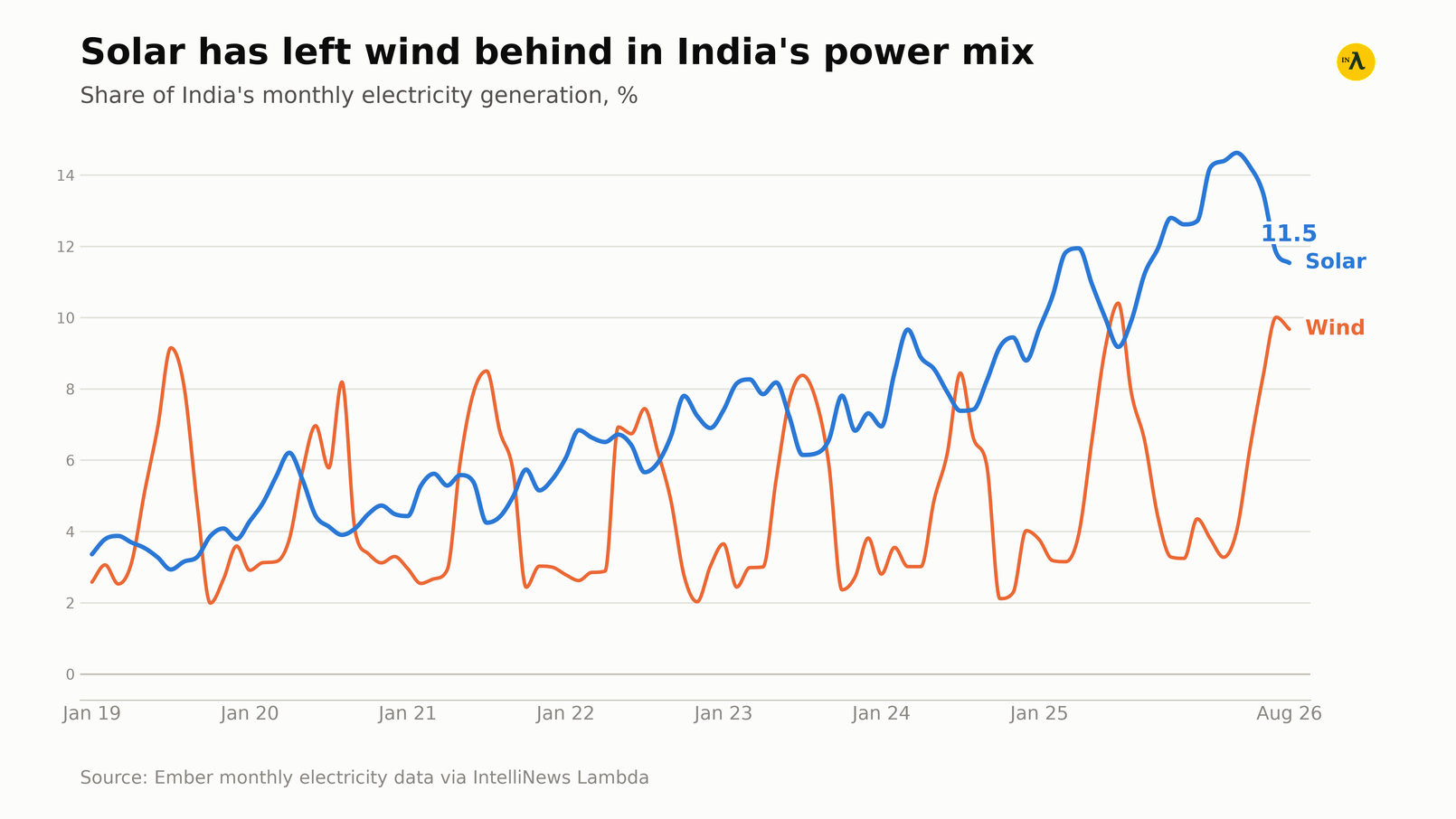
Wind and solar shares of India's monthly electricity generation, %. Source: Ember monthly electricity data via IntelliNews Lambda
Plenty of wind, less usable land
The National Institute of Wind Energy puts gross potential at 1,163.9 GW at a hub height of 150 metres, led by Rajasthan with 284.2 GW, Gujarat with 180.8 GW and Maharashtra with 173.9 GW. The institute's wind atlas also shows where that potential sits: 607 GW on cultivable land, 544 GW on wasteland and 12 GW in forests. Only 164 GW lies in high-yield areas where turbines would run at a capacity utilisation factor above 35%.
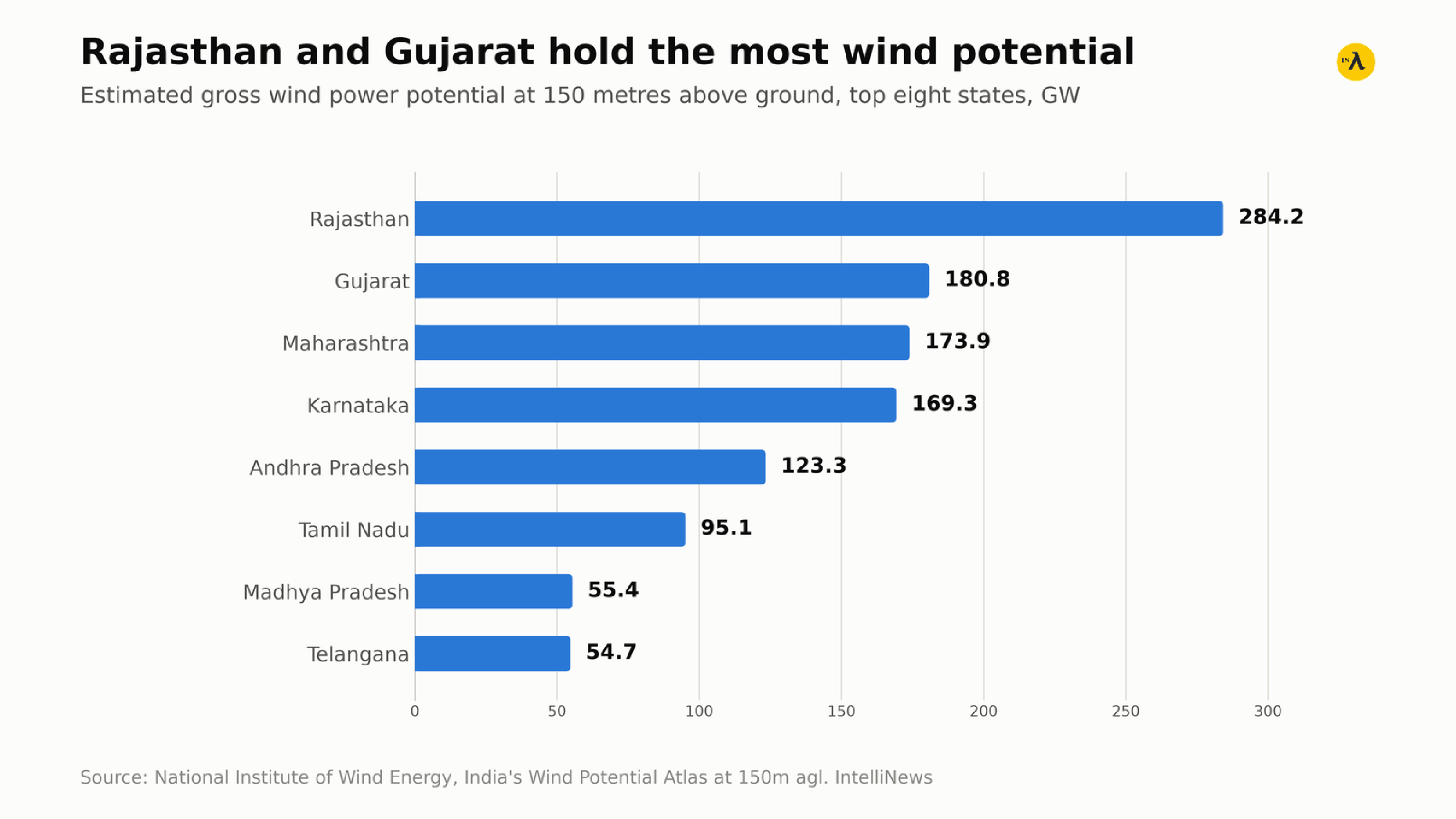
Estimated gross wind power potential at 150 metres, top eight states, GW. Source: National Institute of Wind Energy. IntelliNews
Moving that power to cities is a separate fight. Developers name weak transmission and right-of-way disputes as the main reasons projects slip, and generators in Rajasthan and Gujarat have lost about INR45bn ($486mn) since February 2025 because their output could not be evacuated. New Delhi has approved a 1,150 kV corridor to carry western renewable power east, though it will take about six years to build. A task force set up in January is meant to clear regulatory, land and transmission bottlenecks.
Offshore, still at the starting line
India has yet to put a turbine at sea. The government has approved viability gap funding of INR68.53bn ($739mn) for 1 GW of offshore projects, 500 MW each off Gujarat and Tamil Nadu. The state-run Solar Energy Corporation of India's tender for 500 MW in the Gulf of Khambhat and a separate auction of seabed rights for 4 GW off Tamil Nadu were both cancelled in August 2025 for lack of developer interest, Offshorewind.biz reported.
The ministry is now testing a 500 MW pilot of contracts for difference, meant to give developers steadier revenue, and an offshore taskforce set up with the UK in February is working on market design, ports, supply chains and blended finance.
A factory base waiting for orders
Turbine factories have outgrown the home market. Manufacturing capacity has risen from 10 GW in 2014 to about 24 GW, nearly four times last year's installations, and the government reports 70-80% local content in key components. Makers are looking abroad, with wind equipment exports up nearly 50% to INR128bn ($1.38bn) in the 2025-26 financial year.
That gives wind a home-grown supply chain at a time when solar still depends on imported materials. Whether the factories end up serving a domestic boom or an export drive will be settled by the wires and land deals that have set the pace of every Indian wind build so far. On the ministry's own forecast for this year, the pace still falls short of what 2030 requires.
This article was produced with the help of the IntelliNews Lambda analytical tool

No comments:
Post a Comment