It’s possible that I shall make an ass of myself. But in that case one can always get out of it with a little dialectic. I have, of course, so worded my proposition as to be right either way (K.Marx, Letter to F.Engels on the Indian Mutiny)
Thursday, November 12, 2026
When the Saudi desert was green: a 125,000-year-old lakeside reveals how early humans lived
Evidence of early humans hunting, processing plants and occupying a thriving lakeside during the Green Arabia period
King Abdullah University of Science & Technology (KAUST)
Fieldwork at 'Uruq al-Julaybah, on the shore of the ancient Mundafan lake in southern Saudi Arabia. Left: a researcher exposes finds along a survey grid line. Top right: a fossil on the surface of the ancient lake bed. Bottom right: a fossil being uncovered from the sand.
Thuwal, Saudi Arabia, 15 November 2026 – The Saudi Heritage Commission has announced the findings of an archaeological and environmental study jointly led by the Commission, King Abdullah University of Science and Technology (KAUST) and Griffith University. Megafauna remains, stone tools and rare plant material recovered from the 125,000-year-old lakeside site of Uruq al-Julaybah in Mundafan, southern Saudi Arabia, provide one of the most detailed pictures yet of prehistoric human life in Arabia. Together, the discoveries reveal how early people lived, hunted and used their environment during a greener, wetter period in Arabian history.
Published in Science, the study brings together KAUST researchers spanning geology, archaeology, botany and micropaleontology alongside colleagues at Griffith University and the Saudi Heritage Commission and several other international institutions. The findings add significant evidence to Saudi Arabia's deep human and environmental history and contribute to a wider understanding of early human presence across the Arabian Peninsula.
Researchers used satellite terrain modeling to map the approximately 340 km² ancient lake, which reached a maximum depth of 29 meters. Sediments, geomorphological data and aquatic remains indicated a relatively stable freshwater body surrounded by vegetation and open grasslands.
The team also carried out systematic grid surveys to collect fossils and stone tools, used two dating methods on sand and fossil teeth, applied 3D-refitting techniques to stone tools, and conducted microscopic and chemical residue analysis of tool surfaces. This comprehensive methodology provided direct insights into how early human populations lived and adapted during the last Interglacial period, a warm, humid phase approximately 125,000 years ago commonly known as Green Arabia.
The team documented more than 500 fossil specimens of plants and animals, including invertebrates, at more than 130 locations across the site. Animal remains included hippos, extinct long-horned buffaloes, camels, Arabian oryx, gazelles and ostriches.
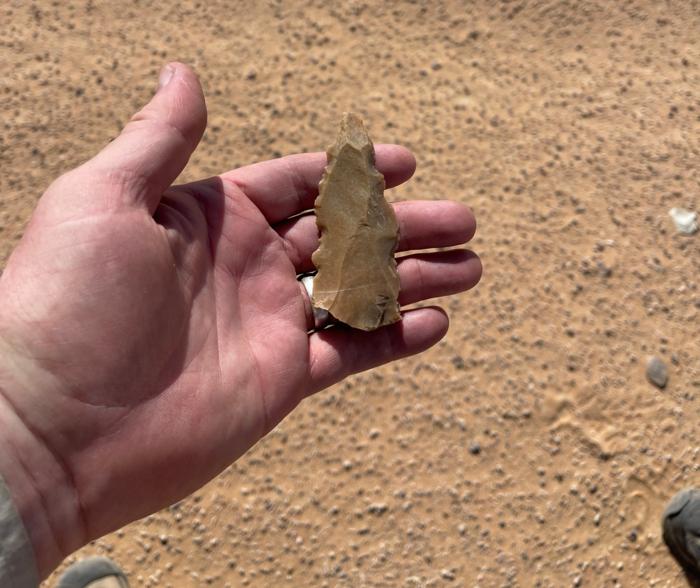
Researchers collected 5,511 stone tools larger than 2 cm from the main study area. More than 98% were made of flint, and analyses showed the use of Levallois techniques in stone tool production.
The tools contain residues of a wide variety of plants, including some that are toxic. Traces of resin and woody tissue suggest the use of hafted weapon tips, while plant residues indicate the processing of tubers, bushes and palm leaves. These traces point to varied uses of plants for food and everyday tasks. Among the most significant findings is evidence of the potential use of toxic plant compounds in hunting technology, understood to be among the first such evidence recorded in Saudi Arabia, alongside some of the earliest evidence of palm-related vegetation found in the region. Together, these findings paint a picture of a population making diverse and sophisticated use of their environment.
What makes this site exceptional is that all of these elements (animal remains, stone tools and plant material) were found together in a single, dated context, allowing researchers to reconstruct in unusual detail the daily lives of the people who occupied this lakeside. The site provides a vivid and unusually complete picture of how humans lived in Green Arabia.
The findings also indicate that the shores of ancient Lake Mundafan brought together freshwater, animals, plants and raw materials during the humid period around 125,000 years ago. This combination supported a range of human activities, including stone tool production, the preparation of hunting equipment, the processing of animal and plant resources, and fiber working.
“It is very exciting to see how the collaboration of so many different specialists allows to reconstruct this uniquely complete picture of life, behavior and the environment in the distant past,” said Professor Frans van Buchem, KAUST Professor of Geology and co-lead scientist.
Dr. Faisal Al-Jibreen, a participating researcher from the Heritage Commission and a professor of Paleolithic archaeology, described the discovery in the sands of Lake Mundafan in the Empty Quarter as an important archaeological find that sheds light on the ancient environment and its relationship with humans and animals in southern Saudi Arabia’s early prehistory.
“This site gives us a rare and richly detailed view of how people lived in a landscape that looks nothing like Arabia today,” said Professor Chris Clarkson, co-lead scientist and Professor of Archaeology at Griffith University's Australian Research Centre for Human Evolution. “The combination of animal remains, stone tools and plant material in a single, dated context is what makes this discovery so significant.”
“Saudi Arabia has an exceptional archaeological heritage. Building Heritage Science capabilities in the Kingdom will enable us to turn the smallest traces into the biggest stories,” said Professor Laurence Hapiot, co-author and Head of Heritage Research at KAUST.
The research underscores the shared commitment of KAUST and its research partners to uncovering the rich prehistory of the Arabian Peninsula, providing pivotal evidence for our understanding of early human life, movement, and technology.
The Heritage Commission supported the study’s fieldwork during the 2023 season, contributed to research funding and facilitated scientific work. The collaboration brought together Griffith University in Australia, KAUST and King Saud University, alongside international universities and research centers specializing in archaeology, ancient environments, history and laboratory analysis.
Poisoned hunting weapons, megafauna and plant use at a 125,000-year-old Arabian paleolakeshore
Article Publication Date
12-Nov-2026
A fossil fragment exposed on the surface of the ancient Mundafan lake bed at ‘Uruq al-Julaybah, marked with a flag during the team’s systematic survey. The team documented more than 500 fossil specimens at more than 130 locations across the site
Sand dunes in the Empty Quarter (Rub’ al-Khali), southern Saudi Arabia. Around 125,000 years ago, during the humid “Green Arabia” period, this area held Lake Mundafan, a freshwater lake of about 340 km², and early humans lived along its shores.
Credit
KAUST/Heritage Commission
Ancient lakeshore reveals how early humans lived in Arabia
Researchers recovered more than 5,000 stone artefacts alongside fossil animal remains, providing insight into how early Homo sapiens adapted to and flourished in Arabia.
A new study has found people living in Arabia 125,000 years ago used complex technologies including composite hunting weapons, plant-fibre processing and possibly poison-assisted hunting, while making use of a freshwater lake rich in resources.
The analysis, accepted for publication in Science, examines the well-preserved prehistoric lakeshore site of ‘Uruq Aljelibah in Saudi Arabia’s Rub’ al-Khali, or Empty Quarter.
It challenges the idea that Arabia was merely a transit corridor during human dispersals, showing how people could settle and develop complex technologies there.
Lead researcher Professor Christopher Clarkson, of ARCHE, said the site lay beside a freshwater lake in the Mundafan basin, in what is now one of the driest regions on Earth.
The site preserves a rare snapshot of life during a humid period known as Marine Isotope Stage 5e.
Researchers recovered more than 5,000 stone artefacts alongside fossil animal remains, providing insight into how early Homo sapiens adapted to and flourished in Arabia.
“The lakeshore preserves evidence of a very different Arabia where freshwater, grasslands and trees supported people and abundant wildlife,” Professor Frans van Buchem, of KAUST, and co-lead author said.
“One of the most significant discoveries is evidence that some stone points were used as hafted hunting weapons,” Professor Clarkson said.
“This suggests people were manufacturing composite weapons made from multiple materials rather than simply using handheld stone tools.”
Several stone points showed impact damage consistent with hunting large animals, while microscopic analysis revealed traces of animal tissue near the tips and plant resin and fibres at the base.
Several points also contained chemical biomarkers linked to Acokanthera schimperi, the arrow-poison tree, which is known historically for its toxic cardiac glycosides.
Researchers identified other potentially toxic plant compounds on weapon points suggesting that poison may have been used in hunting.
“The residues give us clues to parts of these weapons that rarely survive,” Associate Professor Carney Matheson, of Griffith University, said.
“Animal tissue near the tips and resin and fibres at the bases help us reconstruct how the points were mounted and used.
“The chemical traces also raise the possibility that some weapons carried plant poisons.”
The distribution of stone tools closely matched clusters of animal bones, suggesting the lakeshore was a focal point for hunting and processing game.
Fossil evidence indicates the area once supported hippopotamuses, buffalo, camels, gazelles and oryx.
Researchers also found microscopic traces of plant materials including fibres, wood fragments and preserved palm tissue.
Evidence of cutting, scraping and fibre processing suggests these communities exploited a wide range of plant resources for food, tools and binding materials.
The findings add to growing evidence that Arabia repeatedly supported human occupation during wetter climatic phases.
A separate study published in Nature in 2025 documented recurrent humid periods in Arabia over the past eight million years, offering a longer environmental context for these discoveries.
“During wetter phases, Green Arabia provided the water and other resources that people needed to settle and develop complex ways of life,” Professor Michael Petraglia, of ARCHE, said.
“This site helps us understand what people did in those environments from making hunting weapons to processing plants and animals.”
“Sites such as ‘Uruq Aljelibah reveal the depth of Saudi Arabia’s human history,” Dr Faisal al-Jibrin, of the Saudi Heritage Commission, said.
“Working with international colleagues allows us to investigate this heritage in detail and understand its place in the wider story of human settlement beyond Africa.”
“Archaeological sites this old rarely preserve such a complete snapshot of daily life with hunting weapons, butchered animals, plant processing and tool-making areas all in one place,” Professor Clarkson said.
The study ‘Poisoned hunting weapons, megafauna and plant use at a 125,000-year-old Arabian paleolakeshore’ has been accepted for publication in Science.

No comments:
Post a Comment