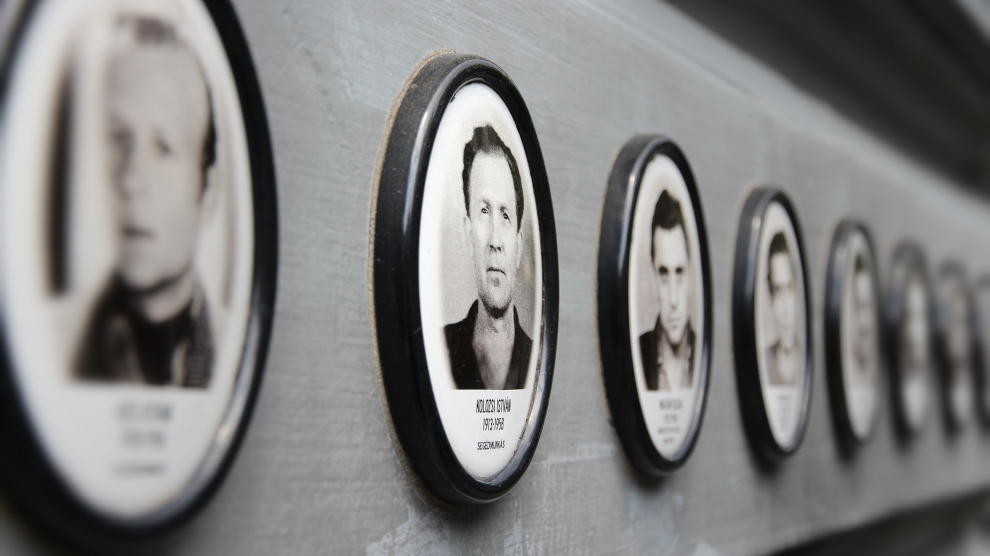
Showing posts sorted by relevance for query HUNGARY 56. Sort by date Show all posts

Thursday, March 10, 2022

Professor: For lessons on Russia vs. Ukraine, look at the USSR's invasion of Hungary in 1956

John A. Tures
Wed, March 9, 2022, 

Blood streams from the cut eye of Hungarian Ervin Zador injured during a fight with a member of the Soviet team in the closing stages of the Hungary vs. USSR water polo match at the 1956 Olympic Games.

This is a column by John A. Tures, a professor of political science at LaGrange College. He is a regular contributor to the Savannah Morning News.

A smaller country wrests itself free from an authoritarian foe. Its leadership seeks its own destiny and independence. A brutal invasion follows, ordered by an angry autocrat.

Does this sound familiar to you? It’s not just Russia’s attack upon Ukraine. It’s also the Cold War story of Hungary, which hoped to chart its own course, providing freedom to its citizens. Let’s see what lessons we can learn from the USSR (Union of Soviet Socialist Republics) invasion of their East European neighbor back in 1956.


During World War II, Hungary was an ally of Nazi Germany, having been wrenched from the Austro-Hungarian Empire post-World War I. But after the failed invasion of the Soviet Union, Stalin smashed through Eastern Europe with a vengeance. Hungary was conquered, and a Communist puppet state was imposed by the victors from the East.

More from John Tures: Does deterrence work? Lessons for the Russia-Ukraine conflict

In the mid-1950s, the Hungarians had enough of the totalitarianism. They pushed out the pro-Soviet regime. Prime Minister Imre Nagy came to power. He called for multiparty elections, a whole series of freedoms that many of us sometimes take for granted and independence for his country. Nagy and his supporters didn’t want Hungary to be forced to join the anti-NATO “Warsaw Pact,” a military alliance of East European Soviet client states designed to target the West.

The USSR, led by the bombastic Nikita Khrushchev, became angered by Hungary’s bid for freedom. Under the cruel Yuri Andropov, Soviet tanks rolled in to crush the new government. Nagy and thousands of Hungarians were executed; we’ll probably never know the full death toll. Hundreds of thousands fled to the West rather than suffer a similar fate.

I learned about this, not so much in my schoolbooks or textbooks, but in person. In 1990, my family joined a travel group to the newly-liberated Hungary, something few people saw possible even in the early 1980s. Among this group was a delegation led by former U.S. Ambassador to Hungary R. Clayton Mudd, who had served there at the height of the Cold War.

The latest on the Russia-Ukraine war: UN votes to demand Russia end war; attacks intensify

Like many countries in East Europe in 1990, the people had just ousted the pro-Soviet puppet regime. They were free to talk about the terrible old days, from purges by Nazis and then Soviets to the awful events of 1956. Everyone seemed to know someone who was killed, wounded or had to flee. I admit that the Hungarian language was a particularly tough one to try out, but I did my best. Through broken English and translator books and emotion, I learned a lot. It’s why I joined Victims of Communism, which I suggest that you do as well.

Here are the lessons from that tragedy, which need to be applied today. We need to be prepared for a lot of Ukrainian refugees who will flee the country, no matter what the outcome of the Russian invasion and occupation is. We have to be more united as a country, the way we were in the Cold War times in standing up to Communism, and not now when pro-Russian pundits and politicians can control the conversation. And we can’t take the side of those who seek to flatter us by day, and hack us and divide us by social media at night.


John Tures

Finally, you do have a voice. You do need to contact your elected officials, and let them know exactly where you stand. You need to back your organizations, like the U.S. Chamber of Commerce, when they do take a tough stand (knowing they’ll pay a price for economic sanctions too).

It’s time to pray for these people who are being attacked, and even dying, just to try to live the lives you get to enjoy every day. It’s a tall challenge, of course. But as history proved, nothing is impossible.

This article originally appeared on Savannah Morning News: Russa's invasion of Ukraine parallels the USSR's invasion of Hungary


SEE
https://libcom.org/library/hungary-56-andy-anderson

2005-03-27 · Hungary '56 - Andy Anderson Andy Anderson's pamphlet, written in 1964 and published by Solidarity is invaluable as a guide to the events of the Hungarian uprising of 1956.


Bureaucracy and revolution in Eastern Europe : Harman

https://archive.org/details/bureaucracyrevol0000harm


Friday, October 23, 2020

Hungary students hold 'freedom' rally on anniversary of 1956 uprising

Issued on: 23/10/2020 - 
  
The demonstration, called "For all of our freedom!", also marked the anniversary of Hungary's anti-Soviet uprising in 1956

Mar 27, 2005 — Hungary '56 - Andy Anderson ... in 1964 and published by Solidarity is invaluable as a guide to the events of the Hungarian uprising of 1956.

 ATTILA KISBENEDEK AFP

Budapest (AFP)

A rally held by students blockading Hungary's top arts university for over 50 days in protest at a reform by Prime Minister Viktor Orban's on Friday drew thousands of supporters in Budapest.

Students from the University of Theatre and Film Arts (SZFE) led a candlelit march and rally before a crowd estimated at around 10,000 by an AFP photographer.

The demonstration, called "For all of our freedom!" by the organisers, also marked the anniversary of Hungary's anti-Soviet uprising in 1956.

Speakers accused Orban of restricting academic freedom and pushing through an overhaul of SZFE's structure without the consent of students or staff.

"You have to talk, accept if others think differently, and listen to others," said Noemi Vilmos, a theatre direction student at SZFE, while the crowd chanted "Free country! Free university!"

The campus blockade began on September 1, a day after it's former management resigned in protest, claiming the government had stripped it of autonomy.

The students at the 155-year-old university, and many staff who went on strike in solidarity, say the government imposed a new board whose pro-Orban trustees are appointed indefinitely.

The reform is seen by critics of Orban as the latest step in his attempt to reshape Hungary's public life to fit his own nationalist and culturally conservative agenda.

Since the campus blockade began the new board's Chancellor, Gabor Szarka, a former army colonel, has been prevented from entering the building by students blocking the entrance.

Szarka has described the building occupation as "anarchy" and switched off the internet at the building, as well as changing door locks inside.

Last week, the students defied an order by the new management to vacate the premises for "maintenance and sanitation" purposes.

Also Friday a Budapest court ruled that the staff strike is "unlawful".

The new board insists that the changes -- including moving SZFE's ownership from state to private hands -- will improve infrastructural and educational standards.

Earlier this month the government doubled the university's budget for next year.

But the protesters, who guard the building's entrance and hold classes inside in what they call an "educational republic," say they will not move until the institution's autonomy is restored.

The blockade presents a rare physical challenge to the self-styled "illiberal" premier Orban, 57, whose control in Hungary has steadily grown since he won a landslide election a decade ago.

In 2018 he declared that "big changes" were also afoot for Hungary's cultural and academic scenes, considered in pro-government circles as hotbeds of liberalism.

Since then, laws have reformed how theatres are managed and removed autonomy from the leadership of the prestigious Hungarian Academy of Sciences.

© 2020 AFP

Tuesday, November 10, 2020


Remembering Hungary’s heroic revolution of 1956

November 7, 2020
Marek Grzegorczyk


Marek Grzegorczyk
Share This!


It was an early Sunday morning on November 4, 64 years ago. Soviet tanks rolled into Budapest to crush, once and for all, a national uprising. It is said that the soldiers – mostly originating from the Asian parts of the USSR – barely knew where they were or who they were fighting against.

About an hour later, Imre Nagy, the prime minister of the 1956 revolutionary government whose attempt to establish Hungary’s independence from the Soviet Union eventually cost him his life, made a dramatic radio speech:

“This is Imre Nagy speaking, chairman of the Council of Ministers of the Hungarian People’s Republic. In the early hours of this morning, Soviet troops started an attack on our capital with the obvious aim of overthrowing the legal and democratic Hungarian government… Our troops are fighting. The Government is in place.”

Freedom above all

Within hours, Mr Nagy had sought political asylum at the Yugoslav Embassy in Budapest.

Meanwhile, István Bibó, the minister of state at the time, a lawyer, political thinker, prolific essayist, persistent advocate of democratic values and the author of The Art of Peacemaking: Political Essays, wrote a proclamation. In it, he declared that Hungary had no intention of pursuing anti-Soviet policies and refuted the accusation that the uprising was fascist or anti-communist in sentiment. He also urged Hungarians not to recognise the occupying Soviet forces or a puppet government.

“I ask the great powers and the wise and brave decision of the United Nations in the name of the freedom of oppressed nations. God save Hungary!” his proclamation ended.

Hungarian radio went off the air at around 8am with a woman’s appeal to “help Hungary … Help, help, help…” In the mid-afternoon, a Vienna monitor picked up what was apparently the last rebel-held radio station in Hungary. It too broadcast repeated calls for help.

“Civilised people of the world. On the watchtower of a thousand-year-old Hungary, the last flames begin to go out. Soviet tanks and guns are roaring over Hungarian soil. Our women, mothers and daughters – are sitting in dread. They still have terrible memories of the army’s entry in 1945. Save our souls. This word may be the last from the last Hungarian freedom station. Listen to our call. Help us – not with advice, not with words, but with action, with soldiers and arms.”

The revolution was stifled within hours.

“The Hungarian counter-revolution has been crushed,” Moscow radio announced at about 1pm, adding that a new “Revolutionary Workers’ and Peasants Government” had been formed under János Kádár, the former “Titoist” who became first secretary of the Communist party at one point in the rebellion.

International idleness

Mr Nagy, before he disappeared, had appealed for immediate intervention by the United Nations. Some hours before, the Security Council had already met in special session in New York to discuss the situation in Hungary. The Soviet Union vetoed an American resolution calling on for an end to the intervention and the withdrawal of Soviet troops. The UN General Assembly, where the veto cannot be used, was promptly called to take up the Hungarian appeal.

US President Dwight Eisenhower sent an urgent message to Nikolai Bulganin, the prime minister of the USSR, asking him to withdraw the Soviet troops and to allow Hungary to choose its own government, but the message fell on deaf ears.

Hungarians continued to fight the Soviets over the next few days. The resistance finally ended on November 11. János Kádár gave his first radio speech as Hungary’s new prime minister, in which he declared the revolution to have been crushed.

The cost of the Soviet repression was high. Between October 23, 1956 and January 16, 1957, some 2,652 people died, 19,226 people were injured and about 200,000 more fled as refugees. They were welcomed as heroes across the world. Hungary’s own attitude towards refugees is today markedly different.

Nagy would eventually be arrested, having been betrayed by Kádár, who had offered him free passage if he left the Yugoslav Embassy. He was executed in 1958 and buried in an unmarked grave.

In 1989 Hungary’s now prime minister, Viktor Orbán – then an anti-communist activist – addressed a rally celebrating the reburial and rehabilitation of Nagy. In 2018 however, the Hungarian authorities removed a much-loved statue of Nagy that had stood since 1997 in front of Hungary’s parliament in Budapest. The statue was moved to Jaszai Mari Square, away from the parliament building. In its place is a memorial dedicated to the those killed during the Red Terror of 1919’s short-lived Hungarian Soviet Republic. A similar memorial stood in the same place before World War II.


Mar 27, 2005 — Andy Anderson's pamphlet, written in 1964 and published by Solidarity is invaluable as a guide to the events of the Hungarian uprising of 1956.


Friday, October 24, 2025

Huge crowds attend rallies to mark Hungary's 1956 anti-Soviet (STALIN) uprising

Huge crowds attend rallies to mark Hungary's 1956 anti-Soviet uprising
/ Facebook - Peter Magyar
By bne IntelliNews October 24, 2025

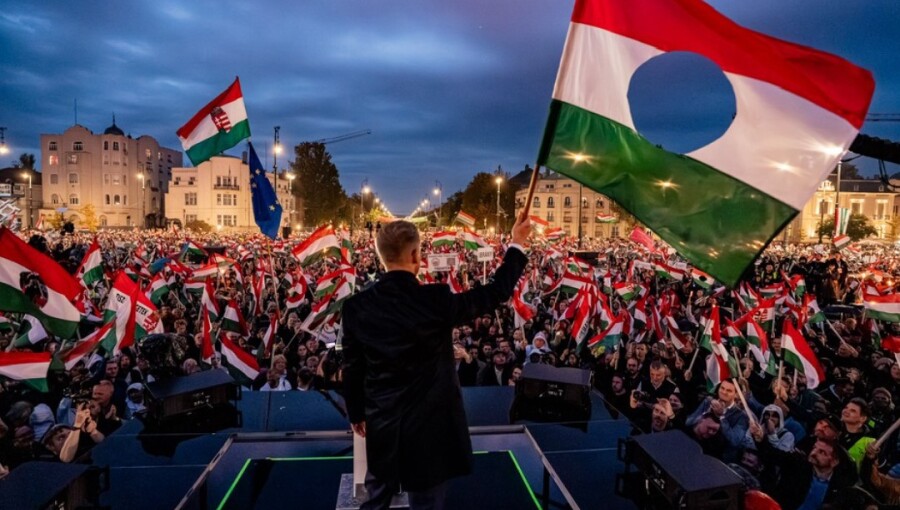
Hundreds of thousands of people took part in rallies on the October 23 national holiday in Hungary, commemorating the 69th anniversary of the 1956 anti-Soviet uprising, as both Fidesz and its rival Tisza Party sought to show force by bringing out as many supporters as possible less than six months before the election. 

Hungarian opposition leader Péter Magyar has called for a peaceful regime change and described it as the most important national holiday since the fall of Communism, according to leftist broadsheet Népszava. Viktor Orban said that those "misguided" people who are in favour of change of government are supporting the war.

The opposition leader argued that the majority of Hungarians recognise that the country is on a dangerous path, one that could lead to another national tragedy unless there is a fundamental shift in leadership.

He drew comparisons between the current political situation and Hungary's oppressive past, warning that the country is being led by what he described as a "Kádár-like" regime, referencing János Kádár, the communist leader who ruled Hungary from the end of 1956 until his death in 1989. Magyar claimed that under the current leadership, those who disagree with the government are marginalised and demonised, accusing the ruling party of labelling dissenters as "enemies" and using divisive language to paint those seeking freedom and prosperity as "criminals" or "insects."

The opposition leader also criticised the government for deviating from the democratic principles that the 1956 revolution sought to uphold. He accused the prime minister of centralising power, suppressing the press, and ruling through fear. Magyar pointed out that in 1989, Orban, as a young opposition figure, had spoken out against centralised power, but now, as Prime Minister, he has created a similar system that suppresses dissent and democratic values.

The 44-year-old opposition leader, a former Fidesz cadre member, made several references to Viktor Orban’s historic speech delivered in June 1989, during the reburial of martyred Prime Minister Imre Nagy and his followers. Many view this speech as marking the beginning of the fall of Hungary's Communist Party. Orban’s bold address catapulted him to prominence, where he called for the withdrawal of Russian troops stationed in Hungary since 1945.

Magyar continued, asserting that Hungary can only remain free and independent if its leaders do not bow to foreign powers in exchange for political gains or photo opportunities. He called for responsible leadership that prioritises Hungary’s sovereignty over external pressures.

The opposition leader also used the occasion to outline his party’s commitments for the upcoming elections, which include restoring judicial independence, joining the European Public Prosecutor’s Office, opening agent files, and introducing a national reconciliation law. He further outlined policies to protect national security, sovereignty, and democratic freedoms, as well as tax reductions, pension increases, and the introduction of a new child protection law.

"In just over 170 days, we will wake up in a free and smiling country," he said, referring to next year's general election. "For that to happen, we'll need humility, humanity, hard work and a great deal of patriotism," he said, announcing that he will set off on another nationwide tour dubbed the "Road to Victory".

Most independent polls show the Tisza Party is leading by double digits, except for those controlled by the government, which still forecast a slight Fidesz lead.

Meanwhile, Fidesz also went to great length to demonstrate its strength with a mass rally ahead of the April elections. With extensive party infrastructure and communication channels, the ruling party mobilised voters from across Hungary, including bus loads of people from smaller settlements. Opposition media reported seeing leaflets offering free food vouchers to participants, and numerous vehicles bearing Ukrainian and Serbian license plates were also spotted in central Budapest.

Orban’s supporters gathered on the Buda side of Margaret Bridge and marched through the city to Kossuth Square, where the Prime Minister delivered his speech. Before the rally, Orban expressed frustration that, despite his requests, EU summits often coincide with Hungary's national holiday. After the event, he flew to Brussels to attend the meeting.

Orban referred to the rally, dubbed the "Peace March," as the largest pro-government rally ever, describing it as "Europe’s largest patriotic movement." He urged supporters to stand firm against Brussels, which he claimed seeks to drag Hungary into war. He emphasised Hungary’s unique position as the only country in Europe to have maintained a "Christian, conservative, and nationally-minded" government for over sixteen years, stressing the importance of defending the nation’s sovereignty against external pressures, particularly from Brussels.

In his address, Orban reaffirmed Hungary’s role in defending peace, describing the country as the "capital of peace" in Europe. He called on his supporters to engage with "misled Hungarians" who favour a change of government, arguing that those voters are supporting policies that align with war. Fidesz is expected to continue the narrative in the election campaign that the Tisza Party is a puppet of Brussels.

Orban also referenced the legacy of the 1956 revolution, drawing parallels between the resistance against Soviet oppression then and Hungary's current opposition to what he called the "liberal and global forces" in Brussels. He repeated his accusations that the EU was blocking Donald Trump’s peace efforts regarding the war in Ukraine, remaining undeterred by the news that the Trump-Putin meeting had been called off.

The news of the postponement of the Trump-Putin meeting, which had placed both the government and Orban in the international spotlight for several days, caught the government and its media off guard.

Following the rallies, debates intensified over the size of the turnout at the two events. Political analysts and online commentators engaged in discussions, with both sides claiming their rallies had a larger crowd. Social media platforms were flooded with images and estimates, further fuelling the ongoing political discourse. 

While Fidesz successfully filled Kossuth Square in front of Parliament, the Tisza rally saw Budapest's iconic Heroes' Square packed to capacity, with people stretching along Andrassy Boulevard leading to the square. A Facebook post of a photo shot from a commercial plane depicting that image went viral on social media.

Peter Magyar later posted: "We are the majority."


... Germany in 1953. Then, in March of 1955, Rákosi was brought back. Poland ... 4 Quoted in Chris Harman, Bureaucracy and Revolution in Eastern Europe ...


LIBERTARIAN SOCIALIST VIEWS
Libcom.orgfiles.libcom.org/files/The Hungarian Revolution 1956.pdf

... Hungary '56 articles. [11,000 words]. For a short history, we recommend ... Andy Anderson: Hungary '56, Solidarity (London) 19^4. Books on Hungary 1956 


The Hungarian Revolution

This Day in Anarchist History

This Day in Anarchist History, October 23rd 1956 we remember the Hungarian Revolution when student protesters and the broader Hungarian working classes took on the Secret Police and the Red Army.

After days of striking and rioting that boiled into a firefight, protesters were able to defeat the country’s Secret Police and even negotiated the withdrawal of the Red Army from Hungary… for a time, that is.

Impromptu proletarian militias wasted no time looting factories to arm themselves. Unfortunately time was in too short supply as the Red Army tanks were sent back just days later, this time with orders to brutally crush the revolt. 3,000 Hungarians were killed, about 20,000 were imprisoned and hundreds of thousands more fled. There was very little dissent from Hungary for the rest of the USSR’s existence.

SubMedia is directed and produced by Frank Lopez. Read other articles by subMedia, or visit subMedia's website.

Mar 27, 2023 ... In June 1953, workers across East Germany rose in the first major rebellion in the Eastern Bloc. For a brief period, the iron grip of ...

Juni 1953 ) was an uprising that occurred over the course of two days in the German Democratic Republic (GDR) from 16 to 17 June 1953. It began with strike ...

In the USSR there were strikes in the great slave camps. In East Germany and Pilzen in Czechoslovakia in 1953 and in Poznan in Poland strikes led to bitter ...


Chris Harman is the editor of International Socialism journal. (www.isj.org ... Revolution: Germany. 1918 to 1923 and Revolution in the 21st Century.

Nov 10, 2009 ... Down the years the books kept coming – the phenomenal Lost Revolution, The Fire Last Time, the extraordinary People's History of the World, and ...


Monday, October 24, 2022

Thousands protest against PM Orban's government, "runaway inflation"

Sun, October 23, 2022 

Hungarian PM Viktor Orban delivers a speech for National Day, in Zalaegerszeg


BUDAPEST (Reuters) -Thousands of Hungarians including teachers and students marched through Budapest on Sunday to protest against the government, demanding higher wages for teachers and a curb on surging inflation that is eroding incomes.

Walking across a bridge over the Danube, protesters held up banners like "Orban get lost" and "No teachers, no future," a few hours after nationalist Prime Minister Viktor Orban pledged to preserve economic stability and maintain a cap on household energy bills even as the EU slides into an "economic crisis".


But at the latest in a series of anti-government protests participants said his government had let teachers down by giving them meagre salaries, while inflation, which topped 20% in September and is still rising, was becoming unbearable.

"I am here...for my children, there should be change," said Gyongyi Bereczky, a mail carrier, who joined the protests for the first time. "This runaway inflation... we cannot save up at all anymore, simply we cannot make ends meet as prices are soaring."

Teachers and students have been protesting for higher wages, a solution to a deepening shortage of teachers, and the right to strike.

As the country marked the anniversary of the 1956 uprising against Soviet rule, Orban, who was reelected for a fourth consecutive term in April, said earlier on Sunday that next year would pose challenges with the war in neighbouring Ukraine.

"A war in the east, and an economic crisis in the West," Orban told supporters in Zalaegerszeg, about 200 km (124 miles)west of Budapest, adding that there was "financial crisis and economic downturn in the EU".

"In 1956 we learnt that unity is needed in difficult times... we will preserve economic stability, everyone will have a job, we can defend the scheme of caps on energy bills, and families will not be left on their own."

Caps on gas and electricity bills have been a key plank of Orban's policies, but the costs of the scheme surged this year due to soaring energy prices, burdening the state budget. The government was forced to scrap the cap for higher-usage households from Aug. 1.

It is due to amend the 2023 budget in December as the budget law, approved in July, forecast growth at 4.1% next year while inflation was seen at 5.2% -- forecasts since rendered obsolete by the surge in prices into double-digits. Economic growth is now expected to slow to 1% next year.

The forint plunged to record lows earlier this month, forcing the central bank to ramp up interest rates in an emergency move.

(Reporting by Krisztina Than, Additional reporting by Krisztina Fenyo Editing by William Maclean)

1956 FROM THE LEFT POINT OF VIEW

Oct 13, 2021 — On 23 October 1956, thousands of protestors gathered in Budapest to demand the withdrawal of Soviet troops from Hungary, setting off a ...

Andy Anderson's pamphlet, written in 1964 and published by Solidarity is invaluable as a guide to the events of the Hungarian uprising of 1956.


Oct 31, 1986 — We are reproducing an article first published in October 1986,the 30th anniversary of the 1956 Hungarian workers' uprising against Stalinist ...