OPINION
Mad for Mamdani
Published November 8, 2025
DAWN
The writer is a Pakistan attorney teaching constitutional law and political philosophy.
THE victory was not entirely unexpected but it was historic. For a while, the polls had shown that Zohran Mamdani, the immigrant Muslim of South Asian origin, was leading in the polls for New York City mayor. But it was not entirely guaranteed as pundits predicted that a larger-than-usual turnout of older voters who favoured Andrew Cuomo could cause an upset. That upset never came and on the night of Nov 4, America’s largest city elected a Muslim mayor for the first time.
For Democrats, particularly progressive Democrats, who had balked at their party’s tacit support for the genocide in Gaza, its lack of action over ICE raids, and lack of real solutions to inflation, the victory was a vindication. In Mamdani — against whom more than 20 billionaires put up millions of dollars — they could finally show where the energy of the party lay. Gen Z turned out in droves to support and vote for him. Here, finally after years of centrist fakes favoured by the likes of Hillary Clinton and Chuck Schumer, was someone who spoke the language of party voters. The margin of his victory shows how wrong the Democratic establishment had been.
The real story is also one of immigrants and of Muslims. New York is the city burdened with the memory of 9/11, which both the Republicans and the Democrats used to start and fund wars everywhere, thus triggering the age of Islamophobia. For over two decades, the memory of 9/11 has been used by politicians in NYC to justify racial profiling and the open targeting of Muslims or even anyone who ‘looks’ like one. Dubious security rationales and unsubstantiated ‘possibilities’ of attacks were used to terrify Muslim men and women. FBI and NYPD agents were sent to infiltrate mosques; Muslims were often coerced into informing on other Muslims even when there was nothing to inform on. Plans to build a mosque were met with vitriolic Islamophobia, including by Jewish-American groups in the city who used 9/11 to institutionalise the marginalisation of Muslims.
This leads to another facet of Mamdani’s win. NYC is the most Jewish city in the world outside of Israel. Many might have thought that in the shadow of the Gaza genocide and Mamdani’s open support for the Palestinians, such a victory was not possible. However, while large numbers in the Jewish community voted against him — exit polls showed Russian Jews had been especially mobilised against Mamdani — a decent number of young American Jews voted for him. Unlike older American Jews, most of whom tend to be Zionists and feel that criticism of Israel is antisemitism, younger American Jews have a more nuanced view.
The real story is also one of immigrants and of Muslims.
This is likely to be very concerning to Israel whose lobby AIPAC funds both Republican and Democratic candidates in the US in exchange for their support. In the mayoral debate for NYC, Mamdani was the only candidate who said he was not interested in taking a trip to Israel and would rather stay in NYC. He was criticised by the other candidates who doubled down on him, but he remained firm. He is also the man who won. This is likely to worry lobbyists who may wonder if politicians realise that Americans are quite exhausted with their politicians supporting Israel while they cannot afford rent or food.
Beyond NYC, Democrats won with big margins, which is being seen as a clear preview of what midterm elections in the US are likely to serve up next year. Voters voted against the Republicans and by default the Trump agenda by notable margins; even lacklustre Democratic candidates managed to win. This is welcome news for everyone in America who has been watching the gutting of the government that has been underway since the beginning of this year. Usually, presidents have a bit more time before the public tires of them. Not so this time.
As for immigrants and Muslims, the news was good from places beyond NYC as well. Virginia elected Indian American Ghazala Hashmi as their first Muslim American woman lieutenant governor; Muslims were elected as mayor of Dearborn, Michigan and Dearborn Heights.
Zohran Mamdani was nine years old when the events of 9/11 happened. His Oscar-nominated filmmaker mother Mira Nair, who is married to the well-known postcolonial scholar Mahmood Mamdani, likely never imagined that the grade schooler, who was a Muslim kid in a city that had begun to grow wary of Muslims overnight, would go on to become the youngest mayor of New York City in 100 years. But miracles do happen and the churn of history means that the outcast can be reborn as a leader in the same lifetime. Zohran Mamdani’s story is a lesson and an inspiration to all those who doubted the possibility of better times.
rafia.zakaria@gmail.com
Published in Dawn, November 8th, 2025
THE victory was not entirely unexpected but it was historic. For a while, the polls had shown that Zohran Mamdani, the immigrant Muslim of South Asian origin, was leading in the polls for New York City mayor. But it was not entirely guaranteed as pundits predicted that a larger-than-usual turnout of older voters who favoured Andrew Cuomo could cause an upset. That upset never came and on the night of Nov 4, America’s largest city elected a Muslim mayor for the first time.
For Democrats, particularly progressive Democrats, who had balked at their party’s tacit support for the genocide in Gaza, its lack of action over ICE raids, and lack of real solutions to inflation, the victory was a vindication. In Mamdani — against whom more than 20 billionaires put up millions of dollars — they could finally show where the energy of the party lay. Gen Z turned out in droves to support and vote for him. Here, finally after years of centrist fakes favoured by the likes of Hillary Clinton and Chuck Schumer, was someone who spoke the language of party voters. The margin of his victory shows how wrong the Democratic establishment had been.
The real story is also one of immigrants and of Muslims. New York is the city burdened with the memory of 9/11, which both the Republicans and the Democrats used to start and fund wars everywhere, thus triggering the age of Islamophobia. For over two decades, the memory of 9/11 has been used by politicians in NYC to justify racial profiling and the open targeting of Muslims or even anyone who ‘looks’ like one. Dubious security rationales and unsubstantiated ‘possibilities’ of attacks were used to terrify Muslim men and women. FBI and NYPD agents were sent to infiltrate mosques; Muslims were often coerced into informing on other Muslims even when there was nothing to inform on. Plans to build a mosque were met with vitriolic Islamophobia, including by Jewish-American groups in the city who used 9/11 to institutionalise the marginalisation of Muslims.
This leads to another facet of Mamdani’s win. NYC is the most Jewish city in the world outside of Israel. Many might have thought that in the shadow of the Gaza genocide and Mamdani’s open support for the Palestinians, such a victory was not possible. However, while large numbers in the Jewish community voted against him — exit polls showed Russian Jews had been especially mobilised against Mamdani — a decent number of young American Jews voted for him. Unlike older American Jews, most of whom tend to be Zionists and feel that criticism of Israel is antisemitism, younger American Jews have a more nuanced view.
The real story is also one of immigrants and of Muslims.
This is likely to be very concerning to Israel whose lobby AIPAC funds both Republican and Democratic candidates in the US in exchange for their support. In the mayoral debate for NYC, Mamdani was the only candidate who said he was not interested in taking a trip to Israel and would rather stay in NYC. He was criticised by the other candidates who doubled down on him, but he remained firm. He is also the man who won. This is likely to worry lobbyists who may wonder if politicians realise that Americans are quite exhausted with their politicians supporting Israel while they cannot afford rent or food.
Beyond NYC, Democrats won with big margins, which is being seen as a clear preview of what midterm elections in the US are likely to serve up next year. Voters voted against the Republicans and by default the Trump agenda by notable margins; even lacklustre Democratic candidates managed to win. This is welcome news for everyone in America who has been watching the gutting of the government that has been underway since the beginning of this year. Usually, presidents have a bit more time before the public tires of them. Not so this time.
As for immigrants and Muslims, the news was good from places beyond NYC as well. Virginia elected Indian American Ghazala Hashmi as their first Muslim American woman lieutenant governor; Muslims were elected as mayor of Dearborn, Michigan and Dearborn Heights.
Zohran Mamdani was nine years old when the events of 9/11 happened. His Oscar-nominated filmmaker mother Mira Nair, who is married to the well-known postcolonial scholar Mahmood Mamdani, likely never imagined that the grade schooler, who was a Muslim kid in a city that had begun to grow wary of Muslims overnight, would go on to become the youngest mayor of New York City in 100 years. But miracles do happen and the churn of history means that the outcast can be reborn as a leader in the same lifetime. Zohran Mamdani’s story is a lesson and an inspiration to all those who doubted the possibility of better times.
rafia.zakaria@gmail.com
Published in Dawn, November 8th, 2025
(RNS) — Mamdani's election has already energized Muslim progressive candidates, political experts say, who are disillusioned by the Democratic establishment or feel shut out of the political system.
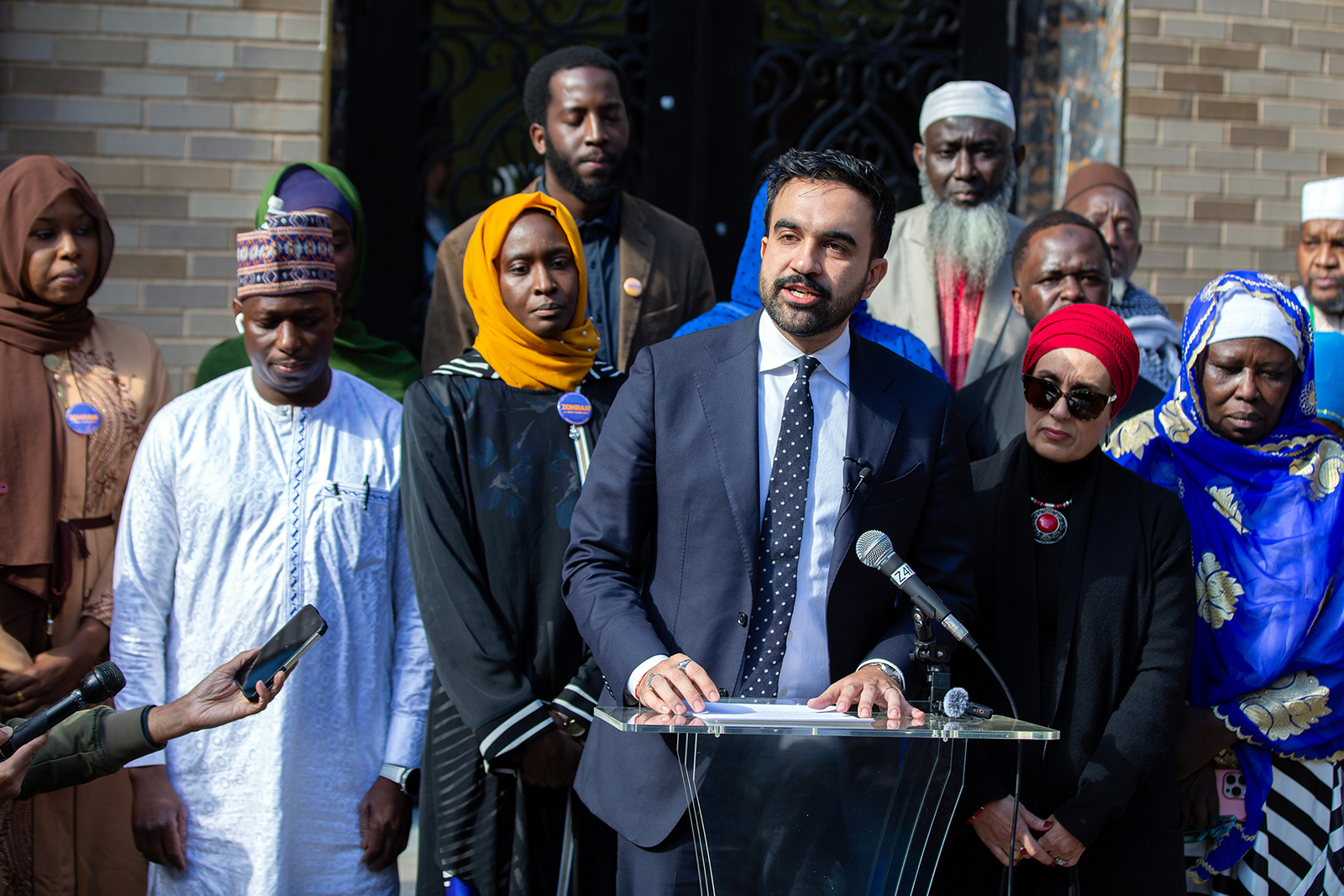
New York City Democratic mayoral candidate Zohran Mamdani speaks at the Islamic Cultural Center of the Bronx mosque in New York on Oct. 24, 2025. (AP Photo/Ted Shaffrey)
Ulaa Kuziez
November 7, 2025
RNS
(RNS) — New York City Mayor-elect Zohran Mamdani spoke unapologetically about his Muslim faith and democratic socialist roots during his victory speech on Election Day (Nov. 4). In a sharp rebuke to the Islamophobic attacks he faced during the campaign, Mamdani said his mayoralty would be one where Muslim interests would be taken seriously in New York, “where the more than 1 million Muslims know that they belong — not just in the five boroughs of this city, but in the halls of power.”
Political experts say Mamdani’s historic win may motivate more Muslims and younger progressives to seek – and attain – those halls of power.
“Mamdani definitely has invigorated many Muslims around civic participation,” said political consultant Salima Suswell. “And I do think that there will be young Muslims who look up to him and want to follow in his footsteps, which I think is an amazing thing.”
The Council on American Islamic Relations, a civil rights and community engagement group, estimates that at least 37 other Muslim Americans won in elections on Nov. 4, among them Virginia Lieutenant Governor-elect Ghazala Hashmi; Dearborn, Michigan, Mayor Abdullah Hammoud; Dearborn Heights Mayor Mo Baydoun; and Virginia House Delegate Sam Rasoul.
Nabilah Islam Parkes, who became the first Muslim woman to serve in the Georgia Senate in 2023, anticipates that more Muslims will be inspired by the success of Mamdani and other Muslims, as she was by the electoral victories of Democratic U.S. Reps. Ilhan Omar of Minnesota and Rashida Tlaib of Michigan. She said these Muslim women showed her that faith does not have to be a barrier to political office.
“They were definitely a catalyst for me as a young Muslim woman,” Parkes said. “It’s our time. We don’t have to wait for some far away time to run for office in this country — when there’s less Islamophobia.”
Mamdani not only showed that winning office was possible, he invited Muslims to rethink their relationship with politics in places where Muslims have felt dismissed or even betrayed by the political system. “I think this creates hope for people that there can be diverse representation in the political world, and not just diverse in imagery, but also diverse in thoughts,” said Saman Waquad, president of the Muslim Democratic Club of New York City, where Mamdani spent time early in political formation.
Waquad said Mamdani’s progressive politics are not for the Muslim community only, attracted a wide range of voters. “We can have political leadership that actually cares for the people and wants to make the city and this country livable and affordable,” she said, “and a political leader who actually thinks about the most disenfranchised folks.”
RELATED: Inside Zohran Mamdani’s bid to win over religious New Yorkers
While a majority of Muslim American politicians are Democrats, they are not uniformly progressive, and most tend to be more conservative on economic stances than Mamdani, said Nura Sediq, a political science professor at Michigan State University. Still, Mamdani’s election, Sediq said, has energized some Muslim disillusioned by the Democratic establishment, who are seeing renewed possibilities in Mamdani’s rapid rise from state assemblyman to mayor.
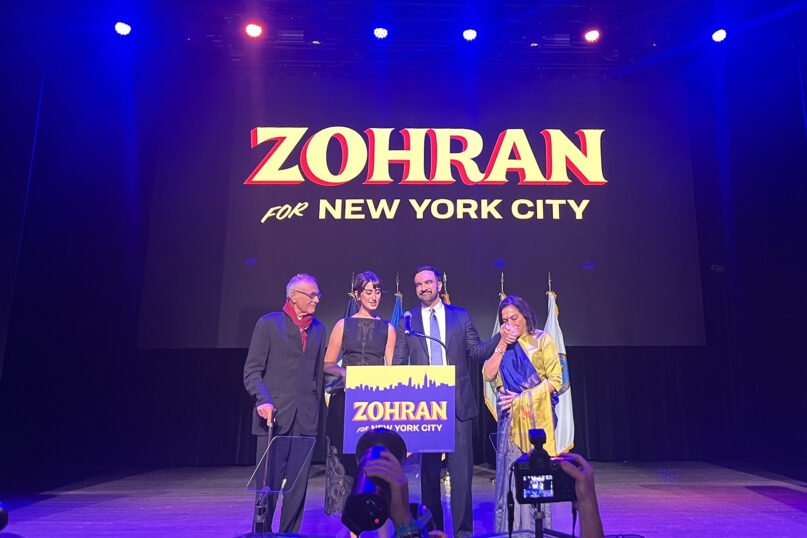
Zohran Mamdani, joined by his wife and parents, speaks during a victory speech at a mayoral election night watch party, Tuesday, Nov. 4, 2025, in New York. (RNS photo/Fiona André)
“Younger progressive candidates are going to feel more emboldened to take the shot and go from being a state legislator to mayor or a Senate seat quicker,” Sediq said.
For Abdul El-Sayed, a progressive Democrat running for U.S. Senate in Michigan, the rising number of Muslims in office is a reflection of a community with growing frustration with American politics. “So long as we continue to have a democracy, they can seek to express themselves in that highest order of citizenship, which is to run for an elected role in their government,” he said. “And that’s a beautiful thing.”
RELATED: Muslim voters didn’t cost Dems the 2024 election, a new poll says. But they may have found their voice
Some are concerned that, with increased visibility, the new wave of Muslim candidates will attract anti-Muslim bias. Islamophobia is on the rise, according to recent data from the Institute for Social Policy and Understanding, which surveyed close to 2,500 people to measure anti-Muslim sentiment among the public.
But CAIR, in a Nov. 6 statement, said that success at the ballot is an important way to push back against Islamophobia. “At a time when many American Muslim candidates endured slander, harassment, and overt Islamophobia, their strength and dedication to public service send a clear message that bigotry has no place in American politics and that Americans are rejecting anti-Muslim campaign rhetoric and cheap political attacks.”
Parkes, the Georgia state senator, agrees that running for and winning office is a antidote to Islamophobia, giving politicians a powerful platform from which to correct misunderstandings about the faith. “It’s so important that we see positive images of Muslims leading and leading well. It combats horrific narratives that are being spewed,” she said. “We are defining ourselves rather than being defined by the far right.”
As important as the increase in Muslim candidates, said Suswell, is the number of Muslims registered to vote, which is higher today than in 2016, ISPU data shows. With Muslim-led organizations mobilizing voters, supporting candidates and forming PACs, all signs point to a growing and diverse Muslim voter bloc.
“We are doing the work,” said Suswell. “As a community, building political power is paramount to us establishing change and supporting the unique needs of American Muslims.”
(RNS) — New York City Mayor-elect Zohran Mamdani spoke unapologetically about his Muslim faith and democratic socialist roots during his victory speech on Election Day (Nov. 4). In a sharp rebuke to the Islamophobic attacks he faced during the campaign, Mamdani said his mayoralty would be one where Muslim interests would be taken seriously in New York, “where the more than 1 million Muslims know that they belong — not just in the five boroughs of this city, but in the halls of power.”
Political experts say Mamdani’s historic win may motivate more Muslims and younger progressives to seek – and attain – those halls of power.
“Mamdani definitely has invigorated many Muslims around civic participation,” said political consultant Salima Suswell. “And I do think that there will be young Muslims who look up to him and want to follow in his footsteps, which I think is an amazing thing.”
The Council on American Islamic Relations, a civil rights and community engagement group, estimates that at least 37 other Muslim Americans won in elections on Nov. 4, among them Virginia Lieutenant Governor-elect Ghazala Hashmi; Dearborn, Michigan, Mayor Abdullah Hammoud; Dearborn Heights Mayor Mo Baydoun; and Virginia House Delegate Sam Rasoul.
Nabilah Islam Parkes, who became the first Muslim woman to serve in the Georgia Senate in 2023, anticipates that more Muslims will be inspired by the success of Mamdani and other Muslims, as she was by the electoral victories of Democratic U.S. Reps. Ilhan Omar of Minnesota and Rashida Tlaib of Michigan. She said these Muslim women showed her that faith does not have to be a barrier to political office.
“They were definitely a catalyst for me as a young Muslim woman,” Parkes said. “It’s our time. We don’t have to wait for some far away time to run for office in this country — when there’s less Islamophobia.”
Mamdani not only showed that winning office was possible, he invited Muslims to rethink their relationship with politics in places where Muslims have felt dismissed or even betrayed by the political system. “I think this creates hope for people that there can be diverse representation in the political world, and not just diverse in imagery, but also diverse in thoughts,” said Saman Waquad, president of the Muslim Democratic Club of New York City, where Mamdani spent time early in political formation.
Waquad said Mamdani’s progressive politics are not for the Muslim community only, attracted a wide range of voters. “We can have political leadership that actually cares for the people and wants to make the city and this country livable and affordable,” she said, “and a political leader who actually thinks about the most disenfranchised folks.”
RELATED: Inside Zohran Mamdani’s bid to win over religious New Yorkers
While a majority of Muslim American politicians are Democrats, they are not uniformly progressive, and most tend to be more conservative on economic stances than Mamdani, said Nura Sediq, a political science professor at Michigan State University. Still, Mamdani’s election, Sediq said, has energized some Muslim disillusioned by the Democratic establishment, who are seeing renewed possibilities in Mamdani’s rapid rise from state assemblyman to mayor.
Zohran Mamdani, joined by his wife and parents, speaks during a victory speech at a mayoral election night watch party, Tuesday, Nov. 4, 2025, in New York. (RNS photo/Fiona André)
“Younger progressive candidates are going to feel more emboldened to take the shot and go from being a state legislator to mayor or a Senate seat quicker,” Sediq said.
For Abdul El-Sayed, a progressive Democrat running for U.S. Senate in Michigan, the rising number of Muslims in office is a reflection of a community with growing frustration with American politics. “So long as we continue to have a democracy, they can seek to express themselves in that highest order of citizenship, which is to run for an elected role in their government,” he said. “And that’s a beautiful thing.”
RELATED: Muslim voters didn’t cost Dems the 2024 election, a new poll says. But they may have found their voice
Some are concerned that, with increased visibility, the new wave of Muslim candidates will attract anti-Muslim bias. Islamophobia is on the rise, according to recent data from the Institute for Social Policy and Understanding, which surveyed close to 2,500 people to measure anti-Muslim sentiment among the public.
But CAIR, in a Nov. 6 statement, said that success at the ballot is an important way to push back against Islamophobia. “At a time when many American Muslim candidates endured slander, harassment, and overt Islamophobia, their strength and dedication to public service send a clear message that bigotry has no place in American politics and that Americans are rejecting anti-Muslim campaign rhetoric and cheap political attacks.”
Parkes, the Georgia state senator, agrees that running for and winning office is a antidote to Islamophobia, giving politicians a powerful platform from which to correct misunderstandings about the faith. “It’s so important that we see positive images of Muslims leading and leading well. It combats horrific narratives that are being spewed,” she said. “We are defining ourselves rather than being defined by the far right.”
As important as the increase in Muslim candidates, said Suswell, is the number of Muslims registered to vote, which is higher today than in 2016, ISPU data shows. With Muslim-led organizations mobilizing voters, supporting candidates and forming PACs, all signs point to a growing and diverse Muslim voter bloc.
“We are doing the work,” said Suswell. “As a community, building political power is paramount to us establishing change and supporting the unique needs of American Muslims.”
The Shift: Pro-Israel groups melt down over Mamdani win
November 6, 2025
MONDOWEISS
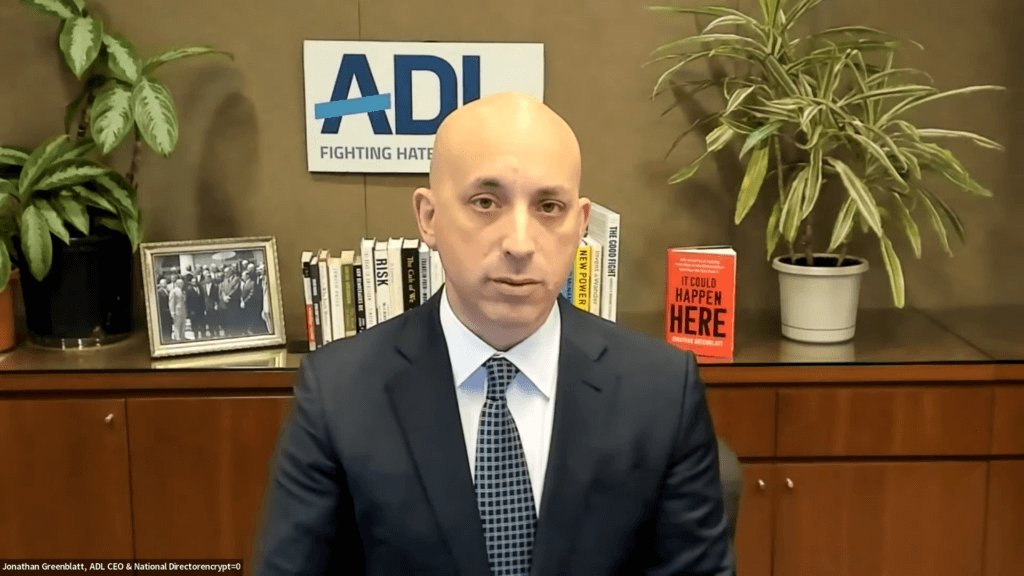
Jonathan Greenblatt of the ADL
Screenshot from ADL video.
Just hours after Zohran Mamdani prevailed in New York City’s mayoral election, the Anti-Defamation League (ADL) announced that it was launching an initiative to track and monitor the policies of his incoming administration.
The ADL’s “Mamdani Monitor” will include a hotline that enables New Yorkers to report antisemitism.
“We are deeply concerned that those individuals and principles will influence his administration at a time when we are tracking a brazen surge of harassment, vandalism, and violence targeting Jewish residents and institutions in recent years,” ADL CEO Jonathan Greenblatt told Jewish Insider.
When Greenblatt showed up on MSNBC to plug the new project, he wasn’t greeted with the usual camaraderie that he’s presumably come to expect from the network.
“I’ll look right at the camera: if you are a Jewish New Yorker, we have your back,” he told viewers.
He then brought up a number of violent incidents, including the firebombing of Pennsylvania Gov. Josh Shapiro’s house, the fatal shooting of Israeli embassy staff members, and the deadly attack on a pro-Israel demonstration in Colorado.
“We’re all shocked and we all find this abhorrent and I’m sure the next mayor would say the same thing, wouldn’t he?,” responded conservative host Joe Scarborough.
“You have to ask him,” Greenblatt retorted.
“He has gone to one High Holiday service after another, he has talked to the Jewish community,” noted Scarborough.
Greenblatt told Scarborough that those people don’t actually count as Jews.
“He went to an anti-Zionist synagogue, which is like going to the Black breakout at CPAC and saying you understand African Americans,” he reasoned.
When Scarborough asked Greenblatt if he was suggesting that Mamdani supports violence, he insisted he wasn’t.
“I never said that! I never said that, no no!,” shouted Greenblatt.
The transcript of his remarks obviously tells a different story.
This was all too much for Scarborough.
“There’s a lot of blurring and blending here Jonathan!” he said. “You know I love you, you’re on all the time and we’re always a fierce defender of yours, but you seem to be blurring a lot of things together and then looking into that camera and say ‘call us!’”
This rebuke is relatively gentle and contains caveats, but it’s worth noting that mainstream pundits almost never push back on Greenblatt when he makes one of his frequent cable news appearances.
The Greenblatt narrative might not be registering like it used to, but dozens of pro-Israel groups are embracing it.
In a lengthy statement, American Jewish Committee (AJC) Ted Deutch expresses deep concerns about Mamdani’s support of BDS and his comments on arresting wanted war criminal Benjamin Netanyahu. He also calls on the mayor-elect to condemn the phrase “from the river to the sea,” but it certainly seems like that ship has sailed.
“And just as we defend every Jewish community around the world, today and in the months ahead, we’ll be standing proudly with New York’s Jews demanding the safety, security, and respect that we fully deserve,” writes Deutch.
Certainly he doesn’t mean every Jewish community, as Greenblatt made clear.
The Conference of Presidents of Major American Jewish Organizations said Mamdani’s win marks a “grim milestone.” Former Israeli finance minister and right-wing leader Avigdor Lieberman said, “The Big Apple has fallen,” and called on Jewish New Yorkers to flee to Israel. The Zionist Organization of America (VOA) vowed to fight against Mamdani’s alleged “anti-Jewish and anti-Israel policies and actions.”
“Globalize Zionism!,” declares a statement from the group on the election.
Democratic Majority for Israel (DMFI) sent out a fundraising email downplaying Mamdani’s victory. The group insists that the elections of pro-Israel Governors Abigail Spanberger and Mikie Sherrill are much more important.
“There’s a lot of noise in the political ecosystem because of a New York City electorate that is an outlier and not reflective of the rest of the nation,” says the group.
A pro-Israel lobbying group doesn’t think the most Jewish city in the United States reflects the rest of the nation? Makes you think.
Other results
New York City wasn’t the only city where Israel and Palestine factored into campaigns.
Two weeks ago, we dedicated a newsletter to several mayoral races. Willie Burnley Jr. lost in Somerville, and centrist Mayor Jacob Frey fended off socialist State Senator Omar Fateh, who faced unrelenting attacks from right-wing media and some Democrats.
At this time, it’s not known whether Israel-critic Katie Wilson or incumbent mayor Bruce Harrell has prevailed in Seattle.
Residents of Somerville, Massachusetts, voted on a municipal ballot proposal to divest from Israel and endorsed it by a 53% margin. The effort garnered 11,400 votes, surpassing those of mayor-elect Jake Wilson.
The group Somerville for Palestine put out a statement on the victory, detailing the local organizing efforts.
“Over 300 grassroots volunteers gathered more than 11,000 signatures to get the ‘Palestine Solidarity’ question on the ballot,” said the group. “Volunteers spent 7 months canvassing the city, chatting with joggers and bikers on the Somerville Community Path, collecting signatures at farmers’ markets and between garage-band sets at the popular ‘Porchfest’ local music festival. The homegrown Palestine Solidarity ‘Yes on 3’ Campaign defied the odds, defeating an 11th-hour opposition from an astroturf group backed by the controversial ADL which outspent them 4 to 1 in an effort to invalidate signatures and bring an unsubstantiated legal challenge which was quickly dismissed.”
The statement quoted Somerville resident and organizer Mia Haddad:
“This measure would follow previous successful efforts in Somerville to boycott companies complicit in South African Apartheid and those that use practices that violate human rights, such as prison labor. Just as these movements treated local activism and foreign policy as interconnected, Somerville residents see the intersection: “ We don’t want to see children go hungry, in Massachusetts or in Gaza.”
“Americans want to reinvest in our communities, not to see our tax dollars spent for genocide or squandered on lavish parties for billionaires.” The vote in Somerville now marks a decisive trend across the United States and around the world calling for aligning investments with community values by moving public money out of companies that contribute to Israel’s apartheid, genocide and illegal occupation of Palestine.”
Just hours after Zohran Mamdani prevailed in New York City’s mayoral election, the Anti-Defamation League (ADL) announced that it was launching an initiative to track and monitor the policies of his incoming administration.
The ADL’s “Mamdani Monitor” will include a hotline that enables New Yorkers to report antisemitism.
“We are deeply concerned that those individuals and principles will influence his administration at a time when we are tracking a brazen surge of harassment, vandalism, and violence targeting Jewish residents and institutions in recent years,” ADL CEO Jonathan Greenblatt told Jewish Insider.
When Greenblatt showed up on MSNBC to plug the new project, he wasn’t greeted with the usual camaraderie that he’s presumably come to expect from the network.
“I’ll look right at the camera: if you are a Jewish New Yorker, we have your back,” he told viewers.
He then brought up a number of violent incidents, including the firebombing of Pennsylvania Gov. Josh Shapiro’s house, the fatal shooting of Israeli embassy staff members, and the deadly attack on a pro-Israel demonstration in Colorado.
“We’re all shocked and we all find this abhorrent and I’m sure the next mayor would say the same thing, wouldn’t he?,” responded conservative host Joe Scarborough.
“You have to ask him,” Greenblatt retorted.
“He has gone to one High Holiday service after another, he has talked to the Jewish community,” noted Scarborough.
Greenblatt told Scarborough that those people don’t actually count as Jews.
“He went to an anti-Zionist synagogue, which is like going to the Black breakout at CPAC and saying you understand African Americans,” he reasoned.
When Scarborough asked Greenblatt if he was suggesting that Mamdani supports violence, he insisted he wasn’t.
“I never said that! I never said that, no no!,” shouted Greenblatt.
The transcript of his remarks obviously tells a different story.
This was all too much for Scarborough.
“There’s a lot of blurring and blending here Jonathan!” he said. “You know I love you, you’re on all the time and we’re always a fierce defender of yours, but you seem to be blurring a lot of things together and then looking into that camera and say ‘call us!’”
This rebuke is relatively gentle and contains caveats, but it’s worth noting that mainstream pundits almost never push back on Greenblatt when he makes one of his frequent cable news appearances.
The Greenblatt narrative might not be registering like it used to, but dozens of pro-Israel groups are embracing it.
In a lengthy statement, American Jewish Committee (AJC) Ted Deutch expresses deep concerns about Mamdani’s support of BDS and his comments on arresting wanted war criminal Benjamin Netanyahu. He also calls on the mayor-elect to condemn the phrase “from the river to the sea,” but it certainly seems like that ship has sailed.
“And just as we defend every Jewish community around the world, today and in the months ahead, we’ll be standing proudly with New York’s Jews demanding the safety, security, and respect that we fully deserve,” writes Deutch.
Certainly he doesn’t mean every Jewish community, as Greenblatt made clear.
The Conference of Presidents of Major American Jewish Organizations said Mamdani’s win marks a “grim milestone.” Former Israeli finance minister and right-wing leader Avigdor Lieberman said, “The Big Apple has fallen,” and called on Jewish New Yorkers to flee to Israel. The Zionist Organization of America (VOA) vowed to fight against Mamdani’s alleged “anti-Jewish and anti-Israel policies and actions.”
“Globalize Zionism!,” declares a statement from the group on the election.
Democratic Majority for Israel (DMFI) sent out a fundraising email downplaying Mamdani’s victory. The group insists that the elections of pro-Israel Governors Abigail Spanberger and Mikie Sherrill are much more important.
“There’s a lot of noise in the political ecosystem because of a New York City electorate that is an outlier and not reflective of the rest of the nation,” says the group.
A pro-Israel lobbying group doesn’t think the most Jewish city in the United States reflects the rest of the nation? Makes you think.
Other results
New York City wasn’t the only city where Israel and Palestine factored into campaigns.
Two weeks ago, we dedicated a newsletter to several mayoral races. Willie Burnley Jr. lost in Somerville, and centrist Mayor Jacob Frey fended off socialist State Senator Omar Fateh, who faced unrelenting attacks from right-wing media and some Democrats.
At this time, it’s not known whether Israel-critic Katie Wilson or incumbent mayor Bruce Harrell has prevailed in Seattle.
Residents of Somerville, Massachusetts, voted on a municipal ballot proposal to divest from Israel and endorsed it by a 53% margin. The effort garnered 11,400 votes, surpassing those of mayor-elect Jake Wilson.
The group Somerville for Palestine put out a statement on the victory, detailing the local organizing efforts.
“Over 300 grassroots volunteers gathered more than 11,000 signatures to get the ‘Palestine Solidarity’ question on the ballot,” said the group. “Volunteers spent 7 months canvassing the city, chatting with joggers and bikers on the Somerville Community Path, collecting signatures at farmers’ markets and between garage-band sets at the popular ‘Porchfest’ local music festival. The homegrown Palestine Solidarity ‘Yes on 3’ Campaign defied the odds, defeating an 11th-hour opposition from an astroturf group backed by the controversial ADL which outspent them 4 to 1 in an effort to invalidate signatures and bring an unsubstantiated legal challenge which was quickly dismissed.”
The statement quoted Somerville resident and organizer Mia Haddad:
“This measure would follow previous successful efforts in Somerville to boycott companies complicit in South African Apartheid and those that use practices that violate human rights, such as prison labor. Just as these movements treated local activism and foreign policy as interconnected, Somerville residents see the intersection: “ We don’t want to see children go hungry, in Massachusetts or in Gaza.”
“Americans want to reinvest in our communities, not to see our tax dollars spent for genocide or squandered on lavish parties for billionaires.” The vote in Somerville now marks a decisive trend across the United States and around the world calling for aligning investments with community values by moving public money out of companies that contribute to Israel’s apartheid, genocide and illegal occupation of Palestine.”
At Mamdani victory party, a broad coalition of faith communities cheers Muslim mayor-elect
NEW YORK (RNS) — From prominent Muslim community leaders to members of Jews for Zohran, Hindus for Zohran and Shias for Zohran, the campaign’s election reflected the diverse coalition of religious communities who rallied behind him.
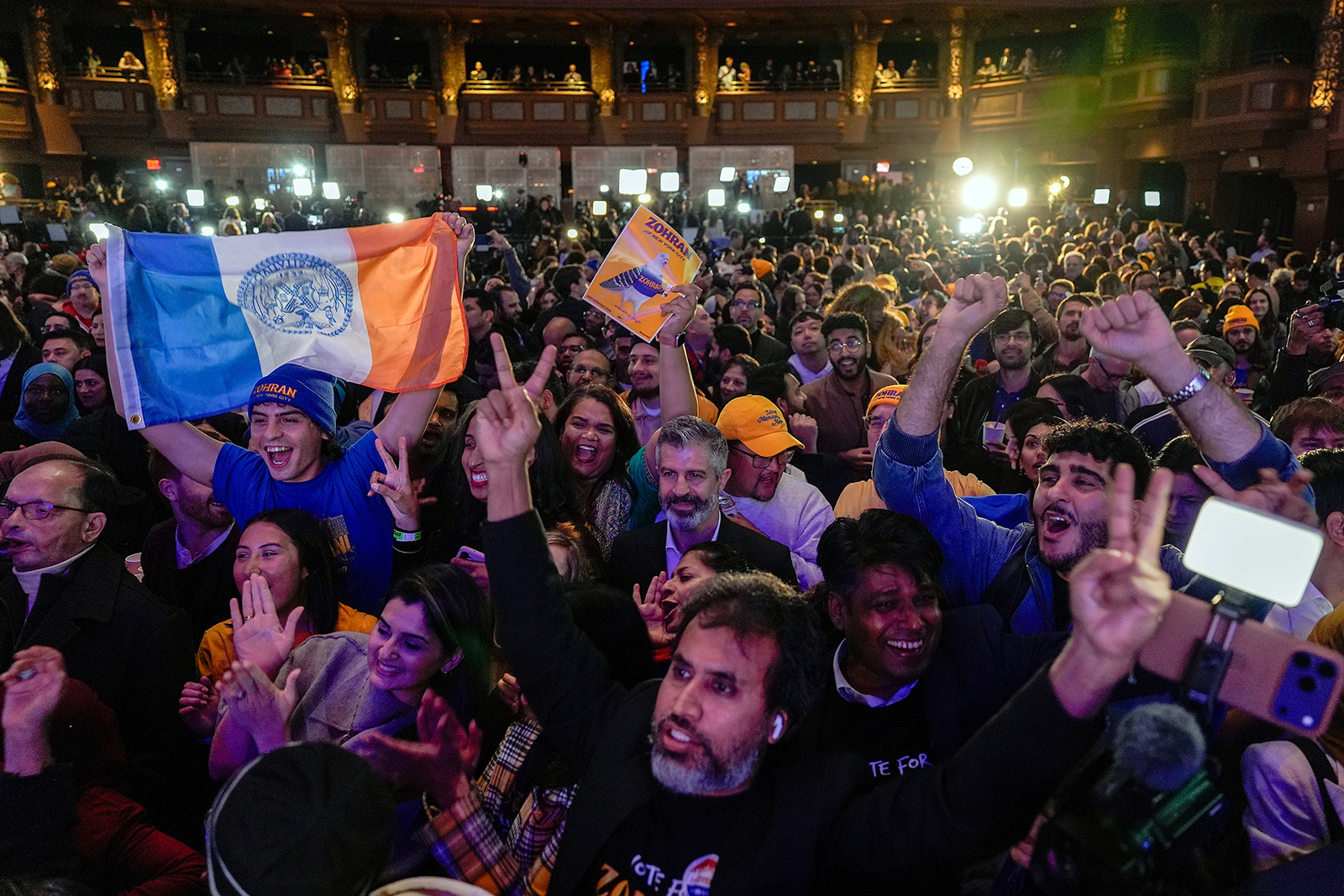
Supporters of Democratic mayoral candidate Zohran Mamdani react as they watch returns during an election night watch party, Nov. 4, 2025, in New York. (AP Photo/Yuki Iwamura)
Fiona André
November 5, 2025
RNS
NEW YORK (RNS) — After the vote was in and Zohran Mamdani, the 34-year-old state assemblyman, had made history in becoming America’s largest city’s first Muslim mayor-elect, the comparisons to another seemingly out-of-nowhere political star began.
“Just like Barack Obama, who was an empowerment to the Black community, Zohran is an empowerment to the Muslim community,” said Juhaib Choudhury, the president of the Muslim Community Forum, at Mamdani’s election party on Tuesday (Nov. 4).
But Mamdani, who won 50.4% of the vote to defeat former New York Gov. Andrew Cuomo and Republican activist Curtis Sliwa, didn’t only bring Muslims to the polls to vote for him. Like Obama, Mamdani fashioned a broad coalition to achieve a generational turnover, one that, as Mamdani said from the stage of the Brooklyn Paramount, “toppled a political dynasty.”
He did it with the help of a broad range of progressive faith groups, including anti-Zionist organization Jewish Voice for Peace and Jews for Racial and Economic Justice, both pivotal in organizing Jewish supporters. Rabbi Jason Klein, of the progressive Beit Simchat Torah congregation in Manhattan, said Mamdani’s election offers an opportunity for New York’s diverse communities to come together and seek to understand one another.
“I’m feeling optimistic about the possibilities of our city, for all the communities in our city,” said Klein before adding he appreciates Mamdani’s commitment to “recognize real antisemitism and to fight against it. … More broadly, I appreciate the commitment to every single community in New York.”
In his victory speech, Mamdani expressed his desire to unify the city and represent the country’s largest Jewish community. “We will build a City Hall that stands, steadfast, alongside Jewish New Yorkers and does not waver in the fight against the scourge of antisemitism,” he said.
But Mamdani’s coalition was also composed of young progressives and working-class New Yorkers, drawn by a program focused on affordability. As he took the stage behind a pulpit adorned with his landmark bright orange “Zohran for New York City” logo, he called his victory the beginning of a new era.
“From as long as we can remember,” Mamdani said, “the working people of New York have been told by the wealthy and the well-connected that power doesn’t belong in their hands.”
Young New Yorkers of every stripe were attracted to Mamdani’s unwavering support for Palestinians in Gaza while aligning with the Muslim community’s interests, though Mamdani’s condemnation of the war in Gaza and of Israeli Prime Minister Benjamin Netanyahu’s government earned him accusations of antisemitism from some Jewish New Yorkers. In parts of the heavily Orthodox Jewish neighborhood of Borough Park, Mamdani trailed even incumbent Mayor Eric Adams, who had dropped out of the race in October.
But Mamdani, a Twelver Shiite Muslim born in Uganda, refused to give up on any faith or ethnic group, often reaching them at their houses of worship. Many in those communities answered by organizing under such banners as Jews for Zohran, Hindus for Zohran and Shias for Zohran.
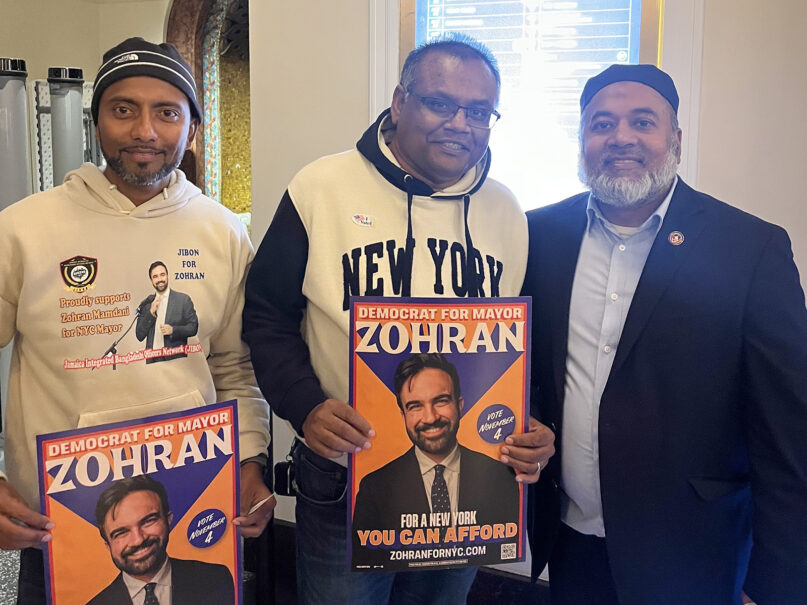
Juhaib Choudhury, right, president of the Muslim Community Forum, with fellow Zohran Mamdani supporters at mayoral election night watch party, Nov. 4, 2025, in New York. (RNS photo/Fiona André)
His deepest support came from Muslim New Yorkers, who voiced their feelings of marginalization in New York’s political landscape before Mamdani’s win. In his victory speech, the mayor-elect talked about dodging Islamophobic attacks from political opponents. “I am Muslim. I am a democratic socialist, and most damning of all, I refuse to apologize for any of this,” said Mamdani.
Mamdani peppered his speech with slang from the streets of Astoria, the neighborhood he has represented in the State Assembly since 2010, and made cultural references to his South Asian roots. “We will fight for you because we are you, or as we say on Steinway, ‘Ana Minkum wa Ilaykum,’” said Mamdani, referring to the busy Astoria commercial street and citing an Arabic adage meaning “I am from you and return to you.”
After dedicating his term to these communities, he exited the stage to the Bollywood tune “Dhoom Machale.”
The neighborhoods of Bay Ridge and Sunset Park, in Brooklyn, and Astoria, in Queens, all home to large Muslim and Arab American communities, went for Mamdani with 49.4%, 58.1% and 76.7% of the vote, respectively. In predominantly South Asian Jackson Heights, the mayor-elect obtained 56.5% of the votes.
Ali Zaman, the owner of Little Flower, an Astoria coffee shop favored by the new mayor, said Mamdani’s victory is significant for Muslims in the city, who, like Zaman, came of age after the 9/11 attacks. “There was a lot of shame around being Muslim, but now, Alhamdulillah, we have someone who’s a really good representative of our religion and our people,” said Zaman, using the Arabic phrase for “praise God.”
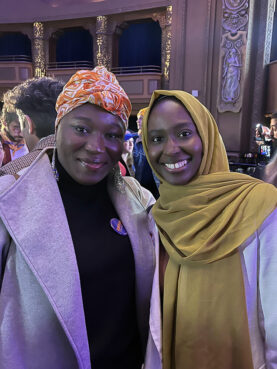
AjiFanta Marenah, right, vice president of New York’s Muslim Democratic Club, attends an election night watch party for Zohran Mamdani, Nov. 4, 2025, in New York. (RNS photo/Fiona André)
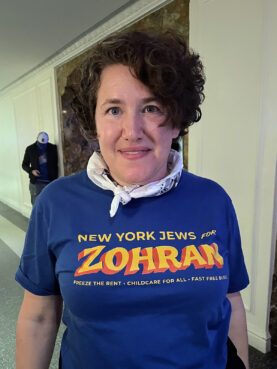
Katie Unger attends an election night watch party for Zohran Mamdani, Nov. 4, 2025, in New York. (RNS photo/Fiona André)
Mamdani’s election is a “very important moment,” said AjiFanta Marenah, the vice president of New York’s Muslim Democratic Club, where Mamdani made his political debut. “The first Muslim mayor and someone who we’ve seen come out openly and condemn Islamophobia, it means a lot because we’ve been targeted for a long time,” said Marenah, who mobilized voters in the Bronx.
RELATED: Zohran Mamdani is running to be New York mayor. How his Muslim faith stirred the race.
But Marenah, like others in Mamdani’s camp, said she got involved with the campaign not for his faith connections, but because his promises on affordability gave her hope. “Zohran and his politics are around affordable housing, affordable child care, fast and free buses, things that I want my community to have access to,” she said.
That sentiment was echoed from people celebrating Mamdani’s victory from across his coalition.
Katie Unger, a JFREJ organizer and member of Jews for Zohran, said Mamdani’s victory showed that the shared aspiration of making the city more affordable unified broad sectors of New Yorkers. “The safe, thriving and affordable city of our dreams comes from us being together,” she said.
Zohran Mamdani represents a historic turning point for American Muslims and all advocates for Palestinian freedom
For American Muslims, November 4, 2025, was a long time coming. Zohran Mamdani's victory serves as a rebuke to those who claim American Muslims have no place in their own country and to those standing in the way of Palestinian freedom.
By Nihad Awad

Mamdani was not alone in making such history. Virginia also elected state senator Ghazala Hashmi to serve as the next Lt. Governor, making her the first Muslim woman elected to statewide office in the United States.
Between Mayor-Elect Mamdani, Lt. Governor Hashmi, Attorney General Keith Ellison in Minnesota, and Reps. Andre Carson, Rashida Tlaib, Ilhan Omar and Lateefah Simon in Congress, American Muslims have made incredible progress that would have seemed impossible in 2008, when the Obama campaign infamously shepherded visibly Muslim women offstage at a campaign event.
For American Muslims, November 4, 2025, was a long time coming. After decades of civic engagement and patient perseverance amid unprecedented bigotry, American Muslims are no longer a political hot potato or beggars asking for a seat at political tables. They are increasingly sitting at those tables, even the head of table.
This progress has come despite—and, in many ways, because of—the deep currents of anti-Muslim bigotry that have tried to drown our community. For over thirty years, we have faced a toxic alliance of anti-Muslim bigots who hate the Islamic faith and anti-Palestinian lobby groups who fear the prospect of a politically powerful Muslim community ending unconditional U.S. for Israel’s oppression of the Palestinian people.
But their prejudice forged a new kind of resilience. It compelled our community to organize, to build lasting institutions, and to engage in politics against the odds, standing up for justice whether in our neighborhoods or in the halls of power.
This election was a rebuke to those who believe that American Muslims have no place in their own nation and those who have spent years suppressing politicians who oppose the oppression of the Palestinian people.
The message is unmistakable: the billionaires who bankroll anti-Muslim bigotry, the pundits who profit from division, and the politicians who weaponize fear are not invincible. Voters still matter. But we must not mistake progress for in one election for permanence. When movements for justice rise, those invested in injustice often respond with greater desperation.
That is why our work to advocate for justice here and abroad must continues, regardless of who is in office. Politicians will not save us or solve our nation’s problems on their own.
American Muslims do not seek privilege. We seek an America that protects equality under law. We seek an America that lives up to its founding ideals of religious freedom, free speech and civil rights. We seek an America that upholds democracy here at home and human rights abroad, including in Palestine.
The results of this election show what is possible when principle meets perseverance and faith meets action. The next generation has seen the truth. The future of America can belong to those who believe that justice is universal—God willing.
Nihad Awad
Nihad Awad is the National Executive Director and co-founder of the Council on American-Islamic Relations (CAIR), the largest Muslim civil rights and advocacy organization in the United States.
Mamdani’s election is a “very important moment,” said AjiFanta Marenah, the vice president of New York’s Muslim Democratic Club, where Mamdani made his political debut. “The first Muslim mayor and someone who we’ve seen come out openly and condemn Islamophobia, it means a lot because we’ve been targeted for a long time,” said Marenah, who mobilized voters in the Bronx.
RELATED: Zohran Mamdani is running to be New York mayor. How his Muslim faith stirred the race.
But Marenah, like others in Mamdani’s camp, said she got involved with the campaign not for his faith connections, but because his promises on affordability gave her hope. “Zohran and his politics are around affordable housing, affordable child care, fast and free buses, things that I want my community to have access to,” she said.
That sentiment was echoed from people celebrating Mamdani’s victory from across his coalition.
Katie Unger, a JFREJ organizer and member of Jews for Zohran, said Mamdani’s victory showed that the shared aspiration of making the city more affordable unified broad sectors of New Yorkers. “The safe, thriving and affordable city of our dreams comes from us being together,” she said.
Zohran Mamdani represents a historic turning point for American Muslims and all advocates for Palestinian freedom
For American Muslims, November 4, 2025, was a long time coming. Zohran Mamdani's victory serves as a rebuke to those who claim American Muslims have no place in their own country and to those standing in the way of Palestinian freedom.
By Nihad Awad
November 5, 2025
MONDOWEISS
Zohran Mamdani and supporters march over the Brooklyn Bridge in New York City on November 3, 2025. (Photo: https://x.com/zohrankmamdani)
When Columbia University students were smeared by New York’s political class and brutalized by the New York Police Department for protesting the genocide in Gaza, few of them probably imagined how the tides would turn in New York City just one year later.
Yet those young people and so many other New Yorkers did the seemingly impossible by turning out to vote in massive numbers and electing a Muslim mayor who recognizes and opposes the genocide they protested to lead New York City. His election is, in many ways, their victory too.
Mamdani won despite facing a barrage of anti-Muslim hate for touching the same third rail of American politics that college students touched: criticizing the Israeli apartheid government. His victory over Andrew Cuomo and an array of anti-Palestinian, anti-Muslim corporations, billionaires and establishment politicians was not just a political upset. It was a historic turning point in the struggle for representation and an unprecedented rebuke of Islamophobia and anti-Palestinian politics.
When Columbia University students were smeared by New York’s political class and brutalized by the New York Police Department for protesting the genocide in Gaza, few of them probably imagined how the tides would turn in New York City just one year later.
Yet those young people and so many other New Yorkers did the seemingly impossible by turning out to vote in massive numbers and electing a Muslim mayor who recognizes and opposes the genocide they protested to lead New York City. His election is, in many ways, their victory too.
Mamdani won despite facing a barrage of anti-Muslim hate for touching the same third rail of American politics that college students touched: criticizing the Israeli apartheid government. His victory over Andrew Cuomo and an array of anti-Palestinian, anti-Muslim corporations, billionaires and establishment politicians was not just a political upset. It was a historic turning point in the struggle for representation and an unprecedented rebuke of Islamophobia and anti-Palestinian politics.
Mamdani was not alone in making such history. Virginia also elected state senator Ghazala Hashmi to serve as the next Lt. Governor, making her the first Muslim woman elected to statewide office in the United States.
Between Mayor-Elect Mamdani, Lt. Governor Hashmi, Attorney General Keith Ellison in Minnesota, and Reps. Andre Carson, Rashida Tlaib, Ilhan Omar and Lateefah Simon in Congress, American Muslims have made incredible progress that would have seemed impossible in 2008, when the Obama campaign infamously shepherded visibly Muslim women offstage at a campaign event.
For American Muslims, November 4, 2025, was a long time coming. After decades of civic engagement and patient perseverance amid unprecedented bigotry, American Muslims are no longer a political hot potato or beggars asking for a seat at political tables. They are increasingly sitting at those tables, even the head of table.
This progress has come despite—and, in many ways, because of—the deep currents of anti-Muslim bigotry that have tried to drown our community. For over thirty years, we have faced a toxic alliance of anti-Muslim bigots who hate the Islamic faith and anti-Palestinian lobby groups who fear the prospect of a politically powerful Muslim community ending unconditional U.S. for Israel’s oppression of the Palestinian people.
But their prejudice forged a new kind of resilience. It compelled our community to organize, to build lasting institutions, and to engage in politics against the odds, standing up for justice whether in our neighborhoods or in the halls of power.
This election was a rebuke to those who believe that American Muslims have no place in their own nation and those who have spent years suppressing politicians who oppose the oppression of the Palestinian people.
The message is unmistakable: the billionaires who bankroll anti-Muslim bigotry, the pundits who profit from division, and the politicians who weaponize fear are not invincible. Voters still matter. But we must not mistake progress for in one election for permanence. When movements for justice rise, those invested in injustice often respond with greater desperation.
That is why our work to advocate for justice here and abroad must continues, regardless of who is in office. Politicians will not save us or solve our nation’s problems on their own.
American Muslims do not seek privilege. We seek an America that protects equality under law. We seek an America that lives up to its founding ideals of religious freedom, free speech and civil rights. We seek an America that upholds democracy here at home and human rights abroad, including in Palestine.
The results of this election show what is possible when principle meets perseverance and faith meets action. The next generation has seen the truth. The future of America can belong to those who believe that justice is universal—God willing.
Nihad Awad
Nihad Awad is the National Executive Director and co-founder of the Council on American-Islamic Relations (CAIR), the largest Muslim civil rights and advocacy organization in the United States.
Zohran Mamdani’s victory is a loss for Zionism
Zohran Mamdani’s historic victory in New York City shows that the Gaza genocide has permanently shifted Israel’s role in U.S. politics.
Zohran Mamdani’s historic victory in New York City shows that the Gaza genocide has permanently shifted Israel’s role in U.S. politics.
November 5, 2025 7
MONDOWEISS

MONDOWEISS
Zohran Mamdani seen on stage at a campaign event. (Photo: Zohran Mamdani campaign)
After Democratic Socialist Zohran Mamdani prevailed over Andrew Cuomo in New York City’s mayoral race, former Israeli foreign minister and right-wing leader Avigdor Lieberman put out a statement through a spokesperson.
“The Big Apple has fallen,” declared Lieberman. He urged New York Jews who want to survive” to flee “to where they belong — the land of Israel.”
This farcical call is obviously based on fantasy, but the source of his anxiety is very real. Lieberman knows that Mamdani’s historic win is a blow to Israel, a country whose international reputation has already fallen apart.
For more than two years, the world has watched the Gaza genocide live-streamed across their electronic devices, and millions have taken to the streets to express their opposition.
Here in the United States, Palestine advocates have faced a brutal government crackdown that’s resulted in deportations, detentions, arrests, fines, and widespread censorship. This backlash has not subsided, but it failed to quell the resistance to Israel’s policies and the U.S. support for them.
A recent Quinnipiac survey found that a plurality of voters (47%) think supporting Israel is in the national interest of the United States, while 41% think it is not. That’s way up from the immediate aftermath of the October 7 attack, when 69% of voters thought supporting Israel was in the national interest, and just 23% disagreed.
A New York Times Siena University survey found that just 34% of U.S. voters say they back Israel, compared to the 47% who said they supported the country after October 7. The Times referred to the shift as a “seismic reversal.”
The gaps are much more severe among Democratic voters. In recent years, dozens of studies have concluded that the party’s base has completely split with its elected officials on this issue. A March Pew Poll found that 69% of Democrats have an unfavorable view of Israel, and a June Quinnipiac survey found that just 12% of Democrats sympathize more with Israelis than Palestinians.
Sympathy for the Palestinian cause was already increasing among Democratic voters, whereas support for Israel remained ironclad with Republicans. However, since October 7, the country’s supporters and its domestic lobbying groups have suddenly encountered an increasing number of problems on the right, particularly among young people.
In the aforementioned Pew poll, 50% of GOP voters under the age of 50 expressed a negative view of Israel, compared to just 35% in 2022. An August University of Maryland Critical Issues survey found that just 24% of Republicans aged 18-34 sympathize more with Israelis than Palestinians.
“The erosion among younger voters is not unimpressive,” Quincy Institute advisor and Responsible Statecraft editorial director Kelley Vlahos told Mondoweiss last month. “They do not have the same instincts, and they are less ideologically shackled. They’re not feeling the same pressure as the Boomer generation.”
Enter Mamdani. He might have pulled his punches as his campaign wound down, but he never actually condemned the phrase “From the river to the sea,” like his critics demanded. He also consistently referred to Israel’s actions in Gaza as a genocide and said he’d arrest Israeli Prime Minister Benjamin Netanyahu if he set foot in the city.
These kinds of positions have long been viewed as disqualifying in U.S. politics. To say this kind of stuff was to touch the third rail and immediately nuke your election chances. Mamdani was accused of being obsessed with Israel, but his critics and the Cuomo campaign were the ones who continually brought up the issue.
They obviously thought his stances would hurt him, but a cursory glance at the numbers always showed that they would actually bolster his campaign. In an exit poll, 38% of New York City voters said their candidate’s position on Israel was a major factor in their voting decision. Less than a third said it wasn’t a factor at all.
Mamdani’s win can’t be dismissed as a blip or a fluke by pro-Israel groups. More than two million New Yorkers showed up to the polls, almost double the amount that voted in the mayoral election four years ago. He’s the first candidate to win over one million votes in an NYC mayoral contest since 1969.
He also did it in the most Jewish city in the United States, despite an ongoing smear campaign aimed at tagging him as an antisemite. In this sense, the election was a referendum on Zionism and a bold rejection of those who insist on conflating it with Judaism.
It’s unclear how Mamdani will govern, or what the inevitable political backlash will look like. It’s also debatable how much influence the mayor of a U.S. city could possibly have on Middle East policy. Many New Yorkers presumably voted for Mamdani because of his ambitious domestic agenda, and viewed his foreign policy positions as an added bonus.
However, it’s undeniable that last night’s results will have a lasting impact beyond New York. Mamdani hasn’t just provided a blueprint for leftists seeking power; he’s shown future candidates that embracing Israel is not a prerequisite for victory. On the contrary, it’s a strength.
“I think Cuomo and some of the other candidates are expecting that Mamdani’s support for Palestine in the end is going to hold him back and allow other candidates to get past him,” Democratic consultant Peter Feld told Mondoweiss months before the mayoral primary.
“I think Cuomo’s attempt to Israelize the election is going to backfire,” he added. “This could actually help give Mamdani further strength to overtake him. If that happens, I think it’s going to set the table for some of the primaries next year.”
The Big Apple hasn’t fallen, but the third rail of U.S politics has been removed from the track.
After Democratic Socialist Zohran Mamdani prevailed over Andrew Cuomo in New York City’s mayoral race, former Israeli foreign minister and right-wing leader Avigdor Lieberman put out a statement through a spokesperson.
“The Big Apple has fallen,” declared Lieberman. He urged New York Jews who want to survive” to flee “to where they belong — the land of Israel.”
This farcical call is obviously based on fantasy, but the source of his anxiety is very real. Lieberman knows that Mamdani’s historic win is a blow to Israel, a country whose international reputation has already fallen apart.
For more than two years, the world has watched the Gaza genocide live-streamed across their electronic devices, and millions have taken to the streets to express their opposition.
Here in the United States, Palestine advocates have faced a brutal government crackdown that’s resulted in deportations, detentions, arrests, fines, and widespread censorship. This backlash has not subsided, but it failed to quell the resistance to Israel’s policies and the U.S. support for them.
A recent Quinnipiac survey found that a plurality of voters (47%) think supporting Israel is in the national interest of the United States, while 41% think it is not. That’s way up from the immediate aftermath of the October 7 attack, when 69% of voters thought supporting Israel was in the national interest, and just 23% disagreed.
A New York Times Siena University survey found that just 34% of U.S. voters say they back Israel, compared to the 47% who said they supported the country after October 7. The Times referred to the shift as a “seismic reversal.”
The gaps are much more severe among Democratic voters. In recent years, dozens of studies have concluded that the party’s base has completely split with its elected officials on this issue. A March Pew Poll found that 69% of Democrats have an unfavorable view of Israel, and a June Quinnipiac survey found that just 12% of Democrats sympathize more with Israelis than Palestinians.
Sympathy for the Palestinian cause was already increasing among Democratic voters, whereas support for Israel remained ironclad with Republicans. However, since October 7, the country’s supporters and its domestic lobbying groups have suddenly encountered an increasing number of problems on the right, particularly among young people.
In the aforementioned Pew poll, 50% of GOP voters under the age of 50 expressed a negative view of Israel, compared to just 35% in 2022. An August University of Maryland Critical Issues survey found that just 24% of Republicans aged 18-34 sympathize more with Israelis than Palestinians.
“The erosion among younger voters is not unimpressive,” Quincy Institute advisor and Responsible Statecraft editorial director Kelley Vlahos told Mondoweiss last month. “They do not have the same instincts, and they are less ideologically shackled. They’re not feeling the same pressure as the Boomer generation.”
Enter Mamdani. He might have pulled his punches as his campaign wound down, but he never actually condemned the phrase “From the river to the sea,” like his critics demanded. He also consistently referred to Israel’s actions in Gaza as a genocide and said he’d arrest Israeli Prime Minister Benjamin Netanyahu if he set foot in the city.
These kinds of positions have long been viewed as disqualifying in U.S. politics. To say this kind of stuff was to touch the third rail and immediately nuke your election chances. Mamdani was accused of being obsessed with Israel, but his critics and the Cuomo campaign were the ones who continually brought up the issue.
They obviously thought his stances would hurt him, but a cursory glance at the numbers always showed that they would actually bolster his campaign. In an exit poll, 38% of New York City voters said their candidate’s position on Israel was a major factor in their voting decision. Less than a third said it wasn’t a factor at all.
Mamdani’s win can’t be dismissed as a blip or a fluke by pro-Israel groups. More than two million New Yorkers showed up to the polls, almost double the amount that voted in the mayoral election four years ago. He’s the first candidate to win over one million votes in an NYC mayoral contest since 1969.
He also did it in the most Jewish city in the United States, despite an ongoing smear campaign aimed at tagging him as an antisemite. In this sense, the election was a referendum on Zionism and a bold rejection of those who insist on conflating it with Judaism.
It’s unclear how Mamdani will govern, or what the inevitable political backlash will look like. It’s also debatable how much influence the mayor of a U.S. city could possibly have on Middle East policy. Many New Yorkers presumably voted for Mamdani because of his ambitious domestic agenda, and viewed his foreign policy positions as an added bonus.
However, it’s undeniable that last night’s results will have a lasting impact beyond New York. Mamdani hasn’t just provided a blueprint for leftists seeking power; he’s shown future candidates that embracing Israel is not a prerequisite for victory. On the contrary, it’s a strength.
“I think Cuomo and some of the other candidates are expecting that Mamdani’s support for Palestine in the end is going to hold him back and allow other candidates to get past him,” Democratic consultant Peter Feld told Mondoweiss months before the mayoral primary.
“I think Cuomo’s attempt to Israelize the election is going to backfire,” he added. “This could actually help give Mamdani further strength to overtake him. If that happens, I think it’s going to set the table for some of the primaries next year.”
The Big Apple hasn’t fallen, but the third rail of U.S politics has been removed from the track.

No comments:
Post a Comment