Saturday, February 28, 2026

WAIT, WHAT?!
Melania Trump to chair UN Security Council meeting

February 27, 2026 
Middle East Monitor 


United States President Donald Trump (R) and First Lady of the United States Melania Trump (L) depart the White House en route Fayetteville, North Carolina on February 13, 2026, in Washington DC. [Celal Güneş – Anadolu Agency]

The White House said on Thursday that First Lady Melania Trump will chair a meeting of the United Nations Security Council next week, when Washington assumes the body’s rotating presidency.

The Office of the First Lady said Mrs Trump will preside over the session scheduled for Monday under the title “Children, Technology, and Education in Conflict.” She is expected to stress the importance of education as a tool to promote tolerance and global peace.

A United Nations spokesperson said this “would be the first time a spouse of any serving world leader has chaired a meeting of the 15-member Security Council.” The council, the UN’s main executive body, has 15 members, including five permanent members such as the United States.

Mrs Trump will lead the session amid tensions between her husband and the United Nations. Since his first term, President Donald Trump has been a strong critic of the organisation, saying the UN, which has 193 member states, is ineffective and needs major reform.

The United States has traditionally been the largest contributor to the United Nations, but funding was significantly reduced during Trump’s presidency. Since returning to the White House, Washington has also withdrawn from several UN agencies, including the World Health Organization (WHO).

Israeli influence over German defense grows


February 26, 2026
Middle East Monitor 


Amnesty International stage a protest in Berlin, Germany on December 5, 2025. [Halil Sağırkaya – Anadolu Agency]

The German Navy received the BlueWhale large autonomous underwater vehicle, jointly developed by Israeli and German companies, according to a recent report, Anadolu reports.

The submarine, made by TKMS and Israel Aerospace Industries (IAI), was delivered to the German Navy at a ceremony held at the Eckernforde naval base in the country’s northern region, according to a statement by TKMS on Wednesday.

The BlueWhale submarine, deployed under Germany’s Kurs Marine 2035+ vision, is designed to act as a force multiplier by extending the sensor range of manned platforms for miles during long and uninterrupted autonomous missions.

The submarine went through testing in the Baltic Sea, one of the world’s most complex maritime environments, to prove its capabilities.

The craft, outfitted with advanced sonar systems developed by TKMS subsidiary Atlas Elektronik, can detect underwater and surface targets, collect acoustic data, and locate seabed mines.

The BlueWhale is expected to significantly enhance Germany’s maritime border protection capabilities and its critical infrastructure in the face of deepening geopolitical risks.

The deal marks the rising defense cooperation and strategic investments between Germany and Israel across underwater and air defense systems.

Berlin approved an additional $3.1 billion package for the Israeli Arrow 3 anti-ballistic missile system in Dec. 2025, bringing the total value of Germany’s Arrow 3 procurement to around $6.7 billion, which is the largest defense export deal in Israel’s history, according to the Israeli Defense Ministry.

The Arrow 3 system, developed with US support, plays a key role in Germany’s broader missile defense architecture in Europe.
Israeli law bars Palestinian university graduates from education sector jobs


February 27, 2026
Middle East Monitor 


A view of Birzeit University campus in West Bank. [Wikipedia]


The Israeli Knesset has passed new legislation prohibiting the employment of graduates from Palestinian Authority-affiliated universities in teaching, administrative and educational supervision roles, a move critics describe as discriminatory and politically motivated.

The law targets Palestinian citizens of Israel and bars any academic who obtained a degree — or even completed a single academic year — at universities in the occupied West Bank from working within Israel’s education sector.

In response, the Adalah Legal Center, in cooperation with Arab members of the Knesset, has filed a petition before the Israeli Supreme Court seeking to overturn the legislation. The petition argues that the measure deprives thousands of graduates of their right to employment and professional integration on the basis of where they studied.

Petitioners contend that the law constitutes a clear violation of the right to education and freedom of academic choice, warning that it imposes collective restrictions without individual assessment.

READ: 1,200 former Israeli officials urge Knesset to reject death penalty bill

Supporters of the legislation claim that students educated at Palestinian institutions are exposed to ideologies hostile to Israeli authorities. However, human rights organisations have rejected these assertions, stating that no factual or security evidence has been presented to justify such sweeping exclusions.

During parliamentary deliberations, both the Israeli government’s legal adviser and the Knesset’s legal adviser reportedly warned that the law lacked an evidentiary basis and risked infringing fundamental rights.

Education experts have also warned of significant practical consequences. Official data indicates that approximately 60 per cent of teachers in occupied East Jerusalem schools graduated from West Bank universities, while up to 30 per cent of teaching staff in the Negev region rely on similar qualifications. Critics say the ban could therefore create serious staffing shortages in Arab schools.

Members of the Arab community in Israel already face longstanding structural inequalities in education and employment, activists say, with limited access to Hebrew-language universities prompting thousands of students each year to pursue higher education in Palestinian institutions.
Activists plan 200-vessel “Freedom Flotilla” to Gaza in bid to break siege


February 27, 2026 
Middle East Monitor 

The humanitarian organization Freedom Flotilla Coalition is in Catania from where the ship Madleen will depart on its mission to break the siege on Gaza, in Catania, Italy on June 01, 2025. [Salvatore Allegra – Anadolu Agency]

Pro-Palestinian activists and civil society organisations have announced plans to launch a large maritime campaign towards the Gaza Strip next month, combining the “Freedom Flotilla” and the “Steadfastness Convoy” in an effort to break the ongoing siege.

Organisers said the initiative will involve approximately 200 vessels scheduled to set sail on 12 April from several Mediterranean ports, including locations in Spain, Italy and Tunisia. The campaign is being coordinated with the participation of around 200 civil society organisations worldwide.

Bülent Yıldırım, head of the Turkish Human Rights and Freedom Foundation (İHH), told Al-Araby Al-Jadeed that donations are being collected across Europe, Asia, Africa, Turkey and the Gulf region to fund the purchase of the vessels. He argued that the scale of the convoy would make it difficult for Israel to stop, adding that “there is no other option but the sea”.

Organisers expect thousands of participants from roughly 150 countries to take part in the initiative, which has received backing from groups including the Mavi Marmara Freedom Association, the İHH Foundation and the Palestine Support Platform.

According to organisers, the mission will extend beyond humanitarian aid delivery. The flotilla is also expected to transport healthcare workers, teachers, infrastructure and environmental specialists, lawyers and investigators documenting alleged war crimes in Gaza. More than 1,000 doctors, nurses and medical professionals are anticipated to join the convoy.

Yıldırım said the campaign was prompted by what organisers describe as severe restrictions on aid entering Gaza, alleging that humanitarian supplies are being obstructed and that residents are facing worsening hunger and disease amid the ongoing crisis.
Britain’s Index of Repression’ documents 964 incidents of anti-Palestinian crackdown


February 27, 2026
Middle East Monitor 


Tens of thousands of people take part in a pro-Palestinian march in London, United Kingdom, following a ceasefire agreement signed yesterday, two years after Israel’s attacks on Gaza, on October 11, 2025. [Raşid Necati Aslım – Anadolu Agency]

A new report by the European Legal Support Centre (ELSC) has documented 964 verified incidents of anti-Palestinian repression across Britain between January 2019 and August 2025, identifying what it describes as a cross-sector pattern of institutional crackdowns on Palestine solidarity.

The findings form part of Britain’s Index of Repression, a searchable national database developed in collaboration with Forensic Architecture and launched today at the Frontline Club in London.

Documented incidents listed in the database include arrests, workplace dismissals, suspensions and event cancellations. The Index, originally launched in Germany in 2025, is now publicly available for Britain and is described as the first accessible database of its kind in the country.

The data indicates a marked escalation in incidents after October 2023, with the publication following what the press briefing describes as a significant post-Gaza rise in recorded cases.

The report identifies a broad range of actors involved in the repression of Palestine solidarity, with law enforcement and state-linked bodies featuring prominently. Police and security personnel were involved in 220 documented incidents, making them the single most frequent actor. Educational institutions were responsible for 192 incidents, while pro-Israel advocacy and lawfare groups were linked to 141 cases. Journalists and media actors were involved in 113 incidents.

The data also shows that repression disproportionately targets those embedded in public institutions and organising spaces. Students, academics and teachers were the most frequently targeted group, accounting for 336 incidents. Activists and organisers followed, with 229 cases. Public and private sector workers together faced 169 incidents, while 71 cases involved artists and cultural workers.
“From smear to sanction”

The report describes a recurring three-stage pattern in how repression unfolds.

It begins with what the authors term “smear and distortion”, accounting for 261 incidents involving censorship, disinformation campaigns and public accusations. These allegations are then taken up by institutions. In 136 cases there were threats of legal action, in 81 cases threats to employment or funding, and in 41 cases demonstration bans or event cancellations. A further 114 incidents involved formal disciplinary sanctions in schools, universities or workplaces.

The final stage involves direct enforcement. The report documents 131 arrests or law enforcement interventions, 111 cases of harassment, doxing or surveillance, and 90 incidents resulting in legal, financial or professional consequences.

The report argues that this architecture of repression is structured around two recurring allegations directed at Palestine solidarity movements: anti-Semitism and support for terrorism. It identifies the highly controversial IHRA Working Definition of Antisemitism and the Terrorism Act 2000 as central enabling instruments.

IHRA has been widely criticised, including by its lead drafter, Kenneth Stern. Stern has warned that the definition has been weaponised against critics of Israel and misused to suppress legitimate political speech.

The notorious legal firm, UK Lawyers for Israel (UKLFI) was mentioned in the report. The study found that UKLFI was involved in 128 incidents leading to institutional repression of Palestine solidarity.
Launch at the Frontline Club

At today’s press conference at the Frontline Club in London, organisers presented sector-by-sector breakdowns, post-October 2023 trends and the first public demonstration of the searchable database developed with Forensic Architecture.

The event included a panel discussion featuring ELSC research staff providing analysis of patterns identified in the data, as well as the first on-camera testimony from an ELSC client describing workplace repression.


New Israeli poll shows young Jewish voters most right-wing, fanatically religious, and pro-genocide in Israeli history

A poll conducted by Israel's Channel 12 found the half a million new Jewish Israeli voters are the most right-wing and religiously fanatic in Israel's history. They're voting in the upcoming Knesset elections.


February 27, 2026 
Israeli settlers, under the protection of Israeli forces, raid the Old City of Hebron on January 31, 2026. (Photo: Mamoun Wazwaz/APA Images)

A new poll featured on Israel’s Channel 12 shows that first-time Jewish Israeli voters, due to participate in the upcoming government elections this year, are more right-wing and religious-nationalist in their outlook than older voters.

Channel 12 is considered a centrist outlet and is the most-watched commercial news channel in Israel.

Netanyahu’s current government is the most right-wing in Israeli history, and it has held together since its election on November 1, 2022. New elections will likely be held between May and October.

The new voters in the poll represent 18 to 21-year-old Jewish Israelis, notably excluding Palestinians with Israeli citizenship, and consequently criticized for being an “apartheid poll.”

That isn’t wrong, but when an apartheid reality exists from the river to the sea, the political leanings of members of the self-described master race are not trivial.

The poll found that 75% of voters described themselves as “right-wing,” compared with 68% among older voters. The remaining 25% identify as “center-left,” and the self-identified “left” accounts for only 5%.

It is important to note, here, the relativity of concepts of right and left in Israeli politics. Opposition leader Yair Lapid, who is head of the centrist Yesh Atid party, recently affirmed that he agrees with U.S. Ambassador to Israel Mike Huckabee’s affirmation of Israel’s Biblical right to conquer Palestine, Jordan, Lebanon, Syria, and parts of Egypt and Saudi Arabia. This is called the “Greater Israel” vision for Israel’s future borders, stretching from the Nile to the Euphrates

On that same note, the leader of the only “leftist” party in the Zionist spectrum, Yair Golan, advocated in December 2023 for starving Gaza’s population. “We’d all like to wake up one spring morning and find that 7 million Palestinians who live between the sea and the river have simply disappeared,” Golan said in 2025. But let’s get back to those young Zionist voters.

The new voting group is said to be a major numerical addition of half a million voters to the electoral picture, the largest in Israel’s history. It is the equivalent of 17 seats in the 120-seat Knesset.

Netanyahu’s Likud party is by far the most preferred among them, polling at 20%. After that, coming in at 11%, is United Torah Judaism, an ultra-orthodox Ashkenazi (European heritage) Jewish party, which has become ultra-Zionist. Then there’s Naftali Bennett’s party, coming in at 10%, and he’s an even more religious-Zionist fanatic than Netanyahu. Finally, there is Itamar Ben-Gvir’s Jewish Power party, leading by 7%. The rest of the parties receive smaller percentages of 5% or less.

Among these young voters, 59% prefer the rightwing bloc that governs now, while 41% prefer the opposition. On the question of Netanyahu vs. Bennett for premiership, 49% support Netanyahu, and only 24% support Bennett.

The other notable point of information in the Channel 12 poll is the transformation toward religious fanaticism. A full 80% of young voters consider themselves religious (compared to 75% of older voters). To represent the polling data more theatrically, Channel 12 invited 12 young potential votes to their Saturday news broadcast. All of them were clear about having become more religious since October 7, 2023.

When asked directly whether October 7 made them more religious, 11 out of 12 raised their hands.

Religiosity, here, goes hand in hand with a hardline form of Zionism. The voters have all become more militarized in their outlook, and when asked whether they were against “Arab parties” being part of the Israeli Knesset, 11 out of 12 once again answered in the affirmative.

Oz, who is 18 and says he will vote for hardline Finance Minister Bezalel Smotrich’s Religious Zionism party, said that his parent’s generation grew up on pro-peace songs, while children today grow up listening to “Harbo Darbo,” a popular genocidal song from November 2023. “Once, we dreamed of peace,” he said. “And today, we’re more, ‘live by the sword.’”

One is often used to the younger generation being a bit more progressive than their parents. For Jewish Israeli society, it’s the reverse.
Nine out of ten Israelis are genocidal

The polls conducted throughout the genocide in Gaza indicated a consistent general trend in Jewish Israeli society. About 4 out of 5 Jewish Israelis supported genocide in various formulations, from the 79% not concerned with starvation in Gaza (August 2025), to the over 75% opining that there are “no innocents in Gaza” (June 2025), and to the 82% supporting the total expulsion of Gaza’s residents (May 2025).

In that last poll, commissioned by Pennsylvania State University, authors Shai Hazkani and Tamir Sorek noted that only 9% of men under 40, the main demographic serving in the Israeli army in Gaza, “rejected all the ideas of deportation and extermination presented to them.”

To put that differently: if you’re a Palestinian in Gaza, there’s a 9 out of 10 chance that the Israeli soldier who controls your life wants you dead.

These young new voters are part of this genocidal turn. They are not just entering the electoral picture — they’re entering the army. Military service is also likely to further radicalize them. They are poised to live by the sword.
Meet the companies and billionaires looking to make a massive profit off Trump’s plans in Gaza

U.S. companies are aiming to make huge profits from the Gaza reconstruction plan, with several billionaires on Trump's Board of Peace openly discussing the opportunity to make billions.

 February 25, 2026 
MONDOWEISS

Donald Trump announces the “Board of Peace” on January 22, 2026, at the World Economic Forum in Davos, Switzerland.(Photo: ©2026 World Economic Forum / Benedikt von Loebell)


Last week, The Guardian reported that the Trump administration is planning to build a 350-acre military base in Gaza to house the future International Stabilization Force (ISF).

Plans reviewed by the newspaper reveal that the base will be “ringed by 26 trailer-mounted armored watch towers, a small arms range, bunkers, and a warehouse for military equipment for operations.”

At this time, it’s unclear who will be hired to construct the base, but the report is yet another reminder that Gaza’s reconstruction could generate massive profits.

Members of President Donald Trump’s controversial Board of Peace openly expressed this sentiment at the group’s first meeting, framing Gaza as a potential money-maker.

“The coastline alone is 50 billion dollars of value alone on a conservative basis… it just needs to be unlocked and financed,” said billionaire Marc Rowan, an executive member of the board and the head of the private equity firm Apollo Global Management.


Another board member, Israeli-Cypriot billionaire Yakir Gabay, told the crowd that Gaza’s coast could be “developed as a new Mediterranean Riviera with 200 hotels and potential islands.”

At the World Economic Forum (WEF) in Davos last month, Trump’s son-in-law, Jared Kushner, admitted that private-sector investment in Gaza could be “a little risky,” but said it would provide “amazing investment opportunities.”

“As you guys know, peace is a different deal than a business deal, because you’re changing a mindset,” he added.

As Quincy Institute research associate Nick Cleveland-Stout points out in Responsible Statecraft, Kushner could end up reaping the benefits of these opportunities, as his private equity firm, Affinity Partners, already has billions invested across the Gulf region.

Another possible partner is the disaster response firm Gothams LLC, which recently submitted a proposal to the White House that guarantees 300% profits via a seven-year trucking and logistics plan.

The Austin-based Gothams LLC gained attention last year after it landed a $33 million contract to help run the South Florida Detention Facility, the infamous migrant jail nicknamed “Alligator Alcatraz.”

“We provide solutions to the most challenging problems in high-leverage situations and strive to make a positive impact on the communities where we live and work,” declares the company’s website. “By combining military precision with private sector agility, we are built to accomplish more.”

When questioned about the proposal by The Guardian, Chris Vanek, a partner at Gothams, who has been coordinating with the Trump team, denied having any discussions about investment or returns with the White House.

“The Board of Peace, Palestinian and Israeli stakeholders, and the US Department of State asked me to assist with planning efforts based on my extensive experience in conflict zones, reconstruction, and disaster response,” said Vanek. “There is no existing agreement or contract, and I have provided this assistance at my own expense in support of peace efforts.”

Gothams “did not respond directly to questions about the profit margin,” noted The Guardian.

Reuters recently reported that North Carolina-based UG Solutions is in talks with the Trump administration to secure a role in Gaza’s reconstruction.

“Our proposal was received positively, but until the Board of Peace clarifies what its priorities are for security, UG Solutions is planning internally for a range of possible ways to support efforts in Gaza,” a UG Solutions spokesperson told Reuters.

The firm provided security for the Gaza Humanitarian Foundation (GHF) last year, and was heavily criticized by the United Nations after over 1,000 Palestinians were killed while attempting to reach aid sites. The operation was shut down after a ceasefire was announced.

Former GHF employee Anthony Aguilar alleged that he saw Israeli soldiers commit war crimes at the sites where UG Solutions provided security.

Aguilar told Democracy Now that the aid sites were “designed as death traps.”

“Those sites were built in the middle of those areas intentionally,” he explained. “It’s not by accident. That, in and of itself, to designate humanitarian distribution sites to service an unarmed, starving population, to build them deliberately in an active combat zone, is a violation of the Geneva Convention protocol. It’s a violation of humanitarian law. And in my opinion, it’s a violation of humanity in general.”

“The GHF and those who stand behind it have Palestinian blood on their hands; they are not welcome to return to Gaza,” said Palestinian NGOs Network head Amjad al-Shawa.

“I’m a real estate person at heart, and it’s all about location,” Trump has said, in reference to Gaza redevelopment. “And I said, look at this location on the sea, look at this beautiful piece of property, what it could be for so many people.”


Gaza does not need new overlords

The U.S. plan for Gaza is the final stage of Israel’s genocide. Bombs and bulldozers obliterated Gaza’s landscape, and now skyscrapers and data centers aim to dismantle its social fabric and capacity to resist.

 February 26, 2026 
MONDOWEISS


Displaced Palestinians return to their destroyed homes in the al-Maghraqa area south of Gaza City, January 31, 2024. (Photo: Omar Ashtawy/APA Images)

Every few decades, a new group of powerful men gathers around a table to decide what to do with Gaza or with Palestinians in general. The language changes. The underlying logic does not.

The latest proposals to “govern” postwar Gaza, from Jared Kushner’s beachfront development fantasies to the so-called “Board of Peace” and various international trusteeship schemes, are presented as bold, forward-looking visions. In reality, they are just recycling the same colonial framework that has governed Palestinian life for over a century: external actors decide what Palestinians need, what they may have, and what they must become in order to deserve it.

Gaza’s crisis was never a problem of governance or waiting for the right foreign administrator. It was, and remains, the product of a specific political structure: prolonged military occupation, a seventeen-year siege that strangled every dimension of life, and a settler-colonial project that treats Palestinian existence as an obstacle to be managed or removed. These are the roots. Everything else — the poverty, the misery, the desperation — is a symptom.

Yet every plan now circulating wants to treat the symptoms while leaving the roots untouched. They promise reconstruction without ending occupation. They offer economic incentives without political rights. They propose “deradicalization” programs without acknowledging that it is the violence of dispossession, not some cultural deficiency, that drives resistance. This is not new. The logic of “economic peace,” the idea that Palestinians can be pacified with jobs and consumer goods while their land is taken and their rights denied, has been tried repeatedly. It failed under the Oslo framework. It failed under the Quartet’s conditional aid regime.

It failed because no amount of economic programming can substitute for freedom.

What is new, and what should alarm anyone paying attention, is the scale of ambition behind the current proposals. Kushner did not misspeak when he described Gaza’s waterfront as “very valuable” real estate. The vision is not reconstruction. It is erasure. Build data centers and luxury resorts on the ruins of Shuja’iyya and Rafah. Erect skyscrapers where neighborhoods, mosques, schools, and cemeteries once stood.

The “Dubaification” of Gaza is not a development plan. It is the final stage of a process that began with bombs and D9 bulldozers: dismantle not only Gaza’s physical infrastructure but its social fabric, its cultural institutions, its memory, its capacity to produce defiance.

This is what makes these plans more than cynical. They are parasitic on genocide. The destruction of over seventy percent of Gaza’s built environment, the killing of tens of thousands, the displacement of nearly the entire population — these are not obstacles the planners must work around, but the necessary preconditions required by planners. You cannot build a seaside resort in a living neighborhood.

I grew up in Deir al-Balah. The Gaza I knew was not a blank slate awaiting foreign investment. It was a place dense with life, with teachers and poets and engineers and farmers and students who debated politics and planned futures despite the blockade. The idea that this place and its people need to be reimagined by men who could not name a single street in Gaza City is not visionary. It is colonial in the most precise sense of the word.

These plans may be attempted. Contracts may be signed. Renderings may be published. But they will not work — for the same reason every previous attempt to govern Palestinians without their consent has not worked. Palestinians are not a problem to be solved or a population to be pacified. They are a people with political demands that no amount of construction can build over: an end to occupation, the right of return, sovereignty, and freedom.

Until those demands are addressed, every plan imposed on Gaza from the outside will meet the same fate. And when it fails, Palestinians will say what they have always said: we told you. The problem was never Gaza. The problem was what you did to it, and what you refused to stop doing.

Moroccan opposition leader criticises foreign minister over Gaza “Peace Council” role


February 27, 2026
 Middle East Monitor 


Secretary-General of Morocco’s Justice and Development Party, Abdelilah Benkirane. [Photo/alquds.co.uk]

Abdelilah Benkirane, Secretary-General of Morocco’s Justice and Development Party (PJD), has criticised Foreign Minister Nasser Bourita over remarks concerning Morocco’s reported leadership of a programme to combat hate speech in Gaza under the framework of the US-backed “Peace Council”.

In a video published on his official Facebook page, Benkirane questioned the context and implications of statements attributed to the foreign minister, warning that they could be interpreted in ways that harm Morocco’s image and its longstanding position on the Palestinian issue.

Benkirane stressed that Bourita was speaking not in a personal capacity but as a representative of the Moroccan state, arguing that this required greater caution and precision when addressing sensitive political matters.

The PJD leader said that calls to promote “coexistence” in the current circumstances risked being understood as an attempt to persuade Palestinians not to regard Israel as an adversary. He argued that any discourse on coexistence should instead be directed towards the occupying power rather than the population living under occupation.

He further claimed that Israel was not genuinely committed to coexistence, asserting that the conflict remained fundamentally about land and displacement rather than a temporary political dispute.

While acknowledging that foreign policy ultimately falls under the sovereign authority of King Mohammed VI, Benkirane said this did not prevent political parties or public opinion from expressing positions on international affairs.

He reiterated his party’s long-standing opposition to normalisation with Israel, describing it as a principled stance embedded in the party’s political platform and internal decisions.

Benkirane concluded by arguing that lasting peace could only be achieved through restoring Palestinian rights, calling for efforts to persuade the United States administration to treat Palestinians fairly rather than exert pressure on them.
Israeli ‘liberal’ opposition leader agrees with Mike Huckabee that the bible gives Israel the right to land from Egypt to Iraq

Mike Huckabee made headlines when he said Israel has a biblical right to land from Iraq to Egypt in an interview with Tucker Carlson. Israel supporters tried to dismiss the idea as nonsense, but Israeli opposition leader Yair Lapid says he agrees.
 February 24, 2026 
MONDOWEISS

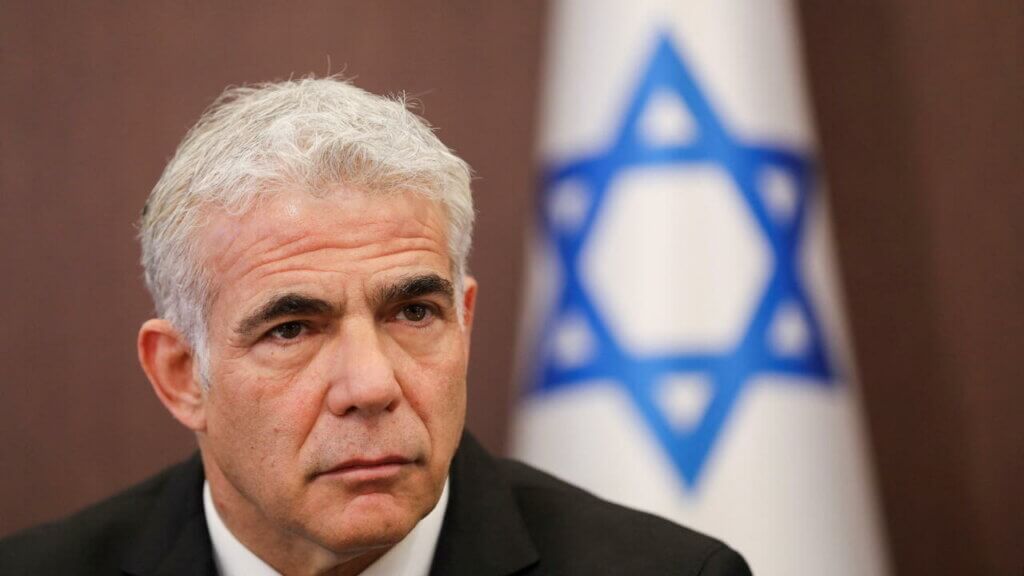
Yair Lapid attends a cabinet meeting at the Prime Minister’s office in Jerusalem May 15, 2022. (Photo: Abir Sultan/Pool via REUTERS/File Photo)

Everyone is talking about Tucker Carlson’s interview with U.S. Ambassador to Israel, Mike Huckabee. It has amassed millions of views, and if there’s one item that caught attention, it was Huckabee’s view that Israel had a biblical right to the land from the Euphrates River in Iraq to the Nile River in Egypt.

Carlson was shocked and pressed him on this:

“What does that mean? Does Israel have the right to that land? Because you’re appealing to Genesis, you’re saying that’s the original deed.”

Huckabee was clear: “It would be fine if they took it all.”

Some were in shock. Israeli hasbarists like Eylon Levy tried to tone it down – responding on X that “literally nobody” with power in Israel believes this and to think so is “a delusional fantasy of the antisemite’s imagination.” To which he added, “Stop spreading mindless conspiratorial bullshit.”

Even Haaretz journalist Gideon Levy opined that Huckabee was an extremist who neither represented the U.S. nor Israel, “he barely represents its crazies,” he wrote. “Huckabee Speaks Boldly in Ways Even Ben-Gvir and Kahane Wouldn’t Dare,” was Levy’s title:


“Not for nothing did Carlson say: This man doesn’t represent my country; he represents Israel. It’s neither of these, Carlson. This man doesn’t represent Israel; he barely represents its crazies. But it’s definitely possible that he represents an America in the making, one whose Secretary of State Marco Rubio recently lauded the West’s “Christian heritage” while in Munich.”

But then, the ‘liberal’ Israeli opposition leader Yair Lapid proved both the Levys wrong.

In a press conference Monday for his party Yesh Atid (‘There is a Future’), Lapid answered a question from a religious Kipa News journalist:

“Good afternoon sir. The Ambassador Huckabee said this week, and we know the extent of the American administration on the government here, that he supports Israeli control from the Euphrates to the Nile, this means [control] over Lebanon, Jordan, Syria, do you support it or do you think this should be stopped?”

Lapid’s answered:

“Look, I don’t think I have a dispute on the biblical level [about] what the original borders of Israel are. The Euphrates, the last time I checked, was in Iraq. I don’t think that when the Americans entered Iraq, they experienced great relief. I support anything that will allow the Jews [to have] a big, vast, strong land, and a safe shelter for us, for our children, and for our children’s children. That’s what I support.”

Lapid was challenged on the size:

“How vast?”

“However possible.”

“Until Iraq?”

“The discussion is a security discussion. The fact that we are in our ancestral land… Yesh Atid’s position is as follows: Zionism is based on the bible. Our mandate of the land of Israel is biblical. The biblical borders of Israel are clear. There are also considerations of security, of policy, and of time. We were in exile for 2,000 years… you don’t really want all this lecture, right? At least you were not waiting for it… The answer is: there are practical considerations here. Beyond the practical considerations, I believe that our ownership deed over the land of Israel is the bible, therefore the borders are the biblical borders.”

“Wait, so fundamentally, the great, big land of Israel?”

“Fundamentally, the great, big and vast Israel, as much as possible within the limitations of Israeli security and considerations of Israeli policy”.

So there you have it. The bible is our deed. Like the first Israeli Prime Minister, David Ben-Gurion, said.

Lapid has stated his principle of “maximum Jews on maximum land with maximum security and with minimum Palestinians” over ten years ago. Now he is saying that the “maximum land” is just a question of exigency – “practical considerations.”

A ‘liberal’, ‘secular’ Israeli opposition leader, just told us that “Zionism is based on the bible.”

I think we need to believe him. We need to stop talking about Netanyahu, Ben-Gvir, Smotrich, and Huckabee. It’s Zionism, stupid.


The Shift: International outcry over Huckabee claim that Israel can control from Egypt to Iraq

The Trump administration is in damage control mode after Mike Huckabee claimed Israel has the biblically mandated right to stretch from the Nile River in Egypt to the Euphrates River in Iraq.
February 26, 2026 
MONDOWEISS


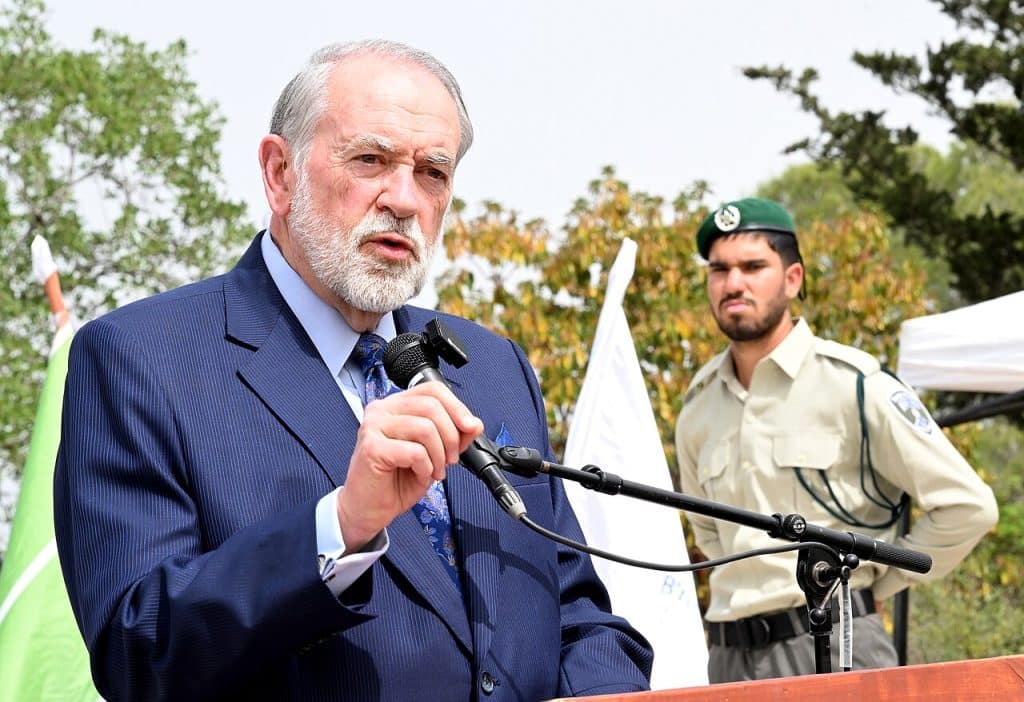
Ambassador Mike Huckabee’s Participation in Holocaust Martyrs’ and Heroes’ Remembrance Day 2025 Ceremony, April 24, 2025 (Photo: U.S. Embassy Jerusalem)


The popular conservative pundit Tucker Carlson recently interviewed U.S. Ambassador to Israel Mike Huckabee.

Carlson pressed the former Arkansas Governor on the country and the U.S. relationship with it, repeatedly leaving Huckabee flummoxed. Huckabee made many perplexing claims, but his most controversial statement came when Carlson asked him whether Israel has a biblical right to the land.

Carlson asked Huckabee, who is a Baptist minister and a Christian Zionist, about a Bible verse in which God promises Abraham that his descendants will receive land “from the wadi of Egypt to the great river, the Euphrates – the land of the Kenites, Kenizzites, Kadmonites, Hittites, Perizzites, Rephaites, Amorites, Canaanites, Girgashites and Jebusites.”

Carlson said this basically amounted to the entire Middle East.

“Israel is a land that God gave, through Abraham, to a people that he chose,” responded Huckabee. “It was a people, a place and a purpose.”

Asked whether Israel had a right to it, he responded, “It would be fine if they took it all.”

At the time I am typing this, the Carlson/Huckabee interview has been watched over 3 million times and is already causing something of an international scandal.

The governments of more than a dozen countries, including allies such as Saudi Arabia and Egypt, issued a joint statement condemning Huckabee’s comments and expressing “strong concern,” as his position directly contradicts official U.S. policy on annexation.

“The Ministries reaffirmed that Israel has no sovereignty whatsoever over the Occupied Palestinian Territory or any other occupied Arab lands,” explains the statement. “They reiterated their firm rejection of any attempts to annex the West Bank or separate it from the Gaza Strip, their strong opposition to the expansion of settlement activities in the Occupied Palestinian Territory, and their categorical rejection of any threat to the sovereignty of Arab states.”

“They further warned that the continuation of Israel’s expansionist policies and unlawful measures will only inflame violence and conflict in the region and undermine the prospects for peace and called for an end to these incendiary statements,” it continues. “The Ministries underscored their countries’ steadfast commitment to the inalienable right of the Palestinian people to self-determination and to the establishment of their independent state along the lines of 4 June 1967, and the end of the occupation of all Arab lands.”

The incident has forced Trump officials, such as Deputy Secretary of State Chris Landau and Undersecretary of State for Political Affairs Allison Hooker, to call Arab leaders and assure them that Huckabee was expressing his personal views and that the administration’s policies have not shifted.

In addition to the international fallout, the interview is reverberating domestically, as it further symbolizes the growing rift over Israel within the Republican Party. A Times of Israel report on the situation refers to the wider fight as “battle for the GOP’s soul.”

The new controversy comes just two weeks after right-wing activist Carrie Prejean Boller was ousted from Trump’s Religious Liberty Commission after criticizing Israel during a hearing.
AIPAC convention

It wasn’t long ago that AIPAC held a massive annual conference that was broadcast on C-SPAN. Thousands gathered to watch presidential hopefuls and influential lawmakers openly pledge their support for Israel.

After its 2020 policy conference, AIPAC put a pause on public meetings over COVID concerns, but they never brought back the annual conference, preferring to embrace smaller meetings and video conferences.

Last weekend was the lobbying group’s annual Congressional Summit, and the event certainly wasn’t broadcast on national television. In fact, you’d be hard-pressed to find any in-depth reporting on it.

An AIPAC source told Jewish Insider’s Gabby Deutch that the meeting would focus on Iran. In her piece on the event, she notes that the organization has “largely stayed silent” amid its rapidly declining reputation among Democratic lawmakers and candidates.

“The question facing the group heading into the midterm elections is whether growing discontent with AIPAC among the party grassroots and a growing number of rank-and-file Democrats will impact its time-tested strategy of working with both parties’ leadership,” writes Deutch. “But the decision by leading congressional lawmakers to attend the conference reveals that AIPAC’s bipartisan playbook is still effective, even as it shows signs of strain.”

Yes, it’s true that House Speaker Mike Johnson (R‑LA), Senate Minority Leader Chuck Schumer (D‑NY), and House Minority Leader Hakeem Jeffries attended the event, but will AIPAC’s overall election strategy prove effective?

Earlier this month, their attacks on centrist Tom Malinowski in New Jersey’s 11th district Democratic primary probably helped Analilia Mejia, the most pro-Palestine candidate in the race, prevail. Now they’re reportedly intervening in the Illinois 9th district, to target Evanston Mayor Daniel Biss, a move that could propel Palestine advocate Kat Abughazaleh to victory.

Rep. Jan Schakowsky (D-IL), who currently represents that district, just pulled her endorsement of Cook County Commissioner Donna Miller in Illinois’ 2nd district over AIPAC donations.

“Illinois deserves leaders who put voters first, not AIPAC or out-of-state Trump donors,” said Schakowsky. “I cannot support any candidate running for Congress who is funded by these outside interests.”
At Milan Fashion Week, industry’s darker side goes unmentioned


By AFP
February 27, 2026


As part of its fashion show in Milan, Tod's had artisans in white coats showing off its trademark leatherwork - Copyright AFP MIGUEL MEDINA


Alexandria SAGE

Artisans in white coats greeted guests at the Tod’s fashion show in Milan Friday, crafting the Made in Italy leather and needlework items for which the company — and country — is renowned.

But despite that display of handcraft, there has been little mention at Milan Fashion Week of some of the industry’s forgotten workers — whom prosecutors found were working in sweatshop conditions at subcontractors for many Italian luxury brands, including Tod’s.

With the glamorous catwalks, celebrities and excess of finery on display, the possibility of the recent investigations uncovering labour abuses being on anyone’s mind appeared slim.

After the show, Tod’s founder and chairman Diego Della Valle told AFP the company’s decision to highlight its artisanal heritage was in no way linked to the recent investigations.

“No controversy — I think we’ll do good things together with the courts and trade associations. I think we’re on the right track,” Della Valle said.

On Tuesday, Tod’s submitted to a Milan court a list of measures it was undertaking to reinforce its supply chain, including the creation of a platform to better trace supplier activity and expanded audits.

“I think that by working together like this, everyone will be involved in finding a solution,” he said, adding that Italy’s laws needed revising “to protect people and artisans”.


– ‘Product first’ –


Many international guests at the show had not heard mention of the accusations of migrant labour exploitation levelled last year at over a dozen of luxury’s biggest names, including Gucci, Loro Piana, Prada, Dolce & Gabbana and Ferragamo.

Allegations include around-the-clock working hours and substandard pay, breaches of safety measures and makeshift sleeping areas inside small workshops.

Asked whether it would matter to the luxury consumer, the vice president and fashion director at Nordstrom, Rickie De Sole, suggested the answer might be yes and no.

“I think the integrity of Made in Italy is incredibly important and I think that at the end of the day, to the customer, it’s product first, right?” she told AFP.

Influential fashion critic and journalist Suzy Menkes, sitting in the front row, cautioned that she hadn’t followed the cases in Italy but said “people do care when there are specific things that have come to light”.

“But I don’t think it’s any different from food and various other things, where one hopes that the bigger the company is, that the more they’re serious about it.”

A Hong Kong content creator dressed head to toe in Tod’s, 26-year-old Stephanie Hui, said people were “desensitised” to stories of sweatshop conditions in the fashion industry, with consumers feeling powerless to effect change.

“It takes a lot of people to band together to like really make a change. It’s not really in our control, but definitely I think if consumers stop spending as much they’ll kind of give the brands a wake-up call,” she said.


– ‘Want to be seen’ –


Fashion industry insiders say that controlling every link in the supply chain is more complicated the bigger the company.

Stefano Aimone, CEO and creative director of Agnona, told AFP in an interview this that it depends on the company’s scale.

“When you’re smaller, you have more control and can really check and know all your employees and consultants by name. When you’re dealing with 400, they’re just numbers, and it’s unthinkable to control everything,” he said.

“Something will slip through regardless, because even if you have contracts with such-and-such subcontractor, you don’t know what they then do in turn,” said Aimone.

Asked whether fashion customers paid attention, Aimone said that despite some headlines, it remained “a B (business) to B (business) issue”.

“The end customer doesn’t know.”

And even if supply chains were better known, the customer might not care, said Iuliana Stetco, 21, a fashion marketing student in Milan.

“They want to be seen, they want to be seen wearing a certain type of brand, a certain label, and so as a result they don’t care much.”
SPACE/COSMOS

NASA announces overhaul of Artemis lunar program amid technical delays


By AFP
February 27, 2026


NASA's Artemis 2 Space Launch System rocket and Orion spacecraft will need to be rolled back off Launch Pad 39B at Kennedy Space Center in Florida to investigate technical issues - Copyright AFP/File Miguel J. Rodriguez Carrillo
Miguel J Rodriguez Carrillo with Maggy Donaldson in New York

NASA on Friday abruptly said it was shaking up its Artemis lunar program that has suffered multiple delays in recent years, a bid to ensure Americans can return to the Moon’s surface by 2028.

That goal remains unchanged, but the US space agency is shifting its flight lineup to include a test mission before an eventual lunar landing to improve launch “muscle memory,” NASA administrator Jared Isaacman said.

That strategic revision comes amid repeated delays to the Artemis 2 mission, which was originally due to take off as early as February, but now will not launch before April. It is meant to see the first flyby of the Moon in more than half a century.

The changes mean that Artemis 3, which was meant to send astronauts to the Moon’s surface, will now have the different test goal of “rendezvous in low-Earth orbit” of at least one lunar lander.

The next phase, Artemis 4, will aim for a lunar landing in early 2028. Isaacman said he hoped that mission could be followed relatively quickly by a second landing within the year.

“We’re not necessarily committing to launching two missions in 2028,” he told a briefing, “but we want to have the opportunity to be able to do that.”


NASA Administrator BILLIONAIRE Jared Isaacman announces changes to the US Artemis lunar program – Copyright AFP Miguel J Rodriguez Carrillo

– ‘Back to basics’ –

The NASA chief said speeding up the cadence of Artemis launches would allow for building more institutional knowledge in the model of the Apollo program, which originally put Americans on the Moon.

“Mercury, Gemini, Apollo, through the shuttle program — I don’t think it would surprise many of the folks in the room that our average launch cadence was closer to three months throughout all those programs, not three years,” he said. “We need to start getting back to basics and moving in this direction.”

“Launching every three years, your skills atrophy, you lose muscle memory.”

Earlier this week, in a setback for Artemis 2, NASA rolled back its towering SLS rocket and Orion spacecraft off the launchpad to investigate problems and make necessary repairs.

– ‘Space race’? –

During his first term President Donald Trump announced he wanted Americans to once again set foot on the lunar surface.

NASA hopes to put humans back on the Moon as China forges ahead with its own effort, which is targeting 2030 at the latest for a first crewed mission.

China’s uncrewed Chang’e 7 mission is expected to be launched in 2026 for an exploration of the Moon’s south pole, and testing of its crewed spacecraft Mengzhou is also set to go ahead this year.

Queried on the so-called “space race,” Isaacman said Friday that “I think competition is good.”

“We’re here talking to you about what is a common-sense approach to achieve the objective, whether we had a great rival in the running or not.”

But delays to space travel are not uncommon — and could also stem from the progress of NASA’s private partners.

SpaceX and Blue Origin, the respective space companies of dueling billionaires Elon Musk and Jeff Bezos, are contracted to develop lunar landers used in Artemis.

Both companies posted praise of NASA’s plans on social media Friday.

“We’re all in!” wrote Blue Origin on X, while SpaceX said it “shares the same goal as NASA of returning to the Moon with a permanent presence as expeditiously and safely as possible.”

“Frequent human exploration flights help establish a sustainable presence for humans in space,” SpaceX said.
WTF!

Court orders Greenpeace to pay $345 mn to US oil pipeline company

“It is very bad not only for Greenpeace, but for the global environmental movement,” 

By AFP
February 27, 2026


At the heart of the North Dakota case against Greenpeace was the Dakota Access Pipeline, where from 2016 to 2017 the Standing Rock Sioux Tribe led one of the largest anti-fossil fuel protests in US history - Copyright AFP/File Robyn BECK


Charlotte CAUSIT

Greenpeace must pay $345 million in damages to the operator of the US oil pipeline it protested, a North Dakota court ordered Friday.

The decision finalizes this phase of the explosive, yearslong case that has pitted the environmental organization against the company Energy Transfer, opening the door to an appeals process in the closely watched legal saga.

The Dallas-based energy conglomerate accused Greenpeace of orchestrating violence and defamation during the controversial construction of the Dakota Access Pipeline nearly a decade ago.


A jury last year took their side, awarding more than $660 million in damages across three Greenpeace entities, citing charges including trespass, nuisance, conspiracy and deprivation of property access.

Judge James Gion of North Dakota cut those damages in half, determining some damages had been counted twice.

But the sum remains staggering.

Greenpeace categorically rejects the accusations, denouncing the proceedings as abusive and a means to silence dissent.

Legal experts and advocacy groups alike have closely followed the case, given its potentially far-reaching implications for protest mobilization and advocacy movements.

Greenpeace has indicated its intention to appeal and has repeatedly stated it cannot pay hundreds of millions of dollars.

“This legal fight is far from over,” Kristin Casper, Greenpeace International general counsel, said in a statement to AFP.

“We will be requesting a new trial and, failing that, will appeal the judgment to the Supreme Court of North Dakota, where Greenpeace International and the US Greenpeace entities have solid arguments for the dismissal of all legal claims against us.”

Energy Transfer, meanwhile, has objected to the halving of its award.

Michael Gerrard, director of Columbia Law School’s climate change law center, told AFP the judgment was “devastating.”

“It is very bad not only for Greenpeace, but for the global environmental movement,” he said.


– Global impact –


The case could have ripple effects worldwide.

When the initial verdict dropped last year, environmental defenders rallied around Greenpeace, denouncing the verdict as a chilling attack on climate action around the globe.

“Fossil fuel companies invest billions in new oil and gas while they spread misinformation, lobby against climate policies, and attempt to silence dissent against their destructive business model,” Allie Rosenbluth, the US campaign manager of Oil Change International, said in a statement to AFP.

“They must not be allowed to act with impunity. These bullying lawsuits won’t stop people from standing up to Big Oil to protect their communities and the planet.”

At the heart of the North Dakota court battle was the Dakota Access Pipeline, where from 2016 to 2017 the Standing Rock Sioux Tribe led one of the largest anti-fossil-fuel protests in US history.

The demonstrations saw hundreds arrested and injured, drawing the attention of the United Nations, which raised concerns over potential violations of Indigenous sovereignty.

Despite the protests, the pipeline — designed to transport fracked crude oil to refineries and on to global markets — became operational in 2017.

Energy Transfer, however, continued its legal pursuit of Greenpeace.

After its federal lawsuit was dismissed, it shifted its legal strategy to the state courts in North Dakota, one of the minority of US states without protections against so-called “Strategic Lawsuits Against Public Participation” or SLAPPs.

Throughout the yearslong legal fight, ET’s billionaire CEO Kelcy Warren, a major donor to President Donald Trump, was open about his motivations.

His “primary objective” in suing Greenpeace, he said in interviews, was not just financial compensation but to “send a message.”

Warren went so far as to say that activists “should be removed from the gene pool.”


ET did not immediately respond to request for comment from AFP.

Greenpeace maintains that it played only a small and peaceful role in the movement, which was led by Native Americans.

Greenpeace International in 2025 announced plans to counter-sue ET in the Netherlands, where the NGO’s international headquarters are, accusing the company of using nuisance lawsuits to suppress dissent.

It is seeking compensation for the costs incurred in these legal battles.


Bleep: The hidden flaw in electric vehicle safety


By Dr. Tim Sandle
SCIENCE EDITOR
DIGITAL JOURNAL
February 27, 2026


Is there a risk of not hearing the traffic? — Image by © Tim Sandle

Electric vehicles are growing more popular, yet their warning sounds may not be doing enough to protect pedestrians. A new Swedish study shows that these signals are hard to locate, especially when multiple vehicles are involved. Consequently, this leaves people unable to tell where danger is coming from or how many cars are nearby.

Researchers from Chalmers University of Technology investigated how well people can locate three common types of warning (or AVAS -Acoustic Vehicle Alerting System) signals from hybrid and electric vehicles moving at low speeds.

To test this, the researchers’ showed that all the signal types were harder to locate than the sound of an internal combustion engine. For one of the signals, the majority of test subjects were unable to distinguish the direction of the sound or determine whether they were hearing one, two or more vehicles simultaneously.

According to lead researcher Leon Müller: “The requirements placed on car manufacturers relate to detection, or detectability, not about locating sound direction or the number of vehicles involved. But if you imagine, say, a supermarket carpark, it’s not inconceivable that several similar car models with the same AVAS signal will be moving at the same time and in different directions.”
Confusing for pedestrians

Car manufacturers often design their own signature sounds. These warning signals are often tested without the complication of background noise. But in a real traffic environment, there are usually many different types of sound.

As Müller explains today’s electric and hybrid vehicles meet the requirements set for acoustic warning systems according to international standards. In Europe, China and Japan, vehicles travelling at a speed below 20 kph must emit a warning signal consisting of tones or noise, to allow pedestrians, cyclists and other non-car users to detect them. However, in the U.S., warning signals are required from vehicles only travelling at speeds of up to 30 kph. This speed difference is often the difference between life and death.


Whilst accidents at 20 kph can be catastrophic, with the risk of serious injury, this exponentially increases with impact speed. For instance, a pedestrian hit at 30 kph has a significant chance of being killed.
Experimental data

The scientific experiments involved some 52 test subjects and were conducted in an acoustics laboratory contained within soundproofed, anechoic chambers. The aim of the tests was to emulate real conditions in, say, larger carparks.

The subject was placed at the centre of the room and surrounded by 24 loudspeakers placed in a ring at chest height. Three types of simulated vehicle sounds were played on the loudspeakers, corresponding to the signals from one, two or more electric and hybrid vehicles, plus an internal combustion engine. One of the signals consisted of two tones, one had multiple tones and one was just noise.

The test subjects heard a vehicle warning signal at about 7.5 meters away, mixed with pre-recorded background noise from a quiet city carpark. When they heard the signal, the subjects had to mark the direction it was coming from as quickly as possible. The signal comprising two tones coming from three vehicles simultaneously was the most difficult and none of the test subjects managed to locate all the two-tone signals within the ten-second time limit.

The test subjects were easily able to locate the sound corresponding to an internal combustion engine. Müller points out this sound consists of short pulses comprising all frequencies; something that is easier for the ear to perceive than a fixed tone at a single frequency. The fact that people can more easily perceive this type of sound may also be because of its familiarity.

Current research tends to focus mainly on detectability and what is usually referred to as “detection distance.” No previous studies have investigated what happens when two or three cars emit the same type of signal. The researchers see a major need for further knowledge of how people react in traffic situations involving electric vehicles.

From a traffic safety point of view, the researchers contend that it would be desirable to find a signal that’s as effective as possible in terms of detection and localisation, yet which does not affect people negatively; something our previous research has shown to be true of traffic noise.

The new study features in The Journal of the Acoustical Society of America, titled “Auditory localization of multiple stationary electric vehicles.”

Macron to set out how France’s nuclear arms could protect Europe


By AFP
February 27, 2026


France maintains the world's fourth-largest nuclear arsenal, estimated at around 290 warheads - Copyright POOL/AFP STEPHANE MAHE
Valerie Leroux and Anna Smolchenko

French President Emmanual Macron is Monday to reveal his vision for how France’s nuclear arsenal could bolster defence in Europe, with the continent scrambling to re-arm against an aggressive Russia and as Washington turns away.

The speech by Macron, at France’s Ile Longue nuclear submarine base, will be closely watched across Europe, which for decades has relied on the United States’ nuclear deterrent but is now increasingly debating whether to bolster its own arsenals.

He is expected to update France’s nuclear doctrine, with a member of his team telling AFP to expect “fairly significant shifts and developments” but declining to give any further details.

Macron has previously proposed to consider how France — the European Union’s only nuclear power — could contribute to protecting Europe.

He said this month he is considering a doctrine that could include “special cooperation, joint exercises, and shared security interests with certain key countries”.

Last year, Macron said he was ready to discuss possible deployment of French aircraft armed with nuclear weapons in other European countries.

France maintains the world’s fourth-largest nuclear arsenal, estimated at around 290 warheads. Britain, which exited the EU in 2106, is the only other European nuclear power.

By contrast, the United States and Russia, the world’s two main atomic powers, have thousands of nuclear warheads each.

Reassurances from US officials that Washington’s deterrent would continue to cover Europe under the NATO alliance have done little to quell European fears of fickleness under US President Donald Trump.

“It is clear that we will need to reflect together on how French and British deterrence can fit into a more assertive European defence,” Bernard Rogel, who served as top military adviser to Macron, told AFP.

– ’27 buttons’ –

This month, German Chancellor Friedrich Merz said that he was holding “confidential talks with the French president about European nuclear deterrence”.

Britain’s Prime Minister Keir Starmer has said the UK’s nuclear deterrent already protects fellow NATO members, but stressed that he was “enhancing our nuclear cooperation with France”.

But how exactly nuclear cooperation would work between the EU’s 27 states is another story.

Rogel insisted that control over the launch decision will remain in French hands.

“I can’t see us having 27 buttons. From a credibility standpoint, that just doesn’t work,” he said.

On top of that, France’s austerity drive and strains in the relationship between it and fellow EU powerhouse Germany, have exposed fault lines in any potential security agreement.

This month, German Foreign Minister Johann Wadephul criticised French defence spending, calling for Paris to do more to turn calls for European security sovereignty into concrete action.

“We are looking forward to and eagerly await another speech by the French president,” Wadephul added.

But Rafael Loss, a policy fellow at the European Council on Foreign Relations, said leaders should find confidence in European support for strengthening nuclear deterrence.

He said people in Bulgaria, Denmark, Estonia, Germany, Poland, Portugal, Spain and Switzerland now tend to support rather than oppose the idea of developing an alternative European nuclear deterrent.

“French and British nuclear forces — as the core of a future European strategic deterrent — likely need to grow in size and change composition (or both),” he wrote.

While a NATO member, France does not make its atomic weapons available to the alliance.

But in his last nuclear doctrine update in 2020, Macron called for dialogue among EU countries about what role the French nuclear deterrent could play.

– ‘Expectations’ –

NATO’s secretary-general at the time, Jens Stoltenberg, dismissed Macron’s call for strategic dialogue in Europe, arguing that a “tried and tested” deterrent was already in place.

But the picture changed after Russian leader Vladimir Putin invaded Ukraine in 2022, repeatedly brandishing the threat of Moscow’s nuclear arsenal, while Trump has pushed Europe down his list of priorities.

Florian Galleri, a historian specialising in contemporary military studies and nuclear doctrines, also warned that Macron would have to tread carefully, pointing to his low approval ratings one year before the end of his presidency.

“This speech creates expectations,” he said. “If it is weak, people will wonder why it was made in the first place. If it is strong, with real changes, the consequences could be significant.”

But Macron’s address could also spark a domestic political backlash ahead of the 2027 presidential election, in which Marine Le Pen’s eurosceptic far right is seen as having its best chance yet at winning the top job.

“The fear is that it could discredit any form of European dimension,” said Galleri
Hackers steal medical details of 15 million in France


By AFP
February 27, 2026


The news came only days after authorities said the details of 1.2 million French bank accounts had been hacked - Copyright AFP/File LOIC VENANCE


Rébecca FRASQUET, Chloé RABS

France’s health ministry said Friday that administrative details and medical notes on more than 15 million people had been hacked.

The announcement came only days after officials warned that the details of 1.2 million French bank accounts had been hacked using the credentials of an official.

The France 2 television channel, which revealed the medical hack, said top politicians were among the millions affected and that the details were now visible online.

It said that some of the information hacked and since seen online included details on whether a patient was homosexual or had AIDS.

The health ministry said the hack, carried in late 2025, involved information from about 1,500 medical practices who had used software made by the Cegedim Sante company.

The data breach primarily involved patients’ names, phone numbers, and postal addresses, but for 169,000 patients there were doctors’ notes “some of which may be sensitive data”, the ministry said.

It insisted however that no prescriptions or results of biological examinations had been involved.

The ministry said the hack had been claimed but gave no details on the group. Cegedim Sante made a criminal complaint over the hack in October 2025. Cegedim said the breach involved about 1,500 doctors out of some 3,800 who used the software.

Cegedim said it was “supporting its clients and their patients as much as possible” and would “fully cooperate with the authorities”.

The hack involved “15.8 million administrative files (…) among which 165,000 contain a personal annotation by the doctor relating to sensitive information”, it said.

Gerome Billois, a cybersecurity expert at the Wavestone consultancy, said the leak could be “the biggest in France” in the health sector and could have “irreparable consequences”.

“Once health information that says: ‘You have AIDS’ or ‘You have such and such a disease’ is released, you can never go back,” Billois told AFP.

The French finance ministry announced on February 18 that a hacker had gained access to a national bank database and consulted information on 1.2 million accounts.

It said the hacker had used the stolen credentials of an official to access details including account numbers, name of the holder and address.
TikTok disinformation: the other weapon in Mexico violence


By AFP
February 27, 2026


Security forces patrol a highway after a wave of violence in the Mexican town of Aguililla, the birthplace of drug kingpin Nemesio Oseguera, who died after a shootout - Copyright AFP Enrique Castro


Arturo ILIZALITURRI

While gunmen for the powerful Mexican narcotrafficker Nemesio “El Mencho” Oseguera were burning vehicles and blockading roads across Mexico in response to the killing of their leader, others stoked chaos through different weapon: disinformation.

The death of the most-wanted Mexican narco, the leader of the Jalisco New Generation Cartel (CJNG), in a military operation on Sunday unleashed a wave of criminal violence in 20 out of 32 states.

It also unleashed the mass dissemination of AI-created images shared thousands of times on social media.

The fact-checking team for AFP in Mexico analyzed a dozen of the fake images and videos linked to the operation and its fallout that were shared over 38,500 times on social media.

One of the most disseminated was an aerial image — made with artificial intelligence — of Puerto Vallarta, the tourist paradise on the Pacific coast of the western state of Jalisco, that showed multiple buildings in flames.

The henchmen of “El Mencho” did burn vehicles and vandalize businesses in the famous beachside resort town. But the damage wasn’t of the magnitude that the false photographs showed.

– ‘Magnifying the chaos’ –

Behind this digital mobilization, according to multiple analysts, are accounts tied to Oseguera’s CJNG.

Alberto Escorcia, a journalist specialized in social media, identified three groups that disseminated false information tied to the wave of violence.

“One was the Jalisco Cartel, magnifying the chaos,” he explained to AFP.

Groups of “opportunists” also participated in the disinformation, using them to promote national and international political talking points, he added.

Multiple of these “opportunistic” accounts have already been identified by AFP as disseminators of disinformation in Mexico and the rest of Latin America.

Escorcia was threatened on social media after he shared a video where he demonstrated the disinformation on the platform X during the chaotic morning.

Mexico’s security secretary, Omar Garcia Harfuch, claimed that there are “multiple accounts” on social media identified by his office as engines of disinformation tied to the operation.

“We’re going to do a deeper job to find out what relationship they have to the criminal organization,” while others “were only dedicated to disinformation,” he said in a press conference.

– Recruitment-

Academic researchers also detected expressions of sympathy for Oseguera, who until his killing was the most wanted narco in the United States, where the government offered a 15 million dollar compensation in exchange for information leading to him.

“There was a notable and sustained volume of publications and comments with expressions of admiration, mourning,” and “aspirational identification” with the druglord, according to Valeria Almaguer, the subdirector of the Seminar on Violence and Peace at the College of Mexico.

This group of investigators, examining Instagram, TikTok, and X, found messages that lamented the death of “El Mencho,” accompanied by emojis tied to the CJNG and “narco-corridos,” popular songs that celebrate criminal groups.

These symbols coincide with the seminar’s findings in an investigation that documented the existence of over 100 accounts on TikTok dedicated to criminal recruitment and propaganda.

“The CJNG leads the use of TikTok as a channel of recruitment and propaganda,” they published in an April, 2025 report.

The usage of social media by the CJNG to fill their ranks has also been identified by the Security Secretary’s Office.

In March, 2025, following the discovery in Jalisco of a training center for the criminal mafia, the department identified 39 profiles dedicated to recruiting young people that TikTok removed at the request of the authorities.
Carmaker BMW to trial humanoid robots at German factory


By AFP
February 27, 2026


AEON, a humanoid robotic created by the company Hexagon, is presented by BMW in Munich - Copyright AFP Michaela STACHE

German carmaker BMW said Friday it plans to deploy two AI-powered humanoid robots in a factory in a pilot programme for the first time this year.

Dubbed AEON and developed by the Swedish company Hexagon, the black-and-white robots stand 1.65 metres (5.4 feet) tall, weigh 60 kilogrammes (132 pounds) and move on two wheels.

They can autonomously manipulate and move components within a factory where the space has been previously fully scanned and digitised.

A months-long pilot phase will start this summer in a plant in Leipzig, with employees working alongside the vaguely human-like robots.

The robot “has a full awareness of its environment” thanks to 22 sensors and various types of cameras, said Arnaud Robert, president of Hexagon Robotics.

Robert declined to disclose the price of the robots, but said it was in the hundreds of thousands of euros.

The AI-powered robot is “intelligent enough to generate its own decisions” and operate “in a manufacturing environment”, said Milan Nedeljkovic, BMW’s incoming chairman and the current head of production.

During a demonstration at a BMW workshop in Munich, the robot could be seen navigating toward a car and scanning the front door of the vehicle using a device.

Another demonstration showed the robot retrieving a part from a person before handing it back a few metres away.

The robot’s battery life is about three hours, but the Swedish developer said the robots can replace their own battery in about 30 seconds using a charging station.

Germany’s once-mighty car industry, faced with fierce Chinese competition, has been struggling to maintain competitive advantages and match Chinese innovations.

During a visit to China on Thursday, German Chancellor Friedrich Merz was shown an impressive coordinated performance of humanoid robots designed by the Chinese company Unitree, aimed at showcasing Beijing’s rapid technological progress.

In Europe, factory automation using robotics and AI has raised concerns about potential job losses.

The BMW Group’s head of digitisation, Michael Stroebel, said on Friday that it is “not planned currently to reduce the workforce” by replacing workers with new robots.


Trump tells US govt to ‘immediately’ stop using Anthropic AI tech

By AFP
February 28, 2026


US tech giant Anthropic will bar Chinese-linked users from its artificial intelligence services. — © AFP Julie JAMMOT


W.G. DUNLOP

President Donald Trump told the US government Friday to “immediately” stop using Anthropic’s technology after the AI startup rejected the Pentagon’s demand that it agree to unconditional military use of its Claude models.

Anthropic insists its technology should not be used for the mass surveillance of US citizens or deployed in fully autonomous weapons systems, while the Pentagon says it operates within the law and that contracted suppliers cannot set terms on how their products are employed.

“I am directing EVERY Federal Agency in the United States Government to IMMEDIATELY CEASE all use of Anthropic’s technology. We don’t need it, we don’t want it, and will not do business with them again!” Trump said in a post on his Truth Social platform.

“There will be a Six Month phase out period for Agencies like the Department of War who are using Anthropic’s products, at various levels,” the US president said, referring to the Department of Defense.

“Anthropic better get their act together, and be helpful during this phase out period, or I will use the Full Power of the Presidency to make them comply, with major civil and criminal consequences to follow,” Trump added.

Anthropic did not immediately reply to a request for comment.

The Pentagon had said Anthropic must agree to comply with its demand by 5:01 pm (22:01 GMT) Friday or face compulsion under the Defense Production Act.

The Cold War-era law, last invoked during the Covid pandemic, grants the federal government sweeping powers to direct private industry toward national security priorities.


Anthropic CEO Dario Amodei has rejected the Pentagon’s demand that the company agree to unconditional military use of its AI technology – Copyright AFP/File Ludovic MARIN

The Pentagon also threatened to designate Anthropic a supply chain risk — a label typically reserved for companies from adversary nations — which could severely damage its ability to work with the US government and harm its broader reputation.

– ‘Stand together’ –

Amid the dispute, Anthropic chief executive Dario Amodei said Thursday that “these threats do not change our position: we cannot in good conscience accede to their request.”

The conflict has drawn a show of solidarity from others in the industry, with hundreds of employees from AI giants Google DeepMind and OpenAI urging their companies to rally behind Anthropic in an open letter titled “We Will Not Be Divided.”

“We hope our leaders will put aside their differences and stand together to continue to refuse the Department of War’s current demands for permission to use our models for domestic mass surveillance and autonomously killing people without human oversight,” the letter said.

“They’re trying to divide each company with fear that the other will give in. That strategy only works if none of us know where the others stand,” it added.

OpenAI CEO Sam Altman told employees Thursday that he too was seeking an agreement with the Pentagon that would include red lines similar to Anthropic’s, and that he hoped to help broker a resolution.

“We have long believed that AI should not be used for mass surveillance or autonomous lethal weapons, and that humans should remain in the loop for high-stakes automated decisions,” he wrote in a memo to employees, according to US media.


Anthropic’s AI assistant Claude vies with rival chatbots from OpenAI, Google and others to be the “agent” relied upon by businesses to independently get jobs done 
– Copyright AFP/File Joel Saget

Industry representatives in Washington had pressed hard for a negotiated outcome to the Anthropic-Pentagon dispute, warning that the confrontation risks damaging the AI sector as a whole.

“Decisions about military AI cannot be settled through ad hoc standoffs between the Pentagon and individual firms,” said Daniel Castro, vice president of the Information Technology and Innovation Foundation.

“If certain AI capabilities are deemed essential for national defense, those expectations should be debated openly and written into law.”