Megaphones Made of Silence: Ai Weiwei at Odds With Power
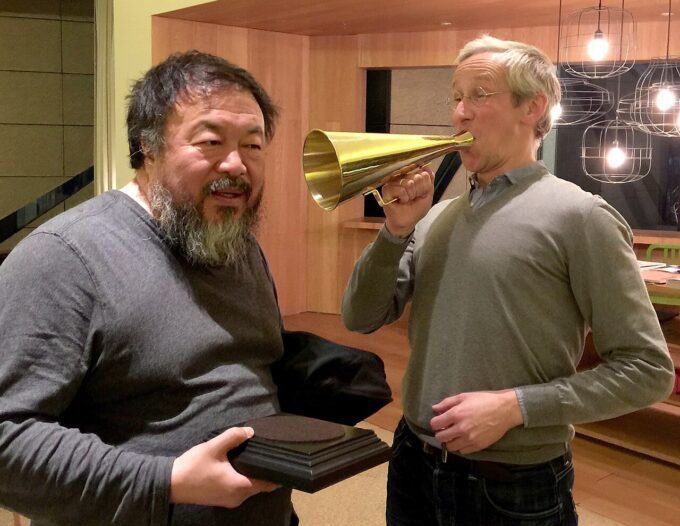
Photograph Source: Catherine Cheng – CC BY-SA 4.0
Last October, I mentioned Ai Weiwei, but was perhaps insufficiently sympathetic. At best, his art bursts with loud, defiant, and impossible to ignore courage. He has detractors, for sure, but sometimes his Zen-like obfuscation is irresistible.
For what it’s worth, we both lived in New York beginning in 1983. He stayed there another four years after I left in 1989. Then there was Lesbos in 2015. He arrived on the Greek island soon after me, both of us trying to understand the first wave of refugees later weaponised as evidence of Europe’s supposed downfall. My work there was reportage. His was described by the prolific Binoy Kampmark here as “a form of ritualised pornogrification that finds gold in crushing victimhood.” To be fair to Ai Weiwei, his installations from the island highlighted true stories within true stories, functioning less as statements than as acts of witness.
Which is why I was grateful to be invited to an event in central London where Ai Weiwei was due to speak about his recent book On Censorship—described as a rallying cry in an age of “big data, mass surveillance and intrusive new technologies of control.” This was only a few days before the 20-year prison sentence was handed out by Chinese authorities to Hong Kong publisher Jimmy Lai. Roger Thorp of Ai Weiwei’s publishers—Thames and Hudson—told me the idea for the book came during a book fair trip he was making to Bologna, where Ai Weiwei happened to be showing at Palazzo Fava. “I was immediately reminded what a powerful voice against oppression he was,” Thorp said.
It is true. Ai Weiwei’s relationship with censorship shapes his work, his movements, even the limits imposed on his body. Censorship is the force he pushes against, and the material he works with—Thorp described the book as emerging in much the same way. Not planned so much as necessary, as if the subject itself was pushing to take physical form.
“It is the responsibility of a publisher,” Thorp added, “to have voices heard in good times and in bad. You are a conduit. And you don’t know what someone will say. Nor does it mean you have to agree with them.”
In response to Ai Weiwei’s art, the Chinese authorities censored his exhibitions, erased his online presence, demolished his studio, confiscated his passport for years, and detained him. Attempts to mute his voice must have been nightmarish for him. Rather than stopping him, however, censorship became his medium. As the artist has said himself: “Censorship is saying: ‘I’m the one who says the last sentence. Whatever you say, the conclusion is mine.’”
The event I was attending was taking place within the monumental gravity of the Methodist Central Hall in Westminster. The air felt weighty, close as it was to Parliament and centuries of judgment, dissent, execution, coronation. In 1946, it hosted the first session of the United Nations General Assembly. Other speakers have included Mahatma Gandhi and Mikhail Gorbachev. It is strange how a book can begin with a series of conversations between an editorial director of art and an artist—and end up where even the public enquiry for the Bloody Sunday incident in Northern Ireland was held.
It is hard at the same time not to think of all those other artists who found themselves at odds with power. Didn’t Caravaggio flee city after city under sentence of death, his paintings growing darker as exile closed in? Didn’t Francisco Goya, deaf and disillusioned, paint atrocities onto his walls when Spain could no longer bear to look at itself? Censorship has only rarely silenced artists. More often than not, it has driven the work inwards, where it becomes sharper, stranger, harder to forget.
Meanwhile, a marble sculpture of John Wesley stood nearby, finger raised heavenwards, as if caught eternally mid-sermon. How well this gesture echoed the evening’s mood—accusation, exhortation, warning.
Ai Weiwei held his own on stage with former BBC interviewer Stephen Sackur. Throughout, multiple cameras fed a live edit onto four large screens. Ai Weiwei lifted his phone and began filming the proceedings himself. “To subvert the format,” he said mischievously. A small act, but one that landed where it was meant to. Much of Ai Weiwei’s art mirrors power back to itself, forcing it to watch itself watching.
Ai Weiwei spoke quietly. So quietly, in fact, that a second microphone was eventually added—an irony that only sharpened the room’s attention, as his softness had already demanded increased listening. English is not the artist’s first language, but he was updating the audience fluently. I had not realised, for example, that he had returned to Beijing just one year earlier. I knew he had left China for what some had thought would be the last time in 2015, after his passport was finally returned, which was when he came to Lesbos. Ai Weiwei described the countless cameras around his studio in Beijing when he first ran into serious trouble as omnipresent, banal, absolute.
Surveillance has always produced its own kinds of art. In the Soviet Union, Dmitri Shostakovich slept with a packed suitcase by his door, expecting arrest, composing symphonies that sounded obedient while hiding dissent between the notes. Like Ai Weiwei, he learned that when the state listens too closely, art adapts.
Was Sackur expecting the artist to savage China? When finally Ai Weiwei did speak comparatively, it wasn’t in the expected register. In fact, the audience reacted agreeably when he referred to the United States as only “the so-called” free world. One of Thorp’s points, too, was that the book was never meant as a simple indictment of one country—but as a kind of anatomy of power’s universal reflex to control. Ai Weiwei even suggested that maybe China and the US were not so different today.
Ai Weiwei has said in the past: “When human beings are scared and feel everything is exposed to the government, we will censor ourselves from free thinking. That’s dangerous for human development.” It felt like this line was hovering invisibly above the audience. Ai Weiwei brought to mind Anna Akhmatova, who memorised her poems and burned the paper, trusting only the human voice to survive the state.
Art and politics surfaced regularly, though Ai Weiwei shrugged at the distinction. “I just pretend to be an artist,” he said, a phrase that landed somewhere between joke and confession. He reminded us on stage his father, the poet Ai Qing, had once been close to Chairman Mao Zedong—as, indeed, had the father of Xi Jinping. History here was not a clean break. It was possibly muddled.
Projected large on the screens, his face looked weary but open—small beard, bags beneath the eyes, sympathetic rather than heroic. When Sackur pushed the artist again on his mistreatment by the authorities in Beijing, it was deflected lightly. In Russia, countered Ai Weiwei, he would have been poisoned. An anonymous question from the audience was offered up via the tablet on Sackur’s lap. “Anonymous questions I don’t answer,” replied Ai Weiwei. Even here, in the Central Hall, anonymity carried the whiff of fear.
Just then, he said the conversation was growing too dark and suggested playfully they let more sunshine in. The hall, I suspected, had always been better at shadows.
As the evening ended, I was struck by how the building seemed to have leaned in throughout—a structure built to amplify power now temporarily hosting someone who had spent a lifetime exposing how power listens, watches, edits, and erases.
Just as China is now making an example of Jimmy Lai, the book is not simply an argument against censorship, but a record of what survives it: speech itself, still continuing. In that vast chamber, Ai Weiwei’s quietness felt radical. A reminder that volume is not the same as force—and that sometimes the most subversive act is simply to speak, and to keep speaking, where history and the bully expect silence.

No comments:
Post a Comment