The Old Left Recognizes the Danger of AI, Where’s Everybody Else?
MARCH 17, 2026
Photograph by Nathaniel St. Clair
It’s time for the so-called new left to wake up to the existential threat posed by AI. The only U.S. politician cognizant of this stupendous danger is old left Bernie Sanders, who recognizes the late-capitalist AI tsunami coming for us all. He’s the only one asking questions about what happens once governments and corporations turn everything over to AI, because the only way to compete is to rely on a technology that functions at the level of “the best humans” and will soon develop beyond and surpass the best and smartest humans.
This is the overall danger posed by AI. More specific ones have been making headlines lately, namely the AI corporation Anthropic’s imbroglio with Pentagon chief Pete Hegseth. With breathtaking arrogance, Hegseth threatened to ditch Anthropic’s $200 million defense department contract for its AI called Claude, if Claude could not be used for certain despicable and frankly illegal purposes: in autonomous weapons systems that can kill people without human input and allowing Claude to be used for mass domestic surveillance. To his credit, Anthropic’s ceo Dario Amodei resisted Pentagon pressure. But these horrifying demands reveal AI’s monstrously anti-human and homicidal potential. On the evening of February 27, before Anthropic and the Pentagon could release their final positions, Trump, in a fit of pique, banned all government agencies from doing business with Anthropic. So I guess we know where the white house stands on potential abuses of AI. But in the end, this hullaballoo between an AI corporation and the Pentagon is only one aspect of the broader danger AI poses to humanity.
So what happens when, in a few years, the labor portion of the economy is zero percent and the capital portion is 100 percent? And that’s coming fast, because Donald Trump has unleashed AI. The situation might be manageable if the U.S. and China slapped some controls on this monster – so that creating AI superior to the best and smartest humans is delayed – and China would probably be willing to do that. But Trump’s U.S., particularly his venture capitalist backers? Not so much.
Most of the left regards AI as merely the latest Silicon Valley craze, like crypto. It is not. On this, the old left, represented by Sanders, is a lot smarter. Because this is not a matter of “well, I ignore AI, so it will leave me alone.” It won’t. Years ago on Twitter, The Wire’s writer, David Simon, was asked if he’d use AI to help him write, and he replied, “I’d rather put a gun in my mouth and pull the trigger.” For those of us who want AI out of our lives, that could soon be the only option.
Roughly five years ago, of the four big AI companies – Open AI, xAI, Google and Anthropic – two stated openly that if we developed an artificial general intelligence, the chance of human extinction would immediately hit 25 percent (Anthropic’s ceo DarioAmodei) or 20 percent (xAI’s boss Elon Musk). It was then still a theoretical concern, but these leaders in the field admitted that to make up for employment extermination, government would have to supply a universal basic income. But now, with the public asleep to this menace and competition having increased, those corporate bigwigs are no longer quite so honest.
Making matters worse is the fact that for Trump promoting AI keeps the stock market booming. And since Trump regards the stock market as the economy, he has issued horrible executive orders on AI, the worst being his attempts to preempt state regulation of AI, which is the only thing that might protect us from this technological Godzilla.
Three years ago, you could easily discern if you were chatting online with AI. But by winter of 2025, most AI passed the Turing Test, which means it could fool you into thinking you were chatting with a person, if it wanted to. Now if you look at more quantitative fields, like computer programming, well, in the past few months, top computer programmers have stopped writing their own code and have turned this task over to AI. In formal mathematics, AI already operates at the level of pretty good PhD students, but not yet professors. So mathematicians are still doing math. But that will likely be the first of the hard sciences that falls to total automation.
The real danger comes in the next few years, when, according to the research institute METR, the task length that AI can complete extends – because it’s been doubling every few months. So that’s an exponential trajectory that means AI will surpass most human knowledge work – computer programmers, Wall Street entry-level associates much of whose work is manipulating Excel spreadsheets (they will be merely the first to go) – in a matter of years. This change will wipe out knowledge workers, since AI will be able to perform all their tasks, faster and better.
Within Silicon Valley opinions differ on how desirable it is to summon super intelligence into the world. But Trump and his venture capitalist supporters, who have quite successfully kept this issue off the public and congressional radar, have backed those who are most gung-ho for creating super intelligence. This is dangerously short-sighted. These guys may all get rich, but they’ll do so producing a super intelligence that could easily decide in the future that we humans are a nuisance, like so many insects that need to be exterminated. If you think this is an overreaction, well then, you haven’t been paying attention.
Bernie Sanders has. Back on November 24, 2025, he released a statement entitled “The Future of AI and Its Impact on Humanity.” “The question is: Who will control this technology? Who will benefit from it? And who will be left behind?” Then on February 20, the Guardian reported that Sanders “Warned that Congress and the American public have ‘not a clue’ about the scale and speed of the coming AI revolution, pressing for urgent policy action to ‘slow this thing down.’” Sanders calls this the “most dangerous moment in the modern history of this country.” He added, “the Congress and the American people are very unprepared for the tsunami that is coming.” Sanders reissued his call for a moratorium on the expansion of AI data centers to “slow down the revolution and protect workers.”
Sanders first called for a moratorium in December 2025. “If there are no jobs and humans won’t be needed for most things, how do people get an income to feed their families, to get healthcare or to pay rent? There has not been one serious word of discussion in the Congress about that reality.” As the Guardian reported December 28, 2025, he questioned the motives of “the richest people in the world” pushing AI. “He singled out tech moguls Elon Musk, Mark Zuckerberg, Jeff Bezos and Peter Thiel.” Sanders calls for slowing “this process down. It’s not good enough for the oligarchs to tell us, it’s coming, you adapt…They’re going to guarantee health care to all people? What are they going to do when people have no jobs…make housing free?” Again and again, Sanders says, correctly, we need to slow this hurricane down.
So when it comes to AI, old left Bernie Sanders knows the score. Donald Trump does not. Or, more likely, he just doesn’t care. In 2025, Trump issued four executive orders promoting AI and deregulating it. Worst of all was his December 2025 order designed to stop states from restricting AI. Scheduled for March 2026, the Secretary of Commerce is tasked with identifying burdens on AI, among other things. Trump’s assault on the only guard-rail against explosive AI development, namely state regulations literally threatens us all. The only way out of this dead end that AI is corralling us into lies in Congress. If Sanders can wake up his fellow congress members, then we humans might stand a chance. Otherwise, it’s a future of no jobs, no income and the likelihood that super-intelligent AI comes to regard the human species as redundant or outright expendable.
An Existential Threat to Organized Labor’s Ability to Help People

Rarely has a story filled me with such a profound sense of dread as Josh Dzieza’s New York Magazine piece this week headlined “The Laid-Off Scientists and Lawyers Training AI to Steal Their Careers.” More than anything I have read before, this story has begun to crystallize for me the exact ways that AI is a threat not just to jobs, but to the entire existence of organized labor in America. This is serious shit.
We are all familiar with the ways that the “gig economy” has preyed upon flaws in American labor law to weaken workers and strengthen capital. Employers figured out that by making all of their workers “independent contractors,” they could avoid paying them benefits, abdicate most responsibility for their welfare, push work costs onto them, and, crucially, rob them of the ability to legally unionize. This dynamic has been evident across the economy for decades. The same dynamic making people become Uber drivers also has made everyone adjunct professors and has made everyone work for shoddy subcontractors rather than directly for the firm that it seems you actually work for. It is the push to eradicate, to the extent possible, the existence of the full time employee. The rise of the gig economy is a serious threat to organized labor power. The labor movement has made efforts to nibble at its edges, but success has been hard to come by.
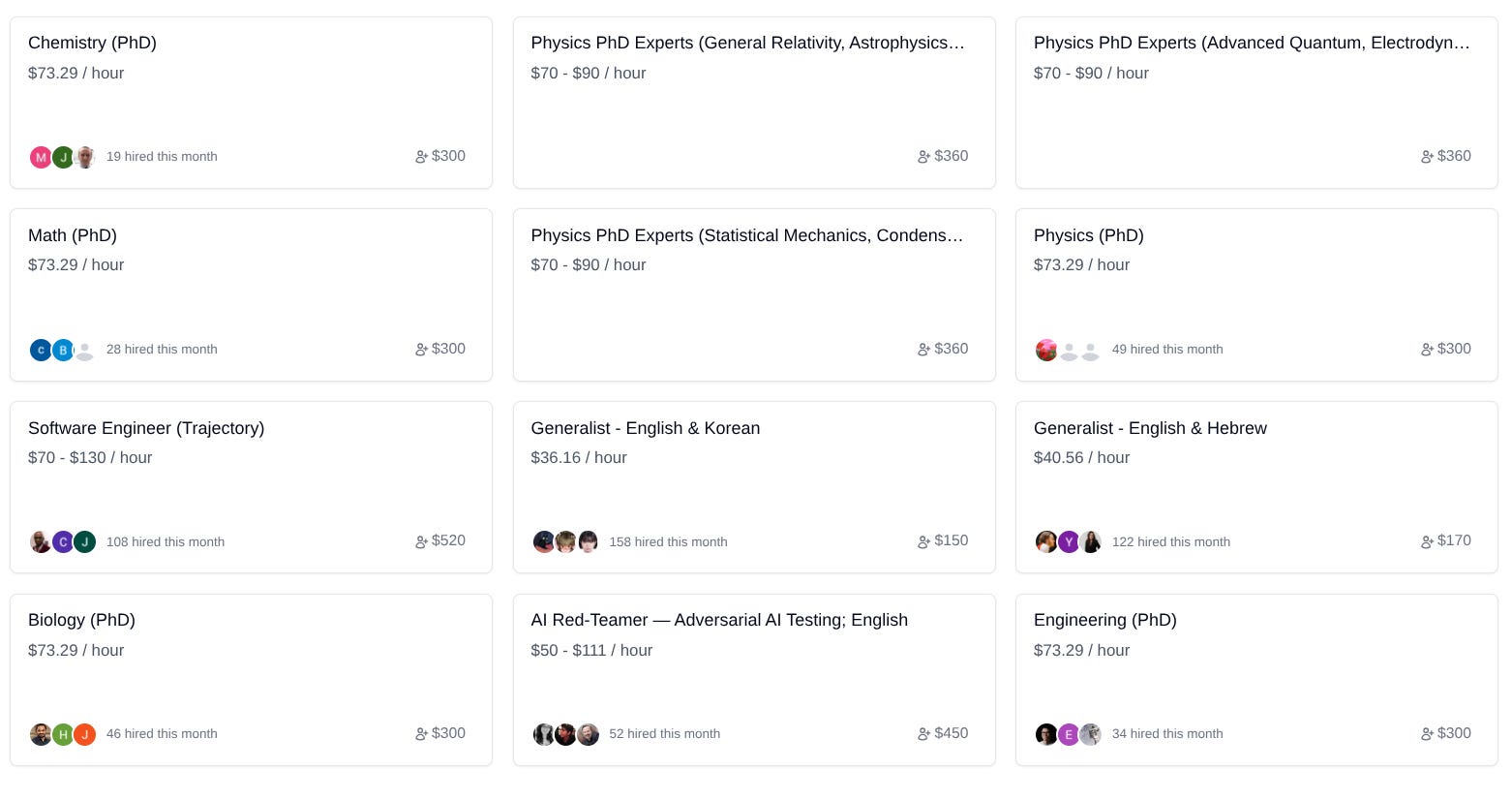
In Dzieza’s story, I saw something that is potentially even more deadly. He profiles Mercor, one of several companies in the business of hiring economically desperate professionals—not just lawyers and scientists, but screenwriters, designers, PhD’s, and experts in a wide variety of academic and professional fields—to train AI models to become better in their areas of expertise. Major AI firms hire Mercor to improve their models. Mercor recruits the appropriate pool of expert works, all as contractors, all working remotely, and then, with no predictable schedule, tosses them batches of work, which they all compete to finish as quickly as possible. Workers do not know the end client. Workers are monitored by software that tracks their actions scrupulously the entire time. Workers can be deactivated and cut off from their supply of work for any reason at all. Workers describe a process of the company cutting rates for the same tasks over time—from $30 an hour, for example, down to $16 an hour. Mercor’s 22 year-old founders became billionaires last year.
Exploitative work is not new. It is a feature of capitalism. American workers have been fighting against it for centuries. The labor movement has a rich history of organizing highly exploited workers and improving their conditions. Coal miners. Factory workers. The list goes on. People died. Violence was intense. Is a company like Mercor really so bad compared to all this?
The answer, I think, is that a company like Mercor poses a fairly unique challenge to the labor movement’s prescription for empowering workers. Here are some characteristics of the type of work that Mercor and its AI industry clients are offering. While many of these characteristics have been present in various workplaces throughout modern history, I do not believe that this lethal combination of characteristics has ever been so ascendant at the center of our economy:
- No worksite. Remote workers are hard to organize.
- No full time employees. Independent contractors cannot legally unionize.
- Workers are in competition with one another for piecework, rather than cooperating on tasks. The nature of the job encourages workers to see one another as threats, not as peers with whom to foster solidarity.
- Total technological control of the work process by the company. Absolute monitoring of tasks, absolute lack of transparency by workers into the company’s operations and what their coworkers are doing, and absolute ability of the company to fire workers at will.
- The success of the company contributes to the economic precarity of its own workforce. These workers, already unable to find jobs that can support them after years of training, are employed to improve the AI models that will automate their own industries. The better Mercor’s workers do their work there, the fewer good jobs for humans there will be in their own fields.
- The workforce gets better as it becomes more economically desperate. A subtle second-order effect of the dynamic described above is that as improved AI models eat more jobs in professional fields, the pool of highly trained workers forced to work for a company like Mercor will expand. Meaning that over time Mercor will be able to offer AI companies more highly skilled workers to train its models, while at the same time being able to offer those workers less, because they are competing with more of their unemployed peers. The leverage of the workers goes down as Mercor’s ability to hire better workers goes up.
As you consider this set of characteristics, ask yourself: Where, exactly, is the realistic intervention point for a labor union to build power for workers here? Even if you were able to overcome the significant hurdles of having a disparate pool of remote workers, and make a list of workers to organize, and pull them together and get them willing to act in solidarity, and avoid having the company deactivate them immediately, they are still caught in a system that is constantly employing them to undermine their own leverage. Even in the best scenario, labor’s leverage at a company like Mercor would be: The company can’t fire these workers because there is a demand for their services from the AI clients. But the more successful the workers are at their jobs, the more the advancing AI models will automate their industries and create an expanding pool of desperate workers who are forced to underbid and undermine the workers at Mercor who organized. It is a non-virtuous cycle. It is a bloodless white collar version of an imperial conqueror who employs impoverished natives as soldiers to oppress their own neighbors.
My own union, the Writers Guild of America, has more or less fully unionized the screenwriting industry. The union is strong and well organized and has experience using its position at a vital chokepoint in the entertainment industry to build and exercise power for writers. It is probably the best-case scenario for existing unions facing this type of AI threat. And even in the case of the mighty WGAE, what companies like Mercor are doing give me the sickening feeling that we are fucked.
The WGA signs contracts with all of the big Hollywood studios and entertainment companies that make films and TV shows. We have an ability to exercise power against these existing companies. We can put provisions strictly regulating AI in our contract with these firms, and strike to enforce it. The real threat we face, though, is not just from the firms who are signatories to our contract wanting to use more AI to replace writers. It is that AI models, trained by us, will become so skilled at replacing writers that entirely new firms can rise up, with little friction, and make film and television without employing writers at all. AI is not the usual sort of threat to labor. In the case of AI, economically desperate workers of today are not training their temporary replacement, or helping a company move to a different place where labor is cheaper; they are training a permanent replacement. The highly trained workers at Mercor are in effect the last gasp of the skilled workforce that they thought they would be entering. They are the desperate members of an expedition, forced to eat the horses that were their only hope of escaping the bad place they are in. After that, they can only eat each other. Then they all die.
Even with respect to “the gig economy”—though it is very difficult—the path for organized labor has been clear. Organize the workers. Build their collective power. Use that power to fight and win protections. But this entire paradigm is being broken now. Even if we could organize the workers of Mercor (something that unions have thus far not even attempted in any serious way), we cannot escape the fact that the very nature of their work is to improve the thing that will destroy their own career prospects in the future. We do not have unions at the AI companies. We cannot strike against them in any meaningful way. Nor do we have a clear path to assert the power of today’s highly skilled workers against the companies of the near future that will be using the AI models we just trained to replicate our work without us.
The progress of the AI industry is in effect shrinking the sphere of economic life in which unions might even hope to be able to help humans. At some point that sphere will become too small to matter to most humans.
This is not just about writers. Not even close. It is about architects and lawyers and scientists and teachers and a whole host of other fields that are facing the same dynamic. The basic threat of white collar job automation by AI has been understood for a long time. But I do not think that organized labor itself—all of the labor unions in America today, the ones still able to exercise power on their own little industrial islands—has really begun to reckon with what we are up against. It is not just that workers are threatened by the job automation, the disappearance of their careers, their declining leverage in the economy. It is that, absent federal laws, it is unclear what unions can even do about this. We can’t organize AI models, and organizing unemployed people offers little power.
The speed at which the AI industry is moving relative to the federal government means it is pretty unrealistic to expect any of us to be saved by the law any time soon. This is very bad—even for the lucky slice of workers who are members of strong unions today. A guillotine is being constructed, by our own desperate peers, that will be capable of rendering today’s version of organized labor more or less obsolete, at least in many of today’s industries that host strong unions. We are heading to a place where not only are workers exploited, but organized labor as it is currently constituted has no moves to make to help them. I confess I don’t have the answer here. But we had better get our fucking thinking caps on, fast.


No comments:
Post a Comment