Why Labour MPs should be worried

MARCH 17, 2026
Mike Phipps reviews The British General Election of 2024, by Robert Ford, Tim Bale, Will Jennings and Paula Surridge, published by Palgrave Macmillan.
Some features of the 2024 general election were apparent in the immediate aftermath: a Labour landslide on the smallest share of the vote in modern times, on an almost unprecedentedly low turnout. For less obvious aspects, we have had to wait over eighteen months for political scientists to crunch the numbers. Has the wait been worth it?
“Brilliant,” “written by the wisest heads in academia,” “masterpiece,” “vital,” “definitive,” “perfection,” “must-read” – the advance plaudits for this account of the 2024 general election perhaps raise expectations too high. In reality, I found much of the analysis proffered by this book to be run-of-the-mill, second-hand and lacking rigour, particularly in the build-up to the big event.
Problematic pre-election coverage
A central weakness is its acceptance of the Keir Starmer / Morgan McSweeney version of how the Labour Party was ‘transformed’ into an election-winning machine in the run-up to 2024. Keir Starmer may still be convinced that the now sacked McSweeney is one of the greatest strategists in the entire world, but that lack of judgment may tell us more about Starmer’s own current predicament.
This book went to press before McSweeney’s demise, but it should not have been relying on this lazy narrative in the first place. Its one-sided approach is particularly evident in the coverage of the sacking of Rebecca Long-Bailey and the suspension from the Parliamentary Labour Party of Jeremy Corbyn.
In places, the book’s acceptance of the Labour leadership’s version of events stands reality on its head. “McSweeney inherited a mess,” we are told. “Labour’s grassroots campaigners and managers had been neglected by the Corbyn leadership.” Anyone who took part in the mass canvassing sessions organised in the Corbyn years would without any doubt question this. Worse, it overlooks the fact that Keir Starmer actually disbanded Labour’s Community Organising Unit and oversaw the suspension of a number of local CLPs and activists, demoralising members and undermining grassroots efforts.
For something that is being promoted as the definitive account of the 2024 general election, there are some curious omissions, particularly on the full significance of the Labour apparatus’s factional eve-of-campaign removal of popular candidates and other self-inflicted wounds during the campaign. The sense conveyed here is that because Labour won the election by a landslide, therefore the people who masterminded its strategy must have their insights promoted uncritically.
“This isn’t factional. We just aren’t insulting voters with piss poor candidates anymore,” a Labour insider is quoted, unchallenged, regarding Labour’s ‘tightened’ selection process. But it clearly was factional, as in the removal of Brighton MP Lloyd Russell-Moyle. Meanwhile, unsuitable candidates continued to be nodded through on an entirely factional basis, sometimes with disastrous consequences, as in the Rochdale by-election earlier in 2024. The failure of this “definitive” account to delve further into these issues looks sloppy, to say the least, and worse, over-reliant on self-interested leadership sources.
Positives
So what will you find in this book that is new and interesting? First, the account of the digital campaign, particularly the dominance of TikTok. This is surprising, as the platform did not significantly feature in 2019, does not allow political advertising and has a young demographic in an election where most parties were focused on older voters. But significantly, material that appeared on TikTok resurfaced as newsworthy in more mainstream media outlets. Digital, the chapter concludes, is now “a pivotal component for those seeking electoral success.”
Newspaper circulation, by contrast, has plummeted since the 2019 general election. Sky News political editor Beth Rigby remarked that “this will be the first time in the general election, probably, that nobody really cares whether they’re endorsed by the editorial of a particular newspaper or not because it doesn’t matter anymore.” On the day, the Sun was the only title to switch allegiance from the Conservatives to Labour, but it was a “tepid, qualified editorial endorsement.” More significantly, many newspapers were instrumental in establishing Reform UK as the main alternative to the big two parties early in the campaign.
The breakdown of the new House of Commons is also worth noting. While a narrow majority of Conservative MPs attended state schools for the third Parliament in a row, the share of privately educated Tories actually rose in 2024. “Three out of the five Reform UK MPs were privately educated, making the populist right-wingers fond of railing against an out-of-touch establishment the only party with a majority of privately educated MPs.”
The gender gap among MPs narrowed and their current ethnic diversity – up from 65 ethnic minority MPs to 90 – for the first time corresponds to that of the voting public. But in other respects, MPs are drawn from an increasingly narrow background and constitute a distinct political class: well over half of all MPs in this Parliament were already working in political professions immediately prior to their election. Furthermore, over half of Britain’s MPs are new to the Commons, including 56% of the Labour intake.
Drilling down into the Labour vote
How people voted constitutes the heart of this book. Age and educational polarisation were again key features of the 2024 election; and while the Tories lost votes across all their strongest demographics, mainly to Reform, there was no “rising tide” for Keir Starmer’s Party: Labour’s largest gains were much smaller than the Tories’ largest losses. In short, “instead of the pendulum swinging directly from government to opposition, the government suffered a record collapse, but the main opposition barely rose as voting fragmented like never before… the 2024 election delivered unprecedented fragmentation.”
Geography was another decisive factor. “Never before in the post-war era has the outcome in seats been so sharply at variance with what would have happened if the rises and falls in party support had been the same throughout the country,” note the authors.
Brexit continued to exercise an influence. The seats which had voted most heavily for Leave in the 2016 referendum were also those where Reform did best in 2024. Additionally, the Tories lost support more heavily in seats where the party was previously strongest – particularly to Reform.
Labour’s vote also merits close examination. Remember: Keir Starmer’s Labour won fewer votes overall in 2024 than in their 2019 defeat under Jeremy Corbyn, and far fewer than Corbyn won in the narrower defeat of 2017.
In England, the Party’s overall share of the vote increased by just half a percentage point on what the Party had achieved in 2019 – so much for the great Starmer transformation. In contrast, in Scotland, Labour enjoyed a spectacular revival with a +16.7-point increase in its support.
In Wales, Labour’s share of the vote fell by −4.0 points, which the authors attribute to having to defend their record in devolved government. But the retirement of the popular Mark Drakeford as Welsh First Minister with a brand image clearly distinct from Keir Starmer’s and his replacement by the scandal-hit Vaughan Gething should also be mentioned as a central factor in Welsh Labour’s falling popularity.
Writing on this site about the general election in Llanelli, Welsh Senedd member Mike Hedges noted: “Having campaigned for decades, I expected areas of council estates and older terraced housing to do well for Labour but in newer private estates and larger detached houses Labour to do poorly. The opposite was true at this election.”
This anecdotal evidence was confirmed by the authors of this book across Wales and England too: as with the Conservatives, Labour recorded their worst performances in seats where they had previously been strongest. “Labour’s share of the vote typically fell back in constituencies where the party had won more than 45% of the vote in 2019 and did so heavily, by nearly 15 points.”
The defection of the Muslim vote was one factor, a consequence of the Labour leadership’s support for Israel’s genocide in Gaza and the strong showing of independent candidates who highlighted this. Independents on average won 14.8% of the vote in seats where more than 20% of voters identify as Muslim. Another factor was that Labour support fell back in seats with a relatively young population, this time losing votes primarily to the Greens.
Labour’s higher vote in areas where they had previously been weak can be explained by anti-Conservative tactical voting. For similar reasons, they were also the main beneficiaries of the decline of the SNP vote in Scotland.
But Labour’s efforts to reconnect with the working-class Leave voters who had seemingly cost the Party vital support in the traditionally Labour ‘red wall’ constituencies captured by the Conservatives in 2019 came to nothing. “Of this,” the authors say baldly, “there is no sign.”
Labour’s ‘Jenga tower’
“‘Change’ was Labour’s slogan in 2024, and change is what voters delivered in an election which sent records tumbling,” conclude the authors. If Labour’s recent by-election results show the Party having its worst ever quarter, it’s because Labour in office have not provided the change they promised and that voters so desperately want.
Labour MPs are worried: the outmoded electoral system, combined with clever targeting, has given the Party a big majority, but with insecure foundations, like an electoral ‘Jenga tower’. Flimsy majorities that will disappear on a small voter swing mean the next election will be fought on a map with more competitive marginals than any recent contest. Will this make backbenchers more rebellious? The next few months may prove decisive.
Mike Phipps’ book Don’t Stop Thinking About Tomorrow: The Labour Party after Jeremy Corbyn (OR Books, 2022) can be ordered here.
“The only way to save the Party”
MARCH 17, 2026
Highlights from Monday’s Restore Labour Democracy rally.
The clampdown on Labour democracy has gone hand in hand with a range of unpopular and out of touch decision from the government, said Richard Burgon MP, opening Monday’s Restore Labour Democracy online rally. That’s why a coalition of trade union leaders, including Sharon Graham of Unite and Andrea Egan of Unison have joined MPs in launching a statement calling for the restoration of Party democracy, which members can sign here.
Over four hundred people, from Cornwall to Fife, attended for the rally, which was addressed by Unison General Secretary Andrea Egan. She explained that attacks on Party democracy had serious consequences for the country: political mistakes and moral failure, from the fiasco over winter fuel payments to attacking the rights of migrants and aiding the genocide in Gaza. She said a “deeply toxic, rotten culture was pushing Labour towards the cliff edge” and attacked the decision to bar Andy Burnham from running in the recent Gorton and Denton byelection, with the result that Labour lost the seat. Members should choose their candidates and have a say in the policy process, she said, and MPs like Richard Burgon and John McDonnell should be able to speak out without the threat of being suspended.
Fire Brigades Union General Secretary Steve Wright pointed out that the disastrous appointment of Peter Mandelson was a factionally motivated decision that has cost the Party and country dear. He called on union members to start making demands on their leaderships to put pressure on the government to deliver much-needed change for working people: more public ownership, stronger workers’ rights, an end to wealth inequality and an international agenda based on peace.
Alex Charilaou of Momentum said that if Labour wanted voters to trust it again, the Party had to start by trusting its own members. He pointed out the role Peter Mandelson played in overseeing the longlisting of candidates for Party selections and encouraged socialist members of the Party to stand as Conference delegates and support important rule changes: reducing the threshold of nominations needed for candidates to run for the Party leadership and restoring the power of longlisting parliamentary candidates to local CLPs.
Paul Holden, author of The Fraud, spoke of his nearly four-year investigation into the shadowy Labour Together faction, headed by the now dismissed Morgan McSweeney, which propelled Keir Starmer to power and organised the accompanying war on Jeremy Corbyn supporters. “There was a pretty profound relationship between Morgan McSweeney and Peter Mandelson,” he said. McSweeney and his allies effectively took over the Labour bureaucracy and used this to clamp down on internal democracy. He explained how a small cabal of Party bureaucrats were effectively able to choose around a couple of hundred Labour MPs, many of whom had undeclared donations funnelled into their election campaigns. This takeover has had profound repercussions, in terms of the adoption of unpopular policies, the consequences of which the Party was now reaping in byelection defeats.
Campaign for Labour Party Democracy Chair Rachel Garnham, gave an overview of the battles for Party democracy waged by the campaign over its fifty-year existence. She recalled Nye Bevan’s observation that “the right wing of the Labour party would rather see it fall into perpetual decline than abide by its democratic decisions.” She outlined how the current leadership has sidelined the work of ethnic minority activists, run down the role of Women’s Conference and refused to implement structures for disabled members. She stressed the need for good candidates to be elected to Party bodies at all levels, in particular Gemma Bolton, Yasmine Dar and Minesh Parekh for the National Executive Committee this year.
Brian Leishman MP, newly elected in 2024, talked about the high levels of inequality in Scotland, particularly in life expectancy and what he described as “bordering on Dickensian levels of poverty.” Public services had been hollowed out, with private capital in charge of vital infrastructure, exploiting it for shareholder gain. So why can’t Scottish Labour make any political headway? Brian blamed the refusal of the dominant faction, backed up by the UK leadership, to focus on the central class issues that could win popular support and solve the problems facing Scottish people.
Bell Ribeiro-Addy MP urged members to stay and fight for socialist policies and Party democracy. “People didn’t vote for managed decline,” she said, “they wanted change.” If we listen to our members and restore internal democracy, she argued, we have a much better chance of winning back the lost support.
NEC member Gemma Bolton said the campaign to restore Party democracy was essential to restoring fairness and inclusivity. She highlighted how the Party was now re-running the elections for Young Labour positions having discovered ‘irregularities’ after some socialist candidates made gains.
Former Shadow Chancellor John McDonnell MP underlined the importance of the issue, because the political moment was so dangerous and the current Labour Party was not in a position to be able to defend us from the rise of the far right. The policies he and Jeremy Corbyn MP developed to transfer wealth and power to working people were blocked by the establishment and one of its channels for doing so was funding a project within the Party that would bury such ideas. Instead, the leadership adopted policies that are “just not Labour” and in doing so have created a level of disillusionment that he had not seen in fifty years of Party activity. He pointed out that not only MP candidates were blocked by McSweeney and Mandelson, but also council candidates, leading to byelection losses, with much worse to come in May. The only way to save the Party was to restore its democracy at all levels.
Dr Rathi Guhadasan, Chair of the Socialist Health Association, highlighted the role of huge donations, such as those received by Health Secretary Wes Streeting MP, in influencing policy in a direction that was not in the interests of NHS workers and users.
Ian Byrne MP closed the rally, with a call for an independent investigation into the role of Labour Together and the damage it had wrought in Labour’s heartlands.
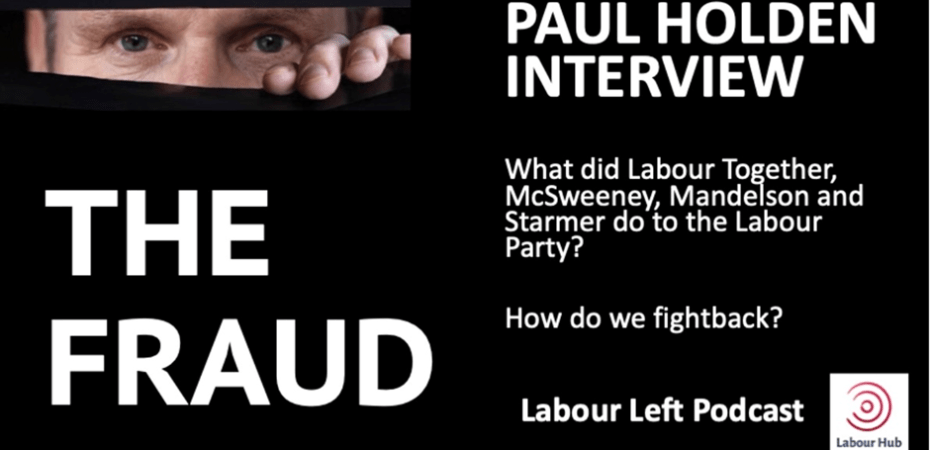
The Fraud: The Paul Holden Interview
In the latest Labour Left Podcast, introduced here by Bryn Griffiths, Paul Holden, the author of The Fraud: Keir Starmer, Morgan McSweeney, and the Crisis of British Democracy, explains what the shadowy Labour Together group did to the Labour Party and how they inflicted their big fraud on the Labour membership.
Ten Pledges
In 2020 Keir Starmer stood for the Labour Party leadership and made ten excellent democratic socialist pledges to the Party membership and the thousands of trades unionists who had enthusiastically voted for him. On 4th April 2020 Starmer was elected Labour Leader. But all was not as it seemed. Starmer had committed a fraud. In the podcast Paul Holden reveals exactly what Morgan McSweeney’s Labour Together had planned for the Labour membership and it certainly wasn’t the democratic socialism they’d voted for!
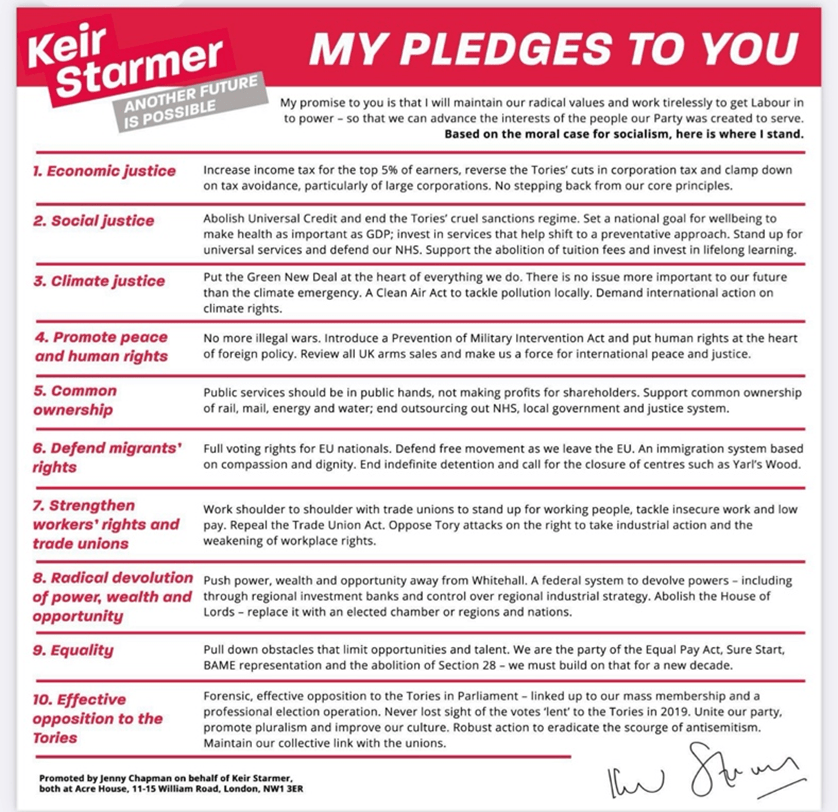
Keir Starmer’s ten broken pledges to the Labour membership
Starmer’s socialist supporters
Back in 2023, Labour Together included prominent soft left figures such as Lucy Powell, Jon Cruddas and Lisa Nandy. Former Labour Left Podcast guest Neil Lawson of Mainstream was assiduously courted by Labour Together. Starmer even employed old Corbyn staffer Simon Fletcher, and Momentum’s former National Coordinator, Laura Parker, was persuaded to back the Starmer Leadership bid.
In the podcast we discuss what was really going on. Did Labour Together and the Starmer Project have a split personality or where the erstwhile socialist Starmerites subject to a big con?
Antisemitism allegations
Even before the book was published Steve Reed, Labour’s Housing Secretary, suggested in Politico that the book “would whitewash” the antisemitism crisis that happened under Jeremy Corbyn. In the podcast Paul Holden give’s his response to Reed’s horrible allegation.
“This is the Machine that now rules us”
In the second half of the podcast, Paul Holden explores the suggestion that Labour Together’s internal authoritarianism is spilling over into Government. Could Labour Together’s factionalism have created the conditions that explain the removal of Sue Gray, the Downing Street Chief of Staff? The appointment of Peter Mandelson as the US Ambassador? The proscription of Palestine Action? The attacks on refugee status? and, even the undermining of jury trials?
Labour Together’s Response to The Fraud
Every Labour supporter needs to know the story of what Labour Together did when they learnt Paul was to publish The Fraud. Paul tells us a chilling story of GCHQ involvement, spy allegations, Russian scare stories and ministerial resignations.
How do we fightback?
Some Labour Left Podcast listeners and watchers have left the Labour Party and I get that. But, if like me, you’re committed to fighting on we need to do something about what Paul has spelt out to us so clearly in this podcast.
Here, as suggested in the podcast are the actions you can take and the links to find out more: Firstly, we need to restore democracy to our party so please join Sharon Graham and Andrea Egan, the Leaders of Britain’s biggest unions, in signing the Restore Labour Democracy Statement.
To sign up to the Restore Labour Democracy statement click here
Secondly, we have some important internal Labour elections this year. If we’re going to begin to change things we need people committed to democracy in key places, so please this year vote for the Centre Left Grass Roots Alliance (CLGA) in the National Executive, National Constitutional Committee, National Policy Forum and National Women’s Committee Elections.
Here are the details of how to support the Centre Left Grass Roots Alliance internal elections campaign: click here for campaign details.
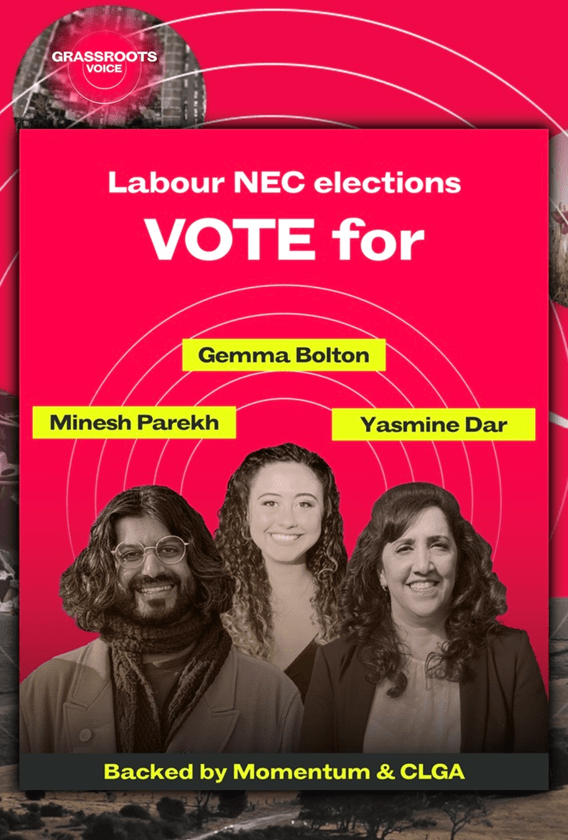
The CLGA candidates for Labour’s National Executive Committee constituency section.
This year the stakes are so high we need to work together with others in the party who want to see democracy. So, when you’ve voted for the CLGA candidates I urge you to use any remaining votes you’ve got to support Mainstream, the new soft left group.

‘Labour to Lose’.
In 2026 we will be up against the ludicrously titled Labour to Win slate who will include the supporters of Labour Together and clearly represent continuity at the top. I think, given their performance recently, they’d be better called Labour to Lose. But whatever we call them, if we want to save the Labour Party we’ve got to stop them.
Watch more Labour Left Podcasts
You can watch the podcast on YouTube, Apple Podcasts here, Audible here, Substack here and listen to it on Spotify here. You can even ask Alexa to play the Labour Left Podcast. If your favourite podcast site isn’t listed, just search for the Labour Left Podcast.
If you subscribe you can catch up on all our 20-plus episodes back catalogue. The top episode of 2025 was the former Shadow Chancellor John McDonnell MP. Other big hits have included Andrew Fisher, the man behind the 2017 manifesto For the Many and not the Few, and Rachel Shabi, the author of The Truth Behind Antisemitism. To reflect more on Starmer’s leadership, check out the episode where Mark Perryman discusses his excellent book The Starmer Symptom.
You can buy The Fraud here.
Bryn Griffiths is an activist in Colchester Labour Party and North Essex World Transformed. He is the Vice-Chair of Momentum and sits on the Campaign for Labour Party Democracy’s Executive.
Bryn hosts Labour Hub’s spin off – the Labour Left Podcast. You can find all the episodes of the podcast here or if you prefer audio platforms (for example Amazon, Audible Spotify, Apple etc,) go to your favourite podcast provider and just search for the Labour Left Podcast.
—

No comments:
Post a Comment