The US’s Strategic Alliance With Israel is a Disaster
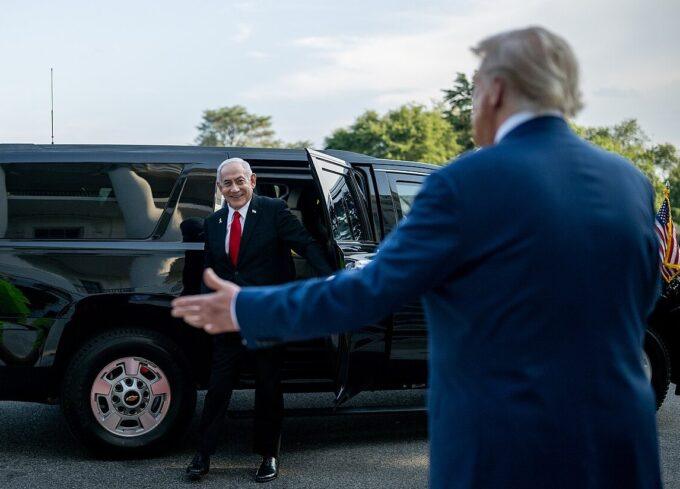
Photograph Source: The White House – Public Domain
It’s difficult to imagine a greater U.S. strategic mistake than to align itself in any fashion with Israel. The United States and Israel have different objectives and strategic goals in the Middle East and the Persian Gulf. Israel is trying to “change the map of the Middle East.” It therefore is trying to create instability throughout the region in its effort to secure geopolitical domination.
The United States should be trying to extricate itself from a region that has become a briar patch. It therefore should be trying to encourage greater stability in the region to allow for such a withdrawal. Meanwhile, the U.S. mainstream media, which is biased in favor of Israel, says very little about the dangers of any U.S.-Israeli alliance.
Israeli Prime Minister Benjamin Netanyahu is an anti-American ideologue. Netanyahu himself has been branded as a war criminal for his genocidal campaign against the Palestinians, and he is giving every indication of pursuing a similar strategy in Israel’s current conflict with both Iran and Lebanon. U.S. media also pull their punches in discussing Netanyahu.
The long history of Israeli anti-Americanism is rarely discussed, although it is not a new development. In the 1950s, Israel agents bombed a U.S. Information Agency library in Egypt and tried to make it appear to be an Egyptian act of violence. Israel’s goal was to compromise U.S.-Egyptian relations in order to stop U.S. Secretary of State John Foster Dulles’ interest in funding the Aswan Dam in Egypt. Dulles eventually reneged on the funding, which provided the Soviet Union with an opening to strengthen relations with Egyptian President Gamal Abdel Nasser.
In the 1960s, the Israelis told the United States at the highest levels that they would not conduct a preemptive attack against the Arab states. But they did exactly that in starting the six-day war. In the war’s opening days, Israeli fighter planes bombed the USS Liberty, killing 34 American sailors. The Israels claimed it was an “accident.” It wasn’t! The Liberty was collecting sensitive Israeli operational messages, and Israel wanted the ship out of range.
In the 1970s, the Israelis did their best to compromise a cease-fire that Secretary of State Henry Kissinger had carefully orchestrated with Soviet Premier Alexei Kosygin. Israeli violations of the ceasefire led to Kissinger’s threats to intervene in the conflict if Israeli military forces did not cease their operations to destroy the Egyptian III Corps that had surrendered. Kissinger’s threats were successful in getting Israeli compliance.
In the 1980s, Israel’s invasion of Lebanon and its war crimes against the Palestinian community led to the intervention of U.S. Marines who suffered terrible losses from the bombing of the U.S. Marine Barracks and the U.S. embassy in Beirut. Israel never informed the White House that it would be invading Beirut.
The Iran-Contra affair in the 1980s offers the best window into the secret U.S.-Israeli relationship because it was Israel that enticed the United States to provide anti-missile weaponry to an Iran that was facing disaster in its war with Iraq. Israel convinced national security adviser Robert McFarland that there were moderates in Iran who would help to get the release of U.S. hostages in Lebanon, including the CIA station chief in Beirut, William Buckley, who was tortured and eventually killed by Hezbollah. Israel ultimately sent 500 anti-tank missiles to Iran through an unscrupulous arms dealer, Manucher Ghorbanifar, who was an Iranian agent. CIA director Bill Casey mistakenly thought that Ghorbanifar was an Israeli agent. Israel was more than the minor middleman that it has always claimed to be.
Netanyahu has gone out of his way to embarrass virtually every American president over the past 25 years. A low point took place in 2015 when Netanyahu addressed a joint session of Congress to stop the ratification of the Iran nuclear agreement—the Joint Comprehensive Plan of Action. Instead of punishing the Israelis for this outrageous action, President Obama rewarded them with a ten-year $40 billion military assistance package. Will we ever learn?
No Time for Losers: Why the War Meant to Save Israel May Destroy It

Image by Timon Studler.
When Donald Trump and Benjamin Netanyahu launched their military aggression against Iran on February 28, they appeared convinced that the war would be swift. Netanyahu reportedly assured Washington that the campaign would deliver a decisive strategic victory—one capable of reordering the Middle East and restoring Israel’s battered deterrence.
Whether Netanyahu himself believed that promise is another matter.
For decades, influential circles within Israel’s strategic establishment have not necessarily sought stability, but rather “creative destruction.” The logic is simple: dismantle hostile regional powers and allow fragmented political landscapes to replace them.
This idea did not emerge overnight. It was articulated most clearly in a 1996 policy paper titled A Clean Break: A New Strategy for Securing the Realm, prepared for then-Israeli Prime Minister Benjamin Netanyahu by a group of US neoconservative strategists, including Richard Perle.
The document argued that Israel should abandon land-for-peace diplomacy and instead pursue a strategy that would weaken or remove hostile regimes in the region, particularly Iraq and Syria. The goal was not merely military victory but a geopolitical restructuring of the Middle East in Israel’s favor.
In many ways, the subsequent decades seemed to validate that theory—at least from Tel Aviv’s perspective.
The Middle East Reordered
The 2003 US invasion of Iraq was widely considered a catastrophe for Washington. Hundreds of thousands died, trillions of dollars were spent, and the United States became entangled in one of the most destabilizing occupations in modern history.
Yet the war removed Saddam Hussein’s government, dismantled the Baath Party, and destroyed what had once been the strongest Arab army in the region.
For Israel, the strategic consequences were significant.
Iraq, historically one of the few Arab states capable of confronting Israel militarily, ceased to exist as a coherent regional power. Years of instability followed, leaving Baghdad with a fragile political system struggling to maintain national cohesion.
Syria, another central concern in Israeli strategic thinking, would later descend into its own devastating war beginning in 2011. Libya collapsed earlier after NATO’s intervention in 2011 as well. Across the region, once-formidable Arab nationalist states fractured into weakened or internally divided systems.
From Israel’s vantage point, the theory of regional fragmentation appeared to be paying dividends.
Without strong Arab states capable of projecting military power, several Gulf governments began reconsidering their long-standing refusal to normalize relations with Israel.
The result was the Abraham Accords, signed in September 2020 under the Trump administration, which formalized normalization between Israel and the United Arab Emirates and Bahrain, later followed by Morocco and Sudan.
For a moment, it seemed that the geopolitical transformation envisioned decades earlier had been realized.
Gaza Changed the Equation
But history rarely moves in straight lines.
Israel’s genocide in Gaza did not produce the strategic victory Israeli leaders had anticipated. Instead, the war exposed deep vulnerabilities in Israel’s military and political standing.
More importantly, Palestinian resistance demonstrated that overwhelming military force could not translate into decisive political control.
The consequences reverberated far beyond Gaza.
The war galvanized resistance movements across the region, deepened divisions within Arab and Muslim societies between governments aligned with Washington and those opposed to Israeli policies, and ignited an unprecedented wave of global solidarity with Palestinians.
Israel’s international image suffered dramatically.
For decades, Western political discourse framed Israel as a democratic outpost surrounded by hostile forces. That narrative has steadily eroded. Increasingly, Israel is described—even by major international organizations—as a state engaged in systematic oppression and, in Gaza’s case, genocidal violence.
The strategic cost of that reputational collapse cannot be overstated. Military power relies not only on weapons but also on legitimacy. And legitimacy, once lost, is difficult to recover.
Netanyahu’s Final Gamble
Against this backdrop, the war on Iran emerged as Netanyahu’s most consequential gamble.
If successful, it could restore Israel’s regional dominance and reassert its deterrence. Defeating Iran—or even severely weakening it—would reshape the balance of power across the Middle East.
But failure carries equally profound consequences.
Netanyahu, now facing an arrest warrant issued by the International Criminal Court in 2024 over war crimes in Gaza, has tied his political survival to the promise of strategic victory.
In multiple interviews over the past year, he has framed the confrontation with Iran in almost biblical terms. In one televised address in 2025, Netanyahu declared that Israel was engaged in a “historic mission” to secure the future of the Jewish state for generations.
Such rhetoric reveals not confidence but desperation.
Israel cannot wage such a war alone. It never could.
Thus, Netanyahu worked tirelessly to draw the United States directly into the conflict—a familiar pattern in modern Middle Eastern wars.
The Paradox of Trump’s War
For Americans, the question remains: why did Donald Trump—who repeatedly campaigned against “endless wars”—allow the US to enter yet another Middle Eastern conflict?
During his 2016 presidential campaign, Trump famously declared: “We should have never been in Iraq. We have destabilized the Middle East.”
Yet nearly a decade later, his administration has plunged Washington into a confrontation whose potential consequences dwarf those of the earlier wars.
The precise motivations matter less to those living under the bombs.
Across the region, the scenes are painfully familiar: devastated cities, mass graves, grieving families, and societies once again forced to endure the violence of foreign intervention.
But this war is unfolding in a fundamentally different geopolitical environment.
The US no longer commands the unchallenged dominance it once enjoyed.
China has emerged as a major economic and strategic actor. Russia continues to project influence. Regional powers have gained confidence in resisting Washington’s dictates.
The Middle East itself has changed.
A War Already Going Wrong
Early signs suggest that the war is not unfolding according to the expectations of Washington or Tel Aviv.
Reports from US and Israeli media indicate that missile-defense systems in Israel and several Gulf states are facing a serious strain under sustained attacks. Meanwhile, Iran and its regional allies have demonstrated missile capabilities far more extensive than many analysts had anticipated.
What was supposed to be a rapid campaign increasingly resembles a prolonged conflict.
Energy markets provide another indication of shifting dynamics. Rather than securing greater control over global energy flows, the war has disrupted supplies and strengthened Iran’s leverage over key maritime routes.
Strategic assumptions built on decades of uncontested American military power are colliding with a far more complex reality.
Even the political rhetoric emanating from Washington has become noticeably defensive and increasingly angry—often a sign that events are not unfolding as planned.
Within the Trump administration itself, the intellectual poverty of the moment is difficult to miss. Defense Secretary Pete Hegseth, whose public persona is built on television bravado rather than strategic literacy, has often framed the conflict in language that sounds less like military doctrine and more like locker-room theatrics.
In speeches and interviews, he has repeatedly reduced complex geopolitical realities into crude narratives of strength, masculinity, and domination. Such rhetoric may excite partisan audiences, but it reveals a deeper problem: the people directing the most dangerous war in decades appear to understand very little about the forces they have unleashed.
Hegseth’s style is symptomatic of a broader intellectual collapse within Washington’s war-making circles—where historical knowledge is replaced by slogans, and strategic planning by theatrical displays of toughness. In such an environment, wars are not analyzed; they are performed.
The End of an Era?
Netanyahu sought to dominate the Middle East. Washington sought to reaffirm its position as the world’s unrivaled superpower.
Neither objective appears within reach.
Instead, the war may accelerate the very transformations it was meant to prevent: a declining US strategic role, a weakened Israeli deterrent posture, and a Middle East increasingly shaped by regional actors rather than external powers.
Trump, despite the lofty and belligerent language, is in reality a weak president. Rage is rarely the language of strength; it is often the mask of insecurity. His administration has overestimated America’s military omnipotence, undermined allies and antagonized adversaries alike, and entered a war whose historical, political, and strategic dimensions it scarcely understands.
How can a leadership so consumed by narcissism and spectacle fully grasp the magnitude of the catastrophe it has helped unleash?
One would expect wisdom in moments of global crisis. What we have instead is a chorus of slogans, threats, and self-congratulation emanating from Washington—an administration seemingly incapable of distinguishing between what power can achieve and what it cannot.
They do not understand how profoundly the world has changed. They do not understand how the Middle East now perceives American military adventurism. And they certainly do not understand that Israel itself has become, politically and morally, a declining brand.
Of course, Trump and his equally arrogant administration will continue searching for any fragment of ‘victory’ to sell to their constituency as the greatest triumph in history. There will always be zealots ready to believe such myths.
But most Americans—and the overwhelming majority of people around the world—no longer do.
Partly because this war on Iran is immoral.
And partly because history has very little patience for losers.
The Growing Problems of Operation Epic Fury
March 17, 2026
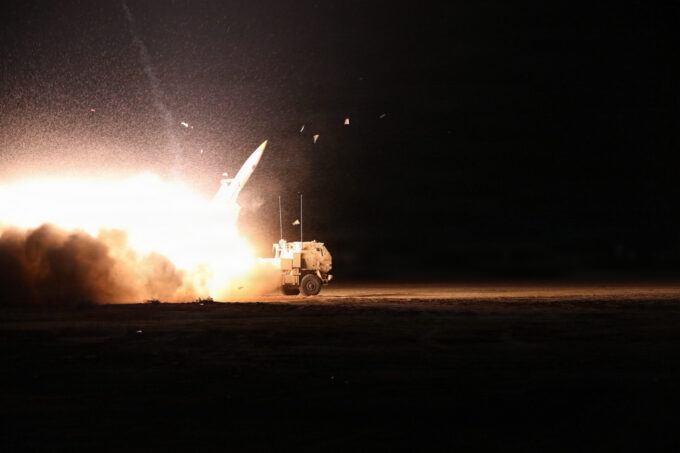
Photograph Source: U.S. Army Photo – Public Domain
The big drain on military resources has begun. A war apparently already won (and not), against an adversary supposedly without means to fight back, its air force and navy destroyed, its missile capabilities blunted, is now drawing the clumsy colossus of American power into the Middle East with embarrassing effect. The Middle East, where US President Donald Trump promised the “forever wars” would end, promises an end to his beginning.
The ledger of losses keeps rising with giddying pace. The US casualty list, for now, remains manageably low, but the military purse is being raided with manic relish. Operation Epic Fury cost US taxpayers $11.3 billion in munitions over the first six days, an estimate that excludes operating and maintenance costs of the engaged military force or the damage inflicted by Iran. The Washington-based Center for Strategic and International Studies (CSIS) claims that the first 100 hours of the war cost $3.7 billion, approximating to $891.4 million each day.
Strain is also being placed on inventories. The US prides itself on deluxe, high brand killing and extermination of targets, using chic weaponry and dull doctrine. Expensive homicidal measures do have to be eventually accounted for. According to reporting from Bloomberg, “as the conflict extends toward a third week, the US war effort is showing unexpected signs of strain against an adversary whose military budget is smaller than the GDP of Vermont – but which has an arsenal of missiles and drones unlike anything the US has ever faced.”
Critical munitions are being depleted. With the campaign barely 100 hours old, 168 Tomahawk cruise missiles had been fired. (Each unit costs a mighty $3.6 million.) This is a staggering figure when compared to the rate of procurement: the previous five years had seen the production of 322 Tomahawks. According to a source quoted in theFinancial Times, “The navy will be feeling this expenditure for several years.”
While the Pentagon gloats at reducing Iranian strikes by 80% or more, Tehran has gotten more economical with its targeting, successfully striking military and energy infrastructure across the Middle East with telling effect. Ballistic missiles have hit the US Navy’s Fifth Fleet headquarters in Bahrain, destroying two AN/GSC-52B SATCOM terminals. A costly AN/FPS-132 early warning radar in Qatar – a facility estimated to cost some $1.1 billion – was successfully struck by a ballistic missile.
The AN/TPY-2 radar facilities used by the lauded yet hideously expensive Terminal High Altitude Area Defense (THAAD) system have also been struck in Saudi Arabia’s Prince Sultan Air Base, Al Ruwais in the UAE, Al Dhafra Air Base in proximity to Abu Dhabi and Jordan’s Muwaffaq Salti Air Base. A sense of how important that facility is to the operation of the battery is provided by N.R. Jenzen, a munitions specialist of Armament Research: “The AN/TPY-2 radar is essentially the heart of the THAAD battery, enabling the launch of interceptor missiles and contributing to a networked air defence picture.” Knocking out the radar blinds the system.
The outstanding feature of many of the strikes is their relative cheapness to the interceptor missiles used to destroy them. “The round’s we’re firing – Patriot rounds, THAAD rounds … these weapon systems, each around is millions of dollars,” laments Arizona Democratic Senator Mark Kelly. “The math on this doesn’t work.” Shahed-136 one-way drones, each one costing $35,000, have played a starring role in upsetting “the math”. CENTCOM commander Adm. Brad Cooper has also noted that the majority of wounded US personnel – some 140 troops – have been injured in “one-way strikes.”
This has compelled the Pentagon to pay greater attention to its own Low-Cost Uncrewed Combat Attack System (LUCAS), which is now seeing service in some instances against Iranian attacks. But the department is also set to seek more cash, expecting to ask $50 billion in additional funding from Congress. Given the sheer unpopularity of the war, some lawmakers have reservations. “You’ve got to be able to provide us with more information as […] justification,” insists Alaska Republican Senator Lisa Murkowski, member of the Senate Appropriations Committee. “Don’t just take it for granted that the Congress’s role is basically to write the cheque.”
US military power is now being drawn from other theatres of interest to feed the Moloch of war. In a recent cabinet meeting, South Korean President Lee Jae Myung confirmed that Washington might relocate air defence material to the Middle East. Multiple launchers of the THAAD system have been or are in the process of being moved to Osan Air Base in Pyeongtaek, roughly 70km south of Seoul, with the interceptor missiles destined for the Middle East.
This shifting of pieces has not been without consequence. The THAAD batteries had been sent to South Korea in 2017 to assure it against threats from its nuclear-armed neighbour to the north. Depriving them of projectiles has gotten tongues wagging about increasing vulnerability. Besides, the ostensible security provided by US power for its allies and partners has been shown to be something of a dud, as Iran’s attacks on the Gulf states has so convincingly demonstrated.
Concern from Taiwan about such moves was registered in an interview by Chen Kuan-ting, a legislator and member of the country’s Foreign Affairs and Defence Committee. As US military assets and resources could not “be deployed in two places at the same time”, it was a case of priorities. And those priorities, it was implied, should lie in Asia. “Deploying the main military assets in Asia and confronting the US’s primary competitor here is more in line with US interests.” That may well be what he hopes for, but it is clear that Washington is battling through the another malady Trump had once campaigned against: the debilitating entanglement of a foreign war with ill-defined objectives involving a resourceful, obstinate foe.
Ending the Trump-Netanyahu War in the Middle East
The Israel-US war on Iran is engulfing the entire Middle East and could escalate to global war. The economic consequences are already severe and could become catastrophic. The Strait of Hormuz carries approximately one-fifth of all oil traded globally, and 30 percent of the world’s LNG. A sustained closure of the Strait would trigger an energy shock without modern precedent.
The conflict is likely to spiral out of control because the US and Israel are dead set on hegemony in the Arab world and West Asia – one that combines Israeli territorial expansion with American-backed regime control across the region. The ultimate goal is a Greater Israel that absorbs all historic Palestine, combined with compliant Arab and Islamic governments stripped of genuine sovereignty, including on choices as to how and where they export their oil and gas.
This is delusional. No country across the region wants Israel to run wild as it is doing, murdering civilians across the entire region, destroying Gaza and the West Bank, invading Lebanon, striking Iraq and Yemen, and carpet-bombing Tehran. No country wants its hydrocarbon exports under effective US control. The war will end if and only if global revulsion at US and Israeli aggression force these countries to stop. Short of that, we are likely to see the Middle East in flames and the world in an energy and economic crisis unprecedented in modern history. The war could easily turn into a global conflagration, effectively into World War III.
Yet, there exists an alternative. The war could stop on rational grounds if Israel and the US are decisively called to account by the rest of the world. Ending the war requires a set of interlinked steps to provide basic security for all parties, and indeed for the world. Iran needs a permanent end to the US-Israel aggression. The Gulf countries need an end to Iran’s retaliatory strikes. The Palestinians need an independent state. Israel needs lasting security and the disarmament of Hamas and Hezbollah. The whole world needs the opening of the Strait of Hormuz, and international monitoring of Iran’s nuclear program to ensure it abides by the Nuclear Non-Proliferation Treaty, as Iran says it wants to do. And all countries want, or should want, real sovereignty for themselves and their region.
Collective security could be achieved in five interconnected measures. First, the US and Israel would immediately end their armed aggression across the entire region and withdraw their forces. Second, Iran would stop its retaliatory strikes across the GCC and resubmit to monitoring by the International Atomic Energy Agency under a revised Joint Comprehensive Plan of Action (JCPOA), which President Trump recklessly abandoned in 2018. Third, the Strait of Hormuz would reopen with mutual agreement of Iran and the GCC. Fourth, the two-state solution would be immediately implemented by admitting Palestine as a full member state of the UN. Israel would be required to end its occupation of the West Bank and East Jerusalem and to withdraw its forces from Lebanon and Syria. Fifth, the UN recognition of the State of Palestine would form the basis for a comprehensive regional disarmament of all non-state actors, verified under international monitoring. The end result would be a return to international law and the UN Charter.
Who would win in this plan? The people of the region, of Israel, Palestine, Lebanon, Syria, Iraq, Iran, and the rest of the world. Who would lose? Only the backers of Greater Israel, led by Benjamin Netanyahu, Itamar Ben-Gvir, Bezalel Smotrich, and Mike Huckabee, who have brought the world to the brink of destruction.
Here are the five steps in more detail.
First: End the US-Israeli Armed Aggression.
Israel and the US would stop their aggression and withdraw their forces. In turn, Iran would cease its retaliatory strikes. This would not be a mere ceasefire. Rather, it would be the first step of an overall peace agreement and collective security arrangement.
Second: Return to the JCPOA.
The nuclear question would be resolved through strict monitoring by the International Atomic Energy Agency, not through bombing campaigns that merely put Iran’s enriched uranium beyond international monitoring. The UN Security Council would immediately reinstate the basic framework of the 2015 Joint Comprehensive Plan of Action (JCPOA), under which Iran must strictly comply with IAEA monitoring and agreed limits on its nuclear program, while economic sanctions on Iran would be lifted.
Third: Reopen the Strait of Hormuz in an Iran-GCC Framework
The Strait of Hormuz would be quickly reopened, with safe passage jointly guaranteed by Iran and the GCC. The GCC countries would assert sovereignty over the military bases in their countries to ensure that the bases would not be used as launchpads for renewed offensive strikes against Iran.
Fourth: The Two-State Solution.
The two-state solution would be implemented, by admitting Palestine into the UN as the 194th permanent member state. This requires nothing more than the US lifting its veto. Palestinian statehood is in accord with international law and with the Arab Peace Initiative, which has been on the table since 2002. In turn, the countries in the region would establish diplomatic relations with Israel, and the UN Security Council would introduce peacekeepers to ensure the security of both Palestine and Israel.
Fifth: An End to Armed Belligerency.
In conjunction with the two-state solution, all armed belligerency in the region would end forthwith, including the disarmament of Hamas, Hezbollah, and other armed non-state actors. In the case of Palestine, the disarmament of Hamas would underpin the authority of the Palestinian state. In the case of Lebanon, the disarmament of Hezbollah would restore Lebanon’s full sovereignty, with the Lebanese Armed Forces as the sole military authority in the country.
The disarmament would be verified by international monitors and guaranteed by the UN Security Council.
The key point is that the Israel-US war on Iran has not occurred in a vacuum. The Clean Break strategy, developed by Netanyahu and his American neocon backers in 1996, and implemented since then, calls for Israel to establish hegemony in the region through wars of regime change, with the US as the implementing partner. As NATO Supreme Commander Wesley Clark revealed after 9/11, the US drew up plans a quarter century ago to overthrow governments in seven countries: “starting with Iraq, and then Syria, Lebanon, Libya, Somalia, Sudan and, finishing off, Iran.” We are therefore living through the culmination of a long-standing plan by Israel and the US to dominate the Arab world and West Asia, create a Greater Israel, and permanently block Palestinian statehood.
We are not optimistic about the likelihood of our plan. The Israeli government is murderous and Trump is delusional about US power. We are perhaps already in the early days of WWIII. Yet because the stakes are so high, it’s worth laying out real solutions even if they are long shots. We do believe, however, that the non-Western world – the part that is not vassal states to US power – understands the urgency of peace and security.
Who, then, could champion a peace plan that the US and Israel will resist with every means at their disposal, until the weight of global opposition and economic catastrophe leaves them no choice but to accept it?
There is one main group, and that is the BRICS nations.
Brazil, Russia, India, China, South Africa, and the bloc’s expanded membership, which now includes the UAE, Iran, Egypt, Ethiopia, and Indonesia, represent approximately half of the world’s population and more than 40 percent of global GDP (compared to 28 percent for the vaunted but overblown G7 countries). The BRICS have the credibility, the economic weight, and the absence of the historical complicity in Middle East imperialism to bring the world to its senses. The BRICS should convene an emergency summit and present a unified framework incorporating the conditions for peace and security, which in turn would be pressed at the UN Security Council. There, world opinion would tell the US and Israel to stop pushing the world towards catastrophe, and would remind all countries to adhere to the UN Charter.
Reprinted from Common Dreams.
Jeffrey D. Sachs is a University Professor and Director of the Center for Sustainable Development at Columbia University, where he directed The Earth Institute from 2002 until 2016. He is also President of the UN Sustainable Development Solutions Network and a commissioner of the UN Broadband Commission for Development. He has been advisor to three United Nations Secretaries-General, and currently serves as an SDG Advocate under Secretary-General Antonio Guterres. Sachs is the author, most recently, of A New Foreign Policy: Beyond American Exceptionalism (2020). Other books include: Building the New American Economy: Smart, Fair, and Sustainable (2017), and The Age of Sustainable Development, (2015) with Ban Ki-moon.
Sybil Fares is a specialist and advisor in Middle East policy and sustainable development at SDSN.
Just Get Out! Now!
As is becoming clearer from President Trump’s own statements and those of his staff, along with press reporting, the US has launched a major war without the input of the experts we pay to advise the President on such matters. The State Department, Pentagon, National Security Council Staff, Defense Intelligence Agency, and NSA were simply bypassed because, as White House Spokesperson Karoline Leavitt said, President Trump “had a feeling” Iran would attack.
The President’s real estate developer son-in-law and friend reinforced that “feeling” when they returned from the second round of talks with the Iranian foreign minister and his team. However, as the news outlet Responsible Statecraft (RS) reported over the weekend, both son-in-law Jared Kushner and friend Steve Witkoff appear to have mis-represented those talks in a way that helped push President Trump toward war. No State Department officials were on hand to ensure the reporting was accurate.
Also, arms control experts at home, according to the RS report, believe that “the duo appeared to have fatally misunderstood a series of basic technical and historical matters” regarding Iran’s nuclear program leading to inaccurate information conveyed to the President.
Congress was completely out of the picture – seemingly uninterested in performing its Constitutional duty – and no case was made to the American people that they must sacrifice and die once again for a war in the Middle East.
Trump’s repeated promises to not start new wars, especially in the Middle East, have turned out to be empty, and Republicans are set for a crippling defeat in the upcoming midterm elections.
Iran had been warning for months – since the last US/Israeli surprise attack in June – that if they were attacked again they would not hold back on US bases in the region and that they would close the Straits of Hormuz. Trump and Netanyahu attacked anyway, and Iran has done what it said it would do.
Now the Strait of Hormuz is closed, oil is about to go out of control, and the global economy – along with the US dollar – seems about to implode.
On March 6th, President Trump refused a UK offer of help, saying we don’t need help when we’ve already won the war. Five days later, at a rally in Kentucky, President Trump repeated that “We’ve won the Iran war!”
It was his “Mission Accomplished” moment, because this weekend, just days after declaring victory against an “obliterated” Iran, Trump began begging other countries to send ships to help the US open the Strait of Hormuz.
Thus far every country has declined, understanding that such a mission has little chance of success.
Tragically, the war thus far has claimed at least 14 servicemembers. It is likely the toll is far worse than they are telling us. Every US military facility in the region is either damaged or destroyed. Billions of dollars of radar and other equipment are destroyed. Our allies in the region, because they allowed their territory to be used to attack Iran, have also seen massive retaliatory destruction.
This is surely one of the worst military disasters in US history. There are no military options available beyond the unthinkable: the use of nuclear weapons.
The only viable option that remains is one that was often urged in the Vietnam War: Just get out. Now! No return to US bases, no security guarantees to Gulf States. End the US empire in the Middle East and elsewhere. If not, it’s only going to get worse.

No comments:
Post a Comment