It’s possible that I shall make an ass of myself. But in that case one can always get out of it with a little dialectic. I have, of course, so worded my proposition as to be right either way (K.Marx, Letter to F.Engels on the Indian Mutiny)
Monday, March 09, 2026
Saudi Aramco Cuts Oil Output as Hormuz Crisis Chokes Exports
Saudi Aramco has begun reducing oil production at two of its fields as the disruption around the Strait of Hormuz starts to choke off crude exports across the Gulf, according to sources cited by Reuters on Monday.
The move comes just hours before the Saudi oil giant is due to report its 2025 earnings on Tuesday, placing the focus squarely on whether the world’s largest oil exporter can keep crude moving during the escalating U.S.-Israeli war with Iran.
It was not immediately clear which oilfields were affected or how much production had been reduced. Aramco declined to comment on the reported cuts.
The production curbs mark one of the clearest signs yet that the disruption around Hormuz is beginning to constrain supply from the region that normally exports roughly a fifth of the world’s oil. Tanker traffic through the strategic waterway has slowed sharply in recent days as military activity, security risks and insurance cancellations make shipping increasingly difficult.
Aramco has begun rerouting some crude cargoes to the Red Sea port of Yanbu, attempting to bypass the Strait of Hormuz using Saudi Arabia’s east-west pipeline network. The system allows the kingdom to move crude from its eastern oilfields to export terminals on the Red Sea, avoiding the Gulf shipping lane.
However, the pipeline cannot fully replace the massive volumes that normally leave Saudi Arabia through Hormuz, meaning export bottlenecks are now beginning to appear as storage tanks fill.
Other Gulf producers are running into the same export constraints as the shipping crisis spreads across the region’s energy system.
Crude output from Iraq’s southern fields has plunged by roughly 70% since the war began, dropping to about 1.3 million barrels per day from roughly 4.3 million barrels per day previously. Southern Iraq accounts for the vast majority of the country’s oil production and exports.
“Crude storage has reached maximum capacity, and the remaining output after the major cut will be used to supply the country’s refineries,” a Basra Oil Company official told Reuters.
Export activity has slowed dramatically. On Sunday, only two tankers were loaded at Iraq’s southern export terminals, each carrying about 2 million barrels. The vessels remained in the Persian Gulf according to vessel-tracking data.
Kuwait has now begun taking similar steps as storage fills across the region. Kuwait has started shutting in production at several oilfields because the standstill in tanker traffic through the Strait of Hormuz has left the country with limited capacity to store additional crude.
Kuwait's national oil company has announced plans to start throttling down production, confirming concerns that it would have to start shutting down within days due to limited storage capacity. It is the latest consequence of Iran's Strait of Hormuz attacks, and it follows shortly after Iraq began ordering its largest oilfields to shut in wells because of an absence of empty tanker tonnage to take on cargoes.
In a statement, the Kuwait Petroleum Corporation (KPC) said that the measure is purely a precaution, and it will be reviewed regularly. The firm said that its supplies to the domestic market are assured, and that it is "fully prepared to restored production levels once conditions allow."
The shutdown occurred a few days ahead of a predicted deadline, and analysts suggest that KPC decided to throttle back output early at some fields in order to preserve a buffer of remaining storage. Reduced-output wells are faster and easier to reactivate than wells that have been fully shut in.
Iran is serious about its closure order, and has attacked at least two vessels physically located in the Strait of Hormuz since it was issued last week. Western tonnage has largely given up the crossing, save for a handful of vessels transiting with transponders turned off - and not all of them are tankers. By contrast, the National Iranian Oil Company continues to load cargoes at Kharg Island and to dispatch its shadow-fleet tankers through the Strait of Hormuz, maintaining de minimus supply for its Asian customers. It has also begun to use its Jask oil terminal on the Gulf of Oman, on the eastern side of the strait, according to TankerTrackers.com.
The tightening supply picture in the Mideast is beginning to have price effects. Oil prices could spike as high as $150 per barrel within weeks if the strait remains closed, Qatari Energy Minister Saad al-Kaabi told the Financial Times on Friday. He confirmed that all of the major GCC exporting nations will have to declare force majeure eventually if the shutdown continues, he warned.
Iraq's fields have already cut production from 4.3 million bpd to 1.3 million bpd because storage has been fully filled, according to Reuters. For now, the only remaining available outlet for Iraqi oil is for domestic production.
Oil Price Shock Could Worsen If U.S. Seizes Iran’s Strategic Oil Island
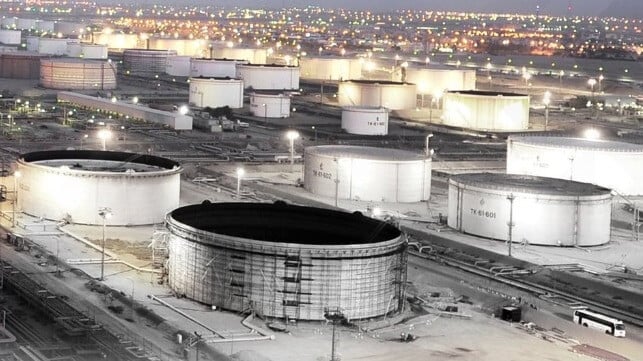
JP Morgan has warned that Iran’s oil production could be slashed in half and oil exports could virtually stall if U.S.-Israeli seize Iran's Kharg Island, worsening the ongoing global oil shock. Located in the Persian Gulf, the continental island is the "backbone" of Iran's oil infrastructure, handling approximately 90% of its crude exports.
The island collects oil transported via pipeline from Iran’s largest producing fields, including Marun, Ahvaz and Gachsaran. Iran--OPEC’s third-largest producer--pumps about 3.3 million barrels of crude and an additional 1.3 million barrels of condensate and other liquids per day.
Oil prices have surged to near-pandemic levels, with Brent crude for April delivery up 5.7% to trade at $98.13 per barrel at 12.06 p.m. ET, while the corresponding WTI crude contract was up 4.84% to change hands at $95.30 per barrel.
"A direct strike would immediately halt the bulk of Iran’s crude exports, likely triggering severe retaliation in the Strait of Hormuz or against regional energy infrastructure," JP Morgan said.
According to JP Morgan, cited by Arab media, Iran ramped up exports from Kharg Island in the days leading up to attacks by U.S. and Israel to near record levels in excess of 3 million bpd, nearly triple its normal clip at 1.3 million to 1.6 million bpd. According to Kpler, the island’s storage capacity is roughly 30 million barrels of crude, with current storage at approximately 18 million barrels, enough for 10-12 days of exports under normal conditions.
A seizure or direct attacks on Khrag Island would be unprecedented. Former U.S. president Jimmy Carter imposed sanctions on Iran during the hostage crisis of 1979, but did not order strikes on the island. Ronald Reagan, Carter’s successor, targeted Iranian vessels and missile batteries while protecting ships during the 1980s Iran-Iraq Tanker War but also refrained from attacking the island. Similarly, Iraqi forces did not hamper operations at the island during the war.
"Although Iraqi forces struck some terminals and tankers during the eight-year war, Kharg remained largely operational and damage was typically repaired quickly, demonstrating that disabling it would require sustained, large-scale attacks," JP Morgan said.
By Charles Kennedy for Oilprice.com
Report: White House Considering a Raid to Seize Kharg Island
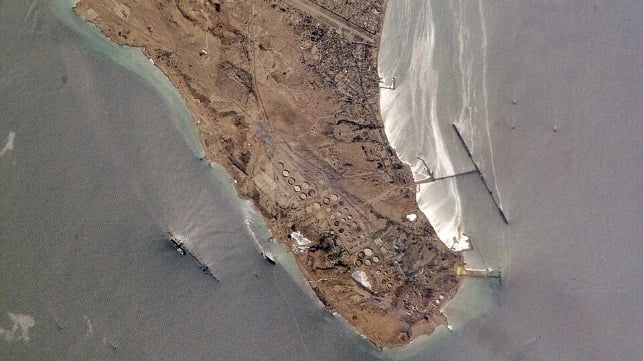
Thin oil slicks emanate from the terminal complex at Kharg Island (file image courtesy NASA)
The Trump administration is contemplating a series of special forces operations inside of Iran, potentially including a raid to seize Kharg Island, according to Axios. Kharg is home to the crude loading port at the heart of Iran's oil export industry.
Kharg Island is located at the far northern end of the Arabian Gulf, opposite Kuwait and about 20 nautical miles off the coast of mainland Iran. It handles the overwhelming majority of Iran's crude exports, and by nameplate capacity, it is rated for moving far more than current Iranian national output. Its primary customers are privately-held refineries in China, which consume the overwhelming majority of Iranian oil.
Kharg Island has a strategic location next to the shipping lanes for Iraq and Kuwait. Officials who spoke to Axios mentioned Kharg in the context of a campaign to retrieve Iran's high-enriched uranium fuel supply from the tunnel complex at Isfahan, which was buried by previous U.S. strikes last year. Seizing Kharg Island could yield a useful refueling point for this and other special-ops incursions into Iranian territory, and for exercising control over the region's sea lanes.
Iran is unlikely to be able to mount an effort to retake the island in the near term: the U.S. has established air superiority along the coast, and conventional Iranian naval forces have been substantially destroyed by concerted action from U.S. Central Command. Last week, CENTCOM claimed that it has sunk more than 30 Iranian warships since the conflict began.
The ultimate goal, according to former Lockheed marketing executive Jarrod Agen, now the director of the National Energy Dominance Council, is to take control of Iran's oil.
"Ultimately, we’re not going to have to worry about these issues in the Strait of Hormuz because we’re going to get all of the oil out of the hands of terrorists," Agen said in an interview on Fox Business.
Almost all of Iran's oil production occurs on land in mainland provinces, and full control of the infrastructure would require more thorough intervention (political or military) than the capture of Kharg Island alone.
India Offered Refuge to Iranian Frigate Before U.S. Navy Sank It
IRIS Dena's stern lifted and broken by a U.S. Navy heavyweight torpedo, March 4 (USN)
The sinking of the Iranian frigate IRIS Dena was a matter of great sensitivity for India, as the warship had just attended an international naval exercise at New Delhi's invitation. The vessel's loss was more sensitive still because she had been offered Indian refuge from the war, foreign minister S Jaishankar said Monday.
IRIS Dena was under way off the coast of Galle in southern Sri Lanka on March 4 when she was torpedoed by a U.S. Navy submarine. The blast lifted Dena's stern out of the water and broke her keel, sending her quickly below. As is standard in submarine warfare, the attack sub departed without intervening to assist survivors; Sri Lankan responders pulled 32 survivors and 87 bodies from the water.
On March 1, just as hostilities between the U.S. and Iran were getting under way, India had granted permission to a request from Iran for Dena and two other ships to moor at an Indian port. The support ship IRIS Laval pulled into Kochi and reached the safety of an Indian naval facility on March 4, Jaishankar said. Dena was sunk the same day, and support ship IRIS Bushehr sought refuge in Sri Lanka on March 5.
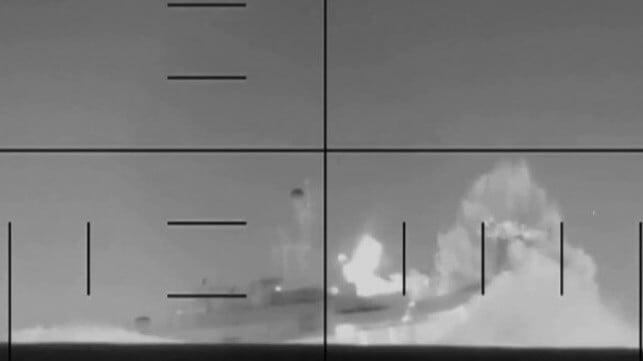
It is unclear why Dena departed India and did not seek safety, especially when the U.S. was actively attacking Iranian Navy vessels in the Mideast. To date, U.S. forces have destroyed more than 30 Iranian warships, and the strikes continue: On Monday, social media footage emerged showing the destruction of a Shahid Soleimani-class corvette at Bandar Landeh. A headline-worthy event on its own in peacetime, the latest attack on an Iranian warship was a footnote in the broader war, unreported by mainstream media.
Aftermath of a reported U.S. strike on an Iranian warship at Bandar Landeh, corroborated by thermal sensing from FIRMS (social media)
Two Iranian Boxships Under Way With Suspected Rocket Fuel Cargoes
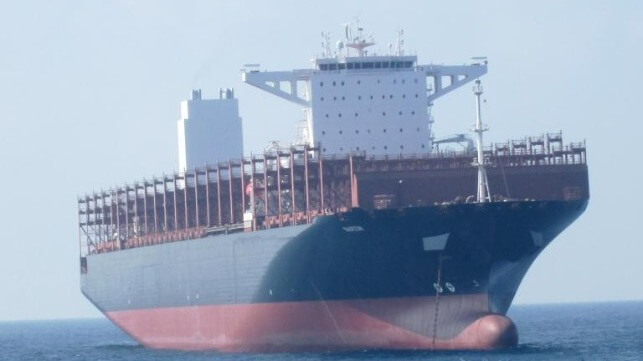
The Washington Post has suggested that two vessels owned by Islamic Republic of Iran Shipping Lines (IRISL) have left the port of Gaolan in Zhuhai, China, destined for Bandar Abbas and potentially laden with sodium perchlorate - a chemical used for manufacturing solid fuel for ballistic missiles.
Sodium perchlorate is the primary material used to manufacture ammonium perchlorate, which in turn makes up 70% of the standard fuel load of most of Iran’s solid-fueled ballistic missiles. Iran used to have some ability to manufacture sodium perchlorate on its own, and could also obtain supply from Russia. But a substantial proportion of Iran’s requirement from sodium perchlorate has for some time been met by importing the material from China on board a shuttle of IRISL ships.
The Washington Post provided no evidence that these particular ships had been loaded with sodium perchlorate, basing its report on an analysis of previous movements and the sanctioned status of the two named ships. Large numbers of IRISL ships ply the China to Bandar Abbas route, carrying a variety of cargos. Both the container ships, the Iranian-flagged Shabdis (IMO 9349588) and the Hong Kong-flagged Barzin (sometimes traveling as the Fanreach, IMO 9820269), are subject to secondary sanctions by the US Treasury’s OFAC on account of their control by IRISL. But Barzin has also been linked to a previous suspected shipment of sodium perchlorate, which left Gaolan on October 2 and arrived in Bandar Abbas on October 16 last year.
The IRISL ships plying this particular route can normally carry more than 5,000 20-foot containers apiece. The Maritime Executive has tracked numerous mixed cargos on their passage from China to Iran, and specifically the deliveries from Shanghai to Bandar Abbas made by IRISL cargo ships MVs Golbon and Jairan. These two vessels brought in a total of 58 containers of sodium perchlorate used for manufacturing solid fuel for ballistic missiles, a consignment widely believed to have precipitated the explosion in Bandar Abbas which devastated the commercial port area on April 26 last year. Hence containers loaded with sodium perchlorate typically would form only a small part of an overall cargo.
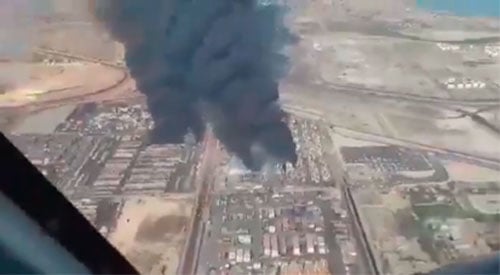
The explosion at the Rajaei Port container park in Bandar Abbas on April 26
Dual-use products, and specifically if they were being conveyed on a ship belonging to IRISL, should fall under the provisions of UN Security Resolution 1929, which cautions states to be aware of IRISL’s sanctions-breaking activities and its role in supporting Iran’s missile development, manufacture and maintenance activities. UNSCR 1929 specifically covers weapons systems related (or dual-use) materials. It calls on "States to inspect any vessel on their territory suspected of carrying prohibited cargo, including banned conventional arms or sensitive nuclear or missile items. States are also expected to cooperate in such inspections on the high seas and are obligated to seize and dispose of the prohibited items when they are found." These sanctions have been strengthened since snap-back sanctions were re-imposed by the UN Security Council on September 28 last year.
Chinese unwillingness to observe UNSCR 1929 was evident last year when a US special operations team intercepted a ship off Sri Lanka and confiscated part of its cargo. The material seized consisted of dual-use components manufactured in China, such as spectrometers and gyroscopes, which can be used to improve the precision of guided missiles. The components were en route to Iran.
On November 12 last year, coincident with the interception at sea, the US Treasury sanctioned a widespread network of companies based in China, Iran, Turkey and the UAE involved in the supply and delivery of dual-use components used for Iranian ballistic missile and drone production. The sanctions notice detailed supply, shipping routes, and one specific ship, the Panama-flagged bulk carrier Shun Kai Xing, sometimes known as the Honestar (IMO 9187368). The Honestar was cited in the US Treasury notice for shipping "a computer numerical control machine used to produce fiber optic gyroscopes, guidance and control systems for weapons systems including ballistic missiles and UAVs."
Other IRISL ships suspected of carrying dual-use cargos on the China to Bandar Abbas route include the Basht (IMO 9346536), Rayen (IMO 9820245), Behta (IMO 9349590), Artavand (IMO 9193214) and the Elyana (IMO 9165827).

No comments:
Post a Comment